Sunday, August 21, 2022

Costs of Doing Business - Postal History Sunday

Welcome to Postal History Sunday, featured weekly on the Genuine Faux Farm blog and the GFF Postal History blog.  If you take this link, you can view every edition of Postal History Sunday, starting with this one (the most recent always shows up at the top).


This week, we are going to feature several pieces of mail that, unless you are looking at them carefully, look to be very similar.  Each and every folded letter is part of the same correspondence between Dutton & Townsend in New York and Jose Esteban Gomez in Cadiz, Spain.  Every single one of the items I will share in this blog features the 24 cent 1861 postage stamp I favor and, in each case, that stamp paid enough postage for the letter to find its way to Cadiz - even though there were times when Gomez had to pay more postage for the privilege of receiving the correspondence.

Different Rates - Same Route

In 1864, the year in which this letter was mailed, Spain was one of the locations in the world where the United States did not have a direct postal agreement to exchange mail.  That meant that correspondents would have to rely on intermediary postal services to get the job done.  In this case, the options were the postal services in the United Kingdom and France.  And since these letters were all destined for Cadiz, the route for each letter ended up being pretty much the same - even though there were multiple postage rate options (which we will talk about later in this Postal History Sunday).

This business letter traveled from New York to Queenstown, Ireland and then to London.  From London, the letter traveled through France, passing through Paris, on its way to the shared border with Spain.  There were two primary border crossings where France and Spain exchanged mail, one in the west at Irun and the other in the east at La Junquera.  Other crossings were limited to local mail.

Since our letters are all destined to Cadiz, and the eastern crossing would be for destinations primarily in Eastern Spain and the Catalan region, we can make a fairly good assumption that each of these went through Irun.

A rough rendering of the route to Cadiz

As a quick geography refresher, I supply you with the map above that shows the route this letter most likely took as it left London, entered France (at Calais) and then went to the western end of the border shared by France and Spain.  Bayonne would be one of the closest communities on the French side and Irun would be the companion Spanish community.  For those who are curious, the eastern exchange would have Le Perthus on the French side of the border and La Junquera on the Spanish side.

What was in that letter?

Dutton & Townsend of New York sent many business letters to Gomez over a period of ten or so years.  Many of the items available to collectors have had at least some of the contents removed.  However, I am lucky to have one that appears to be fully intact (this belongs to the folded letter shown at the beginning of this blog).

"No. 70 Beaver Street, New York December 23, 1864

Dear Sir, 

Your esteemed favor of September 28th last was duly received and its contents duly considered.  We are glad to learn that we shall probably gain something by the interest you have retained for us in your last sales of our staves.

We have again concluded to try your market with a cargo of staves from your opinion expressed that you could probably sell them on arrival so to compensate us.  We have accordingly chartered and loaded the Brig Mattapony of Bath, Captain S.G.Wyman, and she is now on her way to you having sailed yesterday 22 instant."

The context at the opening of this business letter tells us that this is not the first letter in this correspondence.  It sounds like Gomez may have contacted Dutton & Townsend and suggested that he could serve as a broker for their staves in Cadiz.  Prior offerings had gone well, so a new shipment with a range of product (different size and types of staves) was already on its way.

"These staves are of the very best quality of their several kinds and we think you will say on seeing them that the cargo is as fine a one as ever you have received....  This cargo we have caused to be insured here both against marine loss and rebel pirates.  So that in case of loss you will please have the necessary documents sent to us to collect the insurance..."
In late 1864 to early 1865, the threat of Confederate privateers was minimal.  Early enthusiasm for privateering had waned greatly when those private vessels who managed to capture a merchant vessel couldn't get to a Confederate court to collect their reward.  Why take the risk when the award was uncertain?

Even so, Dutton & Townsend indicated that they had acquired insurance for their cargo.  The potential of this account was apparently lucrative enough that it was worth adding this price to the cost of doing business.

What was Dutton & Townsend?

The letter content provides us with a place of business in New York City, which gives us the opportunity to explore a bit further.


Trow's New York City Directory, May 1, 1865

Trow's New York City Directory confirms for us that Dutton & Townsend held office space at 70 Beaver Street and that the business dealt in "staves and heading."  We also learn here that the two persons headlining this business are Edward H. Dutton and John P. Townsend.

Beyond that, it is interesting to me that the only reference of substance I have been able to find (thus far) for Dutton & Townsend has to do with a prior business named Sherman & Romaine.  This business, headed by Isaac Sherman and Benjamin F. Romaine, was established in New York City in 1853 when these two purchased the rough stave business of a William Dennistoun.  According to the source I cite below (*), this was the largest rough stave business in the United States, shipping out as many as 14 million staves in a year.  This volume was enough to take up at least some of the cargo hold for as many as 1000 ships annually.

John P Townsend was a clerk who eventually earned an interest in the business, but when Romaine died, two businesses were spun off of the original in 1862.  One of the two was Dutton & Townsend and the other was Sherman & Wibert.  The latter business ended in 1866, while the former appears to have gone on for much longer.

* Portrait Gallery of the Chamber of Commerce of the State of New York: Catalogue and Biographical Sketches,  compiled by George Wilson, Press of the Chamber of Commerce, New York, 1890, p. 209.

Cooper with barrel - mid 1800s from Library of Congress (DAG no. 1196)

Rough wooden staves were the raw material needed for the construction of barrels by coopers worldwide.  Headings were the boards that were used to construct the top and bottoms of these barrels (hence a business that sold "staves and headings").  According to this site (Roots Web), most barrels require from 24 to 36 staves to make the body.  Wooden barrels were used to ship and store a wide range of products, including wine, oil and other liquids.  The image below comes from the American Oil and Gas Historical Society, which explains why the 42 gallon barrel became the standard for oil production (an interesting read if you are so inclined).

I have been unable to learn anything about Jose Esteban Gomez, but given the location, it is entirely possible that he sold much of this material to cooperages that built barrels for the wine industry that was fairly strong in the Sherry and Malaga regions in southern Spain at that time.

Mail Options from the U.S. to Spain

Both Dutton & Townsend and Gomez were not too concerned about pinching pennies when it came to postage.  Nearly every point in time during this ten year period there were options to get a letter mailed for less than 24 cents.  It seems that Dutton & Townsend, just always put a 24 cent stamp on the letter, knowing that it would be enough to handle any of the available options for mailing.  They wrote off extra postage as a cost of doing business.

While the route was pretty much the same, there were actually several postal rate options if a person wanted to send a letter from the United States to Spain.

1. Prepay to Spanish border via French Mail

21 cents per 1/4 ounce to Spanish border - April 1857 to December 1869

This letter was mailed in Boston on August 2, 1865 to Gomez in Cadiz.  Apparently, someone with the Dutton & Townsend business was traveling and still corresponding with clients.   The 24 cent stamp overpaid this rate by three cents, but it did the job and got the letter to the border of Spain.  The recipient, however, still needed to pay 4 reales to receive the letter to cover the Spanish portion of the postage.

The biggest piece of evidence that this item was sent using the French mails are the black, circular markings near the postage stamp.  They read "Et Unis Serv 14 Aout 65."  The boxed "P.D." marking is also an indicator to us that this was sent via the French Mail agreement.

The biggest disadvantage of this rate was that it was by the quarter ounce (or 7.5 grams).  It was not hard to have a heavier letter that weighed more than that, but less than a half ounce (which was the weight unit for another mailing rate option).  So, only very light letters would cost less than the 24 cents Dutton and Townsend seemed content to pay.

2. Prepay to destination via British Mail

22 cents per 1/4 ounce to destination - January 1868 - December 1869

The second option was not available until 1868, but it also had added the benefit that that the letter would be prepaid all the way to the recipient.  In this case, the 24 cent stamp overpaid the rate by only 2 cents AND Senor Gomez was not required to pay extra money for the privilege of getting the next invoice or business correspondence from Dutton & Townsend.

Once again, this rate was by the quarter ounce.  If a letter was just a little bit heavier, it would require 44 cents, which was apparently something Dutton & Townsend wanted to avoid.  Perhaps they had many sheets of 24 cent stamps they wanted to use up?

3. Pay only what you must to get the letter to the British, let Gomez pay the rest.

21 cents per 1/2 ounce via American Packet to British Mails - October 1858 to December 1867

This brings us back to our first letter.  This one was definitely heavier than the two prior items and would have cost 42 or 44 cents respectively using those rates.  So, instead of doing that, Dutton and Townsend sent this via a provision known as the British Open Mails.

The basic premise of British Open Mails was that the sender only needed to pay for any mail service required to get the item TO the British postal system.  In this case, it cost 5 cents to get this letter to the ship (City of Cork) that would cross the Atlantic.  And, since that ship was under contract with the United States, that had to be paid for as well (16 cents).  That gives us a grand total of 21 cents due to get this item to the British.

Once again, Dutton and Townsend overpaid the postage by three cents, but they were able to send a heavier letter without having to put another stamp on it.  Gomez, on the other hand, may not have been as happy with this because 8 reales were collected from him when the letter was picked up.  An unpaid letter from England cost 4 reales per 1/4 ounce (approximately).  This item weighed more than 1/4 ounce and no more than 1/2 ounce, so 8 reales was the calculated postage due.

So, the total postage paid for the letter was 21 cents (for the US) and 8 reales (for everything else).

5 cents per 1/2 ounce via British Packet to British Mails - October 1858 to December 1867

But, what happened if a ship crossing the Atlantic was under contract with the British?  The only postage a person would need to pay in order to use the British Open Mails was the 5 cents required to get the item to that ship while it was in an American port!

Surely Dutton & Townsend would decide this represented too great a loss and it would invest in a few five cent postage stamps for this situation?  Apparently not!  Sometimes a cost of business is acceptable if the trade-off provides sufficient convenience.  We can not argue that Dutton & Townsend were unaware of the shipping schedules, because each letter identifies the ship of departure the letter was intended to take.  We have to conclude that an overpay of nineteen cents apparently did not mean much for this business's bottom line. 

In every case, there was extra postage paid that was not used.  Gomez usually had to pay some of the postage (with the notable exception of the 22 cent rate via Britain).  The account must have been lucrative enough that neither party cared to spend the extra energy to save a few pennies on either end.  Though I have to admit that Gomez had fewer options at his disposal.  If he wanted to read the letter, he had to pay for it.  

In fact, some of the letters from this correspondence also show that duplicate letters were often mailed (the word "duplicate" is a docket).  This could be simply a reminder to pay for a shipment or it was, perhaps, an additional 'insurance' for possible loss at sea.

Whatever the reasons or the logic, I suspect both parties just accepted postage (and the overpayments) as a "cost of doing business."

10 cents per 1/2 ounce paid to England - January 1868 to December 1869

But, I've still got one more of these up my sleeve!  Here's an 1869 item from the correspondence with another 24 cent stamp to pay the postage.  The British Open Mail cost was now a ten cent flat rate, it did not matter which ship carried the letter across the Atlantic.  

This is the same period of time when the 22 cent rate per 1/4 ounce was in effect to pay the letter to destination, so we might be tempted to ask why this letter didn't use that rate?  Well, apparently, the letter weighed more than 1/4 ounce, so it went using a postage rate that the 24 cent stamp could cover.

The postage rate for an unpaid letter in Spain, from England, must have decreased, so only 4 reales were collected from Senor Gomez this time around.  I have yet to track down that specific information, so if someone has it, I would appreciate hearing from you!

Bonus Material

Back of the folded letter shown above.

Several of the folded letters, but not all, show an interesting marking on the back.  This oval marking appears in black ink and bears the word "Lista."  The purpose of this was to indicate that the letter was held at the post office and it was advertised in the newspaper as being available for pick up by Gomez.

In prior Postal History Sunday entries, you might remember some discussion that not all letters were delivered by a carrier to the person at their address.  Some letters were kept at the post office and awaited the arrival of the recipient (or someone representing them) to come and pick up their mail.  Many post offices would also advertise that letters were available for pick up after they had been in the office for a certain period of time.  Each postal system had different procedures, but many in the 1860s required that the recipient pay an additional fee for letters that had to be advertised.

Is it possible that Jose Esteban Gomez had to pay even a bit more for his letters?  If someone knows the regulations for advertised letters in Spain during this time frame, feel free to contact me.

The last cover I wanted to show today is another British Open Mail item where the 5 cent postage stamp paid the 21 cents required to get the item to England.  This letter is dated October 7, 1863, showing us that the Gomez correspondence with Dutton & Townsend had origins prior to the first letter in our post.

Thanks for reading and your feedback

Some of you might have been saying, at some point during this Postal History Sunday, "didn't Rob do something on this in a prior entry?"  If you did, good for you!  I took a first pass on this topic in May of 2021, not long after I underwent surgery to have a kidney removed.  And, ever since then, I've felt like I had not provided the full attention it deserved.  On the other hand, if this is all new to you - ignore that last bit!

Either way, this is a story that has plenty of complexity and even more that could be explored in the future.  And that, my friends, is part of what motivates me to continue with Postal History Sunday.  There is so much more to learn and so much learning to share.

After last week's entry titled Quarantine!, I received several kind words from people who read and enjoyed that entry.  I found that gratifying as I felt that it was one of my better efforts in this series that has now passed the two year mark of weekly writings.

I would also like to reiterate that I do encourage feedback of all sorts, including constructive criticism, appropriate corrections, and suggestions for resources or directions to continue investigating a given story.

Have a great remainder of your day and a fine week to come.

Saturday, August 20, 2022

Reflections on Water


The two of us seek out streams, waterfalls, rivers, lakes and oceans.  When we find them, we often take the time to gaze at the water, watching its movement or its stillness.  We observe the color of the water and we admire much of what is in, on are near it.  Sometimes, we are dismayed by what we see.  But usually, we find ways to be awed by what we find.

This time, we were captivated by the trees, clouds and sky - as the water portrayed them for us on its surface.  On this day, the water showed us a deeper blue and a cleaner white in the clouds than we observed when we looked up.  And it made me wonder if water was trying to show us that we still need to fine tune our ability to see the world around us.

"Look again," says the water with an inviting, quiet voice, "the world around you is more beautiful than you realize.  Take a moment and try to see it how I do."

Friday, August 19, 2022

Life on the Edges

We stopped at an overlook to view the Mississippi River earlier this week when we took a short, much needed, break.  And, we did what most everyone should do when they go to an overlook.  We looked out to the area the overlook was meant to encourage us to see.  And, we took our time to enjoy the Mighty Miss in all its glory.

We watched while a van filled with a three-generation family piled out and lined up for the obligatory family photo in front of the river and then piled right back in and left not long after arriving.  Box checked, on to the next box.

We, on the other hand, were busy being awed by nature - and it wasn't just the river that we were looking at.

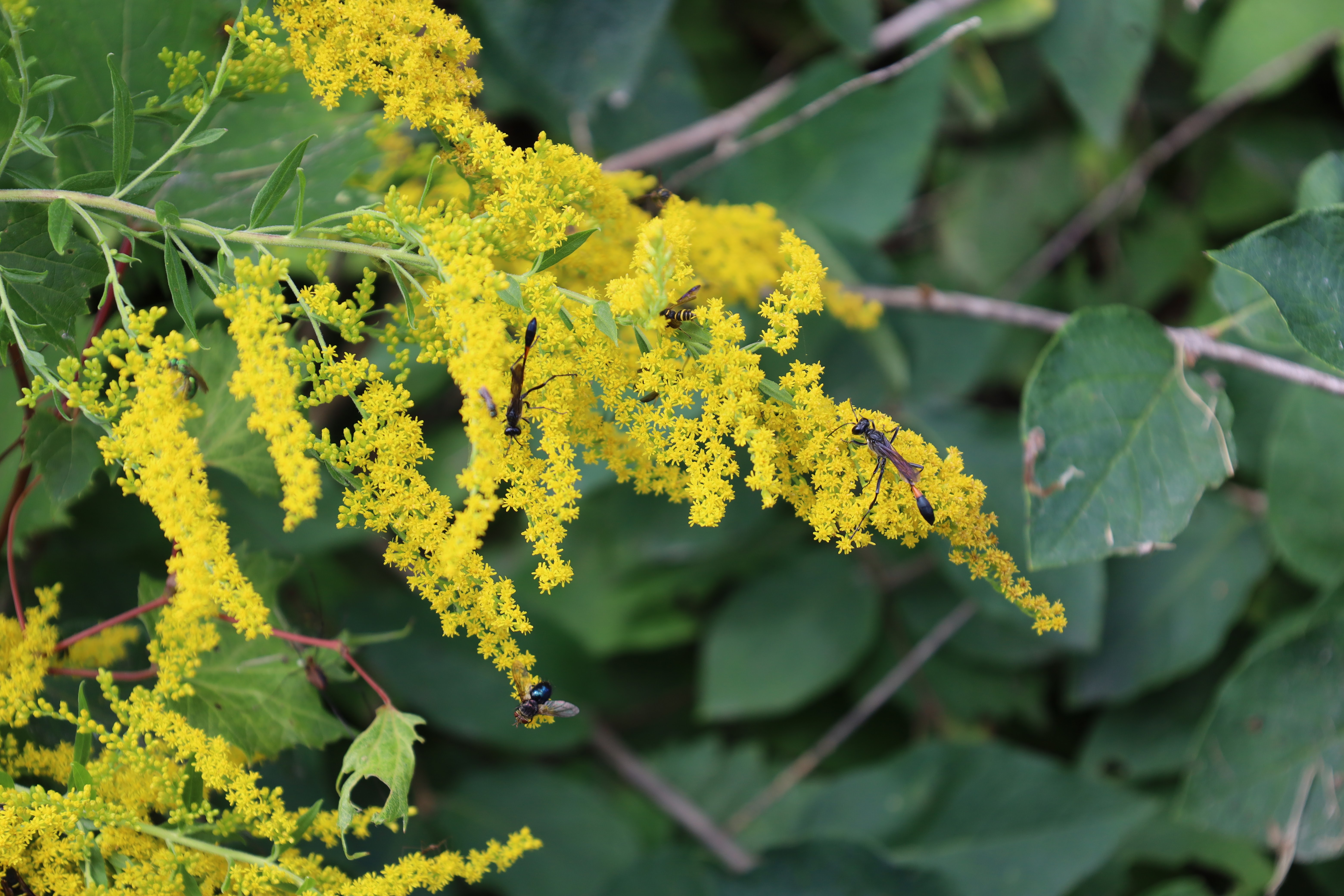
There was some Goldenrod blooming right next to the parking area and we noticed that there was an AMAZING amount of activity on the flowering stems of these plants.  And, it wasn't just one type of insect.  We saw bees, flies, butterflies....  just, lots of critters!

At another location on a gravel road near Rush Creek, we saw more Goldenrod blooming with some Monarda (Bee Balm or Wild Bergamot) next to it.  Both are excellent pollinator habitat plants, though we didn't see quite the activity the plants at the overlook provided us.  I am certain it had something to do with time of day and other conditions.  But, there was certainly activity in most of the places we observed flowering plants.

There were patches of Hoary Vervain that exhibited a significant amount of activity.  Much of that activity consisted of various types of bumble bees.  We were amazed by the large patches of this perennial wildflower in the Mississippi River valley this time of year.  

There was even one area by a homestead that exhibited a very dense and healthy stand of this plant.  Since it was next to someone's house, we didn't feel comfortable with taking photos.  But, there were several opportunities later in other locations to view the Vervain up close and personal.

Because Tammy can't do too much walking and is limited to flat and even surfaces, we were constricted to observing nature from the edges of human environment (roads, parking areas, etc).  While we might have liked to have done a little hiking, we still took great pleasure in observing all of the life on the edges.

The edges of the road exhibited many different wildflowers and pollinators.  The edges of a stream gave us an opportunity to see different birds, insects and plants.  The edges of the river provided us with chances to see lotus flowers and wading birds like the Great Blue Heron.  We witnessed how the edges of a wooded area with the edge of an open/prairie area resulted in a mix of wildlife with the Eastern Wood Pewee constantly telling us it was out and about in the woods and the Tufted Titmouse singing both in the woods and on the edges.  The Mississippi River itself was providing a place for American White Pelicans to stake out sections for their own personal hunting ground.

There were single plants and sometimes small patches of Cardinal Flower here and there near the Mississippi River when we took some time to drive around a park that was situated on the riverbank and some the backwaters.  We know this plant well from our days trying to make perennial flower plantings on the farm and in our prior residences.  

It's actually a bit of a shock to see a plant that you associate with a groomed perennial garden showing up in the wild.  Yet, this gives me some hope that perhaps we can introduce (or re-introduce) some of these plants so that they gain a bit more of a foothold in the wild spaces on our farm.  We would welcome Cardinal Flower, Wild Bergamot and Goldenrod here.  In fact, we do have some of the last two, but we wouldn't cry if we had a bit more.

One of the things that struck me the most was that the activity on the plants we observed during our short break from the farm is both familiar and different to us.

In the past, at some of our prior living locations, we have seen plants covered in pollinators.  For example, we had healthy hyssop at a couple of locations that was covered in a wide range of beneficial insects.  What I do not recall seeing was the wide variety of critters we saw on this short excursion.  Whether that is because we didn't have so much variety or I did not know what to look for them - I'll never know for certain.

I can also say that, despite our efforts to provide habitat and despite having Goldenrod and other excellent pollinator plants, our farm still struggles to see the activity I would expect for the amount of flowering plants we have here.  We know part of the issue is that our small farm is surrounded by less hospital lands for these pollinators.  The monocropped fields around us have fewer edges, providing less opportunity for a variety of living beings.

I suppose I could be discouraged by this because I would like to see this kind of activity on our farm.  Instead, I have come to realize that we are blessed with significant pollinator and beneficial insect activity on our farm.  Some of it through actions we have taken (or not taken - if you will) and most of it simply because nature is amazing.

We'll just keep creating and maintaining edges and wild spaces on our farm and hope we are doing the right things - adjusting each time we learn more.  And we'll keep on learning so we can appreciate all of the life on the edges.

Thursday, August 18, 2022

Conehead & Katydid Symphony

 A few years ago, we were introduced - up close and personal - to an insect known as a conehead (in this case, a Slightly Musical Conehead).  And now we are back into the time of year when the coneheads and katydids (along with the crickets) create most of the evening and nighttime noise we get at the farm. Yes, sure, there are crickets and there have been some cicadas.  An owl will occasionally make itself known as well.  We might even scare up some Killdeer when we walk out to do the chores in the evening as well.

There is a 'click-click' type of noise that we associate with the Oblong-winged Katydid - but we have not too many of them yet this year.  It seems like they get going around here about this time and then are more audible as we approach and go into September.  This is probably the member of the katydid/conehead family that Tammy and I have been most familiar with over the years.  I have no idea when each of us learned that the clicking call was a katydid...but we've been pointing it out to each other for many years now.

Most of the noise is coming from the Slightly Musical Coneheads, like the one you see above.  We mentioned these insects a couple of years ago at this time and it was pointed out that we are supposed to be out of their reported range - but not by much.  And considering we have a visual to go with the audible, I think the range maps might need to be updated.  After all, with the various changes in climate and habitat, it makes sense that they are moving this way.

Our first exposure to these critters came on a day when I was harvesting lettuce and brought the tub in for soaking.   I found this critter sitting on top as he unloaded the tub from the cart and took a photo after it agreed to pose and smile for the camera.  I do not suppose most of our CSA members would have enjoyed having it pop out at them when they went to put some nice lettuce on a sandwich.  It could also be disturbing to see it cleaning salad dressing off of its antennae while it is perched on a slice of cucumber sitting on your plate.

We also have a significant population of Nebraska Coneheads.  While we haven't laid eyes on them personally, their singing is pretty clear at night.  This also should not surprise us because Nebraska Coneheads use the strategy of dropping from their more  prominent perches in 'weedy patches' into the litter at the base of the plants when they are disturbed.  They make their escape from there. In contrast, the Slightly Musical Conehead can be found and held for the camera.

I've always thought the sound Round-Tipped Coneheads make was a cricket.  But, if you visit the link, you might understand the confusion.  I am still not certain I will be able to tell the difference between the two when I hear them, but it is interesting to know.  I am also pretty sure I won't be able to tell these and the Nebraska Coneheads apart if I should see them.  And, if I do see them, how should I greet them?  What is polite to a Conehead?

"Why, hello there.  I see that you are not falling to the ground from your perch on the top of those grasses as I walk by.  Is that because you would like a conversation?  Or are you hoping I will be an audience for your next concert?  Ah!  I see, someone has played a prank on you and tied your antennae together and that has you just a bit discombobulated.  Here, allow me to help you..."

There are around 200 different types of katydids (coneheads are katydids) in North America.  If you are interested in learning more, you can go here to learn more about their calls. And, if you are interested in observing things like coneheads and katydids and participating in citizen science, it has been suggested that iNaturalist is a good option.


This is one of the benefits of working on the farm. We get to observe all sorts of interesting things in the natural world.  Lately, we've seen more frog and toad activity - that picked up after we got four plus inches of rain a week or so ago.  We saw more Garter snake activity in the late Spring than we have some years at the farm and there are often fox snakes.  In fact, one fox snake decided to help me with my work in the farm office this year.

These are all critters we welcome on the farm in part because they do find some of the pests to be tasty.  Even if that were not the case, none of these animals do any harm to us or our crops, so we are happy to see them add to the diversity of what is around us as we work outside.  Though I admit that the office sharing snake will have its access removed in the near future.

As far as katydids and coneheads are concerned, they are a bit of a "neutral entity" as far as our farm is concerned.  While Tammy and I used to think of katydids as a predator insect, we learned that many tropical katydids are predators, but the coneheads in Iowa are an omnivore.  Most species here prefer to eat leaves and grasses.  They will also eat aphids and dead insects - so it might be more accurate to just call them opportunistic.  On the other hand, they are not known to cause any sort of significant crop damage and they would prefer the grasses in the ditch to most anything we would grow. 

I guess we'll accept any bonus aphid predation the coneheads and katydids can provide.  Even it isn't much, we still welcome them as another sign of ecological diversity on our farm.  Now, if we could get some praying mantids to thrive on our farm (something we still have yet to be able to do).  That would be something.

Wednesday, August 17, 2022

A Brief Escape


A Red-bellied Woodpecker expressed it's displeasure on Tuesday morning that the bird feeder just outside the window of the room we were sleeping in was empty.  Since neither of us is used to the harsher "chirps" these birds make (we've never seen one of these on the farm), we both woke up right away - even if we were kind of planning to sleep in a bit.

Neither of us was particularly upset at being up, actually.  You see, we had made an escape - even if it was going to be brief - from the farm and both of our jobs.  Instead of thinking about the chores we had to do and the tasks we needed to complete on this particular day, we jumped up to see the sunrise and listen to some birds sing - many we don't hear all that often at the Genuine Faux Farm.


It's not easy leaving the farm.  Even though we are doing less farming than we used to, we still have turkeys and chickens.  And the cats do like it when we make sure they have food and water.  And there are still high tunnels to open and close.  And...  

Well, you get the picture.

The good news for us is that we have been working harder each year to make certain we don't miss out on some of the beautiful places that are not all that far away from us.  There were many years where the farm drove even the thought of visiting the Mississippi River from our minds.  It was always, "sometime we'll have to do that," and "maybe next year we'll do this."  

Well, the time for a brief escape ended up being "now," this once.  And that's a good thing.

We aren't getting to hike around as much as we often like to.  While Tammy's recovery is going well (despite how she might feel about it), we're still limited to even and flat surfaces.  But, we found ways to enjoy our time together.  

Sometimes it helps to get away from the things that demand your attention on a daily (or even continuous) basis.  Sometimes it is necessary to break away from the routine and refresh your spirit with something that is not in your normal daily experience.  It helps us to refresh our interest in the world around us and renew our energy for learning new things and remembering things learned in times that have past.

The only down side - if you can call it that - is that we have found our appetite, once again, for these excursions.  But that's actually ok.  Because each little escape helps us to remember that our farm is not a prison either.  It is familiar, yes, and we have our responsibilities there (also true).  But there are friendly cats, patient trees, glorious flowers and captivating sunrises and sunsets there for us when we return.

It just might be a bit easier to appreciate them after this brief escape.

Tuesday, August 16, 2022

The Oak Jungle


The mature Burr Oaks on the farm are just like so many other older trees in Iowa - much of their leaves and cover are well above the heads of the humans when the stroll under the canopy.  It just so happens our two-story farmhouse allows us to look out those 2nd story windows and observe some of the activity in the branches of these trees.  But nothing compares to those rare moments we climb up to the attic and onto the flat roof.

I have to admit that the last time I was up there was last year when we were doing repairs to that roof after a storm took the chimney out.  But, while I was up there I took a few pictures, including this one.

Over the years, we have added some bushes and other cover closer to the ground in the "front yard" of the farm house.  The result is that we are seeing more an more wildlife activity in and around these trees.  It has gotten to the point that neither of us can get any work done if we are facing any of the windows of the house that allows us to view the Oak Jungle.

This summer we have witnessed the tentative and often clutzy attempts of numerous young birds as they try their wings once they leave their nests.  We presume there are many nests in these oak trees.  It's probably a very good guess considering the sheer number of young birds we have been observing in the last month or so.  We've seen baby orioles, waxwings, woodpeckers, and bluebirds along with the more common sightings of young robins and wrens.

I am certain that we have had activity every year we have lived here, just as I am certain that our stewardship has encouraged larger and more diverse populations of birds on our farm.  The trick is trying to figure out how much of what we are seeing is because we are seeing better versus having more things to see.  

Don't get me wrong, I think we've always been fairly good at observing the world around us.  But, experience does teach us to see better, if we give it a chance.  

We've been giving it a chance and we're liking what we're seeing.  But if you wonder why we aren't responding to your emails as fast as you would like, it's probably because we're watching those darned bluebirds hopping between the lowest oak branches and the ground.  

That's entertainment!

Monday, August 15, 2022

Beauty and Concern

I don't take terribly many pictures with my phone.  For me, a phone is for making and receiving phone calls and a camera is for taking pictures.  I can appreciate that my phone allows me to take pictures and videos, just as I can appreciate that I could, if I wish, check my email.  My main objection isn't the technology so much as how much we seem to tie ourselves to it.

But, there are times when I am witnessing something and I know I won't catch what I am seeing if I run to get the camera.  That's when the camera function on the phone is actually appreciated.

This past June, at about 9pm, I noted these cumulus cloud formations and took note of some of the vertical ridging that was telling me there was some strong updraft as these built towards a cumulonimbus formation.  

My first instincts told me there was probably some hail in those clouds (it turns out I was correct about that), which means my farmer mentality went right to cataloging all of the things I need to consider as an immediate response.  Those same instincts also told me to calm down because the location of these clouds were such that they were not going to threaten our farm.

Still, that is the reality people like me, who pour themselves into growing food crops and work on their small-scale, diversified farms, must face every time the weather throws something majestically beautiful our way.  Our first thoughts are something along the lines of "oh no, what next?"


I was able to really appreciate the beauty of these clouds only after I had determined we were not in the bulls-eye this time around.  I have to admit that I sometimes feel a bit of guilt when I breathe a sigh of relief, because I know there is someone else in that bulls-eye.  But I can't help it.  Nature is beautiful, even when she is terrible.

Sadly, Tammy had recently had Achilles surgery, so she was stuck on our back porch and the house was between her and what I was seeing.  Knowing there wasn't any chance she would get to see them, I took some pictures so she could see them at a later point in time.  Well, Tammy, it took me a couple of months before I got the photos off of the phone, but here they are.

Learn Something New

Both of us enjoy looking at clouds as they go by, or over, our farm.  It is true that they often bring concern and worry (and maybe a bit of fear at times).  But they are incredibly interesting and they are often inspire awe and wonder in us as we observe them.

I readily admit that the names of the different types of clouds do not readily roll off my tongue.  But, that doesn't mean I am unwilling to get better at it.  It turns out that there is a pretty useful site called What's This Cloud.  Or, if that's not for you, try Science Direct to see what sorts of written resources are out there for cloud classification.  It looks to me like the Encyclopedia of Atmospheric Sciences might be of interest in the future!

Sunday, August 14, 2022

Quarantine! - Postal History Sunday

Welcome to Postal History Sunday, featured weekly on the Genuine Faux Farm blog and the GFF Postal History blog.  If you take this link, you can view every edition of Postal History Sunday, starting with this one (the most recent always shows up at the top).  


So... what have we here?

Today's featured item is an envelope that has a fancy, pre-printed design for the State of New York Health Officer's Department.  Specifically, this envelope advertised that it came from the Quarantine on Staten Island.  This design alone speaks to a significant story related to the immigration of people to the United States.

The postal history angle is actually pretty simple this time around.  The three cent stamp pays the postage for a letter mailed within the United States that weighed no more than a half ounce.  According to the postmark, the envelope entered the US mails at Tompkinsville, New York on April 22, 1864.  The letter found its way to Chateaugay, New York in Franklin County in the northeast portion of the state, near the Canada border.

The letter is addressed to R.G. Swinburne, care of Ralph Swinburne at Chateaugay.  If you look carefully, you can see that the person writing this address crossed out "Rouses," which would have become "Rouse's Point" in New York if they had continued writing.  The envelope itself has no contents, but I can tell you that this item was written by a Dr. John Swinburne, who was sending something to either a brother or a nephew.

Before we go further, let's take a look at a map or two so we can orient ourselves a little bit before we get to the fun stuff.

northeastern shore of Staten Island

Staten Island highlighted in red

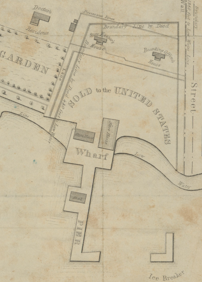
Much of our story focuses on the area shown on this 1873 map at the left that shows the grounds of the "Quarentine" (sic), an area that would soon appear as a privately owned property with multiple wharves and warehouses in maps from the 1880s.  Remember, you can click on images if you want to see a larger version of the image.

This, of course, leaves us with the question - why do I find all of this so interesting?  Read on, and maybe you'll agree that there is a good story behind this old envelope.

The quarantine on Staten Island to 1858

view of quarantine station on Staten Island, 1858 from NY Public Library

The Harbor of New York has a long history of using quarantine to attempt to limit the spread of disease brought to port with incoming travelers and immigrants.  Our story starts with the quarantine grounds and buildings located at Tompkinsville, New York on Staten Island.  The state legislature designated  this location for quarantine and by 1801 it was fully established as such.  A hospital was built at that time (which became known as the Marine Hospital), a wharf was constructed, and an area was designated for anchoring ships that were under quarantine.

By the time we get to the 1840s and 50s, there were multiple buildings serving as hospitals, including one dedicated to Yellow Fever and another to Smallpox on the 1845 map shown below.

1845 map of the Quarantine grounds at Tompkinsville from NY Public Library

This article on the Whaling Museum site provides an excellent summary of the quarantine process:

By 1846 all ships coming into New York Harbor had to anchor off Staten Island for quarantine inspection.  The ships were boarded and if any signs of disease were found all the passengers were taken to the Quarantine Hospital on Staten Island which was opened in 1799 and called the Quarantine.  First-class passengers were taken to St. Nicholas Hospital at the Quarantine and steerage passengers were taken to smelly, overcrowded bunkhouses stripped naked and disinfected with steaming water. [1] The ship then had to remain in quarantine for at least 30 days and sometimes as long as six months.   There were as many as eight thousand patients in the hospital in a year.   It was very dangerous work for the staff and funeral expenses for employees was a category in the accounting books.

An article in Harper's Weekly titled "The Forgotten of Ellis Island," provides an excellent summary of the history of the Quarantine for the New York Harbor that may also be of interest to you.  (Harper's Weekly, A Journal of Civilization, Vol. XXIII, No. 1184, Sep 6, 1879)

It is at this point that we need to remind everyone that Staten Island was NOT an abandoned island with the sole purpose to serve as a quarantine.  There were multiple communities where people lived, including Tompkinsville.  Some of these people worked at the Marine Hospital, while many others were fearful of the possible spread of disease from the Quarantine to the island population.  People were raising families and were less than happy to have this facility in their back yard.  And, of course, many of the wealthier landowners were less than pleased by the impact the quarantine site had on land values.

Rioters burn the Quarantine

image from Library of Congress

On September 1, 1858, a mob of armed individuals burned down many of the buildings at the Quarantine, leaving only one active hospital building.  The local fire department, sympathetic to the cause of the rioters, claimed that their hoses were cut as they stood by and watched the fires burn.  Fortunately, the rioters, for the most part, gave warning and encouraged residents and patients to vacate prior to the planned arsons. 

Harper's Weekly reported on September 11, 1858 that a pamphlet was circulated on the following day that read as follows:

A Meeting of the Citizens of Richmond County, will be held at Nautilus Hall, Tompkinsville, this Evening,  Sept. 2 at 7 1-2 o’clock, For the purpose of making arrangements to celebrate the burning of the Shanties and Hospitals at the Quarantine ground last evening, and to transact such business as may come before the  meeting. September 2d, 1858.

The riots on September 2 were also not a surprise to those at the quarantine as they had been warned that there were intentions to burn the rest of the buildings, including dwellings, to the ground.  In fact, those living in various staff quarters on the grounds removed their furniture and belongings and stood by them to protect them when the rioters returned for a second night.  

Most of the healthy individuals who were under quarantine had been moved during the day, but there remained some staff and patients at the remaining hospital (identified as the "Female Hospital" though I am not certain which one that was).  These individuals were evacuated prior to that building going up in flames, but they were not far away.  Medical personnel poured buckets of water on the sick to help keep them cool while the building burned nearby. (from Stephenson, Kathryn. "The quarantine war: the burning of the New York Marine Hospital in 1858." Public Health Reports, Jan-Feb, 2004)

If you want to read the details of the motivations and the events, I strongly recommend you read that paper.

Now what?  Where's the Quarantine?

Was this area protected by the Marines?

It was at this point that we might be tempted to ask some questions about the envelope that started this whole Postal History Sunday.  If everything was burned down, did they rebuild in the same location even after the local populace had made their feelings about it known so "eloquently?"

Stephenson reports that about 60 US Marines were assigned to protect particular buildings (but nothing else) on September 2 (probably the fenced in area at the bottom right in the 1845 map).  It is possible this is where administration for the Quarantine continued after the 1858 riots, but I have been unable to confirm that.

The short answer was that they did not rebuild at Tompkinsville.  Instead, they moved most of the quarantine to a "floating hospital" (the Florence Nightingale) that was dedicated for this purpose.  Some sources suggest that the steamships Falcon, Empire City and Illinois all served this purpose when needed.  But, it is unclear to me if they were used between 1858 and 1864.

What is clear is that the quarantine protocols for the New York Harbor were now in disarray and the Quarantine was provided with little in the way of resources.  The event of the American Civil War was also diverting attention away from this issue.  But the specter of diseases, such as Yellow Fever, led to the General Quarantine Act of April 23, 1863, which established the office of Quarantine Commissioner, authorized the building of new facilities, and encouraged new procedures for quarantine.

This is where we find ourselves in 1864, the year our envelope is dated.

The Quarantine is dead, long live the Quarantine!

It is at this point that Dr. John Swinburne enters the picture.  The New York State Senate, according the New York Herald on March 20, 1864, indicated that they would approve the appointment of Swinburne to the post of Health Officer for the Port of New York, if Governor Seymour would submit Swinburne's name.  This was done and Swinburne was approved to replace Dr. Gunn at this post with a unanimous vote of approval.

It is at this point that I bring you back to our envelope and remind you of the date it was sent (April 22, 1864) and of the addressee, R.G. Swinburne.  This makes it likely that this letter was written and sent by Dr. John Swinburne just one month after being assigned to the post as Health Officer. 

Apparently, Swinburne's appointment highlighted a rare occurrence (unanimous approval), with Gov Seymour and the New York Senate rarely seeing eye to eye (different political parties).  And, the track record for Dr. Swinburne as Health Officer from 1864 to 1870 provides evidence that his selection was an excellent choice.  The report from the Health Commissioners at the end of 1864 made note of the fact that Swinburne had been left with minimal resources, a leaky hospital ship in need of dire repairs, and no infrastructure to speak of after the 1858 riots.  Yet, his competent leadership resulted in no cases of Yellow Fever escaping the port to infect the city's populace.

Swinburne put in place procedures and facilities that addressed both the need to prevent the spread of disease and to effectively care of those who arrived at port with an illness over the next six years.  The Health Commission found his year-end reports to be so valuable that, rather than presenting the traditional summary, they recommended that the entire report be presented as they "contained much valuable information."

Swinburne Island from Harper's Weekly, Sep 6, 1879

Perhaps one of the most notable accomplishments during Dr Swinburne's tenure as health officer was the creation of two man-made islands that included appropriate hospital facilities to treat those who arrived at port with an infectious illness.  The larger island was named Hoffman Island (after the mayor of New York City and later governor of New York).  The smaller island was initially named East Bank, and then Dix Island - but it was eventually named Swinburne Island.  Swinburne Island was also referred to as "Lower Quarantine" and was completed in 1870.  Hoffman Island was, not surprisingly if you are paying attention, called "Upper Quarantine" and was completed in 1873. Both are now National Recreation Areas and no longer serve as quarantine locations.

How do we know Swinburne sent this letter?

It certainly would be fair to question how I come about making the claim that his letter was sent by Dr. John Swinburne.  So - let's see if I can adequately defend that assertion.

First, the letter is addressed to R.G. Swinburne, care of Ralph Swinburne in Chateaugay, New York (which is near Albany).  Well, if we look at some of the publicly available genealogy material, we find that Swinburne had brothers named R.G. Swinburne and Ralph Swinburne (both older).  Ralph is listed as a lawyer in the 1860 Federal Census for Chateaugay, Franklin County, which gives us a strong family connection for this piece of mail.

So, where does the "Rouse's Point" address come from?  I found Dr. R.E. Swinburne in the National Cyclopaedia of American Biography, vol II, 1892, page 506 (published by the James T White Company in New York). R.E. was Dr. John Swinburne's nephew and the son of  R.G. Swinburne and he lived in Rouse's Point.  The nephew (R.E.) was ten years old at the time this letter was sent, so it is unlikely that this letter was sent to him.  Also, if you look at how the capital "E" in "Esq" is written, you have to conclude that the second initial is not similar.

It makes sense that father and son might leave Rouse's Point for a while to go visit brother and uncle Ralph at Chateaugay and that the good doctor would probably know where to find them - even if he forgot for a moment and started writing out their normal address.

But, here is the icing for the cake.  Take a look at the signature, smeared though it might be, for Dr. John Swinburne below.

from a collection of primary documents - Echols & Arbittier

And now compare that writing to the address panel on the envelope.

Well, folks, I think we've got our man.  It seems pretty clear to me that we do have an envelope addressed by the hand of the current Health Officer for the Port of New York in 1864. 

Bonus Material

Dr. John Swinburne - from biography

It turns out that Dr. John Swinburne lived a life that was worthy of a book, and that book is titled "A Typical American, or, Incidents in the Life of Dr. John Swinburne of Albany," published in Albany, NY in 1888 (Swinburne died in 1889).  If you have interest, you can read this book online.  If you decide to do so, I might encourage you to skip the first chapter, which is more editorial than anything, and begin with the second chapter instead.

If you aren't in the mood for something as long as the book, you can try this condensed summary of Swinburne's life put together by the Friends of Albany History.  Or, I suppose, you can just read on and see what tidbits I pulled out from my own reading.

Swinburne was a fascinating individual.  Much of the reason for the willingness of both political parties to approve his appointment as Health Officer comes from his time serving as a volunteer surgeon during the Civil War.  While that is remarkable by itself, he requested and was given the opportunity to set up at Savage's Station, not far from the lines, so he could establish an aid station that would better serve the sick and wounded.  He remained there, even after the Union's Army of the Potomac retreated and left him behind Confederate lines, where he continued to treat those in his charge.  He was able to gain the cooperation of Stonewall Jackson and treated Confederate and Union soldiers alike.  He advocated for those in his care, making the claim that these people no longer qualified as "belligerents" who should be kept prisoner.  Instead, he claimed they were people in need of medical care, and that mattered more than their military status or allegiance.

After his tenure as Health Officer, Swinburne traveled to Europe, arriving in Paris, France, just prior to the beginning of the Siege of Paris (1870).  While you might be tempted to say that this was bad timing, it turns out that his presence was good timing for many who suffered illness and injury during the siege.  His U.S. Ambulance Corps provided much needed care for those in need over a period of six months.  For his efforts, Swinburne was decorated as Chevalier in the Legion of Honor for the French Third Republic.  He was also recognized for his work by the Red Cross of Geneva.

Swinburne also produced a medical writing titled Treatment of Fractures of Long Bones, by Extension in 1861 and also wrote another on treating gunshot wounds and preparing the patient for transportation. It is said in various reports that Swinburne treated his patients with great care and had a manner that often calmed them regardless of their injury or illness.

Swinburne served as mayor for the city of Albany and was a victim of election fraud and defamation, which led to the resignation of that person when it became clear legal processes would find them responsible.  He also served as a member of Congress for one term, starting in 1885, but lost re-election in another controversial election (only 81 votes separated the two candidates).

Whether you believe Dr. John Swinburne was as good as the author of his biography likes to claim, it is clear that he had many good points.  It would be folly, of course, to believe he was a perfect person.  It is clear that he enjoyed a certain amount of privilege and apparently did not have to worry about finances.  However, I will leave you with this last.

from Friends of Albany site - presumed to be Albany newspaper source

Sometimes we need to take the time to celebrate the truly good things a person has done, whether they live today, or they come from our past. Here's to you, Dr. John Swinburne!

Thank you again for joining me for this week's Postal History Sunday.  Have a great remainder of your day and a fine week to come.