Friday, November 11, 2022

Intercropping: an Underutilized Tool


After nearly two decades of vegetable and fruit production, I have come to the conclusion that one of the most under-used tools in a farmer's toolbox is intercropping.  It doesn't seem to matter how big the farm is, whether it is certified organic, or if the main focus is on perennial or annual plants.  If intercropping techniques are used at all, they are rarely prioritized and are often discarded if they fail to meet unrealistic expectations the first time a grower tries them.

My own experience tells me that intercropping is just like any other potentially effective tool.  You need to expend a little effort on becoming proficient before you fully understand what it can do for you.  It was only when we fully embraced intercropping for our melons and watermelons that we unlocked the potential for vine crops on our own farm.

What is intercropping?

A brief, and simple, explanation is that intercropping is the intentional use of plant diversity within a growing system.  And, I offer up the example at the top of this article as exhibit A.  In that picture you will see melons surrounded by zinnias and borage.  Not easily seen in the photo are two additional types of melon, watermelons, buckwheat, calendula, and sunn hemp.  All of this diversity was fully intentional on our part - and very successful in terms of our production for the season.

A grower, whether they are a large-scale row cropper or a small-scale vegetable producer, can effectively introduce diversity several ways.  Some of that diversity can come in the form of different cash crops (crops that we intend to harvest).  In the example above, the melons and watermelons were our targeted cash crops.  The rest of the plant diversity we identified as support crops because we did not intend to harvest them.

We introduced diversity within our cash crops by growing three types of melons and two types of watermelon in this plot.  We enhanced the diversity in the field further by introducing several types of flowering crops as well as some things that are considered to be cover crops (buckwheat and sunn hemp).  The flowering crops help to support pollinator services and the cover crops help to improve soil health.

How might a grower introduce intercropping?

Every farm has different needs and different strengths, so intercropping may not be entirely the same from location to location and farm to farm.  Row crop farms could add diversity to their fields by using "strip intercropping."  I noticed a couple of farms on a recent drive that integrated corn and soybeans into the same field along with grassy terraces in some of the steeper areas.  Each cash crop strip was twice as wide as their planting equipment.  I also was pleased to see another farm who added perennial prairie strips into their fields to support pollinators and add diversity to their land.

On my own farm, we have always implemented row intercropping.  Each row or bed in our fields is intentionally paired with other rows in hopes that we can introduce positive interactions between crops.  Row intercropping keeps it simple so the increase in necessary labor is minimal.  And, the positive interactions can take many forms.  We typically have planted our carrots between our peas.  There is not a specific interaction between the plants, but we do trellis our peas.  That fencing keeps the deer out of our carrots.

I like to call it functional on-farm diversity.

Over time, we've taken our intentional diversity further by doing more with mixed intercropping (putting different plant types in the same row or bed) and relay intercropping (having two crops in different stages of development in the same bed).  This can be as simple as putting in a few flowers as crop markers to tell us when a crop variety changes to starting lettuce in the tomato rows and harvesting that lettuce as the tomatoes grow and the lettuce matures.

It seems complicated, why do it?

Research in ecology has shown us that biological systems are healthiest and most productive when there is more, not less, diversity.  So, it stands to reason that the closer we get to a single plant type for large areas of land, the less healthy it is because the natural services of the ecosystem are hindered.

But, if you need an argument from the standpoint of farm productivity, consider the natural crop insurance a farm can enjoy when it raises multiple crops.  Some years favor one crop, some years favor other crops.  A diversified cropping system is more likely to provide consistent returns from year to year without external support.  Perhaps you have heard the phrase, "don't put all of your eggs in one basket?"  That's exactly what our reliance on huge agricultural fields with one plant species is like.  It is less robust and far more likely to break when stress is put on it.

There is research that shows us that intentional diversity in cropping systems can provide natural pest control, improve soil health, decrease weed biomass, attract beneficial organisms and - believe it or not - improve overall production.

This brings me back to our cover photo for this article.  That field was a "grand experiment" for the farm that season.  We made the intentional choice to plant 33% fewer melon and watermelon plants that season and we replaced them with more support crops to increase our intentional diversity in that plot.   We were fully prepared to harvest fewer melons and watermelons as a result.  Instead, we harvested 33% more melons and watermelons than we had in prior years.  And we replicated that same thing the next year - and the year after that - and the year after that. 

Thursday, November 10, 2022

Downstream

It's only natural.  We curse those upstream from us and ignore those who live downstream from us so they can have their turn cursing at us.  I am not particularly found of cursing and curses, so I wonder if that is why this particular tendency bothers me so much.  I am guessing, however, that this is not the reason I am bothered... read on if you want to learn more!

Big Picture Issues with "Sending it Downstream"

When we established the Genuine Faux Farm in 2004/2005 we ushered in a phase in our lives where we were to become ever so much more sensitive to the weather, the climate, and the things we all do to our environment in the course of doing whatever it is we do.  I'd like to think that Tammy and I were aware of many of the issues that come with living in the 'commons' that is our world and that we were doing our level-best to not be part of the problem.  And, maybe, just maybe, we were sometimes part of the solution.

"Do the best you can until you know better. Then when you know better, do better."  – Maya Angelou


It turns out that we were woefully uninformed and lacked full appreciation for what is going on in our world.  And, oddly enough, I am hopeful that I will continue to experience life and learning in the years to come so that I can say the same about the "current me" at some later point in time.  In the meantime, we'll get by with what we think we know now and we'll continue to do what we can to do the right things in the right ways, whatever we think these actions/goals might be.

Up until the point where we scaled our farm back and stopped offering our farm share CSA program, Iowa had experienced an increased number of excessive rain events.  It felt personal because the number of flooding and heavy rain events set record after record throughout the state making it difficult for us to continue.  Now that we have scaled back, we've had dry weather and now drought (something our farm is better able to handle).

But, in case you hadn't noticed, this still hasn't mean the excessive rain events have stopped.  Reference the Summer flooding in 2021.

Whether you "believe in" climate change or not, we are foolish if we fail to learn from the floods that have been happening and prepare for future floods (or fires or droughts or...  you get the idea).  Failing to plan for the future is the equivalent of sending the problem downstream for someone else to deal with.

“Forgive yourself for not knowing what you didn’t know before you learned it.”Maya Angelou

And my own corollary to that?  Forgive others for not knowing as well and help them to learn it. 

Let's say for a moment that we all agree heavy rainfalls have happened and that more could certainly happen in the future.  So, what are the things that could be done that might alleviate this situation?

Clearly, our most common solution for far has been to "get the water AWAY from HERE."  In other words, we are passing the problem downstream to someone else for them to deal with it.  If we really want to be effective, we are going to have to make ourselves a bit uncomfortable and do some difficult things.  Things like taking acres out of row crop production and putting them into hayfields, wetlands and woodlands.  Some solutions will might mean some personal property is lost, production of commodity crops may not be the best option and perhaps even whole communities may need to be moved.  Any worthwhile solution is going to have its painful moments and are going to require some soul-searching and commitment.

But that isn't going to happen until we stop looking for someone to blame - we need to start looking for someone (many someones) to begin the work of adjustment and restoration.

A Personal View of What it Means to NOT Send It Downstream

I want to turn the focus of this post on to the things we think we need to do right now so we are not passing current Genuine Faux Farm problems downstream to a point where the problem is only bigger and badder - or just not "ours." 

1. I don't want to ignore a problem and pass it downstream to a later point in time if I can help it.  A known problem usually doesn't just go away - it tends to get more difficult to solve.
2. I don't wish to pass any of our problems/mistakes on to someone else.  Though I admit to being imperfect, so I am sure we'll make a few mistakes in the process that will result in someone else feeling some pain.  Sorry in advance.
3.  I hope that I can stay alert for unintended consequences that only result in passing things downstream.
4. There comes a point when a band-aid will not work.  If all you can do is a baling wire and duct tape solution, then that's what you have to do.  But, if you have a choice to do better, you should do that - even if it is frustrating, annoying, inconvenient and even ... painful.

Bringing It Home to the Genuine Faux Farm
As many of you know, we found ourselves trying to fix our old farm-kitchen a few years ago when it became apparent that it was falling apart and it needed to be done soon.  This was not a 'I hate the paint color and want different cabinets' thing.  This was a 'hey look - there's a hole developing in the floor' thing.

We could have 'band-aided' the whole thing by taking out the sink, the lower cabinets on one wall and the offending area of floor and fixing/replacing that.  But, there were a couple of underlying problems that were causing the rot issue.  One was that the plumbing was placed on a cold outer wall over a granite foundation.  The other was that the blown insulation from a prior generation was collecting moisture and causing rotting issues in the walls.  Without going much further into it, there were a host of other problems we could have covered up and passed that issue downstream to either a later version of ourselves or to some future owner.  We opted to do our best "in the now" in hopes that our choices were the right ones and there were a couple of times where the irritation of being delayed so we could just do it right was pretty high!

With the kitchen (mostly) done a few years later.  We still have to finish trim and the floor.  And, like any project in an old house, it has spread to other things.  

In 2019, we found ourselves looking at some big problems with our farm that we could no longer push downstream.  We realized as that season progressed that we had been applying band-aids for a few years just so we could continue to serve the demands of our Community Supported Agriculture (CSA) program.  For those who do not know what that means - we ran a subscription program for fresh produce from 2005 to 2019.  During most of those years, we delivered for 32 weeks each season.  That meant we had 64 points in time each season where we needed to have a sufficient quantity and diversity of product to supply as many as 120 members with a good CSA product each time.

So, what exactly is the problem with that?

Well, if you are focused on doing whatever it takes to grow produce for the share program, when do you have time to address other issues that crop up over time? (I am not sorry for any puns, intentional or otherwise, that appear in my writing - so there).

This is where we found ourselves after fifteen seasons of running a successful CSA program.  A combination of changing weather patterns, chemical drift issues, and declining local food sales were forcing us to push too much downstream.  When you add in mounting crop failures due to excessive moisture you might understand how this could have an effect on the psyche of the farmers.  It is very difficult to feel successful when you are surrounded by so much failure.

One example of the issue is shown at the left.  This was one of our onion beds that was planted in June of 2019 (late for an onion crop).  Wet fields forced the delays in planting until we found we could wait no longer if we were hoping to get anything in.  That meant we had to till a bed when the soil was too wet.  This is bad for the overall health of the soil, so we hated to do it.  But, it isn't just bad for that reason.

Take a look at the 'pebbling' in the planted area.  Those 'pebbles' don't break down for most of the season.  The soil contact with the new transplants is inconsistent with this soil consistency, so transplant loss is often higher.  Cultivation, if it dries up enough to allow it, doesn't work so well either when you have all of these solid clumps, which means you often have to resort to hand weeding.

The good news - we actually got some nice onions anyway.  Why?  That's a topic for another post - maybe. 

I don't want this post to be all about the negatives, but it is important to get a better idea of the scope of the problem first.  The picture at the right shows one of our fields that had melons and winter squash planted into it.  We put down paper mulch in the planting rows in 2019, which was one of our responses to the wetter seasons.  If you can't cultivate, try to prevent weed growth with mulch.  And, to some extent this worked.  Until we started noticing our squash and melon plants showing signs of inhibited growth. 
 

You can't argue that the transplants were poor - these were some of the best we've put in over the last several years.  You could also argue that the wet conditions may have contributed to the issue.  But, the variable that may well have got us the most was the extended herbicide application range on the corn/soybean fields in the area.  Remember, dicamba drift does not have to come from next door, it can come from a couple of miles away in the right (wrong) conditions.  To make a long story less long, we harvested no melons from the two eastern plots that held them.  We harvested a single butternut squash and very few other winter squash. 

The signs were there that told us we had to change.  We could have changed what we are doing and do something else entirely or how we did what we were doing.  Maybe even a little of both.  But, the reality was that we could not work to find a solution without getting a bit uncomfortable. 

GFF, a few years later

It turned out that our efforts to make big change were well-timed and poorly timed.  Just as all such decisions are.  It depends on how you look at it.

From a growers perspective, the last three years have, on the whole, been much more amenable for the type of growing we had been doing on the farm - if you look at the weather.  Yes, 2021 had a late frost that killed some crops and a nasty storm in August that destroyed others.  But, overall, the weather conditions actually suited our heavier soils, the tools we have, our scale, and the things we grow/grew.

On top of that, the pandemic actually provided a spike in interest for local foods.  One that we missed because we set ourselves to scale down in 2020.

On the other hand, the timing could not have been better for us.  With the pandemic, we found that our access to workers dried up completely.  Our pipeline of college and high school students was gone and we weren't in a good position to find substitutes.  And, of course, as I suspected, the increase in local food demand in our area was probably more of a bubble that has, to a large extent, deflated in 2022.

And then, there are the health issues that have challenged us over the past two growing seasons.  With no workers and one or the other of us recovering from a major health concern - there was no way we could have done what we once did.

But, perhaps most importantly, I am beginning to fully realize that, perhaps, I passed something downstream that was beneficial.

You see, when I think about passing things downstream, I usually think about troublesome things like floodwaters, pesticides and contamination, and topsoil.  I think about failing to address problems and leaving them for another day.

Yet, I find that I might have passed something downstream that the current me in 2022 is just beginning to realize.  My love for growing things was being tarnished by what had become a slog through muddy fields.  And now, when each moment is not a desperate struggle to survive as a farm, I find the desire to grow returning.

The trick is to take the lessons passed downstream and use them wisely.

Monday, November 7, 2022

A Little Downsizing

 We tried this last Fall with marginal success - largely because we just didn't have the time to really promote it.  This year, we are a bit more motivated.  If you decide to leave a comment saying you are interested in something, please sign it with your name so we can tell who it is.

We are located in northeast Iowa.

A Summary (scroll down for details of each item)

  • *21 + 1 rooster remain* 50 to 60 hens, 1.5 years old  - $5 each (take them all & get a deal)
  • SOLD Ford 8n/2n tractor - $2000 OBO
  • SOLD Potato digger, Category 1 - $50
  • Slip Scraper, Category 1 - $50
  • SOLD S-tine cultivator, 8 foot, flexible cat - $150
  • SOLD Two-seat, Holland transplanter, Category 1 - $200
  • Johnny's Bed Roller - $200 (with dibbles)
  • Ariens tiller with Tecumseh 8hp engine - $50
  • SOLD two soilblock makers (different sizes) - $125 each
  • SOLD Harvesting broadfork - $150
  • old truck topper - free

Durnik the Ford 8n/2n

Durnik joined the farm in 2010 and taught us how to safely operate a tractor at the Genuine Faux Farm.  We've maintained him well and he's been shedded most of his life at the farm.  We added an electric start to make it easier to get him going.  It has a Sherman overdrive transmission, PTO and three point, category 1 hitch.  The three-point does not have draft control.  Like most tractors of this sort, it does not have much for brakes, so you should use chucks to keep it parked on an incline.


He's a great little tractor and we've thoroughly enjoyed its presence at our farm, but Durnik is probably better for someone else at this point in time.  We do have manuals and other useful resources that would go with him.

Status: SOLD ----------- Price $2000 OBO

Category 1, 3 point, Tater Digger

The reality for our farm is that we don't need this AND a middle buster.  The middle buster is more versatile for us. So, this one goes.

And, it works fine with Durnik.

Status: SOLD --------  Price $50

Cat 1 Three point Slip Scraper

Once we acquired a tractor with a bucket, this implement was not used much after that point.  It's been patiently waiting in a shed for someone else to love and use it.  Works fine with Durnik.


Status: Available  ---------- Price $50

Flexible 3 point, S-Tine Cultivator on 8 foot Toolbar

Here's another tool that once did a job for us.  Our operation has changed and this is not longer part of the toolset we need at the Genuine Faux Farm.  And actually, we will still be keeping and using another, similar tool bar, so it's not like we've decided it has no use - we just don't need BOTH!

This was formerly a 16 foot toolbar, which we cut in half.  The 3-point attachment could be adjusted to a different category hitch (it is set for Cat 1 right now).  There are four S-Tine gangs that can also be adjusted to your row spacing.

Status: SOLD ---------- Price $150

Cat 1, Two-Seat Holland Transplanter

Complete with different cogs to facilitate different plant spacing.  At one point in time, it had a water tank to allow you to put a little water on the plants as you put them in (and you could add a tank if you wanted).  It just never fit in with our tool and labor sets.  The best time to use it was when we weren't able to have workers available to sit in those seats.

 Status: SOLD ------------ Price $200

Bed Roller

We found this was a useful item when we were using the Johnny's 6-row seeder.  That seeder is persnickety about how nice the bed surface for planting was, so this was a great help.  If you have trouble with seed to soil contact, this is useful.  We also have removable dibbles that can go with it if you want to use it to mark your seed bed for transplants.

We have moved away from plantings that use the 6-row seeder and this tool is no longer useful to us. 

Status: Available  ---------- Price $200 (Johnny's list price $310 new without dibbles, etc)

Ariens Tiller

It feels like just yesterday - and yet it was years ago.  The Ariens tiller blew out its engine and, having no alternatives at the time, we put a new engine on it.  Then, we actually got some bigger equipment and the Ariens has been rolled from one corner of a building to another.  With the new engine along for the ride.  With some TLC, you can probably get the tiller to work for you.  But, the value is in the motor, of course.

Tecumseh 8hp engine with tiller.  Considering how few hours this engine has on it, this is a pretty nice price for the person who could either use that engine in another application or for someone who will do a little rehab on the tiller.

Status: Available ----------- Price $50

Stand-up Soilblock Makers

The soil block maker on the left is a 6 block and the one on the right is a 20 block.  Both with minimal use.  While we liked the concept of them, they simply ended up not fitting our operation and how we went about doing things.  If we had a better seed starting area earlier in the development of our farm, I suspect these would have gotten plenty of play.

These are practically new and from Johnny's would cost $225 each.  We may have dibbles for these if we can find them.  We've priced these so you can order the dibbles if we can't find them and you need to order some and you'll still come out spending much less than you would for new ones.

Status: SOLD -----------  Price $125 each

Harvesting Broadfork

Our harvesting broadfork has seen much more love than our soilblock makers.  However, we have no need for two harvesting broadforks with the changes on our farm.  

Status: SOLD  Price $150 (listed as $250 new)

Truck Topper

Way back when... we used this old truck topper as a shelter for our broilers.  We built a heavy wood base, which is now largely gone.  But, the truck topper is still sitting at our farm, wishing we would find a use for it.

It was given to us and we will give it to someone who feels they can use it.

Status: Available ------- Price free

2021 Hen Flock

We have two hen flocks on the farm at this time.  This year's hen chicks are now producing for us and last year's are also producing.  Simply put, we don't have the demand or the inclination to deal with two flocks anymore.


So, for those who might like a few backyard chickens, we have 50-60 hens and one rooster available from the 2021 flock.  If you want a larger number than just a few, for whatever reason (to supplement your own layers or to process them as stewing hens), we can accommodate you if that's what you prefer.  These birds were chicks April, 2021.  They will still produce for some time yet, but are certainly past the highest production levels in their lifespans.  They are a mix of Isa Browns (brown eggs), California White (white eggs) and Americana (blue/green eggs).

We would like $5/bird if you arrange pickup, more if we have to arrange delivery.  If you want larger numbers, we can discuss details.

We will need to finish negotiations soon as we will need to schedule a processing date otherwise.  Frankly, we'd love to just get them different homes.

Status: 21 hens and 1 rooster remain - $5/bird or negotiated for larger numbers

Are You Interested?

The best way to show interest is to email Rob at genuinefauxfarm@gmail.com

For the larger items on this list, we are asking the buyer to arrange for transportation.  Smaller items we can discuss options.  If you need a definition for large/small - ask yourself, can Rob throw it into the back of his pickup by himself?  So, the slip scraper may be the upper limit.

Why are we selling these items?

The nickel tour answer is this: our farm continues to change as any living farm does, but they may be right for you where YOUR farm or homestead is right now.

Sunday, November 6, 2022

Triple Threat - Postal History Sunday

Welcome to Postal History Sunday, featured weekly on the Genuine Faux Farm blog and the GFF Postal History blog.  If you take this link, you can view every edition of Postal History Sunday, starting with this one (the most recent always shows up at the top).

This week, we're going to take a look at pieces of mail that weighed more than the normal "simple letter" in the 1860s.  For our purposes, a simple letter was a piece of letter mail that weighed no more than the base weight (for example 1/2 ounce or 15 grams) set by a postal service to get that letter from point A to point B.  A simple letter was typically used as a starting point by a postal service to describe the postage required to send a letter.

For example, a simple letter from France to Belgium in 1861 cost 40 centimes as long as that letter did not weigh more than 10 grams.  And a simple letter from the US to the United Kingdom cost 24 cents if it weighed a half ounce or less.

But what happens when that letter weighs more?


Why is this envelope so remarkable?

Above is an example of a letter that weighed more than a simple letter.  In this case, the item must have weighed more than one ounce and no more than 1 1/2 ounces.  The rate at the time was 24 cents per 1/2 ounce in weight.  So, this is a triple rate letter, requiring 24 cents x 3 in postage (72 cents).  Easy!  Right?

Well, yes it is.  And maybe that's why it is so remarkable.

But first, let's consider how much had to be in an envelope to make it this heavy.  A modern envelope with four to five sheets of standard printing paper would weigh about one ounce.  That means this envelope would have to have a bit more than that stuffed into it reach the weight that would require 72 cents in postage so it could be sent to London, England.

By itself, this letter is remarkable because it shows an example of heavier mail, which is certainly far less common for people to send than simple letters.  But, that's not the biggest reason that I appreciate this particular item.  And, before I tell you why, let's give you a bit more to think about first.
 

40 centimes per 10 grams : April 1, 1858 to December 31, 1865

The French kept the triple rate easy to figure

The French and the Belgians came to an agreement that the simple rate between their two countries would be 40 centimes for each 10 grams in weight (so anything over 20 grams and no more than 30 grams would be a triple rate).  And, shown above is a letter that weighed 25 grams - so it is a triple rate cover, requiring 120 centimes in postage to get from St Etienne, France to Roulers, Belgium.  

And, before you think my figuring out that this letter weighed 25 grams was magic, I show you this:

One of these days, everyone who reads Postal History Sunday is going to figure out all of my secrets and there will be no reason to read it - so I probably should stop sharing them!

Each of the orange French postage stamps on the envelope represent 40 centimes in postage and the red "PD" in the box indicates that the French post office saw this item as properly prepaid by those stamps.  This is about as easy as you can get when it comes to a triple rate.

80 centimes per 7.5 grams: April 1857 to December 31, 1869

And, just to show you that it wasn't just the Belgians that were okay with a simple rate progression when it came to the French - here is a triple rate letter from France to the United States in 1866.  This time around, we do not have a marking that tells us how heavy the letter was.  Instead, we have to infer that it was more than 15 grams and no more than 22.5 grams based on the postage applied and the fact that it appears to have been treated by the post office as properly paid.

There are three 80 centime French postage stamps on the envelope.  The red box with the "PD" shows up below them.  A nearby, red, circular marking from New York agrees that postage is paid.  And that neat little "9." in red indicates to me that nine US cents needed to be passed to the United States for their share of the expenses.  This is precisely three times the 3 cents owed for each 7.5 grams in weight.

If that last bit doesn't make sense to you, let me refer you to last week's Postal History Sunday.  That post covered mail from the US to France during this same time period.

7d per 1/2 ounce : January 1, 1868 - May 31, 1870

The British seemed reasonable too

Shown above is a letter mailed from London, England to London, Ontario, Canada, in October of 1869.  There are three postage stamps paying a total of 1 shilling, nine pence in postage.  There is no evidence that further postage was needed, so it seems this item was properly prepaid by the stamps.

This letter was carried by the steamship named "Russia," which was part of the Cunard Line - a British steamship line.  According to British rate tables found in an excellent book by Jane & Michael Moubray*, there were two possible rates.  One for letters carried on the Allen Line (a Canadian steamship line) and British ships that landed in the United States.  This letter was carried by the more expensive option (the British ships landing in the US - either New York or Boston).

A simple letter (weighing no more than a half ounce) was 7 pence.  So, at 7 pence per 1/2 ounce, the amount for a triple weight letter would be 21 pence, which converts to 1 shilling and 9 pence (12 pence per shilling).  

That wasn't hard either.

*British Letter Mail to Overseas Destinations: 1840 - 1875, Jane & Michael Moubray

3rd weight letter for internal letter in France, 1867

Or were they?

You had to know there must be something more going on here - especially if you've read Postal History Sunday before.  Shown above is a domestic (or internal) letter mailed from Paris, France to Bordeaux, France, in 1867.  The amount of postage is 80 centimes, but the rate of a simple letter was 20 centimes as long as it did not weigh more than 10 grams.

It would be tempting to say, without verifying anything, that this is a quadruple weight letter (20 centimes x 4) and have done with it, wouldn't it?  No.  Apparently the French expected more of their own people.  They, at least, should be able to figure out something that was a bit more complex.  Here is a look at the internal letter mail rates for France from 1849 to 1871.

Prepaid Internal Letter Rates for France

Date 1st Rate up to 2nd Rate up to 3rd Rate up to Additional Per
Jan 1, 1849 0,20 7.5g 0,40 15g 1,00 100g 1,00 100g
Jul 1, 1850 0,25 7.5g 0,50 15g 1,00 100g 1,00 100g
Jul 1, 1854 0,20 7.5g 0,40 15g 0,80 100g 0,80 100g
Jan 1, 1862 0,20 10g 0,40 20g 0,80 100g 0,80 100g
Sep 1, 1871 0,25 10g 0,40 20g 0,70 50g 0,50 50g

The rate table effective for the letter I am showing is in row 4.  The simple letter and the double weight letters are pretty easy and calculate as we might expect.  But, the third rate actually covers a much larger weight range.  Any letter weighing over 20 grams and no more than 100 grams (!) would qualify for this third rate at 80 centimes in postage.  Then, any 100 grams after that would cost another 80 centimes.

Ok, so the French can't always be trusted to do the easy calculation thing, but what about the British (and the American for that matter)?

The short answer is "no."

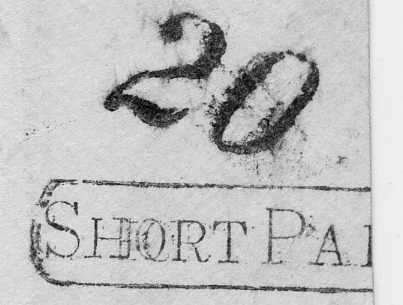
Here is another example of a letter from the US to England that bears three 24-cent stamps for 72 cents in postage.  This letter was mailed in 1864, and unlike the very first item I showed in this post, it was NOT accepted as being properly paid.  If you look, will notice a hand stamp at the right that says "short paid."  Also, the black coloration of the New York marking and the black coloring of the "20" marking are indicators that this was considered to be unpaid.  Think of these as signals to the British Post from the US Post Office that all was not well on the postage front.  

"Hey, you Brits!  The sender failed to pay enough for this, so you better collect.  And while you are at it, send us the 20 cents you owe us for this letter!"


The British Post proceeded to do that, collecting FOUR shillings (the squiggle in the middle).  One shilling was equal to 24 US cents, so they collected the equivalent of 96 cents.

The US and the United Kingdom made a treaty agreement that became effective in 1849 and remained effective until December of 1867.  That agreement set the simple letter rate as 24 cents for a letter weighing no more than 1/2 ounce.  A double weight letter would cost 48 cents and would weigh more than a half ounce and no more than one ounce.  But, from there it all changes!

Any letter over one ounce in weight would add 48 cents in postage for every additional ounce in weight!

And to add insult to injury, any letter that was not fully prepaid would be treated as....completely unpaid!

So, even though the sender might have thought their letter that weighed more than one ounce and no more than 1.5 ounces was properly paid, it was not.  Their 72 cents in postage stamps was completely useless and the US Post Office thanked them for the generous donation.  The British Post, on the other hand, came calling to the addressee at Horbling with their hands out, awaiting payment for the costs of this letter.  

All of that brings us back here.

The first letter I shared with you is dated Jun 12, 1866 and it clearly shows a properly paid triple rate that is 24 cents PER 1/2 ounce.  It would have weighed roughly the same as the cover that required the recipient to pay 4 shillings in postage (over 1 ounce no more than 1.5 ounces).

The first question is, of course, how do we know this one was treated as paid?  There are several clues, and I am betting you can see some of them - even if you don't know postal history.

  1. markings in red typically indicated that a letter was considered paid
  2. both the Boston and the London markings include the word "paid"
  3. the 57/3 marking in pencil is red and gives us confirming information

Yeah.  I think the word "paid" in two places is probably enough for most of us.  But, the "57/3" mark illustrates very clearly that this was considered a valid triple weight cover and NOT a mistake by the post office or overpayment by the sender.  The "3" was written by the clerk to indicate that this was a triple weight.  The "57" indicates to us that 57 cents were due to be sent to the British for their share of the expenses.  If this were a simple letter, that number would be a "19," like this simple letter.


But, our triple rate letter would require 19 cents x 3 = 57 cents.  Which confirms that the cover in question is a triple rate letter.

So, why was that first letter special?

It turns out that many postal agreements and rates through the early 1860s followed what was known as a "British Rate Progression," where there was a simple letter up to a half ounce, a double rate letter up to one ounce and then, every other rate progression would be by the ounce.  You can guess that people who got caught by the British Rate Progression were less than happy with it.  And, the British began changing from that rate structure to a simple rate progression.

On April 1, 1866, the United States and the United Kingdom agreed to follow a simple rate structure that was 24 cents per 1/2 ounce.  This rate would only be effective from April 1, 1866 until December 31, 1867.  After that, the rate was reduced to 12 cents per 1/2 ounce.

And that, my friends, is why this envelope is so neat! It illustrates a major change in postal rates that was not the result of a new postal treaty.  And, it was also likely a relief to postal customers who wanted to mail heavier letters.

1 shilling per 1/2 ounce : April 1, 1866 - December 31, 1867

It went both ways too!

Here is a letter that left Liverpool, England, in August of 1867 and was sent to Houston, Texas, in the US.  This illustrates the same thing our first cover did, only going in the opposite direction.  The 24-cent rate per half ounce translates to one shilling (12 pence) per half ounce from the perspective of a person in England looking to send the letter.

This letter has two postage stamps, one representing 1 shilling in postage and the other 2 shillings, for a total of three shillings paid.  Once again, we have a paid marking in the circular, red New York marking at the left.  The red pencil "15" indicates that the British Post was aware that fifteen US cents (5 cents x 3) needed to be sent to cover the US portion of the expenses.

Is life simpler now?

I've had people remark to me that they are glad that postage rates aren't as complex now as they used to be (like the 1860s).  That got me to thinking.  What does a "triple rate" letter look like today - this very moment?

A simple letter from the US to the United Kingdom, if you sent it today, would cost you $1.40 to mail as long as it weighed no more than one ounce.  So, if we use a simple progression today, the cost for a triple rate letter (over 2 ounces and no more than 3 ounces), the cost would be $4.20.

So, I looked it up.  Is the cost for a triple weight letter $4.20? The United Kingdom belongs in "group 5."

from USPS site


Again, the answer is "no."  The cost would be $3.82.

The first ounce cost $1.40.  The second ounce is $1.22 cents and the third ounce is $1.20.  The maximum weight for a first class letter is 3.5 ounces - and that extra 1/2 ounce costs $1.22.

Ok.  Not simple.  And perhaps a good explanation as to why we rely so much on computers to do rate calculations for us today.  What escapes me is the rhyme or reason for rates this complexity.  I suppose I could probably speculate on the data that resulted in these amounts, but that might be a fun exercise for another time (and maybe another life).

Instead, we will stop there for this week, with gratitude for the postal workers who have to deal regularly with today's complex postage rate structures.

Thank you again for joining me for this edition of Postal History Sunday.  I appreciate all of the feedback, as well as the kind words that have been sent my way.  I hope you learned something new and enjoyed yourself, if only because you avoided doing some unpleasant task that I am afraid I will no longer distract you from doing!

Unless, of course, I can distract you with a silly story or thoughts about leaves.  Your call!

Have a fine rest of your day and an excellent week to come.

Thursday, November 3, 2022

Know Your Okra, Know Your Farmer


This October, 2014, story where a Georgia gardener was raided by state police because they thought his okra was marijuana got me to thinking about what might happen if some authority thought we were raising or growing something we were not.  I fully realize that not everyone can tell one plant from every other, but I guess I would expect those who were intent on enforcing laws with respect to marijuana, or any other specific plant, would be well versed in identifying that plant.

On the flip side, I'm willing to cut anyone a break who is just trying to do their job as well as they are able.  But, I'm hopeful that they, and others who do this sort of work, will spend a little training time on plant identification now.

========================================================================
 
***rrrrring***

Rob: Hello?

Official Sounding Person Yes, hello. My name is *name changed to protect the guilty* . I am with the United States Department of *name also changed because we want to - it's fun*. Are you a representative for the farm known as the Genuine Faux Farm and do you realize that the name of your farm indicates that you can't possibly be real?

Rob: Um. What?

OSP I'll take that as confirmation. Sir, we have a complaint regarding the export of katydids and broccoli without proper licensing. We also understand that you have been evading customs with flights of turkeys and an occasional watermelon.

Rob: What were the turkeys doing carrying a watermelon?

OSP That's classified information, though I can tell you that it was delicious.

Rob Which?

OSP That's classified.

Rob I still don't understand the statement about the turkeys and the watermelon. How would turkeys actually carry a watermelon? Or were they hiding IN the watermelon? And how do you know they were MY turkeys?

OSP So, you do not deny that you have turkeys on your farm.

Rob Well, I had turkeys on the farm.

OSP So, you admit that the turkeys are no longer on your farm.

Rob Well, some of them are... kind of.

OSP Sir, you are being evasive, we are now assuming that you are hostile. We will be sending representatives to your farm.

****knock knock****

Rob Whoa. That was fast.

***opens door to see two persons with dark suits, sunglasses, earwigs and large Elvis wigs. One has a cell phone up to his ear.***

OSP Sir, we have tried to be polite, but I'm afraid we're going to need to search your farm.

Rob I'm right here. You don't need to talk into the phone anymore.

OSP Oh. Yeah. Right.

Rob I'm still not sure what you are looking for? Do you want to see turkeys?

OSP Among other things.

Rob Fine.

***Rob walks to a building, opens the door and points to a large chest freezer***


Rob The turkeys are in there.

OSP In the freezer? That's inhumane!

Rob Um. Well, they're dead.

OSP I suppose so, it must be very cold in there. What would cause you to put them in there?

Rob Well, they'd get pretty stinky if we didn't.  They are for sale, do you want one?

OSP I'll have to talk to my partner about that.

Rob Fine. What else do you need from me.

OSP What are those plants over there in the field? That's not marijuana is it?!?

Rob No. That's okra.

OSP Well, how about those, are those marijuana?

Rob No, those are cabbages.

OSP Well, surely that over there is!

Rob That's a tree.

OSP Ah, so it is. Well, we want you to know that we're keeping an eye on you.
==================================================================

***Don't let this happen to you!  Learn to identify plants and your local farmers that grow them for you!***

Brought to you by an anonymous farmer...Know Your Farmer.  Know Your Food.

Wednesday, November 2, 2022

Too Many Words


Every once in a while, I get feedback from others with respect to this blog and its content or its writing.  For the most part, I appreciate that feedback.  Even if it is a comment that is - for lack of better words - feels misinformed or misplaced, I can still learn from it by considering where it is coming from and what might have motivated the feedback in the first place.

For example, I received a comment in regard to a Postal History Sunday I shared a few months ago.  Essentially, they suggested that the blog was too long - but they liked it.  At least they offered a solution.  They suggested I start by writing a summary that outlined everything at the top.

My first uncharitable thought was, "Yep, add more words because the blog is too long.  That makes sense."

But, let me be fair here.  I've heard something like this before.  A couple years ago there was a blog post that got far more attention than most of mine get.  A person I did not know commented that it was a very thoughtful and worthwhile read but.... it was really long.  Almost as if that overshadowed all else.

When I write for PAN, we try to keep entries in the 600 to 900 word range.  Periodically, we'll let one get longer or we'll split something into multiple parts.  You see, research regarding people's online tendencies tells us if something is longer than that, they will lose patience - or simply just not start to read in the first place.

It is at this point that I could start to tell you how upsetting it is that people can't manage to read more than a page worth of material.  It is here that I can tell you how frustrated I am that when I start to read things online I am frustrated by the lack of detail and information.  I find so many articles I try to read stop before they even start.

Because they are afraid of having too many words.

Instead, I need to remember.  Some people don't read as fast as I do.  Some people don't feel like they can allow themselves the time and concentration to read much more than a few hundred words at a time before they must move on to something else.  Many people want me to get to the point as soon as possible so they can see the conclusion and move on.

I get that.

I also get that there is a time and a place to be brief.  There is also a time and a place to have too many words.  The trick is figuring out how many is the right number for a given moment and a given subject.  Today, 469 words is about right.

Tuesday, November 1, 2022

Make Like a Tree and Leaf

If you are able and you haven't allowed yourself to sit still and watch the leaves prepare to fall - and then eventually tumble to the ground - then you should. 

If you watch right now, in Iowa, you might see the remaining oak leaves, stubbornly clinging - completely unwilling to visit the ground.  Their time, as far as they are concerned, has not yet come.  It's almost as if, like so many of us, they hold a fear deep in their hearts that change is not desired.  Perhaps they are willing to paint the walls a different color, as they explore yellows, reds, rust colors and browns.  But, when it comes to taking that final leap, it just feels like too much.

Other leaves, like the maples, almost seem anxious to get it all over with.  I know the Gingko tree in our yard shook every last leaf off in one instant the day after we got our first freezing temperature.  Those leaves were lemming-like, leaping off the cliff together so they could blanket the ground around that little tree.  One moment, they were green and present, at the end of every twig.  The next, they were yellow and down, ready for the next windy day to take them wherever it wanted.

Some leaves that still remain on the trees move gently in the breeze, still hanging on as they contemplate their impending trip.  There always seems to be one in each crowd that bobs up and down far faster than seems to be required by the wind.  Nervous energy making them stand out, making you wonder if they are excited to go.  Still, they cling to the tree.  That's when you realize that they might be the most fearful ones in the group.  Anxious and tense.  Pacing back and forth within the confines provided by the trees branch and the attachment they cling to.  Desperately.

Eventually, each leaf succumbs and falls.  Some are ripped away from their trees, perhaps prematurely, as a gusty, cold wind tears them from the only home they have known.  Others find a calm day with a light breeze talking them into making the choice for themselves.  This is when it is easiest to see each leaf for what it is and the choices it makes.

One large oak leaf releases its hold and swoops in broad and dramatic arcs from the tree's branches and past other trees.  Somehow, it misses all of the limbs in its path, making one final swoop and dive until it lifts up briefly and settles lightly onto the ground.  Sitting there almost as if it were waiting for applause in response to its fine effort.

The remaining leaves clinging to an elm are dry and curled.  One lets go and you can imagine you hear an audible "pop."  It spirals quickly to the ground at the base of the tree, only tumbling when it meets a small branch on its journey.  It quickly rights itself and completes its corkscrew journey until it lands with its siblings - still standing upright in the pile.  This time, it actually does make a sound.  Not much to our ears, but it must surely sound like the crashing of a mighty wave or the rumbling of thunder to the leaf.

Another stubborn leaf, perhaps from a sycamore, releases its hold.  It doesn't just swoop.  It doesn't spiral.  Instead, it expresses its individuality by tumbling, stem over leaf tip, through the air.  It catches a stronger puff of warm fall wind, allowing it to add a swoop in between its tumbling.  Then, just before it reaches the ground, it stalls - stopping in mid air.  And suddenly, takes the last couple of feet by going straight down and landing flat - next to its brother.

There are leaves that take this falling business very seriously.  Almost as if they imagine a panel of judges, waiting with large cards to display a rating for each effort.  A nine for the leaf that managed to include three loops amongst the tumbles. A quadruple loop would certainly increase the level of difficulty and perhaps win the next leaf a prize.  

Another leaf just simply does a swan dive, plummeting straight down, only to have its path interrupted by human walking on the hiking trail.  Pure happenstance destroying its chance at a ten.  It receives a three instead - along with the sympathies of its audience.

And, of course, there are the leaves that would prefer that their journey to the ground be kept private.  They try out their path when they are most certain no one is looking.  Sometimes they opt to release their grip in the dead of night.  Or they hold on longer than most, to drop with the snowflakes.  After all, THOSE show-offs get most of the attention in early Winter.  Who would bother to watch a leaf when there are snowflakes to enjoy?

But, perhaps, the most amazing thing about each leaf's journey is the fact that they don't get to practice.  They don't get a second attempt.  And they don't always succeed with their loops, twists and spins.  Most of them take a completely disorganized and out of control path from limb to earth.  And some few actually find another place to land, like the limbs of a coniferous tree - cradled there as if they were orphans being cared for by another that doesn't understand how all of these deciduous trees could let its leaves go.

Some trips are longer than others.  The leaves on a seedling are less than a foot from the ground, while others are sixty or eighty feet up.  Some leaves must surely revel in their place so far above the earth, while others may look with extreme trepidation at this great distance.

I don't know, of course, what the leaves think.  But, I do know that it was worth my time to observe, and appreciate, the annual event that is Autumn.