Sunday, December 11, 2022

Visiting the Arctic Circle - Postal History Sunday

Welcome to Postal History Sunday, featured weekly on the Genuine Faux Farm blog and the GFF Postal History blog.  If you take this link, you can view every edition of Postal History Sunday, starting with this one (the most recent always shows up at the top). 

This is the moment where I (the farmer and postal historian) gives myself the opportunity to share some things that interest me with others who may enjoy it.  Please take a moment to take off your shoes, put on some fluffy socks and check any baggage you might have from the week at the door.

Let me remind everyone that you can click on an image to see more details in a larger version.


This week we're going to revisit one of my earlier Postal History Sunday efforts and re-explore an item that is outside of my normal comfort zone.  Postal history covers so much ground that it is not at all difficult to suddenly find that you feel a bit like you are a beginner all over again!  The good news is that experience in one area of postal history provides the tools needed to climb the learning curve a bit faster.

Shown above is a large item that was mailed in 1931 from Germany to Russia - via the North Pole. 

By 1931, philately (stamp collecting) had a strong following.  In fact, it was not at all uncommon for people to send mail via certain routes or on certain dates to create a commemorative item for some event.  For example, each time a new airmail route would open up in the United States, there were individuals who would make up envelopes with special designs to be mailed the first day the route opened.  Sure - they paid the postage and they made up a valid envelope or postcard - so these were real pieces of mail, even if the intent was to create a keepsake or collectible item.


An example of philatelic souvenir mail is shown above.  William Bilden sent a letter to France... to himself.  He overpaid the 30 cent air mail rate with 32 cents in postage because he must have wanted the letter to look a certain way when it was returned to him (he probably liked the idea of this block of four National Parks issue stamps).  His goal was for the letter to be taken on a flight (the first flight) via the Foreign Air Mail route 18.  And, he met with success because the letter was returned and since that time the letter has passed from his collection to others, and it now resides in mine.

This is an instance where the postal historian sometimes collides with souvenir hunter.

As a postal historian, I prefer to find pieces of mail that carried "real letters" or "real business correspondence" rather than something fabricated as a souvenir for an event (often called an event cover).  On the other hand, there are times when the souvenirs themselves illustrate an important event in the history of postal carriage, or they connect so strongly to a historical event that has a good enough story, that I am willing to bend a good bit!

In the 1930s, 'lighter than air' ships were coming into prominence, providing an opportunity to cross the oceans more quickly than ocean-going vessels. 

Knowing a good thing when they saw it, many airship flights were promoted to the philatelic community to encourage the sending of commemorative mail for fundraising purposes.  Postal administrations all over the globe got into the act by issuing special stamps and establishing special postage rates for these flights (typically costing more than normal mail).  And, it worked!  Much of the surviving mail items from these flights were made up just to commemorate the event and to provide souvenirs for philatelists and airship enthusiasts alike.

Shown above is a postal card that was clearly created to commemorate a 1929 flight of the Graf Zeppelin.  The German 2 Reichsmark postage stamp features an airship over the earth - a design intended to promote the event of airship mail itself.  And, the addressee is one A.C. Roe of East Orange, New Jersey - also known as A.C. Roessler.  Roessler is well-known for making commemorative mail by addressing items to himself and these letters typically held no correspondence.  The goal was acquire a decorated envelope that had traveled at a specific time on a designated route, ship, plane or... airship.

The cover I am highlighting today was taken on a highly publicized flight that was planned to fly to the northern polar regions.  Let's remind you now of what that item looks like.

This experimental flight of the Graf Zeppelin LZ 127 was funded to a large extent by philatelic interest (believe it or not), carrying 650 pounds of mail at the time it departed Leningrad and another 270 pounds going the other direction.  It is estimated that around 50,000 pieces of philatelic mail were processed through in total.

Given the larger size of this particular envelope, it is possible - and maybe even likely - that it carried some legitimate correspondence in addition to serving as a way to create an event cover.  Unfortunately, there are no contents in the envelope, so I can't verify that possibility.

This particular piece of mail cost the sender 4 ReichsMarks (RM), which was roughly equivalent to one US dollar in 1931 (to be more precise 1 $ US was 4.2 RM).  

The airship left Friedrichshafen on July 24 and made stops in Berlin (July 24) and Leningrad (July 25).  It then transferred its mail to a Russian icebreaker ship on July 27 near Hooker Island.  If you look closely, even the stamps had a special marking ("Polar Fahrt 1931" = polar flight) and were sold specifically to persons who wanted souvenir mail to go on this flight.


 If the person mailing this just wanted an item to be mailed from Germany to Russia so that it got there as fast as possible, then it would have made sense to take the letter off the airship in Leningrad and let it get to Ishevsk, Russia, from there.  But, the typed instruction "via Nordpol nach Russland" made it clear that the sender wanted this item to get off-loaded on the scheduled icebreaker rendezvous.

A commonly sought reward for those who paid to have letters taken on special flights was a hand-stamped design (known as a cachet) that was placed on each letter to verify that it was, indeed, on board the Graf Zeppelin.  If you look the other items I have shared thus far, you will find other examples of cachets.  The A.C. Roessler card features a blue, round cachet.  And, the William Bilden envelope to France has a very large design featuring an airplane and the statue of liberty.

Sometimes, the commemoration was provided by a special postmark - and this event happened to have both a cachet and a postmark.  The Russian icebreaker Malyguin met the Graf Zeppelin on July 27 and they processed the mail with the special postmark shown above.  The ship took the mail from the airship back to land, where this letter entered the Russian mail system.  

This large envelope finally arrived at its destination on August 8, much later than regular mail would have taken - at a much higher cost. But, the recipient had the souvenir they desired - or maybe it was the sender who wanted this envelope for their collection and they prevailed upon a friend to keep it for them?  That's something we might not ever know - but it can be fun to speculate.

AP photo June 28, 1931 - scanned image taken from a sale item on an online sales site

In order to transfer mail from the Graf Zeppelin to the Malyguin, the airship had to land on the surface of the water.  This maneuver was practiced on the Bodensee (Lake Constance), which borders Germany and Switzerland and it was (apparently) successful when it mattered near Hooker Island in Arctic waters.

The build up to the flight and the flight itself was well-publicized and widely followed.  The video shown below includes a section, with commentary, on this flight starting at 3:05 on the video's timeline.


For those who would like to learn more about the scientific and mapping purposes of the 1931 polar flight of LZ 127, I suggest this summary on the airships.net site, where the map image shown below was found.


 I hope you enjoyed a quick voyage to view the North Pole from an airship.

Saturday, December 10, 2022

Are We Amused Yet?

Our indoor supervisors, Bree and Hobnob (Hob is no longer with us) often got a bit tired of me trying out jokes and puns on them.  They told me by simply giving me "the look" that I needed to find a new audience.  Guess what?  YOU are the new audience.  Aren't you lucky?  

Well, you'll be really lucky if you get to the end of this post (which is highly recommended if you can stand it).

Mood Assessment

Let's start by assessing everyone's mood. 

I warn you in advance, you just might find yourself visiting every single one of these moods on the scale of cat over the next few minutes.  I can only hope if you get stuck on number 4 or number 8 that you don't know where I live or you don't have the energy to hunt me down after.  If you land on number 3, I want you to know that I've already started running.


Unfortunately, I am a farmer, so I really have a hard time trying to figure out where I fall on the scale of cat.  After all, if you believe the graphic shown above, it changes moment by moment.  

In my case, I think I follow a progression from 1 to 9 most days - although I might move #7 to the end.

You might be curious about where I was landing, as far as the cat scale is concerned, when I wrote this particular entry.  Well, I suspect I was wavering on the border between #3 and #6.  Once I was done with it, I am pretty sure I landed back at #1.

So, onto more serious business.  We've been discussing the legal structure of the Genuine Faux Farm.  We are thinking that we should change our farm name simply because I want to be able to put these initials at the end of my name:


Hey, let's be honest here.  We can name me the CIEIO even if we DON'T change the farm name.  It's our farm and we can do what we want.... sort of.

Our next trick is to determine what CIEIO stands for.  Some thoughts include:

Chief Informal Executive Involving Onions
Credible Information Exists In Observation
Crumpled Iguana Ears Ignore Owls

I'd love a few more ideas - so have at it in the comments!

The Sandman used to always let me try out jokes on him.  He usually encouraged me to keep them to myself.   Regardless, the following illustration made me think of the Sandman.  I wonder if he really was a dragon using an illusion spell?  I wouldn't have put it past him.


But, the real motivation for this post is this facebook post that was being shared by a group of farmers I knew several years ago.  Read the caption carefully and consider how easy it is to accidentally (possibly on purpose) a person can flip a couple of letters in a single word to provide us with a different word that has a different meaning.


Once I saw the typo I just could NOT help myself.

I decided I should milk this for all it was worth!  Gather around like cattle and ye shall be HERD!

Dear Diary,

Today I went to the farm to ruminate about ruminants.   I thought they might have a beef with me, but it turns out this was the udder kind of bovine.  I met a cow and gave it the nick-name "Cuddles," but it turns out that this reference turned the cow's stomachs (all of them).  

I tried to cross the field without touching the ground by leaping from the back of one young cow to another.  After that, I took stock of the situation and realized my calves were sore.  Now THEY had a beef with me.  I guess it was time to moooooove on.

I was wondering how farmers select a bull to mate with a cow and figured they must have gone to a meet market of some kind.  One guy tried to tell me that he had a batch of chicks and some young calves that shared a pasture.  After a while one young rooster took a liking to one of the bullocks, riding on its back from place to place.  He said they went everywhere together, including the county fair.  I decided that had to be a cock and bull story.

I realize that many people have not been exposed to the story about the cow that got a foot caught in a trap and had to have its hoof removed.  Removing a hoof is the equivalent of taking off ones toes, it has to be difficult to adapt to.  It was made worse by the fact that the other cows ostracized the hoofless cow.  Apparently, they were lack toes intolerant.  Yes, that's the untoed story.

So, now I HAVE milked this for all it's worth.  Why?
Because you have just experienced "deja moo" - the feeling that you have heard this cow pun before.

Now, go take a nap.  It's pasture bedtime.

Friday, December 9, 2022

End of Year Giving 2023

This will be the third year in a row that I have taken the time to write a blog like this. The motivation came when someone I know asked me for recommendations for end of year donations that had to do with farm, food, and the environment with ties to Iowa.  I am fortunate to have some insight on this, but I don't pretend to know everything, nor do I have full knowledge of every worthy organization in the state or that works in the state.  I can only share what I know - so here we are.

If you have information about other worthy organizations, you can feel free to share them with - then we'll be even!

Once again, I want to remind us all to be patient while the organizations we support inundate us with requests for donations.  Don't take your name off of their mailing lists in disgust.  Instead, watch more carefully for the other things they ask you to do and the resources they provide.  Use those metrics, among others, to determine to whom you are willing to provide support.  Then, if you don't like what you see as check out their work, take your name off of the list.  For now, exercise patience and grace as they all do what they need to in order to secure funding.  

Just remember, many of these organizations exist because you and I don't have the space in our lives to do things like look out for the environment or provide a food resource for those who need it or.. pick your topic that really speaks to you.  They put people on salary so they can focus on trying to make these good things happen.  But, if they don't have the money, they can't have the people.  If they don't have the money, they can't provide the food.  If the don't have the money, they can't monitor legislation and inform you when something important is happening

And, hey... if you don't like being told WHEN you should give, then take matters into your own hands.  Make a budget and a schedule for your giving and send the money on your own terms.  Then you can blithely ignore the additional requests for money while paying attention to the requests to help make change happen.  

Things like this action to ban organophosphate chemicals on our food.

First - Please consider a gift to PAN on my Peer-to-Peer Fundraising effort

Before I get too far, let me send out a plug for my Peer to Peer effort to raise $500 for Pesticide Action Network, where I serve as Communications Manager.  Yesterday's blog featured this campaign and if you would like to participate, here is the link

I have to admit, a small, prideful part of me wants to show the rest of the PAN staff that this steward of a small-scale, diversified farm can come through and meet a goal for fundraising too!  Multi-talented I am!  Or at least persistent in my writing.

For those who are interested, PAN's Charity Navigator rating is now 89.0.  It has gone up two years in a row. They must have heard I work there.  Or maybe they have YET to hear that I work there.  Take it how you will.

This Year's Recommendations

Last year, Tammy and I recently received a request to identify organizations with Iowa ties that promote the health of our environment - whether it is by encouraging/discouraging particular farming practices or supporting wild areas in the state.  This year you will find the focus is, again, environment, food and farming - because that's what I know most about.

We took a moment and checked our recommendations out on Charity Navigator, which does not have complete ratings for every organization, especially if they are smaller.  We encourage you to look beyond the number ratings to see what the rating is based on.  You can decide what, if anything, in these ratings matter to you.  

What we can say is that, in our opinion, all of these organizations would be worthy of your attention.  Read on for some of our opinions and experiences regarding each.

This list is provided (after the first entry) in no particular order.

Iowa Farmers Union

Charity Navigator - N/A

IFU has been a force for pushing alternative policy approaches in a state that does not seem to want to listen to ideas that don't come from corporate agriculture.  IFU has pushed back against the process of farm consolidation, which results in larger farms.  You may notice that IFU has taken a stand to stop pesticide drift, reduce agricultural runoff into our waterways and encourage diverse farmscapes.

The people at IFU have the energy to push for policy change and they need support to maintain that energy and make some progress.  I have had the privilege to speak at one at their annual conventions and have participated in their policy discussions.  This past year I also worked with them on their Iowa Legislature Lobby Day.  

I continue to appreciate the heart and tenacity of the people that make IFU work.

Iowa Organic Association

Charity Navigator - N/A

The Iowa Organic Association is a smaller organization that has been around longer than you think - yet its impact is being felt more and more in recent years.  One of its biggest contributions has been various workshops to help farmers figure out how they can transition to organic production. Even more recently, they have been combining presentations with farmers who certify organic as schools throughout the state.  I was honored to join them in Cedar Falls as the farmer who paired in the presentation with IOA at the University of Northern Iowa for the past two years.  We also had a group come out to the farm this past spring and I participated in a webinar just this week (Tuesday).

If we can find ways to encourage more farmers in row cropping systems to adopt organic practices, we can make a big difference in our environment.

Seed Savers Exchange

Charity Navigator - 82

If open pollinated seed access and preservation are important to you, then Seed Savers should be an organization you consider supporting.  This organization maintains some beautiful land in northeast Iowa, sustainably managing natural areas as well as a heritage orchard, seed production gardens and display gardens.  

Our farm has relied heavily on a number of heritage and heirloom seed varieties sold by SSE for our vegetable production over the years.  If you love Black Krim tomatoes, Thelma Sanders Acorn Squash or Grandpa Admire's Lettuce, you can thank Seed Savers for making them available to farms like ours and gardeners like yourself (if you garden).  Our farm has pushed back against the increased reliance on F-1 hybrid seeds by trying to use open pollinated varieties whenever we are able to - we support Seed Savers mission, in part, by simply working to grow and sell those varieties rather than relying on an increasingly small number of seed producers.  Diversity in seed is important.

And, in 2021, we started raising crops to produce seed for Seed Savers.  So, I would say we feel like we have a strong alignment with the values Seed Savers Exchange promotes.

Northeast Iowa Food Bank

Charity Navigator - 99

As growers of food, Tammy and I are often acutely aware of the fact that there are many people in our area that are "food insecure."  Because we raise quality food products, we have regularly made contributions of food and money to the food bank.   Just in the past couple of years we have made direct contributions of high quality broccoli, acorn squash and garlic.

Tammy has also worked multiple times with Northeast Iowa Food Bank on various projects.  Her research classes have frequently designed, implemented and analyzed the results of surveys to help assess some of the services offered by NEIFB.  Some of you might even recall that Tammy was involved in the initial processes that brought about the Waverly Community Gardens, including the efforts led each year by Ron Lenthe to grow food that goes to the food bank.

All in all, it has been a privilege to witness the positive steps NEIFB have made over the years.

Scattergood Friends School (and Farm)

Charity Navigator - 85

This recommendation may seem a bit out of place if we are talking about environmental issues, but this is where our personal connection gives us an inside scoop to understand what the non-profit does.  We have friends who teach at the school and run the farm that is attached to the school.  We are aware of how the school uses its farm and surrounding natural areas to educate young people with hands-on experiences.  Exposing young people to nature and to how food is grown (they raise vegetables and meats for consumption at the school) is an excellent way to make a difference in how we care for our world now and how we prepare to care for it in future generations.

Practical Farmers of Iowa

Charity Navigator - 100  

If you have read our blogs over the years, then you have heard about Practical Farmers of Iowa.  PFI supports on-farm research, which encourages farmers of all types (row crop, grazing, orchards, horticulture) to 'stay curious' about farming and continue to look for better ways to do things, rather than simply accept what agribusiness tells us to do.  Our farm has participated in several research projects and we have held multiple field days for PFI.

PFI strongly supports the increased use of cover crops to reduce erosion, supply fertility, suppress weeds and provide alternatives to current agricultural processes.  It was PFI who helped create videos on pesticide drift and resources for those who have been drifted on.   Spoiler alert, you might recognize one of the two farmers featured in those videos.  Just this past year, I was involved in creating a new webinar on how to deal with pesticide drift and I will be presenting at their annual conference in January on how to seek compensation for drift.

 Xerces Society

Charity Navigator - 94

The Xerces Society is a national organization that has had a strong presence in Minnesota and has also had some good connections to Iowa.  Once again, you can let them know how much you appreciate their attention to a state, such as Iowa, by pointing out how much we need help maintaining our pollinator and invertebrate populations.

Xerces is my "go to" resource when I need to learn more about pollinators and pollinator habitats.  In fact, we hosted a field day with Xerces and Practical Farmers of Iowa in 2016.  Xerces has also helped other farmers (not just veggie farmers) install pollinator strips, beetle banks and other habitat areas.  Our pollinators need support now and Xerces is a key organization.  

Over the past year, I have worked (with my PAN hat firmly in place) with Xerces staff as part of a Herbicide Working Group that has met with the EPA to alert them to the continued hazards of dicamba products - one of the primary reasons that Iowa's Oak trees are struggling (among other things - but that's for another day).

Rodale Institute Midwest Organic Center

Charity Navigator - 97

Rodale is synonymous with organic.  We have at least two Rodale books that have been in our reference library from day one at the Genuine Faux Farm.  While Rodale is centered on the East coast, they recently (in the past three or four years) opened their Midwest Organic Center in Marion, Iowa.  

In my opinion, it is important that organizations such as Rodale, PAN and Xerces put a focus in a state such as Iowa.  Why?  Well, Iowa may be one of the most unfriendly states (in general) for their efforts with the overwhelming strength of corporate agriculture in opposition to their goals.  The strength of these larger organizations are needed if we want to make headway.  If you decide to donate to Rodale, please tell them that you support their center in Marion.

Iowa Natural Heritage Foundation

Charity Navigator - 100

Here is an organization that works on preserving natural areas in Iowa by supporting the process for lands to be protected by easements.  I have been a supporter of INHF from the time I took my first job in Cedar Rapids until the present day.  I have watched their efforts as they have helped to preserve the Loess hills in western Iowa and set aside larger contiguous pieces of land in the Upper Iowa River Valley (among others).  

I won't pretend to be perfectly knowledgeable about such things, but I suspect we would have even fewer natural areas in this state if INHF didn't exist.  Oh, and some of the beautiful photography on their magazine is quite worthwhile.

Iowa Environmental Council

Charity Navigator - 85 

The Iowa Environmental Council is another organization with which I have some personal connection.  Some of IEC's work helped us through the process of putting solar panels on our own farm by connecting us with a site evaluator.

If you are concerned about the health of Iowa's land and waterways, support renewable energy and want to take action to respond to climate change, IEC is a good place to look.  IEC is a policy oriented organization, looking to advocate for changes at the governmental level to support renewable energy, clean water and land stewardship.  So, if you are looking for legislative change, this is one you should consider.

-------------------------------------

I hope you found this review worthwhile to read and I hope you found some of the information useful.  Tammy and I are both happy to support each of these organizations as we are able throughout the year.  We are also pleased to support other organizations, such as Cedar Valley Friends of the Family.  We also have traditionally supported Iowa Public Radio and Iowa Public Television because we value the services of balanced new reporting and educational television.  I, in particular, remain grateful for the free access to resources from public television when I was growing up.   

Don't get us wrong - we aren't trying to say we are key supporters for any of these organizations, we don't have that much money or influence.  And we are definitely NOT saying we are better than anyone else.  What we are saying is that if you were asking our opinions (and someone did), this is where much of our money and support flows when we are able to give it.

Have a great day and thank you for lending your support to others in whatever way you are able.  Kind words mean something.  Careful and thoughtful actions are important.  And, when you can, donating resources (time, money, etc) is also important.  When we care and put effort into HOW we care, we help make this world a better place.

Thursday, December 8, 2022

Peer to Peer Challenge


Believe it or not, I am now in my third year working with the Pesticide Action Network - North America.  My duties have broadened and are varied, but my title remains Communications Manager and much of the speaking and work I do with Iowa-based organizations is now with my "PAN hat" on.

You have probably noticed that we are deep into the "end of year giving" period that so many non-profit organizations rely on to make their work possible in the coming months.  I have been on "both sides of the ball" now and I fully understand how everyone feels when they get yet another appeal for money.  However, I also recognize that this IS the season when more people are willing to make a contribution.  And, I have also learned that an organization that fails to ask for support will most likely not get it.

Like many of you, I put serious consideration into where I will offer financial support. It is important to me that I agree with the organization’s goals, intentions, and methods. And, of course, I prefer to support groups whose actions match my sense for what will do the most good in the world.

When I joined PAN’s Communications Team in 2020, I realized there was something else that matters when it comes to figuring out where my donations should go. It’s the people.

I am impressed with the quality of the people I work with at PAN. My colleagues are genuinely motivated to do what they can to help us all break out of the cycle of food production and farming that relies on chemical-intensive practices. But even more than that, they do their work with integrity, preferring to put in extra effort to support statements with science while also recognizing the roots in our history that have led to unjust and failing food and farming systems.

While it is not in my nature to do this sort of thing, I still agreed to participate in this year’s “Peer to Peer” fundraising event. Why? It’s because of the people. I believe in them. It’s because of our work. I think it is worth doing.

If you are able to give two dollars, twenty dollars or some other amount, it is all helpful. Maybe if we work together we’ll find that we’ve reached my $500 goal.

If you now feel motivated to make a donation, you can take this link.

Thank you for carefully considering my request - regardless of whether you choose to give or not I appreciate your willingness to hear me out.  Here's here’s to an upcoming year of good and worthwhile work.

Wednesday, December 7, 2022

Boxed WHAT?!

I received a package recently that included a variety of things, but one thing really stood out because it set off the alarms in my head that said "BLOG ALERT!  BLOG ALERT!"  My sense of impending silliness quickly reached overflowing status - which is appropriate because we're talking about a liquid.

So, we'll start with the first picture where we can see a "prepared date" of October, 2022.  So, whatever it is must be fairly fresh - or at least I thought it must be.  And there is a "best by" date in October of 2024.  So, I've got nearly two years until this product "goes bad" on me.

Thank goodness, I wasn't sure I could have stood the pressure if it was going to go bad really soon.  After all, I need some time to consider my options!

So, what was in the box, you ask?

Yes, there you have it.  A box of water.  Two hundred and fifty milliliters (that's 8.4 fluid ounces for you 'Muricans out there) of liquidy wet stuff just begging to be used by October of 2024. I should probably figure out when I can put my consumption of this boxed water on to my calendar because I really would hate for it to go bad.  I am also wondering if it will go best with fish, chicken or red meat.  Anyone know?

Look, we shouldn't be so surprised that the water is due to go bad within a couple of years.  I mean, it's been circulating around the earth for about 3.8 billion years.  We had to expect that the expiration date was coming up sometime soon, didn't we?

I took a quick look at the label to find out where the water came from and noted that the company is based in Holland, Michigan.  So, I suspect Lake Michigan is probably not going to miss 8.4 fluid ounces taken from the approximately 1 quadrillion gallons of water in the lake.  And, it is nice to know that some company in Holland has reverse osmosis filtration to clean the water for consumption.  

But, there's no getting around it - this water is STILL 3.8 billion years old, filtration won't change the fact that it is really old, I don't think.

I'm also curious.  Flint, Michigan is only a couple hour drive from Holland to the east on Interstate 96.  Maybe they could send a giant box or two to Flint so people there could have decent water?


Ok.  I get it.  This company is attempting to respond to the issue that all of these plastic bottles of water marketed and used by people in the United States are adding to issues with plastic pollution.  And, all that water is 3.8 billion years old too.  So, when October 2022 comes along we're going to have all of these boxes and plastic bottles of expired, rotten water to toss out.  At least the boxes should break down... mostly.  But certainly more than the plastic bottles will.

And here's part of the irony of it all - Lake Michigan is dealing with plastic pollution.  I wonder if reverse osmosis takes all of that out too?  So, the box apparently is mostly not plastic (based on their description), but the water in it contains plastic?  Well, whatever, it's all just going to expire in two years anyway.  So never mind.

I wonder if we've considered how we should dispose of all of the rotten water once it goes bad?  Are they going to hire people to pour it out of all of the bottles and boxes into some sort of holding tank?  Or maybe some geological formation miles under ground?  I don't know - but maybe I should research it so I can prepare for the inevitable.

I did note that the producer of this product proudly claims that 92% of the packaging is from "renewable materials, mostly paper."  They claim that even the cap is mostly "plant-based."  

This explains something I've been wondering about.  Have you noticed that doctor and dentist waiting rooms, hotel lobbies and other similar places have fewer plastic plants than they did before.  Perhaps you have noticed that hobby stores don't have as wide a selection of fake sprigs of flowers for crafting.  Well, we've found the reason - mostly plant based caps on boxed water from Holland, Michigan.  What they don't tell you is that the plants were made of plastic.

Well, anyway, my own personal quandary is still to decide when I will break open this box of water so it can be consumed before it expires.  Until then, I think I will send a thank you note with a box of fresh, crisp Iowa air as a token of my gratitude.  

Just one problem.  I'm not sure how old that air is.

Nor do I know when it will expire.

Monday, December 5, 2022

Sneaky Indoor Supervisor?


Bree has always been a bit more nervous about how the world is going change from moment to moment than the other supervisor cats around the farm.  She is also a bit of a "princess," letting the pea take most of her attention even when there is plenty of comfortable mattress she could concentrate on.  Bree has always been an indoor supervisor, only visiting the outdoors if it for a trip to the "place that must not be named."  (that would be the vet for the uninitiated)

Bree's sister, Hobnob, left us earlier this year and that departure has certainly been a mixed blessing for our remaining indoor supervisor.  Bree certainly misses her sister simply because they had been together their whole lives.  However, the sisterly relationship was never one that Tammy and I would call loving.  So, in some ways, Bree has benefited from Hob's departure.

Still, Bree is left as the only remaining feline at the Genuine Faux Farm bearing the title "Indoor Supervisor" and the pressure can sometimes be telling.  For example, this past weekend had a fair amount of upheaval as the humans did some deeper cleaning and moving in the farm house.  It's the kind of cleaning that happens for many reasons.  If you consider that during each of the past two years the humans have taken turns at major surgeries and recoveries that might be enough to get you to understand that many things have probably been "on hold" for a while.

Places and things in the house that have been let be for the past year or two were suddenly being moved, inspected, and even taken away.  It's enough to make any self-respecting indoor supervisor have a great need for a long, uninterrupted nap later in the day on Sunday.

But, maybe I underestimate Bree?  Perhaps she feels she has done a fine job of supervising our efforts this past weekend.  Is that I smile I see on that kitty face in the picture above?  Well, if it is, I am sure she won't give me the satisfaction of confirming or denying.  Yet, I do take note that places she prefers for catnaps were cleaned off and any obstructions were removed.

Is it possible that we've been played?  I am guessing we'll never know for certain.

Sunday, December 4, 2022

Something More... - Postal History Sunday

Welcome to Postal History Sunday, featured weekly on the Genuine Faux Farm blog and the GFF Postal History blog.  If you take this link, you can view every edition of Postal History Sunday, starting with this one (the most recent always shows up at the top). 

We have had an extremely busy week at the Genuine Faux Farm, so the energy and time for Postal History Sunday is a bit shorter than it is some weeks. So, this week we're actually going to build a bit more on a couple of prior entries.  Every so often, I find new items that fit a topic I've already written on or I learn a new thing or two that makes it worthy of sharing.  It doesn't always justify an entire Postal History Sunday, but I still think it might be interesting to give it a try.

Something more for Sorta Paid

Back in June of this year, one Postal History Sunday explored how some postal agreements between France and other nations allowed for partial payment of postage.  But, instead of simply collecting the amount of postage the letter had been shorted, there was an additional cost added to the postage due as a way to discourage people from underpaying mail.

During the 1860s, if someone in France wanted to mail a letter to Spain, they would have to pay 40 centimes (French currency) for every 7.5 grams of weight.  If someone in Spain wanted to mail a letter to France, they would have to pay 12 cuartos (Spanish currency) for every 4 adarmes in weight (4 adarmes is about 7 grams).  And, all would be well if a letter was properly weighed AND properly paid.

It's when someone failed to do just that - for whatever reason - that things get complicated.

The item shown above is a case in point.  There are three blue stamps representing 4 cuartos in postage each.  That would be a total of 12 cuartos, which paid for a simple letter weighing no more than 4 adarmes.  Sadly, this was not enough postage and the recipient in Bayonne, France had to pay more in order to receive the letter.

Our first clue is the marking that reads "Franqueo Insuficiente" (insufficient postage).  I took the liberty of using an image editing tool to try to make the lettering stand out a bit more so everyone can see what I am talking about.  I admit it.  If you didn't have some idea of what you were looking for in the first place, many postal markings are next to impossible to decipher.  

We just have to remember that postal clerks dealt with these things daily, so they knew what they looking for (most of the time).  And, of course, they probably didn't even entertain the idea that someone like me would want to try to read what a marking says 160 years later.

The other clue is the "2" that is written in blue pencil  You can see it in the image above or you can look at the original image of the cover.  This tells us and other postal clerks that the letter was a "double weight" letter.  It weighed more than 4 adarmes and no more than 8 adarmes.  So, the sender should have paid 24 cuartos in postage, not 12.

9 - black hand stamp

90 in blue pencil


Once we figure out that not enough postage had been paid, the next question is "how much MORE postage is necessary to be paid?"

Gee.  I'm glad you asked, because that's a question I happen to know the answer to.  You can certainly ask any number of questions - I do encourage it - but I can't always guarantee that I'll know much about whatever you ask. 

So, how did they calculate the amount due?

First, the payment for remaining postage was to be made in France, which means we need to think in terms of French centimes (cents) or decimes (dimes).  Getting right to the chase, the "9" in black ink represents 9 French decimes and the blue "90" is 90 French centimes.  Both are exactly the same amount.

In France, the unpaid rate for mail from Spain was 60 centimes per 7.5 grams of weight.  Since this was a double weight letter, the cost would be 120 centimes if it were fully unpaid. 

The good news?  The sender did pay for 12 cuartos of postage, which converted to 40 centimes.

120 centimes - 40 centimes = 80 centimes

Um.  Wait a minute, I thought you said you knew what you were doing here, Rob?

Well, actually, I do.  There's just a bit more to the story.  

  1. Incoming mail to France from Spain was charged an extra 5 centimes
  2. Postage due was rounded up to the nearest decime.

120 centimes - 40 centimes + 5 centimes = 85 centimes

rounded up to the nearest full decime = 90 centimes

And now you know too.

To make sure the story is filled out right and proper, here is a letter that was correctly prepaid 12 cuartos for a simple letter that weighed no more than 4 adarmes.  This piece of mail originated in Santander, Spain and was destined for Paris.  

A black marking that shows the letters "P.D." tells us that the postage was properly paid - EXCEPT, the recipient still owed 5 centimes simply because the letter came from Spain.

This 5 centime "droit de factage" (drayage right) was a bit of "tit for tat."  The Spanish collected a delivery charge of 1 cuarto for all incoming mail from other countries (called "derecho de cartero").  This practice continued despite a postal agreement with France that went into effect on February 2, 1860 that indicated payment of postage should cover all costs to the destination.  As a result, the French added their 5 centime fee for incoming letters from Spain (but not other countries).

In both cases, there was no way the sender of a letter could successfully pay the delivery fee, so there was no way to apply a postage stamp to cover that cost - as far as I can tell.  Maybe an expert in the field can show me an exception if it exists.

Spain ended their 1 cuarto delivery charge on July 2, 1869 and France followed by removing theirs on July 15.

And here is an example of a double weight letter from Spain to France that was mailed after the droit de factage was removed.  There are two 12 cuarto stamps that properly pay for this letter that weight more than 4 adarmes and no more than 8 adarmes.  There is no 5 centime marking to indicate a delivery fee.

And, in case you were wondering, the 5 centime fee was always 5 centimes, even if the letter was heavier than a simple letter.

Something more for Borderline Benefits

 The Postal History Sunday titled Borderline Benefits appeared in February of 2021 and it focused on special postal rates between nations in Europe for communities near a shared border.  I do, still, pay attention when I am looking at items that might qualify for these special rates, and here is one that was not shared in that post.

Like so many border covers, the postage stamp design we see here was used on typical domestic mail internal to France.  Simply put, there are lots and lots and LOTS of examples of folded letters and envelopes with this blue, 20 centime stamp on it.  And, nearly all of them are a simple letter mailed from one place in France to another place in France.

So, the trick is to know how to identify hints that what you are seeing is NOT typical.

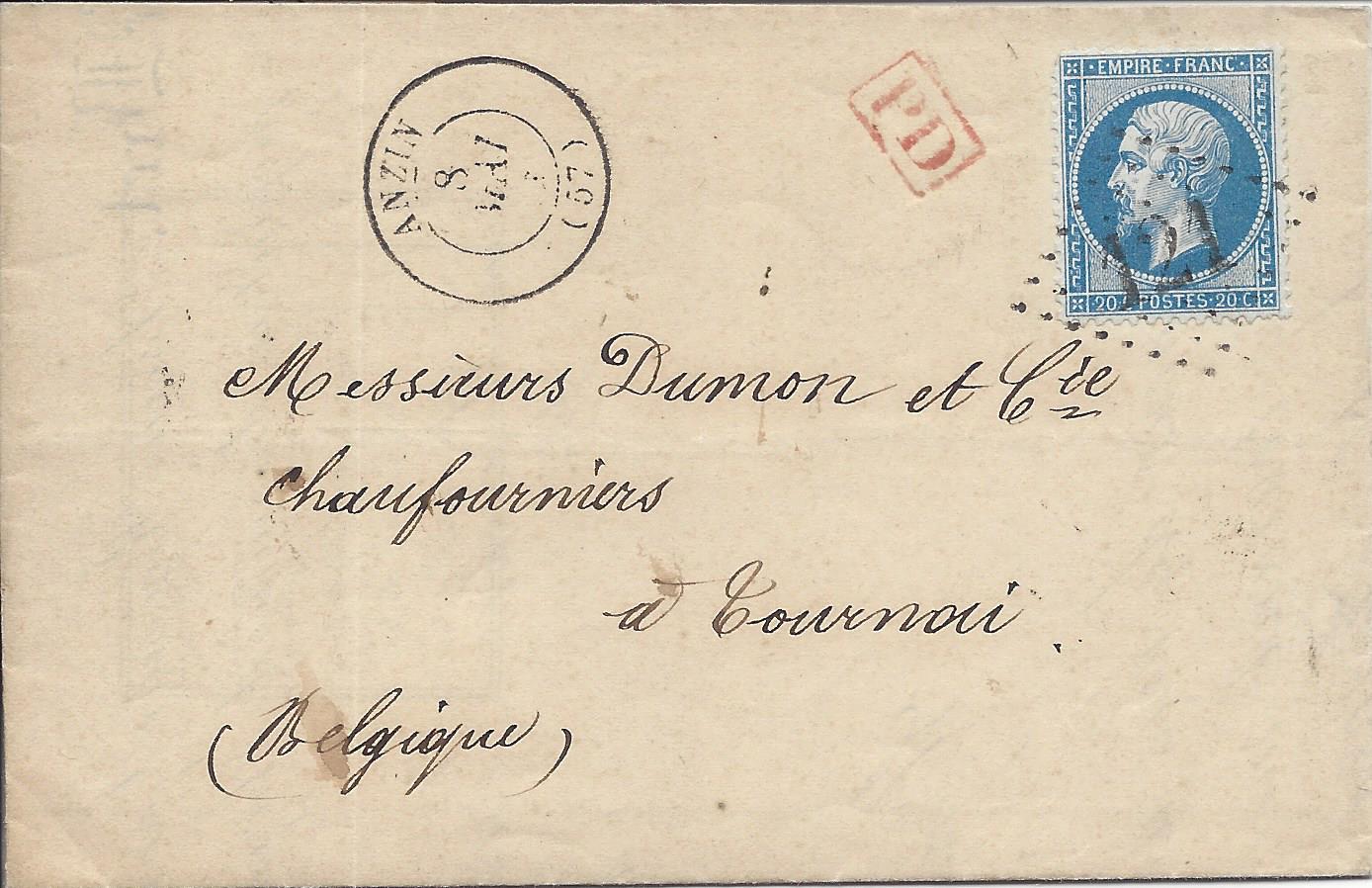
PD in a red box

Belgique (Belgium) in address

The first and easiest clue if you are digging through a whole bunch of envelopes and folded letters from the 1850s, 60s and 70s France is to look for the red boxed marking with "PD" (payee a destination - paid to destination).  Postal clerks in France used this to indicate postage was paid when the letter was going to leave the country.

Shown below is text from the postal convention that was in effect as of January 1, 1966 between France and Belgium.  It sets the border rate at 20 centimes per 10 grams in weight, instead of the 30 centimes for all other mail to Belgium from France.  To be eligible the distance could be no more than 30 kilometers from the origin to the destination.

Click the image to see a larger version

This document includes a list of French communities that were eligible for this reduced rate if the destination was within the 30 kilometer distance.  The town of Anzin is the second one on the list - and that's where this letter came from.

The other challenge, of course, is to be able to read the address.  If you know the letter started in France and the address says it is going to Belgium, you should take notice!


Here is a letter mailed from Paris to Colmar (also in France at the time).  I put this one here to illustrate two possible confounding factors that might make it hard for a person to immediately see that a letter is being sent to a different country.

The first, of course, is hand-writing.  It can be neat - or not.  This letter actually has a pre-printed address except for the city and the department.  Colmar is pretty clear, but "Haut-Rhein" is a bit less so.

And of course, you have to know your geography or be able to find period maps to help you learn that geography.  Sometimes a scrawl is just a scrawl until you find something to help you figure it out.


And then, you need to be able to acquire a bit of regional history.

Mulhouse, the destination town for this letter, is very near to Colmar.  Both are in the Haut Rhein.  Can you see where that department name is written on this folded letter?  If you can't, look at the last part of the address and you'll see "Ht Rhin."

In the 1860s, when the first letter was mailed, Haut Rhein was in France.  But, after the Franco-Prussian War in 1870, that area was ceded to Germany.  Suddenly, Mulhouse and Colmar were in another country and foreign postage was necessary if a person in France wanted to send a letter to those communities.

What we see here is a case where the person sending the letter probably did not personally accept that Mulhouse was no longer in France.  They put a 25 centime stamp on the letter and sent it on its way - and they very deliberately (I think) did not indicate that Mulhouse and Haut Rhein were in Germany.

The French postal clerks knew better, even if they might have sympathized with the sentiment.  They put a red boxed marking that read "Affranchissement Insuffisant" (insufficient postage) on the front.  Then, the German postal carrier in Mulhouse collected 3 German groschen from Fritz Koechlin,who probably was a bit less than pleased with the sender at this point.

While Fritz might have been displeased in 1872, I am hopeful that you are currently feeling a bit more pleased about your own life in the present day.  Perhaps you found Postal History Sunday to be a pleasant diversion that allowed you to enjoy a few moments before you return to whatever it is you must do?

I appreciate your willingness to visit, read, and maybe learn something new.  I am always happy to accept questions - even some I cannot answer - and comments or corrections.  I hope you have a good remainder of your day and a fine week to come.

Saturday, December 3, 2022

Great Tunes for New Speakers


Dusting off the cd collection and the old stereo components has been both fun and mildly frustrating.  After all, I just realized that our Indoor Farm Supervisor (Bree the Cat), probably does not remember the stereo being used.  And she's twelve years old!

Aside from the astonishment at the passage of time, there have also been issues with cleaning the disks and dealing with a cd player that's skipping semi-frequently (also likely due to dust).  And, of course, I had somehow forgotten how rapidly a flood of cds and jewel cases can accumulate around the stereo when I get into a "oooooo! Let's listen to this one next!" mood.

But, here's the really good news.  I have really, REALLY been enjoying the music.  And that might be an understatement.

So, for our December playlist, I thought I would just share the tunes that have really "wowed" me when I got to play them on a good stereo after a long hiatus.  No rules about what's included here.  If they show up on another blog playlist, so be it.

Of course, some of the newer music I enjoy I don't have on cd, so I couldn't play them.  And I will also admit to often just letting the first song on a disc play and if it caught me, good deal. I just put them in this list alphabetically because... I did.

Homeboys - Adam Again

It's the bass line on this one by Adam Again that really got me when I played it on the new speakers.  If I wanted to, I could rattle some windows with this tune.  (for the record, I abstained... this time)

Seemann - Apocalyptica

Pizzicato, interesting vocals and lots of texture.  I tend to like music that has lots of layers, depth and texture.  And, by the way, there is cello... lots of cello.

Finale - Blackhouse

This one has a ton of different sounds and textures.  These guys fell into a label called "industrial noise" at the time.  Not sure what they might be classified as now, but I find them interesting and it played well on the new speakers.

Best of All Possible Worlds - Bourgeois Tagg

This song actually got some radio play in its time (well deserved).  Tunes with excellent production quality tended to really shine and this was one of them.  This group should have seen more success than they did at the time.

I Still Believe - the Call

There are just were some tunes that have been favorites for a very long time.  You can't fault me for wanting to play them.  And Michael Been's huge voice was in full force.  Yet I still felt like I was picking up a new thing or two this time around - which was astonishing.

The Secret of Time - Charlie Peacock

Speaking of astonishing.  I thought I knew this tune.  This time around it was a whole new listening experience.  I could hear every word and every different piece of percussion.  I won't be able to listen to this tune in the background for a while because I'll want to stop and try to catch it all.

What You Think I Am - the Choir

It's no secret that the Choir has been a favorite group of mine for a long time.  I enjoyed several other tunes by them with the new speakers, but this one is the one that provided the most revelation.  I don't think I've really heard it on a hi-fi system before this.  Lots and lots of texture that, frankly, didn't stand out when I played it on the single speaker systems.

Return of the Beat Menace - Daniel Amos

So many different sounds playing off of each other.  It's interesting enough on a single speaker on a computer.  Imagine what happens with better sound equipment.

Smokescreen - Lost Dogs

Here's something that is more of a folk quality tune.  The acoustic guitar was clean and clear.  The resulting soundscape made me feel like I WAS in a remote cabin with the wolves and wind howling.

Golden Age - Midnight Oil

I was drawn in by the opening guitar and the bright tone.  This tune is a bit more sparse than many of the others, yet it felt so much more interesting than I remembered it.  It's got to be the fact that I could catch the details so well.

Mytho X - Mortal

Yeah.  Well, I might have rattled the windows a little here.

Give Me Strength - Over the Rhine

This one has a great fade in followed by a catchy rhythm.  Also, Karen Bergquist's voice sounds amazing on the new speakers.  Good stuff.

Bohemian Rhapsody - Queen

Most people I know are aware of this tune.  Most people who know the tune will understand how hearing it on a good hi-fi system could be a positive experience.  It's almost entirely about the vocals this time around.

Lying - Sam Phillips

This one falls in the same category as the Charlie Peacock and Midnight Oil tunes.  Lots of different sounds that are reproduced clearly and grab my attention.  It doesn't hurt that you can hear interesting lyrics crystal clear.

The Sound of Waves - Steve Scott

Here's a song that's fine on a sound system that isn't very good.  So it was really nice to hear it with some better quality reproduction because it gets even better.

Forum - Undercover

You might notice that many of the tunes I selected have openings with some interest.  I suppose it would makes sense if I was going from tune to tune that I would immediately glom onto tunes with this quality.  It's ok, I liked all of these ALL the way through.

Crush - Violet Burning

I also like songs with contrasting tones.  We've got a lot of that going on here, with an excellent build up throughout the tune.

Attaboy - Goat Rodeo Sessions w/ Yoyo Ma, etc

Let's do something different now!  Four instrumentalists who are among the best in the world for what they play - and the playback on the new system fully supported this statement.  They sounded like the best.  It's a good thing.

Nowhere Else - 77s

This one got me on the "hey na na" fade in vocal.  Then I just sat down and listened to the rest.  This is the Way Love Is followed it and then Perfect Blues...  When the music is good, this sort of thing tends to happen.

I hope you enjoyed a few of the tunes.  And if you didn't, go find something you like and make yourself happy by listening to it instead of all the silly stuff I like!  It's ok.  I won't be offended.  Instead, I'll be listening to one of these or ... something else.

Have a good remainder of your day!

Friday, December 2, 2022

Give and Take

At one point in time, I helped college students learn Computer Science both as an adjunct professor and a full-time professor at various locations.  I was fond of quoting the opening character, a traveling tinker or salesman, portrayed by Robin Williams in Disney's version of Aladdin.  The character tries to sell a device that will "save money, time and space - and also make julienne fries!"

I used that as a hook to try and get them to remember that in computing, there is often give and take between time and space.   Often, to get something to run faster (save time) you have to use more memory or storage (space).  Or, if memory/storage is tough to come by, you might have to pay with less speed.  The trick is to know what you are working with so you can find the optimal balance of speed and storage.

In everything we do, there is give and take - because we don't get to do things with infinite resources at our disposal.  We have to make choices.

For example - should we pursue excellence in one thing or competence in a diversity of things?

Expert vs Jack (or Jill) of Many Trades?  Which would you pick?

I started thinking about this after gathering with family for Thanksgiving.  My brother's children had taken an interest in learning chess and had a new "Wizard Chess" set that they wanted to play.  It is known in my family that I had been good at chess at one point in time, so I was involved at some level.  But, it brought back the memory of my uncle teaching me how to play chess during a similar family gathering.  

Of course, I lost badly because I was just learning how pieces moved.  But after getting a taste of it, I found myself playing frequently with friends and reading books about the game.  

When the next family gathering came - some months later - we played again and I won.

How did that happen?  For that matter, how do such things happen on a fairly regular basis?  I suspect we all have some ideas.  My uncle, being an adult, with all of the things going on in his life, had probably not played or maybe hadn't even thought about chess since the day he taught me the basics.  On the other hand, I, a kid, had much less calling for my attention.  

I had time and could afford to expend the brain space on chess.  With the privilege of childhood, I could concentrate on chess to the exclusion of other things with minimal consequences.  I suppose I could have made a choice at that time to really pursue chess and see how far I could get.  While I have no illusions that I would be a top competitor at the grandmaster level, I suspect I could have seen some success until I started running into those who had more aptitude and access to training.  The biggest difference is having the opportunity and then the willingness to invest significant time and energy to the task.  According to one site I found about chess, it can easily take ten years or more of play to achieve the level of grandmaster.

And there it is.  Give and take.  How much success in chess was I going to be happy with and what cost in terms of time and personal space was I willing to pay to get there?  If it turned out that I didn't have much aptitude, it would take even more dedication to try to get to my goal - assuming I could get there at all.

This is where most of us live.  We all have different levels of competency for so many things because our resources are limited.  And there are so many more things in which we have NO competency because we have not expended any effort.

So, here I am.  A Jack of Many Trades amongst a whole host of Jacks (and Jills) who have a wide range of competence in so many things.  Now, I need to learn to stop apologizing that I have shortcomings in some areas - because none of us has unlimited resources.

Thursday, December 1, 2022

The Sandman - Lost Archives

You will adore me.  I, the Sandman, have spoken.
 
The Sandman, when he was with us at the Genuine Faux Farm, might have been the most photogenic of our cats.  I guess it is possible that Mrranda had him beat, but she really didn't want the limelight.  Sandman, on the other hand?  He always had something to say. Was always pleased to strike a pose.  Expected to get a lift when a passing farmer was walking by and let the farmers know if a skritching was on the agenda. 

While we have been deprived of the Sandman's presence for several years now, we still hear his words and find them to be interesting and, sometimes, oddly relevant.  Here is an interview we had with the Sandman several years ago.

------------------
GFF: Mr. Sandman, would you like to start with an opening statement?  If so, please feel free to make it now.

Sandman:  To all of the people out there who are hypnotized by my gaze (and that would be all of you), I call on you to heed me as I speak.  Then, you will take a nap.   I, the Sandman, have spoken.

He wouldn't "trayed" this for anything.
 
GFF: Well, that's one way to get everyone's attention.  Pressing on, would you tell us about how you came to the Genuine Faux Farm?
 
Sandman: You were lost without me.  You needed me.  Therefore, I am here.  I, the Sandman, have spoken.

The director's cage.
 
GFF: I found this kitten picture of you and notice that you appear to be enclosed in some sort of chicken wire contraption.  What is that all about?

Sandman: Most of your readers may not understand this.  And I am certain you will not.  But, I was employing a mind-control technique to make you and the nicer farmer* more pliable.

GFF: Wait? I thought it was to keep you from getting under the tractor tires.  Besides, I don't think your technique worked.

Sandman:  You do feed me every morning?

GFF: Yes

Sandman:   You skritch me when I ask you?

GFF: Well... um... yes.

Sandman:  You let me ride on your back when you are crawling around in the fields?

GFF:  Ummmm.  Ok, I get your point.

Sandman:  Plus, I was darned cute.  You needed at least a little protection from that.  I am a genius.  I, the Sandman, have spoken (yet again)! 
 
* the Sandman had a way of putting a person in their place.  The "nicer farmer" was a reference to Tammy.  We suspect he might have flipped this if Tammy were doing the interview.

I have always been and always will be - cooler than you.
 
GFF: There are many people who look up to you.  Do you have any advice that you can give them based on your extensive experience as a farm spokescat and all-around fabulous feline?

SandmanYou should take a nap. Perhaps you should also try purring for a minute or two. Just avoid snoring, it tends to pull your whiskers into your mouth, which is uncomfortable. I, the Sandman, have spoken.

Sometimes, it isn't hard to look up to the Sandman.
 
GFF: One last question.  Why do you end your answers with "I, the Sandman, have spoken?"

Sandman: Is it not true?

GFF: Well, yes, I guess it is true.

Sandman: Is it an exaggeration?

GFF: No, I guess not.  And, how did you get such a big vocabulary?

Sandman: You will not gain anything with this line of questioning.  In fact, you will end the interview now and you will find something else to do.  I will take a nap.  I, the Sandman, have spoken.