Wednesday, February 8, 2023

Kuilau Ridge Trail - Walk There Again

I think it would be safe to say that our Kuilau Ridge Trail walk was the most anticipated and most stress-inducing (prior to the walk) during our trip to the island of Kauai.  Since we discovered this trail several years ago, it has been a favorite.  The walk is not too terribly difficult, there are neat things to hear and see on the trail, and the scenic views are... well look at the picture!

And, in case you are wondering, I do not use filters.  And these are accurate color representations.

The stress had more to do with a fear that Tammy might not be able to walk this trail successfully at this point in her recovery.  The trail can be very muddy - and our last trip on the trail was extremely wet, so we know how bad it can get. For those who haven't dealt with the recovery process for Achilles reattachment surgery, uneven and slippery surfaces can be extremely challenging, even if the rest of the walk isn't particularly difficult.

So we had to ask ourselves - how bad would we feel if we couldn't handle the walk?

After acknowledging the fear and worry, we put on the hiking shoes and got a picture of the repaired foot - all adorned to take a walk - at the head of the trail.  And, after some initial mud (nothing too serious), things dried out.  In fact, this might be close to the best trail conditions we've EVER had on this trail.

Thank you for the gift Kauai.  We hope we honor you with good stories and wonderful pictures of the gift that was a successful walk there again!

One of the attractions for us on this walk are the variety of mature trees along the trail.  As a matter of fact, these trees are among the kindest on the island.  Anyone who has walked in a wood has probably felt something about it.  Some woods seem foreboding, making you hesitate before you decide to enter.  Others seem wilder than others, which can be thrilling or frightening depending on the kind of wild.  

These trees seem to have decided that they will accept those who walk under their boughs with Aloha.  Perhaps there was a time they were less than thrilled with human intrusion.  Now, it's almost as if they want us to come discover beauty - and it excites them to share it.

There was one point where it seemed as if the trees created a gateway, where the shade was dense, as if we were in a cave or a great hall.  But, the doors were cracked open so we could see the light behind them.  And in that light was a procession of trees along the trail, providing us with an honor guard.

If the picture you see to the left doesn't give you that impression, I encourage you to click on the image to see a larger version.  In fact, you can click on any of the images to see them better.  The trees made it clear that they were pleased that we wanted to share their story with you.

I will admit that not every person we met on the trail was as enthralled with the trees as we were.  Some were more interested in their conversations and others were simply set on getting from "here" to "there."  Yet others were intent on the grand views that we'll share with you later.  But, they were missing out on other wonders that were closer to hand.

I've said it before, but we miss so much when we don't take the time to really explore.  You can't see if you don't look.  And sometimes the direction you should look is up.

The Mighty Oaks on our farm know how to paint our Iowa skies.  The trees in these woods are masters at their sky-painting artistry as well.  In this particular section of woods, the trees seemed to have communicated well with each other as to which tree occupied what space.  There was often just enough space in between the branches of the canopy that individual trees came close - but typically did not touch.

And, of course, we were happy to explore the different textures and growth habits of trees that are unlike those in Iowa.  Sometimes, the trees were so thrilled to get the attention they seemed to frame pictures for me as I walked the trail.  You could sense the anticipation.

"Will they see it?"  

"Have we made it hard for the humans to recognize this?"

"Shhhhh!  Here they come!  Here they come!"

I'm sure we missed several of their little surprises and they might have been disappointed more times than I realized.  Yet, you could feel a little thrill each time you looked at the right place and the right time.  And as we walked further, you could almost hear them.

"They SAW it!  They LIKED it!  YAY!"

We noticed what we think are Hapu‘u (Hawaiian Tree Fern) as we walked the trail, with more of them as we got closer to the top of the ridge.  These plants seemed to top out at about 20 feet tall and provided an umbrella of leaves that were quite inviting.  As we walked under one of them, I couldn't help but look up and take a picture of the patterns and texture the leaves made.

The tree fern sighed happily because it has spent years arranging each small leaf on every stem JUST SO.  It's always nice to have your hard work recognized by others.

There is a tree that we both look forward to seeing on the trail.  We call it the "Party Tree."  It's not the grandest tree in the forest, nor is it the biggest.  But, it provides shade at the top of the trail in an area where the sun beats down on the path.  And, we used it as a marker to tell us that we can celebrate success in walking the Kuilau Ridge Trail.

The first time we met this particular tree, it provided a pose that was irresistible.  I was able to capture it on film and that photo now resides on our bedroom wall.  It is one of those pictures that makes you feel you could transport yourself onto the path if you could just manage to step into the picture somehow.  

The Party Tree has grown and we're happy to see that.  We made sure to greet it properly and let it know that we are pleased for its healthy and good fortune.  

I wonder if it hears us talk about it when we look at its picture?  Is there a psychic connection that makes that picture seem more real than others?  And if so... is it possible it knows we think about it?  

Maybe we should go back and ask. 

At one point I noticed a bat-like creature fly over my head and I tracked it until it seemed to land on a tree.  I couldn't see it from where I was standing, so I simply pointed the camera where I had seen it last and took a picture.  That picture is shown above.  

I really didn't expect that I'd caught the critter.  But, I did.  Here it is - can you see it now?

This large moth is called a Black Witch Moth and it was introduced to Kauai (and the other Hawaiian Islands).  And yes, even in the picture above it is difficult to see because it blends in pretty well with the trunk of the tree.  While this creature is not native to the islands, I have read that it has a spot in Hawaiian culture as the embodiment of the spirit of a loved one who has passed that wishes to communicate their "goodbyes."

Apparently these moths can have a wingspan of nine inches, which does not surprise me after having one fly by.  No wonder I, and many others, think they've seen a bat instead of a moth.

The valley to the west of Kuilau Ridge was a rich mixture of greens that showed up better when a cloud or two would float by and obstruct the sun for a while on some hills, while leaving others completely sun-drenched.  This is part of the attraction for this particular walk - we get to be treated to beautiful overlooks frequently.

Of course, most people just want to get right to the big show.

And that would be a look at Wai`ale`ale, the mountain and crater of the extinct volcano - and one of the wettest places on earth.  According to data from the Western Regional Climate Center, their recording station measured an average of 373 inches of rain yearly from 1949 to 2008.  

So, it should not be a surprise if Wai`ale`ale made sure to cover itself with some clouds while we took this walk. 

As has been the case with each of our walks since Tammy's Achilles surgery, we have relied on her to determine the point at which we were to turn back.  We decided that we had gone far enough once we reached the overlook that allowed us to take the first picture on this blog.  There was still a little trail left before the Kuilau Ridge Trail gives way to Moalepe.  But, Tammy has been very good at figuring out when it is time to turn around so there is enough energy to successfully return to the starting point.

And, as we were approaching the last little bit on the trail, we were greeted with an unexpected sight!

Apparently, our pleasure at being on this trail in these friendly woods was noticed and we were rewarded with an extremely rare appearance.  Do you see it?  

I'll first refer you to this blog post from a few years ago when we went to Meet the Ents.


Look carefully and you'll see the face of the Ent, a shepherd for this forest, showing his face amidst the moss.

Show your delight in your visit and you, too, might get to meet an Ent.

Tuesday, February 7, 2023

Land of the Living

I knew something was there because my eyes were reporting movement in my peripheral vision.  But, by the time I focused on the spot, I saw nothing but a sandy beach.  Happily, I have learned over time that when this occurs I should stop moving and just watch because there was probably something to see.  I just needed to wait a bit.

There were several small holes just above the water line on Pakala Beach, which told me we might have some creatures using them for shelter.  So, I watched for a while and saw these little crabs slowly climbing back out of the holes they had scurried into as I walked by.  And, at about that moment, someone else walked by - and they dived back into their respective holes.

The crab shown above shall heretofore be known as Claude (or Clawed).  Claude was a crab that decided it was okay to go about business even though a human was insisting on pointing a camera in its direction.  Claude is a Pallid Ghost Crab or ohiki (Hawaiian) and its body was just around one inch in diameter - not a very big critter at all!

The eye stalks were actually fun to watch.  Claude would sometimes turn them sideways, and they did NOT have to go in the same direction.  The crab's coloration was very close to the color of the golden colored sand on this beach and I read somewhere that these crabs may have different coloring depending on the color of the sand on which they live.  It's also interesting to note that one claw is significantly bigger than the other.  This appeared to be true for all of the other Ghost Crabs we watched over a period of a few days, though I admit that I did not check to see if the larger claw was always on the same side (right or left).

That sounds like a worthwhile project some day.  Go sit on a beach and make detailed observations about ghost crabs....  Why?  Well, why not?!? 

Claude was not the only critter we found on, or near, Pakala Beach.  We found ourselves a beautiful looking "Shelob" in the bushes not far from the beach.  And for those of you who do not know, we often call orb-weaver or other showy spiders "Shelobs" in reference to Tolkien's great spider in Lord of the Rings. 

This particular Shelob is known as a Hawaiian Garden Spider and she does not look terribly different from some of the orb weavers or garden spiders we have in Iowa.  Perhaps it is a bit more colorful, but the shape and size are quite similar.  The web has a similar stitch mark towards the center and they seem to like the same sorts of locations to set up a web for the day.

In the process of looking up information, I found this great science packet for elementary school aged kids (though I thought it was fun myself).  This particular resource focuses on Nananana (spiders) and it includes some identification information for spiders in Hawaii.

As for the Hawaiian name for spider - once again it is nananana - I really can't think of a better name.  When a spider walks you can almost hear "nananana" in your head.

Not everything we found on Pakala Beach was a happy, and living, organism.  We took note of a very colorful lobster carcass and determined it must have been a type of Spiny Lobster or ula (in Hawaiian).  The exoskeleton was rather colorful, even though the animal was no longer living.  This particular specimen was about a foot long because...

Well, it was about as long as my foot.  There you have it. 

Now for those of you who think I'm being facetious, we have long known that my foot is actually, and in fact, one foot - as in the English unit - long.  So there.


On one of our Mahaulepu walks, we noticed a bunch of little lizards on the rocks and they were kind enough to pose for a photo or two.  They were clearly sunning themselves happily during the early to mid-morning hours - a point in time when the sun was warm, but not too warm.  

After doing some searching, we discovered that these were PROBABLY Mottled Snake-eyed Skinks.   We do have to admit our shortcomings when it comes to determine fine differences.  It turns out there are a whole bunch of snake-eyed skinks in the world.  However, we are saved some of the struggle since that list is smaller for the island of Kauai.

While these critters didn't seem too concerned with us, it was clear they could really get moving if they wanted to.  But, since they were camped next to a popular hiking trail, I suspect they were pretty secure with the fact that the klutzy humans were an unlikely threat on the uneven rocks they preferred to sit on.

We were even able to discover some "wildlife" in human habitat.  The Gold-dust Geckos were loving an orchid shop in Kapa'a town.   These little critters are fairly common on the island and are diurnal in nature. They are not native to Kauai, but there are numerous ways they could have infiltrated the island - including the fact that people like to keep them as pets. 

Clearly, they are not terribly worried about humans either.  They are frequently found in houses and will periodically make little chirping noises to let you know they are around.  One restaurant we visited even left a treat out for a Gold-dust Gecko friend and they would go out of their way to ask patrons if they were okay with sharing a table with a gecko.

We did enjoy watching it eat a cherry, but it did not have an Australian accent, nor did it try to sell us insurance.  I only say that because I know a couple of you were just desperate to ask, and I wanted to help you to have an even better day than you are already having!

There you are!  A chance to learn a few new things and an opportunity for me to share some of the neat critters we met on our excursions on the island of Kauai.

Have a great day everyone - even if you weren't one of the one's curious about the gecko's professional exploits and global accent!

Monday, February 6, 2023

What? Was it Boxing Day?


It was time to make a change.  We've been using florescent bulbs for a very long time in our plant starting area and, as most of you probably know, those bulbs dim and burn out over time.  In addition to that, some of the fixtures we have been using are showing their age and are less reliable than they once were.  So, we needed to secure new lighting for the 2023 growing season if we want to start some plants for the farm this year.

Well, after Tammy went about seeking information and recommendations, we decided to make the move to some LED lighting.  Our friends at Blue Gate Farm mentioned some LED tube lighting that would not require new fixtures and could be "daisy-chained" for the power connections - perfect for situations where the number of plugins could be at a premium. 

And, here is the top of one of the long (four foot) boxes we received when our order arrived.

Now, let me make this as clear as I can.  This is the top of the long, thin box (about 4' x 1') that says "fixture" on it in the first photo of this blog.  Inside of that box are TWO boxes.  Inside each of those boxes are SIX LED fixtures.  So, each long box has twelve "integrated fixtures" for our use.

See... here's the end of one of the boxes that was inside of the long box so you can see the ends of six fixtures.


So, you might ask (and rightly so) why this is worthy of a blog - unless I were to now give a review of the product?  

Well, this blog has nothing to do with the product and more to do with the packaging.

Do you remember I said the long box had two boxes in it?  And, there were twelve fixtures total in one long box?  Well we ordered 48 fixtures, so you might expect that these might come in four long boxes, right?

Wrong!

One of the long boxes came all by itself.  A single 1 foot by 4 foot by about 9 inch package delivered as you see it by UPS. Each of the other boxes of that size were placed in a much BIGGER and WIDER box (about 4' x 3' x 1').  Now, that might make sense, I suppose if the three long boxes were packed together into one of those wider boxes, right?

Wrong again!

In this case, each long box was packed into a single, wider box all by itself. That means we got three REALLY BIG, long and wide boxes.  Inside each of those was ONE long box.  Inside of each long box were two more boxes and inside of each of those boxes were six LED fixtures.

It all reminded me of this:


And, oh yeah, there was some crumpled up paper kind of tossed into the really big boxes in a sad, and likely ineffective if there were a problem, attempt to provide extra padding.

We're just still trying to figure out exactly why it was packaged this way?  Maybe someone heard we were looking for more space to grow plants and they shipped it along with the lights?

Sunday, February 5, 2023

One Thing Leads to Another - Postal History Sunday

Welcome to this week's entry of Postal History Sunday.  PHS is hosted every week on the Genuine Faux Farm blog and the GFF Postal History blog.  Everyone is welcome here, regardless of the level of knowledge and expertise you might have in postal history. 

This week will be a bit different - but I think I say that almost every week.  So, never mind that!

Just this past Wednesday I had the honor of giving a virtual presentation to the Collectors Club of New York.  The title of the talk can be seen in the lead slide shown below.  But, before I go much further, the video of this presentation will be available for the next week and a half - until the next installment of their Virtual Collectors Club Philatelic Program Series is completed on February 15. After that point in time, the presentation will be available to members only. 

For today's Postal History Sunday, I thought it might be appreciated if I looked at a subset of the slides covered during this presentation.  I have not taken the time to listen to the video - partly because I don't want to subject myself to... well... myself.  But, you might enjoy the presentation.  And, I can tell you that the written word and the spoken word can often convey different things - so it is worthwhile to do both.

The entire premise of this presentation was based on the interconnection of postal history in different geographical regions during the 1860s.  My personal focus on postal history has been on items that include the 24-cent stamp of the 1861 United States postage issue.  Most such items that have survived the past 160 or so years are folded letters or envelopes that were sent from the United States to foreign destinations - primarily to Europe.  While it is possible to be quite knowledgeable about these items without much understanding of European mail systems of the time, I have found that learning about other postal systems has expanded my understanding and made the study much more enjoyable.  In the end, I believe I have come to have a much deeper understanding AND I feel like it enables me to better to explain to others what I am seeing when I look at one of these covers.

Let me start from the beginning by giving you two "baseline" items that will help us to understand two complex items. 

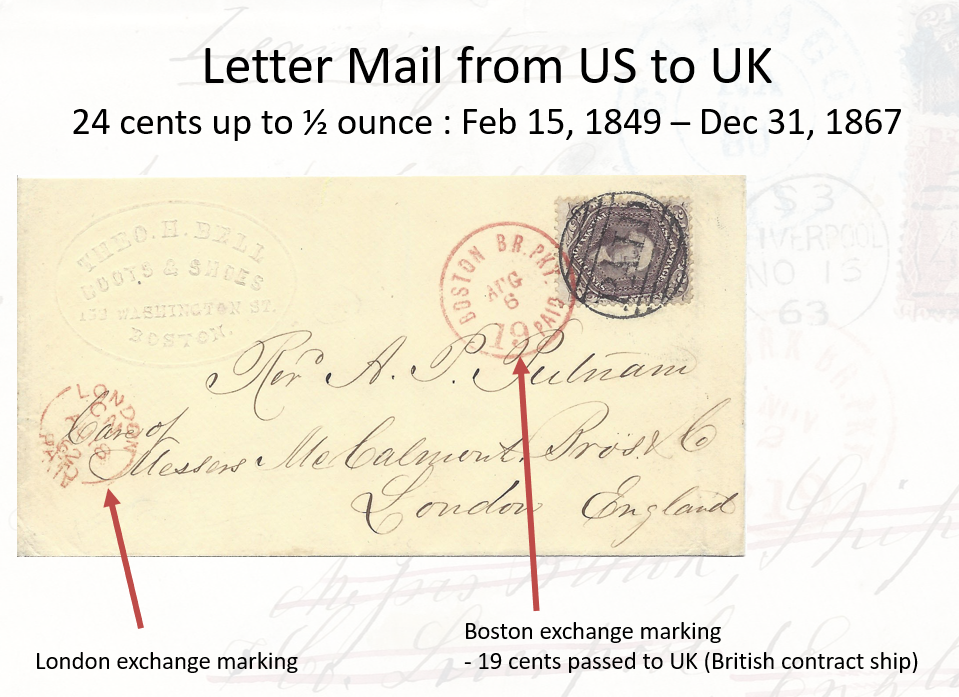
The twenty-four cent stamp was created primarily with the intent and purpose of making it easy for postal customers to pay for a simple letter mailed from anywhere in the United States to anywhere in the United Kingdom (England, Scotland, Ireland, Wales, and even the Channel Islands).  When I speak of a simple letter, I am referring to the lightest weight class for an item that is classified as letter mail.  The simple letter was the cheapest rate a person could mail a letter from point A to point B.  In this case, the cost was 24 cents for a letter that weighed no more than 1/2 ounce.

A letter like this one would enter the mail at a local post office where it would often receive both a CDS (city-date stamp) and a cancellation marking.  The cancellation would deface the postage stamp to prevent someone from using it again.  The cover above originated in Boston and a black cancellation with the word "PAID" in it was used to mark the postage stamp.

If mail was destined for a foreign country, the letter would have to be sent to one of the post offices in the United States that was designated as an exchange post office for letters to the destination country.  It just so happens that Boston was one such exchange office for mail to the United Kingdom.  Other US exchange offices for the United Kingdom included New York, Portland (Maine), Philadelphia, Chicago and Detroit.*

The exchange office would apply an exchange marking that would include an indication as to whether the letter was considered paid and illustrate the amount of the postage that was to be sent to the destination country.  In this case, 19 of the 24 cents were to be passed to the United Kingdom.  Once the marking was applied, the letter was placed in a mailbag for its trip across the Atlantic Ocean.  It would remain there until it arrived at the corresponding exchange office in the UK.  In this case, it would be London.  And, as you can see, the letter was taken out of the bag and the London post office applied their own exchange marking. 

And that, my friends, is a baseline we can work from.  We have an example of a typical letter from 1862 that traveled from the US to the UK.  It is properly paid.  It has a US exchange marking and a UK exchange marking.  It is a basic, "nothing goofy going on here," example.  It gives us a place to work from.

* Baltimore was added later, but it and San Francisco typically only received mail in the exchange office capacity during the 24 cent rate period.


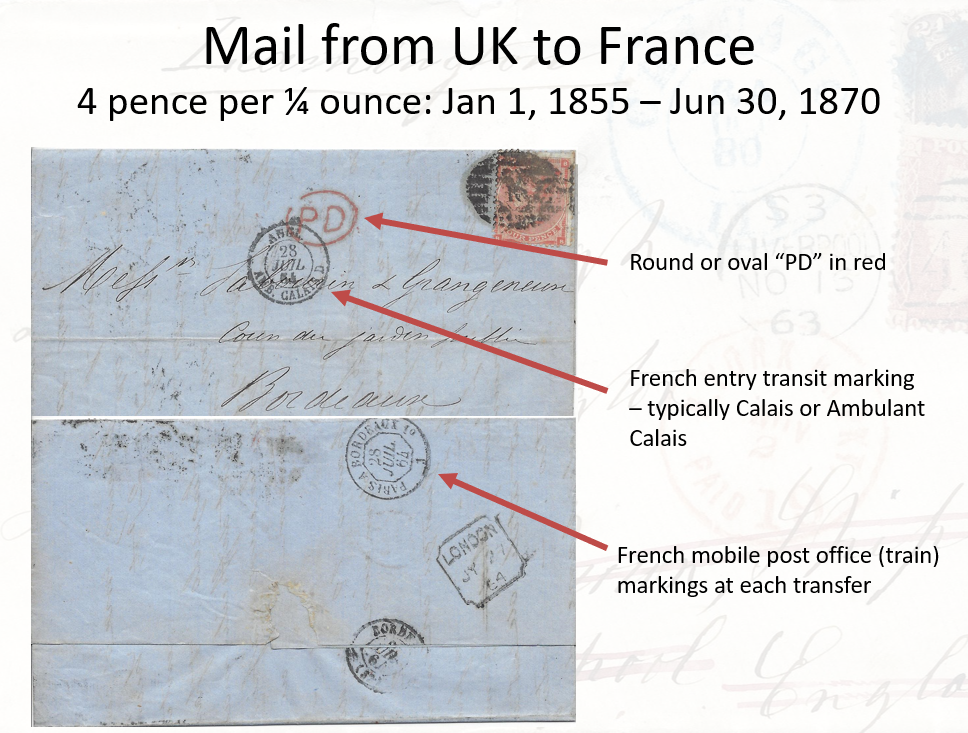
Since we have one baseline to work with, let's take a look at another baseline.  Shown above is a typical letter from the 1860s that originated in the United Kingdom and was sent across the English Channel to France.  A simple letter cost 4 pence and this letter could weigh no more than 1/4 ounce.

The concept of exchange offices still holds for letters between the UK and France.  But, the markings don't look exactly the same as what we saw for the US/UK.  There is still a mechanism to indicate to the receiving country that the postage had been paid.  In this case, it is the red oval with the letters "PD," inside of it.  In English, you could consider it as an abbreviation for Paid to Destination, while the French would be Paye a Destination.*   

The back includes a London marking.  Stephen T indicated to me that the square shape tells us the letter arrived in the London office too late to go on the last mail departure of the day.  This makes sense since the London postmark is dated July 17 and the Calais marking is for the following day.

I guess, on the plus side, this letter got on the earliest boat and earliest scheduled trains the next day!

Most mail between these two countries were carried on contract steamships that traveled to Calais.  Letter bags might be opened at the Calais office, but most were actually opened and processed on the train that traveled between Calais and Paris.  These traveling post offices (or ambulant post offices) would have a marking with the letters "amb" prior to the name (Calais).  

Another thing to take note of here is that the French were particular about where a letter came from.  The letters "Angl" at the top of the entry transit marking indicated that the letter came from the United Kingdom (Angleterre - England).

In France, when a letter boarded a new train, it would typically receive another postmark on the back of the letter.  You can see a French mobile post office marking that reads Paris A Bordeaux.  The ordering of the names on this marking actually provides us with the direction the train was moving (from Paris to Bordeaux).  This makes sense since the letter was ultimately destined for Bordeaux.

And there you go.  Some basics for mail during the 1860s from the United Kingdom to France.  I wonder what we'll do with all of that?

* Apologies for the missing accents.  I'll try to add them at a later date.


What we'll do is use that knowledge to help us figure out this thing! 

The envelope shown above was mailed in the Chicago in 1866.  A 24-cent stamp was applied and properly cancelled.  However, it (and the Chicago postmarks) were mostly covered up by a bunch of stamps from the United Kingdom.  What's up with that?

Well, let's just start by trying to find the BASIC indicators of an item that was mailed from the United States to the United Kingdom.

  • A CDS of the originating post office - Chicago - under the red postage stamps.
  • A 24-cent stamp that pays the postage from the US to the UK
  • A cancellation that defaces that 24-cent stamp (a target shape this time)
  • An exchange mark from a US exchange office (Chicago - 3 Paid)
  • An exchange mark from a UK exchange office (London)

It's all there!  This is, of course, good news.  This tells us that the letter took a normal journey for the time from Chicago to London.  The postage was paid and the letter was treated as paid.

However, the letter did not find James Stewart in London.  The letter was sent care of H&G Rusell* with the knowledge that Stewart was traveling.  H&G Rusell apparently knew that Mr. Stewart had moved on to Paris, so they arranged to forward this letter on to his new location by applying postage and remailing the letter.

* this could be a misspelling.  Another Postal History Sunday may have us exploring this further.

Now we have to take our knowledge we gained from our second cover - the one from the United Kingdom to France - and see if there is evidence on this item that matches up!

Each of the red postage stamps are known as a "penny red," and each represented one penny of postage that was paid.  Since there are four of them, we have four pence in postage paid.  Let's go through the checklist:

  • stamps to pay the 4 pence in postage
  • a postmark (London) and cancellations to deface the stamps
  • an exchange marking for the UK that shows the item is paid (PD in oval)
  • a French entry marking - again the "Ambulant" Calais marking.

Once again, all of the components for a simple letter from the UK to France are there.  The confusion is the fact that we have both the US to UK and the UK to France indicators all smashed together into one cover.  It can feel even more confusing when you add the scribbles that cover the old London address and a second address in Paris at the top left.

You got all that?  

You do?

Good, because I've got another for you!

Here we have another 1866 letter.  But this one was mailed from Boston to London, then forwarded on to Paris.  The good news is that we had a Boston to London letter as an example to start with, so we won't be thrown by the fact that there is no black Boston CDS to go with the black cancellation on the 24-cent stamp.

If I were to cover up all of the extraneous postal markings and show you this cover with only the Boston exchange marking and the London exchange marking, you would agree that this item is very similar to the first one. 

If you look very closely, you'll find a couple of smaller differences.  First, the date of the Boston marking is reversed (Aug 8 and 20 Feb).  The cancellation shapes are certainly different (no PAID in a grid for our new cover).  And, the London exchange mark is bigger and bolder.  But, the components all serve the same purposes. 

This letter was received by the banking firm, the Baring Brothers, in London.  The recipient, General W. F. Bartlett, was traveling in Europe and the Baring Brothers were providing financial services for his travels.  Often, firms such as the Baring Brothers would also provide the service of forwarding the mail to the recipients next location - often sending it to another financial agent.  In this case, John Munroe and Company in Paris.

This time, the letter was forwarded, but the postage was paid in cash, not postage stamps.  A big, red "4" indicates the amount paid (four pence), which was the proper postage rate for a simple letter from the UK to France.

Once again, everything is there that we expect to be there.

As you can guess, this particular item has even more to its story, so I am going to send you to a couple of other Postal History Sundays if you are inclined to read more.

They Went Thataway - if you would like a highly detailed look at this cover, this Postal History has that and more.  You can even learn a bit about John Munroe & Co and General Bartlett.  Sounds like a winner to me!

There and Back Again - this one features a letter that went from the US to the UK and then came BACK to the US.  You can also learn a little bit more about the Baring Brothers in that Postal History Sunday.

Wow!  This has been quite a day for Postal History Sunday.  Not only do you get a preview for a virtual presentation, you get direct bridges to not one, but TWO other Postal History Sundays from 2021 - just old enough that you might have forgotten about them!  Or, perhaps you've never seen them before.  Even better!

Thank you for joining me today.  I hope you have a fine remainder of your day and a wonderful week to come!

Saturday, February 4, 2023

Stopping the Illegal Flower Trade


I have a friend who lives in a state where the flower industry has pushed forward legislation that requires anyone growing flowers for resale must acquire all of the appropriate licenses.  And, as is often the case when regulation is introduced, there will be people that seek to circumnavigate the rules.  As a matter of fact, the "black market" trade of flowers in their state has become a booming business.

Now, it just happens that my friend owns some land, but does not live on that land.  They typically visit the property to fish at the small pond and walk in the woods that are well back from the road.

One day in early May, they went to drop a line in the water for a while.  As they walked through the woods to get to the pond, they came across a greenhouse and a small shed that had NOT been there in November, the time of their last visit.  Much to their surprise, a couple of monks exited the greenhouse carrying arms full of cut flowers toward the shed.

Now, you might ask how my friend knew these were monks, and that would be a fair question.  Apparently, these individuals were members of an order that still wore cowls (hooded cloaks) as part of the daily uniform.  Or, maybe they were just people who dressed like monks.  But, the encounter soon confirmed the suspicion that they were holy men affiliated with a church.

Of course, my friend was astonished and a bit angered.  The monks were confronted and a demand was made that they remove themselves from the property.  Unfortunately, the monks quietly, but firmly claimed that they had been given a sign from God that this particular place was where they should grow flowers to raise money for their holy works.  It didn't seem to matter how my friend approached the subject, there didn't seem to be a way where they could be persuaded to leave.

My friend called the church and got nowhere with them.  They tried logic, they tried bargaining, and they even tried threats.  There was just no getting the holy men to leave the woods on his land.

Finally, a call was made to the sheriff of the county.  Hugh Johnson had been sheriff for almost thirty years and was well-respected throughout the area.  Sheriff Hugh Johnson was known to be fair, but firm, when the situation called for it.  And, it just so happened that the sheriff played in a band with my friend's uncle on the weekend, so it wasn't too hard to ask for the favor of a visit to the forested area where the monks grew their illicit flowers.  

All it took was one visit from Sheriff Hugh and the problem was solved.  The monks took down their greenhouse and shed, and their flower operation was dismantled in a matter of hours.

Of course, you know why.

Hugh, and only Hugh, can prevent florist friars.  

....

You're welcome.  Have a fine weekend.

Friday, February 3, 2023

We Don't Got the Beets - Faux Real Story


In the world before Rob worked full-time on the farm and the Genuine Faux Farm tried to have produce for as many as 120 families every week of the growing season, Tammy and I did not think about beets.  Or, maybe more accurately, neither of us felt terribly compelled to consider growing them.

Neither of us had grown up with much affinity for this root crop.  I suspect Tammy might have been cautiously neutral as far as they were concerned, but I was decidedly ANTI-beet.  In other words, I was perfectly fine with NOT "having the beet(s)" and I was content with not growing beets as part of our crop list.  I mean... I was already growing carrots.  I was (and still am) very anti-carrot when it comes to my own diet.  So, I wasn't ready to add insult to injury.

Beets are fairly divisive - people are split about half and half when it comes to liking or disliking them.  On the other hand, most people are happy to purchase carrots or receive them as part of farm shares.  So I relented and we grew them for Tammy and our customer base.  I was, and am, most likely among a minority of people that just can't find a way to swallow them.  My aversion is enough that my college friends would ask me to get the mixed vegetables so they could watch me efficiently sort out all of those little square carrot pieces and deftly eat the rest of the veggies in the mix.

But, as we looked at our growing plan for a rapidly expanding CSA (farm share) program, we realized that we would have to add some crops that weren't our favorites so we could expand the variety and use the diversity to provide on-farm crop insurance.  So, we added beets to the grow list.  

Philosophically, I was okay with it.  After all, if I was not interested in eating them, then I would be perfectly happy to hand them over to customers with NO regrets.  Right?

We started with a nice seventy-foot long bed of your typical red beets.  I don't even remember the variety we planted that year.  True to form, the veggie that Rob was not looking forward to eating took off.  Germination was excellent.  The growth rate was good.  And, with beginner's luck, we even got the timing and spacing right for this new (to us) crop.

While I say that I was not fond of eating beets, there is another truth that goes along with it.  I like growing green things.  And, when something I plant does well, it makes me happy.  These beets were doing very well and I actually enjoyed walking by that row, anticipating the day that I would pull them and present them to our customers.  I watched as the roots swelled at the surface of the soil and I marked the harvest week in the delivery plan.  Suddenly, the experimental crop was something I was PLANNING on.  It was going to be a key part of this particular delivery.


Before I go much further with the story, there are a couple of additional things you might need to know.  First, we have grown beets successfully for many years since this Faux Real Story occurred.  The picture above illustrates both carrots and beets side by side in Eden (our smaller high tunnel).  Both are looking pretty happy.  And, if I recall, that harvest was pretty darned good.  

We also explored many different varieties of beets and discovered, much to our surprise, that both of us liked the taste of Chioggia and Touchstone Gold beets.  We can even tolerate the red beets when they are roasted.  So, while I still don't like carrots, the same thing can't be said about beets.

And finally, I would like to remind you how we, as humans, can go into "auto-pilot" mode when we are in familiar territory.  Your brain picks up subtle clues about what you are doing and where you are going without really thinking about it.  You turn at the correct street corner.  You open the appropriate cupboard.  You know which side to turn to get toilet paper when you're sitting in the bathroom.

You stop right here for the beet row....

Ahem...

You stop RIGHT HERE for the beet row....

Um...

Where are the beets?

The day of harvest had arrived and I strode purposefully out to the field where I knew that beautiful row of ripe and ready beets were waiting for my attention.  I had the containers ready to go and I walked down the path without really thinking much about where I was going.

Hello cucumbers.  Hello snow peas.  Ah, the summer squash and zucchini are looking pretty good.  

After a moment, I hesitated and stumbled to a stop.  My brain recognized that I had taken too many steps and that I had walked past the beet row.

So I took several steps backward.

Then I retraced those steps forward.

Backwards again.  Forwards again.

I was absolutely certain this is WHERE I had planted those beets.  I was so dumbfounded that I actually put down the harvest containers and I walked the entire plot and looked at each row.  Everything was as I remembered it.  Except for the beets.

I trudged back to the farmhouse and found Tammy and asked her if she had harvested the beets.  Once I got a reply to the negative I walked back to the spot where I was certain beets had been present just 24 hours before.

That's when I saw it.  Regular indentations in the ground that were just the right size for each round beet root.  Next to those indentations were imprints in the soil that matched the cloven hooves of the small herd of deer that must have found our beet smorgasbord during the night-time hours.  The only other evidence that beets had been growing there was one sad and lonely bunch of wilted beet leaves.

So I had to tell all of our CSA customers that "we don't got the beets."

Now our fate was sealed.  We were doomed to grow beets again.  Because the surest way to get farmers, like ourselves, to dedicate themselves to a particular crop is to take a harvest away as close to its completion as you can get.

And, as they say, the rest is history.  Have a great remainder of your day.

Thursday, February 2, 2023

Encouragement for the Future


I remember a day a few years ago when I was feeling pretty down about life at the Genuine Faux Farm. This, in itself, is nothing new. Things don't always work out and you begin to question what you are doing and how you are doing it. You wonder if your efforts make a difference. And, when it comes to something that can be as all-encompassing as working on a small, diversified farm to grow food for people, the roller-coaster ride can be pretty dramatic and can wear on a person.

On this particular day, I found myself alone on the farm.  I was feeling the pressure as we were dealing with pesticides from neighboring farms and heavy rains — and we had limited resources to address these and a myriad of other issues and tasks that the farm required of us.

I will admit that there are times when I talk to myself when I work on the farm.  And, I have been heard to mutter, "Why in the world am I doing this?"

This time around, things were really getting to me, so I voiced those words a bit more forcefully than I usually do.  And, I will admit that there might even have been some profanity laced in there.  I was struggling with the situation THAT much.

Why... in ... the ... world... am I doing this?!?

At that moment, a Tiger Swallowtail butterfly floated over my shoulder and proceeded to land on the clover that was flowering at my feet.  It sat there for a second or two and then flew on.  

All I could say at that point was a very quiet, “ah, okay.”

Fast forward to 2023, and we find the farmer is farming a little less and writing a lot more.  I am still prone to those moments of asking "why am I doing this?"  I suspect the question will always be under the surface, especially when things are not going well.  But now, when I ask, I recall the mental image of a Tiger Swallowtail on the clover at my feet.

I recently shared that story with my co-worker, Lorilani, who is PAN's Organizer for Hawai'i.  She informed me this is known as hōailona in Native Hawaiian culture — a sign from the Universe, from the Elements — from something bigger than we are.

The difficulty with omens or signs is that we are always so ready to make them fit what we want instead of really listening and contemplating what they were MEANT to be.  And, if they aren't something we want, we tend to ignore them for what they are.

Is it possible that we are provided with signs on a daily basis that tell us things we often don't want to hear?

The oak tree leaves throughout Iowa have been showing more damage earlier in the season over the past decade than they have in prior decades.  It's a sign that the environment they reside in is no longer as friendly as it once was.  And, we know one of the causes is the amounts and types of pesticides used so freely on our land.  But, this is a sign we prefer to ignore, either because it inconveniences us or it reminds us that we are complicit in the destruction of trees many of us cherish.

A drive in the country no longer results in a windshield covered in juicy insects of all sorts.  This is another sign that the world around us is becoming less hospitable to life.  But, once again, this is easy to discount – especially if you don't particularly like "bugs" and you aren't  fond of cleaning windshields.  Never mind that it tells us a story of diminished diversity and vitality amongst the invertebrates in our world.

We like our signs and omens when they comfort us or when they reassure us – like a Tiger Swallowtail on the clover.  “It's okay, Rob, I know you're doing your best to do the right thing on your farm to support the natural world and still grow good food.”  That's a beautiful story and a nice sentiment.  But, I can't let my distress that things could go wrong stop me from seeing foreboding images and doing what I can to address the problems they speak of.  I don't want the vision of a swallowtail to become a butterfly's farewell to someone who meant well.  Instead, I want this vision to return and manifest itself every season at the Genuine Faux Farm and everywhere else the clover blooms. 

The calendar has turned to a new year.  My work at PAN with my co-workers and our partners are ready to put in the effort to build a better, healthier, and more equitable food and farming system.  But, we all must take a deep breath to prepare for the months to come.  We see the signs and omens that foretell a difficult future if we do not make changes.  But, we also see the swallowtail on the clover that is the vision we firmly believe we can make a reality.

We (you and I) just need to walk that way together.

Wednesday, February 1, 2023

Moalepe - Walk There Again

The Moalepe Trail on Kauai was the choice of our next walk after the Iliau Nature Loop because it was likely to be drier and flatter than some of our other choices after some serious rainfall.  We wanted to extend our stamina a bit and hoped to be able to complete the five mile total, in and back, walk.  Our estimation as to how much effort walking on the often slippery trail (we said it was drier, not perfectly dry) was off and we made it to the 2 mile point and had to settle for a four-mile round trip. 

It was a bitter pill for Tammy to swallow, but it was still a good decision because the last half mile was a bit of a struggle for both of us.  Tammy had to fight the last bit because there is still recovery going on.  Me? I hadn't been moving around as much as I would like to prior to our trip and I was invested in Tammy having consistent success in these walks.  As a result, I probably expended a good bit more energy that had less to do with my own forward progress. 

Still, it WAS a success.  We got back to the starting point and then recovered fairly quickly after!

If a person is on a Kauai hike for dramatic overlooks, then this one is not going to fit the bill until the very end (which we did not quite get to) as it connects with the Kuilau Ridge Trail.  But, there is still lots to take notice of as you go.

My eyes were drawn to a fairly wide range of flowers that were right up by the edge of the trail.  Now, before you get the mistaken opinion that it was a carpet of color every step of the way, let me remind you that many plants, especially perennials in a long-season environment, like to extend their bloom season and opportunity to be pollinated.

So, there were plenty of flowers, but you had to pay some attention to really appreciate them.  Some of them were pretty small, like this little yellow flower with a dash of red.  On the whole stem of this plant there were multiple buds, but only one was open.

Extended bloom time - that's the ticket.  

The picture above is a Sensitive Partridge Pea.  I found it interesting that there was actually a study of the presence of this legume-type plant to see if it facilitated the increase of invasive grasses.  If the abstract is any indication, there could be a link based on the increased nitrogen from cyclic die-offs of the Sensitive Partridge Pea plants.  

It does not appear that there is a direct correlation.  Maybe I'll dig into that paper some time in the future if my curiosity takes me there.  After all, the abstract tells me that increased nitrogen favors the invasive grass AND the cyclic die-off of the Partridge Pea adds nitrogen.  So, yeah, maybe it helps IF other conditions are also right to introduce the invasive plant.  Still could be a good case study as to how we like to take a study that gives us some information and perhaps leads us to extrapolate to get it to say something more than the collected data should be allowed to say.

Parts of the trail were nicely shaded, like this tree/bush tunnel that invited us to cool down a bit on our walk.  Other parts of the trail were sun-drenched.  And, since the path was surrounded in many places by mounds of soil covered in grasses, there wasn't much for air circulation.  Those places were a bit oppressive and things got warm enough to be slightly uncomfortable.  This was especially true for Tammy, who still had to expend more energy to walk on uneven surfaces than she might have prior to the surgery.  

For those that are curious, the first three quarters of a mile or so has abutting pasture land and is what is left of Old Moalepe Road.  The raised soil sides may be, in part, a natural fence as well as the result of this path becoming a channel for shedding rain water, the erosion continuously making the trench that is the path a bit deeper year after year.


We had some lizard friends that typically scurried away before our human eyes could focus enough to get a good look at them.  Usually there was a quick movement that might catch the corner of your eye and a rustling noise as the critter would seek shelter from the interlopers.

Like much of the plant and wildlife on the island, this is an introduced species, the Brown Anole (if my identification is correct).  The Brown Anole originated in the Caribbean and has spread to parts of the United States, Mexico and the Hawaiian Islands via eggs in dirt around nursery plants.  In Kauai's case, they probably came with shipments to the various resorts on the island.

Unfortunately, the Brown Anole is so successful at reproducing, they rapidly out-compete most native lizards wherever they go.  According to this article, it might be interesting to see if they run into a formidable opponent in another invasive lizard, the Gold Dust Gecko, on Kauai.

It didn't seem to matter, there were hints of lizards (probably anole or gecko) in both shaded and grassy locations.  It's just another indication that these animals are capable of adapting and being successful in a wide range of conditions.

There were also several types of ferns among the plants.  Some varieties provided an interesting display on the sides of the path, while others stayed further back so we could only see them periodically in the shadier locations as we walked by.  


Periodically, we would come across orchid plants in bloom as we walked the trail.  Shown above is a Bamboo Orchid, one of two different orchids that were fairly prominent on this walk.  

Yes, these are also an introduced plant.  At a guess, the native orchids on the island are probably less able to handle human developmental influences and are likely to only be found in the deeper parts of the rain forests.  All three native orchids in Hawaii were found on Kauai in recent years according to this 2012 article.

Another orchid was a bit more plentiful on the trail, and there were many of them in an area we nickname "Morchid Vale."  Yes, there were more orchids - hence "morchid."  And yes, there is a Tolkien reference there as well.  We both agreed that Morchid Vale was much more pleasant than the fantasy vale being referenced in our silliness.

The orchid that really showed off in this area is a Philippine Ground Orchid.  We both made note of the fact that the leaves for this orchid were much bigger (and there appeared to be more, but smaller flowers on a stalk) than the Bamboo Orchid.  The Bamboo Orchid, by contrast had fewer and smaller leaves, and just a few, larger, showy flowers.

We all put our energies into what we feel makes the most sense for our own realities, I guess.


Then there was the Eucalyptipath...  Ok, it was a row of Eucalyptus trees (with a few other trees mixed in).  After a stretch of sun that made us both feel a little bit uncomfortable, the shade from the trees was welcome.  And, to top it off, we had a bit of a breeze moving the leaves around.

I think the only thing about this part of the path that was a negative was the sheer number of roots IN the path.  I would have liked to have walked with my head up, smiling the whole way, to enjoy the sight of the filtered sunlight and the feel of the breeze on my face.  Instead, we had to keep our eyes on our feet most of the time so our faces did not get a close up of the ground and those same roots.

On one end or the other of the Eucalyptipath, there was this interesting tree that Tammy instantly took a liking to.  We think this would be a Pu hala (Pandanus tectorius), which is a type of screw pine that can have pineapple-like flowers.  

We made sure to greet it as we went about our business.

We ran into a part of the path where there were some very, very large trees that we have met before in years past.  We feel as if the largest trees near a path deserve recognition and we do our best to give it to them.  If they are close enough for us to put a hand on them and let them know they are appreciated, we often will do so.

We saw a batch of tulip trees in a lower section of woods near our walk.  At first glance, I enjoyed seeing the splash of color.  And, there appeared to be some birds that appreciated the tree(s) as well.  But, it turns out that the African Tulip Tree is a dangerous invasive plant that was introduced by people who wanted to add it to their own gardens.

People who travel to and from Hawaii can often be heard complaining about all of the restrictions on bringing plant products to and from the Islands.  But, it seems there needs to be more, not less, control if there is a true desire to protect the native flora and fauna on Kauai.  

Maybe that's a blog for another day.

At our turnaround point, where we recognized that we were not going to reach the end of the trail at the bridge that crosses the Opaeka'a Stream, we found an interesting patch of moss on a fallen limb that I thought was pretty cool.

It was soft to the touch and was interesting to view.  Then, we commenced the trek back - concentrating more on walking carefully and properly so we could get back on another trail in another day or two.  And we did accomplish that goal.  You'll just have to wait until next Wednesday when I share another Walk There Again blog post!

I hope you have a fine day.  Remember to spread a little kindness, tell another person that you appreciate something specific that they have done!