Friday, February 17, 2023

Knee Deep - Faux Real Story


The Genuine Faux Farm has beautiful, healthy soil.  But, that soil is pretty heavy and it takes quite a while for it to dry out.  That means our easiest farming years are typically those where we get average to slightly below average rainfall.  On top of that, our farm is pretty flat - so if we get excessive rain it doesn't go anywhere - it just stays until it either evaporates or seeps into the ground.

Don't get me wrong.  I feel that our soil health has improved over the years and I believe that it is a good thing to have water naturally filtering through the soil (and eventually into the ground water).  The difficulty has been that the number of exceptional rainfall periods have been much more numerous since we scaled up our farm in 2007 than they were for all recorded weather in our area up to that point.

If we were growing crops that grew all summer and then got harvested once in the fall, that would be one thing.  But, when you grow a wide range of vegetables and you market them on a weekly basis, you are forced to get out there - even when things are damp.

Oh, what am I saying? We have to get out there even when you might need to take out your snorkel gear to get from here to there.  It doesn't matter whether it was sort of wet or extremely wet, we still had work to do.

The good news is that we maintain permanent grass/clover paths throughout the farm, so we can get from plot to plot most of the time.  Though there have been times where we've had so much continuous rain that this is actually in question.

Several years ago we had a heavy rainfall in August during the morning of a CSA (farm share) delivery day.  We had already harvested most of the produce, but there was more to do before we could say we were ready.  The bell peppers needed harvesting and they were on the schedule to be a featured item.  

Denis was working on the farm with us at that time, so I asked him to come out to the pepper field with me.  We grabbed some harvest totes and squelched our way to the field.  The plan was that I would harvest and Denis would remain on the grass path to catch whatever I tossed his way.  I had the foresight to take my shoes and socks off before stepping off the path and almost immediately sank up to mid-calf in the mud.  (hmmm I wonder why I actually thought of that?)

Now, before some readers might react with disapproval that I was doing bad things to my soil, let me remind you that this is MY story and not yours.  Also, I was planning on keeping the traffic to the minimum.  We had a commitment to fulfill, but I was going to meet it with the least damage possible.

Things got a little crazy as I picked each, beautiful bell pepper and tossed it to Denis, who waited patiently (and gave periodic encouragement).  We kept a careful count so we would know when to stop -and only had to subtract a pepper a couple of times when the throw and catch didn't quite happen as planned.  At one point, I sank up to my knee.  But, once I got past the first few steps, it was actually kind of fun.  I got to do my job and play in the mud.  How many of you can say that?

So... I told you that story so I could tell you this one.  

Our watermelons went into the ground late the previous year, which meant they weren't ready to harvest until September.  So, of course, two things happened.  We had an early frost AND we had a wet Fall.

Things were on the dry side when the frost came, so I used the technique of running an overhead sprinkler over the watermelon rows to keep them from freezing.  We needed a little more time to get them harvested.  But, then I didn't have time the next day, or the next day.... or...

Well, you get the idea.  For the next few days I couldn't harvest and then the rains came.  This wouldn't have been a big deal EXCEPT I had run overhead irrigation on the patch where the watermelons waited for me to harvest them.  This area was already wet - and the rainfall made it wetter.

And then the forecast called for more rain and colder temperatures which meant I had no choice.  I had to harvest in the mud.

The first task was to simply get the watermelons out of the patch and onto the pathways.  So, in I went, picking up as many watermelons as I could each time.

For those of you who have picked up one 15 to 20 pound watermelon, you might be able to picture what it might be like to pick up one and then pick up a second one.  One cradled in each arm.  After taking two out at a time, I realized how much work this was going to be.  Each step had me sinking up to my calf muscles in cold mud - and it was starting to rain some more.

There wasn't an option to toss watermelons to someone on the path, so I tried picking up three at a time.  That was sort of do-able, so I tried four.  

So, let me remind you again.  It was wet.  The watermelons were slippery.  

As soon as I would manage to get that fourth watermelon into my arms another one (or two) would slip out of my grasp.  Sometimes, they would slip out when I tried to do a third watermelon.  The word "frustrating" might not quite cover how I felt at the time.  After one particularly nice watermelon slipped, fell and split open, I resigned myself to the slow slog with two or three watermelons each trip.

The mud and water filled my boots and my feet were cold, muddy and wet.  I was cold, muddy and wet.  The watermelons were cold, muddy and wet.  But, I kept my head down, looking for the next watermelon to harvest.  That's when I walked by an odd lump of mud that was shaped a bit like a foot.

That got my attention.

I looked down at my own feet.  They were both big globs of mud that vaguely reassured me that, even though I couldn't feel them very well any more, I still had TWO of them.  That was a relief, but one of those feet was suspiciously smaller than the other.

To this day, I do not know exactly when the boot came off my foot and I have no idea how long I was trudging around with only one boot and with the other foot clad in a sock that was now halfway off of the foot.

The good news, if there was any, is that I learned some lessons AND I got a story out of it.  

And I still have both feet.

Thursday, February 16, 2023

Revisiting Little Things

Sometimes, when I consider a "throwback" post, I am just looking to identify a really good blog post and share it again. Other times, I want to make a decent post better and I do some re-writing.  Then, there are the times, like this one, where I just want to revisit the topic.  That means I might take some of an old post, or none of an old post, but some of the ideas.

Motivations for today's post comes from the moment in time when I decided the rainfall on the car windshield was interesting - so I took a picture of it.

An assigned story that got the brain started

I remember being assigned a short story to read in 9th grade that comes back to visit my brain every so often.  I have no recollection of the title or the author, but I remember the premise.

We follow an individual through a day where they are feeling good and take pleasures in small things, like the feel of feet on the sidewalk on a sunny, pleasant day.  They take advantage of various opportunities to do something nice for others.  Of course, it was nice enough to read, but I was wondering what the point of it was until we arrived at this person's home and they compare notes with their partner.

The partner had taken the opposite approach, taking pleasure in the fact that they probably got someone fired (among other things).  And, the story ends where they agree to switch roles tomorrow....

Let's just say I had some problems with that whole premise.  But, I suspect that was the whole point.


Permission to enjoy the simple or mundane

Aside from the shock value of two people deciding to take turns as to which person gets to play at being nice or not so nice, I actually prefer to think more about the story before the 'big reveal.'   The main character takes notice of and appreciates a series of things that may not seem like that much of a big deal - and it seems to improve this person's happiness.

How often do you (and I) tell ourselves that it is absurd to be pleased with something because it is too simple, too easy, or just not really all that important?  

We probably do this at least as often as we let something small irritate us and make us unhappy.

I tell you what - I hereby grant myself AND you permission to truly enjoy the little things too so we can offset all of the molehills we turn into mountains when we're not happy with what is going on.

For example, I gave myself permission to attempt to take new pictures of Murphy the Nibster yesterday.  Of course, Murphy is a kitten.  And, as such, Murphy is NOT interested in providing photo-ops for the farmer.  I suppose I could have gotten annoyed that I couldn't get the photo I wanted.  Instead, I just enjoyed trying to get ANY picture that was in focus that featured our active feline friend. 

Simply put, I found it amusing.  And my best picture is shown above.... which amuses me even further. 

Some little things I enjoy

I was tempted to title this section "stupid little things," but thought better of it.  Why?  Because, if I do that, I am still not giving myself permission to actually enjoy them without apology.  There is no reason to apologize here!  We can just let ourselves be happy with some little things.  

Don't make it more complicated.  Don't worry about what anyone else thinks.

I gave myself permission during the morning chores on Wednesday to haul the camera out with me and just see what I found.  I am sure some of the photos will cause people to wonder why I would bother -and that doesn't matter.

It was a little thing that made me happy.

Tammy and I got out of the habit of playing a board game nearly every day once we returned from Kauai in early January.  The reasons why don't matter.  What does matter is that we got back into doing this.  Of course, it would be Wingspan that would get our attention first.  The important thing is that we make this time for each other on a regular basis.

Maybe that's a good bit more than a little thing.

Once again, we potted up some geraniums this fall and put them in the living room window.  And, once again, the plants are very healthy and very happy - and the blooms are coming.   It's a little thing, but it makes us happy.

The new speakers still fill the room around me as I work for PAN most days.  I am discovering and rediscovering music.  Sometimes, I let it distract me from that work.  Maybe I let it distract me too often.  But, the happiness I get from good music puts me in the mood to do better (and more) work.  Who says little things can't lead to bigger things?

Tammy brought me a little decorated wood block some time ago that says "What I love about my home is who I share it with."  It sits to the right of my computer screen and I make sure it doesn't get covered by the flood of papers and other stuff that covers my desk area.

Why?  Because it makes me happy to read that she feels this way.

Someone else took the time to tell me they appreciated Postal History Sundays.  Another let me know that some words I wrote meant something to them.  A friend called me because they hadn't heard from me and was concerned about that.  Another asked for my input on something they were doing.   Someone else said that I had done a good job on something.  Another allowed me to explain what was worrying me without putting words in my mouth or interruption.

These things made me feel valued.  Maybe they didn't seem like much, but that's only true if you don't recognize them and acknowledge that they do matter.

I am reminding myself to take these positives and give them all FULL VALUE.  No apologies for the fact that they might not be a "big deal" and I am certainly not sorry to say that each of them made me feel good. 

The little things are going to help us get through the big things.  What little things have made you happy lately?

Have a great Thursday!

Wednesday, February 15, 2023

Achievement Unlocked - Walk There Again


As Tammy and I planned our walks for this trip to the island of Kauai, we carefully considered how much the repaired Achilles and all of the OTHER muscles, tendons, joints and bones required to hike could take.  We both agreed that the Kuilau Ridge Trail was a reasonable and realistic goal and we would be disappointed if we did not manage it.  The Canyon Trail and the hike to the top of Waipo'o Falls, on the other hand, was purely aspirational.  

In fact, I was a little hesitant to suggest it at first - and I believe I didn't.  I think Tammy suggested it.  So we gave it a go after having several other successful walks.

So, the foot makes another appearance at a new location post-surgery.  We actually had to start by walking a 4-wheel drive road to the trail head for the Canyon Trail.  This road has a reasonably steep grade and is not a perfectly smooth surface.  So, walking it was a non-trivial exercise to begin with.  

Don't get me wrong, hikers with some experience are going to say it's no big deal.  And, as long as you pay attention to where you are going AND remember that the downward slope becomes an upward slope when you return - all will be well.

Every so often, a four-wheel drive vehicle might pass as you trudge down (or up) the road.  We saw a two-wheel drive going down as well.  Sure, you CAN do it if you're really careful, it isn't too wet AND you're kind of lucky.  But, you really shouldn't - just think of the poor folks who have to get you OUT of there if you do get stuck.  

On the return up the road we met a couple where the guy grumbled that they should have driven down to the trail head and said something along the lines of "I don't care about the car, it's only a rental."  

Yeah.  Maybe we'll talk about that in another blog someday.  But, today is NOT that day!  Today, we talk about SUCCESSES!

There were lots of Koa trees on this walk.  I think I mentioned them in the post about the Iliau walk, where there were some smaller specimens.  On this walk, there were numerous, larger Koas - some of which were leaning significantly due to one storm or another.

I am pleased that I became more in tune with recognizing and appreciating Koas each time we went by them.  This part of Koke'e and Waimea Canyon has plenty of them, which I found pleasing and somewhat reassuring for a whole host of reasons.  One of them is the idea that Koa trees have a long history in (and of) this place and it is in their interest to serve as tree guardians here.

As we walked down the road, I found a flower preparing to open.  There was another open flower, further back from the road, so I opted to take a picture of this one.  

It turns out this is a bloom of the Glory Bush, which is considered a concerning invasive species in this area.  That's yet ANOTHER topic I can talk about in a blog.  But, for the purposes of this blog and walk, this bloom actually has a positive purpose.  

Here it suggests that something beautiful is in our future.  And it was actually important at this early stage because Tammy was already second-guessing the decision.  You see, we've walked this trail in the past and she was already very worried about some of the steeper portions on the trail itself.

Since we were staying on the West-side of Kauai, it was easier for us to get an early start into the Waimea Canyon.  We were the first to park in the area where the main Koke'e road meets with this road to the Canyon Trail.  The sun was still lighting the world around us at a fairly steep angle, giving the camera person (me) something to play with once in a while.

Broad leaves were covered in dew drops and there was actually steam rising from some of the low growing plants near the main road when we started.  It wasn't terribly cool (low 60s) but we could see our own breath as we walked.

Speaking of walking.  There is a reason this trail was aspirational rather than a practical goal.  Like most Kauai natural trails, there are obstacles that require attention.  There are rocks embedded in the hard-packed, red earth.  That earth itself could often be damp, making it a slipping hazard.

And there are roots that are exposed throughout the trail itself.  They weren't an issue on the road portion (of course), but once you reach the trail, it's a common hazard.

But, as I said before, most of the Kauai trails have these hazards.  Which means we had already accomplished handling them.  

As Tammy is demonstrating at a later point in the hike, there is some climbing to do (both up AND down).  I wasn't able to take a picture that really illustrated that issue for the wooded portion of the trail. In those areas, you have rocks, roots, slippery surfaces AND some decent steps up and down.  That meant there was a fair amount of starting, stopping, and assists from Tammy's hiking partner (me).

For all of you folks who have healthy Achilles tendons, even you might feel some of this workout.  Now consider that Tammy had hers reattached about six months prior to this hike. She has had to re-teach herself how to walk and use her legs.  I am not entirely sure I can impress upon you how difficult this was and how proud I am of her determination and effort - all while being very aware of her limits so we would know if we had to return before reaching the ultimate goal.  In fact, reaching the goal was in doubt several times along the trail.

Getting back to the walk.  We have found that the sky at the Waimea Canyon can be a very deep blue earlier in the day.  Of course, it was NOT nearly so early once we got to the ridge that leads to the Waipo'o Falls (shown above).  But, it was still early enough that the facing ridge was in shadow - which means Rob could get some pictures of the deep-blue Kauai skies.

So, I talked a little bit about Tammy's Achilles challenges.  Let's now talk about the challenge I had to deal with.  

I am not terribly fond of heights.

Yep.  That's a long ways down.

If you want that perspective, you can read this slightly whimsical version of this hike in 2013 where little birds and goats mocked me as we took this walk.

Let's just say that I can understand how this rock and tree, apparently best buddies, can appreciate the views of the canyons from some great seats.  But, I am not certain I could handle the stress of being that close to the edge.

At least the sky is a nice blue.

Once we got to this point, we stopped in some shade and sat on a nice rock that had situated itself FURTHER form the edge (thankyouverymuch).  We both agreed that Tammy had reached her goal (and possibly her limit) at this point and perhaps she would wait here while Rob went ahead and got a few pictures to share with her.

So, I hiked down the ridge to an interior trail that leads to this little waterfall that fills a shallow pool.  

The good news is, I've done this hike before, so I knew what to expect as far as the trail was concerned.  The first time around, I didn't know where we had to go, so there was a fear that you'd take a wrong turn and experience gravitational acceleration in an up-close and personal way.  But, even knowing where I was going, there was still a little bit of "eek" going on in the brain.

I got to the waterfall.  Looked back.

And there was Tammy!  She informed me that it would be a shame to have come as far as she did without getting to this point.  

Ok then.

So, we took the other spur that leads to the main drop of the Waipo'o Falls.  The climb down to this was going to be too much, so you'll just have to settle with this picture.

We did good, we did.

We climbed back up to the ridge after enjoying the falls for a while and rested in the shade again.  

And, we took a picture of the foot.  Good job foot!

For those who are not familiar, this is Waipo'o Falls in all 800 feet (or so) of its glory.  We walked the ridge that is to the left of the falls and stood just above that first drop that is visible from this viewpoint on the other side of Waimea Canyon.

And then we walked back. It took us about three and half hours to complete both directions.  Yes, we were slower than most hikers and we stepped aside to let people pass many times.  But, speed wasn't the point.  Safety and proper care while stretching what we could do WAS the point.

That, and we love the canyon.  That's a pretty good reason for doing it too.

As we walked back out, we made sure to pay homage to some of the giant evergreen trees that are at the side of the road when things even out.  I am not sure what these trees are, but they can make a person feel pretty small.  Tammy is about even with them in this picture.

And then, as I walked up the road with Tammy, I noticed our little friend, the Glory Bush.

Invasive or not.  It was pretty.  And it was an appropriate summation of this trip.  We had the promise of potential success and ended up achieving it.

Achievement Unlocked - Canyon Trail at the Waimea Canyon to Waipo'o Falls.

Monday, February 13, 2023

Keep Eyes Open for Moments of Awe and Wonder


This is one of the times of year where we have the opportunity to see some of the most amazing color displays in our skies as the sun comes up and when the sun goes down each day.  Tammy and I are fortunate to live in a place where we have mostly unobstructed views if we wish to observe sunrise or sunset.  So, it should not be a surprise that a common exclamation to be heard at the Genuine Faux Farm is "Oooooh!  Look at that sunset!"  And, yes, you can substitute sunrise in that statement if it is morning.

Both of us agree that if we could capture some of these colors, we would love to paint them on the interior walls of the house.  But, we don't (and likely won't) do that because there really is no way to catch the complexity of it all.  Any approximation supplied by paints would be a pale shadow that would not inspire - unless it were to inspire us to pick a new color to cover our failed attempt back up.

On this particular morning, the sunrise was one that started inauspiciously.  It didn't look like it was going to be one of the more outstanding shows.  Suddenly, the interest level went up as things changed over a period of five minutes.  It was enough to get me outside with the camera sans coat, glove and (believe it or not) hat.

I was able to grab a few pictures, but I wasn't quite willing to go traipsing about to find the perfect bit of landscape to frame it.  It turns out that was a good choice, because the colors rapidly faded.  Sometimes the sunrise seems to go on and on, with a light show that lasts long enough that you realize you really should have done your farm chores quite some time ago.  Then, there are mornings like this one.  A quick moment of brilliance, and then we go about our day.

Don't get me wrong.  The rest of the day has its beautiful things, its awesome and wondrous moments.  But, this moment might have been so glorious that it made many other good things pale in comparison.

Keep your eyes open.  These moments that inspire your awe and your wonder for the world around you don't always announce themselves.  We've got to be ready for them, so we can celebrate when they happen - and then celebrate again when we remember them.

Foresight 2023 at the Genuine Faux Farm


The month of February serves as a tipping point for our farm most years.  This is when we have to move on from Farmer Delusional Syndrome and actually make the move towards what will actually happen at the Genuine Faux Farm in the coming year.  If we're going to plant onions, we need to start the seeds now and it won't be long before we need to start other plants if we intend to grow them.  If we're going to raise poultry, the chicks need to be ordered (especially this year with demand for chicks being high).

So, I thought this might be a good time to provide everyone with a farm report that outlines what we THINK we are going to do in 2023.  Of course, time makes fools of us all, so things don't always go according to plan.  So, take the plans for what they are worth - an honest attempt to try to come up with a reasonable set of goals for the farm.

One of those goals is for both of us to avoid a major surgery that makes it that much harder to accomplish anything on the farm (and elsewhere).

The egg (and veggie) email sales will continue

We will continue to offer eggs - and whatever other food products we have available - through our email list.  Deliveries will continue on an every other week basis, with periodic changes when other schedules dictate.  We will continue to make our quick delivery stops in Waverly and Cedar Falls as we have been doing for the past couple of years.

If you want to join the list, use the contact form at the right side of this blog, you may need to scroll down a bit to get to it.

The advantage of this approach is that we can still provide some of the food we produce at a reasonable price to people who have interest.  We can do this without the additional stress and strain that comes with the commitment of a CSA/farm share program, farmers markets or other such set ups.  Essentially, we offer it if we have it and people on the list order it if they want it.  

We are able to do things this way now because both Tammy and I have off-farm employment.  That means we are not under as much strain to make sales.  On the other hand, we are (and will be) under some pressure to get everything done, which is why the delivery windows are small and our product range is reduced from prior years.  We want to grow and provide good food to others, but we have to do it on a scale that is reasonable for the available time we have to give to that endeavor.

What are we growing?

Our first two goals are to feed ourselves and to successfully grow a couple crops for seed contracts with Seed Savers Exchange this year.  Beyond that, we will be growing some vegetables in larger amounts with the stated purpose of offering some of it via the email list and taking the rest to the food bank or other similar destinations.  We may opt to sell some things in bulk depending on the situation.  Additional goals include getting the expense and income sides of the farm to "zero out" and to provide quality food to people that need it while doing so in a way where we can stay healthy while juggling everything we are going to attempt to do.

In other words, we're going to try and let our ideals run the show this year and see where it gets us.

We'll focus on crops we like to eat and crops we like to grow - which only seems fair.  It's also a good way to encourage us to get out there and do the work!  So, we'll be growing beans, peas, potatoes, tomatoes, lettuce, peppers, sweet corn, squash, and all sorts of other things.  We won't be growing garlic this year, which really seems odd to both of us.  We'll see how we feel about it as we approach the typical harvest time.  We just could not get a combination of time and energy to put our crop in this Fall. 

Our growing areas will include our two high tunnels (Valhalla and Eden) and we will grow in approximately one quarter of the area we grew in during past years when the farm was a much more integral part of our income.  We have to continue to refine the farm to fit our current labor force - which provides many fewer hours of work than it did before. 

There will be poultry in motion

We've gone and done it.

We ordered turkeys for 2023.  Our first target for sales will be the Local Foods Connection, as it has been the last four or five years.  We think we will have one other bulk buyer and the remaining birds will be available for others - assuming there are any at that point.  This is one of those things we have to do to make the task fit with the limits on our available time.  Selling seventy birds to seventy different customers eats up a LOT of time.  Selling sixty birds to two customers and then adding a few sales beyond that to a much smaller group is doable.

We also ordered broilers for 2023, but will only do one batch starting in July this year.  Like 2022, we will not have the numbers of chickens for sale like we did in prior years.  But, we will have some - but they will not be available until the Fall. The argument for a later start is the recognition that we need to be working with the veggies and fruit in May and June.  If we add broilers, along with hens and hen chicks - and then turkeys during the earlier months, we can't get it all done.  So, we moved the broilers later in hopes that the adjustment gives us the ability to accomplish what we want to.

And, yes, we ordered new hen chicks - due to start laying in October or early November.  So, unless something drastic happens, we'll be offering eggs into 2024.

So, there's a summary of some of our 2024 GFF farm plans.  There is, as always, more than that going on.  But, if I told all of that to you now, what would I write in future blogs?

Have a good day everyone!

Sunday, February 12, 2023

Another Thing Leads to Another - Postal History Sunday

Welcome to this week's entry of Postal History Sunday.  PHS is hosted every week on the Genuine Faux Farm blog and the GFF Postal History blog.  Everyone is welcome here, regardless of the level of knowledge and expertise you might have in postal history. 

This week's post builds off of last week's post.  Both of these posts are on items that were featured in a virtual presentation I was honored to give to the Collectors Club of New York on February 1.  The video of this presentation will be available for the next few days - until the next installment of their Virtual Collectors Club Philatelic Program Series is completed on February 15. After that point in time, the presentation will be available to members only.

This slightly worn item is the focus of today's exploration.  The ink has eaten into the paper in places and there is a little staining and fading.  But, the story that surrounds this piece of postal history is a good one.  I'm going to focus first on explaining how it got from here to there.  If I still have the energy at the end, we might get into some of the social history.

But, let's start first with some of the ground work to help us understand what is going on here.

Baseline #1: US to the UK

Last week's Postal History Sunday actually covers this example and I'll refer you to that post for the details.  Some basic information we want to take away that will help us understand our focus cover are as follows:

  1. the postage rate was 24 cents for a simple letter from the US to UK weighing no more than 1/2 ounce.
  2. a properly paid simple letter typically had a US exchange marking in red.
  3. these letters usually had an exchange marking, in red, for the United Kingdom.
  4. the exchange markings usually had the word "paid" somewhere in the design. 

Baseline information becomes valuable for a postal historian because it helps us to find patterns even when a cover gets more complex.  These are building blocks for mail in the 1860s, and I find it useful to study these "typical" items so I have the tools to work with "atypical" covers.

Baseline #2: UK to Italy


Our next example is a letter mailed from Manchester, England to Naples (Napoli), Italy in 1865.  This particular folded letter is not quite a perfect baseline item because it is actually an example of a letter that weighed MORE than a simple letter.  The postage stamp provided 1 shilling of postage (12 pence), so this letter qualified as a double weight letter, weighing more than 1/4 ounce and no more than 1/2 ounce.

For the duration of this postal agreement (1857 to 1870) mail from the United Kingdom to Italy via France went by closed mail.  When we say something went by closed mail we are referring to instances where letters were put into mailbags in one country, but traveled through one or more intermediary countries (or mail services) to get to the destination. In this case, the French agreed to carry mailbags between the UK and the Kingdom of Italy, but the French did not process any of the individual letters.  Instead, France received compensation for their services based on bulk amounts (total weight of letters carried).

The take-away here is that we will see markings on this folded letter from the United Kingdom (Manchester and London) and markings for Italy (Napoli).  But, we will not see any French markings because this letter was not handled individually by French mail clerks.

So, how do we know this letter even went through France?  After all, once it leaves the UK, the next marking is Napoli, which is in southern Italy!  The first clue is the docket at the top left that reads "via France and Sardinia."  This directional marking gives us a clue that the letter was intended to go overland.  But, a good question to ask now is whether these directional dockets were always followed - and the answer to that is "usually, but not always."

In this case, we are supported with the knowledge of the options for mail from the UK to Italy.  The default route was overland via France and Sardinia in 1865.  The other alternative with the same postage cost was via France and then by steamship from Marseilles to Naples.  A third option, via German mails was available, but the rate was 11 pence per 1/2 ounce.  So, it is safe for us to conclude that the default route - the same as the one directed by the docket - was taken through France.

Using the baseline examples

Since I am today's tour guide, let me give you a preview of where we are going.  This envelope was mailed in Boston during the year 1865.  It was initially sent to London, was then forwarded to Florence (Firenze) in the Kingdom of Italy.  After that, it was forwarded again to Venezia (Venice), which was within the borders of the Kingdom of Venetia.  Venetia, in turn, was under the control of the Austrian Empire at the time.

Sometimes, and in some places, the description you just got in the prior paragraph would be enough - maybe more than enough.  But, around here, we like to explore HOW to see these things when we look at a cover.  We also like to be able to explain WHY everything fits together.  If something still seems out of place once the description is complete, it might be an indicator that there are more opportunities to learn.

The first step is to recognize the indicators that this letter traveled from the United States to the United Kingdom.  There is a 24-cent stamp, which pays the proper postage for a letter that weighed no more than 1/2 ounce.  The Boston (US) exchange marking is obscured by a British postage stamp that has been adhered over that mark.  Because it is applied with red ink, we know Boston considered the item to be properly paid for.  We can also guess the Boston exchange marking looks a lot like the one in our first baseline example.

There is also a London exchange marking that indicates the letter was considered to be paid when it was taken out of the mailbag.  This letter was then delivered to the Baring Brothers, a financial firm that provided services to Americans abroad.  These services included holding mail until the traveler came to pick it up or forwarding mail to the traveler's next known location.

The Baring Brothers paid the 6 pence in postage required to mail a simple letter from London to the Kingdom of Italy.  The purple stamp represents payment of that amount and the post office at Lombard Street used a black oval obliterator with the number "19" to deface that stamp so it could not be re-used.

The red Lombard Street postmark includes the word "paid" and it also includes the letters "F.O." which stood for Foreign Office.  Like our second baseline example, you will see the "PD" in an oval and a London exchange marking on the back of the envelope.  Also, like our second baseline item, there are no French markings on this envelope, even though it was carried through France.

So, how do we know this one went through France?

This time, we have no directional docket, but we do still know that the default route was overland through France and Sardinia.  Also, the first Italian mail marking we see is the Susa-Torino (or this could be Susa - Modane) marking on the back of the envelope.  This would be the traveling post office on the first railway in Italy that is just east of the Alps crossing between France and Italy.

The major passes through the Alps where mail to Italy was regularly carried can be seen below.  Three passes would have required the letter to travel through Switzerland.  The other two were in France and Austria. If you would like to learn a bit more about the Modane Tunnel and the Mount Cenis Railway, this contemporary article from Harper's New Monthly Magazine might be of interest (No. CCLIV.—JULY, 1871.—VOL. XLIII).


That's enough information to be conclusive, this letter went via France.

There is another circular marking that is not a postal marking - it was applied at the U.S. Consulate General's office in Florence.  The Consulate General was (and still is) "responsible for the welfare and whereabouts of US citizens traveling and residing abroad."  The existence of this marking gives us another clue that the letter was probably to a traveling US citizen who was in Italy in May of 1865.


Unlike the Baring Brothers, the US Consulate General did not have a financial account with the traveler.  The Baring Brothers could deduct any costs for forwarding postage from the line of credit established for the traveler.  The US Consulate, on the other hand, would forward the mail, but they were not likely to pay the postage - though I admit it could be possible.

There are two more markings on the back of this envelope that chronicle this last segment of travel.  The first reads Pontelagoscuro, Ferrara.  If you will take a quick look at the map shown below, Ferrara would be located near the border of Romagne and Venetia.  What we need to know about the status of Italy in 1865 was that Romagne was part of the Kingdom of Italy.  Venetia, on the other hand, was not.  Venetia was under the control of Austria and the Austrian postal system.

Once again, there is a protocol to exchange mail between two different postal services.  The Ferrara marking served as Italy's exchange marking, while the Venezia (Venice) marking was the exchange for Venetia. 

The bold, oval postmark on the back that reads "distribuzione I" tells us that this letter was sent out with a mail carrier with the first distribution of mail on that day.  Yes, you heard that right.  Many cities in Europe sent mail out to be delivered to their customers multiple times each day.  But, we must consider that mail was the most common and accessible means of communication at the time.  There were no phones - postal mail was a vital service that was taken very seriously in the 1860s.

Italy and Austria were not playing well together

But wait!  There's more...

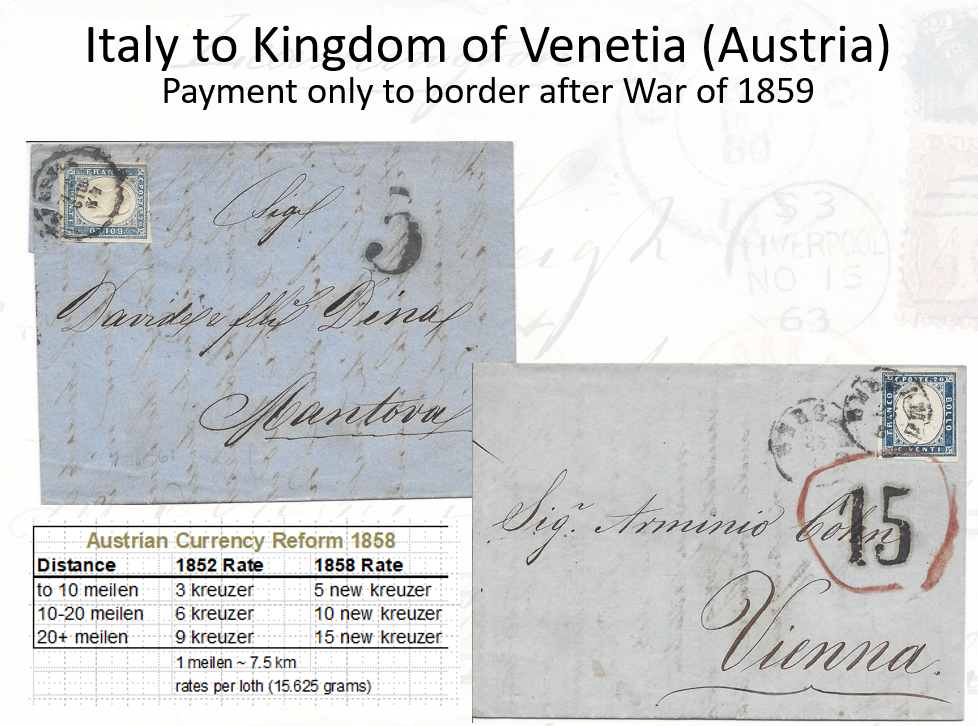
There was another reason the US Consulate in Florence did not prepay the postage to send the letter to Venezia.  It just so happened that a person couldn't prepay that mail.  Austria and Italy had not yet come up with a new postal agreement after the War of 1859.  As a result, a person in Italy could only pay for a letter to get to the border.  After that, the letter would travel through Austrian territory with the internal postage unpaid.  The recipient would have to pay that amount to receive the letter.

Postage rates for mail in Venetia and Austria was based on both weight and distance.  A simple letter could weigh as much as one loth (15.625 grams), but that simple letter would then be given a postage rate based on how far it had to travel.  The first letter shown above did not have to travel more than 75 kilometers from the border with the Kingdom of Italy.  The second had to travel over 150 km from the border to get to Vienna.

Each of these letters shown here have a 20 centesimi Italian stamp that paid the postage within Italy to its border with Venetia.  The numerical markings told the mail carrier to collect five and fifteen kreuzer, respectively, from the recipient for the internal Austrian mail services.*

* note: the first cover is probably rated in soldi, rather than kreuzer, but using kreuzer serves for the discussion.


One more baseline

Before we close the story on our letter from the US to Italy via the UK, we need one more baseline example.  Shown above is a letter that was mailed in the mid-1860s from France to Austria.  The postage rate was 60 centimes, which is properly paid by the postage stamps.  All of the markings for a typical, paid letter from France to Austria can be found on this letter.  But....

There is an ink scrawl that is the number "5."  I have circled that marking in red on this envelope.  This told the letter carrier to collect 5 kreuzer from the recipient on delivery.  Remember, five kreuzer would be the proper postage rate for internal Austrian mail that traveled less than 75 km.

It turns out - this letter was also forwarded.  Like our example, it was forwarded to a new location but the forwarder did NOT prepay the postage.  As a result, the postal clerk made sure the carrier would know to collect postage by putting this "5" on the front of the cover.

Dealing with unfinished business

Since the US Consulate probably would not and could not prepay the postage from Florence to Venice, we should have expected to find an amount due when the carrier delivered this letter to Mrs. Abbott Lawrence.  And, sure enough, here it is!

With all of the pen markings and the damage to this cover, it is not as obvious as one might expect.  As a matter of fact, I did not notice this for quite some time myself.  I knew this letter was forwarded to Venice, but I didn't quite understand how the postage was covered until I observed how Austrian postal clerks wrote their fives.  Once I noticed that, it became easier to see the five on this item.  So, Mrs. Abbott Lawrence had to pay 5 kreuzer (or soldi) to the carrier so she could read the news from Boston.

And that, my friends, is the long explanation for how I piece together clues in my effort to read the postal story a particular cover might have to tell. 

Not quite bonus material

Matthew H. called attention the addressee of the letter from the UK to Italy, Giuseppe Sonnino in Naples.  For those who have some knowledge of European history, the name Sonnino just might ring a bell or two.  Sidney Sonnino was the Prime Minister of Foreign Affairs for Italy during World War I and also served briefly as Prime Minister in the early 1900s (twice).  

While that is interesting, Giuseppe Sonnino of Naples cannot, with my brief bit of research, be easily connected to Sidney.  Sidney's origins start in Livorno and Pisa and he had connections to the Anglican Church.  Giuseppe, on the other hand, can be found as a rabbi for the Jewish community in Naples in the 1860s.  There are enough references in Italian resources for Giuseppe that a person might be able to put some biographical material together over time.  But, unless there is an extended family connection, I don't find a direct connection between the two.

A bit closer to bonus material?

During the presentation, someone asked if the addressee of this cover, Mrs. Abbot Lawrence was one and the same as the person depicted in this painting by John Singer Sargant

Unfortunately, the answer is, once again, no.  But, the relationship is a bit closer this time around.  Portrayed here is Mrs. Abbott Lawrence Rotch, who was born in 1867, after the date this letter was received.  She was married to respected meteorologist Abbott Lawrence Rotch, who is fairly closely related to the letter's recipient (a nephew, perhaps).

Another possibility suggested was that the letter recipient was Katherine Bigelow Lawrence, spouse of Abbott Lawrence. Lawrence was an accomplished businessman and gave Harvard University $50,000 to establish the Lawrence Scientific School. He built lodging houses for the poor in 1845, and pushed for education for the lower class. He was also the Vice Presidential candidate in 1848 as part of an unsuccessful ticket with Zachary Taylor.  When Taylor won in the next election, Lawrence was not on the ticket.  When offered a cabinet position, he opted for a position as minister to Great Britain.  Abbott died in 1855.

However, the information that time was spent in Europe makes it possible that Katherine Lawrence could have been traveling there in 1865.  But, there is a problem with that too.  Katherine Bigelow Lawrence died in 1860 according to this, and other, sources.

painting of Katherine Bigelow Lawrence by Chester Harding at MFA Boston website

This leads us to Abbott Bigelow Lawrence, Jr, who was married to Harriet White Paige Lawrence.  Abbott Bigelow Lawrence was the son of Abbott Lawrence and Katherine Bigelow and was born in 1828, putting him and Harriet (born 1832) at about the right age for her to be the recipient of this particular letter.

So, let's introduce another character into this play.    Timothy Bigelow Lawrence, brother of Abbott Bigelow Lawrence was a colonel in the Union army and was part of General E.D. Keyes' staff.  Unfortunately, Col. Lawrence had a "tendency to deafness that became so much increased by exposure, and especially from the heavy firing he was so long surrounded by, as to impede and limit his usefulness in the field."* Thus, he moved on to a diplomatic appointment that he had delayed filling in his effort to serve with the armed forces.

*this quote and other information on T.B. Lawrence can be found in this printed memorial that was initially in Boston Courier in 1869.  It was printed for private distribution in April, 1869 under the title T. Bigelow Lawrence 1869.

T.B. Lawrence served as the US Consulate General in Florence from 1861 to 1869.  Having a brother in Italy might be enough of a reason for Abbott and Harriet Lawrence to make a visit to Italy (or maybe it was just Harriet?).  It also made it pretty easy to avail themselves of the services of the Consulate General's office!  It can be nice to have connections.

So, yes, there are links to the family and to the women depicted in these two paintings, but neither of them was the recipient of this particular letter during travels in Europe.  But, we still got to meet some interesting people in the process.

And, if our featured piece of postal history looked familiar to you this week, it was also featured in this Postal History Sunday from October 2022.

------------------------

Thank you for taking this journey with me today!  I hope you enjoyed some or all of this entry of Postal History Sunday.  Have a great remainder of your day and a fine week to come.

Saturday, February 11, 2023

Individuals All


The sunlight came slanting through the trees to strike the leaves on a small shrubby plant.  From a distance, it almost looked as if someone had flicked on the switch to power a string of tiny lights that had been invisible until that moment.  The lights were on just long enough to draw attention to the bush before the sun hid itself behind some passing clouds.

A new world reveals itself as the lens of our observation gets closer.  We begin to realize that the sparkle that drew our attention was the refraction and the reflection of the sunlight as it interacts with water.  But, the sun does not make an immediate appearance so we are left to observe the tiny droplets on the fine leaves.  As we do, we start to see fine differences between each one.

One droplet has become oblong and is showing how gravity is pulling it away from its home leaf.  Another is a simple half-globe, with plenty of potential to grow larger if the smaller droplets on top of the leaf decide to slide down and join their friends in a group effort.  Some of the droplets hang from leaves, flowers or stems while others sit on top, preferring to look up rather than down.  There is even some diversity in size and shape on a individual leaves.  Proximity didn't seem to dictate perfect uniformity.

Still, each droplet has much in common with the others, clearly related - with some basic understandings about how life is.  Yet, each also appears to be unique in some way.  Individuals all. And with that individuality, each of them provide a window to a world and community that is beautiful.

Friday, February 10, 2023

Auto Exploits - Faux Real Story


A person's first vehicle is often two things: 

1. not the most reliable or attractive vehicle on the road and 

2. the eventual source of several stories.  

In my case, Einstein the Land Yacht rapidly developed its own mythology that I was happy to perpetuate - once I got out of whatever situation I was in with the car at the time.

Einstein was huge, with a trunk that just might have been big enough to put a sub-compact car into it as a back-up vehicle.  By the time the car entered my possession, it had seen its best days.  But, when it was new, it had some amazing (and new for the time) features.  This car actually had shoulder strap seat belts, which was not a standard feature in 1972.  It even had cruise control, which still worked....sort of...

So, about that cruise control.  I learned the hard way that it didn't quite work when I set it at the speed limit and then I got pulled over for speeding.  Why?  Well, I hadn't noticed that the speed the cruise had me running at kept inching upward as I drove.  It would reset to my setting each time I slowed down for a turn or a stop, but then it would start inching up again.  The thing about this vehicle is it actually rode better when the car went faster, so it didn't seem like we were going all that fast.  But, the objects by the side of the road did seem to pass quicker than maybe they should have.

And, of course, the car had some rust.  

Okay, it had a LOT of rust.  We put a doubled up carpet into the trunk to make sure things didn't FALL OUT as I went down the road.  It wasn't as if it was a huge hole.  But, it was enough that loose objects could fall out.  There were also holes in the floor of the passenger compartment that were not visible because they were covered up by carpet pieces too.

On the other hand, if you were driving on days like this... 


The resulting natural air conditioning was so effective that Einstein's heater had no shot of keeping up.  The good news, for me, was that there was more draft on the passenger side.  So, if I was alone in the car, it wasn't too bad.

Ah, who am I kidding?  There was a reason I stopped at gas stations more often during winter trips.  Yes, the car went through gas like no one's business, that's true.  But, I had to get out and run around a bit to get the feeling back into my feet.  And yes, I am exaggerating a bit... I think.

I think riding in this car is the reason Tammy has gotten into the habit of wrapping a blanket around herself when she is passenger in any car during the winter.  A couple of winter trips in Einstein was enough to scar anyone for life.

I think it would also be accurate to say that Einstein was not running about as often as it was running.  Still, that car always got me TO the destination before it decided it had had enough for a while.  It was good for me because it got me to walk to work more often.  During one of these periods of Einstein "not working," the issue was a dead battery, which was something I could figure out how to replace.


Unfortunately, the closest place to get a new battery was about 2.5 miles away.  The weather was getting colder and we had a light, drizzly rain on the day the trip was made to get that battery.  At the time, my friend, Phil, shared the apartment with me, so we took a walk together to run this errand.

Of course, the walk there wasn't all that bad.  As I said, I was used to walking, as was Phil.  But, once the battery was purchased, it still had to be taken all the way BACK to the parking lot at the apartment complex.  Let me say this - car batteries are NOT easy to carry and they can easily weigh 40 to 50 pounds.  And, to add insult to injury, the rain was starting to pick up and the daylight hours were waning.

We took turns lugging that battery.  Sometimes trying to carry it on a shoulder, sometimes with two hands in front of our bodies, and a few times we tried to carry it like a football.  And I remember getting a bit more disgusted with the world after most everyone driving by gave us curious looks, but no one stopped to ask if we could use some help.  

I suppose we just looked like two young idiots taking their pet car battery for a constitutional.  Each person who saw us and gawked, but drove by, were probably either too astonished by what they were seeing or confused by it to make any decision to offer help.  That, and I am sure we were kind of scary looking to some folks.  I really can't judge.  But, I sure wanted to at the time.  It was simply a measure of how much of a struggle the task of carrying this thing was getting to be that I was letting myself get irritated with anyone who happened to have the misfortune to look at us.

We did, eventually, get back to the apartment.  And, after struggling up the steep drive to the parking area, I just put the battery into Einstein's spacious back seat, where it would sit until the next morning.  And, that next morning, I put the battery in and Einstein started right up!  We took a quick drive around the block to test it out and then parked the car in the lot.  I had visions of getting to drive to work on Monday dancing in my head.  Based on the weather forecast, my other option was to trudge there in the rain.

I got up the next morning and went to the car and turned key in the ignition.  

And I got no response.

The battery was dead.

That's when I learned what an alternator was for. Well, that and how problems with an electrical system can drain a battery.

Well, at least an alternator didn't weigh as much as a battery.

Thursday, February 9, 2023

Former Lives

It's a strange thing when you find your thoughts focused on people, events, or things that were once a big part of your life, but haven't been for long enough that it is noteworthy when they come up again.  For me, it is an odd feeling to reflect and fully realize exactly how important being a cellist, and being involved in music, was to me in primary school and college.  An odd little factoid about me is that I actually auditioned for the Cedar Rapids Symphony Orchestra when I worked at Rockwell-Collins after graduating from college.  I got the call that I was accepted to be a part of that ensemble just days after suffering a broken collar bone in an auto accident.

And it was that moment that the cello - or at least me playing the cello - progressively took less and less of my time, energy, and thought.  Other things took its place as my definition of myself changed.


So, you can imagine exactly how jarring it might be if I suddenly felt myself being thrust back to a time when the cello was a bigger part of life and more of the people I interacted with had something to do with that.  This happened when I learned, just this past weekend, that Stan Sharp, a very talented musician who was one year ahead of me in the Newton schools, passed away several years ago (2018).

The first, obvious, reaction a person might have when faced with news such as this is to feel equal measures of shock, disbelief, grief, regret, and guilt.  It doesn't have to make sense, this is simply what people, myself included, feel when someone dies.  I could not have done anything to alter the path of the pancreatic cancer that ended Stan's life too early.  And, the regret that we had lost touch with each other was simply a reality of two lives busily going in different directions.  The most difficult part of a loss such is this is that all one wants to do is have a conversation with the person who has moved on - and you can't.

I had the most contact with Stan during my high school years, when we were both in the high school orchestra.  Stan's father, Larry, was the orchestra director and a music teacher for the school system - and was my beginning cello instructor.  Interestingly enough, he recognized that I had moved beyond what he could do for cello and he passed me on to Stan.  You might think this could be a problem, having someone who was practically a peer teaching.  But, no, Stan really was that good - and my own learning expanded rapidly with his help.

Once Stan went to college at Drake to study with John Ehrlich, opting NOT to go to Julliard, where he had been accepted.  We had a few conversations and I remember one of them quite well.  Stan was talking about his endeavors to enter and do well in concerto competitions (among other things).  At one point he stopped and said, "You know, I started too late.  If I had wanted to really be successful (as a solo artist) I needed to start earlier instead of fooling around like I did in the earlier grades."

I remember saying something to the effect that there are all sorts of ways to excel and even more ways to be successful.  I suspect he just chalked it up as a platitude at the time because he was a young, ambitious musician trying to see how far he could go.  And, I was young and probably didn't have near enough experience to speak with any authority on the subject! 

I wondered, on and off, over the years how well Stan had done.  I heard about some of his exploits while I was still in college and I remember hearing from him that he was going to study with Lynn Harrell, but I rapidly lost track after that.  Different worlds.  Different people.  Different focus, needs, and desires.

Upon hearing of his death, I took a moment to explore his career.  The simple fact that it wasn't hard to find some of the information is testament to the fact that he was a highly respected cellist.  But, even more than that, he was a trusted teacher and mentor for other musicians.  He was even a founding member, along with his spouse Yu-tong Sharp, of From Classical to Rock, a special concert event that raised money to make music education accessible to kids.

If you want the laundry list, you can take this link or you can look at this discography that shows 52 credits to his name.  Stan did win numerous cello competitions.  He played in the Khatchaturian String Quartet that traveled and performed.  He played in symphonies. He played in front of symphonies.  He played on movie soundtracks and he provided the sounds of the cello for artists in the US and China that included names like Elton John, Stevie Wonder and John Legend.  But, perhaps most importantly, he taught others how to play the cello and how to bring music to life.  His last eighteen years included time as a faculty member at the Colburn School of the Performing Arts.   

Perhaps he wasn't a cellist whose name was a household name like Yo-yo Ma.  Maybe he didn't get the acclaim of Lynn Harrell.  But Stan Sharp found good ways - important ways - to excel and be successful.  I am honored to have been able to call him a friend in a former life of mine.  

Well done, Stan.