Tuesday, March 22, 2022

Basil Recipes


Mixed Herb Butter

  • 2 cups - softened butter (salted or unsalted)
  • 1/4 cup finely chopped fresh herbs (e.g. hyssop, basil, dill, marjoram, oregano, tarragon, parsley, sage, thyme)
  • 1 tsp minced garlic (optional)

Cream butter in a medium bowl with electric mixer until very soft and fluffy. Add herbs and garlic. Mix until well combined. Cover and refrigerate until firm enough to shape into sticks - though any shape will probably do. Shape into 1 inch thick sticks with hands. Wrap in wax paper. Makes 4 1/2 cup sticks. You may freeze sticks for up to 6 months.

Basil Oil

  • 1/2 cup packed fresh basil leaves
  • 1 cup extra-virgin olive oil

Bring large pot of water to a boil and fill another bowl with ice water. Dip basil in boiling water for 15 seconds, pull out with strainer and plunge into ice water. Drain and dry thoroughly with towels. Pack into a blender and add olive oil. Puree until basil is very fine and oil is bright green. Strain through colander lined with cheesecloth set over bowl to slowly drain.

Uses: drizzle on fresh tomatoes, grilled fish, use in vegetable soups, vinaigrette or dipping focaccia.

Recipe yields just under 1 cup

Basil Cucumber Salad

Ingredients
• 2 lbs. cucumbers
• 1-2 med. red onions
• fresh basil (optional) 2 tablespoons
• garlic powder (to taste)
• red wine or white wine vinegar (to taste)
• water (to taste)
• 1 cup chopped tomato (optional)
Thin-slice the cucumbers and onions and put them in a container. Rip or chop the basil and toss it in. Pour in vinegar and water. I use less vinegar than water, but you want the vinegar a little strong so it will get into the cukes. Sprinkle in some garlic, maybe 1/2 teaspoon? Let this marinate for at least 2 hours. It keeps well in the fridge for days. Add the tomatoes at the last minute.

Pasta with Broccoli and Pesto

Make 1 cup batch of pesto by pureeing the following:

  • 1.5 cup fresh basil leaves
  • 1 clove garlic
  • 2 tbs pine nuts

Then add to this pesto:

  • 2 tbs butter
  • 2tbs olive oil
  • Blend and then remove to a small bowl.
  • Stir in 1/4 cup mixture grated Parmesan and Pecorino Romano cheese
  • Set this mixture aside

Core and cut into bite-sized wedges 1 large red ripe tomato

Cut 1 bunch broccoli into small flowerettes and trim broccoli stem into bite sized pieces. Steam until crisp and tender (3-5 minutes)

In a saucepan heat:

  • 3 tbs olive oil
  • add the following to olive oil:
  • 1 clove of finely chopped garlic
  • the prepared broccoli
  • 1/2 tsp hot red pepper flakes
  • Cook over medium heat, stirring gently to warm through. Hold.

Cook 1 pound rigatoni in boiling salted water. Drain, reserving some water to thin pesto.

To serve: Put cooked pasta in a bowl. Add 1-2 tbs hot pasta water to pesto and stir until thinned - then pour over pasta. Salt to taste. Add broccoli, tomato and toss to blend. Serve immediately.


Basil Lemonade

1/2 cup rinsed, lightly packed fresh basil leaves
3 Tablespoons sugar
4 cups water
1/2 cup freshly squeezed lemon juice

In a 1 1/2 to 2-quart measure or bowl, combine 1/2 cup rinsed, lightly packed fresh basil leaves and 3 T. sugar. With a wooden spoon, crush leaves with sugar until thoroughly bruised. Add 4 cups water and 1/2 cup freshly squeezed lemon juice. Stir until sugar is dissolved, l to 2 minutes. Taste and add more sugar if desired. Pour through fine strainer into ice-filled glasses. Garnish with springs of fresh basil.

You can make the lemonade up to a day ahead; cover and chill.
Makes: 4 1/2 cups, about 4 servings.

Note: Use some Dark Opal Basil (purple leaf basil) and have some wonderfully deep colored lemonade that will have a great taste and look!

Basil Penne Pasta

Penne pasta for two, cooked and drained.
Parmesan cheese
1/4 cup finely minced fresh basil
Garlic salt and black pepper to taste
Olive oil

Easy and quick! - Mince the herbs while the pasta's cooking  and you are halfway there!

Cook pasta, arrange on a plate and top with Parmesan cheese, your choice of basil, (Lemon is a favorite, but Purple Opal and Italian combined together is very appealing to the palate, as well as the eye). Sprinkle on garlic salt and black pepper and drizzle with olive oil.

Lemon basil is a great pollinator attractor

Lemon Basil Herbed Rice

2 tablespoons of butter
3 tablespoons finely chopped onions
1 cup uncooked rice
1/4 cup chopped lemon basil
1 small bay leaf
1 tablespoon chopped parsley
Several drops of Tabasco sauce
2 1/2 cups chicken stock
Salt and white pepper to taste.
Serves 6-8

Preheat oven to 400 degrees.
Melt the butter in and oven proof saucepan. Add the onion and cook until it is softened.
Add the rice and cook, stirring over medium heat for 3 minutes.
Add lemon basil, the bay leaf, parsley, Tabasco and stock.
Bring to a boil, cover tightly and transfer to the oven.
Bake 25-30 minutes or until rice is tender. Add salt and white pepper to taste.
With a fork, fluff rice and serve. Enjoy!


 Fresh Fruits With Lemon Basil Dressing

Grapefruit sections
Orange sections
Strawberries
Kiwis, peeled and sliced
Avocado, peeled and sliced

Prepare fruits and arrange on individual plates or a platter. Refrigerate.

Dressing:

2 tablespoons fresh lemon basil leaves, chopped
Juice of 1/2 orange
Juice of 1/2 lemon
Juice of 1/2 lime
1 cup yogurt or sour cream
1 - 2 oz. honey

In a blender or food processor, place the lemon basil leaves with the citrus juices.
Process until pureed. Add yogurt or sour cream and honey.
Taste and correct seasoning with more citrus juice and or honey.
Spoon dressing over fruits and serve.

Rows of basil are a good companion for tomatoes

Monday, March 21, 2022

Time Tension


Hobnob has been one of our Indoor Farm Supervisors since October of 2010.  She is probably our least camera-friendly supervisor, which is one of the many reasons you do not see her featured very often in the blog.  

Hob is a study in contrasts.  She has a tendency to not want to sit still if she is in a lap, bumping hands for more attention and wriggling to try and get into a "more comfortable" position continuously.  She has always been a bit abrupt.  When it is time to sit, she sits.  Time to get up and move, she gets up and goes.  Time to sleep?   She sleeps.

On the other hand, Hobnob is also very good at loooong naps and loooong periods of time looking out of windows.  She can really concentrate on something if she wants.  But, this cat is probably not the most content of our felines.  I get the feeling she's always hoping for something more - whatever that might be.


I came to a realization that I might relate to Hobnob more than I thought I did.

You see, I recognize this tension.  I value the ability to be able to do and be involved in a wide range of things.  I also value the opportunity to have a nice BIG chunk of time to really concentrate on a single something. I appreciate the participation in regular, daily or weekly, activities - things that don't take too terribly long, but occur frequently.  I also like to have big chunks of time where I can just ignore routines and do something completely different.

Finding a good balance between these is a non-trivial activity.

The picture above shows what is left of our old barn.  It's a pile of rubble that is going to take a significant amount of time to clean it up and, maybe, prepare the area for something else.  I was walking around it on one of our recent, nice days, and I had this desire to dive in and begin doing the work.

And I realized that I did not have the time to do that.  I'd barely get the tools out before I would have to get to one of those "daily things" I was referring to.

This is something I have to work out.  I can't just stop doing things because I won't have a long chunk of time to dedicate to them.  I have to find ways to break them down... put them into a bunch of smaller chunks of time.

Hey.  It's Spring.  This happens every time March rolls around.  But, it feels like this March features more of this problem than some have.  

Maybe its just me or maybe its just life.  Either way, I bet many of us deal with the tension that surrounds how we use the time we've been given.

Here's to doing our best to use it well - and learning to accept the decisions we make as we travel from day to day.

Sunday, March 20, 2022

On the Shoulders of Others - Postal History Sunday

Welcome to Postal History Sunday on the Genuine Faux Farm blog and the GFF Postal History blog.  Believe it or not, this is the 83rd entry in this weekly series that, oddly enough, seems to appear on Sundays.  I wonder why that might be?

Let's set those troubles aside for a few minutes (no - don't think hard about where you are putting those troubles - maybe you'll forget where they are and they won't bother you for a while AFTER you finish reading).  And perhaps, we can all learn something new!

This week I wanted to focus a little bit on some of the resources and works that have led me to the point where I can successfully look at pieces of postal history and read some of the story that they carry with them. 

But first, let's start with a piece of postal history!


The envelope you see above was mailed from New York City in 1863 to Shanghai, China.  There is 45-cents of postage on this envelope in the form of two ten-cent stamps (green), a one-cent stamp (blue), and a 24-cent stamp (lilac).  Each of these postage stamps have been marked by a cancellation device that left ink in the shape of a circle filled with grid lines on each stamp.  The basic idea was that, by marking these stamps, it would be difficult for someone to try to re-use them on another piece of mail.

The red circular marking at the top reads N. York Am Pkt Paid Jul 18 and tells us the day of departure of the trans-Atlantic mail packet (steamship) from the New York harbor.  It even tells us that this ship was under contract with the United States (Am Pkt) to carry this mail.  In fact, I can tell you all sorts of things about the voyage of this letter.

This is the route this letter took and the approximate dates at each location along the way:

New York Jul 18, 1863
    departed on Inman Line steamship City of Washington
London Jul 30
Southampton Aug 4
Malta Aug 14
Alexandria Aug 19
Suez Aug 23
Bombay Aug 29
    departed on Peninsular & Oriental Line steamship China
Singapore Sep 13
     typhoon Sep 20 - the China is delayed by 3 days
Hong Kong Sep 23
Hong Kong Sep 25
    departed on the Peninsular & Oriental Line steamship Ganges
Finally arriving at Shanghai on Sep 30

I can also tell you that the postage rate from the US to China was 45 cents per half ounce of weight and that this rate was effective from September of 1861 until December of 1867 - as long as it took the route via Southampton.  You can see that this route was indicated by a docket at the top of the envelope.  This was the slow way to China, taking the sea route around the Iberian Peninsula (where Spain & Portugal are) until it got to Malta.  The quicker, and more expensive route was overland through France (via Marseille).

The magenta colored "24" indicates that 24 cents of the 45 cents collected was to be passed to the British mail system, and the United States retained 21 cents to cover their costs, including the trans-Atlantic ship contract.

But, how in the world did I figure all of that out?

It started with postage rates

I am a fortunate individual.  I have been able to ride on the shoulders of others who had the ability and desire to study and do research with respect to how mail was handled between nations in the 1800s.  And, not only did they do this research, they shared the fruits of their labors with others by publishing their work.  I can say with certainty that I would not be doing what I am today with postal history if it were not for these, and numerous other, works.

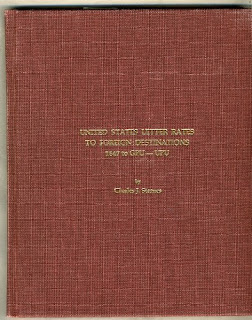
One of the first pieces of literature that centered around postal history in my library was the 1990 edition of the work by Charles Starnes (United States Letter Rates to Foreign Destinations 1847 to GPU-UPU).  Prior to this effort, people would have had to rely on finding rate schedules and official announcements for rate changes from primary sources.  While that could be effective, it could also be cumbersome.  What this book did was put a quick reference in front of anyone who wanted to learn more about that old letter that was sent from the US to some other country during this time period.  You did not have to have access to a library that had copies of those primary sources.

In my mind, some of the most useful information a person can have are the effective postage rates between nations.  This knowledge by itself can help you understand whether an old cover is a valid representative of normal mail handling for the time, if it is an interesting exception to normal processes, or if it could possibly be a fake, altered, or damaged item.

This is why, as I expand my own knowledge of postal history, I often look for sources that help me to get a handle on postage rates.  For example, J.L. Bourgouin's web site features French postal rates to foreign countries and has given me a platform from which to work on cool things like this, an 1858 letter from France to Sweden.  And yes, this item shows a valid rate for the time.


In a future Postal History Sunday, I'll try to share various resources I have found over the years that have helped with postal rates.  But, suffice it to say, I have not found everything I have been looking for and the search continues.  Sometimes it is because I do not yet know where to look.  Sometimes the easy-to-use reference, like the Starnes book, doesn't exist yet for a certain area.  After all, postage rates have never been a simple study - so any useful and comprehensive resource will require significant effort to create.

The ocean caught my fancy

Walter Hubbard and Dick Winter's work, North Atlantic Mail Sailings: 1840-1875 came out in 1988 and its presence opened up a whole new world to me as a postal historian.  Suddenly, a person like me - someone who did not have easy access to newspaper archives and other resources to confirm ship departures and arrivals - was able to use a single reference and have a good shot at determining how a letter crossed the Atlantic in the 1860s (my primary focus of study).

Because this work was made available, I was given another way to look at a cover.  Another way to read the story.  Another opportunity to find something new and interesting.

If it were not for this work, I may not have been able to discover and explore the story of the Saxonia as it fought through a gale, arriving a bit late, but still successfully delivering its mailbags.  And, I would never have even thought that the item in this Postal History Sunday called Run Aground! was anything that was at all special.  Instead, it is one of my favorite things in my collection and a story I enjoy telling and retelling to anyone who might be willing to listen.

If this book did anything, it taught me how to read the exchange markings on letters that crossed the ocean.  And, in reading them, I find I can learn a great deal very quickly.  And, it helped me determine that this item is pretty cool.

Aside from looking a bit different from many letters from the time because of the stamp selvage sealing up the sides, this item was carried by a ship from the Galway Line.  Only 1.8% of the trans-Atlantic mail carried in 1863 was carried by this line, which is the only overlap the Galway shipping line had with the 24 cent stamp I enjoy.  In other words, you don't find much carried by a Galway Line ship.

Dick Winter continues to be prolific, writing Understanding Trans-Atlantic Mail (vols 1 & 2) and continues to write.  I always look forward to his work.

And I learned what guided postal services to do what they do


It was clear from the beginning that both the Starnes and the Hubbard/Winter books were references that you went to when you had an item that you needed to figure out.  The Starnes book is primarily tables with very little additional text.  The Hubbard/Winter book is also mostly ship sailing tables, but there is enough text to teach you about many things if you are willing to read for the details that were not the primary purpose of the book. 

History of Letter Post Communications Between the United States and Europe: 1845-1875 by George Hargest, on the other hand, is not what you would call "light reading."  Nor is it necessarily a reference book you go to for a quick answer.  And yet, it is this book that I attribute much of my ability to understand the mechanics of mail between postal systems. 

I know that I read portions of this book multiple times until the combination of my own personal experience and my "book-learning" finally matched up and provided me with what I call "operational knowledge."  Sure, I could have read this book once and had a few general ideas about how things worked.  But, until I could apply the things I found there to actual pieces of postal history,  I couldn't say I had really learned what I needed to.

I will admit that this process took me a while.  It is, once again, a difficult read that is full of information.  But, I recognized its value early on and kept coming back to it as my understanding grew.

This is the book that helped me understand how the postage was divided between nations and this is the book that introduced me to the postal treaties that set the foundations for mail between nations.

And much more, of course

I am only focusing on a few of the key resources that helped get me started.  These three books, along with the people who populate Richard Frajola's Board for Philatelists, were probably the most influential in encouraging me to go down the paths I have chosen to walk in the world of postal history.  If I were to focus on all resources I have used, I am afraid I would never finish this Postal History Sunday entry - and I don't see how that will help anyone.

If you were to categorize each of these resources, you might say the Starnes book was the practical reference that kept me from hurting myself too much.  The Hubbard/Winter book added a bit of window dressing that made the story line for postal history more attractive.  And, the Hargest book could be likened to a Chilton's repair manual, it gave me some understanding about what was "under the hood" when it came to mail between the United States and Europe.  The Board for Philatelists provided a sense of community that rounded it all out.

And that is the starter recipe for Postal History Sunday.  I have climbed onto the shoulders of others - and is still seeing how much further he can reach with their assistance.

Have a fine day and an excellent week to come!

Saturday, March 19, 2022

March Saturday Playlist

It's been a while since I last shared a music playlist with everyone - so let's do one this Saturday!

This time, I'm going to start with a little bit of silliness.

Mama's Fried Potatoes - Reverend Peyton's Big Damn Band

This one's a bit frantic, it has simple lyrics, and the group is clearly having fun.  Good enough.  Sometimes, that's just what we need - something to reconnect ourselves to a sense of fun.

And let's follow that with something that is still fun, but a good deal less frenetic.

The One Thing - Steph Modder & Michael J. Pritzl

I really like how these two voices play off of each other.  It kind of makes me wish they'd done more than this one tune.

Hross - Skald

How about some Nordic music next?  Sure, why not!?  It's a song about Odin and his eight-legged horse, Sleipnir.  Gives us a completely different topic from the other two (from fried potatoes to a love song and now an eight-legged horse - who said we have to stick to one thing?).

This next tune is not widely available since it has been released only to people who support the Choir via Patreon.  

Just Who - the Choir

This is a great tune that we just keep playing.  Hopefully, they will release it at some point to the general public either as a single or part of a new album.  Who knows?  We're happy we're able to support these artists right now and this was a nice reward.

Walk Between the Raindrops - Adam Again

I tried to get back to the house from the Poultry Pavilion without getting wet.  I was not successful.  But, it made me think of this great tune by Adam Again.

Father Explains - Daniel Amos 

And, here's a tune from Daniel Amos, fronted by Terry Taylor.  Terry produced a new, stripped down version of this tune that really emphasizes the lyrics.  Unfortunately, I can't easily share that version with you, but I still like this version too.  As far as the lyrics go, let's just say it makes one think about current events in an uncomfortable way.

And since we're stuck a bit on rain and raindrops...

Here Comes the Rain Again - Eurythmics

I've always liked Annie Lennox's voice, so it's not hardship to put this song here in honor of the rain theme.

Moving on from the raindrops, let's have a little more fun and put on some boots!

Kelly's Wellies - Gaelic Storm

Since it was just St Patrick's Day on Thursday, I figure a tune or two with the Irish feel wouldn't be a bad deal.

Gerties Return - Glengarry Bhoys

Yep, I think that was the right choice.  

And, now, we enter the realm of songs that encourage me on a regular basis.  Just excellent tunes, with excellent lyrics.

Give Me Strength - Over the Rhine

And another long-time favorite.

Restore My Soul - the Choir

I had to include at least one song by the Choir that you could link to and listen to.   

-----------

Well, there you go!  A new play list for March of 2022.  Enjoy, and have a great weekend.

Friday, March 18, 2022

Promises from the Past

I came across some pictures from 2007.  We did not yet have our own digital camera, but someone loaned us one for a couple of days and we took some pictures of the farm as it was on around May 10 of that season.  The fields in the north plots were prepared and we already had some things taking off - like the peas.  And we were already seeding in things, like the cucurbits (vine crops) because, at that time, we did not transplant those items - we direct seeded them.

Our biggest piece of equipment?  A lawn tractor.  If I recall correctly, we had just purchased a tiller attachment for that tractor - which was a huge expenditure at the time.  And, it was the first year our farm reached its "full size" in terms of acreage in vegetable production (5 acres).

There was no high tunnel here.  Valhalla (our larger high tunnel) now resides in the area that would be on the left of the two pictures above.  The bushes at the left and in front are no where near their current height and density.  Though I must admit they are looking pretty good in these pictures.  

I remember that we had minimal trouble with weeds for these particular bushes because we started with a blank slate.  This land had been row cropped prior to our arrival, so there was no need for us to remove any plant matter.  And, I distinctly remember how we collected leaves from any of our CSA customers who would provide them to us so we could mulch all five hundred feet of these bushes during the first Fall they were present on the farm.  

I'll tell you what - it worked like a charm.  I wish some of our other planting took off like this one did.

But, we couldn't always spend the time it took to gather truckloads of leaves from individuals, haul them to the farm, spred them out...  

Well, you get the idea.

As I look at these pictures, I find myself dealing with a host of feelings.

Pride in hard work and real effort.

A desire to go back and try to tell our former selves about some of the things we know now that would have been so good to know then.

Regret that we aren't going to do things like that again - and relief that we aren't going to do things like that again.

Amazement that the farm looked like that then - and it is so different now.

I see evidence of consistency and change in this picture.  We were already intercropping peas with the cucumbers at that time.  We were already seeding and encouraging clovers to grow in the paths that we would walk and drive between the growing plots.  And, we believed in providing for diversity and habitat for pollinators and beneficial critters on our farm.

And I still see the promise of good harvests and tasty food when I see these pictures.

Thank you for reading today's blog post.  I hope you had a decent week and that your weekend brings you the restoration you might need.

Thursday, March 17, 2022

Be Careful What You Say

 It's Thursday, so it seems like it is a good time for a Throwback post.  Well, actually, I was just thinking about this topic, and rather than re-invent the wheel, I thought I'd re-post something I wrote and shared in 2015.  And, when I say "re-post," I usually mean that I copy in the original and then I can't help myself - I edit for readability or I change things that I feel slightly different about. 

Hey, it's my blog, I can make my own rules about what a "throwback post" means!  Ha!

------------------------------

Once again, I've been thinking.  A dangerous pastime (we know!).

Every time I write a blog.  Or have a conversation.  Or give a presentation.  Or express an opinion.  I run the risk of saying something that is.. well.. simply put.. wrong.  It may be wrong because I misspeak.  It might be that there is an interpretation that I didn't think of as I was typing or speaking.  Maybe I say something wrong because I need to adjust my attitude, or my knowledge base.  Or, perhaps it is wrong in one person's opinion, but not in another's.

Uh oh... he's talking again.

Oddly enough, because we run a small farm business (the Genuine Faux Farm - in case you didn't know that... but how could you not if you are here?!), there are many more opportunities for us to mess up.  After all, we put our thoughts out on a blog.  We put posts out on social media.  We have given presentations to promote our farm and hosted events at the farm.  You might have seen us at a farmers' market or a CSA distribution.  In short, everything we do as the "face of our farm business" provides an opportunity for us to make a mistake of some kind.

I will take a wild guess that most people who will read this post know Tammy or myself personally.  You've already formed some opinions about us (good or bad).  You also don't think of us as an entity known as the Genuine Faux Farm.  You know us as Rob and Tammy who run the farm they call the Genuine Faux Farm.  

But, I've realized for some time now that our ability to last for seventeen (or so) years has moved us from Rob and Tammy who have a farm to "the Genuine Faux Farm that has a married couple who are the owners of the farm."  That's actually makes a big difference in many people's eyes.

Wow, he IS out standing in his field.

In short, it is so much easier for people to jump to a conclusion because there is more distance between us and those to whom we speak (or write) when we are a "farm business" versus "two people who work on / own a farm."  It's all part of the way things work. 

Let me put it this way.  You visit restaurant X for the first time.  You don't know the owners or anyone that works there.  You overhear one of the staff say something that, on its face value, seems wrong to you.  Maybe you didn't hear the whole thing, and maybe you weren't the audience.  But, it's a natural tendency to attribute this one person's statement to the whole establishment.  After all, it was THEIR employee at THEIR premises, therefore THEIR business has a problem with THEIR attitude.

And, that is my point.  There are people behind a business and people make mistakes with what they say.  And, the more chances people have to say things publicly, the more likely they are to say something wrong.  And that can quickly paint the entire business in a way that does not represent that business accurately.

Example number 2:  Tammy teaches Social Work at the college level and I have taught Computer Science at the college level.  There are many opportunities to make mistakes in what we say.  I have heard Tammy do this, and I know I've done it.  When you teach, you often have to have part of your mind on what is coming out of your mouth at that moment and the other part has to be setting up what comes next.  Oh.. and don't forget the parts of your mind that are paying attention to the students and preparing for their reactions and questions!  Sometimes, the part that is paying attention to what is being said NOW gets distracted.  And maybe the word "NOT" gets left out of a sentence.

There is a big difference between:
   "This is the way to do it."
and
   "This is NOT the way to do it."

Can you imagine the damage control when you find out students were actually listening carefully to that sentence - and sadly not the ones around it that clearly contradicted what came out of your mouth for that one moment?

So - what brought this on?  Nothing in particular - it's just been on my mind recently.  No, I am not aware of something I've said or done recently that has me worried - unless you count the things I just can't find the time to do when I know it needs doing.

Instead, I brought this up as a reminder to me and, perhaps, to you as well.

I try to remind myself to be careful what I say - and be more careful about how I listen (or read).  I remind myself that people are involved.  These people make mistakes.  These people may say things for any number of reasons.  But, until I have more evidence and knowledge about what drove them to say what was said, then I will give the benefit of the doubt.  Does it mean I won't say something if I feel what is being said is VERY wrong.  Of course not!  I will say something as politely as I am able.  It does not do the other person a service to stay silent either.  But, there is a difference between an appropriate, measured response and condemning someone (and anyone or anything they are associated with).

And, now, I remind myself to proof read this blog post yet AGAIN.  But, I know I'll miss something.  I always do.  I hope you can forgive me.

Wednesday, March 16, 2022

What is Sustainable Agriculture?


We put up a website for our farm almost as soon as we decided we were going to farm - and one of the first things we did was figure out how to communicate what was important to us when it came to how our farm works.

At the time, the buzz-word was "sustainable."  Since that time, we've watched while that term has been co-opted or taken over by some who just want a nice term applied to them so they can enjoy increased sales.  That, in itself, can be pretty frustrating if your own farm took the time to define what it meant to be sustainable and then worked to share that with potential customers.  What made it worse was the revelation that just using the hot "term" was all it took - people were not generally going to look closely at the "manifesto" a farm might write to guide its own operation.

Well, we still use the word "sustainable" to describe our farm simply because it is accurate, not because we're looking to be part of the cool club.

Today, I wanted to share a slightly updated version of what has been on our website for years.  Why updated?  Well, part of the our definition for a sustainable farm is that the farmers LEARN.  If the write-up never changes, there is no evidence of learning.  

But, I will say this - the foundations are the same, the mechanics and the details have changed as we adapt and grow.

-----------------------------------

What is Sustainable?

One of the buzz-words in the media was 'sustainability' when the Genuine Faux Farm started doing its thing in 2004/2005.  Of course, media or popular recognition is a two-edged sword. On the plus side, a broader segment of the population was more ready to learn about sustainable practices.  Unfortunately, the concept became prone to corruption as it got misused and abused. We first shared our farm's definitions for a sustainable operation in 2007.  It received editing updates a few times on the website over the years.  Now, I provide the most recent update - which will reside on the farm blog, rather than the old website that will soon be defunct.

1. Food with Integrity

Consumers are easily able to see who raised the food, what methods they used and can confirm that the farmer avoids exploiting resources (labor, environment, etc). In short, there is no "smoke and mirrors" here. We grow using approaches that we believe are best for your well-being, the well-being of our environment, our community, our workers, and our farm. As we learn and gain experience, we have made, and will continue to make, adjustments. We constantly ask ourselves if our choices are the best we can make and we constantly challenge ourselves to improve.

Interaction with the community is important. This is where the 'connection to our food' component of sustainable agriculture comes into the picture. Everyone who eats should be concerned about their connections to the grower and how they do their job. The participation of the public - your participation - encourages responsible farming methods. Why would any of us want to support businesses that willfully mistreat workers, pollute the environment, or sacrifice quality to acquire every last penny possible?  And, why would a farmer want to do things that might make you displeased with their work?

For that matter, why would you want to put anything but the best fuel into your and your family's bodies? You should want food that is fresh, tasty, and healthy. If you know the farmer, you have a better idea as to how it is grown and whether it is being produced in a way that makes you feel that you are doing the best you can to provide excellent food for your table.

2. Sustainable Agriculture operations work to optimize their inputs.

We often look at farming from an input/output standpoint. We believe that an operation that provides many of its own resources is more likely to be sustainable - built for the long haul. For example, if a farm can develop its own composting operation, it can maintain soil fertility without relying on other sources exclusively.

It is equally important that we identify things that would be too much for us to expect from our operation.  After all, there are limits to our resources (money, land, skills, and labor).  A sustainable farm needs to carefully consider what needs to come from the "outside."  And, once those things are identified, effort is made to find the best partners to fulfill that need.  For example, our farm has only fifteen acres to work with, so we cannot expect to grow grain crops to make sufficient feed for our poultry.

We do our best to find sources that match our own farm mission as closely as possible.  And, we prefer to deal with local providers when it is possible.  It is important to us that most of the local dollar you give to us will stay in the community as we use it to pay for inputs that are supplied from off-farm sources.

This also links back to food with integrity.  How we secure the necessary inputs for our growing can impact the transparency of our operation.  If inputs come from the farm, then it is easy to assess its quality - and it is equally easy to trace all the steps that led to the production and use of that input (such as compost). If the farm cannot provide the input on their own, then a sustainable farm does due diligence to check the source.  Because, in the end, we are held responsible for the product we offer - even if a problem arises due to a situation caused by an off-farm source.

We work hard to select inputs, whether they take the form of an action or addition of physical item(s), that are more likely to do good than harm. For example, we believe that reliance on synthetic fertilizers and pesticides will impact long range health and productivity of the land where we grow our food, so we opt not to use these things. We agree with organic practices, so we make ourselves go through the certification process every season.  Not necessarily to achieve access to the label - but more so we hold ourselves accountable for a solid and sustainable farm plan each year.

3. Sustainable Agriculture stands on three legs: Community, Environment and Profitability.

What I like most about this is it makes no bones about the business and social sides of sustainable agriculture. If there is to be a sustainable agriculture system, it has to be attractive to new and existing farmers, otherwise, very few people will fill food production needs. What we want are healthy, prosperous farms with people who love what they do.

For some reason, many people believe that profitability comes at the expense of ideals. And, frankly, if it were a matter of starving or being fed, I might agree. But, when did we decide that having enough wasn't enough? There is a difference between healthy profit and exorbitant growth and income. We believe that we can provide for our food needs AND pay the farmer fair prices AND the farmer can use practices that are environmentally sound.

While this may sound too idealistic to work, we'd like to point out that the Genuine Faux Farm has been running since 2004. We have had our share of challenges and successes. Weather patterns have changed, economic climates are different than they were when we started, and our own perspectives have been altered as we learn and gain experience. We are a living farm. We experience, we learn, we adapt. With every change, we do our best to find the balance that best meets the principles we set for ourselves. In the end, we find that we are still here, striving to do our best to be a positive force in the local and sustainable foods movement.

It can be done. But we cannot do this alone. Sustainable agriculture needs the support of the community to work. Let's make it happen - together.

Tuesday, March 15, 2022

Recipes for Turnips (yes, Turnips)


The turnip - it is a much maligned root crop, in my opinion.  It has a reputation that implies that only those who can afford nothing else will find themselves eating it.  This seems a poor reward for a food crop that can be stored for long periods of time without terribly expensive refrigeration systems.

It is true - turnips have a taste and texture that some people may not enjoy - but this is true for every food I know of.  And, as we have learned over time, sometimes it is a matter of preparation.  Here are a few options that have worked for us, or our customers, in the past.

 Grilled Veggies (YUM!)

 Works for turnips, summer squash, zucchini, potatoes, kohlrabi, etc - anything with some substance

Wash veg. Slice into rounds or half rounds, about 1/2 inch thick. Toss lightly with olive oil (putting slices in a bowl, sprinkling olive oil over and tossing the veg around works well) and add any desired spicing (sea salt, chopped marjoram or basil, pepper, garlic all work well). Grill for about 5 min, turning once. They are done when you can easily stick a fork in them.

Turnip Puffs
Ingredients::
• 2 cups cooked, mashed turnips, cooled
• 1 cup bread crumbs
• 1/2 cup melted butter or margarine
• 1 teaspoon sugar
• 1/2 teaspoon salt
• 1/4 teaspoon pepper
• 2 eggs, separated

Preparation:
Combine turnips, bread crumbs, margarine, sugar, salt, pepper, and beaten egg yolks. Beat egg whites until stiff peaks form; fold into turnip mixture. Spoon turnip mixture into a buttered 1-quart casserole. Bake turnip puff at 350° for 40 minutes.
Turnip recipe serves 4 to 6.

Turnips (Young) Stewed in Butter
4 Servings

Take two pounds of young turnips; cut them into small squares or make them of any shape that may be preferred; dissolve two ounces of fresh butter in a saucepan sufficiently large to hold the vegetables in a single layer; put in the turnips and simmer them very gently until they are tender, without being broken. A few minutes before they are done enough, sprinkle a little salt and white pepper over them; put them in the center of a dish, and arrange fried or boiled cutlets neatly around them. Time: three quarters of an hour to stew turnips.

Southern Turnip Greens

4 to 4 1/2 pounds turnip greens
1 pound salt pork, rinsed and diced
1 1/2 cups water
1 cup finely chopped onion
1/2 teaspoon pepper
1 teaspoon sugar, optional
a dash of crushed red pepper, optional

Cut off and discard tough stems and discolored leaves from greens. Wash greens thoroughly and drain well.
Cook salt pork in a large pot or Dutch oven over medium heat until crisp and brown.
Add the turnip greens, water, onion, sugar, pepper, and crushed red pepper; bring to a boil.
Reduce heat, cover, and simmer 40 to 45 minutes or until greens are tender. Taste and adjust seasonings.
Serve with vinegar or pepper sauce and cornbread.
Serves 6.

Turnips Greens with Cornmeal Dumplings

3/4 pound smoked meat (smoked turkey wings are excellent)
4 quarts water
1 teaspoon House Seasoning, recipe follows
2 chicken bouillon cubes
1/4 teaspoon ground ginger
1 bunch turnip greens with roots
4 tablespoons (1/2 stick) butter
1 teaspoon sugar (optional; may be used if greens are bitter)
Cornmeal Dumplings, recipe follows
Place smoked meat in water along with House Seasoning, bouillon, and ginger. Cook over low heat for 1 1/2 hours. Strip turnip leaves free of the big stem that runs down the center of each leaf. Wash in a sink full of clean water. Drain and wash twice more, since greens can often be sandy. Peel and slice or quarter roots. Add greens to meat; cook for another 30 minutes, stirring often. Add roots and continue to cook for approximately 15 minutes, or until roots are tender. (Reserve 2/3 cup turnip liquid for the dumplings.) Add butter and sugar. Serve with dumplings.

House Seasoning: Mix ingredients together and store in an airtight container for up to 6 months
1 cup salt
1/4 cup black pepper
1/4 cup garlic powder
Cornmeal Dumplings
1 cup all-purpose cornmeal
1/2 teaspoon salt
1 small onion, chopped
1 egg
2/3 cup liquid from cooked turnips
Mix all ingredients together. Dipping by teaspoonfuls, gently roll batter in the palms of your hands into approximately 1-inch balls; drop into boiling turnip liquid Make sure each dumpling is completely covered in liquid by shaking the pot gently; do not stir. Boil for about 10 minutes.

Shelghum Ka Korma (Turnip Curry)

8 servings

  • 1 lb turnips
  • 1/2 lb onions
  • 1/2 cup yogurt
  • 1/2 cup oil
  • 3 tsp almonds
  • 3 tsp dissicated coconut
  • 3 tsp poppy seeds
  • 3 tsp sesame seeds
  • 3 tsp coriander seeds
  • 1.5 tsp chili powder
  • 2 tsp garlic and ginger (ground)
  1. Dry roast all seeds, almonds and coconut in frying pan. Grind to a fine paste. Add yogurt and set aside.
  2. Heat oil, add sliced onions and fry until light brown
  3. Wash the turnips and cut into pieces. Add to the pan and fry until light brown.
  4. Add yogurt mixture and fry for about 5 minutes. Add 1/4 cup water, cover and cook over very slow fire until turnips are tender. A thick gravy should have formed. Add salt to taste.

Mashed Turnip, Potato and Kohlrabi

Peel kohlrabi. Peel turnip and potato if desired. Cut into smallish cubes. Boil in water until soft. Drain most of the water, leaving some to make the mixture smoother. Add some butter and mash the contents until smooth.

Add garlic if that taste is desired.

There, I snuck a picture of kohlrabi into the blog too!  Why not?

Have a great day everyone!


Monday, March 14, 2022

Daylight Savings Solutions


When it comes to the controversy that is Daylight Savings Time and the bi-annual shift between Standard and Daylight time, we are a split household.  My opinion is that we should just pick a time (Daylight or Standard) and stick to it.  Tammy's is that she sees a benefit to to each.  She likes the sun to be up well prior to her 9 AM classes in December.  So, she's got a point there.  If we were to choose Daylight Savings time for the whole year, the latest sunrise would be about 8:40 AM (with official "dawn" being about a half-hour earlier).

And, I guess there is the "issue" of dawn arriving at 4AM in June if we stick with Standard time. 

It's only because the switch between Daylight Savings Time and Standard Time seems to mess with me and my own internal time clock so much that she might be willing to agree to stick with one or the other.  And, in case you hadn't heard, the Iowa House just passed a bill to keep Iowa in the Daylight Savings Time slot.

Now, before you get all excited (whether you support this idea or not) - Iowa can pass the law and have it signed by the governor.  But, until the Federal government approves the option for states to make this move - it isn't going to happen.  So, yeah.  There isn't likely going to be a whole bunch of states going willy-nilly in all sorts of directions.  

But think of the fun we could have here!

Option 1: Give the night shift the daylight

All of those fine people who get stuck with the "graveyard shift" deserve a break.  How about we simply switch around AM and PM?  Now the night time hours would be the sunlit hours!

All of those folks who have had to deal with working without the benefit of the sun will suddenly be able to step out during break and catch a few rays.  Isn't it time the rest of us learned what it is like to work our shifts during the hours when the sun is shining on the other side of the earth?

Option 2: Ease the shock of the time change with incremental time changes

One of the reasons I struggle with the time change so much is that we make this big, one-hour shift all at once.  Let's EASE into it a little.

Starting March 1st, we should add one minute to the time each day until, after 60 days, we've reached the one hour mark.  Ha ha!  Now we're where we want to be for the longest days of the year.  Then, we subtract one minute each day for sixty days in the Fall!

I can't see any difficulties with this proposal - can you?  

Option 3: Provide an opt-out policy

Let's let everyone PICK whether they want to participate in either Daylight Savings or Standard Time.  If the time switch really bugs a person, they can sign a personal "opt-out" form.

We can then have two segments of the population that reside in the same area in two different time zones.  Think of the fun we could have with this!

That office meeting that happens every week is now going to have to have two meeting times published if you want everyone to attend.  However, this could also be a way to split things up and give everyone more opportunity!  The high school varsity baseball teams could have a game at 7pm for the DST'ers and a 7pm game for the ST'ers.  Twice as many kids get to play!!  Though I suspect there may be some issues with the use of the ball diamond.

Option 4: Go half-way

Do you have some of the complaints Tammy has regarding sticking with either Daylight Savings or Standard Time?  

The solution is obvious - let's just move it all to a spot in between the two!  The easy solution is to pick the half-way mark, moving 30 minutes forward from Standard and staying there with no further changes.

Or, we can be a bit more innovative!

Let's have everyone vote for which of the two times they like better.  Then, based on the vote we move the time.  For example, if 66% vote for Daylight Savings and 33% for Standard, we just move 40 minutes forward from Standard.

See?!? Everyone got a say in the matter AND we're able to make a numerically supported compromise! 

Option 5: Spice it up and let every state just pick a time measuring method

Hey!  Why don't we do what we seem to like to do with so much of our governing in the United States?  Let's let every state pick how they want to do things.  Surely that will make everyone happy.  I mean, doesn't this approach ALWAYS make everyone happy?

No?

Huh.

Option 6: Go back to sundials

As an introvert, I actually like the idea of sundials.  

First, if it is a really cloudy day, you have to cancel all of your scheduled meetings because NOBODY will know what time it is.  And, second, you can really mess with peoples' sense of time during the night-time hours.  Only those folks who work the night shift will know what's going on.  The rest of us - well, maybe not so much.

Option 7: Use the "Farmer Time" method

To be perfectly clear - I've learned to rely more on the arrival and existence of daylight to tell me when to do things on the farm.  Sometimes the construct that is time zones just gets in my way.

Sun's up?  Time to get up and let the animals out, give them food and water, and just start "doing stuff."  Sun's going down?  Time to put the animals away, put the equipment away, and perhaps do something that is not farm-related for a while.

If you don't want to work the same hours as a farmer, the solution is simple.  Make a calendar that tells you how many hours and minutes of daylight you have each day - then slice off chucks of it for work and for play.  You can either count from the point the sun is at its highest or you can count from dawn or dusk - you pick. 

Works great - unless you live in Alaska.  If you're waiting on sunset to tell you it is time to get to work in the winter months, you may have a problem - and you'll NEVER quit working int he summer months.  

I guess you could figure out this hibernation thing other critters do.

Option 8: Time zone trials

Are you the kind of person who really hates to buy something before you actually have tried it?  If so, you might like this idea!

Let's allow communities a chance to test drive different time zones to see which one fits best!  It could also be a great way to travel without physically leaving where you are.  Want to visit London? Just shift to Greenwich Mean Time for a while!  Or maybe you just had a REALLY GOOD day - you could switch to a time zone that's a few hours earlier and extend that day a bit!

What do you mean that wouldn't work?

Option 9: How about a lottery?

It seems to me that an inordinate number of people like to gamble on all sorts of things - why not gamble on the time zone approach that your locality will be using?

To make this even more realistic, let's first take a poll to find out what the most popular choices would be.  Then, we need to set things up so those choices are LESS likely to be selected.

The basic idea is that only a couple of REALLY lucky people will be happy with the solution.  Everyone else.... loses.

Option 10: Use the sands of time.

We can learn to appreciate or come to despise the sands of time if only we all started carrying an hourglass around instead of watches or phones.  Obviously, it has to be a big enough hourglass for each person to be able to keep track of time for the entire day.  I realize this is something like the idea of having everyone set their own time zone - but I wanted to offer up this option because I just learned....

the largest hourglass is reported to be in Budapest, Hungary.  It measures one year of time and weighs 60 tons.  Happily, an hourglass for one day would be a bit smaller than that.  In fact, you can get a 4-hour hourglass and it is "only" 18 inches tall.  I realize this would not be a perfectly linear equation, but that puts a daylong hourglass somewhere in  the range of six-feet tall.

I hope these things would come with wheels - and turning them over for the new day might be a bit of a production.  That big, Hungary hourglass takes four people hauling on cables 45 minutes to get it turned for the new year.

Option 11: Move the people with the time

Well, if most people don't like the time change, I have another idea that would NOT require that we make ANY changes to our current system of cycling between Daylight Savings and Standard Time.  Keep all of that the same.

Instead, we should make people move from time zone to time zone so they do not have to adjust their clocks - they just have to adjust to a new home and new location.  

I suppose there might be an issue when we start pushing people on either coast into the ocean, but we all have to make sacrifices if we want to solve this problem.

Solving the worlds problems, one at a time

It turns out that, according to this poll, only 28% of people in the United States actually favor this swapping back and forth between Daylight Savings and Standard Time.  On the other hand, they can't agree on which way we should go.  While 40% prefer that we stick with Standard Time, 31% would prefer to stay with Daylight Savings.

Clearly, this is a difficult situation that calls for my unique style of problem solving.  See how quickly and easily I came up with eleven, count them, ELEVEN solutions for this very knotty and clearly divisive problem.

Now that I've provided the world with this service, which problem should I tackle next?  

If you have ideas - put them in the comments, I'll get right on it!

Sunday, March 13, 2022

Williams Creek - Postal History Sunday

Welcome to Postal History Sunday on the Genuine Faux Farm blog and GFF Postal History blog.  It's time for us to set our troubles aside for a short time while I share something I enjoy with you.  Perhaps we'll all learn something new in the process and, if we do this right, we might even forget where we put those troubles once we're done with the Postal History Sunday post.

------------------------------------------

One of the fascinating things about postal history is that a single item can provide us with a window to view interesting events, people, or situations that occurred in the past.   Sometimes, we are fortunate to find something that provides us with opportunities to go in all sorts of directions.  

Starting to make sense of this cover

There is a lot to see and a fair amount to figure out with this particular item - which is just one reason it appeals to me.  The hardest part is figuring out where to start.  In my case, I started with the part I understood the best - the use of a 24 cent United States stamp to carry a letter from San Francisco, leaving July 31, 1865, to Liverpool, England.

The postage stamp at lower right, with the lilac coloration is the United States postage stamp.  The cogwheel shaped cancellation was used in San Francisco during the 1860s, so that matches up nicely with the round marking at the lower right corner of the envelope that gives us the July 31st date from San Francisco.  The postage rate at the time was 24 cents for a simple letter weighing no more than 1/2 ounce that left the United States for a destination in the United Kingdom.  If you want to review that particular rate, this Postal History Sunday from January of 2021 will help.

That was the easy part, but what is it with all of those pink colored stamps - of which one is almost entirely under the 24 cent stamp?

The pink stamps are denominated as paying 2 and 1/2 pence of postage for the colony of British Columbia (north of Washington state in the US), which is now part of Canada.  Prior to 1858, this area had been an "unorganized" British colonial territory known as New Caledonia, but with the gold rush in the Fraser Canyon and the corresponding influx of people, the area became a British colony.

So, the person who mailed this letter, paid for internal colonial mail services in British Columbia AND they paid for the United States postage to get the mail from San Francisco to Liverpool.  All of this apparently paid with postage stamps - a statement that will not be entirely true as you'll see later.

That's enough to start with - and we'll get back to more details after a - hopefully interesting - interlude.


Getting from here to there

Williams Creek was the site of much of the early successes during the Fraser Canyon Gold Rush.  Settlements such as Marysville, Richfield and Barkerville sprang up to gain varying levels of importance.  Barkerville had a documented office for Barnard's Express, a private company that carried mail, early in the 1860's and that's where I suspect the first Williams Creek post office was established.

This item likely followed this route:

  • Barkerville (Williams Creek) - July 21 to July 23 based on typical travel times
  • carried by Barnard's Express on the Cariboo Road (you can see it on the map from Soda Creek to Ashcroft and Lytton)
  • carried by Dietz and Nelson at Yale (another private carrier) to New Westminster on July 26
  • Across the Strait of Georgia to Victoria, Vancouver Island
  • Victoria to San Francisco via steamship
  • Overland to New York - sometimes by train, some of the route by stagecoach.
  • across the Atlantic Ocean on Cunard's Persia to Liverpool

The usual stage time from Yale to Barkerville (approx 380 miles) was four days.  A special express, that included driving the coach during night hours, set a record at 30 hours - which is quite an accomplishment if you start looking more closely at the route these coaches would have to take to get from Williams Creek to New Westminster.  It would not be unreasonable to expect letter mail to be sent on the express, so a July 23 send date is not out of the question.  

Some of the material I read suggested that this mail circuit was completed twice a week - so departure from Williams Creek would have depended on that schedule.

The Cariboo Road

Sketch map of the existing routes circa 1860 - signed R.C.Moody

Prior to the gold rush, much of the travel in the region was accomplished via water routes and less developed trails  The map shown above (you can view a larger version by clicking on it) is a sketch map of the region that likely reflects the state of transportation in 1860.  Richard Clement Moody had accepted the post of Commissioner of Lands and Works and Lieutenant Governor of British Columbia (August 1858) and was also made Commander of a detachment of Royal Engineers.  The sketch map shown above was signed off by him.

If you look closely, there are two routes that combine land and water travel to the North in the late 1850s.  The western route starts at Harrison Lake and goes north to Lillooet.  The Dietz and Nelson company maintained services along this route as well as service from Yale to New Westminster.

However, the development of a wagon road was not something that interested Moody as much as other projects.  On the other hand, Governor James Douglas was adamant about development of proper routes of transportation.

In 1862 the Cariboo Gold Rush attracted 5,000 miners. On this occasion, Governor Douglas produced his plan for a major wagon road, 18 feet wide, to run 400 miles from Yale, beyond the river’s gorge northward to Quesnel, and eastward to Williams Creek. The Great North Road, to be built by Royal Engineers and civilian contractors, was to end the threat of American economic domination by making the Fraser River, despite its obstacles, the commercial and arterial highway of British Columbia. He hoped that the road could be extended to link British Columbia with Canada. “Who can foresee what the next ten years may bring forth,” he wrote in 1863, “an overland Telegraph, surely, and a Railroad on British Territory, probably, the whole way from the Gulf of Georgia to the Atlantic.”  Quoted from the Dictionary of Canadian Biography on March 4, 2022 

Part of the Great North Road referenced by Douglas was to become the Cariboo Road.  It was this route that was favored by Barnard's Express to carry mail south from Barkerville.

Cariboo Road along the Thompson River 1867, from wikimedia commons

The construction of the Cariboo Road is considered to be quite an accomplishment, requiring work in all sorts of terrain (from swamps to sheer cliff faces).  Building of the road was most likely complete or very close to complete at the point the letter from Williams Creek was mailed in July of 1865. The road was over 400 miles in length and it effectively connected the Cariboo gold fields to the rest of the colony.


If you view the map shown above, you can see the two alternative routes in the southern portion.  The older route going through Douglas and Lillooet and the newer route through Yale and Lytton.  The completed route in 1865 would not have gone through Lillooet at all.  The first photo of the Cariboo Road shown above would have been taken north of Lytton (the Thompson River is just to the East of the road.

In the present day, there is a movement to restore portions of the Cariboo Road and to research the exact locations of the original roadbeds.  

Cariboo Road north of Yale circa 1880 from this Canada Parks site (viewed 3/11/22)

Getting to the Cariboo Road

Competing routes brought about competition for transportation services.  And, the competition was mostly in the portion of the route that got to the Cariboo Road itself.

The general rule of thumb is that land routes were normally faster than water routes.  This, of course, assumes the path of travel was developed to allow fast stage travel.  This might not be the best assumption in rugged areas such as those required for this trip. In fact even in later years (1900s) the paved road that followed the Cariboo Road was considered hazardous by some, with no guardrails to provide some sense of security for travelers who might look down form the precipice.  You can listen to a CBC archived broadcast that includes interviews of people who remember driving automobiles on that road and remembering how difficult even that could be.

Regardless, the development of land routes to speed travel had become very important in the Cariboo region simply because the British Columbian government wanted to be able to prevent the interests of the United States from overriding those of the colony.  The road also provided an opportunity to maintain some control and collect some of the wealth that was being generated there. 

The advertisement shown in two parts here references the two routes in competition.  The western route is labeled as the Douglas to Lillooet to Junction route.  This is the same as the Lake Harrison route shown in the sketch map.  The Yale and Lytton Wagon Road would be the eastern option.  Already in 1863, as the Cariboo Road was under construction, the shift had begun to favor the newer, shorter (and faster) route.

 From the Aug 8, 1863 British Columbian published in New Westminster

Barnard's Express, Dietz & Nelson and the BX Ranch

 At the time this letter was mailed (1865), the Dietz & Nelson company carried mails from Victoria to Yale and they also ran a route from Victoria to Lillooet via the western route.  Starting in 1862 Barnard's Express carried the mail either from Yale or Lillooet to the gold fields in the north.  In other words, it was Barnard's Express that carried the mail on the Cariboo Road.  

Barnard's Express became the British Columbia Express Company and was often simply known as BX.  In the winter of 1863, Barnard's added sleighs for winter transport.  In 1864, they added a four horse, 14 passenger stage to the route.  By the time we get to 1867, Barnard's was able to buy out the Dietz and Nelson express company and incorporate it into its own business.  In 1868, Barnard purchased 400 horses as breeding stock and founded the BX Ranch that would supply the engines that made this enterprise go.

Ad in the British Columbian (New Westminster) newspaper published Dec 12, 1866

An excellent history of BX can be found here at the Barnard's Village site.  If you would like to learn more, this book by Ken Mather (Stagecoach North: A History of Barnard's Express) is available through the Royal BC Museum.

Not bad for a guy (Joseph Barnard) who bought a mule so he could put the mail on its back and lead it up the existing trails in 1861.

George Dietz and Hugh Nelson purchased the Ballou Express in October of 1862 and came to an agreement with Barnard in 1863 to connect an express line.  They also made a connection with Wells Fargo in Victoria for mail coming to or leaving from British Columbia.  By December of 1867, Dietz and Nelson decided they could not make money with this situation and sold their interest to Barnard, who clearly made the most of it.

Williams Creek Gold Fields
The map below from Great Mining Camps of Canada can give us an idea as to why some of the settlements developed where they did.  Places like Barkerville essentially appeared where the density of staked claims was higher.  And, where claims clustered, services, such as the carriage of mail, tended to follow.

Placer miners discovered the south end of the gold field in 1860 and all of the river and stream sites that would end up producing significant amounts of gold would be discovered the following year.  Production would peak by 1863, but there is still active gold mining in the region even today.

Barkerville 1863 from Great Mining Camps in Canada

Placer mining focuses on looking for the target ore in sand or gravel, rather than attempting to find a vein of gold in solid rock.  The simplest approach with the least equipment and investment would be to "pan" for gold, placing some of the sand or gravel mix into a shallow pan with water.  Swirling the pan would separate the heavier gold from the sediment, which was washed out by the water.

The power of the river could be used by building sluice boxes.  These provided the opportunity to process larger volumes of the raw material and separate the gold from sediment.  If you would like to learn more, I suggest this U.S. National Park Service page that discusses placer mining.  

Getting Back to the Postal History

I suppose it is about this point that I should bring you back to the piece of postal history that started all of this discussion about placer mining, horses, road building, and the beginnings of British Columbia.  At the start I outlined the route this letter took, but I didn't necessarily show you the things that tell me about that route and the postage rates.

The first clue is the cancellation that can be found on the 2 1/2 penny stamps.

There is a blurred marking that is actually an oval with the number "10" in the center.  If it were clearly struck, it would look like this:

This marking was known to have been applied in the Williams Creek post office (Barkerville most likely), which was established in June of 1864.  That office was actually supplied with two postmarks - and neither of them provide the name of the location or a date.  The second marking can be seen at the bottom left of the cover.

The purpose of this mark is very clear - it indicated to postal clerks down the line that the entire postage had been paid at their post office.  And, cutting right to the chase, the total amount paid was 1 shilling and 9 pence.  The 9 pence was paid by the pink British Columbian stamps (which had been supplied to the Williams Creek post office) and one shilling was paid in cash, which was indicated at top left.

The slash in markings like this separates the shillings from the pence, so this marking is stating that one shilling and no pence were paid towards the additional postage required.  That additional postage represented the 24 US cents required to mail the letter from San Francisco to Liverpool.  

As a quick review - or maybe this is new to you - 12 pence were equal to a shilling.  Two US cents were equal to each British Columbian penny, so 12 pence (1 shilling) is equal to 24 US cents.  The one shilling in cash paid for the 24 cent stamp that sits very nicely on this envelope.  And, that 24 cent stamp was applied on the envelope in New Westminster, but it was not postmarked until it got to San Francisco.

This is one of those interesting practical solutions that were put into place just to get things done with the systems that were in place.  The only way someone in the British colony of British Columbia was going to write home to the United Kingdom was going to be via the United States.  And, in fact, any such piece of mail was going to go through either New Westminster or Victoria (on Vancouver Island).  Both of those post offices maintained a supply of US stamps which they would apply when appropriate.

The other practical adjustment comes about with the pink postage stamps.

If you will recall, I told you these stamps had a denomination of 2 and 1/2 pence EACH.  That's 7 and 1/2 pence in postage.  But, a few paragraphs ago I just breezed a little factoid past you when I said that NINE pence in postage were paid by these stamps.

The internal postage rates had been increased as of June 20, 1864.  The internal postage rate from the Cariboo Region to New Westminster was 6 pence per 1/2 ounce.  In addition to that, there was a 3 penny foreign mail fee, for a total of 9 pence in internal postage required.  The problem was - there weren't any 3 pence stamps printed and available at that time.  

The solution?  Sell the 2 1/2 pence stamps for three pence and just use them as if they were worth three pennies each.  

Works for me - and it worked for them.

There were multiple periods where Williams Creek had to operate without stamps and this excellent article by Steve Walske tells that story.  Mr. Walske is to be credited with providing many reference materials that gave me the tools I needed to read this cover, including this article that discusses the postage rates that applied during the gold rush period.

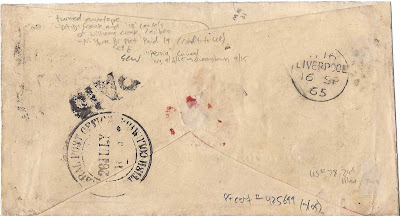
The back of the envelope features another "Paid" marking from Williams Creek and a larger, round marking that was applied at the "General Post Office" in New Westminster on July 26.  Now you know how I had a date for its arrival at that location!

To the right is a Liverpool marking dated September 16, 1865.  If we assume a July 24 send date, this letter took 53 days to make its way to the destination and it collected a whole host of storylines for us to explore for this Postal History Sunday.

--------------------------------

Thanks again for joining me this week.  As you can probably guess, some entries take a bit more effort to put together than others.  As always, the issue is how much detail is enough detail to accurately and correctly tell the story without getting bogged down in too much of the finer points.

For those who might like to learn more about any or all of the things covered here, take the links found in the text and/or check out some of the resources provided below.

Have a great remainder of your day and a fine week to come!

Cariboo Road at Soda Creek

Resources:

Walske, Steve, Stamp Shortages in the Cariboo Gold Country: Mail from Williams Creek via San Francisco, 1864-1868, US Philatelic Classics Society, The Chronicle, no. 218, vol 60, no 2, May 2008, pp 117-128

Walske, Steve, Postal Rates on Mail from British Columbia and Vancouver Island via the United States, 1858-1870, US Philatelic Classics Society, The Chronicle, no.212 ,vol 58,no 4, Nov 2006, pp 289-297
     - Some excellent work here and the rate tables below come from this article.

British Columbia and Vancouver Island Rate Tables on Western Cover Society webpage

Forster, Dale, Paid, Unpaid, Collect and Free Markings on BC and VI Covers, Postal History Society of Canada Journal, No 107, Sep 2001, pp 49-57.

Wellburn, Gerald E, The Stamps and Postal History of Colonial Vancouver Island and British Columbia: 1849-1871, (1987).
     - Since Wellburn's time, postal historians have been able to gain access to more primary sources with far less effort.  As a result, some of the details in this "coffee-table" book are incorrect.  Nonetheless, an enjoyable book to view.

British Columbia and Vancouver Island Covers on Western Cover Society webpage

The BC Gold Rush Press WAS a blog that has dedicated itself to the history of the gold rush in this area and provided interesting perspectives. It was still active Jan 2018, but the domain now appears to have been abandoned.  If anyone knows if this is still housed somewhere, let me know.  This is why I sometimes get very nervous about resource materials that are housed primarily online, their volatility is high.

Downs, Art, Cariboo Gold Rush: the Stampede that Made BC, Heritage House, 1987
     - This book is focusing on making the story entertaining but does so with the integration of primary sources. 

Brown and Ash, Great Mining Camps of Canada: the History and Geology of the Cariboo Goldfield, Barkerville and Wells, BC, Journal of the Geological Association of Canada, Vol 36, no 1 (2009).
     - Lots of detail, well researched.  The focus, of course, is on the geological side of things, but the accompanying historical information is also of use here.  You may have to get past some terminology hurdles.

Some interesting maps can be found at University of Victoria's Digital Collection.  Of note are carriage road maps (proposed in 1861). 

Ken Mather (Stagecoach North: A History of Barnard's Express) is available through the Royal BC Museum.