Well everyone, we made it. Welcome to the third anniversary edition
of Postal History Sunday - also known as the 156th entry of the weekly
series. Postal History
Sunday is published each week at both the Genuine Faux Farm blog and the GFF Postal History blog. If you are interested in prior entries, you can view them, starting with the most recent, at this location.
This week's post is a celebration. I thought I would share
things in the "threes" today to symbolically represent three years of
posts. But before I get started, let me remind you that Postal History
Sunday is written to be accessible to anyone who has interest. There
are readers who have expertise in various areas of postal history and
others who simply appreciate learning something new, but are not
otherwise inclined to dig into the subject. All of you are welcome and
I hope you find something to enjoy.
Let's start with the
question, "which three Postal History Sunday's come to mind when someone
asks you for blogs you most enjoyed writing?"
Three PHS I enjoyed writing
 |
These were posted in bakeries with suggested guidelines for bread prices.
|
The Price of Bread
is an earlier Postal History Sunday (April 2021) that has a great deal
going for it. First of all, the item that started my interest on the
topic didn't look terribly special on the outside, but the contents
(shown above) really grabbed my attention.
This paper was posted
in bakeries to show that they were following voluntary price guidelines
for bread that were established by the government and based on the
price of the grains used to bake bread. Voluntary price controls
was a fairly new situation in France and free trade for bakers was
established in France in mid-1863. Prior to that, there were taxe officielle
that set prices for bread and these controls were actually a tool that was used to
maintain the peace in France.
Discovery of this item led me to
search for other examples and I took great delight in exploring the
topic of official and unofficial price controls for bread. This post is
an excellent example of starting with the postal history and using it
to explore the social history connected to it.
 |
A triple rate letter from the United States to France
|
The
first one is an example of my writing about an area in postal history
(and social history) with which I had less familiarity. The next one is
an illustration of a PHS that features materials and a topic area I
know extremely well. Let's Send a Letter to France
(Oct 2022) represents an effort where I feel as if I was able to find
some of the best words to explain a relatively complex topic - mail from
the United States to France in the 1860s.
This time around,
the focus for me was entirely on word choice, topic ordering and
illustrations. I did not have to also manage a research process at the
same time I was navigating the writing of the blog. I can truly say
that this blog was a joy to write because it was a celebration of years
of learning and accumulated experience that I had an opportunity to
share with anyone who felt like reading it.
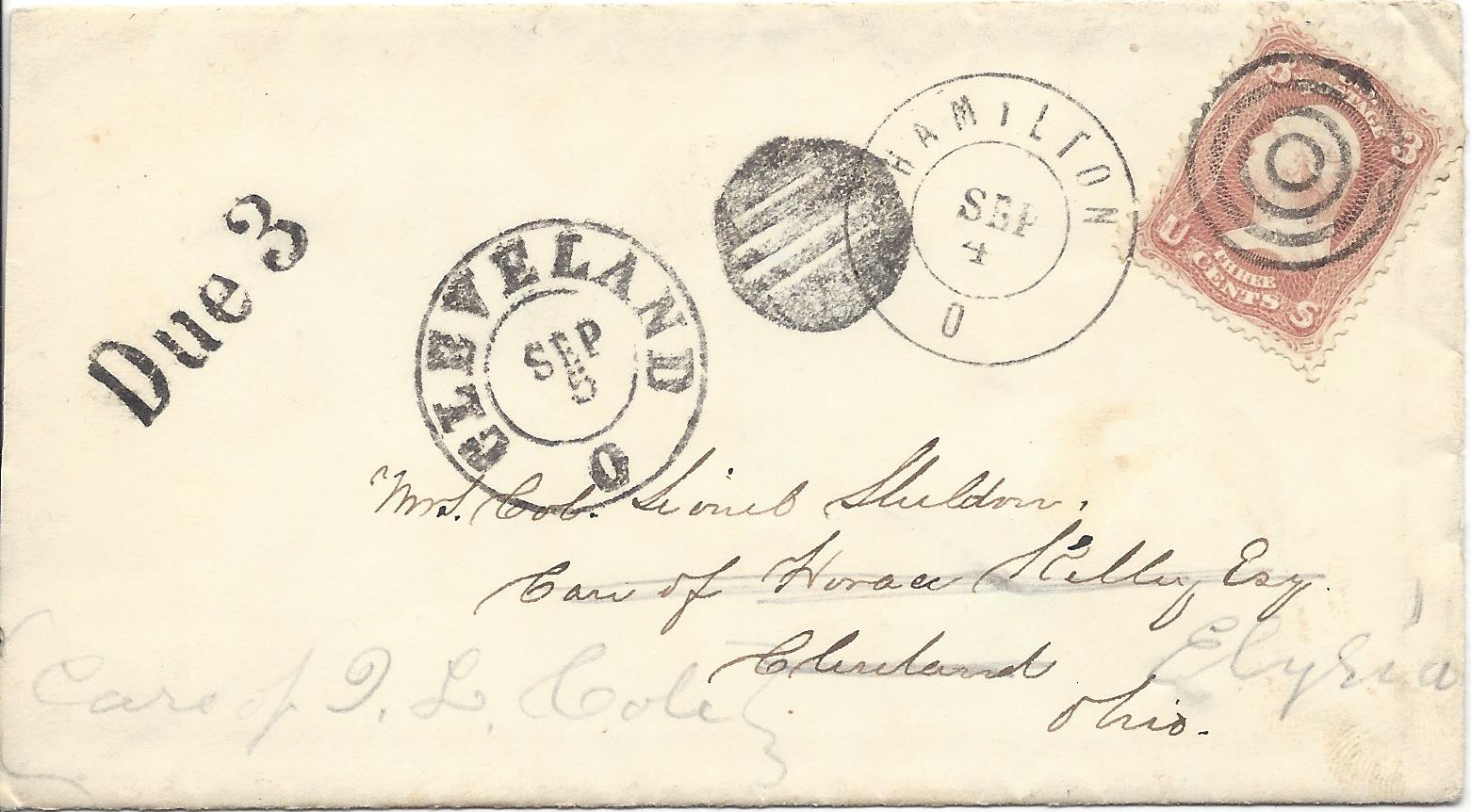
My third example of an article I really enjoyed writing is the offering titled
Did Garibaldi Delay the Mail?
(Nov 2022) that featured an exploration of the cover shown above. This
particular cover has been a long-term puzzle for me as I have sought
the best explanation for why it doesn't seem to follow the patterns
shown by other covers from the US to Rome during the same time period.
This
particular entry afforded me a chance to put into words where my
research had taken me. The effort of trying to explain the problem and
present the surrounding information was incredibly valuable to me as I
continued to dig into the problems presented by this cover. The
conclusions I share there may not be my absolute final solution, but I
feel much better about those conclusions after the effort required to
write this Postal History Sunday.
Three tidbits I take ridiculous amounts of pleasure in having discovered them for a Postal History Sunday
There
is an island near Bingen where an old tower still stands - and it bears
the name Mäuseturm - which is translated as "the Mouse Tower." This
name may actually be a alteration of the name based on a High German
word that made reference to this being a watchtower.
In
the present day, is known for its connection
to a legend that features the Archbishop of Mentz who treated the
peasantry cruelly, murdering many of the poor to prevent them from
eating too much of the food that was in short supply. Archbishop Hatto
fled to this tower to escape an army of mice, who pursued him there - he
was then devoured by the mice as God's judgement for his wicked ways.
This little piece of information in Dominoes
(Jan 2022) has become my "go-to" odd fact when someone asks me for an
example of strange things I have discovered as I research Postal History
Sunday entries, but it's not the only one.
To
give you a bit of background, my Bachelor's Degree is in Mathematics
and Computer Science. So, imagine my geeky delight when I discovered
that the recipient of the letter featured in Foolish Desire (Feb 2023), Erastus DeForest, is credited with
the initial discovery of the
chi-square distribution (for those who know some statistics). Four of
his papers (published from 1866 to 1871) are listed in this Catalog of Scientific Papers compiled by the Royal Society of London 1877 (vol VII).
And finally, one more factoid that I still take delight in learning as I researched Night Flight (Apr 2023).
Postmaster
General Harry S New indicated that the US Post Office was aware that
night flying was going to be necessary in his 1923 Report of the
Postmaster General, signalling a new trans-Continental schedule that
included night flying to begin on July 1, 1924. Beacon lights
were installed along the route from Chicago to Cheyenne, Wyoming every
three miles to guide the pilots in the section of the route scheduled to
be flown at night.
If you have ever been in the country and
well away from towns or cities, you might have an idea how dark it can
get. Now imagine trying to fly a plane at night without any light to
guide you.
Three covers I actually acquired because I wanted to write a Postal History Sunday about them
As
a rule, I have always had an attraction to items that I think will have
an interesting story to tell. But, I will readily admit that I have
added a couple of items to my own collection because I wanted to
research and write a Postal History Sunday about it. The great news
about that is, a great story doesn't necessarily require a huge price
tag!
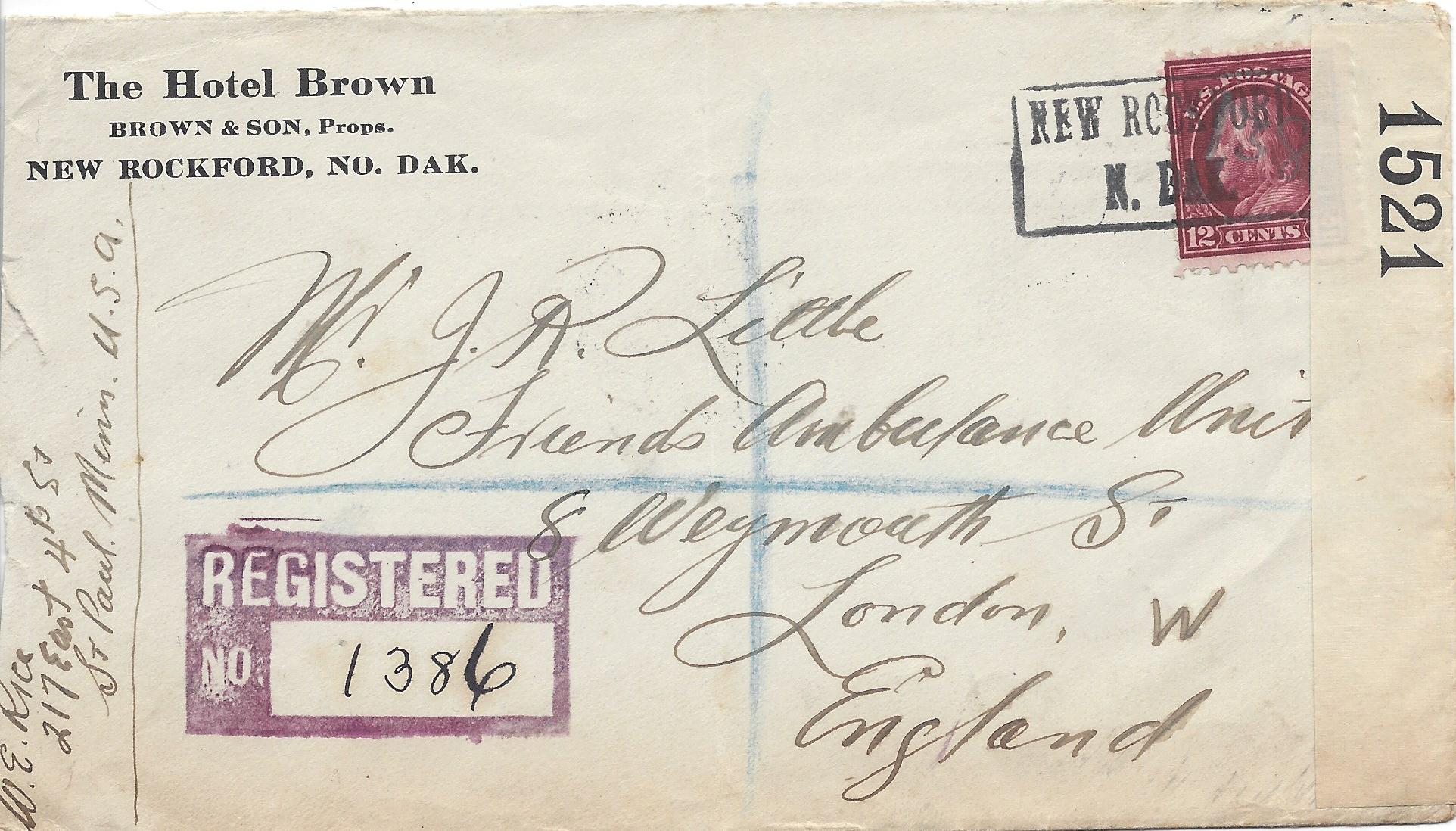
Shown
above is an example of an item that attracted my attention because of
the potential story I could uncover. The key is the part of the address
that reads "Friends Ambulance Unit" (FAU) and I was able to write the
PHS entry titled
Friends in Need
(May 2022). While I actually acquired this before I was writing Postal
History Sunday, I did pick it up because I saw the potential.
J.R.
Little was among those
involved in the FAU from its very beginning, and he coordinated
acquiring and delivering resources to the FAU across the English Channel
providing care for the wounded in World War I. An old envelope
providing a window into a much bigger story is something I really enjoy.
Unlike
the first cover, the one shown above was picked up specifically because
I wanted to write a Postal History Sunday about it. And, in fact, it
only took me a couple of weeks to accomplish that task.
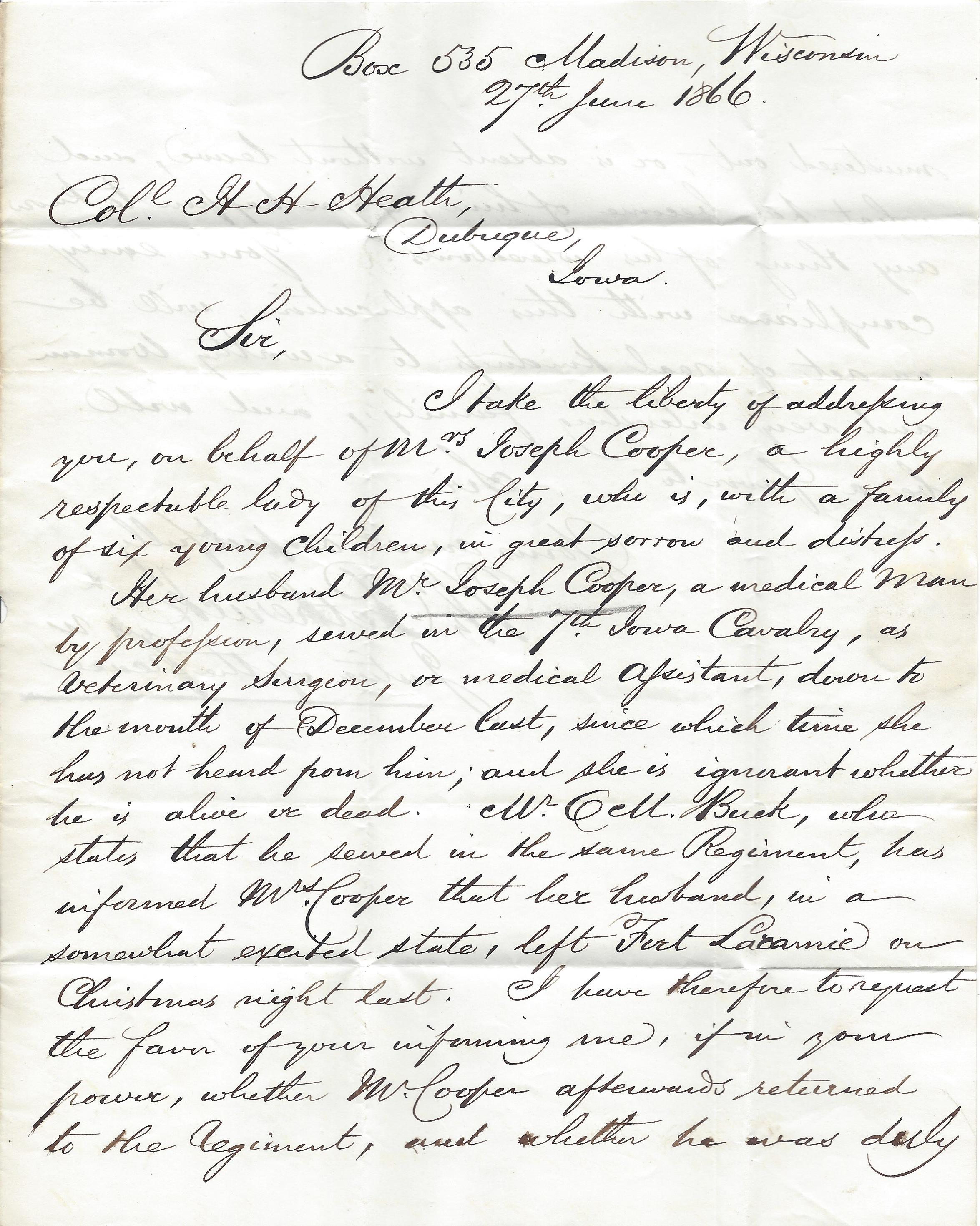
Quarantine!
(Aug 2022) is an article where I was able to do some detective work to
ascertain that the writer was Dr. John Swinburne, who was appointed to
the post of Health Officer for the Port of New York in March of 1864 -
one month prior to the sending of this particular letter. The Health
Officer was responsible for the Quarantine Station and the processes of
quarantining and dealing with persons arriving at the port who were
suffering from infectious disease.
Then
there is this flashy item that had a connection to my home state and
the railroad company that I saw frequently as it maintained a schedule
through my home town as I grew up. It was very inexpensive, but the
personal connection motivated me to purchase it and hunt down the story
behind it.
Trains of Thought
(Dec 2022) was refreshing because it was simply fun. It's a good
example of the balance I am hoping I can manage to maintain over time
with Postal History Sunday. Sometimes it can be enjoyable to really get
into the details of postal history (rates, routes, etc) and other times
it's better to keep the topic lighter. Remember, I am hoping people
with all levels of interest in postal history can find something to
enjoy here.
The three most popular Postal History Sundays
I
have had people ask me periodically how much traffic Postal History
Sunday gets. My answer is that online metrics have real limitations
when it comes to translating visits to actual readership levels. But,
you can get a sense for overall trends and which articles have gotten
the most attention.
According to the metrics supplied by Blogger, here are the three most visited Postal History Sunday entries!
- Up, Up and Away
- Business, Madness and Social Betterment
- Thurn and Taxis
These
are all entries from 2021, which does not mean there were more readers
at that time than there is now. Remember, once an article is published,
it is available to be read from that point on. So, it makes sense that
older posts have more visits - especially if there are links from newer
Postal History Sundays (or other places on the internet) that point to
them.
Three items I am looking forward to writing about
Today's
Postal History Sunday is not just about what has been, it is also about
what we hope will be in the future. I have several topics I hope to
write about in the future - assuming I can find the time and energy to
follow through. I thought I would share three items I hope to write
about soon.
Here's
an envelope that carried seeds through the mail from the James J.H.
Gregory seed company in (probably) 1870. My personal connection to
growing vegetables and farming, combined with my affinity for postal
history, makes this an excellent target. I've combined farming topics
with postal history a few times with some success. So, it feels like it
is about time to keep things balanced by going that direction again
soon.
Here's
another one that is very different from the normal Postal History
Sunday. Anyone who has been a collector from childhood - and it doesn't
matter what that collection is - will have some soft spots for items
that caught their eye when they were younger. For example, many kids
find it easier to be attracted to stamps featuring animals instead of
those that illustrate historical figures or events.
The giraffe in
the stamp shown above is part of a series I remember appreciating when I
was younger. So, it's pretty neat to have an envelope that used one of
those stamps to pay the postage.
And,
of course, there needs to be at least one 24-cent 1861 item in here.
The cover shown above, in combination with a couple of other covers,
provides an opportunity for a great story that I have been working on
for some time. But, like so many stories of this sort, it's going to
take some time to get it right. But, we'll get there one day - and
hopefully you'll be there to enjoy it, just as I'll enjoy writing it.
Thank
you so much for joining me today. We'll be back to a more "normal" PHS
next week. But, until then I hope you have a fine remainder of your
day and an excellent week to come.
Some bonus material
Tammy and I spent the last few days in Cleveland, Ohio to attend the Great American Stamp Show,
sponsored by the APS (American Philatelic Society). This show is held
yearly and is the largest conference / bourse style gathering in the
United States.
I had the opportunity to speak with several other
people who enjoy philately (stamp collecting) and postal history and
was honored to receive several compliments for Postal History Sunday.
One of the most common compliments was that, while I did not write
specifically about the parts of the hobby they focus on, they still
found PHS to be entertaining, accessible, and even useful. One person
told me that they knew that, even if they knew nothing about the topic
going in, I would not abandon them in the process of exploring it.
Thank
you all for your kind words and the support it gives me. Keep the
questions, suggestions and corrections coming. Feel free to tell me if
something wasn't clear and I'll certainly try to explain things in
another way.
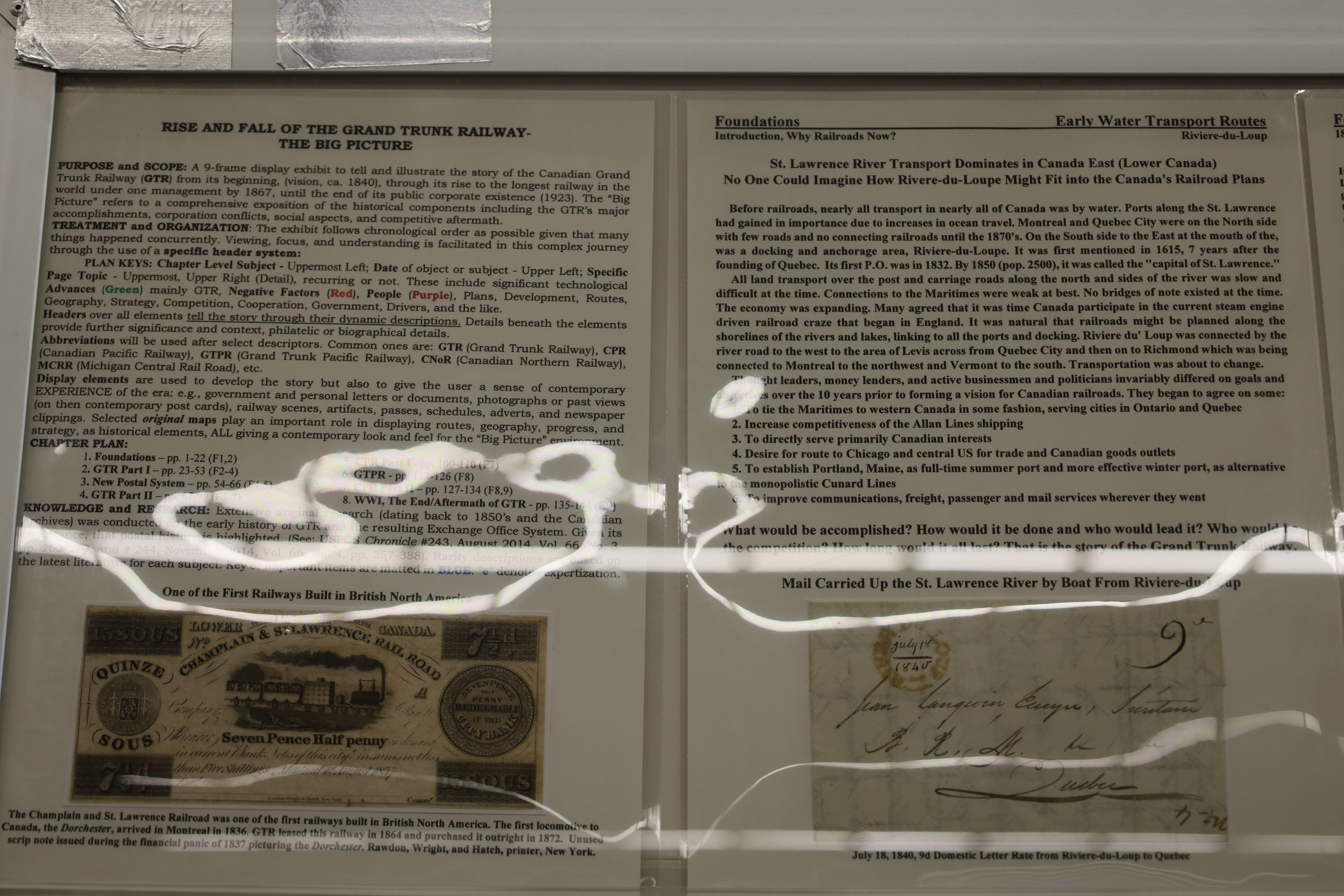
There
were many exhibits at the show. In fact, there were so many that there
was no way a person could easily find the time to enjoy them all.
However, I identified a couple that I wanted to explore a bit more
deeply, including the fine exhibit about the Grand Trunk Railway by
James Allen. This exhibit shows items for a rail line that interests me
because some of my postal history from the 1860s relied on it to get
from place to place.
I
also had the pleasure of talking with Mark Thompson about his Women of
the Black Heritage Series exhibit. Mark received a gold award for the
first time with his exhibit and he is to be congratulated for his
efforts. Each woman featured on these postage stamps has the equivalent
of a Postal History Sunday article in this exhibit and I applaud him
for his careful work in honoring these outstanding people.
And
a big thank you to Chip Gliedman for the personalized "tour" of his
Postal History Map of the United States. It's a gleeful approach to
collecting and sharing postal history items in a way that could resonate
with most anyone. His idea? Find a really neat piece of postal
history from each state in the nation and put them in their place on a
map. Everything from a cover partially burned in the crash of the
Hindenburg to an item with connections to the Choctaw Nation.
And that's all I've got this week. I hope to see you again next week for Postal History Sunday.