Sunday, February 6, 2022

More Sneaky Clues - Postal History Sunday

Welcome to Postal History Sunday (issue #77), which is hosted each Sunday on the Genuine Faux Farm blog and the GFF Postal History blog.  For those who are curious, I put the number on here this time because I had someone ask how many entries I have written thus far.  It's a good healthy number and I am pleased to have gotten this far with the project.

Now, let's pack all of those troubles into an envelope and mail it to some unknown address.  Make sure you don't put your return address on the envelope in hopes that they never come back.  Put on the fuzzy slippers and get a favorite beverage - it's time for some postal history!

----------------------

Last Summer, one of our entries was titled Sneaky Clues, which featured hand-written markings that helped to tell the story of various pieces of postal history.   I had so much fun with that one, I thought I'd do it again!

This time, we're going to start with a letter that was sent from Newport, Rhode Island to Paris, France in 1866.  Can you guess what "sneaky clue" I am going to focus on for this item?

Actually, this time around, I wanted to show how well ALL of the pieces of the story being told by this envelope work together. 

The red "45" at the bottom left is equivalent to the amount of postage found on this envelope: one 24-cent stamp, two 10-cent stamps and one 1-cent stamp = 45 cents total.

The postage rate for letter mail from the United States to France at the time was 15 cents per 1/4 ounce of weight (effective April 1857-Dec 1869).  Forty-five is a multiple of fifteen, so that's a good sign.

The numbers in red pencil read "36 / 3" - which is exactly what they should be.  But why?

I took a moment to enhance the red pencil mark and remove some of the distracting marks from the address panel so you can better see what it is that I am referring to.  

The "3" is in reference to the fact that this letter must have weighed more than 1/2 ounce and no more than 3/4 ounce.  In other words, postage needed to be three times the simple letter rate (15 cents).  So, this number confirms the amount of postage AND the "45" marking at the lower left.  So far so good.

But, what is it with the "36"? 


This is where the docket AND the round, red Boston marking come in.  The docket reads "per Cunard Steamer of Wed Dec 5th from Boston."   The red Boston marking is dated December 5 and states that the postage is paid.  It certainly is nice that both of these things agree about when this letter was put on a steamship (the Cunard Line's Africa) - but this is ALSO where the "36" ties in to the whole story.

Of the 45 cents collected in postage by the United States, thirty-six cents were to be passed on to France so they could pay for their expenses AND so they could pass money to the British.  After all, the Cunard Line was under contract with the British Postal Service to carry the mail across the Atlantic.  

In the end, the postage was broken down as follows:

  • 9 cents for the United States
  • 36 cents went to the French who used it to pay for
    • 18 cents to the British for the trip across the Atlantic
    • 6 cents to cover the British surface mail and transit across the English Channel
    • 12 cents kept by the French to pay for their own postal expenses.

If the ship crossing the Atlantic had been for a shipping line that had a contract with the United States or France, these numbers would be different, and so would the red pencil markings.

And that's how it all ties together.  Why is this interesting or important to a postal historian?

What would happen if we had a letter that did not have a docket, did not have the red "45" and the red Boston marking was smeared?  If there was only a "36/3" clearly written in pencil and 45 cents in postage on the envelope, we could still be able to piece most of the story together because we've seen items (like this one) where all of the pieces are completely and clearly spelled out.  That's part of the reason why I have worked to become more conversant in "sneaky clues."  Sometimes, not everything will be as easily read as they are on our first example.

Here is an 1856 folded letter that was sent from Nancy, Franc to Paris.  There is a 20 centime stamp at the top right and the red box at the top left reads "affranchissement insuffisant" (insufficient postage).

As a public service, I now give you a table that shows the internal letter rates for France during the second half of the 1800s.  I highlighted the text of the row that applies to this letter.

Prepaid Internal Letter Rates for France

Date 1st Rate up to 2nd Rate up to 3rd Rate up to Additional Per
Jan 1, 1849 0,20 7.5g 0,40 15g 1,00 100g 1,00 100g
Jul 1, 1850 0,25 7.5g 0,50 15g 1,00 100g 1,00 100g
Jul 1, 1854 0,20 7.5g 0,40 15g 0,80 100g 0,80 100g
Jan 1, 1862 0,20 10g 0,40 20g 0,80 100g 0,80 100g
Sep 1, 1871 0,25 10g 0,40 20g 0,70 50g 0,50 50g
Jan 1, 18760,25 15g 0,50 30g 0,75 50g 0,50 50g
May 1, 18780,1515g----0,1515g

A simple letter would weigh no more than 7.5 grams and would cost 20 centimes.  Apparently, the person who mailed this felt the letter was not too heavy and paid the cost for a simple letter.  The French postal clerk, on the other hand, did not agree - and they gave us evidence of that fact.

Well, well.  It looks the writer exceeded the weight limit by one-half gram (the marking above reads "8 g" or 8 grams).

For reference, 1/2 gram is the weight of half of a typical business card or half of a raisin.  It's not much.  But, rules IS rules - and this letter simply weighed too much.  Which means the amount of postage paid should have been 40 centimes.

At that time, the regulations for short paid mail in France required the recipient to pay the full amount of postage AS IF nothing had been paid at all.  In other words, the postage stamp paid for none of the postage required to send this item.  Think of it as a donation to the French Post Office if that helps your understanding.  

It may not seem fair that no credit was given for the postage provided - but at the time post offices around the world were trying to enforce pre-payment of letters.  Maybe a few harsh economic lessons would be enough to get the point across?

So, the amount due to the recipient was 40 centimes, which is represented by the big squiggle shown in the image at the left.  Yes, that is a "4," which stands for 4 decimes (equal to 40 centimes).  Remember, the French often used decimes for postal accounting, which is the equivalent to Americans referring to 4 dimes instead of 40 cents.

Now, if you are still staring at the squiggle and STILL don't see a "4," I understand.  This just might be one of those times you're just going to have to trust me.

Uh oh!  Here's that Thurn and Taxis post again!  Take a look at this 1865 folded lettersheet mailed from Sonneberg (Thuringia) to Leipzig (in Saxony).  Thuringia was another area, like the Hessian States, that used the house of Thurn and Taxis for their mail services.

The target-like cancellations on the stamps have the number "265" in the center, which was the number assigned to the Sonneberg post office.  The pencil number "265" with an arrow pointing to the purplish marking was put on the cover by a previous collector.  The intent is probably to indicate that they determined that the purple marking was also applied in Sonneberg.

This marking indicates that the letter was sent as a "registered" letter (Recommandirt).  In order to register a letter, an additional 6 kreuzer in postage was required.  And, some of the numbers found on this cover - those at the top right - are numbers used to track the progress of this letter as it traveled to its destination.  The "293" was likely the number in the Sonneberg ledgers that tracked this letter's departure and "205" may well have been Leipzig's ledger number to record the reception of the letter at their office.

So - we have 6 kreuzer spoken for - that leaves us with 12 kreuzer in postage paid.

The rate between Sonneberg and Leipzig was 6 kreuzer per loth.  At the time, mail in the German States included both a distance and a weight variable to determine the postage required.  The distance between the two cities was between 10 and 20 meilen (German miles) - if they had been closer it would only cost 3 kreuzer per loth.
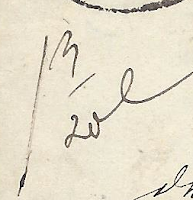

And, there it is!  Our sneaky clue resided at the left, just under the postage stamps.  This scrawl in black pen reads "1 3/20 L," with the "L" standing for loth, the weight unit in use by German postal services at the time.  One loth is roughly equivalent to a half ounce.

So, this letter weighed over one loth and no more than 2 loth, which made it a double weight letter and the total postage needed can be calculated in this fashion:

  • Registration Fee 6 kreuzer
  • Rate per loth for distance between 10 & 20 meilen - 6 kreuzer x 2 = 12 kreuzer
  • Total = 18 kreuzer


Here is another piece of French postal history to consider from 1864.  This item was also sent as a "registered" item (Chargé).  But, that's not what I want to focus on this time around.  

This item was returned to the sender, which would have been the Tribunal Court in Chambery.  The contents are a court summons that apparently did not find the person they were "summoning!"

But, how did I know this was returned to the sender?

The sneaky clue is at the bottom right, just under the Chambery postmark.  The words "au dos," when placed on a piece of letter mail explains that the carrier or clerk should "look on the back" for more explanation.  So, I looked on the back - and this is what I found:

The word "Inconnu," which would translate to "unknown."  The post office in Chambery was unable to locate the recipient of this court summons and they simply returned it to the Tribunal.  

Well, if the postal service can't find you, I guess you don't need to go to court.

Let's close with this 1867 envelope that was sent from New Orleans, Louisiana to Kurnik, Prussia (now in Poland).  The postage applied is 28 cents, which is the correct postage for a simple letter sent to Prussia (not weighing more than 1/2 ounce).  The New Orleans, New York and Aachen markings clearly show the travels this letter took and the dates it visited each location.  A single marking on the back tells us it arrived at the destination post office on April 15.

But, what is all of this?  The use of blue and red pencil might be an indication that there might be some postal significance - but what?

I have to admit that I have been puzzled by these markings for some time.  The numbers "15" and "4" really don't connect to any postal rate calculations that I could determine.  And, there was no reason (and no way) for this item to have traveled through Orleans, France.... unless that is not the word "Orleans" written in blue.

So, this particular set of markings sat in my "to be solved" list for a long time.  Until, one day, I asked the right people and got an answer that makes perfect sense.

This is a docket written by the recipient, simply recording that the letter was received on the 15th of April (4th month) from Orleans (New Orleans).  The little red squiggle before the numbers was simply an abbreviation to indicate a received date, which matches the date of the postal arrival date on the back.

Sometimes the answer is so simple that it is almost embarrassing to admit it to others.  In this case, I think I can hide behind the fact that most Americans list dates in month/day order rather than day/month order.  That's about the only defense I have right now - but I do feel much better now that the mystery is not so much of a mystery any more.

-------------------------------------

An Answer to a Question

I received the following question from an individual who has read a few Postal History Sunday entries and I thought it was worth repeating it and my answer here as a bonus for today.

Q: What is it that attracts you to the postal history you share on Postal History Sunday?  How do you pick the items you feature?

A: The answer can actually get very long and I probably cover it on and off in various Postal History Sunday offerings.  But, this one, titled Favorites, probably sums it up pretty well if you are willing to go read it.

If you aren't willing I can sum it up this way.  I like learning new things.  I like puzzles.  I like history.  I like the artistry found in the stamps, the handwriting and the papers of the time.  And... I like to try to figure out complicated things in history and then try to find the right words to make it easier for someone else to understand the same things I do. 

As far as how I pick the items I feature - every item I show is in (or was once in) my own collection unless I clearly state otherwise under the image.  I like to focus the most on the mid-1800s and I tend to have more connections to the US and European mails.  This might be enough to explain why you see so much of some things and less of others.  We all have our limits, and I have a long, long way to go to conquer every area covered by postal history.

Thanks for joining me this week.  Have a great remainder of the weekend and a fine week to come!

Saturday, February 5, 2022

February PAN Iowa News


With the turning of the calendar to a new year and the return of some bitterly cold weather in Iowa, I have been reflecting on a wide range of topics. But, for Iowa News, there are a couple of themes I wanted to share with everyone.

First, I have been concerned about how willingly we expend effort and energy on removing the wild spaces from Iowa’s landscape. We tear out fence lines, remove the remaining brushy areas, and do our level best to till and plant every square inch that we can. The idea is that we are making the land more profitable, but it seems to me that the actual returns will fail to “pencil out” if you did the math. On the other hand, the cost to wildlife and the health of our environment is far greater than any marginal return the farm might realize. It makes me wonder if we have forgotten the meaning of the word “stewardship.

The other theme that keeps coming back to me is rooted in a recent visit to the island of Kaua’i. The people of Hawai’i also deal with land use issues that make it challenging to grow their own food — but the stakes are so much higher if you also consider how much more difficult it is to import food to feed the people.

In traditional Hawaiian culture, there is a deep relationship to ‘Āina, the Place that Feeds, and in Iowa, we also like to claim a strong relationship to the land. We make the heady claim that we “feed the world.” We have an embarrassment of riches when it comes to our soils and a climate that could support diverse food production. Yet we squander our opportunities in the Land Between Two Rivers.

Like Hawai’i, we import at least 90% of the food we consume in this state. But, there is no urgency to address food security. Our response is to simply ignore the problem. Perhaps we would make more progress if we pretended, for just a moment, that we were also surrounded by the oceans. Maybe then we would work harder to diversify our farms, put more people on the land, and become stewards once again.

Be well,

Rob Faux
PAN’s Communications Associate
Owner/Operator, Genuine Faux Farm, Tripoli, IA

Carbon pipeline

In recent months, the construction of three carbon pipelines has been proposed in Iowa, which would cover significant portions of the state. The stated purpose is to take carbon dioxide waste from ethanol plants and pump it into underground storage in North Dakota. Without considering the potential hazards of a CO2 pipeline, there are legitimate concerns that farms — especially smaller, family farms — will bear the brunt of the costs. Meanwhile, a very small number of very wealthy individuals will be able to cash in on carbon tax credits.

One of the selling points for the pipeline is that it will aid the ethanol industry and stabilize the demand for Iowa’s corn. But, this misses the point that our outsized commitment to a single crop is a losing proposition for the long run. If we want to take our commitment to stewardship of the Land Between Two Rivers seriously, these projects should not be allowed to move forward.

If you would like to take a stand against the carbon pipeline projects, the Iowa Chapter of the Sierra Club has resources available for your use.

Take advantage of learning opportunities

The February calendar is full of opportunities to learn new tools and strategies for becoming better stewards. Here are a few for you to consider:

The Iowa Organic Association’s webinar series continues with a session titled “Tending to the Microbial Life of Your Soil,” presented by Chris Trump from noon to 1 PM on February 8. IOA also maintains an excellent calendar of events with other opportunities for learning.

Practical Farmers of Iowa also provides an impressive event calendar that covers a broad range of topic areas. For example, the Beginning Farmer Summit will be held this weekend (February 7) in Cedar Rapids and registration is still open! PFI is also running weekly farminars through the winter months.

NCAT is hosting the 7th Annual Latino Farmer Conference as a series of webinars. The third installment will focus on pest control and is scheduled for February 9.

The Iowa Farmers Union is continuing their Lunch and Learn Series and you can look for announcements on their social media page. This week’s talk was on parity pricing with George Naylor and can be viewed here. Next week, IFU will host our recently appointed USDA Farm Service Agency Director, Matt Russell.

PAN is seeking a new Executive Director

Just prior to her final days as Executive Director, Kristin Schafer shared the last installment in her series of reflections on her 25-year career with PANNA. I encourage you to read all three parts of this series as it will give you a deeper understanding of what PANNA has been doing and what motivates us to keep going.

PAN is actively seeking candidates for the Executive Director role. If you, or someone you know, feels that you are qualified and have the motivation to lead an excellent staff in continuing this work, please take a look at, or share, the job description.

Take Action! Support PACTPA

If we want to be better stewards of the land, we need legislation that supports that effort. Let’s tell Senator Ernst — who is on the committee that would consider this bill — and Senator Grassley that we need to protect our children, our communities, our farmworkers, and our environment.   Let them know that we think PACTPA is a step towards a better future for Iowa and the nation!

Friday, February 4, 2022

What's Hot at GFF?

The last few weeks have been pretty hectic for both farmers and their respective jobs - and that's not including the things we do still have to do at the farm. 

Now, I realize it probably seems like we are ALWAYS saying that our days are full and there is a lot on our plates.  I apologize if it sounds like I am complaining - I don't really mean to sound whiny.  I am grateful that I do have so many things in which I can participate positively.  It's just that there are moments when it feels like everything needs... well everything... right now.

When that happens, it often helps if I slow down for a minute and think about some of the things that the two of us are enjoying right now.

New Wall Art!

Upon our return from Kaua'i, Tammy and I selected a few of the photos we particularly enjoyed and had them blown up and printed on canvas.  These now proudly hang on a couple of our walls.  I don't know about Tammy, but I still stand in place and look at them every so often as I pass by.  

While I do not pretend to be anywhere near a professional for photography, I know a what I like in a picture.  It adds something when we can consider the personal experience component.  We were there and experienced the place.  We know what it sounds like.  What it feels like.  What it smells like.

And, we took the photos and we selected how we would display them.  The personal touch is a good thing.

Blue Taters!

This year, Tammy and I made sure we stored away enough blue (and red) potatoes for ourselves.  Some years, we got a little overzealous with distributing our potatoes to our CSA customers and/or selling them.  Then we'd look at each other in January/February and realize we had none for US to eat.  That makes for some sad farmers in the winter months.

Well, this year, we made sure to stock ourselves up and we've also made sure to put them where it's easier for us to get them when we want them.  The result?  How about a meal of mashed blue potatoes, snow peas, cauliflower and some hamburger gravy?

Ok, you might not like it and we can respect that.  But, all of the veggies came from the farm and the beef came from another local farm.  On top of that, we used a little salt gifted us by a friend on the island of Kaua'i.  For those who are not aware, the gift of this salt is to be treasured.  So, we can add that as an extra thing we're appreciating right now.

New Stratagies!

Watch out world, Rob figured out a strategy for Splendor that may have some merit.  We're going to see how Tammy adjusts to it now that it has been unveiled.  

So, yes.  We still try to play a game nearly every day.  The default, when both of us are tired and we just need the comfort of familiarity is Wingspan.  But, we've been flitting around the new games a bit as well.  Tammy pretty much schools Rob when it comes to Parks and Rob usually walks away with the win with Arboretum.  It makes sense as each plays to the others strengths.

Splendor WAS even.  But now?  Bwahahaaaaaa!

Ok... I've actually only tried this strategy once and it worked... once.  If it fails in the future you'll never know because I won't write about it!  So there!

And, Bree still likes the bag.  I really should just zip that thing up.  But, she seems so happy....

Have a great Friday everyone!

Thursday, February 3, 2022

Frugality is not Cheap

Over the last few months I've heard some of the following comments and I've worked hard not to respond directly to them.  If you wonder why I stay silent, you have to remember that sometimes common courtesy dictates that the time is not right.  Maybe I need time to process the facts and consider why people say what they say.  Perhaps I am making a judgement that whomever it is, they are not ready for this sort of conversation.  Or, maybe, I was standing in line somewhere and was clearly not meant to be in the conversation in the first place.

However, the time is right for a blog post in an effort to get us all to think about the topic a little bit.

We bought this this disk cultivator in an auction back in October of 2011. There was not much demand for this sort of equipment at the auction we attended, even though prior auctions that year had shown high demand.  We counted ourselves lucky to have purchased this tool - but was it really as good a deal as we thought?

Going back to the original thought process - I've been hearing comments that sound something like these examples:

  • "I don't know why I would buy X product from Y business.  Their prices are ridiculous and I can get it for so much less from ..."
  • "I shouldn't have to pay that much for Z, I can't believe they think I should pay that much."
  • "I know the product from A is inferior, but it was so cheap!  I had to buy several of them."

We all know people who say things that might be very similar to each of these examples.  In fact, each of us may utter similar words and phrases ourselves.  And, perhaps, it is warranted in some situations - assuming we've actually put some real thought into what we are saying.

But, usually, people make such comments for some or all of the following reasons:

  1. We like to portray ourselves as being persons who are too smart to be 'victimized' by those who will take away our money by overpricing things AND we like to portray ourselves as being targeted by unscrupulous sellers. 
  2. Most of us have been raised in a culture that praises those who can get more for less.  I clearly remember the lessens in product comparison.  Divide the total cost by the units to determine cost per unit and find a 'better' price.
  3. We are unable to see a quality difference and (perhaps mistakenly) give each product option equal value in quality and usefulness.
  4.  And, even if we do understand the concept of quality, we can't seem to stay away from a "deal," even if we have an inkling that the quality, usefulness and need to acquire that item might be in question.


We went looking for "heavy duty" hose reels one year and you can read what we ended up going through with it.  This was actually a case where I believe we were trying to locate some quality - but failed to find it.  But, again, let's get back to whatever it was I was trying to say.

Monetary cost is not the same as value

Part of the problem, as I see it, is that we frequently use a one-dimensional measure, monetary cost, in order to assess value.  We devalue quality and we simply ignore the value of work.  We forget that when we buy a cheap product that we end up paying in so many other ways.

If the item isn't a product we have a direct association with producing, we often fail to see where the added value might be.  Therefore, we make the assumption that it should not be as expensive as it is.  On the other hand, we seem to feel like it is ok to complain about other people NOT understanding why products we are involved in creating need to be the price they are.

I bet each of us can recall at least one conversation where this happened.  For instance, I give you this conversation that is loosely based on a real conversation I had years ago:

Person 1: This person came in and took up an hour of time for TWO members of our staff, and we're short staffed already.  They worked so hard to get what this person wanted and then when they asked for payment, the person got all huffy, said it was too expensive and not worth it - and left!

Me: Oh my!  That must have been awful, sometimes people just don't seem to understand how hard your job is.

Person 1: Yeah!  And to make matters worse, we got a phone call from our supplier who said they were raising the price on widgets!  I can't believe it!  I mean we can get widgets from anywhere - there's no reason that we have to pay so much for them.

Yep, there you have it.

Here's the bottom line for me

Frugality is not buying cheap, it is foregoing a purchase when it isn't really needed and saving your purchasing power for when it is needed.  Smart purchases come with the recognition of quality and understanding the value of professional knowledge and experience.  The best value doesn't come from spending little, it comes from spending well.  And, all of this assumes you have the resources to spend at all!

Smart shoppers should be pleased when they receive value for what they pay, just as they should be happy to be paying a fair price.  That fair price helps to insure the continued quality of the product, support for the product and even continued existence of that product.

What's better, buying a quality item that lasts 10 years and costs $110 or a cheap one that costs $10 and lasts one year?   Trick question.  If you do the math, you could argue (ignoring inflation) that the actual monetary cost is better with the cheap product.  But, consider other costs to you that you are ignoring.  Dealing with a broken product at a potentially difficult time.  Making extra trips and and taking extra time to purchase that product over and over again.  Dealing with the broken remnants.  

Then, think about costs that may not be seen by you directly.  How many people were paid inadequate wages to make the inferior item?  Or worse, yet, what sort of shortcuts were used in order to keep the price down so you could get a 'bargain?'

And let's be honest here.  The prices rarely break down that way.  It's more like 10 years costs $110 and 1 year costs $30.  If you are not privileged enough to be able to spend $110, then you are STUCK buying this product at $30 for 10 years and you end up spending far more ($300) - in part because you have no choice.

Products with low monetary cost make us buy them again and again as they break.  We throw more of them into the landfill and go buy another.  AND - this creates a situation where even MORE people are unable to have access to enough resources so they too can have a choice in what they buy.

And then, finally, I submit my last exhibit.

I was recipient of a 'cold call' from a company that was targeting farmers - the actual prompt that got me writing this post.  Apparently "company X" is moving from one warehouse to another.  They have lots of stock they want to sell rather than move.  They suggested that I could get a great deal on "tool Y."  I told them I had what I needed.  The salesperson's response was.  "What if I told you that you could STEAL it?"

Please explain to me how this is a good thing?  Should I feel good if I pay so little for something that I could equate it with stealing?  And, how does paying $x for something I don't need save me money when I don't need it?  

In the end, I have to conclude that frugality is not he same as cheap.  And, enslavement to frugality to the exclusion of allowing for fair compensation for work rendered takes choices and buying power from far too many people.

What do you think?

Wednesday, February 2, 2022

Variety Show - Hot Peppers

There is a whole host of information on our old Genuine Faux Farm website that probably doesn't get visited by much of anyone anymore.   Eh... who am I kidding.  There is probably a great deal of information there that was NEVER looked at by anyone.  

Still, we're going to migrate some of that material into blog posts if we think it could be interesting to others.  

Today, we're sharing (and updating) the information we've gathered with respect to the different hot pepper varieties we have grown over the years at the Genuine Faux Farm.  Remember, our goals may not match your goals and your farm is not the same as our farm.  Sometimes a favorite for us won't work for you and vice versa.  Nonetheless, we can share what we've learned and you can take it and use the information as you see fit!

We prefer to grow open pollinated varieties and have tried a fairly wide range of heirloom and heritage types.  It is our belief that, for many crops, there is a variety that is properly adapted to our farm and our cultivation techniques.  It just takes experimentation to find the right ones.


HOT PEPPERS


Storage:

  • Optimal environment for short storage & fresh use: 45 degrees F at 95% humidity.
  • Many hot peppers are excellent for drying.

Preparation: For most hot peppers, the heat is contained largely in the seed cavity and the seeds themselves. You can make a hot pepper a bit milder by removing this cavity and using the outer flesh of the fruit. When cutting hot peppers, it is often a good idea to wash your hands after cutting to avoid accidentally any residue in your eyes. Very hot peppers are often handled using gloves. If you are cutting a variety of items, it is a good idea to cut the hot peppers last, or use a clean knife. Otherwise, other fruits and vegetables will acquire some of the spicy qualities of the hot pepper.

Drying: Dehydrating and drying hot peppers is the only method of long term storage we have tried with success. Typically, we find that cutting the peppers into thin pieces will speed the dehydration process. You may opt to grind pepper into a powder or store them as pieces. We recommend that you avoid grinding too much at a time as pepper powder loses some of its qualities quickly. We have also simply let some of the thinner hot peppers dry on the counter.

We have had marginal success cutting hot peppers up and freezing them. But, that's not to say it can't be done successfully.

Cultivation:

We grow these similarly to sweet and bell peppers - so I guess we'll get a blog post on those out soon! One of the main differences we note is that the hot peppers seem to like the warmer and dryer weather more than sweet peppers do. So, a cooler and damper season may influence the health of these plants significantly.  Hot peppers do not like "wet feet," so make sure they are in well-drained soils.

Hot peppers love the high tunnel environment, but since we rarely have had a market for large amounts of these fruit, we don't spend that precious space on them.  We did try hoops with some plastic during a cold late Spring and early Fall to provide more heat, which seemed to work well enough.  Keep soil clear around the plants early to encourage the soil to heat up (keep them weeded and don't put straw or grass mulch down).

We also separate our sweet peppers from the hot peppers to avoid cross pollination and possible confusion/mixing of the fruit. In our fields, that usually means putting eggplant, flowers and/or green beans in the rows between the two, typically separating them by at least 15 feet.


VARIETY DESCRIPTIONS


Alma Papricka

Alma Papricka peppers

(Hot Scale 0 of 5)

These plants produce small rounded peppers (1 to 3 inch) that progress from cream colored to orange to red. Fruit can be picked at any point once they reach the cream coloration. We tend to like the taste even better once peppers begin to change color until they reach bright red. We enjoy Alma Papricka fresh on nachos and the taste goes well with chicken or fish. Peppers can be dried and ground to make papricka spice. Plants are generally smaller in size and produce a single flush of fruit in our area (two in the high tunnel, with the second being much smaller). 

Peppers hold well on the plant - a good companion for a range of papricka taste with Feher Ozon. These plants do not like having wet feet, but we have found they love being in the high tunnel. One flush of fruit typically gives 8 to 15 excellent quality fruit and several others that are still useful quality, but harder to market.


Feher Ozon Papricka

(Hot Scale: 0 of 5)

This papricka pepper holds most of its peppers with the pointy end up, rather than down. Of course, the plants can be so loaded with fruit that peppers have to go whichever direction they are able to go. These carrot shaped peppers can be as large as 5 inches long and have an excellent fresh taste. These can also be dried for papricka spice, but their larger size and higher water content requires more effort in drying.

Keep these peppers off the ground (if a plant falls over) for better results. These plants tend to be smaller than Alma and are also not fond of wet feet. They were very happy to be in a high tunnel during the 2013 season easily giving us 10 marketable peppers per plant. Our prior field numbers landed around seven fruit for an average. When picking these peppers, it is best to cut them off since they don't give up their peppers easily and you may end up with a sizable portion of the plant if you are not careful.


Ancho Gigantea

(Hot Scale: 2 of 5)

Ancho Gigantea is a type of pablano pepper. This cultivar can have a very wide range of size for the fruit and can be picked dark green to red with no discernible difference in taste. When picked green, the peppers do tend to hold their firmness longer. Plants can get very large and sprawling and have a tendency to fall over unless carefully staked. The large plants have also been known to break in strong winds once they reach full size. Fruit are often hidden deep inside the plant, protecting them from sunscald. 

We recommend trellising or staking and patience. In cooler climates peppers will take their time maturing. Taste is reasonably good, but we do think some of the other peppers we grow have more going for them in this category.


Beaver Dam

beaver dam plants

(Hot Scale: 2-4 of 5)

This is possibly our favorite hot pepper. Plants are compact, thus we can get many more per foot in one of our rows. We have also gotten as many as three flushes of fruit as long as we pick at the 'lime green' or slightly later stage. Fruits mature to red, first showing some yellow and orange. Taste is excellent at all stages, normally getting progressively warmer as they ripen. 

Each plant will produce between 3 and 7 peppers per plant per flush, with an average around 7 fully formed fruit per plant in a season. Fruit can be as long as 7 inches and are excellent for stuffing. Walls are a bit thicker than many hot peppers. 

Heat levels have been highly variable on our farm. Some can be very mild and others extremely warm. Heat tends to concentrate in the tip of these fruits - but if you get yourself a "hot one" it won't matter much where you take a nibble. These have given the most consistent results in the high tunnel since they do not like wet soil conditions - typically seeing total crop failures in those years.


 Fish

(Hot Scale 3-4 of 5)

This pepper evidently has a history of being used in crab houses for seasoning, according to Seed Savers. If you want to grow a different pepper, this is a good one to try. The leaves are variegated and the peppers are striped. Plants can be brittle and will break easily. 

These peppers are best when they begin to change color. Fruit tend to be small, but potent. Several of our CSA members have responded favorably to these with many being very happy with the taste. These will grow reasonably well in containers and we note no marked difference between field and high tunnel production.

Fruit are shaped like a small, thin jalapeno and are striped green and white early and then red and yellow as they mature.  Wait until they change color for best taste.  


Hot Portugal

(Hot Scale 4 of 5)

Hot Portugal grow long (7 to 8") and thin peppers that are hottest when allowed to turn red. We see these as a type of cayenne and find them easy to dry. People who demand a hot pepper tend not to be disappointed by this variety. In fact, this pepper has been known to leave people who bite into one speechless (for a time).

The tips of the first formed fruit tend to touch the soil and the tip end will often get soft and be breached.  It is best to remove these once you notice the problem - and if you have time (we never did) you might do well to remove the first set early and encourage the second fruit set.  Even if you don't get to that, cutting off the bottom of the pepper leaves you with plenty of pepper to use. 

When green, these have a bit of a 'bean pod' taste and are not as warm. Depending on the season and time of season, we believe Hot Portugal may get the hottest of the peppers we grow. Be very careful not to confuse these with Jimmy Nardello's (a sweet pepper we enjoy) because they can look very similar.  The key is to learn the slight difference in the formation of the shoulders of the fruit.


 Joe's Long Cayenne

(Hot Scale 3 of 5)

One plant will produce large amounts of peppers. So, of course, we grow six to ten plants on the farm. You might lose a few fruit that touch the soil early on and get soft, but this won't make much difference given the overall production will easily compensate. Unlike most cayennes you will see that grow tiny, thin fruits that may reach 4" in size, these grow long thin cayennes that reach 8 to 9 inches. These are easy to pick, easy to hang up for drying, easy to dehydrate and excellent for winter dry storage. Taste is hot enough to let you know it is there, but not so hot that it is all you taste. Picked green, these are very mild and have a bit of a 'bean pod' taste to them. Harvest is typically in September, so be patient. They do not like to be rushed. Our average harvest runs around 30 fruit per plant, but we aren't surprised when we pull 50 or more off of one plant. These are easy to dry and store. Best tasting cayenne we've encountered.


Wenk's Yellow Hot

 (Hot Scale 2-3 of 5)

These plants behave like jalepenos in many ways, but you want to pick the fruit once they turn yellow then orange and then red. In our opinion, jalepenos tend to be a bit bitter and lack taste. Wenk's Yellow Hots, on the other hand, have a wonderful taste and we strongly prefer these to jalepenos. 

Try to mix a few of these into dishes that call for jalepenos and you will find that the added color makes the meal attractive and tasty option.  If you like jalepenos, try adding some of both. 

Plants are not quite as productive as jalepenos, but certainly productive enough with easily 35-40 per plant. We suspect you could make an excellent hot papricka powder out of these if you had the know how and were so inclined.


Aji Crystal

(Hot Scale 3-4 of 5)

Aji Crystal and Hungarian Hot Wax were introduced to the farm at the same time and we liked them both equally well, but found they traveled in the "same lane."  The result was that we would grow whichever we had the seed for on a given year.

 Average production for Aji was 32.7 fruit per plant in 2011 and taste was well received by our customers. We might say that it is warmer than the Hungarians, but the difference is very slight. Fruit have a slight 'boxiness' that gives them a different look. Otherwise, you might say they are a larger yellow jalapeno in shape and size.


 Hungarian Hot Wax

 (Hot Scale 3-4 of 5)

We have to admit that our history with Hungarian Hot Wax makes us want to grow them. These peppers were in our garden well before we started Genuine Faux Farm and we may have kept them, in part, for the link to our past. On the other hand, their taste rates right up there with Aji Crystal and the hotness is similar. 

Unlike Aji, they do not have the boxiness and are a smooth fruit. Our 2011 production level was 32.8 per plant. The biggest difference is that they seem to maintain a more consistent size than Aji Crystal and would likely serve production systems that need consistency and shorter harvest windows.


 Early Jalapeno

 (Hot Scale 2-3)

In general, neither of us is enamored with most jalapenos, finding them to be a bit bitter. Or, worse yet, some are just hot for hot's sake, with no taste to redeem them or make them interesting enough to be willing to deal with warmth. This variety does reasonably well and produces plenty of peppers per plant (usually 50 to 60 if you keep it picked). It will do you no favors to let them turn red as it doesn't seem to improve the taste on this variety, nor does it get any hotter. Instead, the fruit get a bit tougher. Just grab them when they get to the size you want and you'll be happiest.

We also note that some fruit will start to show dry cracking as they age - even before they change color.  This doesn't impact the taste, but it does change the texture - not for the better, as far as we are concerned.  So, keep it picked for best results.


And even more that we've tried over the years at the Genuine Faux Farm

Cyklon (Hot Scale 3-4)

These plants produce thinner peppers that reach approximately 4 inches and they seem to hold a smoother, more uniform shape than others of this type. Pick these when they are red for best taste. Plants are easy to pick and fruit do not tend to split or exhibit any other problems. With Hot Portugal, Maule's Red Hot and Cyklon we felt we were growing too many of the same sort of pepper without enough demand to support them all. Cyklon was the first of the group to be eliminated due to the least consistent harvests.

Black Hungarian (Hot Scale 4)

Black Hungarian plants are very attractive.  They have dark green leaves, sometimes with purplish veining. Plants do not get terribly large and stay self contained. The dark fruit and the beautiful purple flowers are also quite attractive. While you can certainly use the fruit, the taste is somewhat bitter and doesn't have great culinary value in our opinion. Grow this if you want an ornamental pepper. Perhaps you will like the taste, but we won't bet on it.

Maule's Red Hot (Hot Scale 4)

Maule's Red Hots tend to be longer and thinner and remind us more of Hot Portugal than Cyklon. Again, if we had more of a market for hot peppers and people who like subtle taste differences in them, we would have considered growing them more often. But, since we did not, it made no sense to duplicate with Hot Portugal.

Numex Big Jim (Hot Scale 2)

This was our 'Anaheim-style' chile, perfect for rellanos. Plants are very productive, more compact than Anaheim College and seem to be well adapted to the Midwest. We would recommend this variety for our area if you want this type of pepper, but seed suppliers stopped carrying it and it hasn't returned to our knowledge. Another variety called Numex Joe Parker is said to be similar, but we do not have the motivation to try it.

Conchos (Hot Scale 3)

Cylindrical, dark green fruits that look like large jalepenos. Excellent for stuffing and for poppers. Fruits are often 1.75" by 4" in size. We have found some variety in the hotness of these peppers. At times, we would rate this one higher than a 3 on the hotness scale, but rarely lower than that. Once again, this pepper is fine, but the seed disappeared from our normal suppliers and we weren't sufficiently motivated to pursue it. We prefer to give more space to Beaver Dam and Wenk's Yellow Hot.

Senorita Jalepeno (Hot Scale 1-2)

Darker green, smaller jalepeno. Definitely a milder jalepeno that will be adequate for persons who do not care for too much heat. These have a mild taste that gets even milder with removal of the seeds. Plants provide continuous production as long as they are picked frequently. Again, the seed supply disappeared and we moved on.

Anaheim College 64 (Hot Scale 2)

Anaheim College is a chile-type pepper. it is a green pepper that grows long and relatively thick pointed fruit. Used for dishes such as chile rellanos, this pepper has a good taste that gets milder if you gut the seeds.  These peppers tend to begin production later in the season here in Iowa. It is likely this variety wants something different than our Zone 4b weather to do well.

Ancho 211 (Hot Scale 3) 

As is the case with all ancho, these are also known as pablano chile peppers. These do seem to have a fairly broad range of hotness depending on weather. Hotter, drier weather tends to result in hotter peppers. Fruits are smaller (3 inches) and are a blackish green to red color. Plants begin producing later in the year and will produce in great abundance once they start. Our plants at the time of frost were still covered with immature fruit, making us decide to move to Ancho Gigantea in an effort to get more of the fruit to mature size in our growing season. This is a hybrid, hence another reason why we moved away from it.

Tuesday, February 1, 2022

Summer Squash & Zucchini Recipes

In the earlier years of the Genuine Faux Farm, we worked hard to come up with some useful recipes and materials to help people figure out what to do with the produce we grew.  In fact, during our first few years, we were the only growers in the Waverly/Tripoli area that was offering summer squash in addition to zucchini.  So, of course, people weren't sure what to do with them.

Well, here we are, looking to take down our old website that has a ton of recipes on it.  The plan is to migrate them into blogs over the course of the next several months - and maybe more people will get some use out of them.  These will be housed on the blog site using our tag Culinary Corner.  Enjoy!

Success - summer squash

Easy Sautéed Summer Squash
Slice squash (yellow summer squash, zucchini or a combination) into ½” rounds (remove seeds only if large/tough). Slice onions into rounds and chop garlic (1 med onion and 2 -3 cloves garlic per 2 medium summer squash is my recommendation). Sautee squash, onion, garlic in butter or olive oil until tender (about 5 min). Add salt and pepper to taste. 

Variations: Add a finely chopped jalepeno pepper; add ground beef; add parmesan cheese just before serving.

Easy Grilled Summer Squash and Zucchini
Slice squashes into wedges; slice onion and chop garlic (amount to your tastes). Place on tinfoil that has been either sprayed or rubbed with olive oil. Salt and pepper to taste. Seal foil into packets and place on grill. Grill until veggies are tender (10-15 min, depending on the grill). 

Another option – place wedges directly on grill.

Black Beauty - zucchini
Zucchini Bread

3 lg. eggs
1 c. oil
2 c. grated zucchini, seeded and peeled
2 c. sugar
3 tsp. vanilla

3 c. flour, unsifted
1 tsp. salt
1 tsp. baking powder

1 tsp. baking soda
3 tsp. cinnamon
1 tsp. nutmeg
1 c. chopped nuts (optional)
1 c. raisins

(can also add chocolate chips - 1/2 package - to batter)

Bake at 325 degrees in 2 lrg. bread pans (greased and floured) for approximately 1 hour OR bake in 9 x 13 inch cake pan at 350 degrees for 50-55 minutes.

Zucchini Muffins

2 large eggs
1/2 C. vegetable oil
1 C. brown sugar
1/2 tsp. vanilla extract
2 C. grated zucchini (I almost always use 2.5 C--they just need to cook a couple minutes longer.)

1 C. unbleached flour
1 C. whole wheat flour
1 tsp. baking powder
1/2 tsp. salt
1 tsp. cinnamon

optional: 1/2 tsp. cardamon, 1/2 C. raisins or currants, 3/4 C. chopped nuts

Preheat the oven to 350.

Mix together the wet ingredients (first group in the list). In a separate bowl, whisk together the dry ingredients. Stir the dry ingredients into the wet ingredients and mix until just combined.
Spoon the batter into greased or paper-lined muffin tins, and bake for 20-25 minutes. A toothpick inserted into the muffin should come out clean when they are done. Makes 1 dozen muffins.

It is possible to make these without the whole wheat flour, but you need to use only 2 C. of zucchini, and you may want to cut back a little on the oil. 

Cocazelle - zucchini

Ratatouille
1 lb of yellow onions, chopped
3 cloves garlic, crushed
1 lb zucchini, chopped
1 lb yellow squash, chopped
Bell peppers, seeds removed, chopped into 1/2 inch square pieces:
--1 lb green bell peppers
--1/2 lb red bell peppers
--1/2 lb yellow bell peppers
1 lb eggplant, 1/2 inch cubes
1 lb fresh ripe tomatoes
1/4 cup olive oil
salt to taste
2 sprigs thyme
1 bay leaf
1 sprig rosemary
3/4 cup vegetable stock (or thin tomato juice)
fresh ground pepper to taste

  1.  Preheat oven to 400 degrees F.
  2.  Using a large oven-proof pan over medium high heat, saute onions in olive oil until they begin to soften, about 5 minutes. Add garlic and reduce heat to low.
  3.  While the onions and garlic are cooking over low heat, put 2 tablespoons of olive oil in a another frying pan over high heat. As soon as oil starts to smoke, quickly add enough zucchini cubes all at once to cover the bottom of the pan. Keep on cooking over high heat, stirring, until zucchini is lightly browned on all sides. Remove zucchini cubes, and add them to pan with the onions.
  4. Repeat process until all of the zucchini cubes have been cooked. Do the same with the yellow squash. Make sure to add a little olive oil between each new batch. Continue with the bell peppers, then the eggplant cubes, adding the browned vegetables to the onion pan as soon as they are cooked.
  5. When all the vegetables (except the tomatoes) are browned and in the pan with the onions, increase theheat to high and stir, making sure they don't stick to the bottom of the pan. Add salt to taste, thyme, bay leaf, and rosemary, the vegetable stock, and stir well. Place in oven for one hour.
  6. Boil water in a saucepan on stove. Remove stems from tomatoes, and crisscross the bottoms with a knife. Plunge into boiling water for a minute or two, until skin starts to fall away. Rinse in cold water and remove skin. Cut tomatoes in half lengthwise, remove seeds, chop coarsely, set aside.
  7. After the vegetables have been in the oven for an hour, remove from oven, drain vegetables in a colander set over a bowl. Clean browned bits (if any) off bottom of pan with a paper towel. Return any liquid to the pan and reduce to a thick glaze over medium high heat. Keep on adding juices to the pan as they run out of the vegetables into the bowl.
  8. When all the juices have been reduced, return vegetables to the heavy pan. At this point the ratatouille should be moist and shiny, with very little liquid. Turn heat off. Add the chopped tomatoes and cover. If serving as a warm side dish, let the ratatouille stand for 10 minutes, just enough to "cook" the tomatoes. The ratatouille can be served at room temperature or refrigerated and reheated the next day.
  9. When ready to serve, remove the bay leaf, and season to taste with salt and pepper.
Patty Pan - summer squash

Veggie Frittata

Easy vegetable dish for breakfast or dinner. Experiment with additional vegetables, spices or meats. This is REALLY GOOD!

Ingredients:
1 sm. summer squash, sliced
1 sm. zucchini, sliced
1 sm onion, chopped
½ c sliced mushrooms
2 gloved diced garlic
1-2 sweet peppers, chopped
1-2 T butter or olive oil
1/8 c. chopped basil
4 lrg eggs
1/3 c shredded cheese

Directions:

Sautee vegetables in skillet with oil until tender (use 2-3 T water to help steam veggies). Add chopped basil and stir. Don’t over cook vegetables. Make sure some oil remains in skillet so eggs won’t stick.

Whip eggs until fluffy. Add shredded cheese. Pour into skillet, cover and cook approximately 5 minutes over medium heat or until eggs fluffy and cooked through.

Dunja - zucchini

Potato Cakes with Zucchini and Onion

Combine 3 cups grated zucchini & 1/2 teaspoon kosher salt in a colander. Let drain for 5 minutes, then wring dry in a kitchen towel.

Stir together:

  • 3 cups Russet potatoes (grated)
  • 1/2 cup onion (grated)
  • 1/2 cup flour
  • 1/4 cup Parmesan cheese (grated)
  • 1 egg
  • 1 1/2 teaspoon kosher salt
  • 1/2 teaspoon baking powder
  • 1/2 teaspoon cayenne

Heat 2 tablespoons olive oil in a nonstick skillet over med-low heat. Drop potato mixture in oil (1/4 cup at a time). Flatten to 1 inch thick. Saute cakes until potatoes are cooked (about 5 minutes per side). Fry in batches, using additional oil as needed.

Makes 12 cakes.

----------------

I hope you enjoy some of these ideas.  More to come in the next several weeks from the GFF website archives!