Saturday, August 13, 2022

Signs of the Times?

Sometimes, you just can't ignore those signs that carry an important message while maintaining a sense of playfulness.

I do not remember where this sign was located.  I think we saw this somewhere in Wisconsin many years ago, but I just can't be sure anymore.

But, that's not what matters.  What matters is that you and I will not discount this sign because the pun draws attention to itself and helps make the point.  And, yet, it makes me wonder - has it really been a problem that people were parking and driving where they shouldn't at this place?  It seems self-evident to me that this area is not a good area to park.  But, I'm guessing people had been going where they shouldn't and someone tried to soften the message and encourage acceptance of the guideline with a little humor.


Let me put it this way.  We've been enough places with natural features that provide signs to discourage certain activities - and then witnessed people doing exactly what the sign asks them not to do.  I mean - it clearly does NOT apply to THEM.  

For example, here is another sign we saw some years ago.  Why is a sign actually necessary here?  If you park there, I suspect your vehicle will get very wet (and might go floating down the river).  Yet, here is a sign telling us NOT to park beyond this point - probably because SOMEONE has tried it!  

But does this sign work as well as the first sign?  I don't know for certain - maybe they will listen if they are threatened to be TOAD!

So, watch where you're parking buddy!

Then, there is this sign.  I know this is not my photo.  But, like so many things shared on social media, tracking it back to the source is difficult (at best).  

Coyotes have a right to live and do what coyotes do - so I appreciate this sign's reminders that coyotes can be dangerous for humans AND that humans are dangerous to coyotes.  I think people forget that, no matter how much they think they have a connection to wild animals, frivolous and self-gratifying attempts to try to feed them or otherwise interact are only inviting trouble.  Mostly for the coyote. 

It doesn't take much for humans to go from "oh, look, a coyote, how cute!" to "that coyote took my roadrunner!" to "where did that coyote manage to get a hang glider?"

But seriously, when humans provoke reactions from wildlife (intentionally or not), the wildlife usually ends up paying in the end - even when they did not seek out the interaction in the first place.

Have a good Friday everyone - and remember, when you step off of a cliff, you'll be fine until you look down.

Friday, August 12, 2022

Another Gentle Reminder

We are the helpers.  We do our very best to place ourselves where we are most needed.  Even when we are feeling lost or hopeless, we know that we will do what it takes to aid those who need it.

We are the workers.  We do what we can when we can.  We give it our best efforts, knowing that a job well done may not give immediate external rewards.  But there is still gratification for the effort we put forth.

We are those who care.  We wonder if we care too much because it hurts when things appear to be going wrong.  Then, we wonder if we care too little because we didn't catch things early enough to stop bad things from happening.  

Is it because we didn't care enough to understand what was going on - or is it because we cared too much and were blinded?  In the end, what matters is that we recognize that others care and fail to care as well.  

We all care too much.  We all care too little.


We will be the bridge-builders.  We will build bridges between those who help and those who need, those who care and those that need to be cared for.  We will build those bridges so we can move forward together - even though we might do what we do on opposite sides of the flowing waters.  

But, how will we build those bridges?  What must we do when the storm fills the river bed with an angry flood and a swirling mass that threatens to suck us all under?

The answer is still just this.  What we must do is:

Be the helpers.

Be the workers.

Be those who care.

And be the bridge builders.

Then we will find a way to deal with the turbulent river.  And we can move forward together.

Thursday, August 11, 2022

Backing Up First Base


Yep, that's me in the background, playing first base in the adult baseball league I played in some years back.  You can tell it's me because... well, there is a fair amount of unkempt hair there.  And a red hat.  

Ok, just trust me.  That's me.

Anyway, first base wasn't the only position I played.  My favorites were center field and pitcher.  But, as a person who throws left-handed, the conventional (and non-creative) wisdom was that I had to play either right field, first base or pitcher.  So, of course, when I was not pitching in high school ball, I played right field (with a rare appearance at first).  Once I started playing in adult fastpitch softball and baseball leagues, I played more outfield (and pitcher in baseball).  I even got to play third base once or twice and first base every so often.

One of the things they drilled into us during high school practices was that players who were not immediately involved in a defensive play should be moving to back up that play.  As a right fielder, one of the least glamorous and most frequent tasks was to run to back up first base on any ground ball hit to the infield that might require a throw to first base.

  • Every ground ball hit to third base in practice - I would run to back up first.
  • Every ground ball hit to the short stop in a game - I would run to back up first.
  • Passed ball that gets by the catcher with a runner on first? - I would run to back up first.
  • Pitcher tries a pick off to first base - run to back up first.

You get the idea.  There was lots of running to back up first.

Did it pay off?  Not usually - other than the fact that I got some exercise.

Did anyone really notice?  Well, they only noticed if the ball got by first base and the right fielder was NOT there.  Otherwise, it wasn't really something people paid much attention to.  Yes, my Dad did tell me I did I good job getting into position to back things up.  And Coach Rowray (my Junior year coach in high school) noticed as well.  But, really - who is looking for how the right fielder backs up first (other than someone trying to teach a right fielder to back up first)?

Often, if the ball DID get by the first baseman, I had so far to go in the first place that it was unlikely that I could get there any faster than another player.  And, hopefully, we could throw and catch well enough that there would not be that many times a backup was really needed.  But, there were times...

Times when the ball hit a pole on the fence and caromed crazily, making my effort count for something.  Times when someone else forgot to do their job, but I was there, ready to get the ball that had eluded others.  

Times like that one time - that one glorious time - my effort got me to the ball so I could throw a runner out at third and get my team out of a tough inning.

======================================

We have all got our tasks that are very much like a right fielder backing up first.  These tasks are not glamorous.  They are rarely recognized.  In fact, they may not seem necessary much of the time.  But, when these tasks are needed, they are needed.  And when they is missing at a time when they are needed, we all notice.

Tell a right fielder in your life that you appreciate their efforts to back up first and encourage them in their endeavor.  One day you'll need them to throw someone out at third base.

Wednesday, August 10, 2022

Still Quiet

The following is back by popular demand with some edits to improve what was a decent blog post.  Enjoy if you wish - no pressure.  This is how a quiet person speaks.

---------------------------------

"You're so quiet.  I can't believe you don't say anything.  I mean, how can you be so quiet?  I almost forgot you were there!"  exclaimed one of the members of our group as we walked from rehearsal to a quick lunch at a local sub shop.  In response, I just shrugged my shoulders.


It was actually a pretty good question coming from a person who was far more outgoing than I ever would be.  Unlike so many other folks who were extroverted in high school, this individual actually seemed to be truly curious - with a bit of actual concern thrown in for good measure.  I am sure, from their perspective, that my presence in the group was a bit confusing.  He's with us, but he doesn't seem to be with us because he doesn't say much of anything.

What were they to make of that?

And what would they do if they realized I could summarize everything the rest of the group had said for the past hour in less than a minute?  I mean, I had nothing I cared to add - if I had nothing to add, why should I open my mouth?

Play Ball!

You might notice a baseball theme going on over the past few days. If you like that theme, good for you.  If you don't, bear with me because... this too shall pass.

It was not uncommon for me to play some baseball with a couple of other friends on a regular basis in junior high.  Essentially one person would pitch and one would hit.  And if you had one or two others, they would chase down whatever was hit.

It was a familiar place and a familiar activity.  I usually had some connection with the others who played, but it wasn't necessary - it was baseball!

One day, when I was the 'fielder,' I yelled encouragement, jokes, and good-natured ribbing at the other two participants.  Of those two people, one was a very good friend who knew me well - it didn't seem odd to him.  The other was a ... well... distant friend?  So, he did not know me all that well.

After we called a break to hunt for a baseball that had gone into the tall grass, he gave me an odd look and said, "What's with you?  You NEVER talk that much."

I just shrugged my shoulders and found the missing baseball.

Say What You Mean

The high school class was U.S. Government and the teacher, someone I had come to respect, was trying to get students in this required class to provide some opinions about a particular topic.  

It was high school, so there was very little volunteered discussion and most of the answers were filled with "ums and ers" and very few had much substance beyond the basics (if that).  Per the norm, I didn't usually volunteer unless it was under duress.  But, I did answer when called upon and I might answer when it was clear no one else was going to fill the vacuum and an answer was necessary to move forward.

So on this particular day, I gave a concise four-sentence answer that expressed what I understood about the question at hand and then ... stopped.

A girl next to me who could be described as extremely outgoing and very talkative looked at me, her eyes wide with shock, and said, "Holy crap!"

It wasn't because I was quiet that she commented - it was because the quiet individual just encapsulated an entire, relatively complex, position in a compact paragraph.  I understood her meaning because I had seen the look that went with her words before in other settings.

I gave her a quick look and a small shrug.

Words With Purpose

I was leading a discussion-based class that focused on morality, ethics and science as a professor of computer science.  As was always the case in every group of people, there were talkers and there were 'quiet folks.'  Some of the quiet folks might have been quiet because they were lost, tired or unwilling/uninterested in participating.  But, there were also the quiet listeners and thinkers.  The ones who might suddenly erupt and cause everyone else to say "holy crap!"

After a few weeks of class, I introduced a discussion on introversion and extroversion.  And, I asked them what they thought I was.  The general response was that I must be an extrovert.  Until one of the quiet students broke out of her silence and said - "You are working hard to be an extrovert because it is your job to to be one right now. And you don't have office hours right after your last class so you can recover."

Holy crap.

Nice call.

The Quiet People

Not every person who tends towards introversion behaves the same way or likes the same things and not every quiet person appears to be an introvert all the time.  In fact, some quiet people can really get going when they are with someone they know well and trust.  And, they can often do well when their role calls for being more open and expressive.

Anyway, there are some things that seem to be true for most of us - I can't be sure of this, because we don't talk together to compare notes ( Hey.  That was an 'introvert joke.'  If you are an introvert you may now indulge in a quiet inner smile.  If you are not, you may continue to be confused.)

The quiet people aren't always sure about the purpose of small talk and they often spend more time listening than they speak.  In fact, you might be surprised how much they listen and how often they take what you might think is a 'throw away' comment to heart.  Sometimes they nurture the wrong things for far too long and it festers.  Some quiet people can almost 'bleed out' in front of your eyes when something hits too close to home.  At other times, they can take the glow of an implied compliment and fan it into an inferno.  You won't necessarily know its happening, because they won't advertise.  Just trust me that it does happen.

The quiet people are often unconvinced that you care to hear from them - sometimes because they aren't sure they have much to offer - and sometimes because they are pretty sure you really don't want to invest in listening.  And even if they are pretty sure you are willing to listen, they usually self-edit just to make sure they don't overstay their welcome in your life.  For that matter, they often delete some of the words they might say because they are (often painfully) aware that what they say could hurt you.

The quiet people don't always want to be alone.  They often value companionship as much, but differently, than other people do.  

One difference is that the quiet people don't always want to experience the stress of interaction for interaction's sake.  Add a little purpose - like a board game, or a volleyball match - and it can work pretty well.  Put them in a large gathering to just "hang out" and they won't feel comfortable enough to talk much until it's time to go and they can help put some things away (assuming they lasted that long). 

Sometimes, the quiet person just wants to be in the room where it is all happening, preferably accompanied by a special person or two who won't completely abandon them to the 'heathen extroverts' cavorting about the place!  (although it is just as likely they just want to get out of that place and go read a book!)

The quiet people take solace in conversations that have a predetermined purpose.  And sometimes, the quiet people write words - because they know others who want to read them will - and those who tire of them can move on.

Tuesday, August 9, 2022

Ever the Observer

You never know who might be watching you.  That should be enough to give all of us some pause. 

It would be fair to say that this is something that was drilled into my head as the eldest child (who is now the youngest - but that's another story for another day).  I was setting an example for others in the household.  My siblings were always watching and you never knew for certain what they would take from my performance.  I suspect I failed and succeeded in equal parts in my duties - but that ALSO is another story.

For my part, it is fair to say that I was ever the observer.  While I was rarely pushing to be first in line to do things and I even more rarely wanted to try something new with any kind of an audience, I picked up far more than most kids by simply watching.  Watching and picking up the lessons that came with observation.

And... I loved baseball (and still do).  In fact, I was still pitching in an adult league as recently as 2011 or 2012.


Seaver, Carlton, Gibson and Palmer

Those of you who played Little League and Babe Ruth League baseball in smalltown USA can likely relate to the situation I found myself in as I was learning how to play the game.  The 'season' consisted of ten to fourteen games and two (or maybe even FOUR practices) as busy parents did their down-right best to be a coach to kids with a wide range of commitments and skills.  It wasn't really until I was able to participate in the daily practices that came with high school baseball that I had more structure for learning the game.

I ended up pitching at various levels because I was one of the kids that could pretty much put the ball somewhere near the plate most of the time.  At that level, some accuracy meant something.  And, if you have ever watched a little league game, you have watched while some poor kid tried and tried to throw anything near the plate. That struggle was excruciating for everybody involved.

When I returned to baseball, several years later, playing for the Newton Cardinals in the Men's 25 and up league, I was asked how I learned how to pitch.   My answer was mostly - "I watched others pitch."  Even at the high school level, we really did not have anybody who knew much about the craft.  As a result, our pitchers were mostly those who just threw the hardest....hopefully somewhere around the strike zone.

I learned to use my body's momentum throw myself forward into a good fielding position by watching Tom Seaver.  He had this penchant for getting so close to the ground on a follow-through that his back knee always had a dirt stain.  I figured out (finally) how to throw a curve ball by watching Steve Carlton (a lefty like me) throw a complete game shutout.  I learned that there was a mental component to pitching when I heard Jim Palmer in an interview.  And, I came to understand that excellence in competition requires the fire, concentration, and will as displayed regularly by Bob Gibson.

I also learned by observation that I did not want to be any of these people, though I could admire many things about each of them.  Tom Seaver could remember a pitch sequence from years before and could tell you how each at bat ended.  Bob Gibson exuded confidence and encouraged the players around him to perform - sometimes even better than their best.  All of them expected to finish what they started.

And, I learned that I did not have the physical abilities to approximate any of them.  But, I could still participate positively and I could still be involved in a game I love.

What was I looking for?

Bob Gibson and Tom Seaver passed away a couple of years ago.  I have to admit that I did not really see Gibson pitch - just a bit before my time - but I read enough about the legend that was this person and saw enough footage to understand what he could do.  I was able to see Seaver pitch multiple times on televised games, especially when he played for "my team," the Cincinnati Reds.  The retrospective pieces that followed each player's death got me to thinking what I had learned from each of them - even though they were not specifically mentoring me.

And I realized what I learned often did not fall into the category of things that I had opted to assimilate into my own life (or my own pitching philosophy).  But, what I WAS really struck by was how much I remember thinking about what I observed from watching these people I would never meet and would rarely see.

I thought a little more and realized how much MORE I have learned from others I did have direct contact with.  Parents. Siblings. Friends. Family.  Teachers, coaches, peers.  People on the street.  People in stores.  People watching the baseball game.  Ever the observer.  Always trying to learn a little more.

What are you displaying for others to see?

Who is watching you?  What will they learn when they observe what you do?  Do you realize that some of these 'throw-away' moments in our lives sometimes provide lessons that help to shape what someone else does?

One day, outside of my grandmother's house, my Dad said something that stays with me.  "I don't mind paying Social Security as long as people like her (my grandmother) are able to continue to live a good life at home because they get support.  It doesn't even matter if I never see any of it (the Social Security money) myself."

I do not recall who he said it to.  It doesn't matter.  Ever the observer - I absorbed the lesson.  I assimilated it into my own system of belief.  

It is important to do things that may not benefit you so others may have a better quality of life.

On another day, an older relative took me along for a trip to the hardware store.  The person saw a water nozzle that had a price sticker slightly folded over to make the $14 item look like $4.  I got a wink and they said, let's see what happens.  At checkout, the cashier noticed the fold-over and when asked, my relative said, with a straight face, "no, I guess I don't want it then."

Was it a big deal?  You tell me.  Ever the observer - I absorbed another lesson.  But, this time I didn't take the 'face value' interpretation of what had happened.   My eventual conclusion was that 

There are many times in life you do NOT take advantage of someone else's mistake.
Did I make that decision immediately?  No - I had to experience more and do more.  Over time, I came to this conclusion.  But, the initial event spurred the entire internal process of determining a value in my own life.

I observed someone who was loudly belittling some people they did not agree with, using unflattering names to describe them.  And, I observed while a kid emulated that same approach with their friends(?) or siblings(?) almost immediately afterwards.  No, they did not seem to be the children of the person who was speaking so poorly of others.

There are right ways - and wrong ways - to disagree with others.  And a personal attack is one of the wrong ways.

Ever the observer, I witnessed a parent berating a 17 year-old umpire for a Little League game - stabbing their finger viciously towards that young man's face to make their point.  And I observed their baseball playing child looking uncomfortably away.   And I also observed when that player did not return to play the following year.

When you defend someone you love and care for, it is important to consider how (and when) they might like you to defend them.

What are you doing to represent yourself?

Remember, the observers are watching.

Monday, August 8, 2022

Feeding the Dancing Bear

Over the years, I have had people comment that they would like to see more pictures of the farmers and workers on the blog or in social media. Pictures of pretty tomatoes, weeded rows of veggies, hens, cats and clouds are nice - but they don't have the same appeal apparently.

I actually understand where this is coming from, it can be a bit easier to feel a sense of connection if you can actually have visible evidence of the people from whom you are considering purchasing some food.  I also understand that many people would rather see one or two pictures than five hundred words - no matter how personal those words might be.

But, what do you do when you have a couple of people who are not inclined to pose for pictures or take "selfies?"  What the farmers are not inclined to stop work to take pictures?  Or, when the farmers finally think about taking pictures late in the day, they're tired and just need some food and rest.  Besides, I tend to find a picture of zinnias or frogs or butterflies to be more appealing - but I know not everyone sees it the same way. 

Well, the answer on our farm was often to host some sort of work day or host a gathering and ask someone else to take pictures.  When that happened, a few pictures of the farmers popped up now and again! 

But, that is not really the point I was hoping to make.  


Local food producers must also be dancing bears

It seems to me that expectations for farms that hope to sell locally are a bit out of whack.  It is almost as if we need to be performers more than we need to have quality product.  Being friendly and approachable is good (and necessary), but it often felt like we had to be the equivalent of a friendly, approachable, non-threatening, dancing bear - who just happens to grow some pretty incredible veggies.

Yes, I understand the realities of business.  If you have a product and you want to sell it, you must have salesmanship.  That's fair and expected.  Though I suspect many veteran growers would like their experience and solid reputation to speak for them a bit so they can have a little room to breathe!

Now, before some of you get too upset - let me acknowledge that there are wonderful folks who DO support certain farms and farmers consistently and faithfully.  We see you.  We recognize you.  And, we thank you.  And this is NOT about you.  It's more about the fact that there are so FEW of you.


But who do the bears dance for?

Over the years, I have noticed there are a subset of people who act as if they should be given an award for supporting a local foods.  "Look at me!  I went to the farmers' market and I bought $10 worth of produce!  Woo hoo!  Now I can tell everyone I support local food and rest on my laurels for... oh... a few years.  Then, I'll go back again... if they have some live music... and special sales.... and a food truck.  Because I think local food is important."  

The year prior to the pandemic, I had an "ardent local foods" supporter tell me that they were surprised that they did not see us at the farmers' market on some random Saturday.  In the past, I have been polite and conciliatory (remember - friendly dancing bear!).  This time, I was polite, firm and I did not brush it off.

I informed them that we had not been selling at farmers' market for the past five (or so) years, pursuing other, hopefully more fruitful, approaches to selling our product.

Did you really expect any farmer to consistently attend every Saturday, in all sorts of weather, year after year... waiting just for that moment when you tell yourself you might like a fresh tomato from a local farm...in May... when it is way too early in Iowa?  

Eventually, the bear stops dancing if there aren't enough people in the audience to applaud and toss it treats. 

My apologies if you were the person I talked to that day and I characterized you with this broad brush.  Perhaps you support local foods via a CSA or U-Pick or On-Farm sales - all things I could not know.  But, I suspect you would be the exception (good for you!) and I bet the person I am referencing will not read this and is looking forward to their next appearance at farmers' market in two years time - looking for spinach in August because they saw a neat recipe on some cooking show that told them farm fresh spinach is the best.

Evidence is mounting, the audience is growing thin again

So, what got me started on this rant?  Well, it has nothing to do with our farm specifically.  Instead, I am aware of several other small farms that sell locally throughout the Midwest.  Many of them are very engaging with their social media posts.  They hold events at their farms.  They reach out and interact in all sorts of creative ways.  Good, hard-working people.  Many of whom are far more outgoing and willing to photograph themselves than I ever was or will be!  They also don't write blogs that periodically chastise local food supporters! (oops)

They get plenty of reactions and "likes" on social media.  Lots of positive strokes from people who buy $10 of produce from them every three years so they can bask in the glow of doing something good.  But, I am sure these "local foods supporters" also tell themselves how much good they are doing for local foods by liking and sharing social media posts.

Folks -  your local farmers are often doing things to show their personal side - and you reward them with the most impersonal and the least useful support you can give - because hitting a "like" button is incredibly easy - and means so very little in the end.  What means more are personal recommendations for a product and your own patronage.

Do you really want to make your support worthwhile and personal?

  • When a local business you support offers something do more than "like" their post.  Share it!  Link a friend to the post and publicly state "Hey *person I know*!  This is where I got those great tomatoes I told you about. It's easy to get them yourself - here's how you do it!"
  • Every so often, give a specific piece of praise to your local grower.  Give it to them face to face, on the phone, text, email or social media.  "Hey *local business person we appreciate*!  I really like how clean your produce is, you must put a great deal of effort into that.  Thank you!"
  • Honor them with kind and useful feedback - especially when it is requested.  "I liked it when you had lettuce nearly every week in the CSA, but I might like it better if you had two heads of lettuce every other week or every three weeks.  But, by all means, keep getting us that great lettuce!"
  • Consistently support them with your own purchases for as long as the product fits your needs.  But, if life changes and you must move on - be forthright and honest.  Do your level best to promote that business to someone you know who is at a stage in their life where the product does fit so your loss for the local business is balanced by a new customer who could replace your support as you move on to a new phase of your life.
  • Be persistent and consistent in your support.   
  • Be honest with yourself.  How much do you actually purchase from local sources?  Could you do better?  Is it the right thing for you to be doing or is there something better you can expend your energy on?  In the end - do something good!
  • Let the dancing bear have its human moments and extend grace when it is needed.  


Thank you so much for reading our blog.  I suspect, if you read this, that you probably already do some fine things to support local businesses of all sorts.  But, we can all do better in all sorts of things in all sorts of ways - myself included.

Let's all do what we can to take care of each other.  See - we even shared a farmer selfie with you all!  who says we won't dance for you once in a while?

Sunday, August 7, 2022

Telegraph, Steamships and the Mail - Postal History Sunday

Welcome to Postal History Sunday, featured weekly on the Genuine Faux Farm blog and the GFF Postal History blog.  If you take this link, you can view every edition of Postal History Sunday, starting with this one (the most recent always shows up at the top). 

It's early August and you don't have anything better to do than have a cold beverage of your choice, put on the fuzzy bunny slippers, and stretch out in a comfy chair while you read about something that might just be new to you!

Well - even if you DO have something better to do or if this ISN'T new to you, this Postal History Sunday post is still here for you when you're ready.  It's part of the benefit of asynchronous communication.  And, speaking of types of communication - that's where today's post is taking us!

5 rappen up to 4 loth, rayons 1 & 2 : Jan 1, 1852 - Jun 30, 1862

Today's featured item was mailed in Zurich, Switzerland to Aarau (also in Switzerland) on November 30, 1860.  

This is a blue folded letter sheet with pre-printed content on the inside.  The outside was addressed with a pre-printed label, which is not something I've seen very often from this period in time.  The label was clearly cut from another sheet of paper and glued to the wrapper.  And no, I am pretty sure that they did not have a mail merge program on a computer to help them with the process of creating these labels.

This is another example of "printed matter."  If you'll recall, printed matter could not be sealed - and this item has no wax or other seal on it.  Mail was left unsealed so the postal clerks could check to be sure the rules were followed for the special, lower rates given to this type of mail.  

The printed matter rate was 5 rappen (or 5 centimes) for domestic mail in Switzerland. 


The label states that the contents are a Telegraphic Market Report from Perret, Schutz & Bertsche in New Orleans and Mobile.  The report is mediated or forwarded by Hans Voegeli in Zurich.

The contents, printed on the other side of this piece of paper are in German and are shown below (you can click on the image to see a larger version):


My rough translation follows:

The reports of impending signs in the European money market interacted here, and prices are accordingly (various numbers) the political turmoil in the country is generally very demanding and may have contributed to your results.

We note Liverpool Middling
Freight: to Liverpool
Course: London nominal
Weekly feeds up to and including 60,000 bale today
Sells for the week up to and including 42,000 bales today
shipments of the week: to Liverpool 36,000 bales

The uncertain status of the exchange rate paralyzed the market,and caused further pressure on prices so that they can be regarded as nominal.
The rivers are on the rise and shipping is back in full swing. 

There are all kinds of interesting tidbits of information in this short report that most likely is referencing bales of cotton.  Clearly, the news of the tensions between the states was worthy of mention to all who might be interested in the economic impact.  This letter was mailed Nov 30, 1860 and South Carolina would be the first state to secede from the Union just twenty days later.

In addition to political tensions, limitations to transport of cotton (low river levels on the Mississippi especially) would also be pertinent information to those who might be interested in cotton that came via New Orleans.  Needless to say, if the river levels were low, a fully laden steamboat might not clear the river bottom.

from Ballou's Pictorial Drawing-Room Companion
 

Now, some of you might be curious, as I was, how cotton actually got to the steamships in the first place.  Of course, many bales were loaded at standard river ports.  But, what happens if a fairly steep bluff is between your cotton fields and the river?  Either way, the process of loading large cotton bales onto the paddle wheel steamers on the Mississippi was quite a production.  Sometimes the solution was to build a chute to drop bales from the surrounding bluffs down to the river level.  If you would like to read more, take the link under the picture above and you can read the description in Ballou's Pictorial Drawing-Room Companion.

More to this Story - How the Information Got to Switzerland


I would like to call your attention to two things printed on this item:

  1. Telegraphischer Markt Bericht on the front
  2. per Anglo-Saxon at the top of the market report (letter side of the sheet)

The telegraph system in the United States rapidly expanded beginning in the 1840s centering initially around Washington, D.C.  New Orleans was linked into the network as early as July of 1848, when a line via Mobile (Alabama), Macon (Georgia) and Richmond (Virginia) was completed.  The final section of this line was connected between Macon and Montgomery (Alabama).  By the time we reach 1860, when this letter was mailed, there appears to be a second line that runs north towards Natchez (Mississippi) from New Orleans.

Above was an unattributed piece of artwork available for prints by North Wind Press.

The reference to New Orleans and Mobile makes it entirely likely that this market report was initially sent to New York by telegraph on that line.  The message was printed in New York and put into a letter that was sent to Switzerland for Hans Voegeli in Zurich.

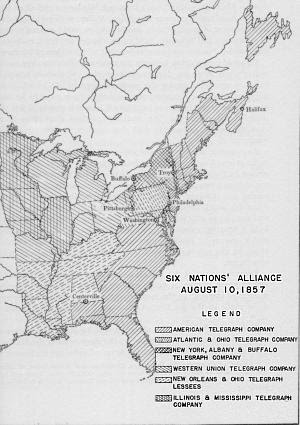
At the time this was sent, telegraph services were covered by companies in the "Six Nation's Alliance" of 1857. Essentially, it was an agreement between telegraph companies to allow monopolies for services within the areas each controlled.  By the time we get to 1866 (and the year the trans-Atlantic cable was active), only Western Union remained.

from Thompson, Robert. Wiring a Continent, Princeton: Princeton University Press, 1947, p 315.

The letter created for Mr. Voegeli in New York traveled via normal mail services via the mail packet (steamship) Anglo-Saxon.  This ship was an Allen Line steamer that ran from Quebec to Derry (northern Ireland) and Liverpool (England).  Once Mr. Voegeli got this report in the mail he had it printed out, labels affixed, and mailed to his clients using printed matter mailing rates.

And that's how investors and business persons in Europe got the latest news about commodities in the United States in 1860.  Now you know.

Demise of the Anglo-Saxon

photo taken from: "Wreck of the immigrant vessel "Anglo-Saxon" off Newfoundland, April 27, 1863, artist's impression, detail," House Divided: The Civil War Research Engine at Dickinson College

Two and half years later, the Anglo-Saxon was lost in wreck off the coast of Newfoundland (April 27, 1863). The steamer was headed from Liverpool to Quebec when it got lost in a heavy fog.  The ship ran aground in Clam Cove, four miles north of Cape Race.  After hitting the rocks, it rapidly broke apart.  Two hundred thirty-seven of the 445 aboard were lost.  And, as a side note, none of the mail survived the wreck. 

However, I bring this up to point out the many directions a person can take postal history.  If I were inclined to do so and persistent enough to do it, I could hunt for mail carried by the Anglo-Saxon on its last voyage prior to this accident.  I could look for items carried on its first voyage.  I could look for mail items that were sent or received by persons who were known to have survived this accident.  It is possible I could find other items that reference this event as well.  

Postal history - it's an opportunity to explore the stories that interest you as they connect to an item you can have resting in front of you.  That's a big part of what I enjoy about this hobby.

Thank you again for joining me for Postal History Sunday.  I hope you learned something new and stayed cool and comfortable while doing so.  Have a good rest of the day and I hope your coming week treats you well!

Saturday, August 6, 2022

Around the Bend

When Tammy and I take a hike on a trail, we do like to take a moment and enjoy our surroundings as we go.  This is even more pronounced if we bring a camera along because we like to try and look at things different ways and capture different viewpoints of where we are at that point in time on the path.


Most of the pictures don't turn out to be much of anything from a 'photo' perspective.  In fact, most of them end up being deleted.  But, some few of them look pretty good and many of them help transport ourselves back to that moment.

Then, there are pictures that - even though I remember that moment and place - make me wonder:

"What would I find if I stepped into that picture and followed the trail I see?  What would be around the bend?"

Would the trees welcome our presence?  Would there be a light breeze or would it be perfectly calm?  Are there birds in the underbrush to the right and left?  Would they grow silent as we stepped through or would they continue to chatter, not caring that someone magically appeared on the path nearby?

Would we remember to look carefully at where we are now and appreciate things like the texture of bark, the smell of leaves and the rustle of sound as a small creature darts around in the brush?  Or will we focus too hard on our destination - the area after we turn that bend in the path? 

I just hope that we can be happy to be on the path in the first place.

Friday, August 5, 2022

Henlet - A Sililoquy

To lay, or not to lay, that is the question

Whether 'tis nobler in the mind to suffer the double yolk misfortune

or to add to the farm's troubles, by pecking - end them.

The eyes of a hen are placed on the sides of their heads, though we have noticed some are a bit more forward in placement than others - even in the same breed.  It is said that a hen has approximately a 300 degree field of vision.  But, if she wants to a get a good look at you, she will turn her head to the side so she can get you in full focus with one of her eyes.

To fly, to leap -- some more

and by leap we oft end in heartache, suffering the natural shocks that poor flight is heir to. 

'Tis a frustration as flight is devoutly to be wished.

If you have seen Chicken Run, you may have the mistaken assumption that all laying hens are unable to fly because they lack "thrust."  This is largely true for "heavier" breeds of chickens.  But, lighter breeds are perfectly able to fly.  In fact, we have found that the California Whites and the Americaunas on our farm are much more capable of attaining the appropriate thrust for some flight.  There is a reason we have six foot tall fences around our main hen pasture.

However, just because you can fly, it doesn't mean you are particularly good at it.  Don't expect any aerial acrobatics out of a hen.  Sometimes, our hens will misjudge their attempt at flight and run into walls, doors, humans... other hens...

Let's just say that innovators of airplanes and helicopters did not use a chicken as a model for figuring out ways to fly.

To sleep - perchance to dream: hey, there's a bug!

For in that sleep my breath in snores and whistles may come

After we have shuffled to our perches, and gripped them with our talons.

Chickens actually do have an REM (Rapid Eye Movement) sleep cycle that indicates the capacity to dream - possibly catching some tasty six-legged things in their sleep or soaring over the treetops, since they typically can't do that in reality.  While sleeping, we have noted that some birds will 'snore' in various fashions.  Some will emit a long whistle, not unlike some of the exaggerated sleep sounds found in cartoons.  

And, as far as perches are concerned, there has actually been research on what the best perches for a chicken might be.  At the Genuine Faux Farm, we tend to favor 2 x 2 square boards that are slightly rounded.  Some birds prefer other surfaces in the hen room and a few prefer staying on the ground.  In fact, if you look closely, they may not be gripping that perch as much as you think once they settle in!

There's the respect that makes calamity of a rooster's life.

For who would bear the snips and scorns of hens,

The crows are long, the proud rooster's song rings about the farm.

Ignoring dawn's delay, wearing the insolence of his office.

Stu and Stwo are the names of our current roosters on the farm (they want you to spell it right - after all, "Stew" would not do).  They are Americauna roosters and they display a fine ruff of feathers around his neck and a pretty decent set of tail feathers. Of particular note is Stu's amazing, extendable neck.  While most chickens can extend their neck out, Stu can go from the resting position you see above to holding his head up a good six to eight inches higher when he straightens up.

One of the things we have noticed over time (and several roosters) is that roosters can have a wide range of temperaments.  Some can become overly aggressive towards both the hens and humans.  Others can be bullied by the hens (a recent rooster never had a chance to grow out a full tail because the hens kept pulling out the feathers).  Some crow a lot and others not so much.  

The biggest reason we keep one or two roosters with our flock is the reliable "alarm" call that you can learn to respond to.  No - I don't mean an "alarm clock."  I mean a call of alarm.  Once you learn the language of the rooster(s) in your flock, you can learn the difference between regular flock noise and a call that indicates there is a problem that requires a farmer's intervention.

To cluck and scratch under the blue sky, but that the dread of something swoops down,

for we live in the country, where a traveling hawk passes by and returns, 

the rooster's call makes us scatter from the ills that may befall us - perhaps to fly to others that we know not of?

thus being chicken makes cowards of us all...

It is true that hawks, owls and other flying predators can be a problem for a laying flock.  But, if you watch closely, the rooster and some of the hens will often turn an eye to the sky to watch for problems.  In fact, in our flocks, we typically have one or two roosters and seventy or more hens.  With that sort of situation, it is not uncommon for a couple of hens to take on more aggressive, protective roles to supplement the rooster's role.

It is also interesting to note that a flock can learn which sort of predators they need to fear (such as the hawk over head) and those they might be able to intimidate (such as Inspector).  If you look closely, you can see that the hens who are warning Inspector away have extended their necks.  The hen at the right is a flock caretaker in our current flock and will usually lead a charge towards our poor cat - who just wanted to come say "hi" to the farmer who was taking pictures of hens.

While you might think hens are really pretty smart (and they are in their own ways), please consider that there are reasons for some of the stereotypes.  We have seen chickens in the pasture get surprised by something as innocuous as a leaf falling.  One hen gets startled and that leads to a whole flock running for cover!

We hope you enjoyed Henlet - A Sililoquy.

Alas -fair Ophelia!

Thursday, August 4, 2022

Why Leadership Matters

I don't think it is any surprise to those who know me that I expect a great deal from people who put themselves into positions of leadership.  It does not matter whether I like or dislike a person who is in that position and it does not necessarily matter whether I tend to agree or disagree with them.  What matters to me is that they are in a position of leadership and I expect them to exhibit certain qualities.  

Here are a few examples that I hold up for myself from my own experiences in life. 

The Crushing Weight from Above Revealed

At one of my jobs as a Software Engineer, I had the privilege to work for a person who was an excellent supervisor.  She quickly earned my respect and I still hold her up as an example of a fine person exhibiting excellent leadership skills.  Immediately after I was hired, she provided me with a vision that she saw for my role in her team.  She allowed me a chance to respond with how I felt about that role and was willing to modify expectations as I learned on the job and as she observed how I worked on the job.

I always felt that it was safe to disagree with her and she encouraged feedback.  Even if the final decision did not go the way I was advocating, I was convinced the decision was based on her best judgement given the facts and the feedback she had received from the entire team and whatever other resources were necessary.

Every member of the team felt valued.  Each person felt like they belonged.  And we learned how much weight she was keeping off our backs when she moved on to a new job.  As I look back, my respect for this person increases when I consider how much pressure she must have been under and how well she dealt with it.

It did not take long for the team and the project to begin falling apart once leadership changed from a model that was consistent, informed and competent to one that was erratic and misdirected.  The atmosphere changed from one that was affirming to one that felt like we worked under constant threat. 

The difference for the members of the team was one person.

Same Pieces, Different Results

I mentioned Coach Rowray in this post called Words to Live By in April of 2017.  He was the Junior Varsity baseball coach during my junior year in high school.  I played on both JV and Varsity teams that season (sparingly on Varsity that year).  Typically, a junior who was on JV might get a bit discouraged and finally give up the sport, but varsity was loaded with seniors and I loved the game.

In the end, it was all to my benefit because I was able to experience another example of leadership that I still reflect on.

Dave Rowray was filling in for one season, so he could have done the minimum and then passed things on, largely intact, to the next person who took on the role.  But, he didn't do that.  He built a team that was disciplined and understood that a team often requires people to take on roles.  While he did not waste many words on long explanations, we rarely were asked to do things without knowledge of the 'why' that came with the task.  

There was one coach that applauded my determination to back up first base.   Guess who that was?

It was clear when he was pleased with your efforts and it was equally clear when he was not.  He made more noise applauding hustle and effort than he did when a player muscled a ball over the fence.  He put people in positions where their skill set would be most likely to succeed.  And, he found ways to encourage each of us to expand our skill sets.

Just prior to our last game of the year, Rowray commented that I had played 16 games without an error prior to game 17.  Then he said, "We can't have that."  Sure enough, I had a tough play in right field that would have been a spectacular play if I could have held onto the ball.  He noted that I had lost one step because I initially turned the wrong way on a ball that was driven over my head.  With no small amount of glee, he told the scorekeeper to "award" me with an error rather than give a hit to the batter.  The message?  You've done great and I see that - and I know you can do even better!  And I believed it.

That team went 14-3 and every player contributed.

With a different coach and most of the same player-pieces, this same group never reached this level of success again, playing .500 ball over the next couple of years.  There are so many variables that one can never tell for certain what all of the causes might have been.  But I can tell you that strong leadership from one person brought more out of each participant and better results for the whole.

Chaos in the classroom

As a person who has been in both student and teacher roles, I can point to numerous examples where classroom leadership was successful and several others that were not.   More often than not, a successful leader of a classroom shows respect for the subject, respect for the profession, and respect for the learners.  

Certainly competence plays a role - I consider that part of the 'respect for the subject.'  But, I have seen clearly competent individuals belittle or make light of the very subject they intend to teach.  Why in the world should students offer their best efforts if the instructor makes it sound like they don't think it is worthy of that effort?

Most of us have examples in our lives of teachers we thought well of and those we... well, thought less well of.  Without belittling how incredibly difficult teaching can be, I bet most of us can detect certain characteristics that made successful teachers competent and effective leaders in the classroom.

The effective teacher-leaders tended to signal to the students that they actually cared about you and your learning.  These people sent consistent messages about the desirability of acquiring knowledge and developing skills.  The best teachers found alternatives to keep as many people engaged and moving forward as was humanly possible  And, in all cases, they presented their topic as accurately as they could and showed professional competence as a model for students to emulate.

These teachers often recognized that there could often be more than one way to be successful.  And they would publicly admit when they, themselves, did not have an answer for a given question - yet they would still be able to outline a strategy to look for the answer that was needed.

Each of us learned to love and dislike numerous areas of study - often because of one person and the qualities of leadership (good or bad) they exhibited.


Leadership Matters

  • Good leadership encourages individuals to be part of a team.
  • Good leadership allows for disagreement and hears different points of view, giving them value even when the final decision can not agree with all participants.
  • Good leadership recognizes the value of roles of all types and understands the different viewpoints each role might bring with it.
  • Good leadership is concerned about encouraging the highest level of excellence each team member is capable of achieving.
  • Good leadership supports members who are struggling when they need it, encourages those who need encouragement, challenges those who could use it and adjusts so the entire team succeeds with the support of each team member.
  • Good leaders are role models - recognizing that they represent the whole.  And, when they do poorly, they recognize it reflects badly on more than just themselves.
  • Good leaders exhibit integrity and competence.  Good leaders instill confidence.  Good leaders take communication seriously and good leaders accept responsibility.
  • Good leaders acknowledge their own failures and work to adapt and change to address them as best as they are able. 
  • Good leaders are willing to admit that they have limits, that they make mistakes and that they aren't always certain of the best course to follow.  But they also instill confidence that they are committed to finding ways to deal with their limitations and mistakes with the team's help.
  • Good leaders stand up for all members when any of them feel threatened or weakened.
  • Good leaders are always looking to improve themselves.
  • And the best leaders recognize that they will lead when they serve.

Wednesday, August 3, 2022

Gentle Reminder


I felt like today would be a good day to share some gentle reminders with those who might happen to read the Genuine Faux Farm blog.

It is our wish that you will be well.  Be kind to each other.  Remember to stop and greet the flowers when they dress up for you.  Nod a greeting to the bees as they pass you by on their way to work.  Skritch a cat and provide them with taxi service if they ask and you are able.  Patiently listen to a tree as it takes the time to use all of the words it needs to describe something to you.  Really listen to some music or to a bird sing.  Watch the sunrise or the sunset.  Do what you do with integrity and show empathy for others.  Work hard and take care of yourself.  Learn something new.  Share something you enjoy with someone else.  Listen carefully and think well.

And, be the voice that tells someone else that they are loved.

Tuesday, August 2, 2022

Caretaker

I was contemplating what to write about for August 2, realizing that I really don't have to write anything for August 2 - or any other day - if I don't want to.  Except maybe I should write one thing - happy birthday Dad!
 

In an effort to tie all of this to the farm, I thought I would share a picture from a number of years ago that highlighted the shelves Dad built in the truck barn so we could efficiently store the coolers, containers and various other things we have need of to do our work.  While the things on the shelves have changed, the shelves are still there and serve their purpose well.  The only thing that has changed about those shelves is that they have been painted.

While Dad was not a farmer, he was (and still is) a caretaker.  I like to think that I am also a caretaker because my father was the role model that showed me how - even if I go about it all a little bit differently than he might.  It didn't matter if he was siding houses, working in sales at Coast to Coast, working as a printer, or helping printers get the paper they needed - the way he went about business showed the value of hard work with integrity, while still appreciating the world around us.

I wrote the following back in August of 2020. It seemed appropriate to share it again now.

Norman Rockwell illustration

The artistry of Norman Rockwell has been something that has captured my attention since I first encountered it at my grandparent's house in an over-sized, coffee-table book.  Rockwell had a way of capturing people in a way that let you get lost in layers of fine detail that told a story, even though there was no motion, no sound and, typically, no words.

In the illustration shown above, it is absolutely amazing how things like the texture of the wood on the scythe and the roughness of the farmers' hands are so clear to see.  But, even more amazing is the depth and consistency of the detail of the work. 

It is perfectly clear that the clothing worn by this individual is something familiar and functional.  There is a wear pattern on the handle of the scythe that implies this is not the first time it has been used - just as the hands of the farmer who is wielding it are roughened and experienced in manual labor.  The details showing the difference between skin regularly exposed to the elements (face, hands and neck) versus those less frequently exposed (upper arm) shows an honest familiarity of what it means to work outside.  The hair is likely a little mussed under that hat and it isn't likely to get much better until the end of the work day and all of the chores are done.

This is one of my favorite Rockwell pieces as it portrays the farmer as a caretaker - one who works hard, but keeps an eye on the well-being of the world around them.  The farmer has an appreciation for hard work and fully understands that 'things don't get any dunner, if you don't do them!"  At the same time, there is a recognition of natural beauty and the fragility of life.  And - the farmer knows that there is time to observe these things, even when more work waits.

Those tough, thick-fingered hands don't blister much anymore because they are all callous - but they can still hold a small bird.  Gently.  Kindly.  With awe and wonder.

This is the image of farmer I wish we could see realized on a regular basis.  Caretakers.  Not businessmen.  Stewards.  Not commodity growers.  There are plenty out there who have the heart to be this kind of farmer.  It would be good if we could find a way to employ them and realize the depth of value, beauty and worth that this type of caretaker brings to the land.

Monday, August 1, 2022

The Difference Eight Years Can Make

July 2014 at the Genuine Faux Farm

I was trying to find a different picture when I came across the photo above from 2014 at our farm.  This is the area out by the road and to the east of our driveway.  It was an area we wanted to get some new trees into as part our stewardship of the farm and its surroundings.

Of course, the two ash trees dominated this area, as they were well established when we got here in 2004.  But, by this point in time we were well aware that Emerald Ash Borers would eventually catch up to these trees, whether we wanted that to happen or not.  So, if you look carefully, you can see a few evergreens we put in and a Gingko tree.  There is another, larger evergreen we put in around 2005.

I recall that we wanted to do more with trees earlier in our tenure at the Genuine Faux Farm, but when you have lots of goals, you have to prioritize because you simply can't do everything.  That, and a couple of trees we put in ended up being victim to some early storms.

So, take a look at this same area today.

2022 at the Genuine Faux Farm

The ash trees are gone, as we had foreseen.  We decided to leave the trunks for the woodpeckers (and maybe we'll put a kestral nestbox on one?).  The evergreens have put on some good size over the years.  But, the Gingko has done next to nothing.  Yeah, it puts leaves on every year - so that's something.  But, it just never has seemed terribly happy with where it is.  And, we've added a couple of crab apples closer to the driveway now.  

This is where looking back can be very helpful as we consider and plan for what we are doing next at the farm.  We see some successful prognostication on our part.  We some opportunities missed and other opportunities taken.  And - we see growth and change that is often too slow for us to recognize from day to day or month to month.  But, when we look at a longer period of time, the evidence is clear for us to view.

And that is why I take the time to look back at the older photos of our farm every so often.  It confirms for me that if we commit to doing our best to do what seems right for the Genuine Faux Farm, there can be positive rewards.  Sometimes doing the right thing is to act on something and sometimes it is to be patient and wait.  And sometimes... we actually get it right.

Did we get it right on this part of the farm?  Well, I suppose we could have done many things differently, but that doesn't necessarily make what has happened wrong.  We can't change what we did eight years ago either, so this is what we have - which means it is as right as it is going to be and as wrong as it is going to be.  All we can do at this point is to take what we have learned and make decisions for what we are doing now.

I wonder what our actions today will look like in 2030?  Well, if we're still here doing our thing, we'll probably share on August 1st of that year - because that seems like the sort of thing we would do.