Saturday, March 11, 2023

Daylight Savings Solutions


When it comes to the controversy that is Daylight Savings Time and the bi-annual shift between Standard and Daylight time, we are a split household.  My opinion is that we should just pick a time (Daylight or Standard) and stick to it.  Tammy's is that she sees a benefit to to each.  She likes the sun to be up well prior to her 9 AM classes in December.  So, she's got a point there.  If we were to choose Daylight Savings time for the whole year, the latest sunrise would be about 8:40 AM (with official "dawn" being about a half-hour earlier).

And, I guess there is the "issue" of dawn arriving at 4AM in June if we stick with Standard time. 

It's only because the switch between Daylight Savings Time and Standard Time seems to mess with me and my own internal time clock so much that she might be willing to agree to stick with one or the other.  

Some of you might recall that this is not the first time I have offered up a set of possible Daylight Savings Solutions.  But, since it is upon us yet again, I couldn't help myself!  I am re-sharing previous solutions (with some edits) and adding in some more!  

That, and I wanted to share some nice sunset and sunrise pictures, so I added them in too!

Let's have a little fun! 

Option 1: Give the night shift the daylight

All of those fine people who get stuck with the "graveyard shift" deserve a break.  How about we simply switch around AM and PM?  Now the night time hours would be the sunlit hours!

All of those folks who have had to deal with working without the benefit of the sun will suddenly be able to step out during break and catch a few rays.  And, isn't it time the rest of us learned what it is like to work our shifts during the hours when the sun is shining on the other side of the earth?

Option 2: Ease the shock of the time change with incremental time changes

One of the reasons I struggle with the time change so much is that we make this big, one-hour shift all at once.  As the sunrise happens a little earlier each day in the early Spring, I find myself getting up a little earlier each day with minimal fuss and bother.  So, let's EASE into Daylight Savings!  Maybe it will convert people like myself into believers that DST is a good idea.

Starting March 1st, we should add one minute to the time each day until, after 60 days, we've reached the one hour mark.  Ha ha!  Now we're where we want to be for the longest days of the year.  Then, we subtract one minute each day for sixty days in the Fall!

I can't see any difficulties with this proposal - can you?  I mean, it's simple.  Though we might get tired of all of the "set your clocks ahead (or back) one minute" reminders for 120 days of the year.

Option 3: Provide an opt-out policy

Let's let everyone PICK whether they want to participate in either Daylight Savings or Standard Time.  If the time switch really bugs a person, they can sign a personal "opt-out" form.

We can then have two segments of the population that reside in the same area in two different time zones.  Think of the fun and excitement we could have with this!

That office meeting that happens every week is now going to have to have two meeting times published if you want everyone to attend together.  However, this could also be a way to split things up and give everyone more opportunity!  The high school varsity baseball teams could have a game at 7pm for the DST'ers and a 7pm game for the ST'ers.  Twice as many kids get to play!!  Though I suspect there may be some issues with the use of the ball diamond.

And given our tendency of late to take sides on practically any issue and make it personal, this might just be a recipe for disaster.


Option 4: Go half-way

Do you have some of the complaints Tammy has regarding sticking with either Daylight Savings or Standard Time?  Would you rather not have the sun come up after you've gotten to work in the winter or have it pop up just after you've finally gotten to sleep?

Here's a solution for you!

Let's just move each time zone half way between the two!  Pick the half-way mark, moving 30 minutes forward from Standard and then stay there with no further changes.

Option 4a: Adjust for popular opinion

Or, we could be a bit more innovative!

Let's have everyone vote for which of the two times they like better - Standard or Daylight Savings.  Then, based on the vote, we move the time.  For example, if 66% vote for Daylight Savings and 33% for Standard, we just move 40 minutes forward from Standard (or about 66% of the distance between the two).

See?!? Everyone got a say in the matter AND we're able to make a numerically supported compromise!  

Option 5: Spice it up and let every state just pick a time measuring method

Hey!  Why don't we do what we seem to like to do with so much of our governing in the United States?  Let's let every state pick how they want to do things.  Surely that will make everyone happy.  I mean, doesn't this approach ALWAYS make everyone happy?

No?

Huh.


Option 6: Go back to sundials

As an introvert, I actually like the idea of sundials.  

First, if it is a really cloudy day, you have to cancel all of your scheduled meetings because NOBODY will know what time it is.  And, second, you can really mess with peoples' sense of time during the night-time hours.  Only those folks who work the night shift will know what's going on.  The rest of us will be completely lost.

Option 7: Use the "Farmer Time" method

To be perfectly clear - I've learned to rely more on the arrival and existence of daylight to tell me when to do things on the farm.  Sometimes the construct that is time zones just gets in my way.

Sun's up?  Time to get up and let the animals out, give them food and water, and just start "doing stuff."  Sun's going down?  Time to put the animals away, put the equipment away, and perhaps do something that is not farm-related for a while - like sleep. 

If you don't want to work the same hours as a farmer, the solution is simple.  Make a calendar that tells you how many hours and minutes of daylight you have each day - then slice off chucks of it for work and for play.  You can either count from the point the sun is at its highest or you can count from dawn or dusk - you pick. 

Works great - unless you live in Alaska.  If you're waiting on sunrise to tell you it is time to get to work in the winter months, you may have a problem - and you'll NEVER quit working in the summer months.  

I guess you could figure out this hibernation thing other critters do. 


Option 8: Time zone trials

Are you the kind of person who really hates to buy something before you actually have tried it?  If so, you might like this idea!

Let's allow communities a chance to test drive different time zones to see which one fits best!  It could also be a great way to travel without physically leaving where you are.  Want to visit London? Just shift to Greenwich Mean Time for a while!  Or maybe you just had a REALLY GOOD day - you could switch to a time zone that's a few hours earlier and extend that day a bit!

What do you mean that wouldn't work?

Option 9: How about a lottery?

It seems to me that an inordinate number of people like to gamble on all sorts of things - why not gamble on the time zone approach that your locality will be using?

To make this even more realistic, let's first take a poll to find out what the most popular choices would be.  Then, we need to set things up so those choices are LESS likely to be selected.

The basic idea is that only a couple of REALLY lucky people will be happy with the solution.  Everyone else.... loses.

Option 10: Use the sands of time.

We can learn to appreciate or come to despise the sands of time if only we all started carrying an hourglass around instead of watches or phones.  Obviously, it has to be a big enough hourglass for each person to be able to keep track of time for the entire day.  I realize this is something like the idea of having everyone set their own time zone - but I wanted to offer up this option because I learned something cool when I first wrote about these Daylight Savings Solutions.

The largest hourglass is reported to be in Budapest, Hungary.  It measures one year of time and weighs 60 tons.  Happily, an hourglass for one day would be a bit smaller than that.  In fact, you can get a 4-hour hourglass and it is "only" 18 inches tall.  I realize this would not be a perfectly linear equation, but that puts a daylong hourglass somewhere in  the range of six-feet tall.

I hope these things would come with wheels - and turning them over for the new day might be a bit of a production.  That big, Hungary hourglass takes four people hauling on cables 45 minutes to get it turned for the new year.

But, I suspect enough of us make New Year's resolutions to get into better shape.  Why not make it necessity to turn over a six-foot tall glass each day?

Option 11: Move the people with the time

Well, if most people don't like the time change, I have another idea that would NOT require that we make ANY changes to our current system of cycling between Daylight Savings and Standard Time.  Keep all of that the same.

Instead, we should make people move from time zone to time zone so they do not have to adjust their clocks - they just have to adjust to a new home and new location.  

I suppose there might be an issue when we start pushing people on either coast into the ocean, but we all have to make sacrifices if we want to solve this problem.

Option 12: Double or nothing

Here's an option for those of us who are always complaining that time goes by too quickly.  Or for those folks who say "wait a minute" and they really need two minutes.  Let's just double the length of all of our time units.  Make each second twice as long, each minute twice as long, each hour twice as long...

I think you get the picture.

How does this solve the Daylight Savings issue?  Well, you just get rid of it.  The swing between longest and shortest days of the year just got cut in half!  Tammy's complaint with the sun not coming up in time to start the work day is moot because now the sun will come up around 4 am even during the shortest days!  And yes, it will still be up well into the evening hours.

If you really like sunrise or sunset, you can get TWO of each of these every day with this plan.  Just think!  You could double your productivity!  A two week vacation would be TWICE as long.  Your favorite holidays could truly be savored because you have double the time to enjoy.  You could even eat TWICE as much in one day!

For those of you who like to take naps, it will be dark in the middle of the day.  So, taking a nap just got easier too!  

On the other hand, if you think a one-hour meeting is bad now...  And while the wait in the doctor, dentist, whomever's waiting area was only fifteen minutes, it was a LOOOONG fifteen minutes.

Option 13: Split it in two

Okay, be honest now.  After Option 12, you just HAD to see this one coming, didn't you?

Let's split each day into two pieces.  One part will be called "night" and the other will be called "day."  We just count time from the beginning of whichever part we're in.

Unfortunately, this then brings us to the debate as to when day and night actually "officially begin."  Is it during Civil Twilight, Nautical Twilight, Astronomical Twilight or Official Sunrise/Sunset?

Well, at least we have the hope of having more than two sides to that argument, won't we?

Solving the worlds problems, one at a time

It turns out that, according to this poll, only 28% of people in the United States actually favor this swapping back and forth between Daylight Savings and Standard Time.  On the other hand, they can't agree on which way we should go.  While 40% prefer that we stick with Standard Time, 31% would prefer to stay with Daylight Savings.

Clearly, this is a difficult situation that calls for my unique style of problem solving.  See how quickly and easily I came up with fourteen, count them, FOURTEEN (remember 4a?) solutions for this very knotty and clearly divisive problem.

Now that I've provided the world with this service, which problem should I tackle next?  

If you have ideas - put them in the comments, I'll get right on it!

Friday, March 10, 2023

Thursday, March 9, 2023

Still Wagging the Dog

I have been thinking about the idiom "wagging the dog" again.  The traditional meaning of the phrase is that something less important is controlling something that is more important.  The idea is that the tail has been given enough power that it can make the dog's body lose control.

Bree, one of our Farm Office Supervisors at the farm, isn't terribly impressed that I am thinking about this because she believes that dogs are kind of 'air-headed' anyway.  What should it matter whether the body or the tail of a dog wags?

An analogy from a couple of years ago

We left the farm for a doctor visit or some such thing and came back just after sunset.  That meant that I had to go straight out and close up the chickens for the night.  As I walked to the Poultry Pavilion, I heard loud voices that sounded like they were out by our east fields.  After completing the chores, I walked that way to investigate.

What I found was that there were three snowmobiles and drivers out at the edge of our property.  Clearly, one of them was stuck and they were loudly trying to 'unstick' their vehicle.  As I walked down the road towards them, they must have succeeded.  They shouted something to each other about cigarettes and beer before driving rapidly across the road and our neighbor's field.

Um. Okay?

There is some background to this story.  There is a snowmobile trail that runs around our farm to the west. There is no trail to our east.  We have noticed a few times that there were some folks who seemed to want to go all over our neighbors' fields.  We don't know if they had permission to do so - we just noticed there were a few who were doing this.

Apparently, on this particular night, in the process of running on our neighbors field, one of the drivers thought our little farm would be a neat place to try zipping around.  They hung themselves up on some caged bushes we have in our buffer zone that were mostly buried under a snow drift.  The result was that the cages and bushes were crushed - and maybe they had some damage to their machine.  

This isn't the only time we've struggled with snowmobile drivers deciding to take detours on our farm.  It isn't the only time they've damaged something.

Letting the minority define the majority

And now we get to my parallel to wagging the dog.  

The temptation after these experiences is for the two of us to conclude that people who drive snowmobiles are ... well...  what should we think?  Let's just say that we're not impressed and leave it at that.  It's so easy to want to grumble at EVERY and ANY snowmobile that goes by our farm after events like this.

But, that's the problem.  We should not allow a few individuals define what we think of all who enjoy snowmobiling.  After all, the vast majority of those who go by our farm stay on or near the trail.  They tend to go by at reasonable hours and not at 1 AM in the morning (which has happened).  They appear to be enjoying themselves while still being responsible and respectful to those of us who happen to live next to the trail.  

But, these other individuals make us entertain the idea that everyone who gets on a snowmobile is irresponsible and disrespectful.  Should we assume that if we see you on a snowmobile that you are are going to start driving all over one of the bushes we worked hard to put in and care for?   Should we paint you with the same brush and curse at you as you drive by?  Should we demand that the trail be shut down or call the sheriff?

You tell me.  But, read the next part first.

The bigger picture

As the pandemic started, the number of hate crimes against Asian-Americans rose significantly.  Apparently, because some people made a claim that China "caused" the Covid crisis, anyone who looks like they might have any Asian characteristics is to blame, is looking to infect everyone else, and should be punished by being treated poorly.

Without even getting into the whole "what causes a pandemic" thing, let's consider this with the same lens I used for the snowmobile drivers. 

Is it fair if I blame every single person who likes to snowmobile for damage to those bushes and cages?

No.

Does everyone who drives a snowmobile intend to damage my farm or wake me at 1 in the morning?

No.

Why would anyone think it is right to assume anyone who "looks Asian" is suddenly to blame for a virus?   How could you possibly justify your bad behavior towards people because you can't differentiate between responsible parties and everyone or anyone else? That's a tail wagging a dog if there ever was one.

And then, how is it that we are then surprised when everyone who is "like us" is lumped into a group and pegged as violent, uncaring and ignorant? 

I happen to be a white male of European decent.  Therefore, I am aggressive, prone to violence, foul-mouthed, and inconsiderate.  I am domineering and unsympathetic.  I sneer at people of color and think they are inferior to me and I believe women are ok, except when they start acting like they might be as smart or smarter than I am.  If that happens, I will put them in their place by showing how much smarter, how much more logical, and just how much better I am.  Or maybe I'll just resort to bullying them until they give up.

And, of course, I am likely to commit a mass shooting in the United States.

If you know who I am, I sincerely hope you disagree with all of those statements (and sentiments).  And yet, there is a whole host of examples of people who are ALSO white males of European descent for whom those descriptions fit.  Since I am like them, I must be .... like them?!?

The takeaway

The next time someone who is not like ourselves enters our world, don't make the assumptions that they are like the worst versions of whatever group we think they belong to. 

That snowmobile driver over there is not necessarily inconsiderate and bent on the destruction of bushes and cages.

The Asian-American walking down the street or living in your neighborhood is not plotting to infect you with a virus, nor are they naturally inclined to do you harm.

And you and I, no matter what groups we identify with, will be lumped with the worst characteristics shown by other people who can also be identified as being in that group.  Until we all make an effort to consider individuals on their own merits.

Don't let the tail wag the dog. 

Wednesday, March 8, 2023

Close Encounters


We have decided that we need to start taking our camera with us whenever we get into a vehicle to go ANYWHERE now.  We've actually said this to ourselves before and really didn't follow up on it.  This time, I think we might just do that - unless you think we'll "jinx" ourselves.  But, before you take a moment to advise us, let me tell you the story that led to the conclusion!

We have been playing the game Wingspan frequently now for a few years.  The relative familiarity we have with the depictions on the bird cards actually have helped us to more readily identify birds when we are out and about.  Shown above are two relatively distinctive birds.  The American Woodcock is a bird I don't think either of us thought we would ever encounter.  The Horned Lark is a bird we see every winter near the roads out by our farm - but we rarely get more than a distant viewing before the flock flies away.

Horned Lark by Jeremiah Trimble - shared at Macaulay Library

Horned Larks, for the most part, have headed north by the time we get to early March.  We might get one last viewing of a group of them on a cold, windy day in late February.  So, imagine our surprise as we rounded one of the sharp turns on the gravel road and noticed a lone Horned Lark sitting on the side of the road.  

Per the the norm, it started to flap its wings to fly away - but then it simply veered back and landed close enough for us to appreciate the bird - not more than ten to fifteen feet away.

My first thought after, "Wow! This is so cool!" was "why didn't we bring the camera, it's practically posing for us!"  Maybe Kip Ladage found the same bird later that same day?  I am pretty sure Kip wouldn't be caught without the camera - but we sure were.

This particular specimen did not have a strong manifestation of the "horns" that give it its name.  But, once it faced towards us, we could really appreciate the strong markings and even some of the yellow coloration that is often hard to see when they give you a side view like the bird shown above.

I have to admit that I worried about this particular bird a little bit.  While it seemed healthy enough and had no outward signs of illness or injury, Horned Larks are not typically loners when they visit Iowa.  They often are found in mixed flocks with Snow Buntings or Longspurs.  And it really was odd that it let us get that close in our vehicle.

We'll never know why this particular feathered friend was partaking in "alone time."  Maybe there are introverts in the bird kingdom too?  That doesn't explain its willingness to interact with us, unless we don't count as an interaction from its perspective?

Or perhaps, this bird is a bit like me - slower to accept change and will move on when its darned well ready - thankyouverymuch!

American Woodcock by Ryan Sanderson - Macaulay Library

As we play the Wingspan game, we often look at the American Woodcock and think how strange that bird looks.  I think we both discounted the possibility of our ever seeing one and just chalked it up to the "it exists, but we'll never have personal evidence that it does."

Believe it or not, we had a similar drive-by experience with a Woodcock on this same gravel road (but a little bit further east).  There is a wooded area that was being partially cleared, so I wonder if the disturbance of its home resulted in a confused bird sitting on the road.

Tammy was driving and I was looking the other way.  Her rapid slowdown and stuttered, nonsensical noises only served to startle me.  But, it didn't startle the bird, apparently.  After a quick bit of backing up, Tammy was able to point out what had her so tongue-tied. 

There we were, only five to ten feet away from one of the strangest looking birds we had ever seen.  

American Woodcocks spend most of their time on the forest floor, using the long beak to probe for earthworms and other tasty treats.  Their eyes are positioned near the top of their head - which is where eyes need to be so they can keep an eye out (get it?) for any threat while the bird forages on the ground.  And yes, the eyes did seem a bit big for the bird.  But, that might simply be our brains making them a bit bigger because they don't feel like they quite belong where they're at!

By the time I got enough of my own senses back so I could grab my phone in an effort to take a picture, the Woodcock ALSO came to its senses and flew away.

But, we still have the memory and the story.  And we still play the game.  But, when these two birds come up, I find that I now have fond memories to attach to them.  It makes me a poorer Wingspan player because I might opt to try to play them even if it's not a good strategy.

But I'm a richer person with these stories in hand.  I prefer that to winning a board game anyway.

Tuesday, March 7, 2023

The Tile Flag Dance


Murphy the Nibster is still very much a kitten.  But even accounting for her kittenhood, she is quite the dynamo.  Both Soup and (especially) the Inspector have registered complaints regarding her zippy, pouncy self.  I tried reminding the Inspector that he had been the annoying kitten not so long ago and he gave me a look.  What did that look say?

"You know full well that I was NEVER like that."

And Inspector is correct.  He certainly WAS a kitten that had some energy.  He did annoy his elders sometimes.  But he was never quite like this.

I have yet to actually catch Murphy sleeping.  Not once.  But, every time I go outside, she shows up.  She runs around.  She pounces.  She darts.  

She kittens.

Her head is still a bit small for the rest of her body, but that has evened out a little.  Her eyes match her fur and she has a very nice engine when she purrs.  

And we're still not sure what role she will adopt on the farm as she grows.

Right now, we're thinking she's an entertainer.  I mean, who knew that a tile flag could result in this sort of choreography?

Monday, March 6, 2023

Easy Decisions


There is a certain level of stress that comes with options.  If you are given no choice, then you just go about doing whatever it is you have to do.  Perhaps you'll grumble about it, but you won't worry too much in the process. But when you can select from a smorgasbord of options, there is an inherent worry that builds the more you consider the relative value each selection might bring with it.

Some options might be very good for you but leave you feeling uninspired.  Other options are exciting and enticing but are definitely a bad idea for your future health.  Then there are all of the gradations in between and the little twists and extra bells and whistles that can be added on top of it all.  Trying to figure out the best solution is probably impossible.  Yet we still let the pressure build as we try to figure it out.

And I was just talking about figuring out what to take from the buffet line for a meal.

I think you get the point.  Sometimes it is easier to accept what is placed in front of you and just decide what goes in your mouth and what does not.  Yes or no can be hard enough sometimes.

Well, we've got a few simple choices to make on the farm this year.  One of which has to do with whether or not we need to get some late winter food to our bees.  The answer for two of the hives is "no."  Why?  Well, there is no reason to feed a hive that has no living bees left in it.  So, it's pretty simple.  The next task for those two hives is to clean them up and prepare for some new bees this spring.  Though, I suppose we have choices there too - do we try to get those hives going again or not?

Interestingly enough, one of the hives still has bees and we did provide them with some additional food.  This was the hive we fully expected to die out as it was the weakest of the three entering the cold months.  Nonetheless, there they were, buzzing as we checked on them during a warmer, calm moment on the farm recently.  I really was expecting to find nobody home and then I'd just start cleaning that one up.

I guess not.  And I really hope they'll still be with us once the dandelions are in bloom.

Another "easy decision" has to do with the lean-to on the Poultry Pavilion.  There was a time not that long ago that we were thinking we might try to rehab the existing framework and just use that.  But, the rapid deterioration over the past couple years made the decision easier.

The best rehab will be to take the old lean-to down and put up new.

It's always amazing how much easier things get once it becomes clear that there is really one choice.  Well, I suppose we have a couple of choices here if I wanted to get persnickety.  We could ignore it and let it come down on its own OR we could help it to come down.  And, yes, we can make choices about timing too.  But once we took the whole series of options away that had to do with shoring up block walls and replacing this, that and the other thing... it got much easier.  And suddenly I find I have more energy for it than I did when there were so many roads we could travel.

It's a fascinating thing - how we react in moments when we either have a paucity or plethora of choices.  For example, I had a whole BUNCH of excellent words I could have used instead of "paucity or plethora."  I agonized for a whole thirty seconds considering those choices before coming up with that selection.  

And you know what?  I actually relished making that choice.  Certainly there was some low-grade pressure involved in the process.  But the task of exploring, considering and choosing was, on the whole, a good thing.  As I think on it, I think I would also have preferred to have more choices to make with respect to living bees too.  I find that I can accept and even appreciate some of the pressures that come with more menu options.

Most of the time.

But I am happy that we aren't going to try to fix that old lean-to.  Sometimes easy decisions that are pushed on you can be a good thing too.

Sunday, March 5, 2023

Stream of Consciousness - Postal History Sunday

Once again, we reach either the seventh or the first day of the week (you get to pick which calendar approach you prefer).  As has been the case for the 132 weeks prior to this one, Postal History Sunday has made its appearance on both the Genuine Faux Farm blog and the GFF Postal History blog.  If you are interested in prior entries, you can view them, starting with the most recent, at this location.

Postal History Sunday started as a pandemic project in an effort to reach out to others, hopefully providing a chance to explore new things and counter the feelings of isolation many were feeling.  Today, PHS is still a place where I share something I enjoy (postal history) and the purpose is the same as it was when I started.  I like to learn and I enjoy facilitating learning - and it is nice to feel the connection with others that comes as a result.  

I welcome everyone here, regardless of your knowledge level or interest level with respect to postal history and the related social history that often comes along for the ride.  It is my intent to write in a way that is accessible to all and encourages you (and me) to learn something new each week.

Put on the fuzzy slippers, tuck those troubles away for a while, and grab a favorite beverage.  It's time for Postal History Sunday!

This week, I was spending some time organizing scanned image files and making copies of those files in different file formats.  When I scan an image, I prefer to put those images into a format called a TIFF file.  However, when I want to share images, it makes sense to make a copy using JPEG format to make the files smaller.  As I went through these processes I found myself thinking about some of the covers and decided following my thoughts as I did the work would be an interesting way to do this week's blog.

Shown above is an 1867 folded letter that was sent from Amsterdam (the Netherlands) to Bordeaux (France).  The postage at top left totals 30 Dutch cents, which properly paid the postal rate between these two nations (Apr 1, 1852 - Mar 31, 1868).

The originating post office needs some method to let the postal clerks and postal offices down the line know whether or not postage was fully paid, part paid or not paid at all.  This particular item is interesting because it shows us both the French and German preferences to indicate that an item was fully paid to the destination.

Franco
P.D. - Payee a Destination

The Dutch post office preferred to mark their postage stamps with the word "Franco," which accomplished two things, it defaced the stamps so they could not be reused AND it told postal people both in the Netherlands and outside the country that they considered postage to be paid.

The French, on the other hand, preferred the "P.D." marking and frequently included language in their postal agreements that such a marking needed to be present to alert their clerks that postage was paid.  Since this letter traveled between the two nations, we get the treat of seeing both styles on one letter.


I came across this next item after I had my musings about the first cover.  It caught my attention because of the way the "franco" is depicted here.  Do you see it?

This letter was mailed in Saxony, one of the German States and a member of the German-Austrian Postal Union.  All members of GAPU were able to treat mail between members as if it was internal mail.  This eliminated the need for exchange offices and many of the procedures that were typically required for mail between different postal systems.  

In fact, members of GAPU didn't really require that "franco" or "P.D." appear on mailed items.  It was good enough to see the postage stamp and no markings indicating that postage was due. 

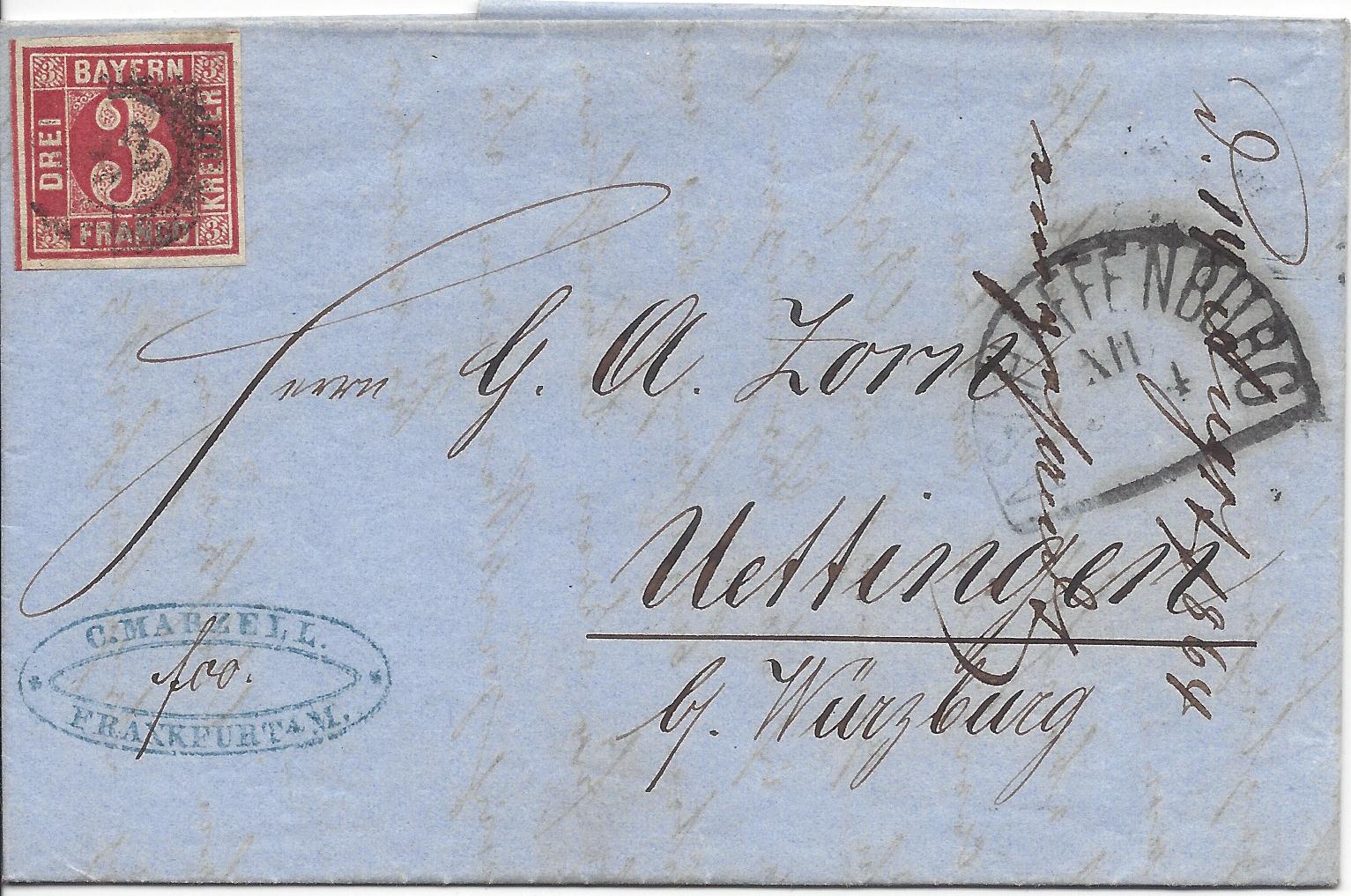
Still, a person sending a letter often felt the need to make it clear that they HAD paid for the letter!   This marking was clearly written in the hand of the person who addressed the envelope.  They added the letters "fco" at the bottom left to represent the word "franco."

Part of what got me to thinking about this was a comment by Mohamed N on Richard Frajola's discussion board asking about a script marking that looked like it said "foo."

Here's a cover that was mailed in Bavaria (also a member of GAPU).  If you look at the blue marking at the lower left, you will see some hand writing that DOES look a bit lit "foo."  It is, in fact, "fco" for "franco" once again.

As a person who has a background in software engineering, I have to admit that the first time I saw script markings like this, I was a bit surprised that foo was being used.  There have been many times that I have looked at programming code and found variables named "foo" and "bar."  It wasn't until I asked German postal historians (thank you Ralph and Tim) about this a few years ago that I realized I was missing the point entirely.

This got me to thinking about all of the things in postal history and philately (stamp collecting) that I would have missed if it weren't for others sharing what they know in one fashion or another.

Here is an 1863 folded letter that started in Livorno, Italy, and traveled to Malta as its final destination.  A postage stamp representing the payment of 40 centesimi for a simple letter weighing no more than 7.5 grams appears at the top left and a "P.D." marking indicates that the letter is considered paid in full.

That's all interesting enough, but it's actually the neat words written in pencil at the top that caught my notice.  "Doppia effigie" which translates to "double effigy."  This was clearly written by a previous collector or dealer to alert future members of the hobby that something else is going on that might be easy to miss.

And, on the back is further information in pencil - this time in English.  "Sardinia, double emboss."

First of all, I am not a fan of any additional collector notations on the front of an item.  So, I would have preferred to see that first notation on the back.  Second, if there are to be notations, they need to be brief, accurate and applied lightly in pencil.  Why pencil?  Because sometimes the notations aren't entirely accurate and new information might uncover that fact.  I have also been dismayed to find covers that had so much writing on them by a collector or dealer that some of the original postal markings that tell the story of the item are endanger of being covered up.

With that aside... here is what both of these notations were trying to get us all to look at.

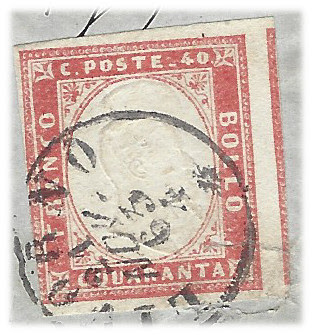
On this particular issue of postage stamp, the image of Victor Emmanuel II (King of Italy at the time) was embossed onto the stamp rather than printed in ink.  Embossing simply means the image was impressed into the paper by pushing the design into it.

The notations are telling us to look for TWO images of Victor Emmanuel's head on this stamp.  Do you see them?

I took a moment and changed the image to black and white and enhanced the image to show the raised edges that would be Victor Emmanuel's head.  When this stamp was going through the embossing process, it must have gone through twice - or something happened to get the top of the head to appear twice here.  I will not claim to be an expert on how these stamps were embossed, so I'll leave it at that.  Perhaps someone can fill me in and I can include the details later.

This got me to start thinking about things I still hope to learn more about.  Which led me to this cover:

When I first picked this item up, I figured it to be a simple letter between two locations in Portugal.  But, it turns out that Porto (or Oporto) is in Portugal and Villagarcia is in northwestern Spain.  

Normally, I would be looking at clues like the French "P.D." or the German "Franco" to alert me to the fact that the letter crossed borders.  Well, there is no such thing on the front of this letter, but it turns out the answer was in front of me the whole time.

The docket at the top left reads "Hespanha," which would be Portuguese for "Spain."  

This is one of the beautiful things about the postal history hobby.  If you allow yourself to explore areas away from your home or outside your comfort area, you can be reminded that for all of our similarities, there are differences, and for all of our differences, there are similarities.

It is also a good reminder to me that it is absurd for me to think that I should automatically know anything if I have never experienced it before.  How should I expect to know that the letters on an envelope were "fco" and not "foo" and how would my brain pick out the word "Hespanha" and know that referenced the land I recognize as "Spain" unless I give myself an opportunity to learn these things?

So, how did I learn that this word was "Hespanha" in the first place?

It started on the back of this folded letter. You can see the following markings that tell the story of the travels this letter took:

  • Porto, Portugal - Sep 2
  • Valenca, Portugal - Sep 3
  • Tui, Spain - Sep 3 or 4
  • Villagarcia, Spain - Sep 4

First of all, it seemed odd to me that an internal letter in Portugal would require so many transit markings on the back.  I suppose it could be possible that the Portuguese were more concerned with tracking their mail than the French - but I didn't think that was the case.  I found it more likely that the extra markings had to do with the exchange process of mail between two postal services.  So, I started doing some map searching and this is what I found.


Valenca and Tui are both very near the border between Portugal and Spain, so they were clearly a good place for mail to be exchanged between countries.  The other clue was that the Villagarcia postmark reads "Villagarcia Pontevedra."  Pontevedra is a province in Galicia, which is northwest Spain.  So, my salvation came with some knowledge of geography and a willingness to explore period maps.  It had much less to do with language.

But, once I realized this was destined to leave Portugal, that roused my suspicions that the docket must have something to do with telling the postal service in Portugal more about the destination.  And that brings us full-circle back to Hespanha.  Now that we all have access to translation software, I was able to do some exploring to find my answer.

And there you are!  This is where my mind wanders as I do a simple organizing task.  This probably explains why one of my favorite sayings is "thinking is a dangerous pastime."

Thank you for joining me for this week's Postal History Sunday.  I hope you enjoyed today's entry and that maybe you learned something new.  Have a great remainder of your day and a fine week to come!

Saturday, March 4, 2023

Something to Crow About

Three crows loved to sit around in the alley behind the local butcher shop.  There was a fence that surrounded the garbage cans and a few other odds and ends.  These three birds would perch on the fence, or the handle of the push mower that leaned on it.  They made sure to be there most days around 7 am because that was when the butcher would toss out the meat that had passed the expiration date.  After all, crow diets aren't regulated in the same way ours are and they don't care if the label says the food is too old.

 Crow picture copyright Ryan Schain, Macaulay Library

On this particular day, the butcher and their apprentice walked out with a bunch of sausages of all sorts.  As they walked to the garbage, the butcher told the apprentice, "We need to throw these so no one gets sick."  They tossed the sausages into the can and walked away.  The crows noticed that the apprentice forgot to put the lid back on.

"Hmmmm," said crow number one, "I think we've got a feast today!"

"I dunno," replied the third crow, "dinna ya hear 'im say it coulda make sommun sick?"

"Pffffff!  We've never gotten sick before, I'm going to go eat as much as I want!"  So, the first bird flew off of the lawn mower and landed on the trash can.  And he ate... and ate... and ate - while the other crows watched.   Eventually, the first crow belched and then struggled to fly back to his perch on the mower handle.

The other two crows sat there for a while longer - waiting to be sure that the first crow would be okay after eating all of the 'past date' sausage.  When it became apparent that he was likely going to be fine, they both flew off of the fence, landed on the edge of the trash can and ate... and ate.... and ate.

Once they were full, they both belched and then struggled to fly up to their perches on the fence.

After a while, the first crow roused himself and stretched a little.  "I'm going to try to fly some of this off - that was quite a feast!  Aren't you glad you listened to me?"

The other crows were so full they just kind of nodded slowly - but they didn't say anything in reply.

The first crow stretched his wings and took off.  He flew up off of the mower handle, up above the rooftops of the buildings that bordered the alley.  They could see him as he started to circle when suddenly....

There was a loud "POP" and the first crow exploded!   Feathers slowly drifted back down into the alley and down onto the ground.  A few even floated in front of the other two crows.

"Well, there ya have it!" said the third crow.  "He shouda knowed ya never shoulda fly offen the handle when yer fulla baloney!"

Friday, March 3, 2023

Resistors are Futile - Friday Faux Real Stories


Welcome to another Faux Real Story on the Genuine Faux Farm blog!  This week, we're going to take you back to a time when the farmer was not a farmer.  Instead, he was a programmer who worked with software that was used to design printed circuit boards.

It was my first full-time job as a computing professional after graduating with my Bachelor's degree in Computer Science and Mathematics.  I had been hired to be part of the Government Avionics Division of Rockwell-Collins in Cedar Rapids, Iowa.  I still vividly remember arriving for my first day at the south entrance of Building 105 and being met by my immediate supervisor, Jerry.  As we walked past some of the entrance office area, that included (believe it or not) a pharmacy and travel agency, and entered the main part of the building, Jerry said, "Remember how to get back to this hallway.  Then you can always find a way back out of the building."

Jerry was not kidding.  Building 105 was actually a complex of buildings and I could see a pinprick of light that represented the far end of the wide hallway we were in.  This particular hallway was wide enough that managers in power suits could been seen walking one way and a forklift carrying a pallet could be going the other way.

Recent satellite image of complex including Building 105

There were various offices tucked into corners and there were computer labs, development labs, storage areas and assembly lines (mostly in the western portion).  It was incredibly easy to take a few turns and no longer know which way was up - much less out.

My job was to help maintain an older CAD (Computer Assisted Design) system that was used to design printed circuit boards.  Things that might look a bit like this:


The whole point of a CAD system was to give a designer a bit more flexibility in moving and visualizing components and making connections as they considered design options.  They could select from a long list of possible components - various capacitors, chips, jumpers and resistors - and position them on the board.  Some programs could be run to help route the circuits and generate the documentation required by the government.

These designs could then be implemented on the manufacturing floor using the various types of equipment.  Some of the newer automated equipment of the time included Surface Mount Technology (SMT) and Wave Soldering.  

One of my projects was to gather the coordinates and placement of simple components (capacitors and resistors) and put them into a computerized file format so that a new "chip shooter" machine could automatically place these components onto circuit boards.  The circuit board already had holes drilled to receive these components at their proper X,Y location.  It would move the board around until it lined up for the "shooter" to put the component into that spot.  This new equipment probably could place somewhere in the neighborhood of eight to fifteen components per second on a given printed circuit board.  In other words, it moved pretty fast.

Here is an example of a chip shooter in action.  This type keeps the board in place and moves the "shooter" around - it's probably for higher precision components that need a bit more care.  The one I saw moved the board to a "shooter" that was stationary.


What I recall seeing was a bit more like this one.  Go to the 57 second mark to see it in action.

In any event, my job was to identify items that could be loaded by the chip shooter in a printed circuit board design.  Then, the program I wrote would take the X,Y locations and the orientation (angle and depth) and place them into a format this piece of equipment could read.  

On the day of the big "first test," I went to the manufacturing lines where I was greeted kindly enough, but in a typical way line workers might react to one of the "educated pups" that worked on those @#$&(! computers.  The good news is that I didn't act like many of those pups tended to - but that still didn't mean they couldn't have some fun on my behalf.

One guy looked at me and asked where my helmet and safety glasses were.  Of course, I had none because no one had informed me that I needed them.  They found me a helmet that was a bit too big and some glasses before we loaded up the file to watch the machine work.  I think they were expecting me to ask why I needed the safety equipment - but I already had an inkling that something was up.

The machine took a while to set up, but once it was ready it pulled in a circuit board and hammered in a series of components and then it moved the board out of the way.  For good measure, it then SPIT another component out that bounced off the floor and flew off to the side.  While it was unlikely that it would have shot up at an angle to hit me in the face, it was not impossible.  Hence, the explanation for the safety equipment.

I am certain they could have stopped the machine then.  But, they decided this was too much fun and let it run a few more boards before shutting it down.  Each board was loaded up properly and then an extra resistor would get sent to the floor below - Zzzziiiing!

Of course, I got some good-ribbing after that because there was a problem with the data I had delivered to them.  I apparently took it well enough because I was invited to eat lunch with them afterwards.

So - what had happened?

Well, a CAD system allows the designer to grab an image that is a component and place it on the screen.  ANYWHERE on the screen.  This includes places that are not actually ON the circuit board.  So, the designer could pick a component, put it on the edge of the screen so they can grab it later and move it into place.  

Except this particular design had an extra component that the designer had left on the side of the screen - either by accident or on purpose.  My program grabbed every resistor and capacitor that was in the design file for any given circuit board.  It very diligently recorded ALL of them, including the one that was set off to the side of the board.

So, the chip shooter was also diligently following the instructions and trying to put this extra resistor where it belonged - off to the side of the board and onto the floor. 

I will say this, resistors are futile when you try to put them off the edge of a board.  But they make for a good story.

Thursday, March 2, 2023

Remember to Check Your Buts

I've been reflecting a bit on the writing I have done since the beginning of the pandemic (three years ago approximately).  After almost 950 blogs since that time I think I've become much more aware of the writing patterns I indulge in - both the good and the bad.  I remember I told myself at about blog 200 during this binge that I would wean myself from using the word "but."

But, I think I have failed to do that....  Yeah.  I suspect you all see what I did there.

No, no.  It has nothing to do with how easy it is to add another "t" on the end so we can all giggle about a stupid anatomy joke.  No, it's not because it isn't a useful word.  After all, I tend to use "but" in my writing to illustrate how I often see more than one side to things.  (note, I use "after all" too much .... ugh!)

I am willing to admit that I use "but" far too often in my writing.  However (haha! take that - I avoided a "but"), I do believe that I have been mostly successful in removing a certain kind of "but" that worries me and sometimes offends me.  It's the sort of "but" that typically leads to no good.

It really bothers me when people use it in this fashion:

"I know X is wrong, but....."

We should all just stop at "X is wrong."  Or, if you want, you can explain why you think "X is wrong."  When you add "but" you are implying that YOU are able to justify an exception for yourself or someone with whom you feel you have an alliance.  You certainly can't claim you have no clue about "right and wrong" because you've already made a declaration that you seem to know which is which.  You're just willing to give yourself and the people you happen to know, like, or promote a free pass to do the wrong thing.

Once the "but" enters the sentence that should set off alarm bells in all of our heads that we need to carefully inspect our motivations and our sense of right and wrong.  Is it possible that a perfectly valid exception exists?  Sure.  However, you might want to reconsider your condemnation of others who ALSO seem to have found an exception to the rule.  It's pretty difficult to claim moral high ground when you're neck-deep in the quicksand yourself.

Then again - maybe that's all the better any of us can do?  That's a sobering and depressing thought.

The other place I am hearing lots of buts?  It's the same form, but with a slight twist:

"When X did this, it was wrong, but what about when Y did this?"

Again.  Stop at "When X did this, it was wrong."  If it was wrong, it was wrong.  You do no favors if you legitimize any bad behavior by trying to put the focus anywhere other than the bad behavior you feel you need to be calling out.

What are we?  Five year olds?  Geez, I know some five-year olds who know better than to do this... 

"Don't blame me Mom!  They did it FIRST!"

And therefore, it's not as bad?  Address your problem first because you should have more control over that.   Or perhaps you actually do believe you own the exception to the rule.   Are you really telling me that it's a bad thing unless you do it?

Why do I get so upset about this?

It's simple.  I know, like, and care for people who have vastly different ideas about what is important in the world.  And, I am witnessing more and more of them forgetting to check their 'buts.'  Maybe some of you read this blog?  Perhaps this will let you know that I care about you, but I am disappointed and unhappy that you are not checking your "buts." 

Do I expect too much of others?  I don't think so.  I actually hold you in more esteem than you know - which is why I say something.

Do I expect too much of myself?  Probably.  I've been trying to check my "buts" for years now and I am dismayed by my lack of perfect success.  I still fall down.  I struggle with this just like everyone else.  That is exactly the point - I am struggling because I want to be better.  Come struggle with me.

Hey - you folks who believe in personal responsibility - spend more time cleaning your own house and set a better example.  Hey - those of you who believe that we need to be more inclusive and sympathetic to all sorts of people - time to offer more grace to those you may not agree with and may not like.

And while you're at it.  Check your "buts" at the door.

Wednesday, March 1, 2023

Short Walks

Not all of our outdoor time spent on the island of Kauai was during the longer walks, like those we've shared in prior weeks.  Some of our excursions were, admittedly, trips by car to visit locations followed by some, but not much, walking.

A good example would be the time we spent at the Waimea Canyon.  This is one of our favorite places on this beautiful earth, but it does require a fair amount of effort to hike on the trails there.  Yes, we did enjoy the Iliau Nature Loop, but that barely qualifies as much of a walk, from our perspective.  To be perfectly clear, the nature loop was worth every moment we spent there, it just wasn't a big hike.  It wasn't until we pushed the boundaries on Tammy's rehab that we got a real walk in when we took the Canyon Trail to the Waipo'o Falls.

There are also many places to stop on the way up to Koke'e State Park that are quite enjoyable but were not exactly hikes.  One of our stops was the Pu'u Ka Pele picnic area.  And while other folks were trotting across the road to take pictures of the canyon, I was enjoying talking to the trees a bit.

A line of trees block the line of sight from the road to the picnic area and the area under the canopy of these tall trees was quite dark - especially on a day that featured clouds and rain.  Of course, I didn't play with the camera settings enough to reflect what it was actually like, but I still like how this photo came out.  It's almost as if the trees are marching in a line either towards us.  

I am guessing that these are Monterey Cyprus (if someone knows better - please tell me) and this first tree in the picture was the largest in the group.  I suspect if Tammy and I stood on either side and tried to touch hands we would not manage doing so.

When the sun would peak though a bit, the droplets of water would shine on the needles of the trees.  If I had been a bit more patient, I suspect I would have gotten many interesting pictures.  But, this is one of those moments in our trip where we had to watch the time AND the weather.  So, I snapped the shots I could and we moved on.  (Most of the pictures were deleted because they didn't really do anything for me - alas!)

Most people stop at this picnic area so they can cross the road and view the Waimea Canyon and Waipo'o Falls.  Which, of course, we always do when we are near any overlook for the canyon.  But, I still think people miss so many good things when they rush to get to the "grand spectacle."  

Let me put it this way.  I got a feel for how small I was compared to these trees.  Then I walked to the canyon and realized that the trees on the OTHER side of the canyon in the next picture could easily be just as big as these trees are!


The weather had been fairly wet in the days prior, so the waterfall was nice and full.  There are certainly times when there isn't much more than a trickle dropping over the edge to the canyon below.  But that was not this day. THIS day was one where there was plenty of water and we could (and did) spend lots of time at the various overlooks just enjoying what we were seeing.

And no, it didn't really matter all that much when the misty rain got us a little damp in the process.

We drove down the highway from Waimea to Hanapepe and Kalaheho numerous times, but we had not stopped at the overlook for the Hanapepe Valley.  There are good reasons for this - among them is the reality that the road can be busy.  Then there is the practicality that we were often going by when there was another goal in mind.

Get to the farmers market.  Go to the canyon.  etc etc.

It was simply too easy to just say we would do it next time.  Well, the next time finally happened on a day when the sky was beautiful and the sun was not directly overhead.  It was nice to see the Hanapepe Valley with the depth that shadows can provide.

As we often do, we stayed at the overlook long enough to see many other people come and go.  We watched, amused, while one young woman handed her phone to her boyfriend(?), quickly struck a pose, and then grabbed the phone back to inspect the photo.  Satisfied, she hopped into the vehicle so she could post the picture on social media (I am guessing) and they drove away.

I'm not sure either really looked at the valley. 

Opaeka'a Falls is an easy stop that we usually make when we are on our way back from the Kuilau Ridge Trail.  There is a well-kept parking area with restrooms and plenty of room for the tour buses to stop as well.  We like to pull in when the parking area looks pretty calm so we can hang around for a while and not be overwhelmed by a throng.

Opae are freshwater shrimp and the name Opaeka'a can be translated to something like tumbling or rolling shrimp.  I suppose if I were a freshwater shrimp and I went over these falls, there would be a fair amount of tumbling and rolling going on. 

From a picture-taking perspective, the overlook is nice, but it can often be hard to get the framing, lighting and background to all work together.  But, I keep trying!  And before you think all I do is look at this falls through a camera lens, that would be incorrect.  I stare happily at the falls for a while and then look around at the beauty that surrounds it.  After awhile, I decide I should try taking pictures again.

I point and shoot hoping that maybe the lighting is better this time or perhaps the clouds will clear a bit in the background so you can see those mountains too.  Whatever.  It makes me happy and keeps me paying attention to what the world is saying to me.

There is a lookout point just outside of Lihue that overlooks the Hule'ia (river) and the Great Fishpond of Alakoko.  Many simply refer to it as the Menehune Fishponds.  The work to restore and maintain this area is ongoing and it has been interesting to see some of the changes over time.

Hāʻupu was overlooking this river valley, standing on the far end.  This time around, there was no rain hat, so we weren't terribly concerned about rain.

There really isn't much walking to be done at this location.  The overlook is essentially where you park.  I suppose you could walk down the side of the road for a bit, but that's not as attractive as just standing and appreciating the valley below. 

Maybe someday we'll find the right person(s) to get permission to visit that valley? 

I could say some of the same things for the Hanalei Wetlands.  There is a pull-off from the road and you can get out and enjoy the view of the taro (kalo) fields.  We were able to take note of the large number of water birds that coexisted with this food growing system.  

I am not certain how much I would enjoy growing a crop that loves these kinds of conditions.  My initial reaction is negative, considering how grumpy I get when things are really wet at the Genuine Faux Farm.  On the other hand, this is what kalo (taro) wants.  Often the crops we grow do NOT want this, which explains at least part of my attitude.

We finally stopped at a location we kept telling ourselves we would visit, but never seemed to find the time to do so.  Our first exposure to it years ago was prior to the site undergoing some significant changes.  Pa'ula'ula (also known as the Russian Fort Elizabeth) has undergone both physical and cultural rehabilitation - if I may use that word.  The Hawaiian name and the accompanying story has been placed into a prominent place, just as it should be.  Perhaps I'll spend a future blog on that topic and explain further.

I took a walk into the fort, following the indicated path.  This led to a stairway where I could stand at the highest point looking out to the water.  It was readily apparent why this would be a strategic location.  But my mind didn't rest on that thought as my attention was grabbed by the sunset. 

And there you are, our offerings for a "walk there again" this Wednesday.  I hope you enjoyed it.