Sunday, March 19, 2023

Quiz Key - Postal History Sunday

Another Sunday, another Postal History Sunday is published.  This week, I felt motivated to do something a little different.  As I was considering what this might be, I came across a request that I produce an "answer key" for the questions I posed during the Author's Choice blog I published on January 1st of this year.  For that matter, I posed questions in the prior year's Author's Choice list as well.

Technically, all of the answers are findable by simply taking the links provided there and doing some reading.  But, I get it.  Sometimes you just want to read what's in front of you without following a bunch of strings tied to various points on the internet.  So, let's see where this idea leads us.

But, before we get started - some housekeeping!  Everyone find a favorite beverage and put on your fluffy slippers.  Set your troubles aside and prepare to learn something new.  Postal History Sunday is published each week at both the Genuine Faux Farm blog and the GFF Postal History blog.  If you are interested in prior entries, you can view them, starting with the most recent, at this location.  

And now, for our first question of the day.

This letter crossed the St Georges Channel between which two ports?


Short answer:  

Kingston, Ireland and Holyhead, Wales.   Kingston is now known as DĂșn Laoghaire.  The Welsh name for Holyhead is Caergybi.

Long answer: 

This letter was mailed on Dec 19, 1865 at Worcester, Mass and it left the next day on a Cunard Line steamship named Asia from Boston.  The Asia landed at Queenstown (Cobh, Ireland) on December 31 where it unloaded this letter in the bag of mail destined for London.  That bag of mail went by train to Kingston and crossed the St Georges Channel to Holyhead.  From there to London, it took railway until it was taken out of the mailbag and marked with the receiving exchange mark.  This letter actually has the distinction of PROBABLY going across the St Georges TWICE because the letter was returned from London and sent back to Worcester, Massachusetts.  

I find things like that to be pretty cool.  But then, I am a strange sort of person - or so I have been told.

The City of Dublin Steam Packet Company were responsible for carrying the mail between England and Ireland, winning their first 10-year contract in 1850.  Their success led to a second contract that began in 1860.  At that point they launched four new steamships named Connaught, Leinster, Munster, & Ulster (after the four Irish provinces).  Much of the mail sent between the United States and England, Scotland, and Wales would have been carried by one of these ships.

Leinster, a print from Royal Museums Greenwich site, viewed 3/18/23

Want to learn more?

The original Postal History Sunday that discussed this cover was published in March of 2021 and can be found here.  This article by Ken Mitchell gives a brief history of the Holyhead and Kingston packets and explores the postal markings that provide evidence of that shipping line's involvement in mail.  And this article by M.J. Tutty in the Dublin Historical Record (Vol 18 No 3, June 1863, pp 80-90) gives more in depth history of the City of Dublin Steam Packet Company.  And this website by Justin Merrigan gives an in depth history of the Port of Holyhead.

What was the purpose of the House of Sailors run by M. John Mayers?

Short answer: 

A Sailor's Home, or bethel, was a chapel - and sometimes a hostel - that was intended for use by sailors whose ships were in port.  M. John Mayers established this House of Sailors to provide for the needs of English-speaking sailors in the port of Marseille.  One of the stated goals of bethels was to see to the moral regulation of sailors while they visited foreign ports.

Long answer:

The author of this particular letter was M. John Mayers, who served as a chaplain in Marseille for the Episcopal Church of England and was the founder of the Sailor's Home in Marseille.  This particular letter was sent to Gardiner Brewer and referenced Brewer's young son, who was staying with Mayers in France at the time.

While the bethel provided food and shelter at reasonable rates (food was often sold at cost), it also concerned itself with the "moral health" of the sailors.  No alcoholic beverages were allowed or served and the idea of providing alternative (and inexpensive) lodging was to save them from the bars and the brothels in the city.  

Rev. M. John Mayers
It is important to note that on most ships the officers and the "common sailor" were certainly of two separate classes.  Officers might have family aboard and would regularly seek out (and be able to afford) better accommodations when in port.  The remainder of the crew were the concern for these facilities that were rapidly proliferating in ports worldwide.

Reverend Mayers was first, and foremost, established as a chaplain for Marseilles and for the ex-Pats who found themselves there.  His primary calling was likely to serve as chaplain for those who were in stations "above" the common sailor.  However, as part of his chaplaincy he took a fundraising trip to the United States to be able to open this home in 1854.

Once the Sailor's Home was opened, the day to day operations were managed by Arthur Canney for the first few years.  If I were to liken Mayers to a present day position, it might be as Executive Director of the bethel.  He provided outreach to potential funding sources and provided a connection to the church administration.

There were numerous such houses worldwide and the Sailor's Magazine, published by the American Seaman's Friend Society provides a useful source.  The society provided funding to many English-speaking bethels and, as such, regularly provided reports that were shared in this magazine.  The following appeared in the June 1855 edition of the Sailor's Magazine.
 

Want to learn more?

This folded letter was first introduced in this Postal History Sunday from May of last year.   The photo and some background about Mayers comes from Jean-Yves Carleur's blog.  This entry from October 2015 was particularly useful.  Carleur also writes a more general post on bethels here.  Another interesting work discusses the "moral regulation" of white sailors in India and provides some background as to why these bethels were established in the first place.

Balloons often carried pigeons out of Paris during the 1870-1 siege.  Why?

Short answer: 

During the Franco-Prussian conflict the city of Paris was surrounded by Prussian troops, cutting the city off from the rest of France.  During this period of time, balloons were used to attempt to take mail (and official or military correspondence) out of the city by flying over the Prussian lines.  Since balloons simply traveled with the prevailing winds, there really was no way to steer them.  A different method to get mail INTO Paris was required.  Homing pigeons were one such method.

And a bit more:

Initially, the homing pigeons were released at the point the balloon landed in order to alert Paris that the balloon had succeeded in crossing the lines. The next step in pigeon-based communications was to return a very limited amount of correspondence written on very thin paper.  More content was sent as the siege continued when microphotography was employed to make content much smaller and lighter.

It even got to the point that the British Post put out an announcement that individuals could, possibly, get mail into Paris via the "pigeon post."  But, you'd better keep that message at twenty words!

British General Post Office notice of November 16, 1870

Want to learn more?

A nice summary that focuses on the microscopy angle of pigeon post is provided here by Ashley Lawrence.  The original question was answered in this Postal History Sunday entry that followed the journey of one piece of balloon mail from Paris.

In what year was the Faxon Squash introduced and made available to gardeners?

In

Short answer:

The Faxon Squash is listed in the Biodiversity Heritage Library as being introduced in 1894.  This advertising cover was mailed in December of 1893 and the designed featuring the newly available squash variety.  

The longer answer:

The longer answer already resides in the original blog, which can be found here.  

Ok, I realize that I added more material that wasn't in the original blogs for my prior answers.  This time around, nothing is coming to me - so we'll just leave it at the short answer!

You did ask for a "quiz key" didn't you?  Well, I've already ruined it because I won't be able to answer them all in today's effort and the ones I did answer I have gone and given you too much information.

Alas!

We'll all just have to muddle on somehow.

Which well-known philosopher called Ferney, France, his home?

Short answer:

If Ferney, the destination of this folded letter, sounds familiar to some of you, you might recognize it better as "Ferney-Voltaire."  The philosopher, Voltaire, purchased the land around the small hamlet of Ferney in 1759.

Longer answer:

At the time Voltaire purchased this area, the settlement could be best described as a hamlet with very little wealth.  The population was under 200 people and the surrounding land was marshy.  Probably not a place most people would think a prominent individual, such as Voltaire, would be attracted to.

Voltaire had left Prussia for Geneva (Switzerland), attracted by the access to publishers and the seeming "spirit of tolerance."  However, his works were soon banned there, as was theater, one of his interests.  He purchased two parcels, one at Ferney and the other at Tournay (both in France, but near the border of Switzerland) to secure his independence.   

Chateau de Voltaire from wikimedia commons

Voltaire transformed the town according to his ideals.  He had the marshes drained, rebuilt the chateau where he lived and supervised the building (or rebuilding) of dwellings, a theater and a church.  He arranged to have roads paved and to get fountains installed.  Businesses to manufacture pottery, tile, silk and watches were developed.  By the 1770s, the town boasted a population around 1000 people.  

Do you want to learn more?

The post that originally illustrated the cover shown above was published in February of 2021 and can be found here.  The organization that maintains the Chateau and makes it available as a historical site has a summary of Voltaire's life if you want to learn about the man.  

Or, if you are like many people (including myself), you recognize the name and might recall that he wrote Candide, but don't hold the significance of the name in the front of your brain, check out this Britannica write up.  

What was the name of the first US warship to traverse the Suez Canal?

Short answer:

The USS Palos was a tug that was refitted as a warship and sent to the Asiatic Squadron in 1870.  This was the first U.S. warship to traverse the Suez Canal on August 11 of that year.

And a little bit more:

Palos was involved in a minor conflict in Korea in May of 1871 and continued to serve, visiting open ocean and river treaty ports, until 1891.  In 1892, the Palos, engines no longer able to propel her, was towed to Nagasaki by the USS Marion and was subsequently sold and scrapped.

The initial Postal History Sunday that featured this cover and USS Palos can be found here.

Painting by Edouard Riou, Inauguration Ceremony of the Suez Canal at Port-Said on 17 November, 1869

Work on the Suez Canal began in 1859 and was funded primarily by French interests.  Concessions by the Egyptian government were needed to allow construction.  The first such concession was granted in 1854 which gave Ferdinand de Lesseps the right to establish a company that would dig the canal.  Fifteen percent of the profits from the endeavor (over a period of 99 years) were to go to the Egyptian government.

I find this historical summary by the Suez Canal Authority to be well-rounded and it avoids some of the Eurocentric versions of Suez Canal history that many sites seem to fall prey to.

------------------------------

Well, there you have it.  I think we'll call this Postal History Sunday complete, even if the "key" is not.  I hope you enjoyed parts or all of what was offered here today and that maybe, just maybe, you learned something new - and that made you happy, content, or some other positive emotion (you can pick!).

Have a great remainder of your day and a fine week to come.

Saturday, March 18, 2023

Minding Your Peas and Cukes

As our farm changes, we reconsider what we will grow and how much of those things we will grow each year.  I know we both love our snow peas and we have a variety of snow peas we really appreciate.  It seems to like to get a start in the high tunnel and then it really takes off when we move the building off of the plants.  

So, we'll be planting snow peas this year.  I guess you could say we are...

Giving Peas a Chance

Young peas at the right, carrots at the left (mid May)

Peas are one of those crops that farms like ours don't often focus on.  The tomatoes, especially when you grow a range of heirlooms, are attractive and easy to talk about.  Lettuce has so many different varieties and they can look very different from one to the next.  If you live in Iowa, you typically have a place in your heart for sweet corn.

I have yet to see a session offered at a farming conference (such as PFI) that focused on growing peas, but we will happily talk about lettuce, tomatoes, squash and numerous other crops.

The reality is that peas do not typically provide high yields per row foot, but they do represent a fairly high cost in terms of labor during harvest.  If you're a small farm with limited resources, peas might not be worth the chance.  In our case, we like the bridge peas give us in late June and early July to the green beans.  But, the overlap between the two can certainly test one's picking patience.

We like to get the peas in the ground around April 30 and earlier if we start them in the high tunnel.  Ideally the four inch soil temperature in the mid-50's gives us good germination.  We focus on pod peas (snow) and stopped growing shell peas years ago.  The return on shelling peas was so low that we couldn't justify trying them any more.

Peas de Resistance

Trying to get a jump on trellising

All of our work having to do with peas is focused around the harvest.  I suppose, you could say this is true for all of our crops if you think about it.  But, we trellis our peas primarily to make the harvest easier and reduce our harvest time.  If we didn't trellis them, we could still get peas and the plants wouldn't suffer too much.  

If you've ever tried to harvest peas that weren't trellised well, you might be tempted to write a book about...

War and Peas

And, in fact, there is a kids book with that title by Michael Foreman.  You can listen to it here.

We've also had some issues with wind blowing some of the vines off of the trellising.

Two rows of peas with nowhere to go?
 
When the vines fall off or otherwise evade our trellis efforts, you could say we have an issue with...

Escapeas!
 
Our trellising technique when we grew as much as eight hundred row feet of peas was a bit of a project, but once it was done, it worked pretty well.  We started with cattle panels at the ends of our 200 foot rows.  This provided and anchor for the Hortnova fencing that ran the rest of the length of the row.  It also provided a barrier against the deer that occasionally like to taste our peas.  So, you could say that the cattle panels provide us with some...

Peas of Mind
Mammoth Melting Peas
 
We have found that the taller vining plants, such as the Mammoth Melting Pea actually prefers the cattle panels to the Hortnova fencing.  As a result, we actually provided cattle panels for the whole length of the row.  Since we put these on the outside rows, this also provided a barrier to the deer.

Blizzard, another pea variety, doesn't seem to care how it is trellised.  But, if the tellis is too loose and rolls over on itself it causes problems.  If you can't quite see how this might be an issue, we'd like you to....

Visualize Whirled Peas

These Blizzard pea plants want you to know that they do not endorse Rob's puns.

In any event, when we have a cooler June and July this provides a great situation for peas planted in the field.  During the years when that happened, we really brought in nice harvests.  Our very best year was 2015, when we brought in about 450 pounds of snow peas from 600 hundred row feet.

Which means we can talk a bit about...

Peas and Prosperity

Oregon Sugar Pod II - consistently reliable.

Our baseline for pea production is about 50 pounds for 100 row feet of peas.  That's what we expect if everything goes well.  And, most seasons, something goes wrong.  For example, in 2013, the Mammoth Melting seeds were not pure, so the peas they produced were not snow peas and did NOT taste good.  On the other hand, Oregon Sugar Pod II has been pretty consistent at 57 to 65 pounds per 100 feet.  The big issue with them are the...

Inner Peas
Well, we had gone so long without a pun, I had to get one in there.  Here's the deal.  Oregon Sugar Pod II is the most heat tolerant, shortest vine, standard snow pea we have grown.  But, unlike Blizzard, it likes to hold many of its peas inside the leaf canopy, which makes it a bit more difficult to harvest.

Spend time amongst the peas and you get to enjoy their flowers.


But, when you actually find that pod sitting deep in the vines, you get tempted to yell...

I Gotta Pea

If you are not in our CSA, then you might not have been pointed to this song by Brent Odom. 

Yes, yes, we know that this type of song is typical of a ten year old's sense of humor.  Therefore, it makes sense that Rob is posting it.

This reminds me of a person I met some time ago at a park.  She liked to sing the alphabet song while shelling peas.  She also had a small tank where she raised minnows for fishing.  Since her name was Ella, she taught us to sing the alphabet song this way.  ABCDEFGHIJK... 

Ella Minnow Pea

I suppose many of you are in some amount of pain by now, so I will get back to talking about our peas. 

Golden Sweet Peas - easier to pick and great taste.

Golden Sweet Peas like the cooler weather and very much prefer to be trellised well.  In most production years, we didn't give them the full attention they deserved but they have a great taste raw or cooked.  The yellow-green color makes the peas stand out from the vines and make it easier to pick.  But, many people aren't sure if the peas are good because the pale color looks a bit anemic. 

Peas Believe Me

Golden Sweet Peas are very tasty.  Rob does not typically eat raw veggies in the field, but he'll make an exception for these.  In fact, he'll eat any one of thes varieties of snow peas we have grown raw or cooked and can tell you that each has their own taste.  The Blizzard and Golden Sweet Peas have the most tender pods of the batch.  Blizzard can be very sweet tasting and Golden Sweet is in between Blizzard and a standard snow pea (Oregon Sugar Pod) for taste.  Mammoth Melting is fine raw but even better in stir fries or steamed since it has a pod that can be a bit tougher.

Hopefully we'll have a good year with our pea crop.  If we do, we might have some available for YOU.  If you buy more than you would need for one meal, you can have extra.  Then one night you can go home, find some leftovers - just a little of this and that - to have...

A Peas Meal.
 

For the longest time we had a tagline that was, of course, pun based.

Minding Your Peas and Cukes

I think it was actually fairly popular.  We gauge such things by the volume of the collective groaning heard from those who are reading it. 

One time, I was out weeding between the carrots and peas and had one of those moments that occurs every so often in the country where there is very little noise.  I guess you could say I had some 

Peas and Quiet

I also noted that this must be a very good year for peas since there were some vining into adjacent bell pepper plants.  If those vines choke out the bell peppers but result in top quality peas, you might say we won the

No Bell Peas Prize

The Blizzard peas STILL do not endorse Rob's puns

In order to appease you (see what I did there?  You did... ups, sorry), we will actually provide you with some interesting information. After all, I've been told I'm full of it.

For example, we do not actually grow peas and peppers in the same area, so happily, we should not have pea vines choking out our peppers.  Needless to say, the trellising helps contain the pea vines somewhat.  But, since the peas grow vertical, they tend to have a shade zone.  Peppers like their sun, so a shade zone might not be helpful to our bell peppers.  As a result, we interplant bush beans with peppers and we have tried some clover as well.

I was just thinking.  Most people seem to like baby animals.  How about 'baby' plants?  Would you find young pea plants to be...

A pea ling?

Ahem.  Moving on.

Since this is supposed to be a post about peas AND cukes, we'd like you to know that the cukes...

Look Just Vine to Us!


Lovely coverage and texture.. soon everyone will decorate with them!

In the picture above, the plants were only just started producing, but the vines were really covering ground.  The season for cucumber yoga had begun!  We do not trellis our cucumbers, which means Rob had to do a fair amount of contorting to pick cucumbers and not destroy vines or fruit in the process.  In short, it can be a fair amount of exercise. 

And, in case you didn't know, peas can get you exercise as well.  We are considering marketing a new hot drink that combines peas and coffee.  You exercise while drinking it (maybe doing cucumber yoga?).  I think we'll call it...

Pea Lattes!

You're welcome.  And have a fine day - assuming you survived this blog post.

Friday, March 17, 2023

At the Crossroads of Spring and Winter


Yesterday was a typical "early Spring" rainy day.  There is still frost in the ground, so the puddles were bound to form more quickly as the soil resists absorbing the moisture.  The only hints of green that I was able to discern came from the moss on the oak trees.  By this time of year, even our evergreen trees are less green than they are for much of the year.  Their color has been dulled and they exhibit a bit of brown and yellow.

The grasses are not yet ready to come out of dormancy and some of the plants that have emerged are still nestled in the residue of plant matter from the past growing season.  I've noticed that daffodils and crocus have broken the surface of the ground, but they aren't quite interested in exposing themselves above the leave litter and mulch that we are keeping in place for a while yet.

We are at the crossroads between seasons.  There are still crisp, frosty days in sight.  Many of those days are certainly behind us, as this picture illustrates - but they could also still make an appearance in our future.  This is my yearly reminder to all of us that we've gotten measurable snow as late as May 4 on the farm since we have been here.

Ahead of us are also days that hold the awakening of our trees and perennial plants.  Already some of our birds are returning and speaking to us of nests, tasty insects, gentle rains and a new generation soon to arrive.  But yesterday, they were more interested in shelter than conversation.

For now, we stand at the crossroads.  It is here that things are brown, muddy and, frankly, difficult to love.  As a farmer, we often refer to this time as "mud season."  It's too early to do many things and too late to do others.  It's a crossroads that we stand at, preparing and waiting to begin our journey down the path of Spring.

The redemption for this time lies in what we can see from here.  We can still see the beauty of a hoarfrost on the trees and we can also sense the impending promise that Spring always provides.  While things may not seem attractive today, we cannot and should not miss the beauty that surrounds us at the crossroads.  This beauty comes from the great value that preparation for change has in this world.  Not every moment is glorious and invigorating.  And, just because these moments are not those things, it does not make them any less important - and any less valuable.

So, while you and I might not identify these days as our favorites, we still need to respect the process and remember that things that are important and necessary have no requirement to also be attractive to us, as human beings.  There are others on this Earth that find things beautiful that we do not, and for reasons that we can't fathom.  That's where I find value for this world at the crossroads.

Thursday, March 16, 2023

It is Not This Day


Tammy and I have been regular attendees of the Practical Farmers of Iowa Cooperators Meeting for some time, and it has been odd to have missed each of the past couple of years.  This is what happens when your life changes.

The two-day Cooperators Meeting features discussion and presentations on how research projects fared during the previous year and then on designing new projects for the upcoming season.  It's a time to exercise curiosity and to seek camaraderie with other agriculturists who seek to become better at their craft by testing what we think we know and learning from careful observation.

Tammy was asked to give the closing remarks for the 2016 Cooperator's Meeting and she was a bit uncertain as to whether she should agree to do so or not.  It was certainly understandable, the meeting typically occurs late in the year, when Tammy's school schedule is fairly stressful.  Adding yet another thing to the "to do" list probably didn't sound all that attractive.  

Still, I encouraged Tammy to do it.  Why?  Well, I happen to think Tammy is far more creative than she gives herself credit for and I thought it would be useful to hear her perspective.  So, with some trepidation, she performed the task - and performed it well. 

In fact, it was liked well enough that PFI put it out on YouTube.  That's a compliment.  And I will continue with the compliment by including the video at the end if you would like to see it.  

But first, let me give you the text.  While this was all presented in a lighthearted fashion, there is a great deal of meat to what is being said here.  Take a moment and enjoy.

---------------------------------------

JRR Tolkien knew how to write a good story.  Is that an understatement, or what?!  For those of you who are not familiar with his work, John Ronald Reuel Tolkien, is an author and linguistic scholar, best known for his high-fantasy novels The Hobbit and the Lord of the Rings. He is also known for his intense attention to detail. I have long loved Tolkien stories and grown to appreciate the importance he placed on detail and accuracy.  “Close enough” was just not good enough.  

I see a lot of Tolkien's dedication to detail and knowledge in PFI farmers and our dedication to detailed research.  Rob has convinced me, despite my admitted preference for “I think” to move to “I know” on the farm.  Count it, measure it, record it, then plan it.  And, repeat - Count it, measure it, record it, then plan it.  

Tolkien writings offer so much timeless wisdom including this exchange early in the “Rings” journey:
“I wish it need not have happened in my time,” said Frodo.
“So do I,” said Gandalf, “and so do all who live to see such times. But that is not for them to decide. All we have to decide is what to do with the time that is given us.”

There are many things farmers struggle with - including increasingly extreme weather and uncertain economics and changing policies.  What we CAN do is decide what WE want to do with what we have – not just “Go along”.

At one point, one of the HEROES in the Ring Trilogy, Aragon, inspires his troops before a seemingly hopeless battle:
"Hold your ground, hold your ground! Sons of Gondor, of Rohan, my brothers! I see in your eyes the same fear that would take the heart of me. A day may come when the courage of men fails, when we forsake our friends and break all bonds of fellowship, but it is not this day. An hour of wolves and shattered shields, when the age of men comes crashing down! But it is not this day! This day we fight! By all that you hold dear on this good Earth, I bid you stand, Men of the West!"

I hope our farming does not seem “hopeless”, though we certainly face challenges.  So, with thanks to Tolkien and assistance from Dick Thompson:
 
Hold your ground,  Protect your ground!  Farmers of Iowa - Row Cropper, Grazier and Horticulturist.  
I see in your eyes that same passion for farm and soil that inspires me.   
A day may come when the courage of farmers fails, when we forsake our passion for sustainable, well managed farms and break all bonds with our history of smart farming.
But that is not this day.  
An hour of weeds, pests and disease, a day of intense pressure to conform, to “go along”, when the age of “thinking farmers” on diverse farms comes crashing down.   
But, it is NOT this day!  
This day we research!  By all that you hold dear for the good of this earth, I bid you, RESEARCH and LEARN, Farmers of the Land!

-----------------------------

It's a good thing to have great respect for your partner in life.  It's also good to be proud of their efforts, the things they produce and the heart they exhibit for the good things of this world.

It's an even better thing to be able to stand together for things we care about.  Perhaps the day will come where we can't.

But, today is not that day.


Wednesday, March 15, 2023

Walk There With Friends


There are places in this world that speak to us, as long as we take the time to listen.  Some of these places draw us back, over and over again.  And, over time, we develop a desire to share that space with people who are closest to us - in the hope that they can also hear what we hear and see what we see.

Or perhaps that they will hear something slightly different and allow us to expand our own understanding in the process by witnessing their conversation.

We had that opportunity during our visit to Kauai in December.  Our friends, Sue and Steve, accepted our invitation and braved snowstorms that made plane departures uncertain and travel the wrong kind of interesting.  But, they arrived and we had that special opportunity to introduce people we care about to a place we care about.

It's a good thing.

Tammy and I are often astounded by how little time many visitors seem to take just staring in awe of what they are seeing.  It's enough to make me consider the possibility that either they have blinders on or their sight is not working somehow.  Or, maybe we're the ones with the problem.  Well, if we are, I think both of us are okay with that.

The good news is that we found out that Sue and Steve could also see what we were seeing.  Perhaps, they were seeing things a bit differently than we did - and that's fine.  The point was, they were seeing.  And they were content to let Kauai, the Pacific Ocean, and this grand Earth tell them about itself.


It even got "Little Steve" to come out and play.  It was a chance to explore and experience.  And it was an opportunity that was not squandered, like so many such opportunities seem to be in our lives as we attempt to be "responsible adults."

We got to play with perspectives.  Different points of view.  Angles we usually didn't consider.

We were allowed the opportunity to watch the different shapes and colors of the water.  We could touch and observe the rock formations and take a moment to consider different plants and the pollinators that were visiting them.

And each of us got to experience things in the ways that suited us best - just as we also had the opportunity to see the world and all it had to offer in this special place as a team.

We got to do this because we worked to give ourselves the time.

This particular walk was on the Mahaulepu Heritage Trail.  A tough enough walk to provide some exercise and a little challenge, but not so much that Tammy couldn't navigate the trail and find ways to keep moving (or find a place to sit) so the Achilles didn't tighten up when Sue, Steve... or Rob... wandered off to check out some odd thing or another.


There were little fish and critters with shells in tidal pools to discover and wonder at.  

 
There were flowering plants with bees collecting pollen.

There were interesting patterns carved into the rock.

The clouds painted the ocean by choosing where and how much light touched the surface.


Birds soared over head - and sometimes, when we were on a high piece of land, they would soar at a level that was even with us.

Some rocks were pock-marked, showing how they erode over time with the application of salt water droplets.

It was a worthwhile and rewarding effort to take this walk with friends.  Maybe we'll get to walk there again some day.

Tuesday, March 14, 2023

Days Like This


Well, Monday was, as they say, "a day."  To fully get the effect, one has to say "Monday was a day" in a voice that implies sarcasm, resignation and weariness all at one time.  It was the kind of day that leaves a cat, like Bree, exhausted to the point that she is sleeping where she is, but is not exactly in the most comfortable of positions (for a cat).  And, as far as the human goes, it was leaving me feeling paralyzed and incapable of doing even the tiniest of tasks.

So, I sat and looked at the cat while it slept.

Bree simply was not feeling well on Monday - and I had the mess near my office chair to clean up to prove it.  Hey, just because she's a cat, it doesn't mean she can't feel ill and get sick.  I think we tend to forget that our companion animals (and our farm animals) can also have good and bad days from both physical and mental standpoints.  Case in point, I got to deal with a (mostly) dead chicken in the hen room today.  Probably an accident from an attempt at flying.  This kind of thing happens - but that doesn't mean I like doing what I was forced to do at that point.

It seemed to me that people I interacted with today were also not their best selves.  Can this sort of thing be contagious?   I do know that one person can actually help change the mood of a group OR that one person could send everyone into a spiral.  So, I guess it shouldn't be a surprise if one issue might be compounded by other issues.

My observation for the day was that most people were falling back on their base tendencies more than usual - without checking themselves as they interacted with people who land on the other end of each spectrum.

The extroverts spoke quickly and often, inserting themselves into every silence.  Those who have task-oriented personalities were driving the agenda forward quickly, trying to get to the bottom of the list.  Those who had personalities that seek to avoid confrontation, might have felt the ripples of discontent, but they went along with everything because there was no desire to stand in the way of progress or those who felt moved to speak frequently.  And the introverts, who often wait patiently to be invited to speak and will not interrupt - even when they are supposed to be talking - decided they should fade into the woodwork.

The people who like straight lines were forging ahead while those who like to squiggle spun figure 8's and other loopy figures.  These two personality traits started at the same place, but I'm not sure they met at any point after that.

It was no one's fault in particular.  It just seemed like people were "off."  And I blame Daylight Savings Time for it all.  I even blame DST for the issues with the chickens and our Indoor Farm Supervisor (Bree). 

So, have you all given more consideration to some of my options regarding Daylight Savings?  After a day like this one, I'm more serious about getting rid of it than I usually am - and that's saying something. 

Hey, if you want more arguments - consider this offering by Northwestern Medicine that points to research that show an increase in heart attacks, strokes, injuries and fatal auto accidents, depressive episodes, and even colitis.

As I was considering all of this, I came across this item by Last Week Tonight with John Oliver.

I was, of course, a bit surprised that people think DST was something that was created to help the farmers.  If anything DST is a hindrance to farmers - especially if they farm like we have at the Genuine Faux Farm.  

You see, chickens, cows, and other farm critters take their clues from the rotation of the Earth, not the time on a clock.  Sun's up, so it's time to be doing.  Sun's down, so it's time to consider sleeping.  I've noticed the plants are much the same way.  The only thing that changes is the construct farmers have to deal with IF they have to interact with other human beings.  

You do realize that we suddenly have to change when some of our chores and other work falls in our day because we have to abide by the societal agreement that tells us when 4:30 pm is (for example).  Yeah - DST was NOT for the farmers, you can count on that.

And there you have it - my rant for the day, courtesy of Daylight Savings Time grumpiness.

Here's to a better day.

Monday, March 13, 2023

Spring Migration

That's a lot of birds!

When we talk about Spring migration, people in Iowa are usually referring to the arrival of the Robin (at the farm Mar 4 this year), Red-winged Blackbird (Mar 1) and Killdeer (Feb 26).  We anticipate and take note of the waterbirds flying overhead as the wetlands thaw out.  The v-shaped formations of Canada Geese and the echoing, rattling cry of the Sandhill Cranes encourage us to think about planting seeds for this year's veggies.  

This is the time of year where I hear the commotions created by small birds that like the shelter provided by the trees and bushes on our farm.  I heard, but only saw the flitting profiles of a batch of American Tree Sparrows by the Harvestore recently.  Even the Cardinals, who never did leave the area, are singing a different tune that tells us Spring is approaching - even if the wind is pretty sharp and the temperatures could be below freezing on any given day in March.

What we rarely notice and discuss is the departure of some of the birds that have spent the cold months with us.  The Horned Larks that rarely let us get a good look at them in the first place are suddenly gone, except for a lone bird that said good-bye to us and served as our last sighting for the year on March 7th.  The Juncos are still around - at least they were yesterday - but they are clearly congregating in larger groups.  One day soon we'll only notice them for their absence.

Or maybe we won't notice they've gone at all.  After all, it's hard to prove an absence rather than presence in our world.  And, of course, our focus is usually on the Spring arrivals, not on the departures.

As we were running a few errands on Friday, March 10, we took note of small flocks of birds (about a dozen birds in each) that would wheel away as we approached - only to land somewhere not too far away.  Because we live in the country and we pay attention to birds, we knew that our less-traveled roads often feature mixed flocks of Snow Buntings and Horned Larks (and perhaps even some Longspurs).  So, we looked for some signs that might tell us who we were seeing.  Eventually, we concluded that we were seeing Snow Buntings.

And, of course, we had no camera.

But, it just so happened that we went on an errand the next day.  Since we would be going to some of the same areas, we DID bring the camera.  And, sure enough, we weren't seeing ANY Snow Buntings. So, we were resigned to the fact that they had probably moved on.

I had no illusions that I was going to get a clear picture of any of these birds.  We know they won't let us get close enough.  If we think Horned Larks are restless and skittish, Snow Buntings have them beat, in my opinion.  Besides, I don't have the kind of lens one might need to even try to get much more than a "look, it IS a Snow Bunting picture!"

But, we were hoping to at least document what we had been seeing.  And that's why we took time to try and take a bunch of pictures when we did run into the MUCH LARGER flock of Snow Buntings that announced themselves as they wheeled away on the road ahead of us.

Snow Buntings are pretty distinctive this time of year because they are now wearing their mating plumage.  The black wing-tips against the bright white feathers actually show up pretty well as they veer away from the road and the implied threat that a vehicle brings with it.

Many birds change into their mating plumage by going through a molt (growing a new set of feathers).  According to All About Birds, the Cornell Lab website, Snow Buntings rub their heads and bellies against the snow to wear off the darker coloration on the tips of their feathers, exposing the lighter, white parts.  

Ah, the things we do for love.

When you look at the photos, you can see some differences in markings.  I suspect some of that difference might have to do with gender, with the males exhibiting bolder black bands on the wings.  And, if you take a closer look, you can see the different shapes these birds take as they fly.  Sometimes the wings are stretched straight out.  Sometimes they are swept back.  And, sometimes, the bird almost takes on a bullet shape as it slices through the sky.

If you live in the country, like we do, you probably notice birds that take off from the side of the road and are simply flashes at the corner of your vision.  They are illuminated only by the edges of the beams of your vehicles headlights.  These are likely Snow Buntings and their friends, the Horned Larks, doing what they do.  For the longest time, we just referred to them as those "snow birds" we can never get a good look at.

The weather would get cold and then they would be on the road edges.  Then the weather would show signs of getting warmer and they wouldn't be there any more.  Their appearance and disappearance was almost magical.  But, their desire to remain unnoticed actually makes their magic act seem unremarkable to most people.

Actually, Snow Buntings are more magical than you know.  They have this amazing ability to disappear the moment they land.  Or, if you happen to see them, they give the impression that they are blowing leaves and snow.  Even as they take off, they can still look a bit like debris in a dust devil until they open up those wings to wheel away.

And once they do that, it's too late for you to get much of a good look at them.

Still, Tammy and I tried our best to get a look at these illusive little birds.  We pulled over on a nearby gravel road and I did my level best to simply take pictures that we could try to blow up enough to see if there were any birds in them.  The picture shown above is one such shot...

and there are LOTS of birds in that picture.  Can you see them?

No, probably not, so I selected a section and magnified it.

Ok, how about now?

There is even one bird in flight (it's blurry because it was moving).  Including that bird, I think there are nine or ten birds in just this section of the overall image.

If I blow it up further, you can probably see at least one of the birds a bit better.  There are actually five or six birds in the portion of the image shown below.

Overall, I estimate we were witnessing the gathering of a flock of Snow Buntings that was at least several hundred birds - maybe as many as one thousand in the combined flock.  And, of course, even when we couldn't see them, we could hear them.  While I don't think we heard any songs, there were plenty of calls.  You get that many birds together, someone is bound to want to say something!

Our timing was excellent.  One day we noticed small flocks and the next we witnessed the combination of those flocks.  Today, I am fairly certain we won't witness any gatherings of Snow Buntings in our area.  Unless, perhaps, a single Snow Bunting wants to approach us for a photo opportunity before it flies off to join its friends in the northward journey.

Sunday, March 12, 2023

Crossing the Pond and Lighting a Candle - Postal History Sunday

Hello everyone!  I'm glad you were able to find this week's Postal History Sunday, which can be found each week at both the Genuine Faux Farm blog and the GFF Postal History blog.  If you are interested in prior entries, you can view them, starting with the most recent (this one), at this location.  Once you are there, all you have to do is scroll down to see earlier content - it's just that easy.

For those of you who do some writing, this question, asked by an anonymous individual, might resonate with you. "Is it hard to find the motivation or the ideas for each week's Postal History Sunday?"  The answer is, of course, sometimes yes and sometimes no.  As far as ideas go, I currently have about fifty different ideas in my notes for future entries.  So, my problem is finding the motivation for a given topic.

Each week things get done one of three ways.  

  1. I force myself to write on a topic idea I've already identified for a given day.
  2. I write about what currently inspires me, even if it's not already in the idea list.
  3. I adapt a topic idea I've identified to my current inspiration.

Often, ideas that fall in category number one will take me weeks or months to write, while things in category 2 can't be predicted - they just happen.  This week's writing falls into category three.  I had it in my idea list to write about how mail crossed the Atlantic Ocean in the 1860s - but there are whole books on this topic.  So, I was waiting for some inspiration as to how to make something work for a single Postal History Sunday (or maybe a series).

Clues on a cover

I thought I would start by explaining the clues a person might find on a cover that traveled across "the Pond," or Atlantic Ocean.  Shown above is a folded letter mailed in August of 1867 from New York City to London, England.  If you've been reading Postal History Sunday for a while, you'll recognize the 24 cent stamp and might remember that the cost of postage for a simple letter to the United Kingdom was 24 cents as long as it weighed no more than 1/2 ounce.  If you didn't know or didn't remember - it didn't matter because I told you anyway!

Nice how that works.


When I first started looking at postal history between the US and the UK, I have to admit that directional dockets like this were initially confusing to me.  In case you are having trouble reading it, it says "City of Paris."

Now, this letter is going from New York City to London.  When I first started looking at postal history, my first thought I would have had was "why in the world would they send this letter through Paris?"  After all, it's not exactly as if it's on the way from one city to the next, is it?  In fact, I still remember the day I found an old envelope that had the word "Africa" at the top left.  I thought I had found an uncommon letter TO Africa, even though the address panel said it as to London.

Well, it was a relatively common practice for writers of letters to put a docket - usually at the top left - indicating the steam ship or sailing ship that they intended the letter to be carried on as it crossed the Atlantic.  So, the writer of this letter intended for it to be taken on a ship called City of Paris.  In fact, the Inman Line of steamships had several vessels named after major cities, just like the Cunard Line had ships named after countries or continents - steamships with names like Africa.

So, yes.  My excitement for that special letter "to Africa" was pretty short-lived because that was the moment I learned about dockets and ship names.  And yes, I learned this fact because I asked questions and I was a bit skeptical that a letter intended to go to England would go via Africa or end up in Africa without more postage or postmarks.

But, what if this letter didn't have a docket - or what if the docket is incorrect (because it could be)?

The exchange office markings for mail from the US to the UK provides us with some clues too!  So, if there is not docket, we can get our start with those.  Shown above is the marking applied by the Foreign Mail Office in New York City.  

The first step of the process is determining which ship carried this letter in the 1860s (until the end of 1867), would be to see if it was carried by a ship under contract with the United States or the United Kingdom.  There are two ways a person can do this.  You can look for a designation that tells us it is an American Packet (Am.Pkt) or a British Packet (Br.Pkt).  This one was carried by a ship that was designated an American Packet.

This effectively eliminates ships that carried mail for the British (Cunard and Galway*), but it still leaves us with many options (Inman, HAPAG, North German Lloyd, Allan, Havre, French, North American Lloyd / New York & Bremen).

* the Galway Line was not actively carrying mail in 1867, but it did carry mail in the 1860s

This is where the date on the exchange markings can help us determine which ship might have carried the letter.  In the United States, the exchange office would typically put the date of the ship's departure in the exchange marking.  So, it is possible that the letter was being postmarked on August 23, but an August 24 postmark was used to indicate the ship's date of departure (there will be more on this in the bonus material).

August 24, 1867 was a Saturday, and that was a big day for steamships with US mail contracts to depart New York.  On this particular Saturday, a ship from the HAPAG Line was carrying mails to the German States, another with the French Line took the mail to France and the Inman Line had a ship carrying mails for the rest of Europe (including the United Kingdom).  The ship for the Inman Line was named the City of Paris.

It sure is nice when things match up!


We actually have another clue that can help us with identifying ships, and that's the receiving exchange marking applied in London.  Sometimes, when we look at an old cover, there won't be a readable docket and the United States exchange marking may not have a readable date.  That leaves us with trying to identify when the letter was taken OUT of the mailbag in the United Kingdom.  If we know that, we can work backwards by matching it up with the arrival of ships that carried the mail.

from page 211 of North Atlantic Mail Sailings: 1840-1875 by Hubbard and Winter

It just so happens that the excellent work by Dick Winter and Walter Hubbard provides the dates for many mail sailings.  These were gleaned from period newspapers and other primary sources and my interest in this area is, in part, due to their efforts.  I could confirm these dates by hunting in online sources like the New York Times, but instead I will gratefully accept the efforts of prior postal historians.

The good news continues.  The last row of this table shows the City of Paris departing New York on August 24 and arriving at Queenstown (Ireland) on September 3.  These dates line up properly with both exchange markings - so we have our ship for crossing the Atlantic!

Inman Line's City of Paris circa 1866 - from Wikimedia Commons

The Inman Line (formally known as Liverpool, Philadelphia and New York Steamship Company) was headquartered in Liverpool and ships were registered under the British flag.  The contract they held in the 1860s for carrying the mail, however, was with the United States - hence we refer to them as American Packets for the purposes of mail carriage.

Inman was exceptional that the line pushed new technologies, such as iron hulls and screw propellers as opposed to the wooden hulled, paddle wheels that were setting the speed records at the time.  Initially, this new technology was slower, but they required much less coal - allowing for more space for cargo and passengers.  With the launch of the City of Paris, improved screw propulsion technology resulted in a ship that could keep up with the Blue Riband (fastest Atlantic ships) holder, Cunard Lines Scotia, which was a paddle wheeler.

To complete the circle on this particular letter, there is one more postmark that is located on the back.  The London post office in the southern district (London - S) sent the letter to be delivered by a carrier on September 4, the same day it was taken out of the mailbag in the London Foreign Letter Office.

Bonus material - Fun with dates?

I am fortunate this time around to have some of the contents of this piece of mail to go with the exterior "wrapper."  And, if you'll recall, I mentioned that is was possible that the New York Foreign Mail office had this letter in their possession on August 23, but they still put an exchange marking on the letter for August 24 - to reflect the date of departure for the City of Paris.

First, I suspect some of you have noticed and have been waiting for me to say something about the upside down date.  The device used to put this marking on letters had a removable date slug.  The postal clerk could remove the center and insert a new date as needed.  Sometimes, that slug didn't get put in correctly.  The result would be a date that is upside down as compared to the rest of the marking.

Hey, if you had to handle as much mail as these people did, I suspect you might have trouble figuring which end was up sometimes too!

And, here is the letter itself.  The date at the top is, in fact, August 23, 1867.  So, it is not just possible, it is likely, that this letter was received at the post office on Friday, August 23, 1867.

More Bonus Material - J.C. & J. Field

This letter was mailed by an individual in New York who was serving as a purchasing agent for raw materials for the company J.C. & J. Field, located in Lambeth March (on Upper Marsh Road), London. As is often the case, it can be hard to decipher the writing in the letter, especially when key words that might help us to identify the business appears.  I did notice the word "beeswax" towards the bottom, but I was having trouble with some of the rest.

Happily, I was able to find some period advertising for this business that helped me to figure out some of those keywords! 

1864 ad from Grace's Guide, viewed Mar 9, 2023

J.C. & J Field made soap and candles according to this 1864 advertisement.  This makes beeswax a logical purchase by their agent on their behalf.  Although, it is interesting to note that the ad mentions "paraffine" candles.  And sure enough, when I re-read the letter, I see that the agent is talking about a bid that was made for 20,000 pounds of paraffin.  They also note, at the bottom of this letter, some current price levels for other products of interest including

London Society Magazine that held ad above
    "Spermaceti...priced 42 cts at which price last sales were made"

and 

    "Beeswax without change 40ct 42"

All of these products would makes sense for a purchasing representative in New York City to be considering for their clients who made soap and candles in London.

Are you wondering what spermaceti is?  I was too. So, I did a little looking.

During the 1860s, candles were made with a wide range of raw materials.  The cheapest, and lowest quality, option was to make tallow candles.  Tallow (animal fat) often left a sooty residue and had an unpleasant odor.  These candles melted easily and required that the user regularly trim the wick.  To make matters worse, the light quality was often poor.

Paraffin is a by-product when petroleum is distilled.  This resource was clearly much less expensive if prices were in the 20 to 24 cent range versus beeswax that commanded nearly twice the price.  Paraffin was a bit more brittle, but the candles burned much slower than tallow and provided a less expensive option to beeswax.  Beeswax, on the other hand, would be a preferable product for quality candles.

Spermaceti, or whale oil, was another high option for the production of higher quality candles.  Made from oils collected from the head of Sperm Whales, these candles burned brightly and odor free. 

If you would like to read a bit more about candles and candle making during the 1860s, I found this site titled Women, Remedy and Herbs of the Civil War to be clear and concise.

1867 ad from The Archer's Register, viewed at this location 3/11/23

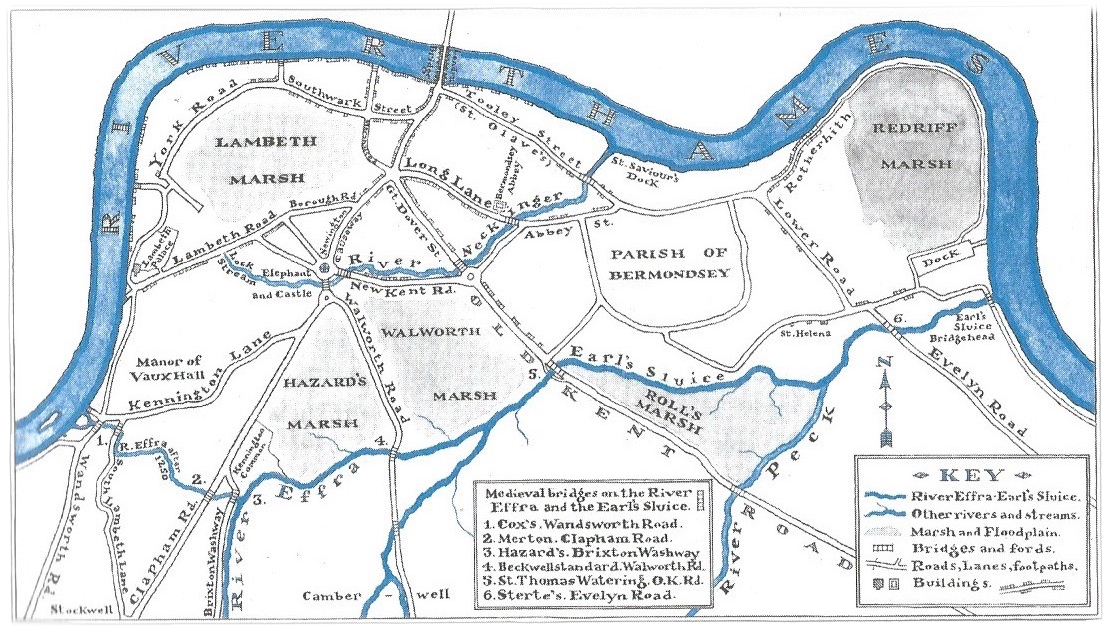
The Field family had a long history as wax and tallow chandlers and this particular business was founded in 1642 in Lambeth Marsh.  The map below shows Lambeth Marsh situated next to the River Thames in the 1200s according to this source (Vauxhall, the Oval and Kennington).  In the 1860s, this area fell clearly within the South London postal district.

J.C. & J. Field maintained their factory on Upper Marsh, a road in Lambeth Marsh, but they also held a location north of the river at 12 Wigmore Street for a period of time.  According to this resource (London Street Views), they may not have continued at Wigmore Street into the 1860s - though they maintained the Lambeth Marsh location until J.C. and J. Field was eventually absorbed by other businesses in the 1940s.

ordinance survey map 1892-5 from this blog

By the time we reach the 1890s, the area of Lambeth Marsh was fully developed and the Field's factory had become a sprawling affair.  You can see it near the center of the map shown above (and not far from the London & South Western Railway tracks).  The Upper Marsh road is north and west of the factory.

----------------

Well, that's what I've got for you this week.  I hope you enjoyed this foray into postal history and some of the surrounding social history that came with it.  Have a fine remainder of your day and an excellent week to come.