Friday, May 12, 2023

A World Gone Sideways


I went outside to do chores with Tammy on Thursday morning, which was nothing new.  The fact that I took the camera out and tried to get some photos of the beautiful flowers on the farm was not unique either. Still everything felt a bit off to me, as if the whole world had gone a bit sideways while I wasn't looking, and my mind, body, and soul were trying to figure out what to do to balance it all out.

Tammy tested positive for Covid last week after feeling very run down with a headache and muscle aches and we were hopeful that I could care for things (and Tammy) while she fought her way through it.  Unfortunately, my immune system didn't keep me completely in the clear either, so I've been given the opportunity to take my own Covid journey since Sunday last.

Both of us managed to "get in under the wire" as far as the national Public Health Emerency Declaration ended May 11th (yesterday).  I say this as if this were a goal of ours to not be left out of the "fun."  In reality, I think both of us are a bit upset that we would keep the Covid wolf away for three plus years, only to succumb now.

I actually got myself down, close to the ground for this picture - something I could typically do without thinking on a normal day.  My body protested the action as my head started pounding and the world felt like it was a little off kilter.  I managed to get back onto one knee and stayed there for a while until everything stabilized.... such has been the way of things for the past few days.  How silly does it sound to say that a picture of dandelions wore me out and I had to quit the photo collection session after that?

I have been finding the world outside to be a surreal landscape as it has rapidly added lush greens.  Even the baby Oak leaves are visible!  Spring can really surprise you with how fast everything changes when you are able to be out in it and paying attention every day.  But, when your perception's a bit skewed because you aren't feeling well, the changes can be dramatic and not quite real.  Sometimes it seemed like it was one of the those softly blurred images where your mind and your eyes feel like if you blinked one more time, it would all clear up.

The two of us have managed to find ways to get the poultry chores done and the seedlings have gotten their water.  The cats are all cared for and we, the two farmers, are doing what we can to help each other.  But, all of the things we must do to get things planted are not getting done.  It's a harsh reality, but the success of our farm relies on the two of us taking recovery seriously so we can actually hope to catch back up.

Still, the journey has not been without some humor.  

We live in an old, two-story, farm house.  Our bedroom is upstairs and we were downstairs.  Both of us were preparing to head up and stood near the base of the stairs - each of us was about the same distance away.  Tammy looked over at me and said, "Go ahead...."

Instead of responding, I simply started to laugh.  Then she started to laugh.  Then I started coughing.  And she started coughing.

If you don't understand the laughter, you need to consider that one of the common symptoms we have been experiencing is an exhaustion that comes in waves.  Tammy was offering that I should go first because the stairs were looking a bit daunting to her at that moment.  I started laughing because I was about to offer that she should go first... for the same reason.

So, instead of toughing it out and climbing up the stairs, we wasted whatever energy we might have had for the task by giggling and coughing for a bit.  It probably wouldn't have been this funny with anybody else.  Ain't love grand?

Tuesday, May 9, 2023

Down and Out

Well folks, this year's blogging streak ends here.

The big bad Covid wolf finally broke down the door at the Genuine Faux Farm after three years of denying it entrance.  Looking at a computer screen is difficult for me, so I'll be taking a break from it.  I hope to be able to complete next week's Postal History Sunday.  Otherwise, we'll see where it goes.

I hope all of you are well and that you have a fine day. Here is a picture - which I am sure is worth at least a thousand of my words.

Monday, May 8, 2023

Iowa News from PAN

Some of you have said you might be interested in seeing the Iowa Newsletter I author eight to ten times a year for Pesticide Action Network.  These are sent out as emails to Iowans who have subscribed to our list and are also posted on the PAN website.

You might see, periodically, themes that I have also explored on the Genuine Faux Farm blog.  Well, that makes sense, since it's the same author!  I hope you enjoy this peek into my work with PAN.

----------------------------------

Last Sunday night, I had the opportunity to view a brilliant display of the aurora borealis (Northern Lights) that was stronger than any I had witnessed previously. The lights pulsed and reached for the skies directly above me.   It was quite an experience that has colored my thoughts for this month’s Iowa News.

I took a few pictures and was amazed how much richer the colors were in the photo than they seemed at first. I learned that the cells that make up most of our night vision only see black, white and shades of gray. Typically, when we see Northern Lights in Iowa, they are not bright enough for our eyes to use the cells that see color. Sunday’s show was actually bright enough that my eyes were picking up some of the color, which tells you something about their strength.

I often wonder how it is possible that people don’t always see how our current food and agriculture system is hurting us. I admit that I have been surprised when someone admits they don’t see a difference between industrial agriculture and a system based on agroecology. Perhaps the problem is that we aren’t shining a bright enough light on the differences between the two. Or maybe, we just need to turn up the intensity when we talk about how much better things could be?

Northern Lights are created when energized particles from the sun strike our planet’s magnetic field at forty-five million miles per hour. The evidence of Earth’s effort to protect life on the surface is more than a show that we can admire and share with each other on social media. The aurora borealis is a reminder that we also have a responsibility to protect each other and the planet on which we live.

We can begin by changing how we grow food. It seems to me that Iowa would be the perfect place to start. If you would like to learn more, read on!

Thank you for being willing to consider my thoughts and words. Be well,

Rob Faux
PAN’s Communications Manager
Owner/Operator, Genuine Faux Farm, Tripoli, IA

What is agroecology?

You might notice that we are using the word “agroecology” more frequently in our work at PAN. Agroecology is about much more than just agricultural practices, which could include organic and regenerative agriculture. If you would like to learn more, I offer this entry I authored that was recently published in our Ground Truth blog. I think it provides a good overview from my Iowa farmer perspective.

If you want a global picture on agroecology, I encourage you to view the ten elements of agroecology, as outlined by the Food and Agriculture Organization of the United Nations.


Why is racial justice in our food systems important?

An individual recently asked us why PAN makes the connection between racial justice and agriculture. We invite questions like this one because they give us all an opportunity to learn. I recommend these remarks by Dr. Ricardo Salvador, a scientist and food and farming expert with strong Iowa ties. Give yourself permission to take the time you need to read that article fully with an open mind.


Carbon pipeline

Last month, the Iowa House of Representatives passed a bill that would ban the use of eminent domain for carbon capture pipelines unless 90% of the route is first acquired through voluntary land sales. The bill was amended and would put fewer restrictions on carbon pipelines than the original proposal. This article by Iowa Public Radio provides more details.

The claim that a pipeline to move liquified carbon (created by ethanol and pesticide plants) will be an environmental “win” is flawed.   Instead, it is an attempt to make our outsized reliance on corn and pesticides “less bad,” while also allowing a wealthy few to capture government funds in the process.

A better solution would be to not create the carbon by-products in the first place. The science behind carbon capture tells us that we can have a meaningfully positive effect on reducing greenhouse gas emissions by adopting policies that support the principles of agroecology.


Ongoing dicamba lawsuit

In 2020, the US 9th Circuit Court of Appeals found that the Environmental Protection Agency (EPA) broke the law by continuing with the provisional registration of dicamba herbicides. The original decision ordered EPA to invalidate the registration based on the demonstrated harm dicamba causes when it volatilizes (becomes a vapor) and drifts after application.

Contrary to the court order, EPA has maintained the registration of dicamba products while making minimal adjustments to the use restrictions. PAN, along with National Family Farm Coalition, Center for Food Safety, and Center for Biological Diversity have filed a continuation. We are asking that the court once again order the EPA to rescind approval of these products. If you would like to learn more, I recommend this article.

Sunday, May 7, 2023

Valuable Real Estate - Postal History Sunday

Welcome to this week's edition of Postal History Sunday.

I'd like to start by acknowledging the many kind words passed my way at Westpex by individuals who have enjoyed these writings for the past (almost) three years.  I heard from persons who I would consider to be very knowledgeable postal historians and others whose expertise landed in philately (postage stamps) and revenue stamps.  I even heard from one individual who was not terribly interested in any of these hobbies - though they were exposed to it by being related to an individual who is.

I am aware that there are many who read Postal History Sunday that might not know what a "Westpex" might be.  Westpex is an event that could be likened to a convention where persons who are interested in postage stamps, postal history, revenue stamps and (sometimes) other paper collectibles gather.  There are many such shows that occur in various locations.  The letters "pex" for "philatelic exhibition" are typically added to create the name of the particular event - like Chicagopex, which I have mentioned in the past.  Westpex was held in San Francisco last weekend.

The other thing I was reminded of is that there is still some mystery as to how my last name should be pronounced.  For those who do not know, my name is Rob Faux - and the last is pronounced "Fox."

Mystery solved!

Philatelic exhibitions provide collectors, such as myself, opportunities to view and perhaps acquire new items for our collections.  I thought I would share a couple of items that caught my attention and some of the reasons I found them interesting.

Shown above is a folded letter that was mailed at the New Orleans (Louisiana) post office on September 9.  It is not hard to see why I came to that conclusion - based on the big, red, circular date stamp at the top left.  The three cents in postage were paid by the stamp and that stamp was canceled with two round grid markings in black ink.  We often refer to a used postage stamp as having received a cancellation, which refers to the various postal markings intended to deface the stamp and make it difficult for someone to reuse it.

An Act of Congress issued on March 3, 1851 reduced the letter rate for mail in the United States to 3 cents per 1/2 ounce for items sent no more than 3000 miles (effective on July 1 of that year).  At the same time, a 3 cent postage stamp was issued to show prepayment of this rate.  In addition, this act authorized the creation of a 3 cent coin (the first of its type) to provide the public with a convenient method to pay for these stamps. 

If you are interested in a summary of the internal US postage rates at the time this folded letter was mailed, it is shown below:

Letter Mail Rates in the United States July 1, 1851 - March 31, 1855

DistanceRatePer
up to 3000 miles prepaid
3 cents
1/2 ounce     
over 3000 miles prepaid    
6 cents
1/2 ounce 
up to 3000 miles unpaid
5 cents           
1/2 ounce 
over 3000 miles unpaid
10 cents
1/2 ounce 

So, our folded letter was mailed only a few months after these new postage rates were put into a effect.  

Let me set the scene for what follows.  In the 1840s and 1850s, a movement was gaining momentum to encourage mail carriers to provide affordable postage rates.  As recently as 1845 (just 6+ years prior), a similar letter from New Orleans to Providence, Rhode Island, would have cost 25 cents in postage instead of 3 cents!

In other words, many who sent letters treated the surface area on a folded letter as extremely valuable real estate - and every opportunity to use it well was taken.
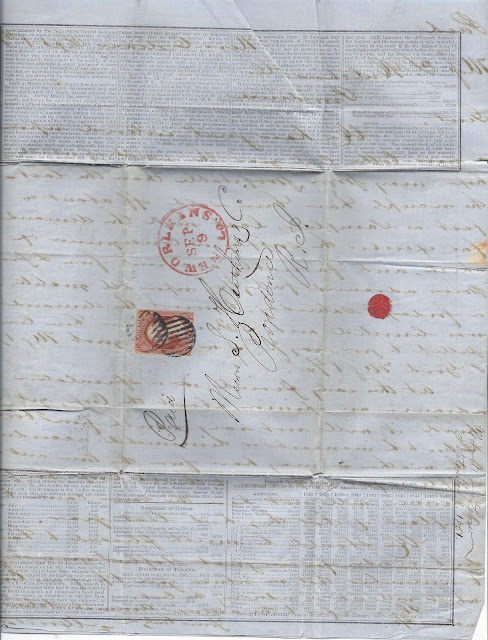
Remember, you can click on images to see a larger version

Just two weeks ago, I talked a bit about folded letters.  This letter consists of a single larger sheet of paper that has been folded in half to create, essentially, four pages - or sides.  One side needed to be used as the outside wrapper for an address and postage.  The rest would face inward once the letter was fully folded for mailing so the contents would not be revealed unless the letter was opened.

Now look carefully.  The parts of this page (or side) that would get folded in is covered with printed information.  The sender of this letter was not about to let that valuable space go unused. 

Two more sides on this folded letter are also covered with pre-printed material.  The content itself was referred to as a price(s) current, or a market report, that provided recent product volumes and values in the New Orleans area.  Much of the report centers around agricultural products, which makes sense as the letter was mailed by a Wood & Lowe, who were cotton brokers in New Orleans.

The printed content actually provides information for multiple years leading up to September of 1851.  The text itself is actually pretty small.  If a person did not need reading glasses before they started reading this folded letter, they might once they completed the task.

One of the four pages also includes a personal note to the recipient.  The docket at the top reads "Sept 8th, 1851," the day prior to the New Orleans post office placing the red postmark on this cover.  The letter starts with discussion of the cotton crop.  Otherwise, this is pretty much a standard business letter that is essentially encouraging the recipient to participate in the purchase of the year's cotton crop. 

Some of you might remember that printed matter, such as what we saw on three sides of this letter sheet, qualified for a cheaper postage rate.  If this item had not included this personal correspondence, it would have also qualified. But since this sheet was printed in such a way that one side was left blank, the intent was clearly to allow space for the personal sales pitch.

The handwriting here is like much handwriting, there can be places where it is harder to read.  But, what I am going to show you next will make this look simple!


Our second folded letter was mailed in New York City to Southampton in the UK.  It entered the mailbag to cross the Atlantic Ocean on July 8 and was taken out of the mailbag in Liverpool on July 18. The letter was carried on the Inman Line steamship named City of Boston, which arrived at Liverpool on July 18 (which nicely matches the postmark for Liverpool at the left).

There are two postmarks on the back of this letter.  One is a London postmark for July 19 and the other is a Southampton postmark for the same day.  So, we can guess that Edward Palk received this missive at that time.  The docket at the left in dark ink reads "Mr Parsons June 1865."  Indeed, the letter inside is datelined "Cleveland, June 1865," which provides us with the date and location for the starting point of this letter.  After taking some time deciphering the contents of the letter, it seems it was written over a period of several days, and it is possible Mr. John Parsons was traveling as well.

Everything I say about the contents of the letter is still open to further study - because reading the letter is not easy.

Rather than spend more time telling you why it was hard to read, let me just show you.

This is the first page of the letter.  Or at least, this is where the letter starts.  Mr. Parsons used a technique called "cross-writing" in an effort to avoid using more sheets of paper that would have caused the letter to exceed a half ounce in weight.  Exceeding that half ounce would have required another 24 cents in postage and, apparently that cost was worth expending the effort of writing in a lighter ink first in one direction.  Later content was written OVER the lighter ink in a darker ink and going in a direction that is vertical, instead of horizontal, on the sheet.

This is certainly a technique that was developed during a time when the cost of mail was extremely high.  But, by the time we get to 1865, postage had come down significantly.  This interesting blog by Kathy Haas makes a valid suggestion that cross-writing might not have always been used because the writer was unable to afford the cost of paper and postage.  It is possible that this was "an ingrained habit or a practice associated with virtuous thrift."

In other words, it is possible that Mr. Parsons was signaling his own virtue to Mr. Palk by... um... making it really hard for Mr. Palk to read the contents of the letter.

the top of the page shown above

The letter opens, "My Dear Friend..."  But, after taking a few moments to attempt to read this writing, I have come to the conclusion that Mr. Palk was either truly a very dear friend OR this was a passive aggressive way to let Mr. Palk know who was better than whom.

The letter actually starts out with some business, acknowledging a draft (for money transfer) and discussion of the status of an account.  The rest of the letter seems to cover a lot of ground.  On the whole, the letter seems to be quite conversational - so perhaps Mr. Parsons did consider Mr. Palk a "dear friend."

Later in the letter, Mr. Parsons speculates on some issues he has read in the paper about Europe.  For example, I see mentions of the Fenians, an Irish nationalist society on this page where the writing runs vertically.  But, I find it very interesting to read his comment that "now that the war is over..." houses were becoming available that were less expensive to purchase than rent.  Apparently, it had been difficult to find rental properties "at any price."

Some of the cross-writing has a notation that reads "July 3," which makes it clear that this letter was written over a period of days.  Mr. Parsons follows the date by saying "tomorrow will be a great one for firecrackers and.. speeches."  No doubt, in reference to Independence Day celebrations.

Perhaps someday I will make the effort to read this letter in its entirety.  Or, I'll just take something for the headache I feel coming on about now.  The handwriting itself is fairly legible.  It is more a matter of familiarity.  Words like "their," "friend," and even "acknowledge" are recognizable because they are common words I know and use.  But, because we are not familiar with the names, time-period references, colloquialisms and subject areas that the writer and recipient are, we are often left to guess - often badly - at the key words that could unlock the content fully.

Bonus Material - Shubael Hutchins

Going back to our first letter, we find that it is addressed to S. Hutchins & Co of Providence, Rhode Island.  We could be dealing with either Shubael Hutchins (2nd of that name) or Shubael Hutchins III, both of whom might well have been part of the business at the time.  The latter Shubael apparently served as president of the American Bank in Providence from 1855 to 1868.  It is a decent guess that the former was a businessman who dealt in dry goods at either the wholesale or retail level.

With that information, I made the educated guess that the elder Shubael Hutchins was the namesake for a drygoods business - hence the reason he would receive a letter from New Orleans regarding the cotton crop.  The Colenda Digital Repository provides support for this guess as it features a letter sent to Hutchins regarding damaged cotton bales.

A small portion of the price-current

One never knows what you can uncover once you are fairly sure you have identified the recipient (or sender) of a piece of mail.  In this case, I actually ran into a court case regarding the will of Shubael Hutchins (the 2nd), and the opinion was published in 1907.  Since Hutchins had died in 1867, this certainly gives one pause - a forty year gap to finalize parts of will seems excessive to me.

Apparently a key issue being considered was this part of the will (most of the rest of the will had been executed successfully):

"To the treasurer of any one or more societies or organizations whose object is the improvement and education of the colored people of the south, I give the sum of ten thousand dollars for the uses and purposes of said societies but I leave it wholly to the judgment of my said trustees as to the time when, how much of, and to what society or societies or organizations said sum or any part thereof shall be paid having reference to the ability of my estate and the Efficiency of any of said societies in the above object"

At issue was the contention by the trustees that they could not find an appropriate society to give the money to, so they wanted to be granted the ability to NOT follow through with this portion of the will.  Cutting right to the chase, the court held that the money was for a valid charitable cause and was not void due to "indefiniteness or uncertainty."

In other words the ruling was saying "figure it out people and get that money where it is supposed to go."

Perhaps there were stipulations that the organization needed to be in Rhode Island.  But, it certainly wasn't a matter of finding where the people of color might have been.  Shown below is part of a map produced in the early 1860s and based on 1860 census data.  I selected the areas closer to New Orleans to make the point.  Each county was shaded to illustrate the percentage of the population that was enslaved.  The darkest shade indicates populations where slaves comprised 80% (or higher) of the total.  Much of the area upstream form New Orleans on the Mississippi River fit that description.

Portion of map published by US Coast Guard, from American Yawp.

I find the irony of this donation from the estate to be very interesting.  Clearly, Hutchins and his business benefited greatly from cotton.  Cotton, in turn, relied heavily on slave populations to produce sufficient crop for people like Hutchins to trade.  Did Shubael Hutchins make the connection and add this into the will as salve for his soul?  Were the trustees of the estate reluctant to follow through with his wishes because they didn't really want the colored people of the south to become educated?

To put this in perspective, $10,000 in 1867, the year Hutchins died, had the same buying power then that $380,000 has in today's world.  It wasn't going to keep a school or other organization running indefinitely, but it certainly could have made a difference for a few people.

For those who might like to learn more about the role of cotton in the US Civil War, I found this blog to be interesting.  If you want something with even more depth to content with appropriate citations, this article on American Yawp fits the bill.

While we will never know the full story of Shubael Hutchins and his bequest, these are events and issues worth pondering and considering - thank you for allowing me to do so in today's writing.

I think we'll call it a day.  I hope you enjoyed this edition of Postal History Sunday.

For those who are curious, I also uncovered interesting material on Edward Palk (our second featured item), which I think I will reserve for future Postal History Sunday!  Hey!  I need to save something for later, don't I?

Have a fine remainder of your day and an excellent week to come.

--------------------

Postal History Sunday is published each week at both the Genuine Faux Farm blog and the GFF Postal History blog.  If you are interested in prior entries, you can view them, starting with the most recent, at this location.

Saturday, May 6, 2023

Pasque Flower Season

It's early May and some of the Pasque Flowers are already starting to fade, though they are also teasing us with a few more blooms.  We first 'discovered' these wonderful perennial plants several gardens ago when we lived in Minnesota.  We realize that most perennial Pasque Flowers that are sold in nursery's are the European varieties (pulsatilla vulgaris) where as the natives to the United States may be found as Pulsatilla patens  or Anemone patens.


For those who like wildflowers, I would like to point out that the first link takes you to a page on the US Forest Service website and the second to a site dedicated to Minnesota wildflowers.  Here is yet another from University of Wisconsin.  It seems that the US Forest Service page is not a permanent one as they feature a wildflower periodically and then move the web page to a new address when it gets featured again.  I admit that I get mildly nervous when excellent web resources that are put together by some of our government agencies disappear or are threatened for various reasons.  But that's probably another day's writing.


The horticulture Pasque Flowers have been hybridized to develop some variety in color and flower form.  We have seen colors ranging from red to white.  Personally, I might prefer large numbers of the native plants, but I find that I am not immune to appreciating some of these varieties as well.  The natives tend to bloom about a week to ten days earlier and they can handle much more competition than the garden varieties people might buy at a nursery. 


The flowers are featured on these plants much earlier than the leaves, which is true for many early flowering perennials.  As the season progresses, these leaves will get much bigger and the flower stalks will stretch out above the plant to hold their seeds high for potential distribution to a new location for a new plant.  If given the chance (with a bit less competition) the leaves can be quite attractive until we hit August.


The other nice thing about Pasque Flowers?  They can handle a little snow and cold.  Even if that snow comes in May (which was when the picture above was taken).  Obviously, I am NOT talking about this May.  Please not this May....
 

The 'fruits' or 'seedheads' on the plants actually can be quite decorative as well.  This year, we've noticed that some of our other plants are encroaching a bit on our Pasque Flowers more than they used to.  Maybe we'll move one or two to a new location so we can enjoy them more?  I don't know.  I guess we'll wait and see where the energy is for such things.

But, the best thing about these flowers?  It's seeing the first bit of green pushing up out of the soil - daring us to hope once again.

Friday, May 5, 2023

Researcher or Research Subject?


I was cleaning the turkey room recently (preparing for a new flock in 2023) and came across something that concerns me a little bit.  I found some paper - and it was not paper that was shredded for bedding.  This paper had writing that had been put there in a chicken-scratch hand... er... no... a turkey-scratch hand that looked like it was intended for someone other than the farmer.

This document had been made to look like one of our turkeys wrote it and we're not sure who might have placed it there.  The alternative - that one of our turkeys actually wrote this - is a bit more disturbing than we are willing to admit.  So, we're wondering if you all could weigh in on the matter and give us some advice.

Here's what was on the paper:

----------------------------

Staff Writer: Ima Turkey

Individuals looking for an entertaining afternoon should look no further than the Genuine Faux Farm. We have found the guy with the red hat to be extremely amusing as he runs around the farm. In fact, we are conducting a study to find out what sorts of actions/sounds he can be made to respond to (see Pavlov and others). Since he is not really an intelligent being (unlike us turkeys), we have no fear that he will figure out that we are conducting experiments regarding his behavior.
 
Observations thus far:
  • Subject tends to mumble audibly when one of us flies onto or over the fences
  • Subject will hesitate in making a choice chasing us (when we're outside the fence) if we divide our numbers and go in opposite directions
  • Subject makes strange "hahaha" sounds whenever we run to/fro our room and the gate in the morning.  We think it is a nervous tic of some kind.
  • Subject tends to throw yummy produce to locations in the field where one of us is NOT located, though he does tend to have a left/right/forward/back pattern.
  • Subject can be trained to bring more tomatoes and cucumbers by eating them quickly.   Similarly, the subject seems to reduce offerings of other food types if we show less enthusiasm.  Have not yet managed to get ice cream.
  • Subject appears to have limited language ability.  Has attempted to respond to "crowd gobbles."  Enunciation is terrible.  We highly doubt the subject has understanding of the meaning of the words.
  • Subject has been trained to allow us to drink out of the hose periodically.  However, Muck learned that subject isn't terribly steady with the hose after getting a face full of water.  Subject has not shown consistency in allowing us to drink out of the hose.  We continue to work on finding a proper prompting action to elicit the desired response.
  • Subject appears to respond to sunrise and sunset with certain activities, including bringing us food and water at sunrise and coming out to see us into our room at night.  Has apparently imprinted on us.  Though subject does show independence - thank goodness.  Who would want to deal with THAT all day and night?
  • Subject has been trained to respond and come into view on certain calls, but appears unaware of the desired response once in view.  We remind ourselves that we must take baby-steps in this process.
  • Subject appears to be unaware of our scientific endeavors - our ruse continues to be successful.
We expect to make a final report to the community in December regarding this study.
Respectfully,
Ima Turkey

-------------------------

Well, there you have it.  Once again, advice would be appreciated.

I don't know what exactly was going to happen in December, but I think it might be a good thing we had a trip to "the park" scheduled before that.

Thursday, May 4, 2023

Playing the Wrong Game

I think I have told the story before that I was so averse to speaking in front of others that when I made the choice between debate class and speech in high school, I chose debate.  Why?  There were fewer people in the class.

This turned out to be one of the best decisions I could have made for myself.  I ended up taking three MORE years of debate... voluntarily.  I credit that choice with my ability to do reasonably well as a public speaker.  It provided me with skills I could use when I became a college instructor/professor, with its constant demand for spoken interactions.  I also credit debate with two more things:

  1.  I learned to explore multiple viewpoints for any given subject - and I honed my skill at arguing from those different viewpoints.
  2.  I learned that a good argument 'wins.'  And I learned that I did not like that lesson.

Now, I get to tell you why I think that.  But first, I want you to consider this photo of Pasque Flower, taken just yesterday on our farm.  We'll get back to it later.

Too Much Emphasis On Winning - Not Enough On Best Solutions 

Competitive debates pit two teams against each other where they attempt to persuade a judge (or judges) that their argument is the 'winning' argument.  Since we are talking about high school-aged people, it is pretty easy to teach the strategies and approaches to making an effective argument to win.  And, unfortunately, it is all to easy to ignore things like integrity and constructive dialogue when your goal is simply to be the victor.

Not once did I participate in a debate where the two opposing teams hashed out a solution that was best for all people.  In fact, it usually ended up (at that time) that one team succeeded because they could show three links to a nuclear war versus the other team's two.  We learned about Malthusian Theory only in that it was a way to win if we could show our opponents would make Malthus's hypothesis come true.

Sadly, I see the same mentality throughout the world in all sorts of situations.

A few years ago, I was at a county convention for a political party where the platform discussion was being held.  It felt good to have a chance to discuss ideas and options for policy with other people who truly seemed to care about what might be best.  And, yet, there was still too much flavor of opposition and not enough collaboration.  To illustrate that point, I had gotten up to speak on a couple of issues where I did not quite agree with the party-line.  My point was that the concept of the policy was fine, but it needed to be flexible for situations where it defeated its own purpose - or where there were important exceptions that needed to be allowed.

In the end, the plank was adopted as written.  In fact, I voted for that to happen because I felt the greater good would go with that position.  What I hoped for was that a few more eyes would be opened to the exceptions - that way, if laws were to be implemented in the future, there would be more people aware of them and perhaps those exceptions could be successfully implemented as well.

After the convention, two people came up to me and thanked me for speaking - but they were sorry that I had to 'lose.'  Folks - there was no loss here.  I was given the chance to have a voice.   I was given respectful attention.  Others could respectfully disagree.  Could we have done more to collaborate and improve the position?  Yes.  Our only 'loss' was that we keep thinking it is about winning or losing our arguments. 

And in so doing - we neglected our responsibility to understand that things worth considering are usually quite complex.  They aren't simply polar opposite choices of "no nuclear war" or "nuclear war", or "Malthus was right" or "Malthus was wrong."


Who Is Your Enemy? 

Over time, I have come to believe that we should be seeking dialog and strive to find the best answer for the largest part of the people - all while trying to provide for as many reasonable exceptions as we can.  The problem is - it is very hard to do this.  It is so much easier to draw lines in the sand and encourage everyone to pick a side.

Over the past few election cycles, I took note of some key questions that were brought about in Presidential debates.  One of those questions was:

"Who are your enemies?" 

Ok, I don't quite know if that was the exact question put to the candidates.  But, it is close enough to the gist of what was asked.  The real point is this - EVERY candidate identified multiple 'enemies.'

Not a single one made the suggestion that, regardless of party affiliation, they were all seeking to be public servants who would work through differences to attempt to navigate policy for public good.  Not one.

For several years now, in partisan confrontations at multiple levels of government, we have been hearing the words - 'the opposition' rather than a name or perhaps 'my colleagues' to indicate that they all are working in a capacity as public servants.  After all, this plays to the simple 'winner/loser' concept.  Us versus them.  I win, you lose.  

It's simple.  Two choices. Right and wrong.  Which, if I may be so bold as to say so - is simply - wrong.  (See how hard it can be?)


Do the Difficult Thing

It is so easy to take a side and blind yourself to any other option.  Suddenly, you don't have to think.  You can accept any bit of information that happens to fit your side of an argument regardless of the source.  You don't have to even try to understand the reasons a person might have to disagree.  Unless, of course, you are really interested in 'winning.'  Then, the game begins as you use any tool - regardless of the consequences - to beat them into the dust.

That isn't winning.  That's making sure we all lose.

So.... why did I intersperse today's blog with pictures of Pasque Flowers, Dandelions, and Grape Hyacinth?  

These were all blooming within five feet of each other on our farm yesterday.  The Pasque Flowers were peeking out from between the tall fronds of Surprise Lilies.  The Dandelion was blooming immediately next to the paved sidewalk and the Grape Hyacinth were in an area that is also a bit overrun with grasses.  It is a small, but complex ecosystem that has changed over time depending on conditions (including our willingness and ability to clean up the cultivated planting).

It isn't a situation of flowers or not flowers.  It's more of a mish-mash of flowers now, flowers to be, flowers that were, flowers we don't recognize as flowers and things that are not flowers.  It's difficult to explain and it is difficult to decide what the best thing for this area and the life that is in it will be for the future.

Today's challenge is that we all decide to do the difficult thing.  Look critically at what you are inclined to agree with because it is already part of what you believe.  If you are the one pointing out issues with another viewpoint, do it with kindness.  In turn, respectfully accept and discuss these things when they are brought to your attention.

Then do the hardest thing.  Reconsider your position.  Reconsider how you feel about other alternatives.  Look to see if there is a way to do better than just us versus them.  

Us versus them and win or lose - that's the wrong game.  Appreciating complexity and finding ways to make it work?  That's the real challenge -and it's worth doing.

Wednesday, May 3, 2023

Just a Stroll


Tammy and I took a short trip to the West Coast so I could try my hand at being part of a team of judges that evaluated philatelic and postal history exhibits. The location of the event was next to the Burlingame Shorebird Sanctuary.  And for those who like birds, ebird actually has a birding checklist for that location.

We took a couple of walks and did our best to view and identify birds.  Some of them were surprisingly familiar because we have seen them at Sweet Marsh (near Tripoli).  And others were a bit more of a thrill because we won't see them anywhere near where we live.

Sadly, the camera did not come along for this trip, so we relied on our phones.  But we're not looking at creating images to print and put on our walls here, so these will suffice.

We went back and forth on the identity of this bird.  We thought it might be a Long-billed Curlew or maybe a Whimbrel. Since a Whimbrel is a type of Curlew, I suppose we could be forgiven for our uncertainty.  After looking at the photo, I am more certain it is a Whimbrel because its curved bill seems to be a bit shorter.

We saw a Clark's Grebe diving in the water and an Anna's Hummingbird checking out the flowers.  There were Plovers, Godwits and Dunlins.  Sandpipers, Dowitchers and Gulls.  A Forster's Tern and a Snowy Egret flew by.  Meanwhile, a Bewick's Wren and a House Finch sang happily and a Dark-eyed Junco hopped on the ground nearby.

All of this courtesy of the fact that the area they were happy to inhabit was not good enough for someone to make another buck.  The humans have surrounded this area with an airport, hotels and various other things.  But with the shallow water and tides changing its borders continuously, it seemed like it would be okay to leave this slice of the world for the birds to reside.  

Hey, let's call it a bird sanctuary and it can be an attraction - I guess there is still money to be had, even if you do let the birds have it.

I might sound a little bitter in the last bit, but don't let that make you think I don't appreciate the sanctuary or that I was not happy to see some of the flowers in the area, many of which had been planted in cultivated beds that various businesses seem to favor.  The world there is what it is now, and if we can do things to support and encourage nature as it is, all the better.

We did notice some Sea Lavender growing near the side of the road.  Clearly, they had not been planted there - they were volunteers (ME!  Take me!  I'll do it!).  Whether these are native cultivars or variety that has been cultivated over time for gardens, I do not know.  

Either way, it was a dash of color that was welcome and appreciated.  The fact that a plant that was this showy was making a go of it just a foot away from a road without human intervention was enough to get me to root for it.  Now I just hope it doesn't turn out to be an invasive plant that it causing more problems than the good it did for me.

Then again, what is it invading here?  The dull landscape near a road that has a convenience store just fifty feet away?  I think we could do more with that sort of invasion.

And speaking of invasions - I await the typical May flush of Dandelions at the farm.  There was a time when I thought this was a bad thing.  Now I see its value.  The pollinators have been hanging on for this time of year - time to feast!

Tuesday, May 2, 2023

Too Proud for Words?

The days are still getting longer and the farmer's endurance is not keeping up!  We can only assume I will eventually figure it out.  While I am working on farmwork stamina, I thought I'd give you a brief blog post for your entertainment (and maybe mine as well).

With Anemones Like These....

Who needs friends when you have anemones?

We have a nice little patch of anemones that started out as one plant 16+ years ago.  It might actually be safe to say that these anemones are actually friends of ours.

Asparaaaaaaaaaaaaaaaaaaaaaaaguuuuuuuuuuuuuuuussssssssssss!

The asparagus is stalking us!

Look, we've seen the cartoon with the reference to the Age of Aquarius song that substitutes Asparagus for Aquarius.  It's funny, ya.  But, why do "Age of Asparagus" when you can do "Eggs and Asparagus?"

So, we got up early on a Saturday, several years ago, for a farmers market.  It was dawn and we were selling eggs and asparagus, eggs and asparagus, aaaaaaaaaaaspaaaaaaaraaaaaaaaaaagussssssssssssssssssss!

You're welcome.

No Trays of Humility

We planted lots for one session, so there.

Yep, sometimes we go on these planting sprees and plant lots of trays.  Shown above is the results of one of those sprees - I don't remember which year the photo is from.

Regardless, we're proud of our efforts on days when we get a bunch of things into trays so they have a chance to grow.   I see no reason for modesty - no trays of humility.

Have a great day!  The groaning of pun aficionados everywhere is appreciated.

Monday, May 1, 2023

Ghosts of May Past

I have been reminded by various people over the years that a 'living farm' is a farm that is not a stranger to change.  Every once in a while, when the "to-do" list seems insurmountable, it pays to look in the mirror and remind ourselves of what has gone before.  Below is proof positive that we do accomplish tasks and we do adapt from year to year as the situation demands. 

2008 - during our first Practical Farmers of Iowa field day.

We don't have terribly many pictures prior to 2010 because we did not have a digital camera at that time.  Hey, do you remember having to develop film?  Indeed, it cost money to do that.  So, we tended to be a bit more selective with our picture taking.  In the case of the picture above, someone else with a digital camera took it.  And, this picture is from August.  Without it, we have no 2008 entry.  

There was still a beautiful Silver Maple in the center of the farm that was an attraction for all sorts of birds, but its trunk touched the base of the garage.  In many ways, it was a different place.

2010 - old plastic cold frames

I had almost forgotten that there was a (non-working) pass-through door on the truck barn in the southeast corner.  There is a window there now and the electric service is now underground and enters in that corner.  Just as important are the changes in how we keep young plants warm.  

The plastic cold frames in this picture are now long-gone.  The plastic covers held up for a couple of years in our wind, but there were only so many times they could withstand a windstorm that uprooted them and tossed them around the rest of the property.  The wooden cold frames took their place, but they too are no longer in service.  Over time, wood rotted, glass broke and the farm moved on to other options.

2011 - we wood if we could.

The old barn still had siding and much of a roof as early as 2011.  Now, it is a shadow of its former self.  The wood pile is much of what came from one of the oak trees that used to reside in front of the house.  Lightning took it out and we arranged to have it taken down.  

That wood pile is still there... sort of.  For some reason, it's a little shorter than it was in this picture - and it's not because we used the wood for bonfires or heating.  Hugelkultur anyone?

2012 - birdy paradise

We used this semi-portable building for raising our broilers for several years until the cover started to break down and the wood base started to rot out.  My wonderful Dad did most of the work on putting the frame together for the end walls.  The only real shortcoming was the 'semi' part of the portable....  Tammy and I moved the building many times, but we decided we needed to do something different after a couple of wipeouts while we tried to move it in very wet years.

The metal frame is still in use, but we put in longer metal legs so we could walk into the building without ducking.  As a matter of fact, this is our new locations to keep young plants warm early in the year.  

It's nice when things in a blog tie together.

2013 - Here, let me help with that.

Some changes are not of our choosing, nor were they welcome.  Mrranda was one of our friendly farm supervisors who disappeared in 2016.  When you live on a farm with outdoor cats you have to expect to lose them well before their 'time.'  We'd been lucky with other cats living very full lives of 12 to 15 years, so having Mrranda leave at about 3 to 4 years of age was pretty rough.  

Sadly, her cousin, the Sandman, went missing in May of 2019.  We've muddled along without them and have a new contingent for our Farm Supervisory Crew.  But we still miss our little friends.

2014 - DUCK!

Other changes have definitely been part of the ongoing reassessment of what we should be doing on our farm.  We raised ducks for a few years with some success, even running a trial between two breeds.  For the most part, we enjoyed having them on the farm. 

Low demand and the growing reality that we just had too many flocks to care for led us to remove ducks from our production list.  At one point in time, we thought we might reconsider and have ducks on the farm once again.  Like many things, the longer it goes the less likely it becomes.  Never say never, but you can say unlikely.

2015 - Bush line time.

It took us until 2015 to finally put in the full effort to complete the eastern bush line on the farm.  This was something we wanted to do years before, but time and other resources often left us (and still leave us) with an annoyingly long list of 'maybe next years.'   

A satisfying percentage of these bushes have matured and done a fine job on the border of the farm.  It may have felt, at times, like they would never get any size to them.  Well, they're a good size now.  It's a reminder that the best time to plant if you want to see trees or bushes get some size on them is now.

2016 - the Inspector arrives

The cast of characters changes as the wheel of time turns.  We have had a number of wonderful people work during the summer months on the farm, but we often had to turn over in that group from year to year.  In recent years, we haven't had anyone else working on the farm.

Workers, customers and farm supervisors move on and new characters that bring their own brand of goodness to the farm each year.

A sizeable crew helps us with plant potting - 2017

That got me to thinking about the number of people who have left an impression, both big and small at the Genuine Faux Farm.  May was often the time of year when we would have groups (often students) tour the farm or come out as a work group.  Sometimes they would have a class project, such as those who took soil samples so they could do a lab to analyze soil components.  At other times, they would get the nickel tour and then help us do something that required many hands - like moving tomato cages out to the field from storage.

2018 - the rotary harrow (Vince) is added to the farm

One of the benefits of time on a farm that is at least moderately successful is that you can build up the infrastructure that is needed to keep on keeping on.  Sometimes, the tool we select and add doesn't excel at its role as much as we hoped.  Sometimes, it does just want we wanted.

We gave this tool the name Vince because it is a harrow and that makes us think of Vincent Price, who was known for horror movies.  If you want a harrowing experience, Vince seems like a good name.

From poultry to Casa Verde - 2019

Changes on the farm don't always mean that we completely remove something or add something new.  The CV Building (Casa Verde) was formerly used to house poultry and after modifications it became a mini-greenhouse to help us harden off young plants.

The job of hardening off plants had formerly been the purview of various cold frames - and now we have this.  The biggest issue has been the plastic.  We've had to replace it multiple times.  Thinking positively, we would rather replace the plastic for this smaller building than one of our high tunnels - so it's all good.

Bees on the farm - 2020

We've had bees on the farm longer than a few years, but it wasn't until 2020 that Tammy undertook doing the beekeeping herself.  Prior to this, the hives on our farm were largely maintained by other beekeepers.  In exchange for the access to our pollinator habitat, we would get the pollinator services.

Now, we do our best to treat our own bees well.  We don't pretend to be experts in beekeeping, but we sure do love seeing the activity around the hives.  

We also have a great appreciation for the native pollinators on our farm, but the responsibility of caretaking honeybees provides us with additional encouragement to keep doing our best to make our farm friendly for them and for the native bees.

2021 - rolling out row cover is hard after surgery

Things changed in a very different way for us in 2021 after I underwent surgery to have a kidney removed in late April of 2021.  Suddenly, early season tasks were significantly more difficult (or impossible) for me to do.  And, of course, what happens, we had a very late freeze.

It was also the first year we were growing plants out for vegetable seed under contract.  The cucumbers under this cover failed, despite our efforts, after the freeze and we could not make up for the losses with no farmworkers and one of the farmers going through the physical recovery process.

Last year - the PIT gets filled

It was just about one year ago that we arranged to get the pit next to the Poultry Pavilion filled up.  This is a project that has been on our minds for years.  But, the combination of time, money and a willing contractor just didn't line up until 2022.

The biggest positive here is that we no longer wonder if we need to check on each other if we're gone longer than usual while doing poultry chores.  While it certainly wasn't quite that dangerous, we knew it was approaching the land of unacceptable risk.

Now it is May once again.  The farm season will soon be in full swing - whatever that might mean for 2023.  It will be interesting to see what we will find ourselves featuring if we update this blog post in a future year for the year that is to come.

Have a good day, and thank you for joining us for today's GFF farm blog.