Sunday, June 11, 2023

That Doesn't Seem Fair - Postal History Sunday

Welcome again (or maybe for the first time) to Postal History Sunday!  Take a moment of time to read about something different and maybe learn something new.  Stuff those worries in the cookie jar for a little bit and make sure you take some cookies out to enjoy while you read.

This week I am going to write about a topic that I often find myself explaining to other postal historians who do not share my specific area of interest.  Now, before you think this will be 'too much,' I can assure you that if you have read any of the other Postal History Sunday posts, this one won't get any more into the weeds than those.  You're going to do just fine.  

Now, if you're worried because you ARE a postal historian and you think this will be boring because it will be too simple...  I guess that's your call!  But, I bet I can find something interesting for you before we reach the end. 

This week's "attention getter"

I'm just going to put this envelope right at the top of the blog.  For those of you who are into postal history or philately, you probably already have some level of appreciation for this item.  And, if you don't know anything about postal history, let me point out to you that there are FIVE twenty-four cent stamps on this letter paying $1.20 in postage.

The letter shown above was mailed in 1864 from Champlain, NY, to Dundee, Scotland.  The cost at the time was 24 cents for a simple letter that weighed no more than 1/2 ounce.  OR, if it weighed more than a half ounce, the cost was 48 cents per ounce.  So, this letter must have had some weight to it.  

But that's not the big reason this envelope is interesting to me.  You see, this letter did not have enough postage to pay what was owed.  The agreement between the US and the United Kingdom was written in such a way that if something was not fully prepaid, it was treated as if it was not paid at all.  As a result, the recipient had to pay the full postage due (6 shillings) and the $1.20 essentially became a gift to the US Post Office.

How could that possibly happen?  That's what today's Postal History Sunday is all about!

Sending a letter to England

This next envelope was mailed in 1862 from Boston to London, England.  This was a simple letter, meaning it did not weigh more than the amount allowed for the first increment of weight (1/2 ounce).  As we would expect, there is a single 24-cent stamp paying that postage.  

Today, in the United States, it costs 63 cents to mail a letter that weighs no more than one ounce in weight.  It costs $1.45 to mail a simple letter (a letter that weighs no more than one ounce) to Scotland in today's mail. So, if you're thinking, "Wow.  It sure does seem like it cost a fair bit to send a letter to England in 1862."  You would be correct.

In fact, the letter rate actually decreased to 12 cents in 1868 and was reduced further to six cents not long after.  By the time we get to the days of the General Postal Union (1875), that price was 5 cents!


To make the point that postage rates declined rapidly after the 1860s, shown above is a simple letter that was mailed from Utica, New York, to Huddersfield, England.  The postage stamp covered the cost of postage - two cents - in 1916. 

As one of my college math professors was fond of saying....  "But, I digress...."  

Getting back to the 1860s.  The twenty-four cents of postage was split into three pieces:

  • 5 cents was kept by the United States for their internal mail service
  • 16 cents were paid to the sailing company that carried the letter across the Atlantic
  • 3 cents were kept by the British for their internal mail service.

The wild card here was that some sailing companies had contracts with the British and some had contracts with the U.S.  It actually mattered which ship carried this letter because it determined which mail service got 16 cents worth of the postage so they could pay the shipping line.

The US Post Office sold the stamp for 24 cents to the customer, who put it on the envelope to show that they had paid for the service.  This letter went via a British packet (steamship), which means the British needed 19 cents (16 + 3) to pay for their part of the services needed to get the mail to the Reverend A.P. Putnam in London.  If you look at the Boston postal marking, you can see "19 Paid" which recognized that 19 cents were to be passed on to the British postal services.

What if it weighed more than a half ounce?

Well, 24 cents would not cover the cost of mailing that item - of course!

remember, you can click on an image to see a larger version

Here is a larger envelope that must have been more than a half ounce, but no more than one ounce in weight.  It was mailed from Chicago to Shaftsbury, England.   Two, 24-cent stamps were placed on the envelope to pay 48 cents in postage.  This letter was sent via a steamship that had a contract with the United States, so only 6 cents was passed to the British.  If you look at the left side of the envelope, you can see a red marking that reads "6 cents" with the word "cents" in an arc below the number.

Below is a summary of the rate table for mail from the US to the United Kingdom from 1849 through 1867.

You might notice that the rate of postage was not 24 cents per 1/2 ounce.   It might be better to think of the 24 cent rate as a special rate for very light mail.  The actual rate might more accurately be said to be 48 cents per ounce.

But, wait a minute - did I say that the letter above was mailed from Chicago?  How did I know that?  The clue lies with that "6 cents" marking I was talking about earlier.

One of the magic powers postal historians develop over time is the ability to recognize certain markings and understand where they came from.  The "6 Cents" marking was used in Chicago to show that the British got 6 cents out of the 48 cents in postage.  There is a similar, more commonly found "3 Cents" marking used for letters that were a half-ounce or less in weight.


Here is an example of a simple letter that was mailed from Chicago.  The blue postmark at the top rigth reads "Chicago, Ills" and we can see a "3 cents" marking that looks a lot like the "6 cent" mark on the other envelope.  Shown below is another example blown up so you can see the details.


Letters that went through the Chicago exchange office in the 1860s were typically sent to either Quebec or Portland, Maine so they could get aboard an Allan Line ship.  The Allan Line had a contract to carry mail with the United States, so the British only got 3 cents and the United States kept 19 cents so they could use 16 cents to pay the cost of trans-Atlantic carriage.

But, what if they didn't pay enough?

People didn't always get the postage right - so there had to be some sort of an agreement to determine how "short paid" letters would be handled.  For example, the letter below (from 1867) has a single 24 cent stamp on it - but it must have weighed more than a half ounce, so it needed 48 cents in postage.


The New York foreign mail exchange office placed a "Short Paid" marking on the envelope and used black ink for their circular marking (the one that has a "42" in it).  The interesting thing is that this letter must have caused the postmaster some trouble because there is a red marking just to the right of it that indicated it was paid.

You can guess how that might happen.  The clerk was going through a pile of letters, stamping them with the red paid marking and got into the rhythm of the work.  He hit this one with the handstamp and then said "hmmmmm."  Weighed it out and realized his instincts were correct - so he put the "short paid" and the black circular marking on the envelope.


The British Post Office agreed with this assessment and wrote the squiggle on the envelope that is a 2 with a squiggly tail.  This was their way of saying the recipient owed 2 shillings for the privilege of receiving this letter.  The envelope contained a death announcement, which is indicated by the black border.  I have a suspicion most people would have found a way to pay the 2 shillings in this case.

How much was 2 shillings in US money?  48 cents.  

The agreement between the United States and the British at this time was that a letter that was not paid in full would be treated as COMPLETELY UNPAID.  Well, that's one way to make a death announcement sting a bit more.  The sender spent 24 cents to send it and the recipient had to pay the equivalent of 48 cents to receive it.  Ugh!

It could be worse!

The letter below has 72 cents in postage applied to it AND the recipient had to pay 4 shillings (equal to 96 cents) to receive it.

This larger envelope must have weighed more than one ounce, so it would require more postage.  So, let's remind ourselves of the postal agreement rates:

Oh... yeah.  It isn't 24 cents per 1/2 ounce - it's 48 cents per ounce once you get to things heavier than a half ounce.  But, that's not what everyone understood when they mailed things.  After all, if you wanted to send a letter inside of the United States it was 3 cents for EVERY 1/2 ounce.  It would be natural to expect a rate to a foreign country to follow the same pattern - and that's what the sender of this envelope expected when they put three 24-cent postage stamps on this large envelope.

The letter must have weighed over one ounce and up to 1 1/2 ounces.  They figured 72 cents was correct if you had 24 cents per 1/2 ounce.  But, they were wrong - which means the letter was Short Paid.  Which means it is treated as UNpaid.  

Ugh again!

Oh my goodness!

And all of that brings us back to our original item.  If you thought the prior letter recipient was being treated poorly, what about poor Mr. Robert Stiver of Dundee, Scotland?   He had to pay 6 shillings for this item sent in the mail to him.

You can guess what happened here.  The sender expected that five 24 cent stamps would pay for a letter that weighed no more than five 1/2 ounce increments.  In other words, the letter weighed over 2 ounces but not more than 2 1/2 ounces, so they figured it should require 5 times the 24 cent rate per half ounce.  

Sadly, the rate REALLY WAS 48 cents per ounce, despite what the general public might think.  The letter weighed more than 2 ounces and no more than three ounces - so it needed $1.44 instead of the $1.20 affixed to the envelope.


The clerk in the New York exchange office, recognized that this was not enough postage and they struck this letter (badly) with a "short paid" marking to alert the receive exchange office in Scotland.  Perhaps a good way to think of this is to consider that the outside surfaces of a mailed letter could be used so postal clerks could send messages to their counterparts at future stops.

But, not every marking was perfectly clear - just like some people's handwriting can be nearly impossible to read.  That's why there were regulations that included directives for ink colors.  The color red typically indicated that a letter was prepaid and black would be an alert that postage would be due.

The New York exchange office marking was applied in black, which also told clerks who would handle this letter later that it was NOT considered paid, despite the postage stamps clearly visible on the envelope.  It is a bit difficult to read because it was placed over the Champlain, New York postmark.

But, this leaves us with the issue of how much of the postage goes to the United States and how much goes to the United Kingdom!  That's where this number comes in:

This number was supplied by the New York exchange office and it represents 126 cents (or $1.26).  In other words, the United States expected that, once the letter was delivered in Scotland, the postal carrier would collect six shillings (equal to $1.44).  The British post would keep only 18 cents (9 pence) and it would send the rest (5 shillings and 3 pence) to the United States.

From the United States Post Office's perspective, they did pretty well with this letter.  Someone had already paid them for the $1.20 in postage stamps, but none of that postage effectively paid for any services.  Then, the US Post Office received an additional $1.26 from the British to pay for the services the US provided.

If you don't think that seems fair, consider how Mr. Stiver must have felt when the postal carrier pointed at this marking on the envelope:

That's squiggle represented 6 shillings due. 

I sure hope the content of this envelope was worth every penny!

How or why could they do this?

It would be tempting to leave you thinking that the postal services were deliberately stealing money from postal patrons with this process.  But, that's not exactly what was going on here.  Postal services around the world were still trying to get people to move from a system where postage was collected on delivery to one that had services prepaid by the sender.  One of the best ways to do this was to make people pay more when they failed to prepay.

The prior system, where letters were paid at delivery, opened the door for postal services to carry mail all the way to their destination only to have the recipient decline to pay.  Of course, the letter would not be delivered in that case.  But the post had done all the work and gotten no compensation for it.

Relief!


We will close with a letter that was mailed from Boston to London in June of 1866.  There are three 24-cent stamps paying 72 cents in postage.  But, this letter has red exchange markings and the word "Paid" shows prominently in the messages mail clerks were sending to each other on the envelope.

If we learned anything from all of the prior items I've shown, it was that an odd number of 24-cent stamps (other than a single stamp) was going to result in some unhappy recipients as they ended up paying the full postage just to open the letter.

On April 1, 1866, the postal rate from the US to the United Kingdom was altered so that it would be 24 cents PER 1/2 ounce.  Suddenly, these odd multiples that the public seemed to think should be allowed WERE allowed.  It only took 17 years (the treaty became effective in 1849), but some relief was granted to those who were honestly trying to pay the postage yet fell prey to a bad assumption.

The postage rate itself would decline to 12 cents per 1/2 ounce on January 1, 1868.  So, these odd multiples of 24 cent stamps that were accepted as paid are difficult to find.  Once you put this envelope together with the other items in this Postal History Sunday, it makes a pretty good story.

Thanks for joining me.  I am hopeful that you learned something new!  Have a great remainder of the weekend and a good week to come. 

-----------

Postal History Sunday is published each week at both the Genuine Faux Farm blog and the GFF Postal History blog.  If you are interested in prior entries, you can view them, starting with the most recent, at this location

Saturday, June 10, 2023

Kittenlympics


Having a kitten on the farm is one way to teach you to look for fun in unexpected places.  Murphy has been encouraging the farmers to participate in several sports that we have either forgotten (since the last kitten was on the farm) or we have never known.  I think it is possible Murphy is making some of these up as we go, but she's not confirming nor is she deny anything.

Here are a few of the games we have been involved in thus far:

Falling Leaf Snatch

I was pruning some lower leaves off of some of the pepper plants that are still in pots (but looking very good) and tossing them to the side.  Murphy was nearby (and she almost always IS nearby when we are outside) and decided this had the potential for a competition.  How quickly could she pounce on a leaf after it had hit the ground.

Please note, it is illegal (apparently) to touch the leaf before it gets to the ground.  I found that out when I tried tossing a leaf or two ONTO the kitten.  That earned me a foul and the momentary disdain of the participating kitten.  If you have never been on the receiving end of a kitten's disdain, it is something to behold.  But, behold it quickly, because they'll soon forget it was a thing.

Especially if you just toss another leaf.


Capture the Flag

I think we may have shared this video (or one like it) before.  Let's just say that there is nothing quite like a tile flag to get Murphy in the move for some of her own gymnastics.  At the very least, she'll exercise those neck muscles just trying to follow the flag as it bounces around.

Thus far, Murphy has never captured the flag.  That probably has more to do with the humans than the kitten.  A tile flag is actually on a fairly sturdy wire and if we got it too close it could do a little damage if kitten and tile flag collided.  The purpose here is to go through the motions of trying to follow the path of the flag successfully - something Murphy is a natural at.

Bowling for Kittens

Some of you might remember the snowball version of bowling for kittens.  The hard part was trying to pack snowballs one-handed so you can record a video with a (mostly) broken phone in the other.  Of course, it is June now, so snowballs are not available.  But, the driveway is full of small rocks.

Yes, Murphy will chase rocks.

Sometimes, when she wants to play, I will distract her by tossing a rock further down the drive and she'll dash after it.  She won't grab it and only rarely will touch the rock.  It's more of a chase and then watch to be sure the rock's temporary animation is completed.

Our graveled drive runs to the garage and out to the granary.  We often walk back on the drive after doing some of our chicken chores and Murphy, of course, is often "helping" with said chores.  Tammy was returning from doing some task and decided she wanted to encourage the kitten to stop walking exactly where Tammy wanted to walk.

The solution?  Toss a rock forward and get the kitten to chase.  Once you catch up to the kitten, pick up another rock and repeat the process.

Worked like a charm.

Friday, June 9, 2023

Grand Iris Tour 2023

The Grand Iris Tour at the Genuine Faux Farm is coming to a close for 2023, but we certainly had some wonderful surprises this year as we had less wind and little stormy weather.  As a result, the iris held up beautifully and we still have a fresh bouquet in the house as of this writing (mid week).

I managed to get enough energy and motivation together at the same time to get some photos prior to harvesting the flowers for a bouquet.  But, earlier in the bloom season the best we could do was harvest and enjoy.  You'll notice a few pictures are after they were placed in a vase.

Hey, you work with what you have!

At one point in time I told Tammy that every German Bearded Iris we had was beautiful.  And, yes, I still believe that.  But at the time I think I was more enamored with having an example of every variety we could manage to get to bloom.  

Now, my perspective is different.  There are varieties that I really, REALLY love and I celebrate (possibly more than is warranted for a single flowering plant) each and every time they show me their colors.  The iris shown above (Rare Treat) is one such iris.  It has been with us since we started growing specialized iris (1998).

I still take a moment and gently touch the fuzzy, caterpillar-like beards.  I can't always feel their soft tickle this time of year when the calluses are reforming on my fingers.  But I still try.  And, an iris flower's beauty holds up when you view them up close as well as from a distance.

Since I like to play with different perspectives on things with the camera, I tried to take pictures of portions of a few iris flowers.  I feel like the one shown above is a winner.  I'm not sure that I am as pleased with the next one.  But, I will share it anyway.


The bottom iris leaf is from the iris named "Sing Out," which is also a variety we have cultivated since the beginning.  It's been on the edge of not making it several times - including its first three seasons - so I always take some pleasure in seeing it again.

Sometimes I wonder if we could just go back to that initial fifteen (or so) varieties and just grow a bunch of all of them, would we be happy with what we had?  Certainly, if we were able to grow them well, we would enjoy it. And we would definitely appreciate the blooms every season.

But that question, like so many philosophical questions, is a bit unfair.  We have watched and appreciated so many other varieties since that time so it is almost as if we're being asked to reject all of the other, equally wonderful, flowers.

Would you want to reject this one?

Perhaps the best answer is to say that we will appreciate, enjoy and do our best to care for the flowers we've got.  Maybe, if we find our hearts yearning for an old favorite that no longer graces us with their presence, we could search for a replacement plant somewhere out in the wide world.  I know we have been tempted once or twice to do that, but we never quite get motivated enough to follow through.

That's okay.  While we no longer maintain the "show gardens" of iris we had early on at the Genuine Faux Farm, our iris friends still show up each year.  And we make sure to get out there and give them attention and praise for their efforts.  A few iris even thrive despite our relative neglect for their circumstance.

This year's bloom period has hours, not days, left to it.  I always feel a bit sad when we get to this point and I try to console myself by remembering that these flowers wouldn't feel quite so special if they bloomed year around.  But I don't actually believe what I am saying.  

I probably would find these flowers to be special if I could see them blooming all year.  And that's why I take the pictures.  Then I can share them with you each year and we can all enjoy them together.

Thursday, June 8, 2023

Cultivating Thoughts

The seeds are gathered from my experiences and the knowledge I have acquired by reading, listening and experimenting over time.  I am not the source of most of these seeds.  Many of them come from other people.  A significant group of them came from observing the natural world.  But, in most cases I no longer remember where I got them.

But, I plant this diverse set of seeds into the soil of my mind and wonder what the harvest will bring.


I cultivate the seeds I have planted, selecting which young ideas and thoughts will be given time to grow into something that has more meaning.  I honor those I keep by assigning them names and words that identify them and I add to the richness of the soil by arranging and re-arranging these words so they are just right.  Over time, I find many ways I can express what I see in these living things - these ideas - that are beginning to gain strength.

Sometimes, they develop into a weed and I find that I am no longer interested in where they will lead me.  Rarely, I discover one that needs to be aggressively removed.  But, usually, I remain curious about how they will turn out.

So, I cultivate the soil and supplement it with what I discover and how I feel as I work around them.  I select more words that represent these feelings and I begin considering descriptive words that might express how I want things to turn out.

Or maybe how I think things will turn out.

Or how I fear what will be revealed at the harvest.

I harvest the new understandings I raised from seed.  This harvest includes connections to other people, places and things in my world.  I recognize the idea that came from the Meadowlark sitting on the line and the philosophy presented to me as I witnessed a rainstorm.  The fruit over there came from that moment when I saw an angry person stop and apologize rather than continue to place blame.  The flower by my feet came into being when someone else gave a little extra effort to do something well.  The carrots?  Well, we usually don't talk about those.

Some of these are new to me and some are well known.  Sometimes, I enjoy the fruits of this harvest and I consider new words that express my gratitude as well as a longing to do even better.  Occasionally, what I have learned leaves me wondering what there is to be grateful for and I fight to express that disappointment and how I still long to do better.

I look around and I find that there are seeds that come with this harvest.  And I realize there are plants that I do not remember putting into the gardens of my thoughts and they provide seeds as well.

I view the gardens others near me have created and I see other ideas of beauty, kindness and wonder.  Sometimes, they offer me some of their own seeds.   And they surprise me when they ask for some of mine.

Now I have a new batch of seeds.  Some I know well.  Others are entirely new to me.  And still others have an origin story that I have since forgotten. 

So, I plant this diverse set of seeds into the soil of my mind and wonder what the harvest will bring.

Wednesday, June 7, 2023

Twin Springs - Walk There Again


We all make promises to ourselves that we fail to keep for whatever reason.  Some of these promises are critical to our very being and they can define what and who we are.  Breaking them would result in a personal crisis so we do what we can to succeed in keeping them.  But there are other promises that might qualify more as wishes - things I would like to have happen if life allows - and these are the promises I often fail to keep for myself.

One such promise was to take more "walk there agains" during the Spring.  We did a fine job in the Fall and had plenty of accomplishments to report on while we were at Kauai.  But other parts of life - things like illness and a sense of overwhelm from our jobs and the farm - have taken away the energy we wanted for regular hikes over the past couple of months.  

We took a short trip to the Decorah area because we needed to pick up a bulk order of flour at the Oneota Coop, with whom we have been members starting when we lived there years ago.  It was supposed to be a there and back sort of trip so we could use some energy and get a few farm things done.  Luckily, Tammy made the suggestion that we stop at Twin Springs and interpreted my ambivalence as a "yes."

This was a short hike at a place both of us appreciate very much.  You can learn more about our reasons for liking it in this August 2020 Walk There Again.

One of our first sightings was a Hairy Woodpecker.  You can probably find that bird in the photo above.  Unlike Kip Ladage, we don't have the equipment or skills for a "nature calendar shot" that he is so good at (yes, that is a plug - his daily comments are worth reading and viewing).  So, we take pictures of birds that are more documentation than anything.

Elm trees, on the other hand, are unable to flit, fly, creep, crawl, run, jump or otherwise get away from us as we approach.  So, this elm allowed me to get close enough to take a picture of these leaves.  Both Tammy and I have fond memories of the giant American Elms that graced so many towns in the Midwest as we were growing up.  Dutch Elm disease resulted in the death and removal of most specimens over time - but this appeared to have the leaf structure of an American Elm.

We know that some younger American Elms still exist out there, but they often get to a certain size and then succumb to the disease.  If we identified this one correctly, has it adapted somehow?  It's just one of the things we wonder as we walk.

Since our last walk here was in August, the ground cover in the area was very different this time.  I don't recall seeing Comfrey, probably because the plants were not blooming.  But, there were several specimens near the walking path this time around.  

The Minnesota wildflower site identifies Common Comfrey as a "garden escapee."  In other words, it is not a native wildflower, but it was introduced to the area by gardeners and the plant propagated into wild spaces.  They have a different entry for Wild Comfrey, which is clearly different if you take a look.  The Eloise Butler Wildflower Garden site has a page for Common Comfrey and they also identify it as an introduced plant.  But, the mere implication of its inclusion as a "wildflower" sends some mixed messages.

Well, I won't help much with the mixed messages.  I am often concerned how human actions introduce invasive plants that crowd out and make life difficult for native plants.  On the other hand, you have to ask the question for each invasive about how it performs on a balance.  Common Comfrey is related to borage and is great for pollinators of all sorts and has numerous other good qualities.  No one would mistake Twin Springs as an undisturbed landscape, so maybe it's a positive addition here?  I won't pretend to have the answer, just a lot of questions.

We will hear the song of an American Restart rarely at the Genuine Faux Farm.  The habitat we provide is probably not optimal for this little warbler.  Twin Springs, on the other hand, appears to be perfect.  We heard multiple Redstarts belting out their song as we walked.

Tammy noticed a little bird in the bushes at the base of a larger tree that was busy going about its business.  After sizing us up, it decided we were not a threat and it went through the process of posing for the camera. 

This is an American Redstart and we're thinking it is either a female or an immature male.  It didn't sing or make any scolding noises while we were watching.  But it did spend a fair amount of time foraging in the bushes. 

Periodically, the bird would flare out its tail and flap its wings, showing the bold pattern of yellow and black.  Apparently this bright flash startles the insects that would be the bird's prey.  And, sure enough, as soon as the bird went through this maneuver there was a flurry of foraging behavior. 

There was a sporadic breeze that moved the leaves on the trees in their upper stories, but the air was very calm down where we were.  The Redstarts were chirping away, bumblebees were buzzing and the water burbled and gurgled its way along the stream bed.  We weren't walking terribly fast because we were enjoying what we were seeing in the world around us.

In other words, we were relaxing - and it felt good to do.

As we progressed, we came up on this area where we saw some plants we initially thought might be Wild Phlox, but it turns out they were the invasive plant known as Dame's Rocket.

Wild phlox flowers have five petals and Dame's Rocket has four (see below).  Dame's Rocket originated in Eurasia and it has a long bloom period, which allows it to produce large numbers of seed.  The plants are biennials (starting one year and blooming, producing seed and dying the next) and their success in seed production and a relative lack of natural controls can result in a monoculture (just this type of plant) in areas where it gets established.

Crowding out other plants might be the best reason to not like Dame's Rocket.  Otherwise, they are a decent food source for some of our pollinators - such as Tiger Swallowtails.

It is interesting to note that some states have placed Dame's Rocket on their invasive species list.  Meanwhile, some wildflower seed mixes actually INCLUDE this plant.  I have noticed that many sites suggest that you check the seed list for wildflower and pollinator mixes carefully before you purchase and use them.  Yes, I know.  More work for you.  But, if you really want to do it right, you need to check the seed list in the mix and then check to see if what you're getting is filled with native wildflowers (assuming that was your intent with a wildflower area).


We were also able to observe a Hummingbird Moth / Hawkmoth zipping around the flowers we found in the area.  Clearly, the Dame's Rocket do a good job attracting pollinators, which insures that their high volume of seed production will result in more viable seed for future plants.

And this is why I sometimes struggle with the balance.  It is tempting to equate "invasive" with "completely bad."  But, that's not true.  Both the Comfrey and the Dame's Rocket have some value in the landscape.  I just don't know enough to decide whether the scale is tipped too much one way or the other.

And speaking of struggling with ambivalence - the larval stage of Hummingbird Moths are Hornworms!  Certain types of hornworms can be a real problem for tomato production.  However, we learned over time at the Genuine Faux Farm that, if you have a good, balanced habitat, there are parasites that can help control that population.

And speaking of parasites....

We were able to spot a couple of Black Giant Ichneumon Wasps on a tree during our walk.  These wasps lay their eggs next to the eggs of a Horntail Wasp where their young will parasitize the Horntail larvae.  Horntails typically lay their eggs on trees that are in poor health (which was true in this case).  

So, while the Black Giant Ichneumon Wasp might look a bit threatening from a human's perspective, they actually provide a balance for another wasp that we probably don't want to have a population explosion.  How cool is that?

And, by the way, these wasps have a very long ovipositor (egg laying tube) - note the thread like appendage that curls up and then back down to the surface of the tree.  This wasp was currently laying eggs when we took the photo.  Some people see these wasps and proceed to "freak out" because they have a long "stinger."  No.... sorry.  It's not a stinger and this wasp isn't interested in you at all. It just wants to lay its eggs so they can hatch and live their lives.

And there you have it.  A short and unplanned "walk there again" ended up being a full-fledged learning opportunity.  I think we're just going to have to get back on the hiking bandwagon, don't you?

Monday, June 5, 2023

An Old, Radical Idea - Farm Well

The following is a cross-posting of my work published on the Pesticide Action Network blog.  I try to share what I write for PAN here every once in a while so you can all see what I am up to!  Thank you for considering my thoughts and words.

-------------------------------------

There are many voices who argue effectively and well that agroecology holds the answers that can address the shortcomings of our farm and food systems.  I have added my voice to theirs as a farmer and steward of my own small-scale, diversified farm in Iowa.  Many make the mistake of thinking that this battle has just begun, even when there is plenty of evidence that many of the techniques of growing that would be better for our world have been discussed and promoted for generations.

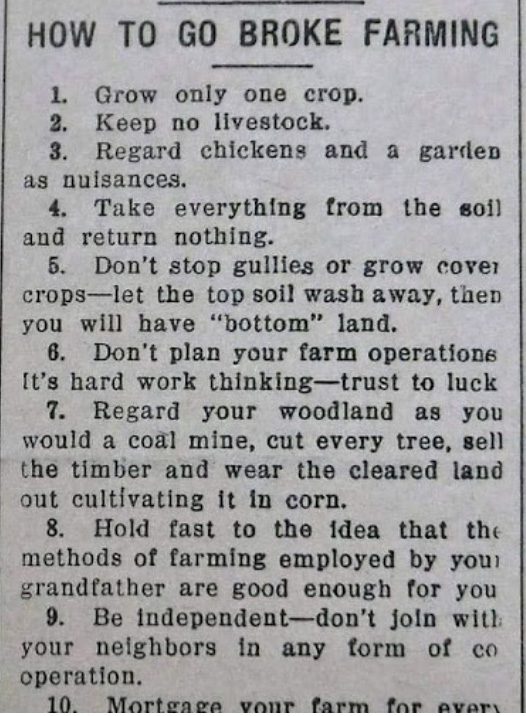
How to go broke farming

As a small-scale farmer, I have a membership in a hard-working community of like-minded land stewards who often share knowledge and information freely with each other.  Several months ago, an old newspaper clipping from the June 17, 1927 Farm and Dairy publication was passed from person to person through email and social media platforms.

This is not the only historic example of farming wisdom that has been circulated in recent years.  I have viewed documents from the 1940s, 1870s and, yes, even the 1700s that discuss farming practices that, for some reason, have been historically overlooked by many of those who farm.

how to go broke farming

Here is a summary of this article:

  • Grow only one crop
  • No animals on the farm
  • Take everything from the soil and return nothing
  • Let top soil wash away
  • Don’t plan
  • Cut every tree and grow corn
  • There is no reason to learn and adjust your farming methods
  • Don’t cooperate with other farmers

This list, assembled by the University of Tennessee Extension, outlines some of the approaches that were well-established as bad practices for a successful farm in the 1920s.  In my opinion, this is all just common sense.  Of course you should grow a diverse set of crops, using a carefully planned crop rotation and implementing intercropping.  The concept of integrating animals for both fertility and diversification on the landscape isn’t hard to understand.  Protecting the health of the soil feels like it should be a basic tenant for all food producers.  And, the concept of continued learning and the spirit of cooperation between growers just seem like necessary tools for a successful farming system.

Apparently the lesson is difficult to learn

As I read this news clipping from 1927, I asked myself why they felt it necessary to point out that these practices were a bad idea.  That’s when I realized that the authors were fighting the same battle we find ourselves fighting today.  There were a significant number of farmers and landowners in the 1920s, just as there are today, that fail to recognize that farming needs to be a complex operation.

Yes, you heard that right.  The way many of our grandparents and previous generations farmed was less than optimal.  And it feels like there are plenty of folks out there who are quite happy to maintain that tradition in the present day. The only real constant for generations in the United States has been a willingness of too many people to ignore the principles of land stewardship.

Perhaps the only difference is that people have found a way to continue making money despite abusing the land they farm.  If anything, the changes in our food and agriculture systems since 1927 have made it difficult to farm well.  Instead, our systems reward the pesticide and synthetic fertilizer industries (among other big ag businesses) and place hurdles in front of anyone who might like to engage in being a steward-farmer.  Bigger farms growing single crops in larger fields that sit bare during the winter months while the soil erodes is what we currently reward.  We prop these farms up with our governmental programs so they can feed the ag industry — even if we know that this model would fail as soon as we kicked these false supports away.

Eventually some of these false supports for poor farming — such as herbicides — are no longer able to hold the wolf at the door.  The weeds are adapting and the strain of continuous tillage and pesticide use is making our soils less fertile and less productive.  The deep, rich soil we have in states like Iowa isn’t as deep and rich as it once was and we will be called to pay for our debt to the land.

If we spent more time caring for the land, it would take care of us.  We wouldn’t need to rely on the next new and novel technological solution for pest control, soil fertility, and weed control.  Instead, we could use those tools in only the most exceptional of circumstances, relying on complex and healthy systems instead.

We can still learn and act to change

I recognize that there are many people, from every generation and many different backgrounds, who have farmed and been true stewards of the land.  These people, some Indigenous, some people of color, some white immigrants, have stood out from the crowd.  They are often seen as the exceptions (and sometimes hailed as exceptional) and they often feel the pressures of not going along with the corporate plan for agriculture during their time.

This is, in my opinion, backwards from the way the world should be.  These are the food growers and land stewards who should be faceless (except when they are in their own communities) because there should be so many of them.  Those who should stand out as exceptions are those who fail to farm well.  And then, our strong farming communities could provide the support they would need to join the rest in being positive and effective stewards of the land.

I know, it’s a radical idea.  And apparently it’s been radical for generations.  Perhaps it’s time for this to be the mainstream attitude?

Sunday, June 4, 2023

Historically Imperfect - Postal History Sunday

Welcome to the first Postal History Sunday of June 2023.  Believe it or not, this is the 146th Postal History Sunday published since August of 2020.  My current goal is to reach the three-year anniversary (the August 20 entry).  This is how I reach bigger goals, I focus on subgoals that are close enough to glimpse - and then we go from there!

Before we get started, I would like to invite everyone who reads Postal History Sunday to give feedback as you see fit.  There is a contact form in the right column in the web version that will send an email to me.  If you are viewing this on your phone, you will need to select "view web version" to see it.

I am always happy to receive suggestions for future topics, corrections and other thoughts.  I am particularly interested, as I reach another milestone, what you would like to see here in the future - and remember, if there are specific things you have enjoyed with the prior 140 or so posts, then tell me what has worked for you so I keep doing those things!

The Golden Age


I had someone make a common lament to me recently.  "I just want to go back to the way things were."

We can all understand that sentiment at some level or the other.  There was a time when you knew less and were aware of less, so things were simpler - yes?  Perhaps you had less responsibility?  Or maybe you are having trouble navigating the uncertainties of your world today.  After all, since you've already lived yesterday, if you could go back and live it again, you might have a shot at doing better because you had some insight as to what would happen.

I have also heard people make claims that the current generation "doesn't know how to work" or that they "don't care about anything."  And, "things worked better then."

Yep, I'm sure they did and I am also sure that they didn't!

As a postal historian, I have the privilege of looking into the past and visiting, through the words of those who lived years before.  I can tell you that regardless of the "when" you choose, the new generation never knew how to work and things were always better during an earlier time!

Shown above is a cover mailed in Phildelphia in 1863 to Andelfingen, Switzerland.  Many who collect such things will tell you that this is a very nice looking item.  But, it has a fault - can you see what it is?

A Piece Missing

Here is a different item that was sent to France in 1862.  Three different stamps were used to add up to the 30 cents required to pay for a piece of letter mail that weighed over 1/4 ounce up to 1/2 ounce.  From a collector's standpoint, this is a very nice looking item.  The colors are bright and the envelope is pretty clean - especially considering it is almost 160 year old.  I like it - that is for certain.

But, look carefully at the bottom center of the brown 5 cent stamp.  There is a nice little chunk out of the stamp.  Many people living today barely understand the function of a postage stamp, with the advent of the internet, email and social media.  Even fewer will recall fully that stamps came in sheets with perforated holes that were intended to give you a guide so you could 'easily' separate them.  You also had to wet the back of the stamps (usually by licking them) to activate the gum so it would stick to the envelope.

The US Postal Service has been issuing primarily self-adhesive stamps since the 1990s and the first US self-adhesive was actually issued in the 1970s.  The US Postal Service recently announced that all postage stamps would be self-adhesives going forward.  But so few recent issues have been perforated and gummed stamps that most people under the age of 30 will not have the experience of separating these stamps unless they are (or are related to) a stamp collector!

Some collectors are nostalgic for the 'good old days' when these water activated gum stamps with perforations to separate them were the norm.  But, I am certain they are forgetting how often the stamp itself would tear in the wrong place (like the 5 cent stamp above) if you rushed the job.  They are conveniently omitting experiences where the gum on a sheet of unused stamps would get wet (for whatever reason) and they would stick to each other - or other things that you didn't want them stuck to.  I am also guessing they don't remember the time their cat found a sheet of stamps and licked them until they folded over and stuck to themselves.

Okay, that one happened to me.  Maybe I am unique in that instance?

This marking (and the one that follows) are two of the reasons I find this particular cover attractive.  They are clear enough to read, which means I can learn more about the travel story for this letter. 

The marking above reads "Etats Unis Serv Am Calais 14 Nov 62"  This is the French exchange marking that tells us when and where the letter was removed from the mailbag after it crossed the Atlantic Ocean.  It also gives us a clue that the ship crossing the Atlantic was under contract with the United States Post Office.

The Boston marking is the US exchange office marking that tells us when (Oct 31) the steamship was to depart on its crossing of the Atlantic.  Once this exchange marking was applied to the envelope, the letter was placed in the mailbag until it got to the French exchange office.  

The portion of the marking that reads "PAID 12" can be confusing to people who are not used to reading covers during the 1860s between France and the US.  It would be tempting to think that the total postage paid was 12 cents.  But, there are stamps on this cover that add up to 30 cents in postage.

What's up with that?

The postal rate for mail from the US to France from 1857 through 1869 was 15 cents per 1/4 ounce in weight.  So, twelve cents seems to make... no sense.

This is where you have to understand that the US exchange markings included the portion of the postage intended to be passed to France to cover THEIR portion of the costs in handling this mail.  This marking tells us that the US KEPT 18 cents and passed 12 cents to the French.  Because of that amount, we can determine that the ship carrying this letter across the Atlantic was under contract with the United States.

I thought I would include this table from a prior Postal History Sunday for those of you who might like the reminder.  If it only serves to confuse you at this point, never mind.  Either way, read on and enjoy with the knowledge that there is no quiz at the end and no one will judge you if you don't want to waste the brain space on figuring out whatever tangent Rob is currently taking!

Imperfect Solutions

We live in a world where things aren't perfect.  And, the solutions we create for problems rarely work out on the first, second, and maybe every try.  And, before you try to tell me that we were better at that sort of thing in the past, I'll remind you that we have always used the trial and error process with varying degrees of success.  This is true now.  It was true then.

The letter above was mailed in 1863 from Chicago to Liverpool England.  It was then forwarded to another address in England.  The 24 cent stamp paid for the mail from the US to England.  The red stamp paid one British penny to pay the postage to forward the letter.  But, that's not what I want to focus on for this envelope.

The blue postmark reads "Chicago ILL  RA Oct 30."   The letters "RA" were part of a short-lived experiment that likely was an attempt to help with mail routing problems.  Apparently, Chicago had a significant volume of mail lose its way en route to its destination.  Enough to encourage some experimentation in hopes of finding a solution.

You see, they didn't use return address labels AND it was common for mail to be refused, to have a bad address, or for a recipient to have moved on with no forwarding instructions.  Such items would go to the "Dead Letter Office" where clerks would attempt to ascertain who sent the letter in hopes that they could return the contents.  This was especially important if the sender was mailing anything of value.  And, yes, it was pretty common to mail money.

Even in 1863, there were lots of people in Chicago (an estimated 160,000 people).  How do you find the sender of a letter in "Chicago" if they leave no further clues in the content? 

If you add misdirected mail into the pile of items in the Dead Letter Office (DLO), it makes sense that options would be explored to prevent mail items from going to the DLO in the first place.

Well, what if you use some codes in the postmarks to indicate how things were routed OUT of Chicago?   Other letter combinations, such as "GA," "SB," and "X" can also be found in these Chicago blue ink postmarks.  An excellent analysis by Leonard Piszkiewicz provides us with the explanation that each of these letter combinations corresponds with a train station or routing. The "RA" has been deduced to likely mean "Randolph" train station.  It's actually a fairly clever idea, but it apparently wasn't deemed a success after a short trial. 

Since 1863, we have made return addresses at the top left common practice and we have implemented ZIP codes to help focus where things go in our postal system.  And, if you want to pay for tracking, you can see where your mail is going as it finds its way - assuming no one makes a mistake.  So, it wasn't perfect then - and it could likely be improved now.

Close Enough
 

I'll close with an item that has 30 cents of postage on it.  But, the required cost for a letter via the Prussian Closed Mails was 28 cents if the letter was prepaid. I'd like to remind everyone that 2 cents in 1865 was a bigger deal to people than it is now, though it was a small enough amount that some might not consider much more than a nuisance to overpay that much.

There are two things going on here.  First, the postage rate had declined from 30 cents to 28 cents early in the decade.  So, it is entirely possible that the person mailing this item was just working with a memory of an older postage rate.  However, there was still an option to send mail without postage.  So, if someone in Germany sent a letter to someone in the US unpaid, the recipient would need to pay 30 cents to receive the letter.  It is possible this over-payment was the result of someone reading the postage tables incorrectly and selected the rate for unpaid mail.

Or, maybe it had to do with convenience?  There were 2 cent stamps issued at the time and there were one cent stamps as well.  In other words, there were plenty of ways a person could select stamps to add up to 28 cents.  Is it worth it to overpay by 2 cents if you only had 24 cent and 3 cent stamps?

Of course, we do not have enough evidence to tell us the reason why this letter had two more cents in postage than it needed.  Mr. DeForest, the recipient, was likely traveling in Europe.  Maybe the postage was placed on the letter with the intent that it would go to France, just like the second item we shared today.  But, by the time the person was ready to address the envelope, DeForest's itinerary indicated he would be in Brunswick, Germany.  It's all speculation, but sometimes it can be fun to explore the possibilities as long as we acknowledge that we'll never know for certain.

So, we go back to our first item.  If you will recall, I mentioned something was not quite perfect for this very nice looking cover from 1863.  Once again, this item has too much postage.  The rate to Switzerland via the Prussian mail system was 33 cents per 1/2 ounce, but there are 35 cents in postage on the envelope.  I suspect we'll be featuring this particular cover in the future as well, so stay tuned.

Human error won't leave us.  I misread things, you misread things.  We also make daily decisions about what is going to be 'good enough' and often accept less than perfection as an acceptable result.  It is not new and it is not likely to change.  Historically, we are imperfect - which is exactly why we have so much we can strive for.  So, as we strive together I hope that you will have a fine remainder of the day and an excellent week to come.

-----------------------

Postal History Sunday is published each week at both the Genuine Faux Farm blog and the GFF Postal History blog.  If you are interested in prior entries, you can view them, starting with the most recent, at this location.

Saturday, June 3, 2023

12 Things You Didn't Know About the Genuine Faux Farm

I thought I would revisit a blog mini-series we called "Ode to Clickbait!"   It's Saturday, we're supposed to have a little bit of fun with the weekend blogs, aren't we?

Wait?  You don't know what clickbait is?  Well, let's start with that first:

Clickbait is a title or link that intentionally over-promises OR misrepresents in order to pull people to a particular website.  The idea is to give you a sensational headline that you just can't resist so you come read our blog!  But, to fully qualify as clickbait - we're supposed to fail to deliver on what we promise with the headline.

I already have a problem with that.  I just might have to rethink this.

Other characteristics for click bait?  Content is usually short (under 300 words).  

Uh oh.

They often steal content from other sites and very little is original.  Uh oh again.

Maybe we'll just stick with click-bait-like titles for a few posts and see if we can have some fun with it.

Here we go!  12 Things you might not have known about the Genuine Faux Farm.

1. We are not "Faux Farms"

We ARE the Genuine Faux Farm, honest and for true.  Please note two things about the name.


First, we are only ONE farm.  

The "s" is not applicable to us.  We own only one small farmstead of about 15 acres, which hardly puts us in the same category of organizations that have gathered multiple farm-sites under its farm name.  If you would like for us to become "Farms,"  please contact us about the 50 acres of prime veggie growing or turkey pasture raising land that you will donate to us so we can make the "s" applicable.   Or, you could just remove the "s."  

Choices... choices.

Second, we are the GENUINE Faux Farm.  

If we're Faux Farm, then we are either just fake/false or incapable of creativity because we'd just be using our last name for our farm name.  Hey!  Look at this blog post!  Creativity abounds!  Please let us be a little bit clever and give our "Genuine Faux Farm" name a chance.  It's a small thing to do in order to build up our confidence.  You can still roll your eyes after you say it - especially if you do that while reading the blog because we can't see you. 

Or can we?   Hmmmmmmm.   NOW, I've got your attention!

2. Our farm has been producing food since 2004 and blog posts since 2008.

A picture is worth a thousand words, but on our farm - we'll do both a picture AND a thousand words with our blogs.  This is very much against the standard operation procedures for click bait.  

I am really BAD at this.  And, I'm actually proud of that.  Go figure.

Since we've already broken some (or maybe all) of the rules of click-bait, we'll just go ahead and break them more thoroughly by providing real information.  We moved to the farmstead during the Summer of 2004 from Chokio, Minnesota where Rob worked at the University of Minnesota-Morris as a college professor in the Computer Science Discipline.  We moved to Tripoli so Tammy could take a job at Wartburg College as a professor of Social Work.  We actually received permission to plant a veggie garden at the new place before we had officially purchased it.

That might give you an idea as to some of our priorities in life.

7. We know how to count.

See!  I toad you so!


3. Kohlrabi Yes, Fennel No

When we are asked what we grow, we often answer with either "everything from A to Z" or "name a vegetable."  It's true that we do grow asparagus and zucchini, but we have to cheat a little with "Q" by saying we grow Quadrato asti Giallo bell peppers and we have no idea what to do with "X."

When we offer the "name a vegetable" option, we usually get a fairly common answer that is easy to say yes to... Tomato?  Yes.  Green Beans?  Yes.  Onions?  Yes.

Sometimes, a person will get clever and try "Kohlrabi?"  Why?  Because it sounds fun and the plants look kind of weird.  And, we can still say "yes" to it because we have actually grown several types of kohlrabi.  On the other hand, we've never grown fennel.  Why?  Well, for one, we don't particularly care for it.  And for two?  We never had any demand indicated for it.  

If someone had asked, we probably would have given it a go.  That's just the way we roll, I guess.

4. The cats aren't (quite) in charge (yet)

But, they WILL sit on things you are about to move.


5.  It takes two PhD's to run a small diversified farm

Ok.  It takes two PhD's to run the Genuine Faux Farm, which just happens to be a small, diversified farm.  Rob is the 'Farm Boss,' and until 2020, he worked full-time at the farm (and is the principle blogger and spreadsheet maker).  His PhD is in Computer Science and Adult Education.  As you can see, he is fully applying his education in this profession.  And, while that is meant to be somewhat facetious, I can tell you that pattern-matching and problem-solving are two skills that are needed in both Computer Science and farming.

Yes, I do keep telling myself that.

Tammy is the 'Queen Boss' on the farm.  Our joke is that when you don't like something, you complain to the 'Farm Boss' and if you do like something, all praise to the 'Queen Boss.'  If you want to get something done, go to the Farm Supervisors (the cats) and they'll tell you to make the two 'bosses' do it.  

While it may not really take two PhD's to run a small diversified farm, it DOES take two PhD's to run THIS small diversified farm.  Rob could not succeed at the Genuine Faux Farm without Tammy (and hopefully she feels the same way about Rob).  The Farm Supervisors do NOT have PhD's, but that's ok because they know everything and didn't need to study.

6. The view on the farm is incredible

There isn't actually a GFF West.  Does this qualify as appropriate for clickbait?  Or is it just silly?

8.  We thrive on variety

We believe in diversity on our farm and we've talked about this topic many times on this blog and elsewhere.  That said, we need to tell you some things that you didn't already know about us....

In 2019, we grew 20 different varieties of lettuce and 30 different varieties of tomatoes.  Most of these were heirloom or heritage varieties.  Since we started in 2004, we have tried approximately 70 different tomato varieties, twelve green bean varieties, fifty lettuce varieties and... well, you get the idea.

We have raised a wide range of veggie cultivars because we know people have different likes and dislikes for taste and texture. We also know that many varieties of the same vegetable type feature different tastes and textures.  A range of cultivars provide us with a form of crop insurance too.  For example, some tomatoes deal with cool seasons better than warm seasons and vice versa.  Since we grow in Iowa, we try to cover our bases so that we have some successful crops each and every season.

10. It has been a while since we did Farmers' Markets

Here is a fact about our farm that we are guessing a number of people who do know about us might not have actually realized.  We have not been involved in a farmers' market for almost seven years now.  We're still amazed that people ask us if we were 'at market.'

9.  We work in all sorts of whether
Tammy says that we work in all sorts of whether because we work
- whether or not it is raining
- whether or not the sun shines
- whether or not the tractor is running
- whether or not it's the 4th of July or Memorial Day or Labor Day
- whether or not we want to on any given day

And that is today's whether report!

11.  There is NO Number 12 on this list.

But, here are some baby chicks.  That usually makes up for it.


11. We like to educate and have a little fun

In case you hadn't noticed, one part of our farm's mission is to educate and inform others about sustainable farming and local foods.  One part of our own personal mission is to enjoy life and have a little fun once in a while.

We also actually like to provide some value with everything we produce - even if we use a 'click bait' type of title to draw you in.  We hope you enjoyed the post and even got something positive out of it. 

Nope, I really am not very good at producing clickbait content.


Friday, June 2, 2023

Not Beneath Our Notice


In late April and early May, our lawn areas were dotted with purple (and sometimes white), especially under the oak trees and by Eden, the smaller of our two high tunnels.  These little lawn jewels bloom longer in years when we aren't having one of our top ten driest May months on record.  But, that doesn't mean we can't enjoy them when they are there.

from KWWL
I remember spending a fair amount of time outside and on the ground growing up so I could look at clover, dandelions and violets.  My siblings and I even bought into the May Day basket idea of collecting some of the early Spring flowers and putting them into baskets.  The only difficulty was figuring out which houses would appreciate finding one of those little baskets at their door after we put them there, knocked - and then ran away.

Yes, it's true.  Not everyone saw the beauty in a small, sometimes bedraggled, bouquet of flowers.  It's kind of a shame that so many people didn't, really.

If you were (or still are) one of those children who took some amount of delight in picking a few Common Violets, you would know that each flower appears atop its own stem that comes from the top of the root ball.  There are no leaves, or other flowers, that share the stem.  This means they are perfect for miniature flower art projects.

Every so often, I have found violets that are white, which seems like a conflict of interest or something.  Violets are supposed to be violet colored, except when they're white, or maybe even yellow.  While the yellow violets are a different species, the Common Violet can sometimes have white coloration, occasionally mixing the color violet with white.  There was a couple of plants that featured mostly white flowers down by Eden last year, but I did not see them this year. 

Yes, I noticed that they weren't there.  Yes, I went looking for them.  Why?  Is that weird?

Perhaps you don't think it is weird to look for violets, but you do think I am at least a little bit strange that I enjoy a nice, healthy bloom of dandelions.  But maybe you would change your mind if you noticed the bumblebees bumbling their way around the flowers during their early season flights.

Getting back to the Common Violets, however, it is interesting to note that some people herald them for their potential as a foraged food in natural landscapes.  Both the leaves and flowers are edible, though I will admit that I prefer observing them to eating them myself.  On the other hand, there is another camp that sees violets as a nasty weed to be controlled.  After all, you wouldn't want a slightly different texture and a little color to become part of our urban landscape!  At least this lawn site gives a little balance, citing the Common Violets beauty and potential as a food item - before telling you how to kill them.

Isn't it strange how we have somehow decided that clover, dandelions and violets are all undesirables in our lawn.  While some people make the claim that dandelions were introduced to North America by the Puritans in the 1600s, the actual introduction to the continent is a bit less certain.  However, it is documented that Europeans brought dandelions with them as both a food and medicine source.  If you are wondering how to eat dandelions, try this source.

From a soil health perspective, we like the way the deep taproots loosen and aerate the soil.  We feel that these same roots bring nutrients up from deeper soil layers so they can be used by other plants.  And, because they draw most of their moisture and food from a deeper soil layer, they often don't compete with our food crops, so they aren't a bad weed for a veggie farm.

And then there is the clover.  Prior to the 1960s, clover was a regular part of lawn seed mixes until the herbicide industry began selling the idea that grass, and only one kind of grass, should be welcome in a "well-maintained" lawn.  I still remember that barefoot children always took note of where the clover was so they didn't accidentally step on a bee and get stung!  Now barefoot children stay off the lawn because it's been recently sprayed with pesticides.

It's amazing to me that we have allowed ourselves to be convinced that less life is better in the outdoor spaces around us.  Well, I don't buy it.  Give me more clover, more violets and even more dandelions.  Certainly, there will be places on our farm where we remove some in favor of other plants.  But as far as weeds go, these three are our friends.  Maybe there are some other new friends we will also learn to get along with too?  We're always open to learning and we'll let you know as we do!

Thank you for considering my words and thoughts.  Have a wonderful day and a fine upcoming weekend.

Thursday, June 1, 2023

Which Side Are You On?

Some time ago, someone pushed me on an issue and wanted to know "exactly what side I was on." They wanted me to stand against some "others" in a way that made me uncomfortable because it felt like we were not differentiating between the problem and the people.

The moment you imply that I should demonize good people that I happen to know are not in agreement with you is the moment I find myself wondering if I need to put some distance between us.  It does not matter if my thoughts actually align with you with respect to whatever issue you have brought up.  After all, it turns out that some of the things I think and believe line up with people I happen to get along with as well as people I don't get along with all that well.  

Yes, you heard that right.  I don't particularly like some people with whom I agree with frequently.  And I like others with whom I disagree with frequently.  It sure is easier to get along with people you agree with more often than not, but it is not a prerequisite.  

That's part of why I resurrected the "Carrotman" creation (thanks again Sam!).  I am not particularly fond of carrots.  Ok.  I grow them and harvest them and even clean them.  But, I will not eat them (yes, I have tried).  I mean... I could have stood completely on principle and determined that I would not grow carrots on the farm ever...

But, I overcame my differences enough and there are, in fact, we will plant some in our fields this season.  They grow well in the southwest plot, so we'll give them a go again in 2023.

So, am I "pro-carrot" or "anti-carrot?"  Which side am I on?

Well, Tammy actually likes to snack on carrots and I like her a lot.  Does that make me a "pro-carrot" individual?  However, I honed a skill to remove all of the little orange carrot squares from my mixed vegetables so I could eat the rest of the veggies without a single carrot touching my lips.  So, I must be part of the "anti-carrot" crowd...

It may sound like I am not taking the actual subject seriously.  But, I actually am.  The idea of being for or against carrots is actually more complex than either/or.  I can be pleased to pull out a nice sized "Bugs Bunny" carrot out of the ground and not want to see it on my plate in any form.  On the other hand, I can take pleasure in the fact that Tammy (or numerous other people) will happily enjoy carrots I grow.

Do you actually think a more serious topic should be simplified down to just "for or against?"

You've got to be kidding me.  Really? 

I can't simplify liking and disliking carrots because there is actually more to it than that.  And you think bigger things are easily compartmentalized into two sides?

Let me be blunt.  This is how relationships come to an end.  This is how we tear down good things that have been built.  This is how wars are started.  

Stop pushing the narrative that your side is "good" while everyone else who is not on your side is "bad."  You aren't making change, you are creating conflict.  Conflict usually hurts those who can help themselves the least.  We are better than that.