Sunday, August 27, 2023

Forward! and the Mystery of Joseph Cooper - Postal History Sunday

Well, here you are!  Viewing the 158th entry of Postal History Sunday, a weekly blog written by me, Rob Faux, so I can share something I enjoy - postal history.  

It is not required that you know much about postal history to enjoy these articles and you are also quite welcome if you do know a lot about postal history.  My goal is to write in a way that makes the topic accessible and enjoyable for as many people as I possibly can.  I do take feedback and I am willing to answer questions.  I will even try to explain things several different ways if my first choice of words leave you confused or unsatisfied!

This week is actually a continuation of last week's entry titled "Forward!"  While it is not necessary that you read that blog to understand this one, you certainly can if you want to.  Either way, take those troubles and put them in a blender and set it on high.  They won't be recognizable when you're done with that.  Grab a snack and a favorite beverage and let's see if we can learn something new today!

More Forwarded Mail

As I mentioned last week, the problem with people moving around from one location to another is not a new problem for postal services.  And, it is not difficult to find examples of mail that was sent successfully to one location only to find that the recipient had moved on.  If there were instructions for sending the mail to a new location, then that letter could be forwarded through the postal services.

Postal historians use the general term redirected mail for any postal item that had it's routing changed in the process of getting from its origin to the eventual destination (wherever that may be).  This could include mail that was routed around a battle zone or a natural disaster.  Another example of redirected mail would be a letter that was delivered to the wrong address by the postal service and they had to work to remedy that problem by taking it to the correct location.

Forwarded mail is a special case of redirected mail.  To qualify, the item had to be delivered to the correct post office for the address, only to find that the recipient was not there.  At that point, the options are limited by whether a new address is known.   If it is not, that brings us to other topics, like returned mail or dead letter mail.  But when a location is known and the item is forwarded, there are three different ways I classify them:

  1. The letter is forwarded and the extra postage is paid once it gets to the recipient
  2. The cost of forwarding is already paid and the letter is sent to the new location without postage due.
  3. The postal service offers free forwarding services, so no additional postage was needed.

Postage due on delivery

Our first item illustrates a case where the letter was forwarded to a new location and the postage was due upon delivery.  

This cover was mailed in the mid-1860s from France to Austria.  The postage rate was 60 centimes, which is properly paid by the postage stamps.  All of the markings for a typical, paid letter from France to Austria can be found on this letter.  But, this letter was forwarded to a new location and Austria wanted that postage to be paid.  So, they placed a "5" on the envelope which indicated that 5 kreuzers were due from the recipient once the letter caught up with them.

No postage for local forwarding


And here is an example where a letter was actually forwarded to a new location but no additional postage was required.  In this case, the original address (Portman Square) is served by the same office as the new address (Cavendish Square) - both in London.

At the time this letter was mailed (1867), the British Post did require additional postage for forwarding if the new address was serviced by a different post office.  The marking just under and to the left of the postage stamp that is shaped like a ring (with an "R" inside) was an indicator that the letter was redirected for free.

If you'd like to see more about this item and see other items that did require postage, you might enjoy the Postal History Sunday titled With This Ring.

Free forwarding of the mail

 
Eventually, mail forwarding became a free service in most postal systems.  Shown above is a 1935 letter that was sent from Brooklyn, New York, to a ship due to land at San Juan, Puerto Rico.  The sender was clearly aware that the recipient might have already departed the ship by the time the letter arrived and provided an address for forwarding.  Sure enough, Mrs. Rosemary Rabus had left the ship.  The original address was crossed out and the letter was sent to the second address provided.

The second address was the General Delivery window in the Juana Diaz post office. Anyone could come to the post office to check if they had mail to be picked up via General Delivery, but there was always a danger that a person would not necessarily know to go there.  In this case, it seems that the sender and the recipient (likely related and probably married) were both aware of the plan.

No mystery for Lionel Sheldon

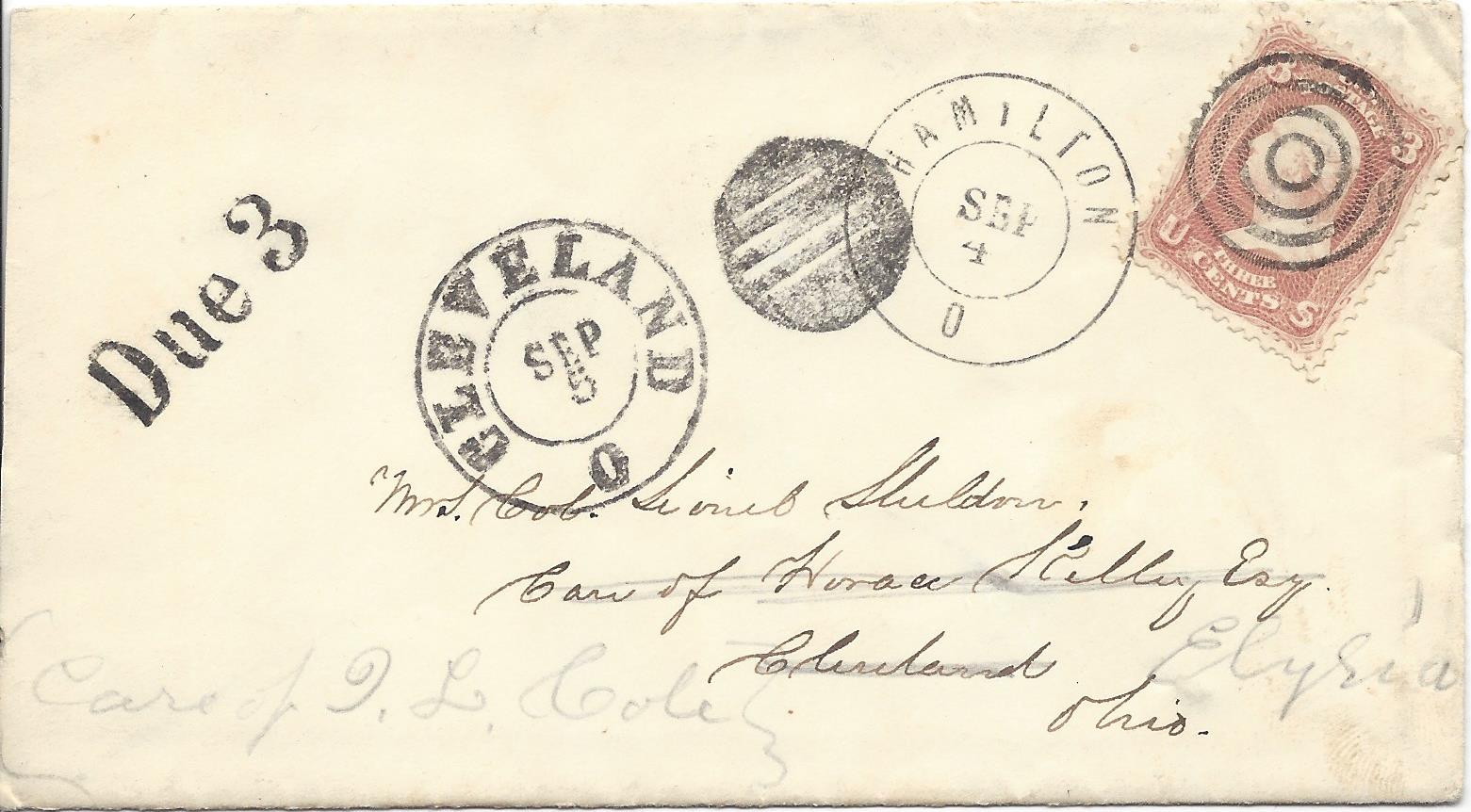
And now we bring back one of our covers from last week.  This was our example of a simple letter that was forwarded and the cost of forwarding was expected to be paid at the new destination.  Initially mailed on September 4 at the Hamilton, Ohio post office, the Cleveland post office forwarded the letter to Elyria, Ohio.  The Cleveland postal worker put a "Due 3" marking on the envelope to make it clear to the postmaster there that three cents in postage were to be collected on delivery.

I ran out of time last week to share a bit of the social history that surrounds this particular item.  The letter is addressed to a "Mrs. Col. Lionel Sheldon," and it was sent care of "Horace Kelley, Esq."  Pencil markings show that the letter was forwarded to Elyria, care of "I.L. Cole."

The "Mrs. Col." was the spouse of Lionel Sheldon.  Formerly Mary Greene Miles, she had married Sheldon in 1858 at the age of 17.  Her father was a merchant in Elyria, so it is not surprising that she might have gone there to visit.  This might have been especially true if Lionel were away due to his involvement in the Civil War.

Unfortunately, the contents of the letter are no longer with the envelope, so we can't confirm who the letter was from or what it was about.  Similarly, there is not much written about Mary, though there is reference to her "officiating at the White House" because President Garfield's wife was in poor health.  On the other hand, a great deal can be learned about Lionel Sheldon.

image from Library of Congress

Lionel Allen Sheldon (1829 - 1917) was born in New York and raised on a farm in Ohio.  He attended Oberlin College and law-school, being admitted to the bar (becoming a lawyer) in 1851 and settled in Elyria where he most likely met Mary.  In addition to being a judge of probate, he was strongly involved in politics, supporting John C. Fremont at the Republican convention in 1856.  He was also involved in recruiting for the Federal armed forces at the beginning of the Civil War.  He had reached the rank of colonel in 1862, commanding the 42nd Ohio infantry (after serving as Lt. Col. under Garfield).

Sheldon was wounded in the Battle of Port Gibson (May 1863), but he recovered to participate in the Siege at Vicksburg (mid May to early July 1863).  The conflict at Thompson's Hill (Port Gibson) is likely where he took his wound.  A first hand account indicated that "[t]he heaviest loss by any regiment in our brigade was in the 42d Ohio, who had about seventy killed and wounded." (account by Cpl Theodore Wolbach, May 1, 1863) 

Map found in the book The Forty-Second Ohio Infantry - A History of the Organization and Services of That Regiment in the War of the Rebellion, 1876 - F. H. Mason, Cobb, Andrews & Co., Publishers and reproduced here.

By the time we get to 1864, Sheldon was in Louisiana where he was a brevetted brigadier general of volunteers, supervising repairs of levees and fort structures.  He settled in New Orleans and was able to take up his legal practice again starting at the end of 1864.  It is about that time (perhaps earlier) that we can assume Mary might have been able to rejoin him.  So, we can make a guess that this letter to Mary was sent in 1863 or 1864, perhaps as early as 1862.  However, most evidence points to 1863.

Sheldon would serve as a US Representative in Congress from 1869-75 for Louisiana, returning to Ohio in 1879 to help forward James Garfield's cause to become President.  In 1881, President Garfield named Sheldon Governor of New Mexico territory.

And, as far as Horace Kelley is concerned, he too is a name we can track easily.  He was a part of a family with strong ties to early Cleveland history.  He was married to Fanny Miles, who was also from Elyria, Ohio.  This gives us some of the connections we need to understand why Mary Sheldon might have been visiting the Kelleys - and why Horace might have been receiving mail addressed to her.  

So, did you catch the little tricky fact that links these two men?  Lionel's wife was Mary Miles.  Horace's was ... Fanny Miles.  

The Mystery of Joseph Cooper

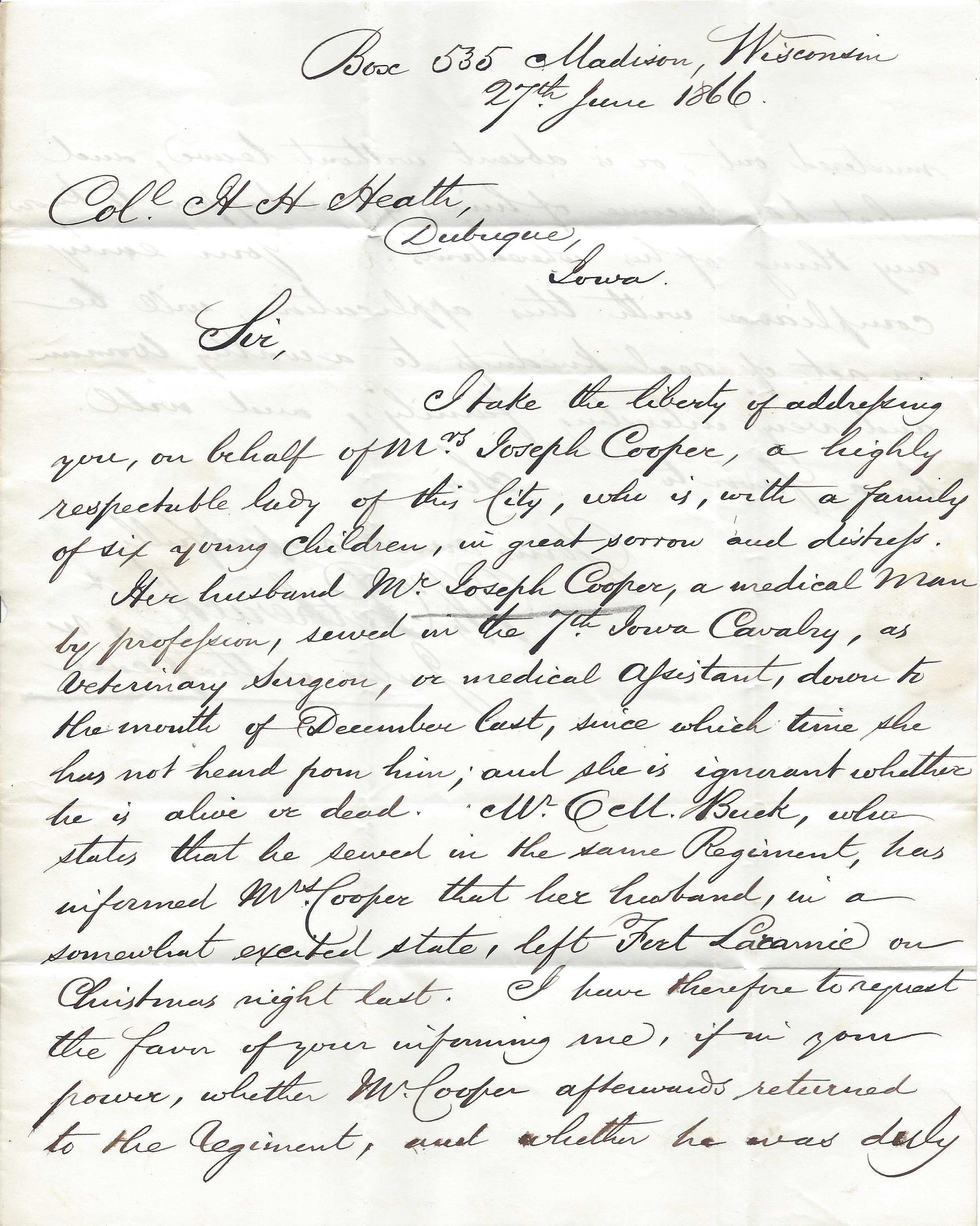
That brings us to this folded letter that we also showed last week.  This letter was mailed in June of 1866 to Dubuque, Iowa.  It was forwarded to Washington, D.C., where Colonel H.H. Heath was then stationed.  As of July 1, 1866, forwarding of mail no longer required additional postage, so this would have been forwarded for free anyway.  But, because Heath was in the military, this letter would have qualified for free forwarding even before July 1.

But, while the postal history part of this item is interesting, it's the contents of the folded letter that grabbed my attention the most.

The letter is datelined June 27th, 1866 from Box 535 in Madison, Wisconsin.

Sir,

    I take the liberty of addressing you, on behalf of Mrs. Joseph Cooper, a highly respectable lady of this city, who is, with a family of six young children, in great sorrow and distress.

    Her husband, Mr. Joseph Cooper, a medical man by profession, served in the 7th Iowa Cavalry, as Veterinary Surgeon, or Medical Assistant, down to the month of December last, since which time she has not heard from him; and she is ignorant whether he is alive or dead.

    Mr. [Orville] Buck, who states that he served in the same regiment, has informed Mrs. Cooper that her husband, in a somewhat excited state, left Fort Laramie on Christmas night last.  I have therefore to request the favor of your informing me, if in your power, whether Mr. Cooper afterwards returned to the regiment, and whether he was duly mustered out, or is absent without leave, and what has become of him, if you happen to know anything of whereabouts.

    Your early compliance with this application will be an act of real kindness to a worthy woman and very interesting family, and will be a favor to,

Yours most respectfully, Wm Petherick, Justice of the Peace.

Now, imagine you were Mrs. Joseph Cooper.  Your husband is part of the 7th Iowa Cavalry and you haven't heard from him for many months.  Then you hear from an individual who apparently was in the same company that your spouse left Fort Laramie, Wyoming - at night - at a time of year when temperatures were rarely above the freezing mark.

Yes, I think we would all have been worried.

Map from Wyoming history site.

Beginning with the Lakota Uprising in Minnesota (1862), tensions between Native American nations and the United States continued to increase.  The opening of the Bozeman Trail, which traveled through Nebraska and Wyoming - taking people west to Oregon - was seen as an incursion into prime buffalo hunting lands that had been recognized as belonging to the Lakota.  The Lakota, with their allies the Arapaho and Northern Cheyenne stood in opposition to the development of the trail and the establishment of forts, settlements and telegraph lines along that route.

If you take this link to a piece written by Doug Fisk and hosted by the Fort Kearny Historic site, you can get some of the feel for what it might have been like for members of the 7th Iowa Cavalry.  In this work, Fisk quotes Alson Ostrander who was posted to Fort Reno as a clerk in 1866.

     “As we got farther into the Indian country, I found that the enthusiasm for the wilds of the West I had gained from ... dime novels gradually left me.  The zeal to be at the front to help my comrades subdue the savage Indians ... also was greatly reduced.  My courage had largely oozed out while I listened to the blood-curdling tales the old-timers recited.

        “But I was not alone in this feeling.  When we got into the country where the Indian attacks were likely to happen any moment, I found that every other person in the outfit, including our seasoned scouts, was exercising all the wit and caution possible to avoid contact with the noble red man.  Instead of looking for trouble and a chance to punish the ravaging Indians, the whole command was trying to get through without a fight.  Our little force we knew would be at a serious disadvantage should old Red Cloud sweep down on us with his horde of angry warriors.”

The 7th Iowa Cavalry's history is described at the IAGenWeb site and provides opportunities to get an idea of where Joseph Cooper might have been while serving and what he might have had to deal with.  Six companies of the 7th Iowa marched from eastern Iowa to Omaha in July of 1863 under the command of Major H.H. Heath, who is our addressee for the folded letter as Colonel H.H. Heath.  Additional companies left for Omaha in 1864, apparently taking Joseph Cooper with them.  Once at Omaha, companies and detachments were assigned to different posts throughout Nebraska, Kansas, Dakota and Colorado territories, spreading just over one thousand men over a wide area.

We find Joseph Cooper of Madison, Wisconsin, in Company F, enlisting on January 19, 1864 and mustered just under a month later.  Joseph is listed as having been born in England and was aged 45 years at that time.  It is possible that he was conscripted rather than a volunteer.  The Enrollment Act of 1863 required every male citizen and all immigrants who had filed for citizenship between the ages of 20 and 45 to enroll.  Quotas were then assigned to each state and congressional district.  If a district was behind quota, they could fill the quota by conscription (selecting and requiring members in the enrollment lists to join).

Given Joseph's age and the fact that he had six small children, I imagine that he did not volunteer for service.  It is also likely that he was not affluent enough to avail himself of the commutation option (pay $300 and you don't have to join) and he may not have been willing or able to find someone to take his place.

So what did happen to Joseph Cooper?

Sketch of Fort Laramie, 1867 by Anton Schoenborn in Fort Laramie National Monument by David Heib

And so, we find Joseph Cooper in Fort Laramie on Christmas Day after having served nearly two years.  There had likely been a Christmas celebration as there was in 1866.  He had been away from his family for a long time, may not have volunteered for the job in the first place, and dealt with difficult conditions regularly as part of the 7th.  And... he was looking at just over one more year before he could go home.

Orville Buck saw Cooper leave Fort Laramie in an "excited state."  And Orville Buck did not report to Mrs. Cooper that he witnessed Joseph's return.

Did Joseph Cooper desert his post?  This roster listing suggests that he did so.  Dr. Terry Lindell also chimed in with this information:

Regarding Joseph Cooper, Roster and Record of Iowa Soldiers in the War of the Rebellion, Vol. 4, p. 1283, has this entry for him in Company F, Seventh Iowa Cavalry: "Cooper, Joseph. Age 45. Residence, Madison, Wis., nativity England. Enlisted Jan. 19, 1864. Mustered Feb 5, 1864. Transferred to Company F, Seventh Cavalry Reorganized." Page 1415 lists him in Company F, Seventh Cavalry Reorganized and adds this information: "Deserted Dec. 26, 1865, Fort Laramie, Dak."

What is not clear at this point is whether or not Joseph Cooper was captured, returned or died of exposure not long after leaving Fort Laramie.  It is hard to imagine a situation where he could have survived alone in the elements for long.

At Forest Hill Cemetery in Madison

The FindAGrave website shows this entry for Joseph Cooper (1818 - 1865) that seems to match, listing him as a veterinary surgeon.  His wife, Isabella Waite Cooper (1822 - 1909) and six children also seem to line up with the facts provided in the folded letter that started the search for Joseph Cooper's fate.  Isabella's obituary listed on the FindAGrave site may give us a bit more to the story.

In the passing of Mrs. Isabella Cooper, who died at her home at 1025 West Johnson street Wednesday evening, goes one of the early pioneers and staunch women who added so much to the citizenship of Madison in days gone by. Mrs. Cooper was born in Low Green, near Leeds, England, in June 1822. She was married to Joseph Cooper of Skipton, England, in 1843. Mr. Cooper's profession was that of chemist and druggist. He came to this country in 1843 buying a farm in the town of Fitchburg. The family joined him in 1849 and they lived on this farm for several years, then moved into Madison where they family has lived since, with the exception of the years 1857 and 1858, which were spent on a farm in Sauk county. There were ten children born into this home, six of whom grew to manhood and womanhood, and three of whom survive the mother, Mrs. Mary J. Lamont and Miss Annie Cooper who resided with the mother and Mrs. Fernando Knight of Beloit, Kan.

Wisconsin State Journal
Madison, WI
May 19, 1909

The existence of a grave for Joseph Cooper seems to imply that, perhaps, his body was recovered and returned to Madison.  Or, maybe, the grave was a symbolic gesture to recognize what seemed inevitable.  What does seem clear is that Joseph Cooper never did return home.

And there you go, that's my current best effort for solving the mystery of Joseph Cooper.  I hope you enjoyed it!  Have a great remainder of your day and a fine week to come.

-----------------------
Postal History Sunday is published each week at both the Genuine Faux Farm blog and the GFF Postal History blog.  If you are interested in prior entries, you can view them, starting with the most recent, at this location.

Saturday, August 26, 2023

Writing = Active Listening and Learning


We live in a world where we are often more worried about whether or not we are heard than we are about whether we are hearing/listening.

You see it in conversation.  People frequently interrupt each other to get their own opinion vocalized without really paying any attention to what was said.  All they really heard was the general topic area, which triggered some sort of response in their brain that they must now be sure they can press their opinions forward - even if it isn't appropriate at the given moment.

I fully recognize this same tendency in myself.  In fact, I suspect I was pretty bad at this at one time.  But, a strange thing happened - I grew up a little bit (even if I am still 10) and spent more time working hard to listen.  So, apparently we have a rash of 'not growing up' in this world. 

(note: I am still acutely aware that I fail to listen sometimes.  It's part of being human and continuously learning and trying to improve)

Lots and lots of words

Over time, I have written lots and lots of words.  In this blog alone, there are plenty of words (and pictures).  Just look at the illustration below taken earlier this week from our blog.  As of this writing, we are sitting at 218 blog posts for 2023.  I've got over 2300 posts since the blog started in 2009 with what I estimate to be about two million words worth of writing.  NO... I did not (and will not) count them.  I know I said I liked numbers and counting - but not that much.  Really.


It's a point of pride and self-ridicule that, as of Wednesday of this week, I had written a blog in 218 of 235 days for 2023. That's almost a 93% success rate, but who's counting?  
 
Ok, apparently I am.  But I did say I like numbers - as long as they are smaller than one million.

Who will read them?

I have broached this topic before - who actually reads these posts?  Remember, this comes from a person who did write a dissertation for his PhD - lots of words there again.  I suspect there *might* be one or two people in this world (other than myself) who read the entire dissertation.  But, in those cases, it was their job to read it.

I ask this same question when I write for Pesticide Action Network.  Who reads the things I write for PAN?  When they read these things, how WELL do they read them and how WELL do they end up understanding them?  Does it motivate them to think about something carefully?  Will it challenge them to learn a bit more and adjust their opinion even a tiny bit?  

I don't know.  And maybe it isn't important that I know this?  After all, am I writing so other people will read?  

The answer to that last question is my typical "yes and no" sort of answer.  I think you'll understand as you read more of this blog.

Writing reflects my listening and learning

I took the writing of my dissertation very seriously.  I realized at the time that very few people would ever read it.  Yes, I guess I did have a few fantasies that what I would write could become something bigger and more "important."  But, I knew these thoughts for what they were - fantasies.  Even with that knowledge, I still worked very hard to write what I felt was an excellent dissertation.

Why?  Because, by writing, I was exercising my listening and learning skills.  It was a process to put all that I had read, all that I had collected in research, and all that I had assimilated into my knowledge base into a cohesive form.  In effect, it became a reflection of active listening and active awareness regarding things that I was trying very hard to understand as well as I possibly could.

And now for the dose of humility.

I was encouraged to submit an article in a professional journal.   I thought, "Wow, I could get people to think about the results of my hard work?  Wonderful!"  But, to do that I had to condense my 150+ page dissertation into .... five to seven pages.

First reaction?  "You've got to be kidding me!"

Then I actually accomplished that task - and got it published.

New reaction?  "Why did I write so much in the first place when I could get the point across in seven pages?"

The answer to that question after getting published?  "Because I thought that was what I needed to do - even if it wasn't what I actually needed to do."

My thoughts on it now?  "Writing the original piece was part of my growth and learning process.  The short article was the expression of the resulting mastery of the topic - evidence that I had listened and learned and could succinctly summarize all of that in hopes that others might build from there."

Doesn't that sound like a silly academic?  Alas for me.


So here I am, writing some more

I am still listening and learning - and I am still writing to try and make sense of it all.  I could certainly type all of this or hand-write it into a journal that I would not share with anyone else.  But, then, I would miss the potential opportunity to listen to others and learn more as they respond to my thoughts.  And, perhaps, because there is the potential for some interaction, I am encouraged to explore things I would not bother exploring if it were only for me.  

Maybe something I write will encourage someone else to speak so I can listen.  Perhaps something I write will bring about a new line of thought for another person who might then move forward and do something good.  And, I will freely admit that there are times I hope I can help someone to learn and there are other times I hope I can be a positive or useful influence for others.  I do still have the heart of a teacher and I do still care enough to try to get people to think harder about things.

How much longer will I write?  After all, I have gone through periods where I just did not want to....  I suspect I will go through similar times in the future.  If you take a stroll through the blog, you can probably take some guesses about what leads to more or less writing.  There are numerous periods where the content seems pretty obligatory - after all, this is a farm blog and it has been used in the past to inform our customers.  

But now our farm is no longer the focus of the blog.  Now we have moved from a pandemic to a point where Covid is endemic.  Now the novelty of a small-scale, diversified farm writing about everything from flowers to farming to postal history has worn off.  The reasons for writing have never been more uncertain than they are right now.

And yet, I finding myself wanting to write and share.  Maybe that's because I am in the mood to learn - and I hope I can infect others with the need to learn and grow as well?

That's my story for now and I'm sticking to it.  Until I hear something that makes me consider otherwise.  Then I might write about that.

Friday, August 25, 2023

In Their Own Sweet Time


We harvested our first broccoli of the season on Wednesday morning before the real heat settled in for the day.  There are many more broccoli heads that are approaching maturity out there as well.  We'll just have to see how they handle the weather conditions.  Because that's just the way it is sometimes.

When the farm was my primary job, the first big broccoli harvest was usually an indicator to me that the harvest season for our farm was really starting in earnest.  Sure, we would have pulled in significant amounts of produce prior to that broccoli harvest.  But there's a difference between off-peak and on-peak harvest on a diversified vegetable farm.  

Off-peak harvest is something you work for so you can have fresh food available for a longer part of the year.  On-peak harvest is when you have to work desperately hard to keep up with all of the things that need to be brought in NOW.  And, you have to find homes for it SOON.

Even now that we have scaled back, the broccoli still symbolizes on-peak harvest season.  Suddenly we are trying to keep up with the green beans, onions, melons, peppers, tomatoes, cucumbers, zucchini, summer squash...  well, you get it.  Everything.

Things are very different now than they were when the farm was my full-time (and only) job.  For example, crop timing is important to us for completely different reasons now.  When we had a CSA, what mattered most was the timing of our crop with respect to each other.  If the broccoli was a little early or late due to weather conditions (or other matters) it mattered less as long as it still held the proper slot with respect to our crops.  If the weather was a bit cool and slowed the broccoli down, that was ok because most everything else would also slow - so the slots each crop held were pretty much intact.

In our current iteration of the Genuine Faux Farm, it matters much more to us that crops fall into slots that work with our job schedules and the relationship to sales opportunities or trips to the food bank.  But, no matter how hard you try to plan your planting dates and calculate your anticipated days to maturity, each crop is going to mature in their own sweet time.

It doesn't matter if you have a big project due this week for this job, or there are wall-to-wall meetings for that other job.  The broccoli decides when the broccoli is ready.

One of the bigger factors for vegetable production timelines is the "growing degree day."   A very basic way of looking at growing degree days that they are calculated by taking the average of a given days minimum and maximum temperatures and then we subtract a base temperature below which a given crop will grow (often 50 degrees Fahrenheit).  More growing degree days will typically accelerate the growth of most plants.  And yes, there are exceptions.  Many plants slow growth when temperatures get too high (usually over 86 degrees Fahrenheit).

As you can see, Iowa can be a pretty interesting place when it comes to temperature.  Just last week, we recorded a 47 degree low at our farm.  Then there was yesterday.  

Well, take a look.

A little before 3 PM on Wednesday, our weather station recorded a high of 100 degrees.  At that moment, the heat index was 122.  Around noon, we had our highest heat index (128 degrees) and our highest dew point (85).  For that matter, the heat index was already over 100 when I harvested the broccoli somewhere between 8 am and 9 am.

It's safe to say that very few of the plants at our farm found yesterday to be friendly for positive growth.  Yesterday was a "just survive day."  We'll see what happens after this.  Sometimes broccoli will start to bolt after a heat burst like this one.  We'll just have to see.

But they'll still do what they do in their own sweet time.

Thursday, August 24, 2023

Caretaker

The picture of newly hatched chicks in a Genuine Faux Farmer hands may still be one of my favorites.  By the shape of the hands, it looks like Tammy was the picture taker and I was the hand model for this photo.  I am no longer certain who took this one and it doesn't really matter - because both of us would have had rough, cracked hands.

And we both would have held the chicks gently, watching for their well-being even as we took the time for a photo opportunity.

The artistry of Norman Rockwell has been something that has captured my attention since I first encountered it at my grandparent's house in an over-sized, coffee-table book.  Rockwell had a way of capturing people in a way that let you get lost in the layers of fine detail.  And yes, I mean detail in more than one way.

Norman Rockwell illustration

In the piece shown above, it is absolutely amazing how things like the texture of the wood on the scythe and the roughness of the farmers' hands are so clear to see.  But, even more amazing is the depth and consistency of the detail of the work.  Other than the unlikely appearance of the flying bird in the panel in just that position, nothing really seems out of place.  Nothing rattles against the subconscious - telling us something isn't right.  Even that bird belongs.

It is perfectly clear that the clothing worn by this individual is something familiar and functional.  There is a wear pattern on the handle of the scythe that implies this is not the first time it has been used - just as the hands of the farmer who is wielding it are roughened and experienced in manual labor.  The details showing the difference between skin regularly exposed to the elements (face, hands and neck) versus those less frequently exposed (upper arm) shows an honest familiarity of what it means to work outside.  The hair is likely a little mussed under that hat and it isn't likely to get much better until the end of the work day and all of the chores are done.

This is one of my favorite Rockwell pieces as it portrays the farmer as a caretaker - one who works hard, but keeps an eye on the well-being of the world around them.  The farmer has an appreciation for hard work and fully understands that 'things don't get any dunner, if you don't do them!"  At the same time, there is a recognition of natural beauty and the fragility of life.  And - the farmer knows that there is time to observe, honor, and protect these things, even while the work waits.

Those tough, thick-fingered hands don't blister much anymore because they are all callous - but they can still hold a small bird.  Gently.  Kindly.  With awe and wonder.

This is the image of farmer I wish we could see realized on a regular basis.  Caretakers.  Not businessmen.  Stewards.  Not commodity growers.  There are plenty out there who have the heart to be this kind of farmer.  It would be good if we could find a way to employ them and realize the depth of value, beauty and worth that this type of caretaker brings to the land.

Wednesday, August 23, 2023

Paraphrased and Misinterpreted


It's been a while since I've shared a "Faux Real Story," so this seems like a good time. Actually, this time, their is a bit more after the story as a bonus - so I hope you all enjoy it!

One of my early career jobs saw me holding the title "Programmer/Analyst II" for an insurance company in Madison, Wisconsin.  I was placed on the software development team that was pretty much populated with individuals early in their career.  I was only a couple years out of college myself at the time.

The big project assigned to us was to adapt claims processing software that was written by another company to fit our claims systems.  That meant I spent a great deal of time simply reading manuals and looking at the code (the software language code that instructed the computer how to act) to learn the details of how this set of connected programs (there were hundreds of them) worked.

Initially, I was the only person on the team assigned to this task, while the other members continued to write and revise programs for the old claims processing system.  But, the time came for them to begin the process of figuring out how we would transfer all of the old claims files from the old system to the new one.  It was their job to help me to understand how things were set up in the old system and it was my job to help identify how all of that lined up in the new one.

So we had two projects on our plates.  One was to modify the new system so it did all of the things we wanted it to do.  The other was to write programs to convert old files accurately into the new file formats.  Neither was a simple task.

During one conversation I had with one of my team-mates I suggested that we could handle records that couldn't be translated without more human input by implementing a "post-process."  In other words, we would run the software and convert 90 to 95% of the files with the programs, leaving us with 5to 10% for humans to review and transfer OR we could find patterns and create a secondary program to help us make better decisions for those records once we saw what sorts of records failed to successfully transfer.

I called it a "post-process" because it would happen after the primary conversion tools were run.

My cohort interpreted it to mean "posting process," a bookkeeping and accounting term that was... um... not entirely accurate, but was close enough that it wouldn't cause confusion.  I tried to correct him a couple of times, but gave it up as a cause that wasn't worthy of further effort.  

So, from that point forward we had a "posting process" that would happen after most of the old files were converted to the new format. 

My only qualm is that my co-worker proudly would tell everyone that the posting process was my idea - and so was the name.  I couldn't help but squirm a little bit each time, even though he WAS being nice and even though posting process wasn't incorrect either.

Join the herd

I am absolutely positive that I have misunderstood other people and steadfastly failed to take the clues being sent my way that I haven't quite got something right.  It's just that there are times when you are so happy to have acquired some new term, phrase or quote that you don't take much time to examine whether you are holding it at the right end.

It's kind of like getting a new power tool or hand tool.  You're happy you have it and like the idea of it very much.  You just don't always take the time to fully appreciate what it's best uses are and what the most effective way to use it might be.  After all, you could use a hammer and hit the nail with the handle end if you want - or maybe you could turn the business end sideways and still actually drive a nail in.  It gets a bit more serious if you grab a reciprocating saw by the wrong end and turn on the power.

So, what got me off on this tangent?  

Well, one thing people love to do on social media is to share profound quotes attributed to famous people.  The problem is, more often than should be the case, the person being credited with words did not say them.  Or they did not say them quite THAT way.

Currently, there are memes running around that feature Dr. Carl Jung, crediting with the saying, "Thinking is difficult, that's why most people judge."

You could take this as a thought provoking statement or maybe just a provocative statement, intending to try and call people out for not being "good people."  I prefer the thought provoking side because it made me think about myself and whether I fall prey to judging more than thinking.... I'll let you chew on that a bit.

In any event, this quote is actually kind of a paraphrase of the real quote, which is "Thinking is difficult, therefore let the herd pronounce judgment!" (page 46, "Flying Saucers: A Modern Myth of Things Seen in the Skies," published in 1959.

Now that IS a provocative statement that is intended to put the majority of people in the level of "the unthinking herd."  The paraphrase is actually just a nicer way of saying it, I think.  I wonder if Jung would cringe at this mistaken attribution, angrily refute it, or just simply sigh and go about his business.

Regardless, it's no posting process.  Have a good day everyone!

Tuesday, August 22, 2023

Walking Ledges Trail

It seems like it was months ago that we took a walk on the Ledges Trail that is part of the Virginia Kendall State Park Historic District, near the Cuyahoga Valley National Park.  In reality, it was only a week ago that I first wrote about walking in the Cuyahoga River Valley and only a few days before that when we were actually there!

As often happens in our lives, I had grand plans that I would contemplate and then write about the things we saw and learned while we were there.  And now, I look at the pictures and I wonder if I can recall enough to write anything!  

The answer is, actually, that I can recall a great deal if only I give myself the time to immerse myself in the photos.  As I look at them I remember my thoughts and feelings at the time I took them.  That, in itself, is a good reason for trotting around in the woods with a camera.

At least it works for me.

The parking area was fairly large and there was a nice shelter next to a very large open area that someone described to us as a lawn.  It was certainly mowed and kept as a public gathering space, that is for certain.  But, the lawn itself was surrounded by woods and interesting sandstone formations.

The trail started as a fairly wide paved walkway and then it transitioned to a wide rock path.  Eventually, it turned into what was just a broad, packed-down path until we got to some of the "ledges" the park was named for.  Then the Ledges Trail finally seemed a lot more like a trail (in my opinion).


We went at a reasonable morning hour before many people had decided to visit the park and before things heated up.  Although, the woodlands canopy was sufficiently dense that I wonder if it ever gets all that hot there.  

It is possible that the thing I liked best about this walk was the filtered light and the silence that seems to come with wooded areas like this.  Even though we could periodically hear vehicles, planes and other hikers, there was a stillness that had a calming effect on my nerves.  Perhaps Tammy did not feel the same, but I am certain we both enjoyed this walk/hike.

Speaking of Tammy, I am very proud of her continued progress as she has now passed the one year mark since she had reconstructive surgery on one of her Achilles tendons.  Walking on uneven surfaces can still a bit difficult, especially now that her hip is getting in on the act.  It turns out if you spend a lot of time favoring one leg that has an Achilles problem, it can beat on the hip on the opposite side.  Alas.

Still, she continue to do her physical therapy and stretches to try and improve her mobility.  It's hard work and I suspect it can impact how enjoyable some of these walks are.  But I am hopeful if I take lots of pictures and write about them, she might get to re-enjoy the walk without the "less fun" parts.

Oh look!  There she is!  Go Tammy go!

One of the issues with Tammy's recovery is that she does move much faster than she did last year at the same point in time.  I've gotten into the habit of stopping ... um... a fair amount, to take pictures and look at things.  It used to be easy to catch back up to her.  Now she has to stop every so often to wait for me to catch up.

I am fortunate that she tolerates my "walk there again" silliness.  I actually do have fun trying to take photos of where we are going and what we are seeing.  Sometimes, she points out areas she thinks could make a good picture.  And, of course, she is usually correct.

There were a few places where the sun broke through.  I am often surprised by how strong it is during the month of August.  As we crossed these locations we were reminded that it was Summer and we should expect to get a bit sweaty as we were actually exerting ourselves.  

Of course, it was nothing like what we are going to experience here in Iowa for the next few days.  But, it was a bit like the next few days are going to be.  A period of discomfort followed by relief.  We were warm for a short while as we crossed the sunny patch, then the trees welcomed us back to their shade and we were reminded to be grateful for their presence.

If there are people out there who don't understand or believe that trees can have a profound impact on the temperature around them, they need to visit a forest as soon as possible!


The camera I use does a very good job with shaded images and a filtered light.  It does a less fine job with very bright conditions.  So, of course, I took lots of pictures knowing I would be able to capture more depth than I can in other situations. 

What I like most about the pictures I am sharing in today's blog is that they actually do a good job of representing to me how the place looked and felt as we walked there.  Sometimes images feel flat, appear brighter or darker than they seemed when we there, or otherwise fail to feel like they are accurate.  At least from my perspective, the colors and textures you see here are also those that reside in my brain as memories.

Hopefully I will find it in me to share the batch of images that celebrate the textures of this part of the world.  Initially I had this idea that I would learn some geology and talk about how some of these rock patterns happened.  I also figured I'd learn a bit more about moss and trees and spiders and all kinds of other things.

And I will.  Because I am always trying to learn more about all sorts of things.

But I don't think I'll wait to share those images until I've done all of that because... well, you know.   Sometimes it's more fun to share your learning as it progresses rather than waiting until you think you've completed the task.  And besides, if you think you're done learning, you're probably wrong.

Monday, August 21, 2023

A Bobwhite's Greeting


One of the beautiful things that comes from paying attention to the world around you is that you gain a sense of what is normally there.  Once you have that sense of the typical, or the normal, or the most common, you gain the power of recognizing new things.  Or, if you are lucky, even slightly different things.

Or the call of a Northern Bobwhite, a bird that we have never heard or seen on the farm before.

I first noticed their call while I was working in the office on Friday (with the windows open of course).  I was concentrating on what I was doing, not just sitting around wishing I was doing something else and letting anything and everything distract me.  Somehow, part of my brain recognized that something different was making its voice known and realized, fairly quickly, that this was a new bird call for me at the Genuine Faux Farm.

It is possible I've heard this bird before - but that was probably a time years ago when my birdsong recognition was much less than it is now.  Happily, I also have access to the Merlin app that showed me, much to my delight, that this was, indeed, a Bobwhite.

It is not uncommon for a new bird to stop by our farm and then be gone the next day.  In fact, we had a Wood Thrush sing happily at our farm for exactly ONE day.  So, we were delighted to hear the Bobwhites again on Saturday.  Then we saw them running around the northern portion of our farm.  On my way out to bring the chickens some food, I noticed one bird foraging near our compost piles and I snapped a quick (and blurry) picture with my phone.  I figured that was going to be my prize shot to prove to myself that we actually were seeing a Northern Bobwhite.

Eventually, I went to get the camera in the off chance that I would have a better opportunity.  Then this happened.

A little call and response between two different Northern Bobwhite on the farm.  That was pretty cool.  Then I slowly eased my way around the tree and bush at the right of the video until I could see the bird that was singing - and I took a photo that I could blow up so you could see our new little friend.

This bird stopped it's signature "bob? bob WHITE!" call once it understood it was seen.  About all it managed for a while was a quiet "bob?" and then silence.

It did not leave and simply went about preening.  In fact, a few of these birds walked into Valhalla (our larger high tunnel) while Tammy was in there picking beans.  She actually had to escort them out of the building and was only a few feet from them as she did so.

While these are neat little birds, we are really pleased by their presence because their numbers have been in sharp decline, despite the fact that they can have two or three broods a year of young.  The main cause of their decline is the removal of habitat.

Well, I guess our farm has become friendlier for Northern Bobwhite.  

I can live with that.

Sunday, August 20, 2023

Forward! - Postal History Sunday

Welcome to Postal History Sunday!  

I feel like I've been saying this a lot lately, but I've had another busy week.  But, here we are with another PHS for everyone to read.  This week, I'm going to go with a shorter entry that is actually going to lead to next week's PHS!  A series!  So, let's get started, shall we?

A week ago, I had the opportunity to attend the Great American Stamp Show in Cleveland.  While I was there, I enjoyed looking through many pieces of postal history and I was able to identify some that I wanted to add to my own collection.  And, of course, I selected many of these items simply because I could already see that they would work well in a Postal History Sunday!

Today, I wanted to work on the theme of mail that is sent to one location, but the recipient has moved on - for whatever reason.  If the new location of the recipient is known, that letter could be forwarded to the next location.  

But, the rules for forwarding changed over time.  During the 1860s, the period I study the most, there were some definite changes with respect to forwarded mail.

Forwarded mail - the recipient pays at delivery

Shown above is a letter that was likely mailed in September of 1863 or 1864, clearly during the US Civil War, from Hamilton, Ohio.  The original destination was in Cleveland, but the letter was forwarded to Elyria, Ohio.  The cost to mail a letter inside the United States was 3 cents per one half ounce and a three cent stamp paid the cost to mail the letter from Hamilton to Cleveland.  However, forwarding was not free - and three more cents were needed to send the letter from Cleveland to Elyria.

That's where the "Due 3" marking comes in.  Applied in Cleveland, this marking let the postmaster in Elyria know that Mrs. Col. Lionel Sheldon would need to pay three cents when she, or her representative (I.L.Cole) received the letter.

The US Postal Regulations in effect at the time gave instructions in Section 55 for forwarding mail stating that "It is proper to forward a letter when duly requested ... If it has been delivered according to its address, and then forwarded, it must be charged with additional postage ... [which] may be paid either at the forwarding office or the office of delivery."

What we cannot be certain of with respect to this letter is whether the "request" to forward this letter came after it was delivered to Horace Kelley, Esq. or if there was a request on record with the Cleveland postmaster that they were honoring.  And, as far as the postal service was concerned, that didn't really matter.  Either way, the letter was sent on its way on September 5, only one day after it was originally posted in Hamilton.  Either Kelley was very efficient with the request to forward after having the letter placed in his hands or there was already forwarding instructions on file.  I tend to believe the latter if I had to choose.

Forwarding pre-paid

Here's an example where the cost of forwarding a letter was already paid.  Reverend Mr. Willard (Samuel G. Willard) must have arranged for his mail to be forwarded to Burlington, Vermont, care of Rev E. Mix.  In doing so, he appears to have either prepaid or arranged for mail forwarding to be placed on his account by his instructions.  The result was that the Willimantic postmaster applied a second three cent stamp on mail to be forwarded to Rev Willard so it would be paid to the new destination.

Rev Samuel Willard served as a Congregationalist Minister in Willimantic, Connecticut, from November 5, 1849, until September 2, 1868 - a fairly long tenure.  The Congregationalist church makes the claim as the first "place of worship"  established in Willimantic, dedicating a church building in 1828.

This letter, sent from Milford, Connecticut, in July of 1865, would have come at a time when Willard was well established in the First Congregationalist Church of Willimantic.  He might have been visiting his fellow minister, Eldridge Mix, who served at the First Congregationalist Church in Burlington

While this letter has no contents remaining in the envelope, we can construct a bit more about it based on the dockets written sideways on the left side of the element.  The docket provides notes for Rev. Willard that the letter was from a Dr. Chas Jewett and was received on July 20, 1865.  That lines up nicely with the Milford July 18 and Willimantic July 19 postmarks.  Willard apparently responded to the letter the next day and also sent a letter to a Rev E.H. Pratt that must have dealt with a related matter.


And then, the rules changed

So, we come to this letter that was mailed on Jun 28, 1866 from Madison, Wisconsin, to Dubuque, Iowa.  The letter was forwarded on from Dubuque on July 9 to Washington, D.C. There is no additional stamp and there is no "due" marking to be seen on this folded letter.  However, if you look at the top left, you will see the words "Forwarded" and "Free."

So, let's give the easy part first.  According to an Act of Congress on June 12, 1866, letters were to be forwarded without additional postage cost.  This new regulation was to take effect on July 1 of that same year.  So, while the letter was initially mailed and likely arrived in Dubuque before the first of July, it was not forwarded until after the first.  So, it qualified for free forwarding.

However, if ALL prepaid mail was to be forwarded for free, why did the Dubuque postal clerk find it necessary to include the extra markings that read "Forwarded" and "Free?"  Isn't that a bit redundant?  

I actually have a possible explanation for this, believe it or not.  On July 24, 1861, a change in the postal laws stated that prepaid letters to soldiers in the service of the United States would be forwarded for free - likely recognizing that said soldiers were going to move around at the behest of the government, so it didn't seem right to charge them additional postage to get their letters.  Therefore, post offices were probably used to pulling out handstamps for free forwarding to alert clerks at the destination office that this special rule applied.

In other words, it was no longer necessary to make the special distinction for letters forwarded to soldiers.  But that doesn't mean the postal clerks were going to break procedures that had become habit that easily.   

Hey... how many of you still write the wrong year on things during the month of January?  For me, it's actually more like February or March when I finally get with the program.  So, I can sympathize.

A teaser for next week

This folded letter actually had contents.  And you know what that means - there's potential for more story!


So, next week, we are actually going to explore both the first and the third items from today's article from their social history perspectives.  The letter shown above is written by a Justice of the Peace on behalf of Mrs. Joseph Cooper, who is looking for her husband - part of the 7th Iowa Cavalry.

Thank you for joining me this week, and I hope to see you next week.  Have a great remainder of your day and a fine week to come!

Saturday, August 19, 2023

The GFF August 2023 Playlist


It is time for a new music playlist on the Genuine Faux Farm blog.  Once again, my choice of when to do a new playlist is pretty arbitrary.  But I have been able to do one nearly every month for a while.  If you are curious about others, you can go here.

Classic Crime - Lost Magic

I first "discovered" Classic Crime when I stumbled on their Phoenix album some undisclosed (and probably forgotten) number of years ago.  If you wanted to introduce yourself to this group, that is probably their best work.  So, it was a good choice for me to start with and to encourage me to watch for new recordings.

Well, they just released a new one.  And, it has some of the feel of Phoenix, without being terribly redundant.  


Sinead O'Connor - Mandinka

Let me first admit that I never was a huge Sinead fan.  It has nothing to do with talent and more to do with what I preferred listening to at the time they were at their creative peak.  I certainly had no objection if Sinead's music was played by others or in restaurants or other public places.

Sadly, for me, it took her premature death to encourage me to take a moment and rediscover (or maybe discover) some of her work for myself.


Plini - Homemade Cities

Sometimes you discover music by happenstance.  In this case, I was looking for something else and here this was.  I've always appreciated electric guitar compositions.  Sometimes I just want to hear the music and not worry about vocals and lyrics.

Plini reminds me of a group named Fourth Estate - which is a group we stumbled upon at a Summer music festival years ago (before the farm).

Dave Beegle - Classical Gas

Since I brought up Fourth Estate, how about sharing some of his beautiful sound and composition with this rendition of Classical Gas.  Now imagine somebody playing top notch electric guitar in a side tent with a full band - unannounced.  As people walked by, they were drawn into the tent just to see what was going on.

And once they were in, they did not leave until the playing was over.

Emperor's New Groove

No, it's not a song.  And this is MY list, not yours.  So you can't complain.

Ok, you can complain.  But it won't matter because I'm not changing it.

Sometimes when Tammy and I need a laugh, we'll start quoting this passage at each other.  Not always in the correct order.  It doesn't matter.  We're having fun.

Black Violin - Showoff

It's true, I prefer cello to violin.  I am sure it has something to do with the fact that my sweetie has played cello.  Perhaps it had something to do with ME playing cello.  Or maybe it's just because cello is a superior instrument.

But, yeah.  I suppose I can do some violin.  I like the way these guys are mixing musical styles and still showing off some serious classical playing skills.  This is an accessible flashy example, but there are some other tunes I like better that I might share next time around.

2Cellos - I Will Wait

Two violins and now two cellos.  Sometimes when instrumentalists cover a popular tune, it seems like they are trying too hard.  This rendition of I Will Wait works pretty well and almost makes me feel as if they aren't covering an existing tune.

NRBQ - Rats in My Room

Sometimes you just have to have a little fun with the music.  This is fun.  I'm just going to leave it at that and you can listen.


77's - I'm Gonna Run to the City of Refuge

One of the problems that I have with using Youtube to share music is that you can't guarantee that you will find a tune there.  And, on top of that, when you find it, it is often NOT endorsed by the musicians - or, more to the point - they don't get much benefit by having the tune available there.

I was looking for other songs by the 77s and didn't find the ones I was looking for.  But, they have an extensive library with very good songs, so I don't feel like it's a problem to go with my fifth or sixth choice.


Mark Heard - I Always Do

Mark Heard was an amazing song writer who featured insightful lyrics.  I find myself having new insights every time I listen to his songs, even if they are ones I've known for many years.  Even better, the lyrical meanings allow me to expand my own understanding based on my lived experience.  

Good stuff lyrically, even if this is not a fully produced version of this song.

Hoi Polloi - Rest Tonight

Here's a group and a song both Tammy and I have enjoyed for a long time.  It's a treat to see a recent live version and it's nice to share it here.


And there you go.  This list goes to eleven!

Friday, August 18, 2023

Gentle Reminder at Dusk


It's been a very long week.  No.  It's been a very long series of weeks for everyone at the Genuine Faux Farm.  Even Murphy, the youngest Farm Supervisor (aka cat), has had some stressful moments - which is saying something.

Crops on the farm are ripening, as they do in August.  And they are clamoring for our attention.  Over the past week we have brought in, with the help of some fine people, somewhere in the neighborhood of 86 pounds of green beans (and we're not done yet).  We've canned peaches and we're getting anxious to freeze beans,broccoli and corn, process tomatoes, and do our best to get excess produce to others.

The broiler chicks are just about ready to go out on pasture and the henlets are about ready for us to let them out on the pasture outside of their room.  But, we've got to get the pastures ready first - of course.  And that's not all of the farm stuff.

Meanwhile, we both have jobs that are needing us to be twice our normal selves right now.  Both for different (and similar) reasons.

It's all enough to bring about a serious ugly mood if we let it.

Then I went out to do the chores after we made our veg and egg deliveries for the week.  And the hens were dawdling around again, not wanting to go in.  This was the LAST outdoor chore before I could go inside for the day and the sun was already below the horizon.

Rather than getting mad about the hens.  I decided to just absorb what was going on around me at the moment.  I didn't have anything else to do but wait for the birds... and see, feel, and hear the beautiful world I get to live in.


Perhaps Crazy Maurice and his tree friends arranged this moment for me?  Or maybe this moment has just been waiting for me to notice it.  

It's a gentle reminder to breathe.  Live.  Appreciate.

And, look at that, the last chicken was in once I panned the camera back around at the end of the video.

Now I could go in, gift firmly in hand.

Thursday, August 17, 2023

Culinary Corner: From Cucumber Cooler to Sandwiches

We're entering peak garden harvest season for everyone out there who has a garden (and our farm is seeing a lot of things coming in now).  So, I thought we could share a throwback post from 2015 with some ideas you could use for some Summer food goodness.  Of course, I've edited the post so it is updated because... well, I can.

--------------------


Basil Lemonade
We actually brought basil lemonade to our CSA distributions on and off over the years so people could try it.  We had a recipe there for interested persons to take a picture of it, but then we thought we'd get it out on the blog in case that didn't work for you!

Making the Syrup

  • 2 cups basil
  • 2 cups water
  • 2 cups sugar
(or you can double this with 4 cups of each)
Boil the syrup ingredients together for about one hour.  Let cool and then strain out the basil.  You can store the syrup in the refrigerator if you do not intend on using it all immediately.

Making the Lemonade
  • 1 cup lemon juice
  • 2 cups basil syrup
  • 5 cups of water

Stir the ingredients together and add ice for a refreshing twist on lemonade!


Cucumber Cooler
We also had this refreshing drink available to taste test at our distributions periodically!

  • 1 cucumber
  • 1 qt cold water
  • 1/3 cup honey
  • 1 1/2 tbsp lime juice
  • pinch of salt
  • ice cubes
  • additional cucumber (sliced in rounds)
Partially peel the cucumber and slice off the ends.  Cut into 1 inch cubes and puree in a blender or food processor for one minute.  Strain the juice into a large pitcher, using a spoon to press out as much juice as possible. Add honey, lime juice and salt to the pitcher and stir well.  Finish with ice & cucumber slices.

Let me also refer you to this 2015 post on dealing with the bounty of the season.  If you've looked at it already - great.  If not, take the word of several of our CSA members who told us that the post was timely and useful.  And, if you have now read that post, you won't be surprised if we tell you that stir fries and frittatas are not uncommon for us at the farm.

Stir Fry to the Rescue

The great thing about stir fries is the ability we have to put wide range of veggies into them and then we have an equally wide range of things we can put the stir fry ON!  We'll be starting to dig potatoes, so putting the stir fry on a baked potato is something we are known to do.  We also use various types of pasta and rice as bases for our stir fries.

Here is one example of a base for a stir fry that we might do:

Swiss Chard with Garlic

  • 3 pounds Swiss chard (about 2 large bunches)
  • 1 large garlic clove
  • 1 tablespoon olive oil

Tear Swiss chard leaves from thick white stalks and coarsely chop leaves, reserving stalks. In a large saucepan or kettle of boiling salted water simmer stalks until tender, 5 to 10 minutes, and drain in a colander. Chard may be prepared up to this point 1 day ahead, stalks cooled completely and leaves and stalks chilled separately in sealable plastic bags. 

Mince garlic. In a large skillet heat oil over moderate heat until hot but not smoking and cook garlic, stirring, 30 seconds. Add leaves in 2 batches, tossing to coat with oil and stirring after each addition, and cook until leaves are wilted. Add stalks and cook, stirring occasionally, until heated through. Season chard with salt and pepper. Makes 6 servings. Gourmet March 1998

We realize that this doesn't use up a whole bunch of produce.  But, it illustrates a couple of things.  First, you could split preparation time for when you are able to do things.  Tammy, in fact, actually does not boil the chard before using it in a stir fry and we have no problem with that.  But, it gives you a way to have the chard ready to go in advance if you want.

What this recipe does is give you a basic start on a stir fry with swiss chard (for example).  It is not hard to cut up some zucchini, onion, summer squash and pepper and put them in the pan with the garlic.  I might suggest cooking the garlic for a little bit first, then add the harder items and finish with the greens.  The more volume you add to the pan, the more you time you might need to cook it. As you add to your stir fry, you will be amazed by how much produce can be used in one dish!

The Foil Packet on the Grill is Grate... er Great.

If you are grilling something for dinner, add a nice big foil packet of veggies to the items on the grill.  Depending on the veggies and amount your are grilling you may want to put them on prior to the meat (assuming you are grilling meat as well) so they have a chance to cook sufficiently.

Touchstone Gold beets
We have had great success with golden beets, potatoes, summer squash, zucchini, kohlrabi, cucumbers (yes, cucumbers), carrots, eggplant, peppers, onions and other items in foil packets. 

The really great thing about this?  You could make a foil packet for each person in the family.  Do you have someone who absolutely cannot swallow a carrot?  Well, they can put their selection of cut up produce into their packet.  They can opt to add spicing, olive oil, etc as they wish.  Seal the packet up, put it on the grill and remember which packet belongs to each person.

S stands for Simple and Sandwich
A sandwich does not have to be 75% meat, 15% bread, 5% condiments and one small slice of lettuce.  When you have quality produce available, much of it should be fair game for sandwich making.  The two of us and our crew regularly enjoyed the ability to add fresh heirloom tomatoes, peppers and lettuce to our sandwiches.  Often, the tomatoes are so good that we find ourselves stacking more tomato than meat on the bread!

If you like a bit more of a crunch on your sandwich than a few chunks of pepper might provide, you can try some slices of cucumber or a thin slice of kohlrabi.  And, don't forget a little onion!  But, if raw onion doesn't do it for you, cut part of an onion up and caramelize it.  This can be a nice treat to add to your sandwiches.  If you want to get a bit more exotic, caramelize the onion with some chunks of eggplant (cut to whatever size seems to work with you and your family).

We have found that a nice leaf or two of chinese cabbage is mild enough that it works very well as a lettuce substitute.  Or, if you like the taste of kale or chard raw, they will work just fine for you on a sandwich.

Enjoy the fresh produce and have a little fun trying some new things!
The most important thing is that you should take a moment and let yourself enjoy the season of fresh produce.  That season is a mere fraction of the entire year, so don't let the bounty detract from the opportunity you have right now to enjoy veggies at their peak!

Wednesday, August 16, 2023

Seconds

The Barn Swallow chicks are showing their faces much more prominently over the last couple of days in the granary.  Their space is getting a bit crowded and I suspect they will find themselves fledging very soon.  This is the second brood of the summer at the farm, which is fairly typical for the Barn Swallows that call the Genuine Faux Farm home for the warmer months.  What isn't typical is the fairly large number of chicks.  We usually see four, sometimes three, but very rarely five.

According to Audubon, Barn Swallows can have as lay as many as seven eggs in a brood, with the potential for seven chicks.  After seeing the jostling in this nest, I have no idea how seven little birds would have any hope of staying in the nest.

If you look closely, you might notice that the size of the chicks vary, with the smallest at the back left.  I didn't have time to research it, but I can speculate that there could be two reasons for this.  One, many birds do not lay all of their eggs at the same time.  If they are anything like our chickens, they might lay one egg a day over a period of five or six days to form the brood.  Between the age difference and the fact that the chicks compete with each other for food from the parents... there are good reasons for some looking more fit than others.

Barn Swallow eggs hatch about two weeks after they are laid and the chicks are ready to leave the next about three weeks later.  That's pretty darned quick, so it stands to reason that even 24 hours could result in a huge difference in the development of a young bird.  It won't be long before we have large numbers of birds wheeling about our farm again before they all head South.

Anyway, since our second group of Barn Swallow chicks are looking at flying soon, that got me to noticing some other Summer "seconds" on the farm.

Clematis flowers are typically a feature in May or June at the farm.  After they drop the petals from their Spring/early Summer bloom, the plants seem to fade into the background of the perennial garden.  The leaves are green, but not terribly eye catching.  And the plants store up energy for next year's bloom.

Well, things were so dry early in the year that this particular clematis plant must have felt a bit cheated and it still had a bloom left to give.  It just didn't feel that it had enough energy and water until August to push this one open.  So, it's a "second" bloom.  

Just one flower.  Unexpected and unlooked for.  But I took notice of it and I gave it the attention it deserved.

I do hope that the plant has a better year next year so it can get its business done in the time it would prefer.  But I don't mind seeing a flower out of season either.


Here is a different kind of "second."  Surprise Lilies (or Naked Ladies) are a different kind of plant.  They send up thick bunches of leaves in the late Spring to early Summer, but they do not flower.  Instead, the leaves die back and there is little to no evidence of the plant in July.

Until....

August arrives and these plants send up stalks with these delicate lily flowers.  Surprise!

It's a second growth that comes after you think the plant has done its bit for the year.  It's a wonderful reminder that there are so many ways in this world where plants, animals... and even people... can be successful.  It isn't required that all of the other flowers understand this kind of success either.


We have noticed that some of our bushes as giving us some half-hearted blooms now as well.  The Mock Orange opened a single, lonely flower at the top of a stem.  The Wiegala have a few flowers here and there that the Japanese Beetles love to turn into ragged messes soon after they open.  And, some of the clover we mowed down to encourage a second bloom about four to six weeks ago are now showing us a new bloom that the bumblebees and honeybees are taking notice of.

Spring may be the time for firsts, but don't ignore the "seconds" that August brings us.  They are often less noticeable because there is so much more green growth in our landscape now than there is when leaves are just opening on trees and plants are just pushing up out of the ground.  

Take a moment to search for the unexpected and to enjoy the chicks in the nest before they learn to fly on their own.  And you can take that last statement whatever way you want, because second meanings have value too.

Tuesday, August 15, 2023

Walking Near Cuyahoga


The two of us took some time away from the farm - in the middle of Summer.  That, in itself, is quite a feat.  Perhaps I'll take the time to write a little bit about what it took to leave the farm and hope to come back with all of the poultry, cats and plants still alive!  But, that is not today's topic.  Instead, I thought I'd show a few pictures of some of the places we walked while we visited Cleveland for a few days.

But, let me first ask you this - did you know that there is a National Park just south of Cleveland in Ohio?   Well, there is one.  The Cuyahoga Valley National Park celebrates natural areas and regional history.  But, in my mind, I equate this with a comeback for a river system that was once noted for extreme pollution that led to it actually catching on fire not once, but multiple times.

The photo above is Bridal Veil Falls in the Bedford Reservation, which I believe is not formally a part of the park, but is adjacent.  I am afraid I never did quite get a feel for what exactly was included and what was not because Cuyahoga National Park is very much an "urban park" because it is surrounding by urban areas.


We took our time walking the Ledges Trail during one morning of our stay and then had a quick walk to view Bridal Veil Falls during the other.  It was pleasant walking in the shade of a mature forest and feeling the cool moist air amongst the rocks that give this trail its name.  And, of course, the camera came out to play too.

I've got a whole host of interesting pictures that I hope to share with those who might like to learn with me.  The issue will be finding the time to do the viewing, learning and sharing.  

For now I'll just say that we enjoyed our walks.  They weren't "walk there agains," instead they were "walk there for the first time."  We enjoyed it enough that we might, indeed, walk there again.

Thanks for taking a moment to visit the blog.  Have a great day everyone!