Welcome to this week's edition of Postal History Sunday.
I'd like to start by acknowledging the many kind words passed my way at Westpex
by individuals who have enjoyed these writings for the past (almost)
three years. I heard from persons who I would consider to be very
knowledgeable postal historians and others whose expertise landed in
philately (postage stamps) and revenue stamps. I even heard from one
individual who was not terribly interested in any of these hobbies -
though they were exposed to it by being related to an individual who is.
I
am aware that there are many who read Postal History Sunday that might
not know what a "Westpex" might be. Westpex is an event that could be
likened to a convention where persons who are interested in postage
stamps, postal history, revenue stamps and (sometimes) other paper
collectibles gather. There are many such shows that occur in various
locations. The letters "pex" for "philatelic exhibition" are typically
added to create the name of the particular event - like Chicagopex,
which I have mentioned in the past. Westpex was held in San Francisco
last weekend.
The other thing I was reminded of is that there is
still some mystery as to how my last name should be pronounced. For
those who do not know, my name is Rob Faux - and the last is pronounced
"Fox."
Mystery solved!
Philatelic
exhibitions provide collectors, such as myself, opportunities to view
and perhaps acquire new items for our collections. I thought I would
share a couple of items that caught my attention and some of the reasons
I found them interesting.
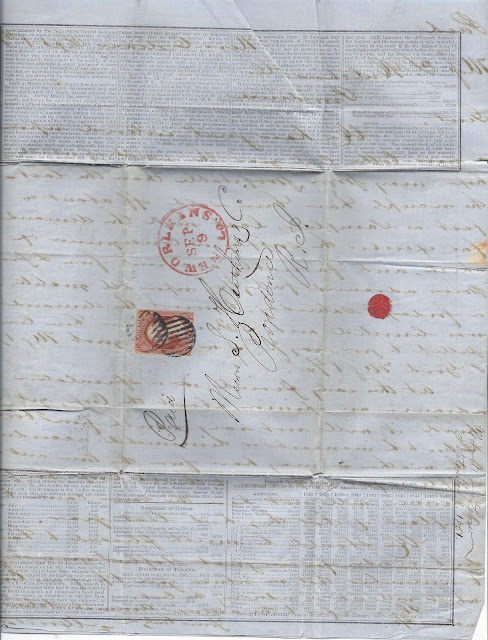
Shown above is a folded letter that was
mailed at the New Orleans (Louisiana) post office on September 9. It
is not hard to see why I came to that conclusion - based on the big,
red, circular date stamp at the top left. The three cents in postage
were paid by the stamp and that stamp was canceled with two round grid
markings in black ink. We often refer to a used postage stamp as having
received a cancellation, which refers to the various postal markings intended to deface the stamp and make it difficult for someone to reuse it.
An
Act of Congress issued on March 3, 1851 reduced the letter rate for
mail in the United States to 3 cents per 1/2 ounce for items sent no
more than 3000 miles (effective on July 1 of that year). At the same time, a 3 cent
postage stamp was issued to show prepayment of this
rate. In addition, this act authorized the creation of a 3 cent coin
(the first of its type) to provide the public with a convenient method
to pay for these stamps.
If you are interested in a summary of
the internal US postage rates at the time this folded letter was mailed,
it is shown below:
Letter Mail Rates in the United States July 1, 1851 - March 31, 1855
| Distance | Rate | Per |
|---|
up to 3000 miles prepaid
|
3 cents
|
1/2 ounce
|
over 3000 miles prepaid
|
6 cents
|
1/2 ounce
|
up to 3000 miles unpaid
|
5 cents
|
1/2 ounce
|
over 3000 miles unpaid
| 10 cents
| 1/2 ounce |
So, our folded letter was mailed only a few months after these new postage rates were put into a effect.
Let
me set the scene for what follows. In the 1840s and 1850s, a movement
was gaining momentum to encourage mail carriers to provide affordable postage rates. As recently as 1845 (just 6+ years prior), a similar letter from New Orleans to Providence, Rhode Island, would have cost 25 cents in postage instead of 3 cents!
In
other words, many who sent letters treated the surface area on a folded
letter as extremely valuable real estate - and every opportunity to use
it well was taken.
 |
Remember, you can click on images to see a larger version
|
Just two weeks ago, I talked a bit about folded letters.
This letter consists of a single larger sheet of paper that has been
folded in half to create, essentially, four pages - or sides. One side
needed to be used as the outside wrapper for an address and postage.
The rest would face inward once the letter was fully folded for mailing
so the contents would not be revealed unless the letter was opened.
Now
look carefully. The parts of this page (or side) that would get folded
in is covered with printed information. The sender of this letter was
not about to let that valuable space go unused.
Two
more sides on this folded letter are also covered with pre-printed
material. The content itself was referred to as a price(s) current, or a
market report, that provided recent product volumes and values in the
New Orleans area. Much of the report centers around agricultural
products, which makes sense as the letter was mailed by a Wood &
Lowe, who were cotton brokers in New Orleans.
The printed content
actually provides information for multiple years leading up to September
of 1851. The text itself is actually pretty small. If a person did
not need reading glasses before they started reading this folded letter,
they might once they completed the task.
One
of the four pages also includes a personal note to the recipient. The
docket at the top reads "Sept 8th, 1851," the day prior to the New
Orleans post office placing the red postmark on this cover. The letter
starts with discussion of the cotton crop. Otherwise, this is pretty
much a standard business letter that is essentially encouraging the
recipient to participate in the purchase of the year's cotton crop.
Some of you might remember that printed matter, such as what we saw on three sides of this letter sheet, qualified for a cheaper postage rate.
If this item had not included this personal correspondence, it would
have also qualified. But since this sheet was printed in such a way that
one side was left blank, the intent was clearly to allow space for the
personal sales pitch.
The handwriting here is like much
handwriting, there can be places where it is harder to read. But, what I
am going to show you next will make this look simple!
Our
second folded letter was mailed in New York City to Southampton in the
UK. It entered the mailbag to cross the Atlantic Ocean on July 8 and
was taken out of the mailbag in Liverpool on July 18. The letter was
carried on the Inman Line steamship named
City of Boston, which arrived at Liverpool on July 18 (which nicely matches the postmark for Liverpool at the left).
There
are two postmarks on the back of this letter. One is a London postmark
for July 19 and the other is a Southampton postmark for the same day.
So, we can guess that Edward Palk received this missive at that time.
The docket at the left in dark ink reads "Mr Parsons June 1865."
Indeed, the letter inside is datelined "Cleveland, June 1865," which
provides us with the date and location for the starting point of this
letter. After taking some time deciphering the contents of the letter,
it seems it was written over a period of several days, and it is
possible Mr. John Parsons was traveling as well.
Everything I say about the contents of the letter is still open to further study - because reading the letter is not easy.
Rather than spend more time telling you why it was hard to read, let me just show you.
This
is the first page of the letter. Or at least, this is where the letter
starts. Mr. Parsons used a technique called "cross-writing" in an
effort to avoid using more sheets of paper that would have caused the
letter to exceed a half ounce in weight. Exceeding that half ounce
would have required another 24 cents in postage and, apparently that
cost was worth expending the effort of writing in a lighter ink first in
one direction. Later content was written OVER the lighter ink in a
darker ink and going in a direction that is vertical, instead of
horizontal, on the sheet.
This is certainly a technique that was
developed during a time when the cost of mail was extremely high. But,
by the time we get to 1865, postage had come down significantly. This interesting blog
by Kathy Haas makes a valid suggestion that cross-writing might not
have always been used because the writer was unable to afford the cost
of paper and postage. It is possible that this was "an ingrained habit
or a practice associated with virtuous thrift."
In other words, it
is possible that Mr. Parsons was signaling his own virtue to Mr. Palk
by... um... making it really hard for Mr. Palk to read the contents of
the letter.
 |
the top of the page shown above
|
The
letter opens, "My Dear Friend..." But, after taking a few moments to
attempt to read this writing, I have come to the conclusion that Mr.
Palk was either truly a very dear friend OR this was a passive
aggressive way to let Mr. Palk know who was better than whom.
The
letter actually starts out with some business, acknowledging a draft
(for money transfer) and discussion of the status of an account. The
rest of the letter seems to cover a lot of ground. On the whole, the
letter seems to be quite conversational - so perhaps Mr. Parsons did
consider Mr. Palk a "dear friend."
Later in the letter, Mr.
Parsons speculates on some issues he has read in the paper about
Europe. For example, I see mentions of the Fenians,
an Irish nationalist society on this page where the writing runs
vertically. But, I find it very interesting to read his comment that
"now that the war is over..." houses were becoming available that were
less expensive to purchase than rent. Apparently, it had been difficult
to find rental properties "at any price."
Some of the
cross-writing has a notation that reads "July 3," which makes it clear
that this letter was written over a period of days. Mr. Parsons follows
the date by saying "tomorrow will be a great one for firecrackers and..
speeches." No doubt, in reference to Independence Day celebrations.
Perhaps
someday I will make the effort to read this letter in its entirety.
Or, I'll just take something for the headache I feel coming on about
now. The handwriting itself is fairly legible. It is more a matter of
familiarity. Words like "their," "friend," and even "acknowledge" are
recognizable because they are common words I know and use. But, because
we are not familiar with the names, time-period references,
colloquialisms and subject areas that the writer and recipient are, we
are often left to guess - often badly - at the key words that could
unlock the content fully.
Bonus Material - Shubael Hutchins
Going
back to our first letter, we find that it is addressed to S. Hutchins
& Co of Providence, Rhode Island. We could be dealing with either Shubael Hutchins
(2nd of that name) or Shubael Hutchins III, both of whom might well
have been part of the business at the time. The latter Shubael
apparently served as president of the American Bank in Providence from 1855 to 1868. It is a decent guess that the former was a businessman who dealt in dry goods at either the wholesale or retail level.
With
that information, I made the educated guess that the elder Shubael
Hutchins was the namesake for a drygoods business - hence the reason he
would receive a letter from New Orleans regarding the cotton crop. The
Colenda Digital Repository provides support for this guess as it features a letter sent to Hutchins regarding damaged cotton bales.
 |
A small portion of the price-current
|
One
never knows what you can uncover once you are fairly sure you have
identified the recipient (or sender) of a piece of mail. In this case, I
actually ran into a court case regarding the will of Shubael Hutchins
(the 2nd), and the
opinion was published in 1907.
Since Hutchins had died in 1867, this certainly gives one pause - a
forty year gap to finalize parts of will seems excessive to me.
Apparently a key issue being considered was this part of the will (most of the rest of the will had been executed successfully):
"To the treasurer of any one or more societies or organizations whose
object is the improvement and education of the colored people of the
south, I give the sum of ten thousand dollars for the uses and purposes
of said societies but I leave it wholly to the judgment of my said
trustees as to the time when, how much of, and to what society or
societies or organizations said sum or any part thereof shall be paid
having reference to the ability of my estate and the Efficiency of any
of said societies in the above object"
At
issue was the contention by the trustees that they could not find an
appropriate society to give the money to, so they wanted to be granted
the ability to NOT follow through with this portion of the will.
Cutting right to the chase, the court held that the money was for a
valid charitable cause and was not void due to "indefiniteness or
uncertainty."
In other words the ruling was saying "figure it out people and get that money where it is supposed to go."
Perhaps
there were stipulations that the organization needed to be in Rhode
Island. But, it certainly wasn't a matter of finding where the people
of color might have been. Shown below is part of a map produced in the
early 1860s and based on 1860 census data. I selected the areas closer
to New Orleans to make the point. Each county was shaded to illustrate
the percentage of the population that was enslaved. The darkest shade
indicates populations where slaves comprised 80% (or higher) of the
total. Much of the area upstream form New Orleans on the Mississippi
River fit that description.
I
find the irony of this donation from the estate to be very
interesting. Clearly, Hutchins and his business benefited greatly from
cotton. Cotton, in turn, relied heavily on slave populations to produce
sufficient crop for people like Hutchins to trade. Did Shubael
Hutchins make the connection and add this into the will as salve for his
soul? Were the trustees of the estate reluctant to follow through with
his wishes because they didn't really want the colored people of the
south to become educated?
To put this in perspective, $10,000 in
1867, the year Hutchins died, had the same buying power then that
$380,000 has in today's world. It wasn't going to keep a school or
other organization running indefinitely, but it certainly could have
made a difference for a few people.
For those who might like to learn more about the role of cotton in the US Civil War, I found this blog to be interesting. If you want something with even more depth to content with appropriate citations, this article on American Yawp fits the bill.
While
we will never know the full story of Shubael Hutchins and his bequest,
these are events and issues worth pondering and considering - thank you
for allowing me to do so in today's writing.
I think we'll call it a day. I hope you enjoyed this edition of Postal History Sunday.
For
those who are curious, I also uncovered interesting material on Edward
Palk (our second featured item), which I think I will reserve for future
Postal History Sunday! Hey! I need to save something for later, don't
I?
Have a fine remainder of your day and an excellent week to come.
--------------------
Postal History
Sunday is published each week at both the Genuine Faux Farm blog and the GFF Postal History blog. If you are interested in prior entries, you can view them, starting with the most recent, at this location.


