Tuesday, November 14, 2023

Looking Back at Eden's Start

There was going to be some assembly required

There was a question regarding EQIP funding for high tunnels that came to my attention and I suddenly found myself taking a trip down memory lane.  You see, our first high tunnel, aptly named "Eden" was built in 2010 when the program to allow EQIP funding to help with their construction started.

The Genuine Faux Farm was among the first in the state to apply for and receive funding towards a new high tunnel and I believe ours was the first to be successfully constructed in our county.  It was new territory for us.  It was new territory for the folks in the NRCS office.  And it was newish territory for most small-scale vegetable growers in Iowa.  It was new enough that Practical Farmers of Iowa used our high tunnel build to create a two-day high tunnel build field day in July of 2010.


Yes, it does seem odd to see a ladder in the middle when everything else is on the ground.

On the positive side, we got lots of help.  Because it was a sponsored event, we were able to receive support from the designers and fabricators of the high tunnel, Four Seasons Tools, and guidance from Adam Montri of Michigan State University.

On the other hand, the whole thing was almost more of a whirlwind than we could handle.  Early July is already a busy time in the best of years, but 2010 had not been a good year for us up to that point.  There was rain.  And more rain.  And even more rain.  

We had so much rain that most of our field crops were on their way to ending their lives prematurely.  And we were on the verge of calling the Genuine Faux Farm a failed experiment.  And now we were going to host a whole bunch of people at a farm where the moral was low and our confidence was lower.

And, looking back on it, I don't regret having done the field day or the building project at all.

In a very real way, this field day and building project saved the Genuine Faux Farm from extinction that year.  It was because we had agreed to do this project and we felt a responsibility for seeing it through that we fought through to get to the point where many willing hands helped put the hoop building together.

Yes, it's true that Tammy and I spent more time running around finding tools or answering questions for media than we did learning how to build our own high tunnel.  It's also true that we were more involved in all the rest of the logistics than we were wielding impact drivers or shovels.  And, we were a good bit more than exhausted at the end of each day.

And that's coming from two people who knew what it meant to be truly exhausted at the end of a day.

As I review some of the photos from those two days now, I fully recognize the place that was the Genuine Faux Farm in 2010.  And, I can barely recognize the place that is the Genuine Faux Farm in 2023.  It really hasn't been all that long and it has been a lifetime ago.

Even the photo above has numerous reminders that things were different then.  The giant Silver Maple that had been allowed to grow out of the foundation of the garage was a big beautiful tree then.  We had managed to frame out the front of the old garage, but we had yet to work on the nearby Truck Barn (as we call it).  The granary still needed a new roof in 2010 and the cupola (if I have the right term) was still intact on that roof.  

We were still using cold frames to start plants by the Truck Barn and Grover the blue truck was still plugging along helping us do our farm deliveries.

One thing that hasn't changed is the fact that Tammy and I are still a team and we are the most important elements of what has made, and will continue to make, the Genuine Faux Farm what it was and is.  Certainly, some of our dreams from 2010 have not survived to the present day.  Many of those visions have been changed either because the reality of our lives forced changes or we found there was a way that fit our realities better.

But, the best thing is to look at these images and realize that we have shown ourselves that we are resilient and we are capable.  We are not as timid as we sometimes think we are, nor are we as inconsistent or uncertain as we worry we have been.

Sure.  Others might have been or might be more aggressive, more adventuresome, more profitable or more whatever it is measure you want to pick.  But many, many others have also been less so.  Once again, using whatever measure you want.  Besides, this was never a competition with anyone other than ourselves.  We've always been seeking to be our best selves rather than seeking to best someone else.

In short, we've done alright.  We've fought through some tough stuff and done some things to be proud of.  And we've done it with integrity and a good heart.

There isn't much more I could have asked of us.  Well done us.  Even if I do say so myself.

Monday, November 13, 2023

Murphy's Morning Chores


Murphy, the youngest Outdoor Farm Supervisor, is beginning to feel a bit more secure in their role.

In other words, Murphy has decided what role Murphy is going to play. She's a cat, so that's typically how it works.

Murphy is unlikely to grow much more than she has up to this point, so it is fair to say that she is a small cat.  You can get an idea as to size by looking at how big she is as compared to my size 12 foot.  Yes... my foot is a foot long.  

No, it's not a joke.  But, I suppose if you must...


One of the important tasks Murphy feels needs to be done is making sure that at least one of the farmers provides food and water for the Farm Supervisory Crew.  In her zeal to do just that thing, it is not uncommon for her to forget the fact that this task has already been completed.  But, that's what happens when you really love your job.  You enjoy it so much that you just can't wait to do it again!

Once the sun comes up, Murphy will station herself somewhere near the back porch of the farm house.  That's the door the farmers typically emerge from and it is very important that she be RIGHT THERE at the moment the door is opened.  To do this job right, there must be some conversation as the door opens.  In Murphy's case, she opts for a bright and cheery tone, salted lightly with implied urgency and the tiniest dash of reprimand for slow service.

The next step is to trot lightly down the stairs of the back steps and make a route that goes over the picnic table and on to the garage where the food is stored.  If one of the other Farm Supervisors happens to be in the path, there is usually an exchange of mild aggression - usually a clawless bat at each other.  It's Murphy's way of reminding everyone of the importance of her task.

Outta my way, Soup!  Ima gonna get us some food!  Watch it there Inspector!  Comin' thru!  You'll thank me later!


If the farmers are unusually slow on a frosty morning, we might be greeted with a message from Murphy on the back steps.  An impatient little dance leaves impatient looking foot prints for the farmer to read as they open the door.  

On days like this, Murphy often does not show up right away to escort us to the food.  Instead, there is only this message that spells out frustration and maybe even disdain for the farmers' lack of consideration for the Farm Supervisory Crew.


But, I actually got outside recently before Murphy was ready for me and I left a message for her.  There it was, a single set of foot-long foot prints leaving the farm house and heading straight for the garage.  From the garage, the footprints led to the granary and then to the Poultry Pavilion.  

And, sure enough, as I opened the hen room door to exit their room, I found Murphy waiting there for me.

You see, on a typical morning, all three cats will eat a little bit as soon as the food is placed by the garage for them.  Like many outdoor cats, they'll eat their first few morsels as if they are starving.  But, these cats do fine and they often do not eat much more than a few bites at this time.  (hunting time is often prior to sunrise and they do manage to catch some rodents on a semi-regular basis)

Once the food has been tasted and found to be sufficient, I often get some supervision as I perform the poultry chores.  And, of course, there are skritches to be doled out the the Farm Supervisory Crew.  

Murphy is often a bit too wound up to get much more than a little bit of attention most mornings.  But, on this particular morning, she insisted, in her own way, that I should pick her up.  So, I did - after giving Soup and Inspector their greetings.  And, Murphy let me know she got my message by snuggling in and providing me with a good purr.

Sunday, November 12, 2023

Let's Send a Letter to Switzerland - Postal History Sunday


Welcome to Postal History Sunday!  

Everyone is welcome here, whether you know a lot or a little about postal history.  Bring a little curiosity along for the ride, grab a favorite beverage and a snack, tuck those troubles away and put on the fuzzy slippers.  This week, we're going to see what options a person in the United States had for sending mail to Switzerland from 1860 to 1867.

While those dates might seem somewhat arbitrary, I can provide a short justification.  The start date is because I like studying postal history during this decade (the 1860s).  The end date is derived from the point when significant changes in available rates were happening.  It might be just as well to write a whole new blog entry starting in 1868 and ending in 1875 when the General Postal Union went into effect rather than try to cover all of that territory here!

Postal treaties set the rules for mail exchange

Letter mail between countries prior to the General Postal Union (1875) relied on postal conventions that were established by treaty between nations.  Needless to say, not every pair of sovereign states had a direct agreement that dictated how mail would be exchanged.  Mail between nations that did not have a direct agreement relied on a chain of postal conventions that connected them.  In most cases, that chain was created by finding one intermediary that had independent agreements with both of the states in question.  

Switzerland and the United States had no postal convention in place until 1868.  This makes sense for several reasons, but the most obvious is that there was no way mail could be carried between the US and Switzerland without transiting a third nation.  Any postal agreement between Switzerland and the United States would require connections to other agreements just to manage the transit through some or all of these independent states.

In 1860, the United States maintained postal agreements with the French, Prussian, Bremen and Hamburg systems.  It was also possible to send mail to the British mail services to be sent on through whatever routes were available between the United Kingdom and Switzerland.  

That's actually quite a few choices a person could make just to send a letter to one, smallish, country in the middle of Europe!

1860 - 1867 Letter Rates - US to Switzerland
Effective Date Treaty Rate Unit Mail System
Oct 1852 - Apr 1863
35 cents
half ounce
Prussian Closed Mail
May 1863 - Dec 1867
33 cents
half ounce
Prussian Closed Mail
Apr 1857 - Dec 1869
21 cents
quarter ounce
French Mail
Oct 1860 - Dec 1867*
19 cents
half ounce
Bremen-Hamburg
Jul 1849 - Dec 1867**
5 or 21 cents
half ounce
British Open
May 1863 - Dec 1867 
28 cents        
half ounce
PCM to border

* The prior postage rate was 27 cents per half ounce (July 1857 - Sep 1860)

** This rate was advertised from Jul 1849 to Jun 1857, but still available afterward

Prussian Closed Mail

If you look at the table shown above, you will find Prussian Closed Mail three times on the table.  For the first part of the decade, the fully prepaid amount was 35 cents.  But, in May 1863, the amount was reduced to 33 cents.  And, you will see a third option at the end of the table where a person could pay the postage up to Switzerland's border, but no further, for 28 cents.

We will start with a letter that illustrates the 33 cent rate to Switzerland via Prussian Closed Mail.

33-cent per 1/2 ounce rate via Prussian Closed Mail

The Prussian mail system provided mail services for the United States to Switzerland starting in 1852 until December of 1867 when the Prussian system was superseded by the North German Union mails (essentially the Prussian mails with other German mail systems consolidated with it - a topic all its own).  The postage rate was reduced by 2 cents in May of 1863 in part as a response to the postal rate to Baden (a German State bordering Switzerland on the north) being reduced from 30 to 28 cents at the same time.

Mail to the Prussian system typically traveled through Belgium after a stop in England.  Mailbags would enter the Prussian mail officially at Aachen (Aix la Chapelle) or on the mobile post office between Verviers and Coeln.  This particular cover shows a boxed Aachen exchange marking that was applied once the letter was taken out of the mailbag.  
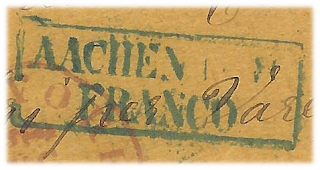
Aachen exchange mark

This letter was put in the mailbag in New York City and remained there until Aachen, even though it did transit the United Kingdom and Belgium.  This is why it was referred to as "Prussian Closed Mail."  Despite carriage in territory not served by the Prussian mails, the intermediary postal services did nothing to process the individual mail pieces. 

Both Belgium and Prussia featured highly advanced rail systems that facilitated rapid mail dispersal.  Travel to Switzerland from Aachen required transit through Prussia and Baden or through Prussia, Hessian states, and Wurttemburg.  

"12" - marking applied in New York City

Like many of the postal agreements at the time that involved the United States, a significant amount of effort was made to show how the postage was to be split between postal services.  A letter sent at the 33-cent rate via Prussian Closed Mail to Switzerland required that the US send 12 cents to Prussia.  This marking was applied using red ink, which was a message to the clerks in Aachen that the letter was considered fully paid and that the US owed Prussia twelve cents for this letter.

Some of the postage sent to Prussia was passed on to the Swiss for their costs to deliver the letter.  Another piece of that postage went to pay the Belgians and British for transit through their territories.  As for the 21 cents the United States kept, five cents paid for mail on US soil and 16 cents paid for the trip across the Atlantic Ocean.

Baden railway marking - Z 23 is the train number

Since I mentioned Baden earlier, this particular cover does a nice job of tying it all together.  A significant number of the letters via Prussian Closed Mail to Switzerland from the US traveled through Baden.  And, while Baden was part of the German Austrian Postal Union, they still maintained control of their mail system.  So, they liked to process mail that went through their territory.  A clerk on this particular train made sure to mark this letter to show that it had, in fact, gone through Baden on August 17 of 1866.

A 35 cent rate example 

That brings us to a second envelope that was mailed to Swtizerland via the Prussian Closed Mail.  This time, I get to show you a pretty cover with a 24-cent 1861 stamp on it.  The letter itself was sent from the Swiss Consulate in Philadelphia (the docket at the top right tells us this information).

35- cent per 1/2 rate via Prussian Closed Mail

This letter is particularly interesting to me because it was mailed on April 27, 1863, just days before the postal rate was going to change to 33 cents.  In fact, by the time it arrived in Aachen on May 12, the rate had changed.

Baden railway marking

On the reverse of this particular cover is a different type of railway marking for the Baden "Eisenbahn."  So, once again, a letter to Switzerland from the US took the route through this particular German State.

And one that was paid to the border only

Our next item was mailed in 1866 and it only has 28 cents of postage, which means it could only be paid up to the border between the German States and Switzerland.  This letter also exhibits the boxed Aachen marking and it traveled on a Baden railway before entering at Basel, Switzerland.

28 cents paid only to the border of Switzerland

The Prussian system is interesting in that it would allow mail from the United States to be paid 'up to the outgoing border.'  In other words, the sender could opt to pay the 28 cent rate to get a mail item to anywhere within the German-Austrian Postal Union (GAPU).  Once it reached the border, it would be sent on - essentially as an unpaid piece of mail from the Prussian system to its destination in Switzerland.  

This rate was not advertised in the postal rate tables at the time, so the clerks or patrons had to be aware of other options that were not shown in those tables.

Since the letter was not fully paid to the destination, the recipient was required to pay 10 rappen (or centimes) in Swiss postage for the privilege of receiving their mail.  This Postal History Sunday illustrates a situation where some mail was sent from Switzerland to Rome and the postage was split.  So, this was certainly not unknown at the time.

French Mail to Switzerland

Double the 21 cent French Mail rate from the United States to Switzerland

The French mail system provided the United States with services to Switzerland from April of 1857 until December of 1869 at a cost of 21 cents per quarter ounce (7.5 grams) for letter mail.  Much of this postal convention can be viewed here if you are curious.

Mail to Switzerland via France would travel by trans-Atlantic steamship from New York, Boston, Portland (Maine) and Quebec bound for locations in England, France and Germany, depending on which steamship line carried the piece of mail in question.  Items bound for France would typically sail directly to France or travel via Britain.  The entry point in France was most often Calais (or the rail line from Calais to Paris), but it could also be locations such as Havre and Brest.  If you would like more detail on how mail got to France during this period, this post will provide you will provide you with that information.

border region of France and Switzerland

The rail systems in France were developing rapidly from the 1840s through the 1860s and, for most of the 1860s, foreign mail was carried by train to Switzerland via three primary border crossings.  There were other crossings that typically handled local mail and were unlikely to carry foreign mail, though it is technically possible.  

Mail could enter Switzerland in the north at Basel, west at Pontarlier and south at Geneva.  The route was chosen based on a combination of train schedules and location of the destination relative to the border crossing.  The hope was to send the mail via the route that would see the quickest delivery time.


The envelope shown above is presumed to have gone via Pontarlier based on some incomplete train schedule data that I have located.  It is entirely possible that this is incorrect and I hope to be able to decipher the route more fully in the future.  The 1864 year date makes it possible that the entry was in the south at Geneva depending on the completion dates of some of the rail lines in the Jura mountains.

The difficulty for a postal historian who wants to figure out the route a letter took is that letters transiting France to Switzerland from the United States were not provided some of the same markings seen on Swiss/French mail.  As a result, we get fewer clues from the piece of mail to isolate the route once it was in Europe.  Instead, we are left to speculate by looking at train schedules and, perhaps, looking in a crystal ball or some tea leaves.

And now we take a quick diversion!  Someone asked me show, once again, how I display postal history.  So, below is the exhibit page I created for the letter shown above - feel free to click on it to view a larger image.

This cover appears to have been sent from New York City to La Chatelaine near Geneva, Switzerland.  The portion of the address panel that reads "pres de Geneve" simply indicates that this is La Chatelaine "near" or "next to" Geneva.  The larger, red circular marking was applied in New York, dated March 9 and indicates that 36 cents of the 42 cents collected in postage is to be passed to France to cover postal expenses not rendered by the United States postal system.  The French then passed money to the British and Swiss postal systems to cover their parts in carrying this letter.

The breakdown of the postage rate is often not as simple as saying 6 US cents go here and 12 US cents go there.  What can be said entirely accurately is that 42 US cents were collected via US postage.  Thirty-six of those US cents were passed to the French postal system.  An amount roughly equivalent to 16 US cents was sent in French centimes (probably 80 centimes) to the English to cover the sea passage and the transit on British rail from Liverpool and the English Channel crossing.  This left 20 US cents, which is in the neighborhood of 1 franc in French currency, to cover transit through France and the cost of mail in Switzerland to deliver to the recipient.

For the sake of argument, mail from France to Switzerland cost 40 centimes (French) per 1/4 ounce.  So, this double weight letter would have cost 80 centimes if it originated in France.  This rate was split at 50 centimes for French postage and 30 centimes for Swiss postage.  So, it is not unreasonable to speculate that 30 centimes (about 6 US cents) was passed on to Switzerland to cover their postage costs.

Did you follow all of that?

No?

Let's try this instead:

  • The US retains 6 cents of postage.
  • France receives 36 cents from the US.
  • Britain receives 80 centimes from France.
  • Britain pays 6 pence to the Cunard Line for trans-Atlantic crossing.
  • Britain retains 2 pence for internal rail service and the English channel crossing.
  • France passes 30 centimes to Switzerland (equal to 30 rappen) for the Swiss mail service.
  • France retains 70 centimes for their internal mail.

Now you're all saying - why didn't just put it this way in the first place?  The answer?  I don't know, I think it's because I like to hear myself write.

All of these amounts are estimations because I am not currently willing to work out all of the details as to actual exchange numbers between all of the players. involved.  For this excercise, I am operating under a simple 5 French centime to 1 US cent conversion, though the actual rate was 5.26 centimes per 1 US cent.  In the end, that conversion number matters less because the actual postage breakdown numbers are filtered through three sets of postal treaties; the treaty between the US and France, the treaty between France and Britain and the treaty between France and Switzerland.  In the end, it appears that the French make out like bandits since their internal rate was 40 centimes for a letter weighing 10 to 20 grams and they walk away with 70 centimes instead!

There is still plenty that can be explored regarding this cover.  If you look, you will notice several manuscript markings.  A pencil "2" notation certainly was applied to indicate that this is a double weight letter.  I have no idea whether the "53" is a postal marking or a filing docket placed on the envelope after it was received.  

The "12" that is crossed out may well reflect some early confusion by a clerk in New York.  They might have expected the item was going to go via Prussian Closed Mail, where that "12" would be an expected credit marking.  But, once they realized it was for a double weight letter via France, they crossed it out.

Bremen or Hamburg Mail Treaty to Switzerland

US to Switzerland via Hamburg Mails at double the 19 cent rate.

Bremen and Hamburg were two Hanseatic cities that negotiated mail treaties with the United States including mail service to Switzerland beginning in July of 1857 at a rate of 27 cents per 1/2 ounce.  The rate was reduced to 19 cents in October of 1860 and became obsolete when these mail systems were combined with the North German Union postal system in January of 1868.  

Initially, mail packets (steamships) traveled between New York and Hamburg every four weeks , but that increased to every other week (alternating with the ships that traveled to Bremen) as we progress through the 1860s.

Once again, I share an exhibit page for those who might enjoy viewing it.


Mail from Hamburg and Bremen typically traveled through Frankfort (Hessian territory) and would go through Baden to western Switzerland and Wurttemburg to eastern Switzerland.

The different numerical markings help us figure out how the postage was shared between mail systems.  First, the blue "8" is in the German silbergroschen currency, which would translate to 19 US cents approximately.  It appears that the blue "8" was applied in Frankfort A Main, which would imply entry into the Thurn and Taxis posts.  

Thurn and Taxis would have kept 6 silbergroschen for their transit of mail to Switzerland and 2 silbergroschen would have been passed to Switzerland for their surface mails (about 5 cents). The red marking next to the "8" is "2 fr"* which represented the amount passed to Switzerland.

* this is a weiterfranco marking, weiterfranco is a German postal term that indicates an amount of postage passed forward to the next postal service.

British Open Mail to Switzerland

An alert clerk prevented loss of the entire 24 cents postage paid by using British Open Mail

There was no option to send a letter via the British Mail to Switzerland as a fully paid letter.  Instead, the only option was to split payment between the person sending the letter and the person receiving the letter.

In the case of British Open Mail, the US postal patron had to pay the US portion of the postage and the recipient would pay for all postage costs from the point the letter entered the British mail to the point it got to its destination.  It is interesting to note that this rate was advertised in rate tables as an option until the middle of 1857.  After that, it was not advertised, even though the postal treaty between the US and the UK provided the option for destinations like Switzerland and the Netherlands.

The open mails were especially valuable for mail that was overweight but not paid as such.  The sender of this appears to have intended to pay the 21 cent French rate to Switzerland.  However, the item must have weighed more than 7.5 grams (1/4 ounce), which would require 42 cents in postage.  

The postmaster realized that at least some of the postage applied to the envelope could be useful by paying the US portion of the trip to England.  So, the item was sent via the British Open Mail at 21 cents per half ounce, since an American contract ship took this mail across the Atlantic).

It was up to the Swiss postal service to collect sufficient postage to cover the costs that were now to be split between the British, French and Swiss postal systems.  To simplify the accounting of the time, debits and credits were often (but not always) dealt with in bulk rather than a letter by letter basis.  For example, the British and French agreed on 40 centimes for every 30 grams of bulk mail.  The justification for this is partially based on an assumption that 30 grams would represent three to four pieces of letter mail on average.  
 
Rather than having an exact count of mail pieces and the rates paid, the entire mailbag could be weighed out to figure what was owed for the British (and later French) transit.  This is, of course, an efficient way of doing business as long as the actual averages held true to the estimates.  But, from a postal historian's perspective it makes it difficult to make the postage breakdown nice and neat.  I am sure this postal historian can get over that small issue - eventually.

Why Choose One Option Over Another?

With five different options for sending mail from the US to Switzerland, how was a person to choose?
  • French Mail: 21 cents per 1/4 ounce
  • British Open Mail: 5 cents per 1/2 ounce OR 21 cents per 1/2 ounce with remainder to be collected from recipient in Switzerland.
  • Prussian Closed Mail: 33 cents per 1/2 ounce (35 cts prior to May 1863)
  • Prussian Closed Mail to border: 28 cents per 1/2 ounce with remainder to be collected from recipient.
  • Bremen or Hamburg Mail: 19 cents per 1/2 ounce.
Clearly, if cost were the only consideration a person might prefer Hamburg Mail, French Mail or British Open Mail.  But, the French Mail rapidly loses its luster if the mail item exceeds 7.5 grams (now it would cost 42 cents).

Hamburg Mail looks good at 19 cents per 1/2 ounce.  But, what happens if you missed the most recent sailing of the ship for Hamburg?  You would have to wait one more week for the next departure to Bremen (or two to Hamburg).  Are you really willing to add another seven days to the typical 12 day transit period?  That means you would have to wait nearly a month for a reply.  The other mail systems benefited from being able to receive mail from multiple sailings each week.

British Open Mail and Prussian Mail to the border both require that the recipient pay part of the postage.  This may not be the best policy if you actually want the recipient to accept what you have sent to them.  After all, they were not required to accept and pay for a letter that had postage due.  On the other hand, there are multiple instances where it is clear that two businesses intended to split postal expenses in this fashion, so perhaps it was a reasonable option for some.

The last option to consider is the fully paid rate via the Prussian Closed Mails.  If the letter item was between 1/4 and 1/2 ounce, this option is clearly better than French Mail (42 cents).  If you were also concerned that the recipient accept the mail and not have to pay to receive that mail AND you found yourself in a position where you didn't want to wait a week for the next Bremen or Hamburg sailing, then Prussian Closed Mail is your choice.

As might be expected, my observations have shown more mail addressed to Switzerland from the United States using French mail or Bremen/Hamburg mails than the other options. Apparently, the choice was most often made by selecting the least expensive option

-----------

Postal History Sunday is published each week at both the Genuine Faux Farm blog and the GFF Postal History blog.  If you are interested in prior entries, you can view them, starting with the most recent, at this location.

Saturday, November 11, 2023

November Playlist


I just realized that somehow, I skipped October when it came to a music playlist.  But, that's ok, I had two in August.  So, we'll just do our November list a bit earlier than normal.  

I tried to include a few links to Band Camp songs rather than Youtube videos.  This provides you with an opportunity to purchase songs from the artists if they interest you.  Often, the Youtube videos are not authorized by the artist and don't benefit them.  Since I often share music by artists that get less coverage, it makes sense to try to support them in this way if I can.

I hope you find a tune or two that you enjoy - and if you don't, make sure you treat yourself to sounds you DO enjoy sometimes today.

Danny Oertli with Phil Keaggy and Dave Beegle - Planes, Wolves and Bears


The Ascendants with Leigh Nash - Once in a Lifetime

This is a cover of a Talking Heads tune and I do like what they've done with it.  It's fun and an enjoyable listen.  The Bandcamp link is here.

Talking Heads - Road to Nowhere

Well, you knew I had to include something by the Talking Heads after referencing them in the prior tune, right?

Acceptance - Midnight


 Centrifugal - the Choir

 Here's a newer tune by a favorite artist of mine. 

Mysterious Ways - U2

Stellazine Prophesy - 77s

Berlin Kitty - Violet Burning

Demon Box - Veil of Ashes

Dark Night - Undercover

Tired of Winning - Nothing More

Friday, November 10, 2023

Swirling Confusion


Last week, I followed a pattern I have followed for most days over the past three to four years.  Early in the day, I turned on the computer, made sure the daily blog had published as I had scheduled it, then I proceeded to share that blog on a few social media platforms.

Usually, the process is pretty quick and I don't allow myself more than a cursory examination of what is on those social media feeds during the process.  To be perfectly honest, these posts used to actually result in some readership for the blogs I wrote, but now I don't think they do.  The social media software companies have changed their algorithms over time to try to prevent people like you and me from seeing posts that encourage you to leave the social media platform - unless it's a paid advertisement.  You'll find those all over the place, of course.

Still, I go through this process most every day anyway.  And last week, I went through the process as I usually did and everything seemed fine.

Until I received a notice later in the day that led me to this:

First, let me be clear about something.  I do think social media platforms should have some moderation. The issue here is about the effectiveness of that moderation.

There are so many social media posts that it would be ridiculous, given the chaos that is the social media universe, to expect a horde of human mediators to be checking in on every post.  That might work if social media were truly segmented off into interest groups (as some of it is) that had mediators and a bit of a social contract to go along with it that most participants would naturally adhere to.  But, we don't have that.  It's a mass of swirling confusion (just as the image of Bree on a swirly blanket seems to convey).

Facebook, for example, has been relying on algorithms modified by artificial intelligence (more algorithms) for some time.  Apparently, I found some combination of key words that set them off and this post was removed.  And clearly, the post and the link to the blog, did not break any community rules.

Of course, I protested the removal of the post and the implied and direct threats of further removal/censure that came with it.  But, let me tell you, that process was unclear, generic - and generally unsatisfying.  And, as of this moment, the post has not been returned to the feeds I placed them in.  As far as I know, I'm still on some mysterious "black-list" kept by the Facebook software that encourages the algorithms to watch me more closely.

Irritating?  Yes.  Frustrating?  Yes.  Critical?  

No.

One of my pet peeves is being accused of something I did not do.  So, it is actually pretty difficult for me to let go.  If I'm going to be punished, then make sure it is for something I did.  It especially gets me going when I scroll through my own feed and find that at least a quarter of the posts probably deserved to be removed.

But, I got over it by reminding myself of how low the bar can be for what we think is acceptable work and accurate information.  Well, no... that actually made me more upset.  This does not appear to be working!

Here's a sample of what I mean.  There is an online board game playing site that I have used periodically over the past couple of years.  I took note that they include an area in player profiles that show the number of games and relative success the player has had with those games.  I had noticed something odd with the numbers and I decided to grab some of the most outrageous examples to make the point.

I don't know whose profile this is or when I looked at it.  But, I'd say we have some sort of problem either with math, or, well, something.

14 victories in 44 games and this person is said to have "won" over half of their games (half would be 22 folks, in case you didn't want to do the math yourself).  But, they actually had more wins than they played when it came to Cacao.  Um... good for them?

And then there's this.  

Social media tries to be "social" by encouraging interaction, of a sort.  In most platforms you can show the poster (and everyone else) that you "like" something with hearts or stars or thumbs up or whatever. 

I vacillate between thinking these are useless and mean nothing to feeling they might mean more than they should.  I do know that I wish we just had thumbs up or "no reaction" instead of all of the choices given to us on some platforms now.

The image I show above was attached to a post that focused on a young person's illness and the journey they were taking.  I did not see anything that might indicate there was any scam surrounding it and it was for a person only "once removed" from my acquaintance.  In other words, a few people I know were direct acquaintances with the child and their family.

I understand the message a thumbs-up or a heart might give.  It's a simple (and often empty) attempt to show support.  I'm okay with that because a little bit of positive energy is always needed during trying times.  As long as we don't fool ourselves into thinking it does much more than provide a small burst of "aw, look!  People actually sent positive thoughts my way!" - then we're fine.

But, what's with the small batch of laughing faces?

I've seen it before.  Some author shares a post that shows concern for an issue they feel strongly about and those who select the laughing face clearly disagree.  It's meant to be a mockery rather than a friendly belly-laugh because something was truly funny or mirth-inducing. 

Or maybe they just clicked on the wrong icon.  After all, there are so many social media posts you need to respond to in a day!

And now, I will set this blog to publish on Monday morning.  I'll get up and put out my obligatory social media posts letting everyone know the blog exists.  And I'll sit back and wonder if anyone other than the algorithms will take notice.

Thursday, November 9, 2023

Farmer Delusional Syndrome Strikes Again!


November.  The daylight hours are fewer and the dark hours are longer.  But, the transitions from one to the other are frequently full of color and drama.  The moments of sunrise and sunset are enough to even lift the spirits of a farmer who has grown tired of the growing season that was.  And, depending on the farmer, it may even lead to a bout of optimism that might be less healthy than you think it is.

Yes, I'm talking about 

Farmer Delusional Syndrome

Typically, Farmer Delusional Syndrome starts the moment seed catalogs begin appearing in the mailbox.  It ends whenever it becomes clear to the farmer that they are already behind and their well-considered plans for the year are already shot.  This is usually April for me, but I am sure some growers might argue for an earlier date.  I just might hold onto my delusions more firmly than most. 

Is it possible that you, too, suffer from Farmer Delusional Syndrome (FDS)?  Let's review the symptoms together, shall we?

1. Do you circle forty new varieties and three to five completely new vegetable types to 'trial' for the coming season in the first catalog you see?

If the answer is yes, you might simply suffer from Gardener Delusional Syndrome (GDS), a closely related malady.  The main differences have to do with volume.  A person with GDS might be thinking about growing a couple of plants of each thing.  We're talking about FDS when the individual already has a list of oh... say... one hundred vegetable varieties that are on the "must grow" list and a "trial of a few plants" is typically just "a few hundred row feet."

A person who suffers from FDS  thinks they can squeeze all of these crops into their system somehow.  Or, even if they don't believe that, they at least believe they'll be able to set aside more time to investigate these options in order to make the "best" choice before seed trays need to be started.

2. The farmer forgets that pictures like this one don't show the ENTIRE field.

And they forget the field doesn't STAY this way.

Every grower who records a season's progress with photos falls prey to exactly the same thing I do each season.  I just cannot help but immortalize those moments in the field when everything actually manages to look the way I dreamt them up to be.  It may only happen a few times each year.  But, by golly!  I'm going to get a photo of it so I can blow it up and hang it in my brain to remind me that it CAN be done.

Unfortunately for the sufferer of FDS, images like this only feed the insanity.  Suddenly, every field WILL look like this in the coming year.  And, it will look like that all the time!  And...um.... that back corner that didn't get cleaned up just prior to the photo won't be there either.

3. It's cold outside right now.  Like most people in Iowa, the sufferer of FDS idealizes warm June, July and/or August days.  

Yes, those days.  The ones where we have often gone through three, four, five and even SIX t-shirts as they get soaked by sweat.  Days where we have been known to go see a movie we didn't want to see just to get into air conditioning for a little while at the end of the day. 

4. The farmer sees nothing wrong with a calendar that includes five or more good sized projects in April and May. 

After all, getting plants started, handling sales, planting a majority of the crops and dealing with poultry chicks only take "a couple of hours a day."  For us, it only gets worse as Tammy's time is pretty much monopolized by her work at Wartburg and we usually don't have anyone working on the farm with us yet.

The months may be slightly different depending on the grower and their situations.  But everyone with FDS conveniently forgets the tasks that just simply have to get done every year (or day).  Suddenly there are no labor costs associated with them and they always get done, to completion, with no issues and minimal fuss.  As soon as we convince ourselves that they will magically complete themselves, it's pretty easy to decide to add a small task or two - like, oh, building a new greenhouse or maybe tearing the old farmhouse down and building a new one using just matchsticks and bubblegum.  

Yeah, little things like that.

5. Every row is straight.

Straight as an arr....oh.

It's a good thing that drip tape is flexible, that's all I can say.

The photo above was a moment when I fully realized that other people do not have the same sense of straight lines that I do.  But, if you have FDS, every row is perfectly straight UNLESS you don't want it to be straight.  This is the time of year where a grower might allow themselves to consider more complex shapes and growing systems - and actually think they can manage it without adding lots of extra time to the effort of maintaining it all.

The growing season is when you find yourself adapting to complex shapes and growing systems because THINGS HAPPEN.  The off-season, when you have FDS, is the time when you willingly think about DESIGNING those things into your farm so you can deal with them ON PURPOSE.

6. Fields are dry when you want to work in them and rain only falls right where you want it to.

Ok, maybe we don't believe that one.

If you are really suffering from acute FDS, you will also believe that weather, in general, is a non-factor in your growing season.  Never mind that weather conditions may be the most important confounding factor during any given growing season.

7. Taking a weekend or two off in the middle of the growing seems like it shouldn't be all that hard to do.

After our first few growing years at the Genuine Faux Farm, we realized exactly how much the farm dictated what we did with the rest of our lives.  We knew that it was important to find ways to balance the daily farm grind with things that helped us to stay healthy and happy.  And it is a common Winter exercise for those who suffer from FDS to fervently agree that there WILL BE time off next season.

You can gauge the severity of this symptom based on how far a person actually gets in planning the mythical weekends off.

8. This will be the year that a major, unplanned for project does NOT cause us to re-prioritize.

No Snorts Allowed!

In a very real way, FDS makes a grower behave a bit like an ostrich (burying their head in the sand so they don't see problems).  The next season's plan is a place where the sufferer of FDS steadfastly ignores the bumps and the bruises that are most certainly coming!

9. Deer don't eat beets.

Or apple trees, or carrots, or... houseplants.  

And, rabbits don't cut down young pepper plants, cucumber beetles don't girdle young vine crops, raccoons don't eat chickens, woodchucks don't graze on trays of broccoli, gnats don't cover your face, neck and arms in welts, horn worms don't eat every leaf off of a tomato plant, dandelion seeds don't clog up air intakes on the tractors, tools don't break, seedlings won't dry out.  

The wind won't be THAT strong, thistles don't hurt that much, my body won't get that sore in May, cleaning carrots doesn't take very long and I won't let the pile of receipts get so big before they are recorded this time.

Those wheels didn't break, they just couldn't have.

10. A place for everything.  And everything in its place.

We like the sentiment and the intent - at the least.

This will be the year that everything on the farm gets organized.  No more walking from building to building trying to find the open-ended wrench that is the size you need to get a stubborn bolt loose on one of your farm implements.  The harvest bins will be stacked neatly and they'll be clean when you need them, so you don't have to stop what you are doing to make them clean.

That space you keep saying you want to set aside so you can more easily do maintenance on the tractors will be ready to go every time you even get an inkling that an oil change is necessary.  And, of course, you won't set something down in the grass path for just a second and then be unable to find it later on because you will ALWAYS be mindful of putting things where they belong.

Yes, sufferers of Farmer Delusional Syndrome always think that THIS will be the year that everything will work the way they've always wanted it to.

And the final symptom?

11.  The farmer spends time making creative blog posts about fictional syndromes.

Our first reference to Farmer Delusional Syndrome appeared on the blog on February 5, 2014.  It is likely that Tammy and I made our own personal reference to this syndrome - even if the name was not yet refined - as early as 2005, when Rob went through the process of creating a business plan for the Genuine Faux Farm.

In other words, it's been around the Genuine Faux Farm for a long time.  I think we now have enough experience with FDS that we can tell you that, even though it is not listed as a real syndrome, it probably should qualify as one.

Well, I guess we should get on with the season.  Don't mind me while I immerse myself in my own world of farm perfection for a little while.  Sometimes, I think Farmer Delusional Syndrome might be the healthiest disorder a grower could have.

Have a fine day everyone!

Wednesday, November 8, 2023

What's Next for the Genuine Faux Farm Veggies?

On Monday, I shared a blog that discussed some of our options for poultry at the Genuine Faux Farm.  As I think I stated in that blog, none of this is set in stone and it's all still being negotiated and considered.  After all, it is only November.  The planning processes have only just begun!

Adaptation IS figuring it out

The current phase of the existence of the Genuine Faux Farm started a few years ago, as a pandemic was altering everyone's lives and I was considering working "off farm" for the first time in many years.  It was a big shift, going from weekly deliveries of veggies and poultry products for most of the year to a model that had to integrate new responsibilities to an outside employer.

I would like to say that we've figured the transition out by now, but the truth is that we haven't.  It certainly is not for lack of trying.  The reality is that the Genuine Faux Farm is in transition every year, all year.  From season to season, things change and if you want to be successful farming, you must navigate your way through it all constantly.

It is also true that we haven't had the smoothest sailing the last few years too.  There have been some health issues that made working on the farm AND working off the farm difficult.  Each time we think we're going to be given the opportunity to really "figure it out," something pops up to remind us that adaptation IS figuring it out. 

Looking for positives over the past 3 years

Despite the challenges, we do have several successes that we can hang our proverbial hats on!  We have successfully grown out heirloom peppers (Napoleon Sweet and Quadrato asti Giallo) for seed each of the last two seasons.  We've made some significant produce donations to the food bank.  And our freezer and root/squash storage areas have been full each Winter.

And, because we still have our egg and veggie email list, we have been able to sell some of our produce to interested people.  While it is not what it was, it still means we maintain contact with a group of people we enjoy and we can provide them with some quality produce.  The additional positive is that we simply offer what we have, there isn't the additional stress of feeling we MUST have a certain amount of product to fill a contract, like a CSA farm share.

I have been privileged to have moments each season where I could look at what was growing and feel good about it too.  I've enjoyed some excellent harvests of squash, green beans, tomatoes, potatoes and numerous other crops during this period of time.  Never anything quite like what we were doing when the farm was my full-time job, but it would be silly to expect that.

Putting joy and satisfaction at the top of the list

I took joy in harvesting what was probably "too many" onions this fall.  We've discovered, over the years, that our farm has excellent soil for raising high-quality onions and that is hard for me to ignore.  But, the number of onions I planted clearly indicate how hard it is to scale down, once you're scaled up.  When you have a history of planting thousands of onion plants, it doesn't seem like much to plant just ONE thousand.

Certainly, there was a little stress trying to see that many onions through the processes of seeding, transplanting, cultivating, irrigating and harvest (and then cleaning and delivery).  But, I found myself remembering that I actually do like doing some of this work.  I just need to allow myself to put that attitude up-front rather than the "oh no!  I've GOT to do X with the onions or else!"

And maybe, I won't do one thousand onions next year too.  How about nine hundred?

Preliminary 2024 plans

I am looking at the coming growing season with the realization that we have done a better job with what we call "one and done" crops than we have "multiple harvest" crops - in general.  And, by doing better, I mean we've derived more satisfaction from those crops.  We love our green beans, for example, but they become a source of distress if we don't keep them picked.  Perhaps we can address situations like that by changing our attitude and our plan for those crops?  We shall see.

For example, we could intentionally plant green beans and harvest them during their first peak only.  We could then allow them to go to seed and harvest that seed for future season's planting.  It's not quite one and done, but it does manage our expectations.

The root of our plans comes form the food we want to feed ourselves and our families.  We love having corn, peas, beans, broccoli, cauliflower, asparagus, tomato sauce, and even some zucchini/summer squash stir fry in our freezers - ready to go for meals.  We also appreciate storage crops like butternut and buttercup squash, potatoes and onions.  I find myself missing Golden Beets this year, so they go onto the list as well.

We have taken great pleasure in eating melons and apples from the farm this year.  And Tammy likes some fresh cucumbers and cherry tomatoes (Black Cherry, thank you very much), along with her Golden Treasure peppers to snack on through the Summer and into Fall.

And, we love our flowers.  They're great for pollinators and they're good for habitat.  And.... they're good for us too.

So, for now, our preliminary plans are to try to execute the plans we've had for the last few seasons - with adjustments based on what we've learned since 2020's big change.  There will be excess produce - so interested persons should take note.  The Genuine Faux Farm isn't done yet.  It's just adapting.

Tuesday, November 7, 2023

Textures

Back in early August, Tammy and I took a couple of walks near the Cuyahoga River (Cleveland area) and found ourselves thoroughly enjoying the experience.  Of course, the camera came out and many images were captures because...  well, it's a digital camera and you can do that.  And, the walk was about relaxing and immersing ourselves in the natural world.  I sometimes find that I can enhance that experience by taking the time to view things differently and then seeing how it turns out through a lens.


I also saw capturing the images as an investment.  It was an investment in my own sense of awe and wonder.  

You see, I knew the walk itself was going to have some time constraints on it.  I wasn't going to be able to meander on these trails all day long for days on end.  But, also, the light and the wind and the feel of the world around us changes constantly.  There were some beautiful moments I wanted to savor a bit longer - so I tried to grab the ghost of that moment in a picture.

Sometimes, the image was for future exploration. What kind of mushroom was that?

Sometimes, the image was to remind me of an observation I had about the forest floor.  It was early to mid-August and look at all of the leaf litter on the ground.  Last year's leaves (and probably some of this year's) were providing cover for the soil.  The forest canopy was so dense that there was very little in the way of understory plants - and yet nature still provided a blanket of organic matter.

I've often had a fascination with dew drops as well, so it makes sense that I might try to chase them wherever they might form.

They softened the look of trees that might seem, if you don't look too hard, to be quite prickly and uninviting.  But the dew droplets cling to them happily, reluctant to fall away.

Maybe they know something about these trees that we don't?  Perhaps they are better hosts than they let on?

At one point, I followed a stray beam of light that had infiltrated its way through the tree canopy.  I don't think you can say that it sneaked in because sunbeams are quite direct in their intentions.  They either get through or they don't.

This particular sunbeam was lighting up a fallen tree trunk that was smooth, having lost all of its bark.  And what should I see from a distance on that trunk?  A bright red object, beckoning to me.

Needless to say, I had to go look and I had to record that moment.  

It was a little bit like so many movies that use the beam of light to illustrate a promised land or some amazing treasure.  In this case, the treasure was a bright, red leaf - placed there as if it was of great value to the forest itself.

There were also textures that were not of the natural world.  The trails evidenced human intervention and there was evidence of the need to record our presence on a few of the trees near that trail.

I was here!  So was I!  Did you notice?  This is me!

I, of course, refrained from doing the same.  Instead, I recorded the moment in digital form.  And, I wondered about this need to mark our territory and our inability to see how our cumulative efforts to carve a niche can wear a bigger hole than we ever intended.

Of course, I took time to look up.  I don't know when I started this practice, but it's a new habit of mine to stop at several points during a walk just to see what the world looks like above me.

If you do any hiking on uneven trails, I am sure you understand that looking down is part of the program - if only to avoid meeting said ground a bit more forcefully than you want with more parts of your body than you need.  And, of course, looking ahead is just a human's default given the orientation of our head and our body.  Looking side to side is fairly simply as well.

But, looking up?  That takes some thought and some effort.

And it can be very rewarding.

The intersection of the bones of the Earth with living green things always fascinate me.  As a person who has cultivated plants in the good soil for a long time, I can't help but exude a bit of wonder at how lichen and moss do what they do.

My sense of cultivating growing things tells me that the ground here is not the kind that supports green and growing life.  Yet, here it is.  

And then, there is the sculpture that comes from the interaction of soil, water and plant life.  Trees and bushes also were finding their way despite not having feet... or even inches... of top soil to get their starts in life.  

How wonderful.  

It doesn't take much, but there is life.  And I was given the chance to observe and appreciate that life.  And now I can appreciate that moment once again by viewing, considering - and writing about - the images I have.

There was a strong chance that these pictures would remain covered in a virtual pile of rock slabs.  Newer images piled on top of older images on the disk drive of my computer.

This is how things work when you live in the present.  The most recent things reside closest to our minds, so that's what we see when we cast about for things to say or do.  But, we need to remember that the things that lie on top are not always those that reside closest to our hearts.  Sometimes, we have to dig through the pile to find those things.

And when we do, we add texture to our lives and to the present.  And we provide depth to the past.