Tuesday, May 17, 2022

Summer Squash and Zucchini Recipes III


Here it is, the final installment of recipes that were housed on the old Genuine Faux Farm website.  Now that I've got them all moved to the blog, I can complete the process of removing that site.  If you are interested in viewing the other posts, go to our Culinary Corner tag and each of the posts can be viewed, most recent first.  You may even find some gems from years ago that were posted on the blog!

------------------

Zucchini/Summer Squash Stir Fry

1 medium summer squash, cut in half and into ¼ inch think half circles
1 medium zucchini, cut into ¼ inch think circles
4 cloves garlic, diced
1 medium or large onion, cut into thin rings or half rings
2 Tbsp Olive oil or butter
Sea salt and fresh ground pepper, to taste

Add all ingredients except salt and pepper to large skillet.  Sautee over medium high heat until vegetables are tender, stirring often to prevent sticking.  Add ¼ water to pan if veg is sticking or you desire a more steamed texture.  Add salt, pepper and other spices (oregano and marjoram are good) to taste.  Serve immediately while still hot.


Zucchini/Summer Squash Grilled

1 medium summer squash, cut into wedges (similar to potato wedges)
1 medium zucchini, cut into wedges
3 Tbsp olive oil
Salt, pepper, oregano, marjoram and/or thyme

Place vegetables in a 9x13 inch cake pan. Toss vegetable wedges in oil.  Sprinkle on spices and toss to mix.  Place vegetables directly on the grill.  Turn after 5 minutes.  Check after 5 more minutes – they are done when they are very soft when poked with a fork.  (Keep an eye on them so they don’t burn).

Zucchini Muffins

2 large eggs
1/2 C. vegetable oil
1 C. brown sugar
1/2 tsp. vanilla extract
2 C. grated zucchini (I almost always use 2.5 C--they just need to cook a couple minutes longer.)

1 C. unbleached flour
1 C. whole wheat flour
1 tsp. baking powder
1/2 tsp. salt
1 tsp. cinnamon

optional: 1/2 tsp. cardamon, 1/2 C. raisins or currants, 3/4 C. chopped nuts

Preheat the oven to 350.

Mix together the wet ingredients (first group in the list). In a separate bowl, whisk together the dry ingredients. Stir the dry ingredients into the wet ingredients and mix until just combined.
Spoon the batter into greased or paper-lined muffin tins, and bake for 20-25 minutes. A toothpick inserted into the muffin should come out clean when they are done. Makes 1 dozen muffins.

It is possible to make these without the whole wheat flour, but you need to use only 2 C. of zucchini, and you may want to cut back a little on the oil.


Cool Zucchini Slaw
1 1/2 pounds zucchini (3 medium), grated
1 medium sweet onion,  very thinly sliced
1 1/2 teaspoons coarse kosher salt
1 small red bell pepper, diced
1/4 cup cider vinegar
3 tablespoons frozen apple juice concentrate
2 tablespoons chopped fresh basil
Salt & freshly ground pepper to taste
1. Place zucchini and onion in a colander set over a bowl. Add salt and toss to coat. Let drain at room temperature for 30 minutes. Rinse vegetables and squeeze to remove as much moisture as possible.
2. Transfer vegetables to a medium bowl. Add bell pepper, vinegar, apple juice concentrate and basil; toss well. Season with salt and pepper. Serve immediately.


Zucchini Marinara

Cut up Zucchini into chunks and toss into cooked Marinara (tomato sauce with garlic, basil, anchovies). Cook 15-20 minutes until soft.


Zucchini “Hummus”

Good use of an abundance of large zucchinis!

1 cup roasted shelled sunflower seeds, soaked for several hours or overnight

  • Olive oil
  • 2 cups chopped yellow onion
  • 2 teaspoons chopped garlic
  • 4 cups peeled and diced zucchini
  • Juice from 1 lemon
  • 2 tablespoons tahini (sesame butter)
  • 2 tablespoons reduced sodium soy sauce

Sauté onions and garlic in olive oil over medium heat until onion begins to soften. Add zucchini and sauté until veggies are very soft and beginning to brown. Remove from heat.

Drain sunflower seeds. Combine remaining ingredients in pan with veggies. Place all ingredients in a blender or food processor (you may need to do in batches). Blend until smooth. Chill.

Serve with pita chips or veggies or use as a sandwich spread.


Vegetable Cheesecake

Ingredients:
3 cups (packed) coarsely grated zucchini
a little salt
2 Tbsp. olive oil
1 c. minced onion
1/2 t. salt
1 c. grated carrot
2 Tbsp. unbleached all purpose flour
2 tsp. dried basil
1/2 tsp. dried oregano
1/2 tsp. dried thyme
5 med cloves garlic, minced
1/4 c. minced fresh parsley
1 Tbsp. lemon juice
3 c. (1 1/2 lbs.) ricotta cheese
1 c. (packed) grated mozzarella cheese
1/2 c. grated parmesan
3 large eggs, beaten
black pepper to taste
2 med-size tomatoes, sliced in wedges or rounds halved to make D's
3-4 Tbsp. bread crumbs

(note: this can be done without bread crumbs and flour (though it will suffer cohesion-wise a little), also can remove basil & garlic, & salt and use 3-4 Tbsp pesto)

Grate vegetables.  If you have a processor, you can grate the carrots & zucchini, separately or together, and put aside, then mince the onion (and garlic), all without rinsing.

Put the grated zucchini (and carrot, if you did it together) in a colander over a sink.  Salt lightly and let stand 15 minutes.  Squeeze out extra moisture.

Preheat oven to 375.  Use a little olive oil to oil the bottom of a 9-inch springform pan.  (Pastry brush works well; be sure to do wall/bottom corner)

Heat remaining oil in a large, deep skillet.  Add onion (and salt) and saute over medium heat about 5 minutes.  Add zucchini, carrot, flour (if necessary) and dried herbs (and/or pesto).  Cook, stirring, over low heat for about 2-3 more minutes.  Remove from heat and stir in garlic, parsley, and lemon juice.

Beat eggs in a large bowl.  Add cheeses and beat vigorously (by hand is okay) for a minute or two.  Add vegetable mixture and mix well.  Season to taste with black pepper, and salt if necessary.

Transfer to prepared pan and arrange tomato slices on the top.  Sprinkle with bread crumbs if desired.

Bake on center rack (with a pan underneath in case of leakage) for 50 minutes plus.   Cool at least 20 minutes before springing the pan sides.  Serve at any temperature!

Monday, May 16, 2022

How Does Your Garden Grow?

I have to admit, though I don't really want to, that we haven't been pushing very hard to get things planted this season.  Days just go by faster than we can manage to do our jobs, live our lives, AND plant our gardens.

Well, that and the fact that the weather hasn't been particularly friendly to growing things just yet.  The outdoor fields are just now at the point where we could work them.  We do have some things, like the lettuce shown above, in Valhalla (one of our high tunnels).

We planted peas, just like we did last year and the germination has been off.  This is pretty frustrating for us, of course.  But it's what happens sometimes.  We've got a few plants that came up, now we have to decide if it is enough to go with or if we need to start over.  Either way, we'll have to decide soon because delay will do nothing to help the problem.

On the other hand, the potatoes we put into Valhalla are emerging AND looking really good.  It is possible they look better than last year's group we started in the building.  The time is coming soon where we'll need to move the building off of these plants so we can get the late season crops planted.  Hopefully we can get that done in a timely fashion!

The picture above is a Adirondack Red potato plant and the one below is Adirondack Blue.

The germination of the green beans has been scattered, but the row fills out a bit more each day.  So, I am feeling like there isn't anything, other than a quick cultivation that we need to worry about there.  This is why I hesitate a bit with the peas - maybe they'll fill in a bit more?  

But, I know better, we've got what we're going to get in that row and I just have to make a decision.  But, the beans?  They'll be just fine thank you!


I was telling you about the need for our fields to dry out a bit so we could work them and the photo below shows us how we have to hold certain plants UNTIL the ground is ready for them.  The onions shown below are in tubs and we'll do our best to keep them happy until we can transplant them.  Maybe that will happen soon?  I guess we'll just have to see.

On the other hand, we planted the garlic last November and mulched them with straw so they could survive Winter.  It looks like things are good for them this year so far!  Now, we have to find the time to clean up the beds nearby so we can put in our broccoli and cauliflower.  

The bees are pretty happy right now because everything that flowers seems to have decided to flower at once.  Talk about a smorgasbord of choice for the bees!

We are, of course, happy about this.  But we are also looking to do our best to provide them with food for as long during the year as we can.  We've got a few trays of annuals that are going to go into the ground soon and we'll be planting some of their favorites, like borage, soon.


Both hives are looking pretty good so far and I'm starting to see my little friends around the flowering plants.  I have also noticed more bumble bees this year than we have the past few.  I hope this is a trend for our farm, but I know better than to get my hopes up too far.  We have even acknowledged a few butterflies as they flutter by.

The wild bird contingent looks to be close to full force now with the first hummingbird sighting.  So far we haven't seen or heard a Dickcissel - and it is possible we won't this year as it seems they do not consistently go back to the same places every season.  Mr Bunting has been heard and not seen, as have the Common Yellowthroats and their "wichitee whichitee whichitee" song.  Chirpa Chirpa bird has been sighted but heard less than we notice some seasons (Brown Thrasher).  And yes, the chorus of frogs sings a little each evening.  

I know, this last part doesn't sound like I'm answering the title's question (how does your garden grow), but these critters are an important part of how we grow.  If they are doing well, then something is going well enough.

Have a good week everyone!

Sunday, May 15, 2022

Duck, Duck, Goose - Postal History Sunday

Welcome to the 91st entry of Postal History Sunday, featured weekly on the Genuine Faux Farm blog and the GFF Postal History blog.  If you take this link, you can view every edition of Postal History Sunday, starting with this one (the most recent always shows up at the top).  

For those of you who do not live in Iowa, someone must have hit the "reboot" button for the change of the seasons one too many times and we went straight from late Winter / early Spring to Summer in one 24 hour period.  After that jolt, temps are supposed to be more like a normal May for the coming week - but we shall see.  All of the trees, bushes and perennial plants around here have all decided that NOW is the time - regardless of what future weather will bring.

Now I will place my farmer's concern for upcoming weather to the side and I invite you to grind up your own troubles into a fine powder, just as I hope to do.  Then, we can use it as fertilizer for all of those plants we want to grow green and flower.  In the meantime, let's explore a little postal history -something I enjoy - and maybe we'll all learn something new!

Getting to Know the Regular Ducks

Many of us might recall the game called Duck, Duck, Goose (or Duck, Duck, Grey Duck if you live in Minnesota).  This game was often a feature in elementary schools in the United States (I am sure there are varieties elsewhere) where kids sit in a circle on the ground.  One participant walks around the circle, touching each person in turn - naming each person a "duck" until they opt to call someone a goose (or grey duck). At that point, the newly anointed goose/grey duck chases the namer around the circle...

Ok, that's enough of that.  The point I am making is that the goose / grey duck is different than the ducks.  I like to think of the simple letter as the "duck" of postal history.  The vast majority of surviving postal artifacts are, in fact, simple letters.  Like this one:


Other than the junk mail most of us are quite familiar with, we might have the most familiarity with letter mail.  Junk mail is typically referenced by postal historians as printed matter or reduced rate mail.  Unsurprisingly, that sort of mail is harder for a postal historian to find because...well... it is often considered to be "junk" and is thrown away.  Letter mail, on the other hand, is more likely to be personal in nature - whether it serves as a business record or part of a personal correspondence.  That makes the chances that a postal historian might encounter old letter mail pieces is much higher.

A simple letter is the most common sort of letter mail.  To put it - simply - a simple letter requires a single rate of postage for that letter to travel from its point of origin to its destination.  This typically means the weight of the letter is below a certain limit (or the number of sheets in the letter does not exceed a certain number).

Shown above is an example of a simple letter that traveled in the mails internal to the Italian state of Modena.  The postmark at top right tells us it entered the mail at Modena (the city) on Apr 1, 1853 and was sent to Guastalla, about 56 km to the northwest.  The back has a marking from Guastalla that shows it was received at the post office there on the same day.

The postage stamp is has a 5 centesimi value, which was the correct postage for a simple letter in Modena that traveled no more than 10 meilen (75 km).  Letters qualified as a simple letter if they weighed no more than 8.75 grams.  This postage rate became effective on Sep 4, 1852 and remained in effect until mid-1859, when Modena was going through the process of unifying with Sardinia and other Italian states to create the Kingdom of Italy.

There were actually destinations within Modena that were further apart than 10 meilen (75 km).  A simple letter that traveled these greater distances had a higher postage rate - 10 centesimi per 8.75 grams.  

Above is a letter that was sent from Massa-Carrara on April 10, 1854 to the city of Modena, arriving there two days later according to the postmark on the back.  Massa-Carrara was located near the shores of the Mediterranean and was about as far away from the city of Modena as you could get (about 150 km) and still be in the Duchy of Modena.

You will find Modena is the purple region just above Tuscany (which is in bright yellow).  You may click on the map image to see a larger version if you would like.

These two items would be the "regular ducks" a person might find to represent simple mail internal to Modena for most of the 1850s.  I find it very useful to identify the "ducks" in a new postal history subject area so I can learn what would be considered normal, or common, characteristics for mail of the time.  That way I have a chance to be ready for any "goose" that might come along - whether it is something uncommon or something that has been altered and is not what it seems to be.

Modanese "Ducks" for the Italo-Austrian League

You might recall that I wrote about the Italo-Austrian League just last month.   Austria, along with the Italian states of Tuscany, Parma, Modena, Lombardy, Venetia, and the Papal State agreed to regulations for mail exchange between all participants.  So, from Modena's perspective, their postage rates for mail sent to any of the other participating states was the same.  This was not something that could have been said prior to the establishment of the league.

Here is a letter that was sent from the city of Modena in 1855 to Bologna, a city that was then in the Papal States.  The distance between the two locations was only 43 km, so it would qualify as the shortest distance category for letter mail in the Italo-Austrian League.  The cost in Modena for just such a letter was 15 centesimi for a letter weighing no more than 17.5 grams.

Below is a table that summarizes how postage was calculated for each of the participating postal systems.  This is the same table that was presented in the April Postal History Sunday that covered the Austro-Italian League.

Letter Rates to Oct 31, 1858
League member < =10 meilen
>10 and <=20
>20
Austria
3 kreuzer
6 kr
9 rk
Lombardy-Venetia
15 centesimi
30 ctsm
45 ctsm
Modena
15 centesimi
25 ctsm
40 ctsm
Papal States
2 bajocchi
5 baj
8 baj
Parma
15 centesimi 25 ctsm 40 ctsm
Tuscany
2 crazie
4 cr
6 cr

That means there are two other types of "ducks" as far as Modena and the Italo-Austrian League is concerned.  One for each distance shown in the table above.

Well, here's one! 

This particular piece of mail bears a 25 centesimi postage stamp at the top right and a postmark in Modena dated June 17, 1856 and received in Brescia one day later according to the postmark on the back.  The distance between Modena and Brescia is right around 150 km, which would be around 20 meilen.  Apparently, the postal tables of the time listed the distance as falling within the second distance (10 to 20 meilen).

Brescia was in Lombardy, which was part of the Kingdom of Lombardy-Venetia at the time this letter was received.

And our last "duck" for this series is shown above, a letter from Modena to Gandino in the Province of Bergamo (which was in Lombardy).  Gandino is further north than Brescia, so it makes sense that this letter had to travel further than the last one, exceeding 20 meilen, qualifying it for the longest distance and the higher 40 centesimi rate.

This folded letter is dated October 17, 1855 and the weak postmark on the front of the cover looks like it could either be Oct 17 or Oct 18.  Happily, the receiving postmark on the back is much easier to read.

The letter arrived at the post office in Gandino on October 20, two or three days later.  It would be tempting to say the postmark on the front was Oct 18, just to keep the delivery time to two days - but there might be a reason that this letter was slower to get to its destination.

Here is the region of Lombardy where both Brescia and Gandino are located.  You can easily find Brescia, which the destination of the 25 ct letter.  Gandino is located northeast of Bergamo.

Clearly, Bergamo and Brescia are larger cities and both show that a rail line runs through them on this map from 1879.  Now, granted, the letters we are looking at are from the 1850s, but primary routes would have been the same, even if they did not have rail service.

Gandino was smaller.  Gandino was not part of a major travel route.

Is this a Goose?

Is it possible that our last duck is actually a "goose" in disguise?  I suppose it depends on what sort of differences you are looking for.  If you are looking for an interesting oddity with respect to the postal regulations of the time, this letter is a fine "duck."  It is a clear and simple illustration of the 40 centesimi simple letter rate for an item that traveled over 20 meilen to get to its destination.

However, every letter we have shown in this Postal History Sunday was between larger towns or cities of the time.  If you look at more modern maps, you might come to the conclusion that Guastalla (our first letter) is a smaller community, but its growth was stymied once decisions were made to go through Gonzaga, rather than Guastalla for the railroad.  In the 1850s, it actually WAS a larger settlement in Modena.

But, Gandino is located in the Alps and, at the time, it was the end of the line.  There was no railroad to get there in 1879 and there likely wasn't much for continued traffic beyond that settlement.  Even today, the population of Gandino is listed at around 5000 people, though the tourism industry probably results in a wildly fluctuating number of humans in the area depending on the season.

This simply illustrates a truth for letter mail of the time.  Most surviving mail in collectors' hands will be to or from the larger cities and towns.  This is especially true for mail that traveled longer distances.  But, here we have an item that traveled to an individual in a much less traveled part of the world.  I suppose if you are looking for evidence of more rural mail services, this could be a "goose" of a sort, but I think I'll still call it a "duck" for now.

Unanswered Questions

There are a number of questions that come to mind that are still looking for answers.  I thought I would share some of them - and maybe you would share some leads with me if you have them!

1. Who was Marco Ghirardelli?

Our last letter is addressed to Marco Ghirardelli in Gandino.  If you are wondering why the last name is familiar to you, you might be thinking about the chocolate company in San Francisco.  However, I am fairly certain THIS Ghirardelli is not directly linked to that particular family.


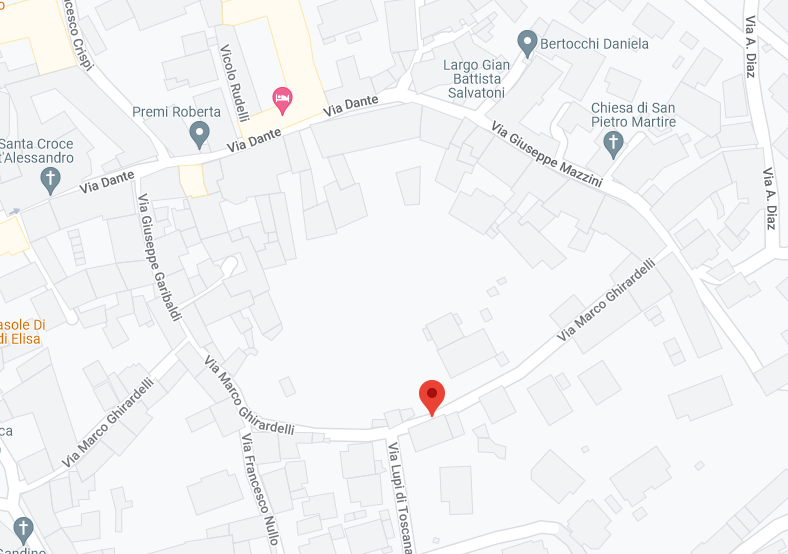
 Here is a portion of a current map of Gandino, clipped from Google maps.  Note the names of the streets:

Giuseppe Garibaldi, Guiseppe Mazzini, and....  Marco Ghirardelli.

The first two are well know Italian nationalists who had much to do with the process that led to Italy's unification.  Is it a coincidence that Marco Ghirardelli's name is also honored in this area of Gandino?  Was Marco Ghirardelli the local hero of the unification movement?

I don't know.  And, I ran out of time and patience as I began to explore for an answer.  I'd be happy if someone could point me in the correct direction.

2. What is that black boxed marking?

Sometimes you just have to see another example of a marking to be able to read the one that is front of you.  I have not yet been able to decipher the marking in black.  I admit that part of the issue may be that I am trying to do too many things at once right now and just need to concentrate on one thing for a while.  Still, if someone knows what it says OR can point me to a proper resource, I would appreciate it.

But, perhaps I can reward you with a little bit of the "see how one thing builds off another" here.

Note the words "Via Malcontenti" at the lower left on this envelope.  My initial reaction whenever I see "via" is to think that this is a directional docket that says, get to your destination by going this way.   Things like "via Southampton" or "via Marseille" for example.

Or, note the words "via Brindisi" on the piece of letter mail from the United States to India below.  I know that was a directional docket to route the letter through Brindisi (Italy) on its way to India.

But, if we learned anything from the first question, it's the fact that streets in Italy towns and cities are named in this fashion:  "Via Marco Ghirardelli,"  "Via Giuseppe Garibaldi," and...

"Via Malcontenti"

In other words, it is a street address.

And this is why I always remind myself to be patient when someone from another location on this earth asks me a question that seems simple on its face.  I just have to imagine exactly how exasperated someone who lives and has grown up in Italy might be with me that I did not immediately recognize that this was simply a street address.  It is possible that someone is amused that I do not know who Marco Ghirardelli is too!

Well, I'm not that proud.  I learned something new about street addresses in Italy and I have become curious about a person who appears to have resided in Gandino in the 1850s and had a street named after them.  I don't know about you, but I'll call this a good day.

Thanks for joining me for Postal History Sunday.  Have a good remainder of your day and a great week to come.

Saturday, May 14, 2022

Way With Words

There was once a time that I read books and would find myself straining against the descriptive words authors would use to paint a picture in my mind.  My imagination wanted to paint its own pictures, with its center being the actions of the characters traversing the story held within the pages.  I admit that I do this sometimes still when I am completely captivated by the story and it draws me forward in the book's time - anxious to see the conclusion revealed.

The sad thing here is that many authors portray a rich tapestry with amazing detail and beautiful words, and the reading is somewhat paler when the reader doesn't take a moment to observe the power they wield within the story.

The redeeming feature of a book is that you can read it again, revisiting the past by reliving it.  This gives us the time to actually pause and appreciate the textures and the depth.  The story line is still there for us, but we are aware of the path the main theme will take.  We can now spend some time exploring the side-trails and backwaters, finding a heron wading in the shallows or the sound of the wind through the branches of barren trees.

Because I spend more time with words now, I find myself taking note when words are put together in a way that calls to me.

"The unicorn lived in a lilac wood, and she lived all alone.  She was very old, though she did not know it, and she was no longer the careless color of sea foam, but rather the color of snow falling on a moonlit night.  But her eyes were still clear and unwearied, and she still moved like a shadow on the sea."  from The Last Unicorn by Peter S. Beagle

And now we all know better what a unicorn is, or was, thanks to some well chosen words.  

I wish I could say the entirety of The Last Unicorn maintains this quality.  In reality, the turn of beautiful phrases flit in and out of the book amidst uneven and inconsistent character development and a story line that can be difficult to follow.  Yet, I find myself continuing to read because the ideas in the story are brilliant and these word gems appear just often enough to keep me digging for more of them.

"She did not look anything like a horned horse, as unicorns are often pictured, being smaller and cloven-hoofed, and possessing that oldest, wildest grace that horses have never had, that deer have only in a shy, thin imitation and goats in dancing mockery."

As near as I can tell, this is also an accurate description of the best writing.  We know it when we see it, but so much is just a thin imitation or a dancing mockery of a unicorn.

Friday, May 13, 2022

Friday Genuine Faux Farm Update

Why is there a dump truck parked in the drive at the Genuine Faux Farm? 

I looked out the window early Thursday morning and had that very thought cross through my groggy brain.  It was apparent that I needed some sort of jump start because I honestly was a bit startled to see this truck there even though I had looked out that same window the night before and looked at that same truck.

Now, if you were to ask that question, I think you would have justification for doing so.  But, I really don't think I have an excuse other than I wasn't exactly awake at that moment, I guess.

The main project centered around the Poultry Pavilion, shown above.  This long building was first built as an open front machine shed.  It was then converted to a hog "finishing" building.  To do that, the prior owners had an 8 to 9 foot deep pit dug the whole length of the building to catch manure and waste.  This pit was covered by rebar enforced cement slats.  All of that was then covered by a lean-to on the south side of the building.

Over the course of time, we have repurposed the building to be the night-time shelter for turkeys and hens and a brooder room for chicks.  There is also some difficult-to-get-to storage areas.  Over time, the slats over this pit, which is typically filled with water, have started to break down.

And it was making us nervous to walk on them.  Nervous enough that each of us has admitted that we get nervous if one of us is gone for a bit too long to do bird chores.


The time came where we finally had a combination of funds and a willing contractor to fill that pit so we could preserve the building AND make it safe for us to do work around it.   Our thanks to Burkle Landscaping and Trucking for taking on the job - a less than glamorous piece of work, but still very necessary!

I realize this may not look like much to you.  But to us, this is a major breakthrough.  It is now safe for us to rebuild the parts of the lean-to that we would like to use.  There is future green house space here.  There is future tractor equipment storage here.  

And a huge catastrophe that has been waiting to happen has now been averted.

And while we had a dumptruck (or two) available, we also asked them to fix up our driveway.  It's been many years since we did major maintenance on it and it was exhibiting a number of issues.  Things like water draining back into the buildings instead of away from them... and holes in the drive that were beginning to look hungrily at our little car every time it drove by them.

Meanwhile there are some signs of life at the farm.

We are not planting nearly as much as we have in prior years.  Partly due to the weather.  Partly due to our jobs.  And mostly because we're trying to do too much at once.

Still, the potatoes in Valhalla are germinating, as are some of the peas and beans.  

And, plants in the seed trays are looking pretty good too.  We started many of them later than usual, but that's ok, given the way the season has gone.  We would not have had the time to try to adjust and move plants around with the weather the way it has been.  Now, we should be in a decent place.

And the garlic we planted last fall is starting to put on some growth.  It was very slow to start, but the last few days have really encouraged them to look like garlic.  


Now, depending on the weather the next few days, we'll see if we can actually get out there and do a little work with the soil.  The forecast puts that in some doubt, but we'll figure it out.  We usually do.

Thursday, May 12, 2022

Pheline Fysics II

Pay attention!  This is serious stuff. I, the Sandman, have spoken!

Physics is the study of objects (matter) as it moves through space and time.  Yes, yes, I know.  The Physicists in the audience are cringing at the simplification, but we are actually going to cover Feline Physics today.  The rules are different, so a poor one-line summary of physics will suffice.  So there!

Also - the above statement was approved by the Inspector.  And, as we all know, if the Inpsector approves, it is as good as gold!


Cats in Motion
For some reason, it seems like cats have their own formulas that they follow when it comes to speed of travel and acceleration.  How is it possible that a cat can cover so much ground in such a short period of time and STILL make it seem like forever?  For an example, the short Youtube video above shows Inspector coming to check that Rob has closed Valhalla up correctly for the night.

This brings me to some points to ponder when it comes to cats moving through time:

1. How does a cat know what speed is appropriate to maintain a human's attention for the entire distance of travel while still frustrating them with the delay?

For example, Inspector will announce his presence by 'meowing' to the humans.  He has their attention.  They respond by saying hello and inviting him to come visit.  He accelerates just enough to show interest and to freeze the human in place.  Then, once he is sure the human is waiting, he decelerates enough to show that he isn't THAT interested.  There appears to be some sort of sensor in a cat that knows when to speed up a little when the human starts to lose interest and to slow down just enough to increase the anticipation (or frustration).

2. Cats appear to have the ability to go from 0 to 60 mph and back to 0 mph instantaneously.  How is it that we have not unlocked this travel potential ourselves?

Granted, it is not often you will see a cat going full speed all that often.  It is also true that you will find them sleeping (0 mph) more often than not.  Perhaps we just need to sleep more and then we can wake up and instantly travel someplace else at a full rate of speed... then sleep again? 

3. How do some cats know when you really need them to act like they are very happy that you called them over?

There are times when a cat actually shows a fair amount of... well... joy, when their human acknowledges them and encourages them to travel the distance between them.  It doesn't happen often and it doesn't mean they forsake rule #1 above.  But there are times when each member of the Farm Supervisory Team (indoor and outdoor) have made it VERY clear that they are happy to see us.

The amazing thing is that it doesn't have to happen much more than once or twice a year, yet they somehow manage to get the memory of that event to STICK in our brains.  Suddenly we are thinking that the cats ACTUALLY LIKE US.  Which, of course, makes us more tolerant for longer periods of time so they can do more strolling than trotting when they are making their way to us in the future.

Clever kitties.


Cat Gravity and Particle Physics

If you have spent any time around cats, you have likely witnessed evidence that they do not follow the same laws of gravity we do.  Watch a cat bound up or down a stairway, leap from the floor to a ledge 6 feet off the ground (with out a run up) or get startled into a jump and turn completely around in the air and you are seeing evidence that they must not have to play by the same rules we do.

It's even more evident that something is different when an older, heavier cat can make going up the stairs seem like a chore one day and then there is evidence that they some how got on top of the REFRIGERATOR the next day.  Cats are either natural sandbaggers or they have a "get out of gravity card" that they can play when there is a Spider plant up on the refrigerator for them to chew on.

But there is no place where the exceptions for cats are more evident than the human lap.  Cats have special sensors that KNOW when you are about to get up.  If they are NOT on your lap at that moment, they will seek to get there, turning off gravity so they can leap more easily from wherever they are to arrive at their destination before your muscles do much more than twitch with the beginning motions for rising from your chair.  If they are already IN your lap they hit you with the double-whammy:

a. they turn gravity ON so they become much heavier than they have a right to be.  It's almost as if they are saying, "NOW, try to move me, bub!"
b. they begin emitting "sleepions."

Sleepions are notorious for causing two reactions in the human species.  The first, of course, is that they may cause drowsiness.  The second is a profound feeling of guilt or regret that you must disturb such a nice, warm, sleepy critter just to do something as inconsequential as.. oh.  say...

Get something to drink.  Use the bathroom.  Go do work.  Find out why the fire alarm has gone off.  You know.. stuff that can wait.   

You can wait.  So there.
Brownian Motion?
A physicist might tell me that this is random motion of particles in a fluid, but I tell you that this is the random results on your keyboard when a cat decides to help you type.

Tell me I'm wrong.

Cats and the Passage of Time
We know cats are aware of the passage of time because they are very good at reminding humans what time it is.
  1. It's time for you to feed me.
  2. It is NOT time for you to get up.  I am in your lap.
  3. You have nothing but time when I am walking toward you to say hello.
  4. The best time for a nap is NOW.
  5. Do you remember that time the cat followed our schedule?  Neither do I.
  6. The sun puddle has moved, time to get up.
  7. It's time for you to feed me (again).


Schrodinger's Cat.. for Cats

The basic idea of Schrodinger's Cat was that if you put a cat in a box with something that could kill it and sealed it up, you would not know whether or not the the cat was alive - hence it could be both alive and dead at a given moment.  Please note, I think we have to assume that Schrodinger had somehow created a sound proof box.  I find it hard to believe that any self-respecting feline is going to go down without a few choice words.

While cats do not much care for this thought experiment with that particular context, they do exercise this thought pattern every day.

Cat: Hm.  The door is closed.  I wonder if there is food or no food on the other side?
(you can substitute "human lap," "sun puddle," or "keyboard" for "food" in that last sentence if you would like variety)

Cats, however, really don't care about the 'both could be true' thought experiment.  What they care about are ANSWERS NOW.  This is why closed doors draw so much feline attention.

Pay attention!  This is serious stuff. I, the Sandman, have spoken!

Catmatism

I was going to call this "cat magnetism," and then I also thought about "cat hypnotism" and "cat pragmatism."  So, we'll just go with "catmatism." 

The cat pragmatism is clearly illustrated with the Schrodinger's Cat thing.  As I said, a cat doesn't really care about thought experiments, unless it is "there is an answer" or "there is no answer."  Why should they worry about "there could be more than one answer and they could be opposites?"  To a cat, that makes no sense and it makes no difference.  What matters is the answer that is WHAT IS, not what COULD BE.  

You could argue that my analysis here is incorrect because the very fact that cats seem to work to make certain things happen just might imply that they do consider what "could be."  And, you could have been right except cats don't consider that the opposite of what they WANT is even POSSIBLE.  

There is (food, sun puddle, lap, spider plant, etc) on the other side of this door.  I will get there and I WILL partake.

All of that comes about in part because of the hypnotism and magnetism components of a cat.  

Hmmm.  Why do I feel that I must pick up Bree's favorite toy now and wave it around.  I mean, she's just been sitting there... looking at me for the last several minutes.  Could it be?  Nooooo.  I WANT to play with the cat now.  It's my choice, not hers.

Right?

Wednesday, May 11, 2022

Whoops, We Blinked

Prior to this week, the highest temperature recorded at the farm for the year was 73 degrees Fahrenheit, and we got there (barely) only once.  Otherwise, conditions have been cooler than normal.  And, if you add a bit more cloud cover and rain, you get soil temperatures that tell the plants it is NOT time yet.

Mix in a LOT of wind, and you have the past couple of months.

You've got to know things are a bit topsy turvy when your Bur Oak trees are budding out at the same time all of the other trees are deciding they can begin to unfurl their leaves.  For those who do not know, oaks are among the slowest to decide it is time to greet the new growing season.

Pasque Flowers at the farm are among the first to bloom, along with the Crocus.  The violets usually aren't too far behind that in the sheltered areas.  And, our Forsythia bushes are also typically anxious to show color earlier than most other woody perennials.

This year, the early bloomers are hesitating and the mid season blooms are looking like they want to get going.  The result is this compressed bloom cycle.  The Virginia Bluebells are just getting themselves going right now.  The Lungwort (first picture) were among the hardy few that managed to adhere to the normal schedule, but that may have to do with its location near the front steps of the house more than anything.

Well, I might have offended the Fernleaf Peonies too.  They also are a fairly stubborn perennial.  Maybe you can relate to the Fernleaf Peony?  Gosh darn it!  The calendar says today is the day that I should emerge from the soil and begin to grow.  So, I'm a gonna do it!  

Actually, the ground has been unfrozen for some time now, which means plants that just need the frost to be out should have been able to get going.  This is, I think, where the cloudy conditions have played a role, because I would think the Pasque Flower would fall into this as well.  But, with the way this year has gone, weather wise and plant growth wise, I am kind of giving up predicting what's next.

In all seriousness (as if I wasn't serious before), we have experienced these conditions at the Genuine Faux Farm in prior growing seasons - and they probably bother all-season growers of diverse crops more than most.  Yes, I get it.  The corn and soybean growers are having trouble getting into the fields to plant.  That's frustrating.  But, consider this:

A diversified vegetable producer will have, among their crops, many cool season crops that they are trying to nurse through cooler weather so they can harvest and provide fresh produce in late April and May.  These things do still need sunshine to grow.  But, when we get temperatures hitting the low 90s all of a sudden, those crops DO NOT LIKE IT.  As a result, many of them bolt (go to seed) and fail to provide much return for the grower.

In the meantime, the diversified grower is ALSO delaying many of their other crops (just like the row croppers) that need the warmer weather.  That puts them into the bind that their early crops terminate too early and their mid-season and late crops are all delayed.

Yep.  It can be frustrating.  Which is why I am glad we are not trying to run a CSA program this year.  Tammy and I have sweated out enough season starts like this in our careers and we're willing to take a different perspective on growing now.  But, it doesn't mean this weather isn't effecting us at all.

The biggest problem for us this year is that the number of hours we have to work on the farm are much more limited than they have been for years prior (except last year, of course - the kidney thing).  When Mother Nature decides to jump us from late Winter to mid-Summer in a couple of days, it is even harder for us to catch up on all of the work that just got compressed into a much smaller period of time.


Well, at least the peonies are coming up now too.  They should be on pace to bloom by Memorial Day - just in time for a rain and wind storm to come along and beat all of the petals off of the full blooms right when they are reaching their full glory.

We'll know then that things are back on track - because it happens nearly every year.

Tuesday, May 10, 2022

A Few More Miscellaneous Recipes

Amish Deer Tongue lettuce - what you show when you can't find the spinach pictures!

Spinach - Standard Preparation

Spinach goes wonderfully with butter, cheese, cream, lemon, vinegar, eggs, garlic, dill, parsley, onion, mushrooms, bacon, and fish. Eat younger greens raw in tossed salad and use larger leaves for sautéing or other cooked spinach recipes.

If your spinach is slightly wilted, soak it in some cold water and it should perk up nicely for you!

Sautéed or wilted spinach

Wash but don’t dry 9 packed cups spinach (coarsely chopped if leaves are larger.) In a large skillet, heat 1 to 2 tablespoons olive oil, butter, or bacon fat. Add spinach and cook over medium heat, stirring frequently, for 4 to 6 minutes. Leaves should be just wilted and still bright green. Generously season with salt and pepper, sprinkle with lemon or vinegar.

Spinach-ricotta stuffing (for ravioli, manicotti or large pasta shells)

Clean 1/2 lb fresh spinach; wilt or steam; drain of excess moisture and chop finely. In a medium bowl, mix together with 1 cup ricotta cheese, 3/4 cup grated parmesan or romano, 1 egg lightly beaten, 1 clove minced garlic, chopped fresh parsley, scallions, salt & pepper to taste, and a splash of olive oil.

Spinach Frittata

Heat 3 tablespoons olive oil in a large heavy skillet. Saute 1 clove minced garlic and a
few chopped scallions. Add 1 pound washed spinach and cook until wilted. Remove veggies from pan; lightly beat 6 eggs and add to pan along with spinach mixture, 3/4 c parmesan or feta cheese, and some parsley. Stir all together and cook over low heat until frittata is set. Allow to cool slightly and cut into wedges to serve.

Spinach as Dinner Salad

Use young spinach leaves for a dinner salad with bacon, blue cheese, grilled chicken, and vinaigrette dressing. Add spinach to lasagna, stir fry. Puree wilted spinach for cream soup, or finely chop for yogurt or sour cream dip along with green onions, garlic, bacon, and parmesan cheese.

Chicken Bruschetta

1 teaspoon garlic powder
1/2 teaspoon salt, divided
1/4 teaspoon black pepper, divided
4 (4-ounce) skinned, boned chicken breast halves
Cooking spray
1 tablespoon olive oil
8-ounces sliced mushrooms
1 small zucchini, quartered lengthwise and sliced (about 5 ounces)
4 garlic cloves, minced
1 cup chopped tomato
1/2 cup chopped red onion
1/2 cup chopped fresh basil
4 teaspoons balsamic vinegar
1/4 cup (1 ounce) grated fresh Parmesan cheese

Preheat broiler. Combine garlic powder, 1/4 teaspoon salt, and 1/8 teaspoon pepper in a small bowl; sprinkle chicken with garlic powder mixture. Place the chicken on a broiler pan coated with cooking spray, and broil for 6 minutes on each side or until chicken is done. Remove the chicken from pan, and keep warm.

Heat olive oil in a large nonstick skillet over medium-high heat. Add 1/4 teaspoon salt, mushrooms, zucchini, and minced garlic; saute 2 minutes. Add 1/8 teaspoon black pepper, tomato, onion, basil, and vinegar; saute 3 minutes. Serve the vegetable mixture over chicken; sprinkle with cheese. Yield: 4 servings (serving size: 1 chicken breast half, 1/2 cup vegetables, and 1 tablespoon cheese). Serves 4.

Sweet Potato Puree

Ingredients

  • 4 large sweet potatoes, peeled, cubed
  • 1/2 cup butter
  • 2 cloves garlic, minced
  • 1 tablespoon finely chopped fresh sage
  • 1 1/2 cups heavy cream
  • 3/4 cup shredded mozzarella & provolone cheese

Directions

  1. Place potatoes in a large saucepan; cover with cold water and add salt to water if desired. Bring to a boil over high heat. Reduce heat; simmer uncovered 14 minutes or until potatoes are very tender. Drain potatoes in a colander.
  2. Melt 1 tablespoon of the butter in the same saucepan over medium heat. Add garlic; cook 1 minute. Add sage; cook 1 minute. Add cream; bring to a boil.
  3. Put hot cooked potatoes through a ricer or press through a strainer.* Gradually add the potatoes to the cream mixture, beating with a wooden spoon or large whisk. Gradually beat in remaining butter 1 tablespoon at a time, stirring vigorously after each addition.
  4. Stir in cheese until melted. Season with salt and freshly ground black pepper to taste. 

Creamy Polenta with Roasted Corn and Fresh Sage

Ingredients

  • 2 ears corn
  • 3 tablespoons olive oil
  • 1 teaspoon finely chopped garlic
  • 1/2 yellow onion, diced
  • 3 cups water
  • 2 cups milk
  • 1 cup cornmeal
  • salt and pepper to taste
  • 3 tablespoons chopped fresh sage leaves
  • 1/2 cup grated Parmesan cheese

Directions

  1. Grill corn in the husks, or roast in the oven; cut kernels from cob.
  2. In a heavy 4-quart saucepan heat oil over medium heat. Stir in garlic and onions; reduce heat to low and cook until onions are translucent.
  3. Stir in water and milk and bring to a boil over medium-high heat. Slowly stir in cornmeal, whisking thoroughly. Reduce heat to low and simmer for 30 minutes, stirring often to prevent sticking and burning. Season with salt and pepper; simmer 15 minutes more.
  4. When cornmeal is tender, stir in corn, sage and Parmesan cheese. Transfer to a large bowl to serve.

Sagey Cream Cheese
Ingredients

  • 1/2 cup fresh sage
  • 1 clove garlic
  • 2 (8 ounce) packages cream cheese, softened
  • 3 tablespoons frozen lemonade concentrate, thawed (or 1 TB sugar and 2 tsp lemon juice plus 1 TB water)

Directions

  1. Combine the fresh sage and garlic in the container of a food processor. Pulse until finely chopped. In a small bowl, blend together the cream cheese and lemonade concentrate. Stir in the garlic and sage. Cover and refrigerate for at least one day before serving for best flavor.