There is so much we can discuss with respect to organic certification, but the key is for us to share with you how we see organic certification on our farm. A key item that we feel we should make clear before the season really gets going is how last year's spraying "event" impacts our certification.
If you do not know what I am talking about with respect to the 'spraying event' you can see our most recent post about it here:
Spraying Event Post
Our first two posts on certified organic are here:
An overview of what it takes to certify organic
post 1
How we interpret and apply organic principles with respect to inputs on the farm.
post 2
The organic 'rule' number 4:
Production land must have been transitioned for three years after ANY non-approved substance has been applied before anything from it may be certified organic. Efforts to avoid contamination (including buffers) are required.
There are two things everyone might like to know about with respect to this section. First - the unwanted spray applied on the West half of our farm on July 27, 2012 kicks that part of the farm into 'transitional' status. In other words, until July 27, 2015, we cannot sell anything from that part of the farm as certified organic. But, in the meantime, if we wish to recertify that half in 2015, we must continue to follow all organic regulations on that half of the farm.
Can we grow in the sprayed area?
This does not mean we cannot grow produce in that area. But, it does mean we must be careful not to label any of that produce as organic. In fact, since most of our produce will still be certified, we may go a bit overboard just to be sure no one thinks we're trying to break the rules. In effect, our sweet corn and pie pumpkins will not be certified organic. Nothing from the high tunnel can be certified organic (this one really hurts). Our poultry will graze on pastures that were sprayed last year, so they cannot be certified organic. Most of our perennial herbs are in the West half of the farm and a small batch of asparagus are there as well. All other produce will be certified organic -which will be a sizable portion of our farm's production.
Product safety - can we eat this?
Will the produce and poultry grown in the west half of the farm be safe for consumption? We believe that they will be safe since we have taken actions to help the system cleanse itself and the half-life of the products sprayed indicate they should have broken down. We will not introduce any other poisons to the system and will continue to treat these areas as we treat the rest of the farm (with exceptions noted below). To be perfectly frank, this produce, eggs and meat will be as clear of chemical residue as most produce you can find in the state. But, we need to inform you of it, because this area WAS sprayed. There is a reason there is a three year setback for transition, so we still have to consider the possibility that there is residue from that event. That may lead to another post in the future.
Extra work required with split operation.
But, we are required to do additional work since some of our product will be certified and some will not. For example, any containers used to harvest produce in the transition area must be cleaned before being used in the certified organic areas. This holds true for farm equipment and tools. We will have to maintain separate tracking records and we must fill out additional forms for our certification process for the next couple of years.
What else are we doing to address the spray problem?
We are charged with working to avoid contamination of our crops. Clearly, we cannot be prepared to stop any contingency - last I looked it was illegal to put giant plane-catching nets around our farm.
The buffer zone is a work in progress for us. Some parts of the farm are surrounded by bush plantings, but not all. We continue to work to put in more bushes in an effort to provide some vertical buffer space. The entire farm has a buffer area (space that is adjacent to our neighbor's fields) that is intended to absorb any unintentional drift of their inputs. The thing that bothers us about this is that we must maintain a buffer, but they do not have to. This, too, is fodder for another post on another day.
We also contact our neighbors, the coops they might use and any other party that may have something to do with chemical applications in the area. In fact, the list of things we try to do is reasonably long. Suffice it to say, we do what we can.
Friday, April 5, 2013


Tuesday, April 2, 2013
Don't Mess With Tradition
Don't mess with tradition - even if that tradition is only in its second year.
New Apple Variety Trial on the Farm
We are planning to introduce a new variety of apple to our growing list this year. Researchers have developed a fruit bearing plant that combines bush and vine habits. The Ankare Apple can be very prolific if growers remain calm and follow a complex and difficult set of cultivation techniques to maintain the plants. We feel that we should be successful with these fruit after attending Ankare Management classes. But, if these plants get too frustrating, we still might till them under. We are told it is a matter of self-control.
Compressed Air Aids Laying Hens
The process of laying eggs can cost a hen a great deal of energy. And, as we have found, egg production decreases during temperature extremes due to the increase in energy required to maintain body temperature. We are considering the purchase of a new air compressor with special tubes and attachments to aid the hens with their egg laying tasks. This special equipment is not entirely unlike automated milking machines in set up, but rather than using suction, puffs of air will be sent through the hoses and into the birds' beaks. Essentially, the intent is to reduce the effort of laying eggs by helping to push the eggs out with air pressure. It appears the most difficult part of setting up this equipment will be determining the correct psi (pounds per square inch) setting on the compressor. Clearly, if the setting is too low, the only thing that the birds will get out of it is an extra dose of oxygen. On the other hand, we're not entirely sure we want to find out what happens if the setting is too high. We really do not want to be dodging eggs flying around the room that got pushed out a bit too quickly.
Five Year Farm Development Plans
We review the status of our farm yearly, but every five years we try to assess what the next steps are for the bigger projects. One of the items on our list for future development is the modification of the old hog manure pit into an aquaponics project. You may have heard of hydroponics (growing plants in water), but aquaponics is hydroponics with the addition of fish to the system. We hope to fill a niche market for baby swordfish. Apparently, certain cultures find these very young fish to be a delicacy and they often use the 'sword' for needlepoint projects. On the other hand, sales of baby swordfish are strictly regulated. Persons who have a history of using voodoo dolls or those who failed their Ankare Management courses would not be able to make purchases.
Spinach to Soap Program
Genuine Faux Farm spinach is certainly tasty, but did you know that spinach is also known to contain saponins? The saponins in the soapwort plant are the impetus for its name ("soapwort"). Crushing leaves, adding water and then agitating the solution creates a soap-like substance. Saponin levels in spinach is relatively high, so we are considering creating a value added product from spinach plants that bolt and go to seed in warmer weather - liquid spinach soap. The best thing about this project is that it ties in well with our other projects. Accidental wounds inflicted by flying egg shell shards or wayward baby swordfish can be cleansed quickly with a ready supply of spinach soap. And, if we forget the principles learned in the Ankare Management classes, we can always wash our mouths out with saponins.
First Vulture of Spring
There was much celebration on the farm with sighting of the first vulture of Spring. While we have seen vultures since approximately March 20 in the area, the first vulture to circle to farm appeared on April 1st.
For Those Who Didn't Get Enough of This
The post that began the tradition of April 2nd posts for April Fool's Day... is here.
New Apple Variety Trial on the Farm
We are planning to introduce a new variety of apple to our growing list this year. Researchers have developed a fruit bearing plant that combines bush and vine habits. The Ankare Apple can be very prolific if growers remain calm and follow a complex and difficult set of cultivation techniques to maintain the plants. We feel that we should be successful with these fruit after attending Ankare Management classes. But, if these plants get too frustrating, we still might till them under. We are told it is a matter of self-control.
Compressed Air Aids Laying Hens
The process of laying eggs can cost a hen a great deal of energy. And, as we have found, egg production decreases during temperature extremes due to the increase in energy required to maintain body temperature. We are considering the purchase of a new air compressor with special tubes and attachments to aid the hens with their egg laying tasks. This special equipment is not entirely unlike automated milking machines in set up, but rather than using suction, puffs of air will be sent through the hoses and into the birds' beaks. Essentially, the intent is to reduce the effort of laying eggs by helping to push the eggs out with air pressure. It appears the most difficult part of setting up this equipment will be determining the correct psi (pounds per square inch) setting on the compressor. Clearly, if the setting is too low, the only thing that the birds will get out of it is an extra dose of oxygen. On the other hand, we're not entirely sure we want to find out what happens if the setting is too high. We really do not want to be dodging eggs flying around the room that got pushed out a bit too quickly.
Five Year Farm Development Plans
We review the status of our farm yearly, but every five years we try to assess what the next steps are for the bigger projects. One of the items on our list for future development is the modification of the old hog manure pit into an aquaponics project. You may have heard of hydroponics (growing plants in water), but aquaponics is hydroponics with the addition of fish to the system. We hope to fill a niche market for baby swordfish. Apparently, certain cultures find these very young fish to be a delicacy and they often use the 'sword' for needlepoint projects. On the other hand, sales of baby swordfish are strictly regulated. Persons who have a history of using voodoo dolls or those who failed their Ankare Management courses would not be able to make purchases.
Spinach to Soap Program
Genuine Faux Farm spinach is certainly tasty, but did you know that spinach is also known to contain saponins? The saponins in the soapwort plant are the impetus for its name ("soapwort"). Crushing leaves, adding water and then agitating the solution creates a soap-like substance. Saponin levels in spinach is relatively high, so we are considering creating a value added product from spinach plants that bolt and go to seed in warmer weather - liquid spinach soap. The best thing about this project is that it ties in well with our other projects. Accidental wounds inflicted by flying egg shell shards or wayward baby swordfish can be cleansed quickly with a ready supply of spinach soap. And, if we forget the principles learned in the Ankare Management classes, we can always wash our mouths out with saponins.
First Vulture of Spring
There was much celebration on the farm with sighting of the first vulture of Spring. While we have seen vultures since approximately March 20 in the area, the first vulture to circle to farm appeared on April 1st.
For Those Who Didn't Get Enough of This
The post that began the tradition of April 2nd posts for April Fool's Day... is here.
Monday, March 25, 2013
Certified Organic at GFF (part II)
Periodically, we are asked if we are organic. We answer positively that we certified organic. Of course, the next question to us is - what's the difference between organic and certified organic?
The simple answer is this - technically, something can't be marketed as organic unless it is certified as organic. The exception is if a grower sells less than $5000 in product during a year. In that case, they may apply for and receive an exemption, but should still follow all the rules.
Click here our first post in the series.
The first installment is an attempt to summarize all it takes for us to certify our vegetable production as organic. We thought we'd discuss a few specific things that may be of interest to others that pertain directly to our farm.
2. Use substances in production that can be found in an approved list.
In my last post, I noted that this means sprays are NOT prohibited. But, let me clarify - most sprays are not on this list. More specifically, the synthetics are not there. It is certainly possible, however, to find herbicides, insecticides and other items that are on the list of allowed inputs for an organic operation. Which is why we encourage you to get to know your farmer and how they do what they do. Seeing the organic certification is the first step towards knowing what is important to them. But, it is not the final word as to how well they protect the land or how clean their product might be for your consumption. Simply put, if I needed to buy food products and the only options were organic or non-organic, I would buy organic because there is some regulation in place for the food producer that I support. But, if I have the option of buying locally where I can learn something about the practices used by the producer, I will typically choose that - assuming, of course, that I agree with enough of their practices.
Putting it another way - there are people who are certified organic that don't do it well and don't have their hearts in the right place. Similarly, there are local growers that don't do things the way I would prefer they did. By paying attention to who I buy from, I can work to support practices I find agreeable and responsible.
What do we believe?
We don't believe in using pesticides and herbicides. And, if you want reasons for this, we'll cover it at a later point in time - or you can refer back to other things we've written in this blog or elsewhere.
You would think fulfilling our obligations on point two should be easy since we hold this stance about these sorts of sprays. But, remember, the answers aren't so easy. This list applies to any input for the farm. This includes soil for seed starting, cleaning solutions and mulches. In other words, we must consider any input to be used on our farm carefully and we can't just take someone's "word" that a product is "organic."
And, there are some inputs that are permissible on a certified organic farm that we are not comfortable with using on our farm. For example, many farms have taken to using plastic mulch. This is allowed as long as that mulch is removed each season (it typically would only last for one growing season anyway). We're not entirely comfortable with how plastic might adversely impact the biology in the soil, so we choose not to use it. Instead, we try to use organic mulches such as straw, grass and more recently, paper.
What does this mean for us?
The decisions we make about inputs on our farm are largely based on how we feel about the impacts they might have on our soil and the surrounding environment. There are a number of practices that we subscribe to that are not necessarily embraced by other growers due to cost or efficiency reasons. And, we readily admit that there are some things we do that may not provide us with the best bottom line.
On the other hand, we also do not assume that the financials provide us with the true "bottom line" for our farm. There are other things of value (tangible and otherwise) that are not easily measured by a profit margin. So, we try to assess whether these benefits are sufficient to offset what might have been lost profit.
The other exception we make is for things we believe can be *made* to be efficient or profitable. In these cases, we have decided not to follow the current conventional wisdom as we work to figure out if our alternatives can be made to work successfully. We are willing to sacrifice some of our bottom line results in the hopes that we can find the way to make some of our ideas work in an effort to reach our ideals.
The simple answer is this - technically, something can't be marketed as organic unless it is certified as organic. The exception is if a grower sells less than $5000 in product during a year. In that case, they may apply for and receive an exemption, but should still follow all the rules.
Click here our first post in the series.
The first installment is an attempt to summarize all it takes for us to certify our vegetable production as organic. We thought we'd discuss a few specific things that may be of interest to others that pertain directly to our farm.
2. Use substances in production that can be found in an approved list.
In my last post, I noted that this means sprays are NOT prohibited. But, let me clarify - most sprays are not on this list. More specifically, the synthetics are not there. It is certainly possible, however, to find herbicides, insecticides and other items that are on the list of allowed inputs for an organic operation. Which is why we encourage you to get to know your farmer and how they do what they do. Seeing the organic certification is the first step towards knowing what is important to them. But, it is not the final word as to how well they protect the land or how clean their product might be for your consumption. Simply put, if I needed to buy food products and the only options were organic or non-organic, I would buy organic because there is some regulation in place for the food producer that I support. But, if I have the option of buying locally where I can learn something about the practices used by the producer, I will typically choose that - assuming, of course, that I agree with enough of their practices.
Putting it another way - there are people who are certified organic that don't do it well and don't have their hearts in the right place. Similarly, there are local growers that don't do things the way I would prefer they did. By paying attention to who I buy from, I can work to support practices I find agreeable and responsible.
What do we believe?
We don't believe in using pesticides and herbicides. And, if you want reasons for this, we'll cover it at a later point in time - or you can refer back to other things we've written in this blog or elsewhere.
You would think fulfilling our obligations on point two should be easy since we hold this stance about these sorts of sprays. But, remember, the answers aren't so easy. This list applies to any input for the farm. This includes soil for seed starting, cleaning solutions and mulches. In other words, we must consider any input to be used on our farm carefully and we can't just take someone's "word" that a product is "organic."
And, there are some inputs that are permissible on a certified organic farm that we are not comfortable with using on our farm. For example, many farms have taken to using plastic mulch. This is allowed as long as that mulch is removed each season (it typically would only last for one growing season anyway). We're not entirely comfortable with how plastic might adversely impact the biology in the soil, so we choose not to use it. Instead, we try to use organic mulches such as straw, grass and more recently, paper.
What does this mean for us?
The decisions we make about inputs on our farm are largely based on how we feel about the impacts they might have on our soil and the surrounding environment. There are a number of practices that we subscribe to that are not necessarily embraced by other growers due to cost or efficiency reasons. And, we readily admit that there are some things we do that may not provide us with the best bottom line.
On the other hand, we also do not assume that the financials provide us with the true "bottom line" for our farm. There are other things of value (tangible and otherwise) that are not easily measured by a profit margin. So, we try to assess whether these benefits are sufficient to offset what might have been lost profit.
The other exception we make is for things we believe can be *made* to be efficient or profitable. In these cases, we have decided not to follow the current conventional wisdom as we work to figure out if our alternatives can be made to work successfully. We are willing to sacrifice some of our bottom line results in the hopes that we can find the way to make some of our ideas work in an effort to reach our ideals.
Wednesday, March 20, 2013
Spring is Coming
It may not feel like it, but Spring is coming!
Soon, we will see things like cranesbill blooming. We have several patches of cranesbill on our farm, remnants from a time when we did as much perennial flower gardening as we did vegetables. These plants divide easily and continue to expand (but not in an invasive manner). They only bloom for a couple of weeks, but they are worth it.
 We've already seen a rainbow this year, but there was no green grass to go with it. We're also hoping that pot of gold that is supposedly out by the high tunnel can be found this year. We've got some projects that gold could help fund!
 Every year we think we'll actually get around to putting in some mass bulb plantings on the farm. Every year, we fail to get to it. That doesn't mean we don't have a few tulips, daffodils and other flowering bulbs on the farm. And, as long as the rabbits don't get them first, they can put on a nice little show.
 The dance of the seedling trays has already begun on the farm. But, the days of putting them out on the driveway or near the cold frames are apparently still in the future. Mother Nature has her times and her ways. We're just going to have to work with it the best we can. But, there's still the promise that we'll have tray after tray of starts that will soon become row after row of healthy vegetable plants.
 Speaking of plants - soon we will have tomatoes, peppers, eggplant, cucumbers, squash, basil and other plants available to sell to those who want to grow their own. We intend to sell at the Waverly Farmers' Market and we will also set a couple of days to sell in Cedar Falls (and perhaps Waterloo) at the Hansen's Dairy stores. Stay tuned to date announcements.
 The picture shown above is already a bit strange for us. We've grown used to Chumley the big red truck and can hardly believe that the picture shown here is less than a year old. There he is, Grover, the blue truck with the red hood. Rest In Pieces.
 We're always anxious to see which iris plants will bloom for us. We're anxious to see which ones made it through last year's dry weather. Who knows how many or how much. I guess we'll just have to wait and see. Rob is hoping Thornbird (the name of the iris shown above) is one who will grace us with her presence this season.
 Seedlings hold the promise of more to come. Get through the next few cold days and think about all of the green and growing things that are getting ready to start their growing season.
Soon, we will see things like cranesbill blooming. We have several patches of cranesbill on our farm, remnants from a time when we did as much perennial flower gardening as we did vegetables. These plants divide easily and continue to expand (but not in an invasive manner). They only bloom for a couple of weeks, but they are worth it.


Monday, March 18, 2013
Lafou, I've been Thinking...
Thinking...a dangerous pastime.
And, my thoughts have been all over the place recently.
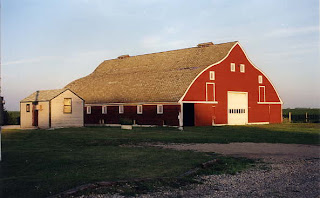 The picture above shows the super cool barn that was on our property when we lived in western Minnesota. This was 'pre Genuine Faux Farm,' but it may have had a lot to do with us ending up starting the farm.
I started thinking about this when I was considering our current barn in its skeletal state. Frankly, our current barn never was in a configuration or state of repair to have lended us much use for what we do on our farm. So, while it is sad to see a 100+ year old building on its way out...
On the other hand, the barn above would have fit our needs on our current farm extremely well. You just don't see that design all that often. The real kicker about the barn shown above, it did not originate at the location you see in the picture. It was MOVED several miles and placed on this spot. No, not by us. Yes, it was on purpose. We both loved that barn, we just didn't know what to do with it at the time. So, if anyone runs across a barn like this - mail it to: PO Box....

There was also a granary on the property. It may not look like much on the outside....but, the inside! The walls were made of 2x4 lumber. That may not sound strange. But, the 2x4's were laid on top of each other (flat) to make a solid wall. They were not used as framing. We joked that this is where we would have gone in case of severe weather. That thing wasn't going anywhere. We don't trust any of our current outbuildings for that sort of duty. Looks like the basement in the house wins here.
 An amusing thing about people. We think things that are new to us are, well, new. We also tend to think that older ideas aren't worthwhile, unless they are old enough to be nostalgic. Then, they might be fun to try - just don't expect to use them practically. We also tend to think that the way it has always been done is the way it should still be done. It's just that the way we are referring to is the way WE have always done it, not necessarily those before us. Full of contradictions, aren't we?
The Planet Jr models of wheel hoes and seeders have been around for quite some time. And, small farms such as ours will often use seeders and cultivators similar to one shown above. It may sound odd to you - but I actually feel like I want to walk for a while behind a wheel hoe right now. It's good exercise and it accomplishes something useful. And, it would be warmer and I'd be outdoors right now. Maybe that's not so odd sounding.
 Then there is Mo Farah. This picture was shared with us last August and provided us with some humor to balance the not so humorous events around that time. This meme involved pasting a picture of Mo Farah in front of various objects. Most of them were, of course, amusing.
I'd like to make this picture more amusing. Let's rearrange the situation so that the airplane is being chased away by hordes of people who do not want chemicals dumped on their heads. Yes, I like that.
 A while back, I played with some of my favorite digital pictures and tried out some of the effects provided by Adobe Photoshop. It's not something I'll ever spend lots of time doing, but it was a nice diversion on a cold, windy day when I had a cold.
This serves as a reminder to me (and maybe to you) that a farmer who promotes diversity on the farm should probably promote diversity in his/her own life. It should be possible to remain dedicated and appropriately focused on our farm without completely shutting out other things.
And there you have it. A rambling post about ... things. Enjoy.
And, my thoughts have been all over the place recently.

I started thinking about this when I was considering our current barn in its skeletal state. Frankly, our current barn never was in a configuration or state of repair to have lended us much use for what we do on our farm. So, while it is sad to see a 100+ year old building on its way out...
On the other hand, the barn above would have fit our needs on our current farm extremely well. You just don't see that design all that often. The real kicker about the barn shown above, it did not originate at the location you see in the picture. It was MOVED several miles and placed on this spot. No, not by us. Yes, it was on purpose. We both loved that barn, we just didn't know what to do with it at the time. So, if anyone runs across a barn like this - mail it to: PO Box....

There was also a granary on the property. It may not look like much on the outside....but, the inside! The walls were made of 2x4 lumber. That may not sound strange. But, the 2x4's were laid on top of each other (flat) to make a solid wall. They were not used as framing. We joked that this is where we would have gone in case of severe weather. That thing wasn't going anywhere. We don't trust any of our current outbuildings for that sort of duty. Looks like the basement in the house wins here.

The Planet Jr models of wheel hoes and seeders have been around for quite some time. And, small farms such as ours will often use seeders and cultivators similar to one shown above. It may sound odd to you - but I actually feel like I want to walk for a while behind a wheel hoe right now. It's good exercise and it accomplishes something useful. And, it would be warmer and I'd be outdoors right now. Maybe that's not so odd sounding.

I'd like to make this picture more amusing. Let's rearrange the situation so that the airplane is being chased away by hordes of people who do not want chemicals dumped on their heads. Yes, I like that.

This serves as a reminder to me (and maybe to you) that a farmer who promotes diversity on the farm should probably promote diversity in his/her own life. It should be possible to remain dedicated and appropriately focused on our farm without completely shutting out other things.
And there you have it. A rambling post about ... things. Enjoy.
Friday, March 15, 2013
Certified Organic - Part I
So, your farm is Certified Organic - so what does that mean anyway? No chemicals or sprays? Grow like my grandparents used to grow?
Ah...if only you could ask a simpler question when you wanted a quick answer!
--------------------------------------
I'm completing our paperwork to apply for organic certification in 2013. It must go in the mail today if I want to get a discount on the fees. And, once I complete the paperwork, I find myself a bit more sensitive to persons who take organic certification lightly. So - a few blog posts are in the making. I'll keep it from getting too heavy - but I won't skimp on information either.
--------------------------------------
Step 1 - Look at the National Organic Standards
Take the link, I'll wait. Just take a quick look, then come back.
Ok, There is the framework for what becomes organic certification. In short, it tells us that a certified organic producer will do the following:
1. Maintain quality records of all aspects of production
"Fully disclose all activities and transactions of the certified operation in sufficient detail as to be readily understood and audited"
These records must be available for review and must be kept for five years. They must demonstrate that we meet all regulations.
2. Use substances in production that can be found in an approved list.
You may petition for other items and the process of putting things on the list is not simple. Without going into that, the things you need to know are these:
a. Certified Organic does not necessarily mean NO SPRAY. This also means that there is no guarantee that a broad spectrum insecticide was not used.
b. What it does mean is that ALL applications can be traced (see #1) and it enforces more of an open book.
c. This also means that some thought is put into deciding what inputs to a farming operation are more sustainable and support a healthier environment.
3. Certified Organic producers must have a production plan that is reviewed and approved by an independent certifying agency. This plan must meet all other NOS requirements, such as those that follow.
4. Production land must have been transitioned for three years after ANY non-approved substance has been applied before anything from it may be certified organic. Efforts to avoid contamination (including buffers) are required.
5. Soil health must be monitored and cared for using methods approved by the National Standards. Specific rules for application of compost, manure, etc must be followed. No synthetics or sewer sludge are allowed.
6. Seeds and planting stock must be from a certified organic source unless no source can be found. In those cases, it must be shown that no treatments with non-certified substances were made that can contaminate the fields. Effort to find sources of certified organic seed must be shown.
7. Crop rotations must be practiced that show efforts to maintain soil health, deal with pest control, avoid soil erosion and manage plant nutrients.
8. Pest, weed and disease control must be planned and use approved methods and materials. This is big enough that it may need its own blog post. Again, synthetics are prohibited. Use of natural habitat is encouraged.
9. Post harvest handling must be planned, recorded and must not used non-approved substances for cleaning, etc.
10. Storage, buildings and facilities used to process foods produced and to be certified organic must meet certain requirements.
11. Non certified product should not be allowed to commingle with certified organic product. Equipment must be cleaned properly if non-organic product was harvested, etc. prior to working with product to be certified organic.
12. Product must be traced and handled properly until it reaches its destination. Use of "organic", "certified organic", etc on labels is strictly regulated.
Certification is an annual process. Those who wish to be certified organic must apply to a qualified independent certifying agency. Most states also provide a service through their Ag departments (we certify through Iowa's). The process includes development of an application that shows the producer's plan to meet the regulations. It is reviewed by the agency and any shortfalls are noted with indications as to what needs to be adjusted. On site inspections are part of the process. Any shortfalls or denied certifications must be reported to the certifying agency.
These accredited agencies require applicants to pay fees in order to be certified organic. Our costs this year are estimated to be around $750. We do not begrudge them these fees as they are needed to secure the services of people who have sufficient expertise to review our applications and provide inspection services.
If you made it this far - good for you! If you didn't - how did you get to this comment? Did you cheat and read the end first? Booooo! Boooo! You missed the plot twist that way! Go back and start over. Then, when you come back.
Good for you!
Ah...if only you could ask a simpler question when you wanted a quick answer!
--------------------------------------
I'm completing our paperwork to apply for organic certification in 2013. It must go in the mail today if I want to get a discount on the fees. And, once I complete the paperwork, I find myself a bit more sensitive to persons who take organic certification lightly. So - a few blog posts are in the making. I'll keep it from getting too heavy - but I won't skimp on information either.
--------------------------------------
Step 1 - Look at the National Organic Standards
Take the link, I'll wait. Just take a quick look, then come back.
Ok, There is the framework for what becomes organic certification. In short, it tells us that a certified organic producer will do the following:
1. Maintain quality records of all aspects of production
"Fully disclose all activities and transactions of the certified operation in sufficient detail as to be readily understood and audited"
These records must be available for review and must be kept for five years. They must demonstrate that we meet all regulations.
2. Use substances in production that can be found in an approved list.
You may petition for other items and the process of putting things on the list is not simple. Without going into that, the things you need to know are these:
a. Certified Organic does not necessarily mean NO SPRAY. This also means that there is no guarantee that a broad spectrum insecticide was not used.
b. What it does mean is that ALL applications can be traced (see #1) and it enforces more of an open book.
c. This also means that some thought is put into deciding what inputs to a farming operation are more sustainable and support a healthier environment.
3. Certified Organic producers must have a production plan that is reviewed and approved by an independent certifying agency. This plan must meet all other NOS requirements, such as those that follow.
4. Production land must have been transitioned for three years after ANY non-approved substance has been applied before anything from it may be certified organic. Efforts to avoid contamination (including buffers) are required.
5. Soil health must be monitored and cared for using methods approved by the National Standards. Specific rules for application of compost, manure, etc must be followed. No synthetics or sewer sludge are allowed.
6. Seeds and planting stock must be from a certified organic source unless no source can be found. In those cases, it must be shown that no treatments with non-certified substances were made that can contaminate the fields. Effort to find sources of certified organic seed must be shown.
7. Crop rotations must be practiced that show efforts to maintain soil health, deal with pest control, avoid soil erosion and manage plant nutrients.
8. Pest, weed and disease control must be planned and use approved methods and materials. This is big enough that it may need its own blog post. Again, synthetics are prohibited. Use of natural habitat is encouraged.
9. Post harvest handling must be planned, recorded and must not used non-approved substances for cleaning, etc.
10. Storage, buildings and facilities used to process foods produced and to be certified organic must meet certain requirements.
11. Non certified product should not be allowed to commingle with certified organic product. Equipment must be cleaned properly if non-organic product was harvested, etc. prior to working with product to be certified organic.
12. Product must be traced and handled properly until it reaches its destination. Use of "organic", "certified organic", etc on labels is strictly regulated.
Certification is an annual process. Those who wish to be certified organic must apply to a qualified independent certifying agency. Most states also provide a service through their Ag departments (we certify through Iowa's). The process includes development of an application that shows the producer's plan to meet the regulations. It is reviewed by the agency and any shortfalls are noted with indications as to what needs to be adjusted. On site inspections are part of the process. Any shortfalls or denied certifications must be reported to the certifying agency.
These accredited agencies require applicants to pay fees in order to be certified organic. Our costs this year are estimated to be around $750. We do not begrudge them these fees as they are needed to secure the services of people who have sufficient expertise to review our applications and provide inspection services.
If you made it this far - good for you! If you didn't - how did you get to this comment? Did you cheat and read the end first? Booooo! Boooo! You missed the plot twist that way! Go back and start over. Then, when you come back.
Good for you!
Thursday, March 14, 2013
If This Doesn't Require A Caption...
The photo shown below shows three members of our self-styled GoF farming group that comprising our farm (Genuine Faux Farm), Scattergood Friends School Farm, Grinnell Heritage Farm and Blue Gate Farm.
The picture below was taken during our end of season gathering that included a much needed calendar burning, some frisbee and... of course... lots of good food.
The picture below was posted on facebook not long after and resulted in a flurry of caption ideas. I noted this the other day and decided it was worth reposting here. From left to right: Mark from Scattergood, Rob from Genuine Faux Farm and Sean from Blue Gate. It is likely not a mistake that the Grinnell Heritage contingent stayed OUT of the photo.

The picture below was taken during our end of season gathering that included a much needed calendar burning, some frisbee and... of course... lots of good food.
The picture below was posted on facebook not long after and resulted in a flurry of caption ideas. I noted this the other day and decided it was worth reposting here. From left to right: Mark from Scattergood, Rob from Genuine Faux Farm and Sean from Blue Gate. It is likely not a mistake that the Grinnell Heritage contingent stayed OUT of the photo.

- Rob Quick! Caption contest!
Tammy Mark: You must eat raw vegetables. Sean: Oh NO! Rob: Mphph. (translation: I AM munching raw veg!!!).
Mark "I will wear chacos on December 3rd and there is nothing you can do about it!"
Jill Sean, to himself, "and society thinks theatre people are weird?"
Jill but the wall color looks GREAT, Jennie!
Rob Rob's thought bubble: "If I have to separate these two again, I really will have to take a nap."
Denis Shermfaux Holmes notices the week old dried piece of potato salad on the finger of the pointing man, identifying him, in a fantastic series of deductions,as his longtime nemesis, Arty-Morty! Elementary my dear Watsit!
Rob You are part of the Rebel Alliance and a traitor. Take him away!
Rob Ok.. on the count of three, we all change our facial expressions - moving them clockwise. One.....
Mark From right to left: Speak no evil, hear no evil, evil.
Rob Reactions differ to the old "pull my finger" joke
Rob Gotta boogie! (see Weird Al)
Jill nope, nope, wont do it!This is all just further proof that Iowa vegetable farmers are a creative bunch. Or maybe they've just been hit one too many times with a blunt object to the head. Come now - we DARE you to come up with better captions. Get to it!
Thursday, March 7, 2013
More Song Lyrics by A Man With a Hat
Heat Mats and Grow Lights
(adaptation of Heat of the Moment by Asia and an ode to those plants in trays that always seem to not get the water at the right time)
I never meant to be so bad to you
One thing I said that I would never do
Fresh veg from you that I would not waste
And that would put the smile back on my my face
Do you remember when we filled some trays?
And sprouts arose from the seeds we placed
One thing lead to another we were busy
We could almost scream , in such a tizzy!
It was the heat mats and grow lights
Making the soil dry out
The heat mats and grow lights - at least we tried!
And now you find yourself in compost too
The soil hot spots held no charm for you
We concerned ourselves with other things
If watered more, income you would bring
'Cuz it's the heat mats and grow lights
The heat mats and grow lights
The heat mats and grow lights - oh how we sighed!
You were looking good. My! How you'd grown.
How many times these seeds we've sown.
You wouldn't think we would miss that shelf.
Our best intentions, should blame myself.
But, 'twas the heat mats and grow lights
Making the soil dry out
The heat mats and grow lights - yes, they fried!
It was the heat mats and grow lights
Heat mats and grow lights
Heat mats and grow lights - again we will try....
=====================================================
 For the lyrics from the original tune by Asia, you may find them here: http://www.metrolyrics.com/heat-of-the-moment-lyrics-asia.html
(adaptation of Heat of the Moment by Asia and an ode to those plants in trays that always seem to not get the water at the right time)
I never meant to be so bad to you
One thing I said that I would never do
Fresh veg from you that I would not waste
And that would put the smile back on my my face
Do you remember when we filled some trays?
And sprouts arose from the seeds we placed
One thing lead to another we were busy
We could almost scream , in such a tizzy!
It was the heat mats and grow lights
Making the soil dry out
The heat mats and grow lights - at least we tried!
And now you find yourself in compost too
The soil hot spots held no charm for you
We concerned ourselves with other things
If watered more, income you would bring
'Cuz it's the heat mats and grow lights
The heat mats and grow lights
The heat mats and grow lights - oh how we sighed!
You were looking good. My! How you'd grown.
How many times these seeds we've sown.
You wouldn't think we would miss that shelf.
Our best intentions, should blame myself.
But, 'twas the heat mats and grow lights
Making the soil dry out
The heat mats and grow lights - yes, they fried!
It was the heat mats and grow lights
Heat mats and grow lights
Heat mats and grow lights - again we will try....
=====================================================

Tuesday, February 26, 2013
Planting for You? Part I
ed: this is part 1 of 2 - other items we are growing for sale in 2013 will be in the second post that will appear in 2 days after the first.
It's time for us to start promoting ourselves a bit more. And some it has to do with planning and of course - PLANTING!
We are starting to put things in trays, but we need a little help from you to make some decisions about what we are growing for PLANT SALES this Spring.
Below is a list of what we intend on growing for sales purposes. For each vegetable type, we will include a list of all of the plants we are starting for the farm.
What should YOU do?
- If you see something on our growing list that is NOT on the sales list, but you WANT us to start some for you - you'd better say something now!
- If you think there is a limited number of something and are afraid that what you want won't be available - the same applies.
- If you want to be sure to get something, send us a note and reserve some plants.
Everyone's Favorite - Tomatoes
 Sales List
German Pink (54), Italian Heirloom (54), Trophy (54), Amish Paste (36), Speckled Roman (18), Red Zebra (18), Green Zebra (18), Tommy Toe (54), Hartmann's Yellow Gooseberry (18), Moonglow (24), Golden Sunray (18), Black Krim (36), Jaune Flamme (36), Silvery Fir Tree (36)
On Grow List, but not on Sales List
Dr Wyche's Yellow, Druzba, Rutgers, Wisconsin 55, Powers Heirloom, Federle, Opalka, Black Cherry, Nebraska Wedding, Redfield Beauty, Paul Robeson, Ponderosa Red, Hungarian Heart, Gold Medal, Tastey Evergreen, Peach Blow Sutton, Stupice, Wapsipinicon Peach, Japanese Black Trifele
A Taste of Summer - Sweet Peppers

Sales List
Jimmy Nardello's Frying Pepper (36), Golden Treasure (36), Purple Beauty (18), Tolli Sweet (36), Quadrato asti Giallo (18), Wisconsin Lakes (54), King of the North (54)
Grow List - Not Sales
Chervena Chushka, Marconi Red, Garden Sunshine, Ace, Jupiter, Napolean Sweet
 Spice it Up - Hot Peppers
Sales List
Joe's Long Cayenne (12), Alma Papricka (12), Wenk's Yellow Hot (6), Early Jalapeno (12)
Grow List - Not Sales
Beaver Dam, Feher Ozon Papricka, Hot Portugal, Fish, Hungarian Wax, Ancho, Aji Crystal
Fun to Grow and Under Appreciated - Eggplant
Sales List
Pingtung Long (24), Casper (6), Rosa Bianca (12), Listada di Gandia(12)
Grow List - Not Sales
Florida Highbush, Diamond, Black King
Great to Grow with Tomatoes - Basil
Sales List
Genovese (54), Dark Opal (36), Mrs Burns Lemon (18), Thai (18)
It's time for us to start promoting ourselves a bit more. And some it has to do with planning and of course - PLANTING!
We are starting to put things in trays, but we need a little help from you to make some decisions about what we are growing for PLANT SALES this Spring.
Below is a list of what we intend on growing for sales purposes. For each vegetable type, we will include a list of all of the plants we are starting for the farm.
What should YOU do?
- If you see something on our growing list that is NOT on the sales list, but you WANT us to start some for you - you'd better say something now!
- If you think there is a limited number of something and are afraid that what you want won't be available - the same applies.
- If you want to be sure to get something, send us a note and reserve some plants.
Everyone's Favorite - Tomatoes

German Pink (54), Italian Heirloom (54), Trophy (54), Amish Paste (36), Speckled Roman (18), Red Zebra (18), Green Zebra (18), Tommy Toe (54), Hartmann's Yellow Gooseberry (18), Moonglow (24), Golden Sunray (18), Black Krim (36), Jaune Flamme (36), Silvery Fir Tree (36)
On Grow List, but not on Sales List
Dr Wyche's Yellow, Druzba, Rutgers, Wisconsin 55, Powers Heirloom, Federle, Opalka, Black Cherry, Nebraska Wedding, Redfield Beauty, Paul Robeson, Ponderosa Red, Hungarian Heart, Gold Medal, Tastey Evergreen, Peach Blow Sutton, Stupice, Wapsipinicon Peach, Japanese Black Trifele
A Taste of Summer - Sweet Peppers

Sales List
Jimmy Nardello's Frying Pepper (36), Golden Treasure (36), Purple Beauty (18), Tolli Sweet (36), Quadrato asti Giallo (18), Wisconsin Lakes (54), King of the North (54)
Grow List - Not Sales
Chervena Chushka, Marconi Red, Garden Sunshine, Ace, Jupiter, Napolean Sweet

Sales List
Joe's Long Cayenne (12), Alma Papricka (12), Wenk's Yellow Hot (6), Early Jalapeno (12)
Grow List - Not Sales
Beaver Dam, Feher Ozon Papricka, Hot Portugal, Fish, Hungarian Wax, Ancho, Aji Crystal

Fun to Grow and Under Appreciated - Eggplant
Sales List
Pingtung Long (24), Casper (6), Rosa Bianca (12), Listada di Gandia(12)
Grow List - Not Sales
Florida Highbush, Diamond, Black King
Great to Grow with Tomatoes - Basil
Sales List
Genovese (54), Dark Opal (36), Mrs Burns Lemon (18), Thai (18)
Wednesday, February 20, 2013
And now, for something completely different...
Sometimes, we see things and we just can't help ourselves. We receive a few magazines related to horticulture (I wonder why that would be?). And, those magazines have advertisements. And, many of those advertisements are for products we won't use. And... well, here's a picture that is supposed to make us want to use an insecticide.

a. Caterpillar, it's what's for dinner (alas for Copland, a fine piece of music forever scarred)
b. Hey Rocky, watch me cut off my arm with this stylized hatchet!
c. I have something to tell you, I'm not left appendaged either!
d. Look, I've got a new cell phone holder! It makes me want to.... sing!
On another front, this picture is from early January. There is a snowmobile trail that goes around our property. The signs, set out by the snowmobiling club, indicates the trail crosses the road and into the ditch on the other side, before turning South and away from our farm.

Then, there is this picture. I took it when I noticed (in December) how shiny Chumley's bumper was. Mrranda noticed I was taking a picture and wanted to watch. So, you can see the cat looking up (bottom left).

Then, there was Bullwinkle the potato...

If you recall the growing season for 2013, you'll remember it was dry. But, do you also remember how warm it got REALLY early? All of the trees budded out early and fruit trees in Iowa went to town, putting blooms on absurdly early. Then, of course, we had freezes that took out most of the fruit crops in the state.

As veg farmers, we don't get quite as excited for Spring as we used to. Don't get us wrong. Both of us still felt the thrill of seeing some robins down by Knoxville last weekend. But, Spring means the beginning of the season that doesn't let us slow down. It's fine once it starts, but sometimes a person doesn't want to start. I'm sure everyone knows that feeling.

So, when all else fails. We remember iris flowers. Now, there's a good reason to look forward to Spring. The flower above is known as Spouting Horn. Hoping to see it again this Spring.
Speaking of "Spouting Horn," here it is - from the coast of Oregon. No, we don't get to go back there this March, but we sure did enjoy our trip there last March.

Spring also makes us think of wind.... speaking of which, we are slated to get a bit of that with some snow tomorrow. Now that I've visited Oregon, I can look at the picture below and get some perspective.

When I'm tempted to complain about the wind on the farm, I'll look at this. Our trees don't look like that. Maybe the wind here isn't so bad after all.
Monday, February 18, 2013
Tools of the Trade
With another batch of cold weather and maybe some precipitation heading this way, we are encouraged to continue evaluating tools, supplies and other items for the farm in 2013. Since neither of us grew up on a farm, the whole process of scaling up our operation and acquiring proper tools for our operation is new to us. Ok, so we've been going through the process for eight or so years, so it's not that new and we're not entirely lost. But, if we take a little time to reflect, it can be a revelation to us to see where we've been and where it looks like we're going.

If you've been with us for a while, you might recognize this picture. We started Genuine Faux Farm when our biggest pieces of equipment were the walk behind tiller you see above and a lawn tractor. Our first graduation came when this tiller threw a rod and stopped running (not too long after this picture) - and we weren't done prepping for planting. We made our first larger farm purchase by acquiring a tiller attachment for our lawn tractor. It was unnerving and frightening to think about investing so much into this project with which we had so little experience and direct knowledge.
We've learned that a key part to being a sustainable farming operation is the ability to complete the tasks we've set out to do each season. The trick is finding the balance between environmental health, our financial health, a positive place in the community (which includes the satisfaction of our customers) and our personal well-being. We believe that they are all related in that if you ignore one of these, you are likely to harm the others. But, there is tension between them as well.
Case in point - the high tunnel (2010).
 This building is the second largest purchase we have made for the farm (with Chumley the truck exceeding it in 2012). We decided to make this leap in part because the extremely wet years of 2008 and 2010 illustrated that we needed to be more resilient during years that saw too much rain. Our long term financial health was in jeopardy if we couldn't respond to weather extremes better than we had up to that point. We decided to put this tunnel up as part of our efforts to address the problem. It was a toss up as to whether it would help our personal well-being and it made our short term finances a bit tenuous. We were/are also concerned about how the increased use of plastics in horticulture may be negatively impacting our environment. And so, we made a larger short term financial sacrifice in an effort to reduce a perceived negative impact on the environment. We invested in a movable high tunnel in order to allow nature to do its magic on the ground that had been farmed the previous season and we resist the temptation to let optimal financial returns dictate how we grow in this structure. Of course, they are a part of it. But, the day we let that be our only decision point is the day we will cease to farm.
Working at the Farm

Having people work on the farm is another advance we've made over the last several years. Thank you to all who have done so! I bring this one up because it is part of my calculations as I consider new equipment, technologies or techniques for our farm. If you think you know exactly where I am going, you are likely only partially correct.
Many new tools are intended to reduce our reliance on manual labor. So, a simple way to look at something is to do the following:
It cost us X dollars to hire the three ladies shown above to weed the melon patch in 2007. Mystery tool/technology A will cost me A dollars to purchase and B dollars to maintain yearly and it does the same job. In the end, the labor cost I save will have it paying for itself in Z years. That's what you expected, yes?
Well, consider this as well. As a small, local farm, we feel we have some responsibility for providing a positive place for people to do some good, honest work for decent pay. If we blindly make changes to our farm in an effort to wholly mechanize, we remove opportunities for people. Now, at this point, we are not in danger of mechanizing to the point of not needing help on the farm. We are very, very far from it. In fact, we are still attempting to identify and acquire enough tools so that we can accomplish what our farm needs to accomplish each season with a reasonable number of workers that we can afford to pay.
But, when I consider tools, I also consider what sorts of jobs are best suiting to people and which are not. In fact, I feel a responsibility to myself and to those who work for us that the jobs should be interesting, have an element of challenge and be diverse in their actions. The tools we buy are purchased in an effort to make working on the farm a more positive experience, both for us and for those who join us each year. They are not intended to replace anyone. This may be one of the most attractive attributes small, diversified farms have. Tools are not typically intended to replace humans, instead they are intended to support them in their efforts.
Out of the Comfort Zone

Every year we push ourselves out of our comfort zones and try to figure out what the best approach for our farm will be. Each season we try new things, even if we have had little personal experience doing those things. We challenge what we think we know and we ask ourselves if what we are doing is the best we can do for our environment, our community, our customers and for ourselves. We ask questions and look for answers, we share what we think are the answers so far and we dream about what we could do, exploring new ideas constantly. It is difficult, it is frustrating and it is oh so rewarding when we make steps forward - even if we are just going to question ourselves again later to see if we've done everything we should have done.
What's Next?
We are back from our Gang of Four "Nota" Conference and I am full of ideas and thoughts about their farms and our farm. The list of investments for the year is long and I'm trying to figure out what we should do. Then I have to figure out what we MUST do. After that, I determine what we are ABLE to do. We'll share some of that process with you in the next two weeks via the blog.

If you've been with us for a while, you might recognize this picture. We started Genuine Faux Farm when our biggest pieces of equipment were the walk behind tiller you see above and a lawn tractor. Our first graduation came when this tiller threw a rod and stopped running (not too long after this picture) - and we weren't done prepping for planting. We made our first larger farm purchase by acquiring a tiller attachment for our lawn tractor. It was unnerving and frightening to think about investing so much into this project with which we had so little experience and direct knowledge.
We've learned that a key part to being a sustainable farming operation is the ability to complete the tasks we've set out to do each season. The trick is finding the balance between environmental health, our financial health, a positive place in the community (which includes the satisfaction of our customers) and our personal well-being. We believe that they are all related in that if you ignore one of these, you are likely to harm the others. But, there is tension between them as well.
Case in point - the high tunnel (2010).

Working at the Farm

Having people work on the farm is another advance we've made over the last several years. Thank you to all who have done so! I bring this one up because it is part of my calculations as I consider new equipment, technologies or techniques for our farm. If you think you know exactly where I am going, you are likely only partially correct.
Many new tools are intended to reduce our reliance on manual labor. So, a simple way to look at something is to do the following:
It cost us X dollars to hire the three ladies shown above to weed the melon patch in 2007. Mystery tool/technology A will cost me A dollars to purchase and B dollars to maintain yearly and it does the same job. In the end, the labor cost I save will have it paying for itself in Z years. That's what you expected, yes?
Well, consider this as well. As a small, local farm, we feel we have some responsibility for providing a positive place for people to do some good, honest work for decent pay. If we blindly make changes to our farm in an effort to wholly mechanize, we remove opportunities for people. Now, at this point, we are not in danger of mechanizing to the point of not needing help on the farm. We are very, very far from it. In fact, we are still attempting to identify and acquire enough tools so that we can accomplish what our farm needs to accomplish each season with a reasonable number of workers that we can afford to pay.
But, when I consider tools, I also consider what sorts of jobs are best suiting to people and which are not. In fact, I feel a responsibility to myself and to those who work for us that the jobs should be interesting, have an element of challenge and be diverse in their actions. The tools we buy are purchased in an effort to make working on the farm a more positive experience, both for us and for those who join us each year. They are not intended to replace anyone. This may be one of the most attractive attributes small, diversified farms have. Tools are not typically intended to replace humans, instead they are intended to support them in their efforts.
Out of the Comfort Zone

Every year we push ourselves out of our comfort zones and try to figure out what the best approach for our farm will be. Each season we try new things, even if we have had little personal experience doing those things. We challenge what we think we know and we ask ourselves if what we are doing is the best we can do for our environment, our community, our customers and for ourselves. We ask questions and look for answers, we share what we think are the answers so far and we dream about what we could do, exploring new ideas constantly. It is difficult, it is frustrating and it is oh so rewarding when we make steps forward - even if we are just going to question ourselves again later to see if we've done everything we should have done.
What's Next?
We are back from our Gang of Four "Nota" Conference and I am full of ideas and thoughts about their farms and our farm. The list of investments for the year is long and I'm trying to figure out what we should do. Then I have to figure out what we MUST do. After that, I determine what we are ABLE to do. We'll share some of that process with you in the next two weeks via the blog.
Tuesday, February 12, 2013
Variation on a Theme
Here we are - most of the fields are now planned. The calendar is being laid out for the season. Seed orders are being placed.
It is time to promote our CSA to those who may have interest.
Let us begin by telling everyone what we intend to grow this season!
arugula, mustard greens, lettuce, spinach, radish, collard greens, swiss chard, kale, pok choi, chinese cabbage, cabbage, amaranth, kohlrabi, turnip, carrot, beet, rutabaga, melon, watermelon, basil, pepper, eggplant, hot pepper, dry beans, eggplant, green beans, snap peas, snow peas, cucumbers, okra, pie pumpkins, winter squash, summer squash, zucchini, garlic, onion, leeks, potato, tomato, broccoli, cauliflower, romanesco, brussels sprouts, daikon, wax beans, rosemary, sage, marjoram and maybe some other things I've forgotten on this list...
This is one of the best reasons to join the CSA. There is a lot of variety coming your way during the season. And, every year, we get better and better at doing this. Part of the issue is gathering the tools needed to succeed, but most of it is simply the fact that we continue to learn more about what it takes to succeed. We don't stand still and we don't give up.
But, the variety doesn't stop there! We have worked hard to identify some of the tastiest varieties of these vegetables. Don't think you like beets? Then you need to try Chioggia. And, you've got to join just to try the Jade green beans. Who says gourmet taste has to be small and expensive? A Costata Romanesco has a light, nutty taste that will change your mind about zucchini. And, the Black Krim tomatoes.... you may consider having a T instead of a BLT. Except, you might consider having some Pablo lettuce for the L. And, very few people are able to say no to bacon. If you haven't had spinach from the farm, you don't know what it's supposed to taste like. It's hard not to mention all of the converts who love the pale True Lemon and Boothby's Blonde cucumbers. Let us convince you that a Rosa Bianca eggplant really does taste alot like a portabello. Consider kale sauteed in garlic from our farm. Or, if you don't like stirfry, try a zuppa tuscano with the kale.
Are you hungry yet? If you are, now is the time to tell us you are hungry for produce! We still have room for you.
It is time to promote our CSA to those who may have interest.
Let us begin by telling everyone what we intend to grow this season!
arugula, mustard greens, lettuce, spinach, radish, collard greens, swiss chard, kale, pok choi, chinese cabbage, cabbage, amaranth, kohlrabi, turnip, carrot, beet, rutabaga, melon, watermelon, basil, pepper, eggplant, hot pepper, dry beans, eggplant, green beans, snap peas, snow peas, cucumbers, okra, pie pumpkins, winter squash, summer squash, zucchini, garlic, onion, leeks, potato, tomato, broccoli, cauliflower, romanesco, brussels sprouts, daikon, wax beans, rosemary, sage, marjoram and maybe some other things I've forgotten on this list...
This is one of the best reasons to join the CSA. There is a lot of variety coming your way during the season. And, every year, we get better and better at doing this. Part of the issue is gathering the tools needed to succeed, but most of it is simply the fact that we continue to learn more about what it takes to succeed. We don't stand still and we don't give up.
But, the variety doesn't stop there! We have worked hard to identify some of the tastiest varieties of these vegetables. Don't think you like beets? Then you need to try Chioggia. And, you've got to join just to try the Jade green beans. Who says gourmet taste has to be small and expensive? A Costata Romanesco has a light, nutty taste that will change your mind about zucchini. And, the Black Krim tomatoes.... you may consider having a T instead of a BLT. Except, you might consider having some Pablo lettuce for the L. And, very few people are able to say no to bacon. If you haven't had spinach from the farm, you don't know what it's supposed to taste like. It's hard not to mention all of the converts who love the pale True Lemon and Boothby's Blonde cucumbers. Let us convince you that a Rosa Bianca eggplant really does taste alot like a portabello. Consider kale sauteed in garlic from our farm. Or, if you don't like stirfry, try a zuppa tuscano with the kale.
Are you hungry yet? If you are, now is the time to tell us you are hungry for produce! We still have room for you.
Tuesday, February 5, 2013
Awfully Dry Lemonade
I noted one image that caused me to look for the other image which has me thinking - which we all know is a DANGEROUS PASTIME.
The first image is a National Weather Service drought map. Our area is right on the tip of the orange/severe drought in northeast Iowa. In other words, not great, but it could be oh so much worse. But, the thing we need to keep in mind here isn't the fact that there are areas in a drought - that's almost always the case. It is the fact that so much of the landmass is in one.

From NOAA climate maps.
Of course, the weather concerns me because I intend to (yet again) try to grow some delicious produce and raise some poultry this year. And, raising food requires water. Any given day on the farm illustrates for us exactly how important water is. Every day we give our animals water, sometimes twice a day (or more) when it is hot, dry and windy. Water is important to keep our plants alive and growing. We need water to help clean produce, eggs and ourselves before we deliver. Water is used to clean equipment and containers. Our extensive use of water concerns us, and we hope to continue making changes to improve our conservation of the water we use.
How wonderful for us that we will try to be responsible. But, what happens when not enough of us are being responsible?

Photo shared by the Leopold Center for Sustainable Agriculture, taken from wiki. Texas dust storm during the Dust Bowl.
The first image is a National Weather Service drought map. Our area is right on the tip of the orange/severe drought in northeast Iowa. In other words, not great, but it could be oh so much worse. But, the thing we need to keep in mind here isn't the fact that there are areas in a drought - that's almost always the case. It is the fact that so much of the landmass is in one.
From NOAA climate maps.
Of course, the weather concerns me because I intend to (yet again) try to grow some delicious produce and raise some poultry this year. And, raising food requires water. Any given day on the farm illustrates for us exactly how important water is. Every day we give our animals water, sometimes twice a day (or more) when it is hot, dry and windy. Water is important to keep our plants alive and growing. We need water to help clean produce, eggs and ourselves before we deliver. Water is used to clean equipment and containers. Our extensive use of water concerns us, and we hope to continue making changes to improve our conservation of the water we use.
How wonderful for us that we will try to be responsible. But, what happens when not enough of us are being responsible?
Photo shared by the Leopold Center for Sustainable Agriculture, taken from wiki. Texas dust storm during the Dust Bowl.
Yes, that is a picture from the Dust Bowl. Pretty amazing. And, very frightening.
Nature will do what it does. Even if we are all being responsible, there will still be droughts, floods, fires and whatever else. But, when we are not watching what we're doing, we can take a natural event and help turn it into something exceptionally nasty.
On a scale that I have no direct control over, we have hydraulic fracturing (fracking) being used to recover natural gas. This process uses large amounts of water, often in areas that have very little left to give. Consider the Dakotas as a case study (reference the drought map please). We've been lucky to not have to deal with extreme water shortages and water wars in the United States. But, poor water use decisions may be changing all of this.
Then there is the case of corn ethanol. The cost for corn ethanol is being taken out of our hides by increased water use for corn crops in areas that are better suited to grow other things. Or, by the contamination of water through the processes used to grow the corn. And, I thought the purpose of ethanol was to be better stewards of our resources? Apparently not. And, it gets a bit more disturbing when I realize that the pressure to grow corn has come from government subsidies for corn ethanol as well as subsidies for the corn commodity crop.
And, perhaps we should also consider bare soil farming. If you drive down Iowa's roads in Winter, you might notice the snirt (dirty snow) in the ditches. This is an indicator of wind erosion of our farmland. Those who use no-till practices see less of this, but they are still losing soil. In fact, we are acting like we all want to see a repeat of the Dust Bowl. Are we really that enamored with tragedy that going to the movies isn't good enough now? It isn't that difficult to implement longer rotations (instead of corn-soybeans or worse, corn on corn) and it isn't hard to plant cover crops to help hold the soil.
So, how does it come to this? Does it really require regulation to force us to try to take care of our environment and our resources? Are humans really so greedy that we won't reduce our profit margin a bit in order to get something done right? Are we so inflexible that we can't adjust once we see a problem with how things are being done? Are we all just so lazy that we can't bring ourselves to do a little bit more in an effort to prevent catastrophe? Or, are all of these things so much more complicated than a single blog post can address?
Yes.
But, that doesn't mean we shouldn't still try to do something about it. I don't want to see a reenactment of the second picture. Do you?
Saturday, February 2, 2013
February Newsletter
It has been a while since our last newsletter. So, here is out February newsletter with alot of January posts! And, a picture that hopefully makes everyone think Summer!

Recent News
You can get a quick summary via our post of News Shorts
But, suffice it to say that we are now in the season where we are looking for CSA members to join us in 2013. Encourage people to contact us!
What Veg Do YOU Want More of?
Recently, we asked this question via the blog and via Facebook. The responses we received resulted in a number of posts showing our plans to address these wants. It's not too late! If you have an opinion, let us know about what you want to see more of in 2013!
Our plans to increase tomato availability.
Broccoli
A post about asparagus, peas and winter squash
And spinach
Want to see what vegetable varieties we are planning to grow? Some of these will also be available as plants we sell in the Spring!
Tomatoes
Melons
The Lighter Side
I guess the blog has been known to have some humor in it. If you can call it humor, it makes an appearance in the following:
Winter Games
Stream of Conscious Traveling
The Sandman Has Spoken
Excuse Me Sir, You Appear to Be Listing
There has to be something with a list. And, of course, our 2012 in Review contains such a thing!
Winter Ramblings and Rumblings
'Tis the season where the farmer has a bit more time to ruminate. And, so he tries to do just that with a few posts. The first offering describes a couple of December farm work days as a response to a request about what we do in Winter.
An unexpected gift around Christmas had us thinking about the whole idea of bonuses and work on the farm.
And, finally, a post that wonders why we do what we do with our blog, newsletters and everything else.
Still Fighting the Spray
We continue to share how we are dealing with last year's spraying event by sharing some numbers from our farm.

Recent News
You can get a quick summary via our post of News Shorts
But, suffice it to say that we are now in the season where we are looking for CSA members to join us in 2013. Encourage people to contact us!
What Veg Do YOU Want More of?
Recently, we asked this question via the blog and via Facebook. The responses we received resulted in a number of posts showing our plans to address these wants. It's not too late! If you have an opinion, let us know about what you want to see more of in 2013!
Our plans to increase tomato availability.
Broccoli
A post about asparagus, peas and winter squash
And spinach
Want to see what vegetable varieties we are planning to grow? Some of these will also be available as plants we sell in the Spring!
Tomatoes
Melons
The Lighter Side
I guess the blog has been known to have some humor in it. If you can call it humor, it makes an appearance in the following:
Winter Games
Stream of Conscious Traveling
The Sandman Has Spoken
Excuse Me Sir, You Appear to Be Listing
There has to be something with a list. And, of course, our 2012 in Review contains such a thing!
Winter Ramblings and Rumblings
'Tis the season where the farmer has a bit more time to ruminate. And, so he tries to do just that with a few posts. The first offering describes a couple of December farm work days as a response to a request about what we do in Winter.
An unexpected gift around Christmas had us thinking about the whole idea of bonuses and work on the farm.
And, finally, a post that wonders why we do what we do with our blog, newsletters and everything else.
Still Fighting the Spray
We continue to share how we are dealing with last year's spraying event by sharing some numbers from our farm.
Subscribe to:
Posts (Atom)