Monday, November 21, 2022

Conflict Resolution

When the temperature rises, what does Carrotman do?  Does he throw the other vegetables out of the pan to save them, or does he negotiate with the person controlling the stove to cool things down?  It's actually a pretty good question for all of us to be asking ourselves now and again.

At a recent retreat participants were asked to use an online tool to help determine each person's natural inclination when it comes to situations of conflict.  This tool can be found on this site maintained by United States Institute of Peace.

Over my lifetime I've taken various personality tests, the most well-known being the Meyers-Briggs Type Indicator.  And, for the record, I have been a solid INTJ from the beginning.  And, I am definitely not at all wishy-washy on the "I" part (Introvert).  In fact, my score on the test that was on record when I first attended college alerted the helping services folks (or whatever they were called) at the school that they should check in with me.

When I arrived at my appointment I simply pointed out that I had come to the meeting successfully, which meant I probably could handle life at college as an introvert.  If I had skipped the meeting - which my score probably indicated I would - it would have confirmed that we would have an issue. They readily conceded the point and I happily returned to my dorm room.

Later on, I was introduced to the Merrill-Reid Method to understand personality types, and this article explains the basics fairly well.  While Myers-Briggs helped me to understand myself a little bit better - even if I was personally annoyed that most of the questions should have had the answer "it depends," Merrill-Reid encouraged me to spend more time understanding others.

And, again full disclosure, I fall under the "analytic" personality type - which explained to me why my initial reaction to some folks who are "expressives" might be to back away slowly (or rapidly depending on the situation).  

Then there is Connie Podesta's Personality Shapes.  My introduction to this classification system was in a group where everyone spent time placing themselves physically in a room on a spectrum in answer to various questions.  It helped because everyone could see that sometimes a reaction isn't so much because of a person as much as the the situation or the presentation.

That brings us to the Conflict Styles Assessment that started the whole blog.

I was completely unsurprised by anything I found as I read the results.  My top two results were "Problem Solver" and "Accommodator."  

I landed somewhere in the 50 to 55 percent range for "Negotiator" and "Avoider" and then landed at a resounding NO WAY (0%) for "Competer."

Again, there were no surprises here for me at all.  This is especially true when we all remember that these are tendencies, not hard and fast rules that are always followed.  I am not always going to act like an Introvert.  I can find myself landing in the Driver or Amiable quadrants instead of the Analytic when my situation calls for it.  And, I can even be a Competer if I have to be.

It is all about recognizing better what makes each of us who we are.  It reminds me that other people don't fall back on the same tendencies I do.  It encourages me to exercise other parts of me that come less intuitively.  And it helps me to understand what I am not.

For example, I am capable of acting like a Competer if I am presented with a crisis that calls for swift, decisive action and the use of my persuasive skills.  But, I can also tell you that I would not be happy doing it.  That would be especially true if I felt I were making other people unhappy and unfulfilled in the process.  I am not that person who tries to always push my agenda on others - even if I do write a blog almost daily. 

So, what was my reason for taking the blog down this path today?  Well, I tend to notice that some participants in groups that explore personality types like to embrace their personality type as if it is a shield to protect them from all other personality type.  Others prefer to have the label as an excuse, so they don't have to own their own actions.  Some even believe it is a reason to stop trying to exercise other "personality muscles," like the introvert learning how to speak in front of others, or the squiggle learning to listen more effectively.

Instead, I feel that learning your personality tendencies provides you with information so you can improve yourself and so you can offer grace to others when they fall prey to their own default actions.  And that's why I take the time once in a while and think about them.  Maybe it will help you too?  Or maybe you've just realized why you do (or don't) enjoy reading some of my blogs.

Good enough for me.  Have a good week everyone!

Sunday, November 20, 2022

Puzzling It Out - Postal History Sunday

Welcome to Postal History Sunday, featured weekly on the Genuine Faux Farm blog and the GFF Postal History blog.  If you take this link, you can view every edition of Postal History Sunday, starting with this one (the most recent always shows up at the top).

Sometimes the attempt to write a fresh post every Sunday can feel pretty daunting.  This is especially true if the planned post topic no longer works.  And, of course, that is essentially what occurred this week.  The initial plan was that we would be attending Chicagopex (a stamp/postal history event) for at least part of the weekend.  I figured I would do something I had done in the past and report on what was going on there.  I expected I would take some pictures, make some observations, and otherwise tell everyone what was going on.

Well, a funny thing happened on the way to the show...  Ok - not funny.  We received a call after we had driven for over three hours that the people who were going to tend the farm for us had been in a car accident (they're fine) and could not take care of things.  So, we sat in a Casey's parking lot for about 45 minutes trying to find alternatives.  In the end, we turned around and here we are - back at the farm and in "make the best of it" mode.

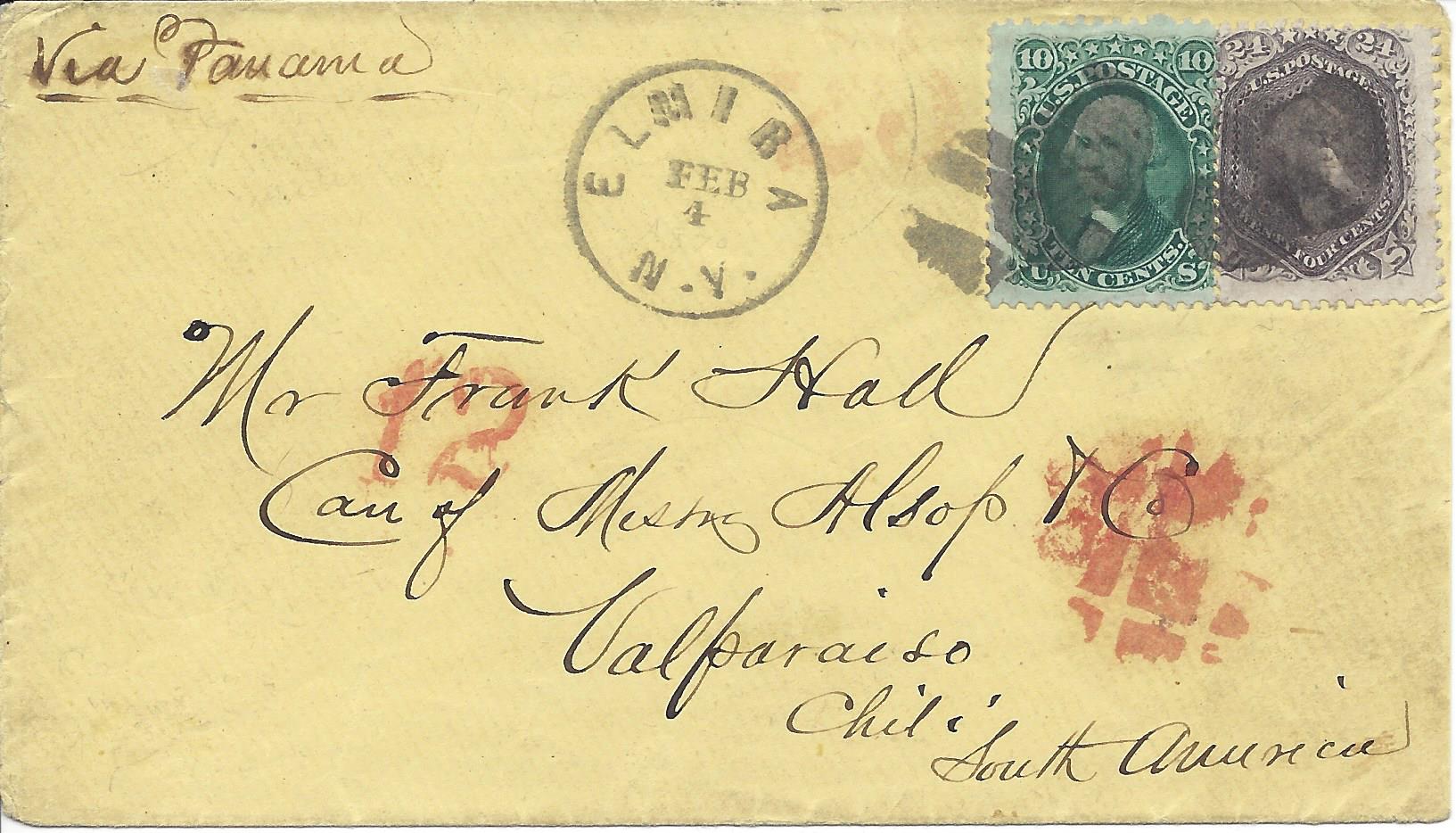
So, I'll move up the time table on my exploration of the cover shown below.  It attracted my attention because of the two bold, red markings on the front.


The Puzzle

All of the hints about the story this envelope can tell are visible to you right now.  There are no contents.  There are no dockets other than the "via Panama" at the top left.  There are no markings on the back-side (the verso) of this envelope.  This is it.

The letter was mailed and postmarked at Elmira, New York on February 4 and it was sent to Valparaiso, Chile for a Mr. Frank Hall.  He had apparently arranged for his mail to be sent "care of Messrs Alsop & Co."  Thirty-four cents of postage appear at the top right which was apparently accepted as sufficient pre-payment.

That leaves us with three more markings that have something to tell us.

We'll start with the easiest one to see and explain.  The red "12" is the amount of the collected postage that was to be given to the British postal services.  In order for a letter to get to Valparaiso, Chile, from New York, it had to be carried first to Panama.  It would then cross the Isthmus until it was put on board a steamship that was under contract with the British Post Office to carry mail to South American ports.  At the time this letter was in the New York City post office, we must have been under an agreement that British service would cost 12 cents.

Then,we come to this mess.  If you look carefully, you can see the number "24" in red that had apparently been put on this envelope.  Someone must have decided this was wrong and they covered up that marking as best they could with a heavy waffle-like cancellation.  If you take a moment, you might be able to notice that the red ink for the "24" is slightly different than the ink for the "12" and the waffle marking.  But, the "12" and the waffle seem to be the same ink.  That tells us the "24" was applied at a different time than the other two.

And then there's this.  Look carefully, do you see another marking in red ink here?

Even if you can't see it, there is a marking there that is the number "25."  This marking was applied in Chile.  But, how did I know that?  And, why am I not certain the postage rate for this letter was 34 cents?  For that matter, what year was this letter sent?  Ah... puzzles can be so much fun!


What was the "25" for?

I'm going to start with another envelope that does not present so much of a mystery for me. This one was sent from New London, Connecticut in 1867.  The recipient was a Captain Hinckley and his ship must have been the barque "Fannie."  His mail was also sent to Messrs Alsop & Co, which would have been the most common location for United States ship captains or US citizens to have their mail sent if they were visiting Chile.

And there is a big, bold '25" right in the middle of the cover!  As I mentioned before, the marking was applied in Chile and the slant of the numeral "5" was normal for this marking.  Unfortunately, it is also pretty common for it to be very lightly applied, so it can easily be missed.

Foreign mail to Chile could only be pre-paid to the point of entry into the country.  Chile charged an incoming foreign mail fee equivalent to 5 centavos (July 1853 to December 29, 1874).  In addition to the incoming mail fee, incoming mail required two times the domestic internal rate (10 centavos) for a total charge of 25 centavos collected from the recipient at the point of delivery.

How did mail get to Chile?

Mail for South America that had an origin in the eastern half of the United States would typically go to the exchange office in New York City.  From there, it would take a steamship owned by the Pacific Mail Steamship Company (often called the Aspinwall Line) to Chagres.  Chagres was located on the Gulf of Mexico side of the Panama Isthmus and was often referred to as Aspinwall at the time this letter was sent.  Mail would then cross the Isthmus and board a British steamship at Panama City.

The British steamships were run by the Pacific Steamship Navigation Company (PSNC) and they made stops along the west coast of South America.  There were stops in Ecuador, Peru, and, finally, Chile.

The second cover shown above has a black, circular marking that was put on the cover in Panama City by the British postal clerks.  This particular cover was handed over to the British agents on February 19, according to that postmark.  A typical steamship schedule by PSNC would have this letter arriving in Valparaiso at or around March 9.

On average, it might take nine or ten days to get from New York City to Panama City and another seventeen or twenty days to get to Valparaiso.  If you would like to learn a bit more about the route from the east cost to the west coast via Panama, there are numerous sources you could try.  Among them might be John Kemble's 1938 paper titled The Panama Route to the Pacific Coast: 1848-1869.  Or if you want something contemporary to this period, you can read Isthmus of Panama: History of the Panama Railroad and of the Pacific Mail Steamship Company by Fessenden Otis, published in 1867.

How much did it cost to mail a letter to Chile?

The only postage rate for mail from the US to Chile during the 1860s was a 34 cents per half ounce rate that was in effect from December of 1856 until early February of 1870.  And since I concentrate the most on the 1860s, that is what I am most familiar with.  The 34-cent rate was broken down into two parts: 10 cents to cover the US postage and 24 cents for the British carriage from Panama City to Chile.

But the price governments were willing to pay steamship companies to carry the mail was declining in the 1860s and early 1870s.  As a result, the British reduced their own postage rates to destinations on the west coast of South America by 6 pence (equivalent to 12 US cents), making this change effective on January 1, 1870.  They would not pass on those savings to US postal customers until February 15, 1870.  As of that moment, the US only had to pay 12 cents, instead of 24 cents, to the British, and they were able to lower the postage rate for US customers from 34 cents to 22 cents (Feb 15, 1870 - June 1875).

Answers to the puzzle

So, we return to our first cover so we can provide what I think is the most probable explanation for this particular letter!

A postal customer in Elmira, New York went to their post office and gave this letter to the clerk, probably paying that clerk 34 cents to pay the, then current, postage for a letter to Chile.  The clerk or the postal customer put 34 cents worth of postage stamps (a 10 cent and a 24 cent) on the envelope and the clerk dutifully postmarked the letter and cancelled the stamps so they could not be used again.

The letter was then put in a mailbag so it would go to the foreign mail exchange office in New York City. The docket "via Panama" told people at the exchange office that the letter should get on a steamship to go to Panama, rather than overland to San Francisco and then down to Chile.  The PMSC steamship named the Henry Chauncey was due to leave New York's harbour on February 5th.  So, as long as the letter got to the New York foreign mail office in time, all should be well.  

The foreign exchange clerk in New York put a "24" marking on the envelope, just like they had been doing for every letter to Chile since 1856.  And then they realized that it was too late to get this letter to the Henry Chauncey, it left the Port of New York without this item.

The next steamer scheduled to leave New York City for Chagres was the Alaska on February 21, six days after the postage rate was to change from 34 to 22 cents.  And, once that happened, the amount of postage to be passed from the US Post Office to the British would only be 12 cents.

So, at some point, the clerks in the New York Foreign Mail Office used this waffle grid to cover up the old "24" credit markings and they replaced it with the "12."

Why?  Well, they didn't want to send the British any more money than the postal agreement was asking for, and this letter did not sail on a British ship until AFTER the rate had changed.

So, my final answer is summarized as follows:

  • The letter was mailed when the rate was 34 cents per half ounce.
  • The New York exchange office marked it as a letter mailed at the 34 cent rate by putting a "24" on the cover.
  • It arrived in New York too late for the ship departing on Feb 5
  • The rate changed to 22 cents
  • The New York exchange office marked it as a letter mailed at the 22 cent rate by covering the "24" and putting a "12" on the cover
  • The letter traveled on the Alaska to Chagres at the Isthmus, leaving February 21
  • Probable arrival in Valparaiso after March 20

That's my story and I am sticking to it!

Outstanding questions

At this point, I do not have actual departure or arrival dates of the Henry Chauncey or the Alaska.  I also do not have the departure/arrival dates of the PSNC ship that left Panama for South America.  So, if anyone has information on those, I would be grateful.  Otherwise, it will simply wait until I have time to dig a bit more.

Also, I am willing to hear any arguments that might indicate that my conclusions are wrong - though I don't think I am.  However, it makes it pretty hard to learn if I won't entertain the possibility that I am in error in the first place.

Bonus Material

Let's go back to the second envelope I featured for a couple of interesting tidbits that you might enjoy!

While I was unable to find much on Capt Hinckley or the barque (bark) Fannie, I was able to locate some information about one person who handled this letter on behalf of the good captain.  

This letter was initially sent to Alsop & Co in Valparaiso, but they sent that letter on to W.E. Billinghurst in Iquique, which was in Peru at the time this letter was sent (1867).  We can assume this letter caught up to Capt Hinckley there since there doesn't appear to any more travels recorded on this envelope.  

Mr. Billinghurst was listed as a shipping agent for Lloyd's in Iquique during the 1860s and was, like many who worked as a shipping agent, also the representative for many other concerns. Anyone involved in trade, especially of Chilean saltpeter, had likely heard of him.  So, it might not be surprising to hear that his demise was specifically noted in newspapers throughout the world.

I found an article in the Brisbane Courier of Oct 13, 1868 (page 3) that explains the fate of Mr. Billinghurst (about 15 months after handling this letter).  An extremely large earthquake, estimated today as having been somewhere from 8.5 to 9.3 on the Richter Scale, was centered around Arica, north of Iquique.  This would place it among the most violent earthquakes recorded.  That earthquate caused tsunamis that impacted many of the ports to the south, including Iquique.

Brisbane Courier, Oct 13, 1868 p.3

If you have interest in reading about the severe earthquake activity in South America during 1868, here is a contemporary report from Harper's Monthly from 1869 that might give some insight.

Iquique, despite being located in a desert region, was a port of prominence because that desert had strong deposits of sodium nitrate (Chilean saltpeter) - used for fertilizers.  Prior to the late 1860s, the Chinchan islands off the coast of northern Peru had been mined for guano that could be exported worldwide as a fertilizer.  With those deposits rapidly being depleted, attention was shifting southward to the Atacama desert - and to Iquique - as the primary port of departure for ships laden with Chilean saltpeter as a fertilizer product.  In 1867, nearly 116,000 tons of saltpeter were exported by Peru. This amount declined the following year, likely due, in part, to the earthquakes.*

If you would like to learn more of the Atacama desert, I did come across a book by Isaiah Bowman titled Desert Trails of the Atacama, published in 1924.  I started reading parts of it and then realized I needed to finish this Postal History Sunday post!  At the very least, I put the link here so I can look at it in the future if I would like!

*Greenhill & Miller, Peruvian Government and the Nitrate Trade, 1873-1879, Journal Latin American Studies, pages 110-111

Iquique 1865 by Mariano Felipe Paz Soldan from wikimedia commons

 --------------------

And there you have it!  Another Postal History Sunday in the books! I hope you enjoyed this journey and that maybe you learned something new.  

Thank you for joining me.  Have a great remainder of your day and a fine week to come.

Saturday, November 19, 2022

Music for the Long Nights


It is time for a November music play list.  At least that's what I tell myself.  And since I'm the person that actually has to write the blog post if there is going to be one, that's probably all that matters.

Mid-November is the time that I realize that we are about as far from the bloom time of iris as we are at any point during the year.  The night hours in Iowa far exceed the daylight hours and reduction in sunlight can play havoc with how I feel about myself and the world around me.

Thankfully, I have pictures of beautiful flowers and there is music to listen to.  Here's a batch of tunes I'm currently paying some attention to.  Maybe you will also like one or two of them.  I hope so, because sharing things we enjoy is another way we can combat the potential onset of "winter blues."

Let's start with some banjo in a tune that honestly DOES sound like warmer (and longer) sunlit days.

The Sound of Summer Running - Alison Brown  

I've always appreciated the lyrics of the next tune.  In particular this little bit:

I never saw my shadow 'till I saw the light
And now I need more light to drown it out
I cannot bear that this should continue
Nor can I bear that it should stop

Drop - Massivivid

Then we'll move on to a couple of tunes that celebrates persistence.

I'm Down - the Almost

Hard Love - NeedtoBreathe

Then maybe we'll go outside for a bit, but you need to remember to...

Grab Your Coat - Fair

Then we can enjoy a tune that starts with some snow.  But, 

"It's only a season, it's only a run.  Only love, only friendship will last."
Seasons - Future of Forestry

Maybe we'll take a moment and play a couple of tunes that remind us of summer music festivals.  In fact, parts of this video was probably taken at a festival we attended.  A heavy thunderstorm made the fields muddy and I remember people diving in the mud and smearing it in their hair.  Did they get that idea from that event?  I'll probably never know. 

Like I Was - Prayer Chain

And we remember this group playing late into the night - using their songs to start extended jams.

Let It Slide - Vector

The nights might be long, but there is always hope for brighter days.

Dark Night - Undercover

Whisper - Evanescence

And we'll close it out with a little Maria McKee.   And, I'll have you know that this list went to eleven.  Just as every list on this blog should.

Soap, Soup and Salvation - Lone Justice

I hope you found a tune or two you like.  And, if you didn't, you can always hope I'll do better for you next month.  Until then, find a tune you love and give it a listen.  If that tune is the wind in the trees or the sound of waves, I hope you give yourself permission and opportunity to enjoy them.

Friday, November 18, 2022

Today is a Good Day


Today is going to be a good day.  Or, if you are reading it later in the day, today IS or HAS BEEN a good day.

This is not negotiable.  This is how it is how it is going to be.  Sure, I suppose things could happen that might be undesirable.  Perhaps I will drop my toast and it will land butter-side down.  I might stub my toe or step up to my knees in a mud puddle.  Maybe the skies will be cloudy and a cold wind might blow.  But today is still going to be a good day.

It's going to be good because this person - the one in the picture shown above - is my friend and partner.  And today is the anniversary of her arrival on this planet.  That makes today, for me, a good day.

You, on the other hand, can have whatever kind of day you feel you need.  But, I highly recommend having a good day.  They really are worth the effort.

Thursday, November 17, 2022

When you work for yourself...


As a person who works as the steward of a small-scale, diversified farm, it should not be a surprise that my status for much of my time at the Genuine Faux Farm has been "self-employed."  And, not to denigrate any of Tammy's hard work and participation in the efforts that make the farm what it is, it could be said that there are long stretches where I work by myself... for myself.

This, of course, got me to take off on a series of thoughts that started with the phrase

When you work for yourself...

And, of course, Tammy encouraged it by adding her 2 cents worth to the list.  So, this list is for all of you who have been, or currently are, self-employed and are, typically (or frequently), working on your own.

The difficulty of trying to keep things to yourself

Some of the things that came to mind had to do with the fact that there seems to always be a person in your place of self-employment that must be a real blabbermouth - because everyone involved (yes, it's just you) always knows what's on your mind.

When you work for yourself...

  • it's impossible to keep a secret from your boss or your co-workers.
  • you know what your co-worker's salary is, and you don't find it odd that you get paid exactly the same thing.
  • the boss always seems to know when you start looking at new places of employment.
  • decisions are transparent to all workers and they all know exactly how little justification there was for that decision.

When you work for yourself, there really is no need to speak in whispers because everyone (me, myself and I) is going to hear it.  You might as well speak clearly and loudly. That way you get everyone's attention and no one can say they didn't understand because you were mumbling. 

Well, ok.  You can mumble and you'll probably STILL understand yourself.  Except for those times when you don't understand yourself.  But, that's a topic for another blog.


Difficulties with teamwork

And then, there are the difficulties that come with covering all of the roles that are required to run a farm (or whatever business a self-employed person might have).  It doesn't matter if you are a team of one, cooperation is still an important part of getting the work done.  I will say this - the workplace has a chance to be pretty quiet since much of the discussion goes on in your own head.  Well, that's true until the discussions get heated.  There's no telling how loud things can get when a full-blown disagreement gets going between yourself and... yourself.

 When you work for yourself...

  • it's really hard to figure out who gets to take vacation and still keep the business running.
  • and you get promoted, you realize that you don't get to leave the old task list behind and the new task list looks an awful lot like the old task list.
  • and you can't get the whole team to agree on a work plan, you've probably got bigger problems to worry about.
  • you often wonder why you keep getting assigned to teams with the person you like working with least.  (this is a version of everywhere you go, there you are)

This is a good news / bad news situation.  From personal experience, I can tell you that I like my co-workers' taste in music and we (almost) always agree when it is time to take a quick break.  And yes, the dress code always seems to fit whatever I am wearing on any given day.  On the other hand, someone is ALWAYS eating my lunch AND I know who it is.  I am pretty certain I won't be able to get him to stop doing that.  But, I can get him back.

Why?  Because it is also very easy to move the pile of work from my desk to his.


Dealing with management

I have heard people suggest that the biggest attraction to being self-employed is that you don't have to deal with all of the garbage that comes with management and managers.  Well, I am here to say that this is not true.  What actually happens is that all of the discord and tension between workers and managers simply gets internalized into one person... you.

When you work for yourself...

  • and you can't stand your boss, just get rid of all of the mirrors and you'll never have to look at his ugly face.
  • and your employee isn't doing what they need to do you can fire them, but good luck finding a replacement - they always seems to be EXACTLY like the original.
  • if you're concerned you are about to get fired, you can find the boss quickly to ask for a positive reference before the axe falls.  If you're really proactive, you might know you're about to get fired before your boss (also you) knows you should be fired.
  • you will know when your employee is disgruntled, just watch for signs that they are forming a union.  That could be a real disaster because you might end up doing all of the work when they go on strike....  (um.. wait.)

Oversight is darned near omniscient when you are self-employed.  If you use the company vehicle for personal reasons or make a private call on the company phone, management ALWAYS seems to know about it.  And, don't bother looking over your shoulder when you take office supplies out of the supply cabinet.  Management is already there and they're tallying how much you owe for what you've taken.

Still, there are plenty of reasons that working for yourself is a good thing.  For example, you can complain heartily about bad decisions and past mistakes without fear of reprise.  After all, the person responsible for them is in your past and they can't hear you now. 

Wednesday, November 16, 2022

Land Between Two Rivers


I grew up in Iowa and have lived most of my life in the Land Between Two Rivers and I sometimes wonder if I have actually done what I need to do to fully appreciate the place where I live.  For that matter, does anyone fully appreciate the place where they are right now?  I guess that depends on what I mean by the question.  But, let's just say that we all could probably improve in this category.

As a kid in Iowa schools, I recall that "the Land Between Two Rivers" was used frequently in various educational settings when we would talk about Iowa history and Iowa landscape.  It doesn't seem like that phrase is used as much in recent years, but it (apparently) really stuck with me.  And, given my own personal life journey, it should not be a surprise that I see much of my connection to the state as starting with the land itself.

Stuck between the Missouri River and the mighty Mississippi, Iowa actually has a satisfyingly diverse topography, if you allow yourself to explore it.  We've got the Driftless Region in the northeast and the Loess Hills in the west.  There are rivers and grasslands, swamps and woods.  

It can be difficult to get around the fact that we've decided to till most of the land and drain most of the wetlands.  It is estimated that 85% of Iowa was covered by prairie or grasslands prior to the arrival of white settlers.  Today, less than 0.1% of that prairie remains.  Our woodlands, by comparison, have made a slight rebound after hitting their lowest marks in the 1970s.  As recently as 2009, eight percent of Iowa's land was woods.  Though you could make an argument that this may have declined since that time.

Oh, and by 1930 95% of Iowa's wetlands (especially in the north central portion) had been drained so it, too, could be tilled up.  It turns out there was a reason towns like Plover and Curlew were named after waterbirds - we had a lot more acreage in wetlands for habitat.

What we see today is not what the Land Between Two Rivers had been for many centuries prior to the arrival of the Europeans.

And yet, the land still endures.  The land still has its beauty.  The land still speaks to us, if we are willing to listen.  There will be no returning it to what it once was, but perhaps we can listen to what it wants to be now.  Our well-being, the well-being of other creatures, and the health of this land - the Land Between Two Rivers, is tied to our willingness to support and recreate wild spaces throughout.  

Each of us can have a hand in turning things around.  One thing we can do is visit our natural areas and treat them with respect.  By exposing ourselves and the people we interact with to the natural world, we can remind us how valuable wild areas can be.

We can tell our elected officials that we want our state government to hire people who care for our parks and natural areas on our behalf - and fund them so they can help to educate our young people... or better yet, educate all of us to understand our land better.  

Those of us who have a plot of land in our care can plant and tend natural areas where we live and if we don't have such a space, we can be involved in supporting communal natural areas.  

And we can educate ourselves.

Some of you might remember the Iowa Public Television series called the Land Between Two Rivers.  Here is an episode on the Karst areas in northeast Iowa, which includes visits to two of our (Tammy and I) favorite places, Twin Springs and Dunning's Spring.   Don't ignore these pieces and others like it.  If you take the time to understand the land and how it works, how it was made, how it behaves... you can understand how we need to work and how we need to act when it comes to the land around us.

Tuesday, November 15, 2022

The Farmer's Yapping Again


It's something I am willing to do.  Though, for the life of me, I'm not always sure why people want me to do it sometimes.  And yes, that is me, deflecting the possibility that I might have something useful to share with others.

It has been time for the farmer to do his Farmer Yapping Tour in the 2022/23 speaking season.  Today, I'll be speaking to a class at the University of Northern Iowa along with Olga Reding, who will be representing the Iowa Organic Association.  Last week, I was at Hawkeye Community College and the week before that I was at Wartburg and even added in a presentation for Black Hawk County Extension.  I even presented via Zoom for a class in Arizona!

It sounds like there will be another event for Iowa Organic Association and I'll be speaking at the Practical Farmers of Iowa conference in January.  And, there are other things in the works.

I will be honest, I actually like presenting.  That might sound contrary to my introverted nature, but it actually fits pretty well.  It is important to me to do what I can to help others to learn.  I think it is fair to say that I have the heart of a teacher/facilitator of learning.  On top of that, I actually have a fair amount of training for public speaking - despite my introversion tendencies. 

And remember, when an introvert is asked to present, it gives them license and purpose to speak.  You are not just throwing them into a room with  thirty other people and telling them to partake in "small talk."  That, my friends, would be enough to make me find the darkest corner of the room and hide.

Or maybe I'm the guy with the lampshade over his head.  Or those feet at the bottom of the curtain might be mine.  

But most likely, you'll see my backside as I head right on out the door as soon as I find an opportunity.

But, give me purpose and license and I can do very well.  Hence the Farmer Yapping Tour.

Thus far, I have gotten many excellent and thoughtful questions during these presentations.  Maybe. Just maybe, I've encouraged a few people to think a little bit and to consider things that need considering.  Perhaps they've even learned something new in the process too!

Monday, November 14, 2022

Hole in the Canopy

There was a gaping hole in the canopy of the forest that was noticeable even if you didn't look up.  I knew it by the change in the light and the feel of the air.  My senses picked up on the weight of absence - or maybe the memory of something that was, but no longer is.

With all of our recent walks in the woods with my friend, I feel like I've become more sensitive to the rhythms of the trees and the land on which they grow.  I've made numerous observations (mostly to myself) about what I have been seeing, smelling, hearing, and touching as we walk on leaf covered paths.  One of the most jarring revelations (if I can call it that) is that the trees in the forest, individually, are rarely the type of specimen that many of us would welcome in our overly manicured yards where only the finest examples are welcomed.

Yet, somehow, each of the trees in the woods, with all of their imperfections, belong.  All of them add something to the beauty and being that is a woodland.


The trees in the woods seem to be in a constant roller coaster between competition and cooperation.  

Each seed that germinates has little choice about where it has fallen.  It is where it is and that is where it must succeed - if it is going to.  Sometimes the most fertile ground that provides opportunity for new seedlings will result in clusters of trees that were certainly happy to land in such a good spot.  Only, after a while, they realize that they would like a little space for themselves and they lean away from their companions.

As they grow, each tree does its best to find its unique path to the sun and fresh air, sometimes bending back on themselves in contortions that are both amazing and painful to observe.  It is during these fall and winter months, when the leaves no longer create the umbrella that collects the sunbeams and converts them to food, that we can observe how much struggle each individual must engage in to grow and reach their own, best, potential.

During the warmer months, the cooperative nature of the trees becomes more evident when all but a few are clothed in their greenery.  The canopy holes are filled in most places and the sunlight is filtered as it tries to find its way to the forest floor.  

Except for this place.  Where the canopy has been torn and the outline of what was once a magnificent tree remains.  Almost as if the rest of the trees are mourning the absence of a once proud elder who no longer reaches for the stars, and the sun, and the open sky.

After the wake, the forest floor will come alive in future seasons and the dance will continue with new participants.  Each of them finding themselves where they are planted, trying to figure out if they will be the next proud tree to fill the vacancy.

Sunday, November 13, 2022

Like a Fly to a Bug Zapper - Postal History Sunday

Welcome to Postal History Sunday, featured weekly on the Genuine Faux Farm blog and the GFF Postal History blog.  If you take this link, you can view every edition of Postal History Sunday, starting with this one (the most recent always shows up at the top).

This week we're going to give myself a bit of a breather.  And before you get too worried, that doesn't mean there won't be a Postal History Sunday.  What it means is that I am giving myself permission to not dig as deep into things as I often do.  Instead, I am going to answer a question that came to me from three different people in three different forums.  Of course, they did not ask in exactly the same way, but I kind of liked how Majid Hosseini asked it, so I will quote here:

"Considering your varied topical interests, I wish you did a post some day about what makes you interested in a cover."

Ok!  Let's have a little fun with this question and maybe learn something new while we are at it.


The Training Ground

When I started paying attention to postal history, I was pretty overwhelmed by all that was out there.  So, I made a choice to find a filter so I could focus on a smaller area.  Initially, my filter was postal history that had stamps from the 1861 United States postage series.  But, it became apparent that this was too broad and I narrowed it to postal history featuring just the 24-cent stamp of this series.

The majority of the mail using that particular stamp was sent from the United States to the United Kingdom to pay the 24 cent rate for simple letters weighing no more than 1/2 ounce. So, if I was reading books, or looking at catalogues - trying to view examples of this stamp on covers - I would find lots of things that looked kind of like the cover shown below.


These covers typically featured a single 24-cent stamp.  There was typically a town postmark and cancellation showing where the letter was mailed from, a red circular marking from an exchange office (like New York) and often a receiving exchange marking for London.  That was a typical 24 cent cover to England.  And, once I saw enough covers that looked like this, I was able to train my eye to see hints that things were different.

That brings me around to the cover I showed first in this blog - and I'll show it again here.

This folded letter was actually described as another 24 cent cover to England because it has a single 24 cent stamp.  But, because my eye had been trained to look for this sort of thing, I noted some differences right away.  The first thing that told me the description was wrong was the word "Franco" in blue that is down and to the left of the stamp.

That was enough of a difference that I was encouraged to investigate. 

Mailed from New York City in November of 1867, this letter was destined for Venice, which had been incorporated into the Kingdom of Italy after the war with Austria in 1866.  The route for this letter went through Bremen, which was part of the North German Confederation in 1867.  But the United States was still operating under a mail convention it had negotiated with Bremen.

It just happened that there was a 24 cent postage rate for mail from the United States to Italy for a very short period of time (from February to December of 1867).  This postage rate was only effective for mail sent via the city of Bremen and their mail services.  As a matter of fact, there are only a few existing covers out there that show this rate, so the fact that I found one masquerading as a cover to the United Kingdom is pretty neat - if you ask me.

But, I found it because I had become very familiar with what was normal.  And, it was NOT normal to see the word "Franco" on a cover with a single 24-cent stamp.  That was all it took to clue me in on the fact that I might want to pay more attention.

Jumping off to related areas

Once I became comfortable with mail from the US to the UK in the 1860s, it wasn't all that hard to figure out how mail that went the other direction worked.  It took much less time to figure out what "normal" would look like for simple letters traveling from places like London and Liverpool to various destinations in the states.  

In fact, it would look a lot like the cover shown above, with one exception - there would be only ONE green, 1-shilling stamp on the cover because 24 cents was equal to 1 shilling.  The red "paid" marking was pretty normal, and so was the red "5 cents" marking.  But, my brain was alerted to the fact that there was a red "5," which would tell me this was a simple letter that should cost ONLY ONE shilling.  

Yet, here it was with 2 shillings in payment.  It turned out that the explanation was on the back.

The Liverpool marking has the abbreviation "F.R.H." at the bottom, which stands for Floating Row House.  Liverpool had a special post office on the wharf for ships leaving to carry mail across the Atlantic Ocean.  A person who was too late to get the letter to the regular post office could pay an extra shilling to get their letter on the ship almost to the point of departure by coming to the Floating Row House.

And that explains the extra shilling.  But, it was my recognition that the "5 cents" and two 1-shilling stamps wasn't a normal pairing that clued me into researching this item more.

Looking for more explanations

This whole time, my main collection and interest has remained with the 1861 24-cent postal history.  But, I am driven to understand those items in my collection as fully as I am able to.  So, when I find something else that might help explain more of the story, it attracts my attention.

For example, the 1867 business letter sent from Marseilles, France to Genoa, Italy provided me with a foothold to better understand how letters might travel between France and Italy.  The key this time is the marking at the top right that reads "Francia via di mare," which would translate to "France, via the sea."  This marking was applied to indicate that the letter was placed on a coaster steamer in Marseille and taken off at Genoa.

Then there is this 1862 folded letter mailed from Boston to Rome.  It bears 27 cents in postage (including the 24 cent stamp) that properly paid the 27 cent rate for a letter mailed via France to Rome.  The marking below shows us that the letter was received on April 5.

If you do not know what you are looking for, the words in the bottom curved panel of this marking read "via di mare."  Now that you've seen it with the letter from Marseille to Genoa (or now that I've pointed it out to you), it is easier to try to decipher it here.  But, imagine that you had not seen these two covers in this order.  Would you be able to decipher what that bottom panel said?

Well, in my case, I was happy enough to be able to decipher the date of arrival.  And, for quite some time, that's as far as my understanding went.  Then, I realized at some point that mail to Rome probably had to be taken by ship, because Rome was not getting along all that well with the rest of Italy.  

THEN I saw that letter from Marseille to Genoa with the words "via di mare" and it all clicked.

This explains some of the items that attract my interest - they represent a way to better understand MORE of the mail processes that the 24-cent covers would have used as they went to, or through, Europe.

But, something else happened along the way as I was looking for more in-depth knowledge.

Something new to explore

I started to realize that I now knew enough about mails in the 1860s that I actually had just enough to not be completely lost if I looked at European mail during that period.  In fact, I was able to make at least some inroads for items dated from the 1850s to the 1870s.  

Let's be honest with ourselves here.  It can be pretty difficult to really enjoy the learning process when you have NO IDEA where you should start, right?  Sure, some of our most important and critical learning events in our lives are the most traumatic.  But, I'm not doing this because I want to be traumatized.  I want to learn and I want to allow myself to enjoy learning.

That means it makes sense to continue to build off of the areas where I already have some foundation to reach from.

Shown above is a letter that was mailed in Torino on July 26, 1863 - and the destination was also in Torino.  A five centesimi stamp pays the local postage rate of the time for the Kingdom of Italy.  But here's where it starts to get a bit odd.  The fancy letterhead, shown below, tells us that the sender, Giuseppe Bonetti, was located in Cremona.  If this were mailed in Cremona, it would not qualify as a local letter.

This is where experience in reading dockets for items in the 24-cent 1861 collection comes in handy.  It tells me that information could be found if you read such things and we have one that looks like this at the top left of the cover.  And it simply says "favore."

This likely explains things more fully.  This letter was taken to Torino for Giuseppe Bonetti by someone other than the Italian postal services.  Perhaps he had a business acquaintance who was on their way to Turin (Torino) and they were willing to take a letter or two with them and drop them at the local post office, saving Giuseppe a little bit of postage.  Maybe Giuseppe even paid a little bit of money for this person to carry a few letters to Turin for him, but it was likely less cost than it would have been to mail it in Cremona.

Things that hint at a story to tell

Of course, as I explore more and more things, I have gotten a bit better at recognizing things that might have a story to tell, such as this May, 1944, registered letter that was returned to the sender because it must have had some content the US mail censor was disinclined to allow to leave the country.

This letter is eighty years younger than most things I pay attention to for postal history, yet I still find it to be interesting.  Covers with potentially stories are the thing that make me feel like I am a fly attracted to a bug zapper.  I know that I am less familiar with mail during this time period and I am fully aware it will take me longer to work out the details that might be discoverable.  But, I can't help it.  I smell a story - and I am hopeful to unlock that story (and maybe share it here) someday.

As a matter of fact, one of this year's Postal History Sunday entries I am most proud of features this World War I period envelope.  This one was titled Friends in Need and it featured the Friends Ambulance Unit that was established in London to provide medical support in France and Belgium where fighting was heavy.

Overall, this letter is, as far as I can tell, fairly unremarkable for a registered letter sent from the United States to London in 1916.  The mail censorship was a fact of life for mail going between these two countries.  Registration of mail items was not at all uncommon.  

But, that hook to the Friends Ambulance Unit snuck its way into my brain and I just had to take a learning journey.

Personal connections

I am just like anyone else in that my attraction to some things are based mostly on some sort of personal connection I might have.  This 1923 letter from Germany to Muscatine, Iowa, is fairly nice looking and it illustrates a postal rate during the hyper-inflation period.   

But, the initial attraction to me was more personal than it was postal history.  First, Tammy's grandfather was a stamp accumulator and was proud of his German heritage. I still think of him when I look at postal history from this area.  Second, we have an Iowa connection - my home state.  And finally, the person from whom I purchased this item, for all of one dollar, was a kind soul who was continuing to attend small stamp shows in Iowa as a dealer of postage stamps (and a few covers).  He always made me feel welcome - so I think of him when I look at this item.

Fulfilling childhood wishes

I actually "started" collecting stamps very young, when Mom would cut stamps off of the mail and give them to me when I was three years old.  I remember gluing them into a little notebook and drawing around (and sometimes on... hey!  I was three!) them.  But, as I got old enough to learn how to handle stamps "properly" there were certain designs that caught my eye, like the 1913 Dutch issue of the time. 

Part of the attraction was that these were a different shape and there were many different values in the set.  So, it should be no surprise that I might like to acquire an item that represents a stamp issue I recall being fond of back then.

The envelope above has a pre-printed design with vegetables, so you can guess why a vegetable farmer, such as myself, might find a personal connection here as well.  But, when you add to it the fact that it shows a nice, clean example of the cheaper printed matter rate (Drukwerk), that makes it interesting for me.

Things that have curb appeal

When a piece of paper, like an old envelope or folded letter that went through the mail, still looks pretty new even though it might be fifty, eighty, or one hundred and fifty years old, it is bound to get my attention.  If the postal markings are clear and boldly struck and the hand writing is neat, I can't help but notice.  If the postage stamps have nice color and the edges of the envelope or paper are not tattered, why wouldn't I want to look at it a second or third time?

There are aesthetics when it comes to postal history.  And that might come as a bit of a surprise to those of you who do not do anything more with the hobby than read a Postal History Sunday now and again.  But, the odd thing about those aesthetics is that things do have to look their age - as long as they don't look TOO MUCH their age.

Although, sometimes, the ugly duckling finds a place in your heart.  Even if you wince a bit when you look at it.  I guess we need to remember that we all need love.  Maybe a tattered envelope that was mailed in 1865 from Indiana to Australia qualifies for some of that love?

A nutshell to simplify it all

Now that we have done all of that, I'll summarize my answer to Majid and others who were asking.

What makes me interested in a cover or piece of postal history?

Primarily three things:

  1. An item that helps me learn something new about postal history
  2. Something that gets me interested in a story
  3. Things that might help me recall the memory of a person, place or event

And now you're all saying, "Why didn't you say that in the first place?  Instead you just rambled on and I neglected to refill my mug with my favorite beverage."

Well, here's hoping you were in a comfortable chair and your fluffy, bunny slippers kept your feet toasty warm.  All is not lost, because your worries you put down to read Postal History Sunday were run through the wash machine with your extra socks.  If you're lucky, you aren't missing a sock this time.  Instead, it was your troubles that went missing.

And that makes for a good day.  Thank you for joining me.  Have a good remainder of your day and a fine week to come.