Tuesday, July 25, 2023

Wait a Minute, It Will Change


I allowed myself the opportunity over the past weekend to watch the clouds for a while.  Well, ok, I wasn't just watching the clouds, but they did grab my attention.  Sometimes...

That's the neat thing about the way clouds move in and out throughout the day.  They can roll in, coast in, float by and build up or disappear slowly over the horizon or past the trees and hills.  Sometimes, they strike a pose where they contrast light and shadow, showing their depth and shape in intriguing ways.  If you are lucky, you'll be paying attention when that happens.

If you don't happen to recognize it, that's ok.  Just wait a minute, things will change.  And maybe you'll get to see something wonderful, but different.

Monday, July 24, 2023

Texture

Maybe some of you are like me when it comes to watching water and clouds, leaves in a breeze and a flock of birds wheeling in the sky.  I find myself watching intently.  So intently that I periodically recognize with a start that I need to remember to breathe.  Except, I've been breathing just fine the whole time.

Over the past few weeks, I've been trying to catch some of the textures that the motion creates with the camera.  It's yet another thing I am allowed to do because it is a digital camera.  As odd as it might sound, I am still trying to shake off the limits I placed on myself during the time when you had to load film into the camera and you had a limited number of shots (unless you had lots of resources to develop all of the photos).


Happily, there is no requirement that I succeed with these pictures.  There is no requirement at all.  If I capture some texture that I appreciate - or that someone else appreciates - good enough.  If I don't?  That's ok too.

Sometimes I find myself using the camera lens to block off the noise that comes with what can be seen on the periphery so I can concentrate on something in particular.  I used to do this without a camera, sometimes putting my hands around my eyes to block out the distractions.  

Ah... who am I kidding?  I still do that sometimes.


I was attracted to the opportunity to take pictures of the swallow flock for the picture above as much for the color and texture of the clouds and sky behind them.  I had the option of watching the birds swooping and diving or I could focus on the skies as they darkened and lightened, depending on where the sun was in relation to the cloud openings.


I've always loved the "helicopter seeds" that some trees produce.  But, I have to admit that I rarely pay them much mind at any point other than when they have reached maturity and they come spinning down from the trees.

This was an exception to that rule because the nice rosy color provided a contrast to the leaves.   I think the picture above is a Sycamore, but maybe someone who is better with tree identification can confirm or point me to a better id.  


And for some reason, I haven't really paid much attention to lily pads in the past.  And yet, I find the patterns they make fascinating.   It's a bonus when there are some blooms in the midst of the leaves, but it's not a requirement.  Sometimes, when the water is still and clear, it can seem like they are floating on thin air.

Perhaps, by sharing them here, you can at least get a glimpse of what will sometimes get me to hold still - and breathe without knowing my lungs are working.

Sunday, July 23, 2023

Display - Postal History Sunday


Welcome to Postal History Sunday, a weekly online offering where I write about postal history related topics that I enjoy.  Everyone is welcome here.  Each article is written with the intent of making it accessible to those who do not have significant knowledge of the topic while still making it interesting to those who may have expertise in that same area.

This week I am finally going to get around to answering a question I've received on and off for the past few years.  In essence, the question has to do with how I go about displaying the actual postal history artifacts.


When I don't have a display page made, I typically store folded letters and envelopes in Mylar / archival safe sleeves that come in standard sizes.  There are also three hole punched, 8 1/2 by 11 inch, pages with pockets for storage of old letters and wrappers.  This is where they stay until I find the time and motivation to research the covers and make a page.  I can place paper slips with descriptive notes written in pencil into the sleeves or I can put a label on the sleeve or pages to help me remember key points that I've discovered over time.

Now, before I go much further, let me make something clear.  I am writing from the "perfect world" perspective.  Things don't always go this way all the time.  I have notepads of paper with various research notes and I have electronic files with other notes - not necessarily organized in a way that makes them easy to find.  This is what happens when you grab five or ten minutes here and there to seek an answer to a question.  You just put the answer somewhere and hope you can find it again when you want it.

The same thing goes for when I go through the process of creating display pages.  The process isn't always as smooth as it sounds because it is often interrupted by the rest of life - job, farm, friends and even Postal History Sundays! 


Shown above is the display page for the item that I used to open up this week's article.  This piece of printed matter included all of the contents, so I also had to make choices about what I wanted to display and what I was okay with not showing on the page.  Happily, the technology to scan items and make images that I can re-size makes it easier to illustrate as much (or as little) of the interior, or reverse, of an item as I choose.  

This particular item has more content than is illustrated on the display page.  Clearly, choices had to be made in the interest of clarity and aesthetics.  And that's one of the main issues when it comes to creating the page - how do you use the "real estate" available for each item in the best way?  If you want to keep things to a standard page size, there are some very real boundaries that need to be considered.

I like to include some consistent information on each page, such as the postage rates, information about the route the item traveled and a description of the postage stamps (if any) used to pay the postage.  I also like to provide some additional point(s) of interest - usually at the bottom of the page - because I've just got to be me.


I create my page designs in a software program called Visio, which allows me to lay elements out on a grid, opening up the possibility that I can place an element anywhere on the page.  I use a scan of the postal history artifact that is scaled to its original size so I can make sure everything will fit on the page.  You might notice that I opted to experiment a little with the layout for the item shown above.

It is not uncommon for me to take digitized copies of maps from the same period of the postal history item(s) I am displaying.  I use open source software called Gimp to fade out the map and add my own highlights as I deem necessary.  For the map above, I darkened the country borders and provided bolder labels for geographic features that applied to the postal history shown on the page.

My interest in postal history stems from philately (the study and collecting of postage stamps), so it should not be a surprise that I have mixed the two on a page.  One of my favorite postal issues from the Netherlands is shown above with a single cover to illustrate the use of the most common denomination (5 Dutch cents).  This has become a bit less common for me to do as I move further into postal history and seek to find new homes for much of the off-cover stamps

Once the page is ready to print, I use acid free paper and mount the item(s) with archival quality corner mounts (the stamps have special mounts, but I'm not getting into that).  The entire page is housed in a mylar sleeve (also archival quality).  I take as much care as I am able to protect these pieces of history so they will not degrade and future caretakers can enjoy them and explore them just as I have.  It's part of the responsibility that comes with the pleasure I get in viewing and researching the items that come my way.

And remember, most of the things I enjoy are from the 1860s - well over 150 years old.


Shown above is a page that highlights the item featured in this Postal History Sunday.  Clearly, my display techniques have changed a bit over time.  But, it does beg the question "which comes first, the display page or the Postal History Sunday article?"  In this case, the page came first.  In the past couple of years, more and more items have gotten the honor of having the article prior to the display page.  In fact, I have many items awaiting the display page treatment despite their appearance in Postal History Sunday.  Either way, I like to do a certain amount of research on an item before I finalize an article or a page.

The challenge with making a display page after writing a Postal History Sunday is attempting to eliminate 95% (or more) of the detail so it will fit in limited space.  If I want to go from display page to article, nearly everything can be migrated.


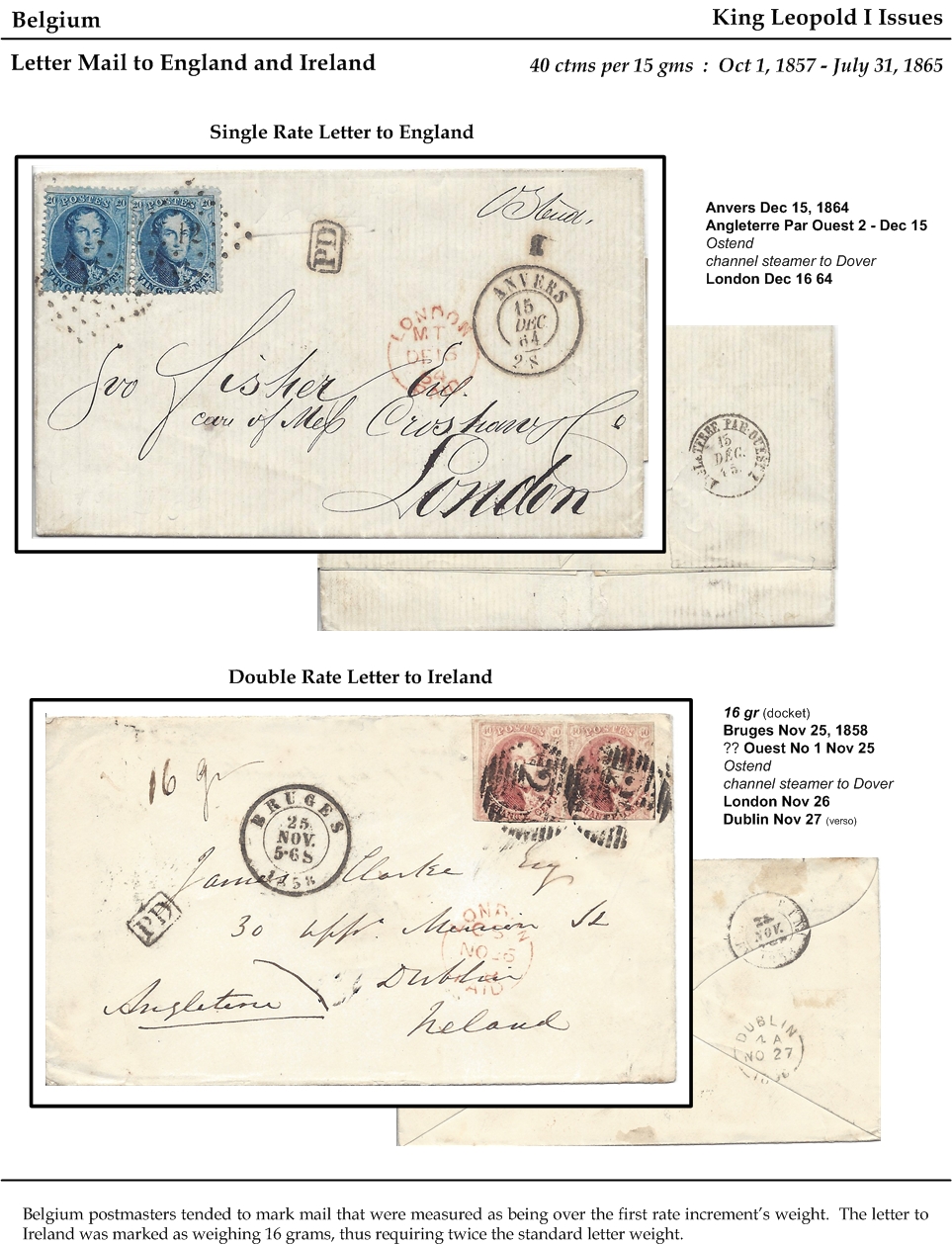
Often, a display page has a purpose that goes beyond telling the story of a single cover.  The example shown above was simply intended to give examples of mail between Belgium and the United Kingdom in the period between 1857 and 1865. The information that applies to all items on the page is shown in the header.  Each cover has its own heading and a block of details that explain the travels it took.

Sometimes, I decide it is important to see postal markings on the verso (back).  In that case, I will take a scan of the back and print a reduced size version on the page.  If I don't have much space, I might simply show the portion of the back with a marking.  Either way, I resize the image until I like how things look (and I can clearly see the marking).  And, no, I don't reduce every item to the same percentage of their original size.  Sometimes, I actually increase the size of a feature so i can see it better.  It's all a question of looks good to me.


Here is a page that was created before a Postal History Sunday appeared to feature the covers shown.  Sometimes, the critical information to help understand what is going on can best be illustrated with a simple table.  

Part of the point of a display page is to impart information in the most clear and efficient way a person can manage.  Often, words are the least efficient medium, especially when space is limited.  So, I like to use maps, tables, headings and consistent lists of the markings and places a letter visited during its travels.  While I do like to have some freedom to make a page look good to me, I also like to have some consistency so I can quickly find and understand the details I uncovered as I researched each item. 

But things change some once I decide that my display pages are meant for an audience that is bigger than me.

Shown above is the second page of my exhibit titled "The Postal History of the 24 cent 1861 Adhesive."  This exhibit now contains 128 pages and people typically view the exhibit while standing because the exhibits are placed in A-frame displays in the exhibition area.  That means it is important to provide some consistency from page to page so a person can quickly figure out what is interesting about each and every item.  It is also important to arrange the pages in a way that makes sense and has a purpose.

To help viewers, I included the page above to explain how to find and interpret things on any individual page in the exhibit.  It's all about communication.  You want to give the viewer as many tools as you possibly can to help them succeed as they attempt to understand what you are trying to share.

The article titled Timing is Everything gives you the Postal History Sunday version of the exhibit page shown above.  It's a rare moment where both a table and a map show up in an effort to explain the travels of the folded letter being displayed on the page. 

The challenge is to make it possible for a person to walk up and decide to view any page anywhere in the exhibit and get something out of that page that interests them.  This is combined with the challenge that the entire exhibit has to hold together and make sense for the person who is looking for a logical progression from page to page.  Creating something that can be successfully viewed in order or piecemeal is difficult, but well worth the effort.

I will leave you with this last example of a display page.  Sometimes, if a topic area is new to me, I find myself working even harder to find ways to explain what is going with enough detail and breadth so I can come back to it later and re-learn what I have discovered before.

In this case, I included a map, so I could get a quick geographic picture of where this letter traveled.  A photo of the coastal steamer that likely carried this item adds some color.  The description at the bottom summarizes some of my learning for future use if I want it. 

There are markings from the verso (back) of the folded letter, including a brief explanation for one of them.  Two of the markings are not actual scans from the cover, instead they are enhanced tracings from other sources because the actual markings on the cover are smudged and incomplete.  Simply illustrating a poor example of a marking does nothing to help me learn to see what I am looking at.  But, if I compare the complete examples at the left with the actual markings on the cover (they are both there), I can train my eyes to see them in the future.

And there it is!  A brief look at how I go about making display pages for postal history items.  If you were looking for more postal history content this week, it's actually already here.  Click on the display page images and look at a larger version of each one.  You can then view maps, short descriptions and gather interesting information about each and every item!

Thank you for joining me this week.  I hope you have a great remainder of your day and a fine week to come.

-----------------------------------------------

Postal History Sunday is published each week at both the Genuine Faux Farm blog and the GFF Postal History blog.  If you are interested in prior entries, you can view them, starting with the most recent, at this location.

Saturday, July 22, 2023

July Playlist


This seems like a nice Saturday for me to share the July music playlist on the Genuine Faux Farm blog.  And, since you all are reading the blog after the point where I held an internal debate about whether I should do a playlist or not - you're just going to have to go along with my decision!

Many months, over the past couple of years, I've put together playlists that go to eleven.  If you are curious about others, you can go here.

Sixpence None the Richer - Waiting on the Sun

Last month, I featured a cover by Sixpence and this time around, let's do an original tune.  Like anyone else who enjoys music I allow myself to be captivated by certain artists for a while and I'm currently in the mood for Leigh Nash and Matt Slocum.  Of course, their music is still very good whether I am actively listening or not. 

The Cure - Pictures of You

The Cure is a group that I, admittedly, have only listened to a few of their tunes.  But, I've enjoyed this one since it was initially released.  It's got a laid back feel to the music and lyrics with some depth.  You can choose to just let it wash over you or you can really contemplate it.  Your call.

Sam Phillips - Zero Zero Zero

I've come to realize that I like sharing Sam Phillips music in the monthly playlists.  Perhaps that's because it feels like she should get more attention than she has over the years.  Maybe it's because I can usually find a tune of hers that somehow fits into every playlist.

Write This Down - Hand Grenades

It's probably no secret by now that I often like various forms of rock and that I enjoy identifying indie groups that happen to catch my ear.  Write This Down can do a bit of "yelling" in some of their tunes, but this one doesn't go that far -so it's okay for a wider range of listeners.

Over the Rhine - Faithfully Dangerous

We had the privilege of seeing this group during some of their earliest iterations when they were a full band.  Over time, they have become a husband/wife team with outstanding song creation ability. 

Steve Taylor and the Perfect Foil - Rubberneck

If you like your music a bit heavier and more upbeat and if you appreciate some sharpness to the lyrics, Steve Taylor's got you covered. 

John Austin - Leave the Light On

Apparently, I was in the mood for some talented singer-songwriters this time around.  John Austin is also someone we were able to hear very early in his performance career.  It's nice to watch talent unfold over time.

King's X - Manic Moonlight

I noticed that King's X is touring again this year.  This is a group that's been making new tunes since 1979 under a different name.  The music library under the name King's X and all of the material put out in other projects by Dug Pinnick and Ty Tabor is significant.  It makes it hard to pick one for a list.

The Choir - Sunshine Girl

Yes, it's true, I going with a number of long-time favorite artists this time around.  This tune.... let me warn you....  You'll be humming it later on.

Takenobu - Method and the Masses

There must be cello.  And here it is.  I like the creativity Takenobu has to use voice, looping and cello to build music.

Skald - Fluga

And now, we go to some music that uses traditional Norse influences and instruments.  That seems like a good way to end the July list - especially if you are feeling warmer on the day your read this one.


There you go!  Enjoy the music.  And if you find nothing here you like, you know what to do!  Find something you like and take a listen.  Have a good remainder of your weekend.

Friday, July 21, 2023

The Whatsit

Back in 2016, we shared a photo of this farm implement on Facebook.  Then, we asked people to give us ideas about creative uses.  I just happened to run across the post when I was looking for something else and found it amusing - so I thought I would reshare!


The original post:  

Soon, this will be put to use. So, how shall we use it? Be creative!

The mayhem that followed:

Nancy DSome kind of chipmunk torture device?

Jeff C Picking pea pods, before they break the surface?

Keith K - I used one identical to this, as a kid, on my parents farm for digging potatos. It's an old potato plow (meant to be pulled by a horse), modified for a tractor. Maybe you know this. I just got excited when I saw the picture.

GFF's Response to Keith: 
Keith...you're not supposed to be accurate, just creative.
Everyone ignore Keith! Keep being creative. Keith K - Crab grass filtration device. Dress it up into a scarecrow for Fall. Cloths drying rack on top, boot dryer on bottom. I'm done. (that's the spirit Keith! We know Keith and realized he could take a nice chiding.)

Susan C - a device for slinging turkey manure into your neighbors fields...

Theri V It looks like it could be a big, scoop-billed bird with big whacky eyes!

Keith Khook it to a zip-line, and provide rides at the farm. (Boy, I tell ya, get the guy started....)

GFF - Yaaaaaaaaaaaaaaaaaa! Now we're having fun! If the zip line was lined up with a row of potatoes.....

Glen E A gold finder

Michael P - It should definitely involve a cello bow, an amplifier, and a full moon. (how'd he know we both played cello?)

Melissa J - Looks like a catapult. Aren't the turkeys getting to the obnoxious teen phase? Threaten to launch them into the corn fields! (no animals were harmed in the making of this comment)

Ryan Dwe all know plants grow better with music, it is an oversized thumb harp called a Hypogaea Harp. Best played in the fall to get the one last upward spurt out of the plants before harvest.

Theri V - How about a giant robot head to go up against your new pergola?  Like the "Bad Robot" at the end of some of the TV shows, like Lost.

We're glad so many people had some fun with this and we hope others enjoy the responses as well.  

Do you have other ideas?  Respond to this post and share them.  Or, if you can't get the comment feature to work and still want to share, use the contact us form at the right side of the blog and we'll add it to the comments for you!

Have a good Friday everyone!

Thursday, July 20, 2023

Merry-go-round

Since it is Thursday, we are offering this Throwback post from July 9, 2020.  It illustrates how our farming day went at that time.  Of course, things are a bit different this year - and yet, I am surprised how similar it is at the same time.  It's true, we do not have turkeys this year, but we will have broiler (meat bird) chicks next week.  We're mostly done with the seed trays, though there will be a few still for short season greens.

So, if you want a peak into the daily chore list at a farm like ours, read on!

-----------------------------

In early July, the daily chore list can get pretty long.  It's a good thing we have more hours of sunlight to do them in!  We had someone ask us to write a post about what it meant to "do the chores" at our farm.  As with every farm, the chore list has a great deal to do with the time of year and the way the farm goes about business.  For our purposes, we decided a chore was something we absolutely have to do every day or every other day, without fail.  That means things like, weeding, harvesting, planting, mowing, mulching... well, you get the picture... these things don't qualify.  We may do them most days, but it is rarely the same place or the same crop.  We also eliminated things like laundry and cleaning harvest containers.  These are done regularly as well, but I'm not sure we'll impress anyone by including them here.

And, you know us, we're ALL about impressing people.  Yep.

Step 1: Care for the Farm Supervisory Staff
You know what they say - if management ain't happy...

The Inspector will make sure that Step 1 is completed prior to any other task.

The cats (both indoor and out) need to have the ritual of food, water and some nice skritches for the day to start off right.  We have learned, much to our chagrin, that it is not a good thing at all if we skip step 1.

The Inspector will lead you to the location for food and water if you appear lost.

Step 2: Open It All Up
Most of the tools are in buildings.  There are plants in buildings.  If you want to do any work on the farm, you have to start.. er...   Ok, you start by caring for the felines.  But, if you want to start doing work, you have to open some things up.

We'll need some food for the poultry, I suspect it is in here.

Typically, we'll open a series of doors and leave them open for most of the day unless the weather is inclement or there is something we are hiding from the farm supervisors.

We'd better get Eden and Valhalla opened up too!

While we are at it, we have to make sure the plants in the high tunnels don't get to warm.  That usually means we open up doors and roll up the sides.  There are two high tunnels to open.  On a regular basis we run irrigation in the high tunnels (every 3 days).

Casa Verde needs to be opened up as well if there are plants inside!

Sometimes, we actually do a quick run around and let the various flocks of poultry out even before we provide them with fresh food and water.  This is especially true on very warm days/nights.

Interlude 1: Say Hello to the Workers
The bee hives are on the way to some of our next tasks, so we often stop for a moment and say hello.  And sometimes we put water into a shallow bowl or container by their hives. 

The bees usually are too busy humming a tune to return the greeting.

Step 3: Feed and Water Birds
This can often be the largest part of our chores, especially in early June when we have two flocks of broilers, two hen flocks, turkeys and a new batch of broiler chicks.

There be new broiler chicks on the farm!


Each flock is going to need food and water each day.  Well, ok, most days.  Sometimes, new chicks don't go through all of their water in a day and sometimes if there are lots of puddles, the other flocks may not drink the waterers down.

My, the turklets have grown into Turkles!

The birds currently in the brooder room are the turkeys and the broiler chicks.  The room is kept warm and we work to cut breezes until true feathers are forming.  As they grow we might start to ventilate the room more until we move them out.  We check how spread out the flocks are listen for problems - making adjustments as needed.

The henlets are next door.

The henlets (our new egg laying flock) are getting closer to full hen size.  At present, they stay inside the hen room in the Poultry Pavilion as part of the process of getting them to identify this room as their 'Home Base.'  In a couple of days, they will be allowed out into their pasture area.  As with all the other flocks, they need food and they need water.  Once we start letting them onto pasture, we will be opening and closing their room door so they are protected at night and have access to the outdoors during the day.

ah, the Summer Cottage is near Crazy Maurice right now

The hens are out in the Northwest Territories of the farm and are closed up in the Summer Cottage until we go open the door and put up their access ramp.  Obviously, we give them food and water - usually before we let them out so we don't have to dodge birds as we do it.  We normally make a first check for eggs at this time too.

Then, there are the Boyus!

We have two flocks of "Boyus" in the Eastfarthing and they both need to be let out, fed and watered.  On an every other day basis (unless it is way too wet to do so) we move the buildings using Rosie, the tractor so they rest over a new patch of pasture.  Every couple of weeks, we have to reset the solar-powered poultry netting, which includes mowing the greenery down so it doesn't short the fence out.

Step 4: Wet Our Plants
Hey, the plant nurseries of the world get to use that pun all the time, but we also water plants, so we should get to use it if we want!

We have houseplants and flowers on the front and back porches

The potted plants usually need water every other day, unless it is particularly hot and windy, they we'll water each day.  They have enough soil to be somewhat forgiving.

There are fewer trays right now, but they still need water.

The plants in seedling trays need watering in the morning as well.  Earlier in the season, we have them in Casa Verde, in the trailer you see above, on a hayrack and on heatmats in the garage and basement.  These all need watering.  Since they have less soil, they are prone to drying out - so we need to pay attention here!

Interlude 2: Admire a Flower
We have flowers here and there, just so we can take a moment and view them as we go about our daily business.  This daylily opened its first flower for us at the Genuine Faux Farm. 

Ain't it purdy?

At this point, we are done with what we might term the 'morning chores.'  There are numerous other things that might happen during the morning chore set depending on how things stand, but they tend to have something to do with these tasks.

In other words, we can start doing "real work" now.
That might be Rob working for PAN or Tammy working for Wartburg.  Or we might plant, weed, harvest, mulch, turn a compost pile or clean out a poultry room.  Perhaps we'll prepare for a delivery?  The possibilities for the day abound!

Until...

Mid to Late Morning Chores
Well, whatever we decide to do, at some point we need to do a few things that are classified as 'chores.'

Like collect eggs from the hens.

Sadly, we have yet to figure out how to train the hen flocks in collecting, cleaning and packaging eggs.  We get to do that particular chore.  And, if we don't want them to break a bunch of those eggs, we need to visit them more than once in a day.

While we're at it, we'll check the babies.

And, if you have baby birds, you need to check them fairly often as well to make sure temperatures are what they need.  It doesn't take long, but it is just one more thing...

Oh, and about that irrigation you started this morning.  You probably should turn that off.

Oh, and don't forget to water the seed trays in Valhalla too!

Mid-Afternoon Chores
There are common themes here.  Collect eggs, check baby birds and other similar things.

Haven't we seen this picture before?

But, we also have to add - wash the eggs to this list.  It's a chore - that's for sure!

And yes, you should check all of the flocks on a warm day to make sure they've got water and see that there aren't other things going on that need your attention.  And, remember those seedlings in trays?  They might need more water by now!

Baby plants need water, that's a fact.

Early Evening Pre-Chore
So, about those broiler chickens....

Yeah.  These guys.

It turns out that they LIKE to be where their food is.  We take their feeders out of the building every morning and fill them and we put them BACK into the building every evening to encourage them to find their way into the building by the time the sun goes down.  A waterer usually goes in as well.

Why?  Well, we've found that most of the birds will go in without our doing this.  But, when we do put this step in, all but one or two will go into the building without our herding them later in the evening.  Believe me, it's a worthwhile chore to move those feeders now!

End of the Day - Put It Away
Barty and Rosie at the end of a busy day.

We admit that there have been days when we are really tired and there is absolutely no rain in the forecast that we might forego putting some things away.  This is especially true when Barty (the tiller) is on the other side of the farm.  But, most days, all the tools go back under shelter.  Sadly, we are not always so good as to put everything back into its place.  That is another story.

End of the Day - Close it Up
All of those opened doors need to be closed. 

Remember all of the doors you opened in the morning?

  And the high tunnels need to be closed as well.

Time to roll down the sides and close the doors.

We've considered leaving the high tunnels open on very warm nights, but we don't particularly care for dashing out to close them at 2 AM when a thunderstorm with strong winds pops up.  Others can worry about that.  Us, on the other hand?  We'll close them up every night.


Oh!  Better remember that too!
 
End of the Day - Shut It Down
We have learned the hard way that we need to check that all water sources are turned off.  Irrigation that runs for twelve to fourteen hours is not a good thing.

Ah, good the hydrant at the left is off.
 
We have two hydrants by Valhalla, one by Casa Verde and the faucet on the north side of the house.  It may not sound like much, but by the time we are doing our final chores, it is 9:30PM in June and July.  We're usually pretty tired and find ourselves reminding each other to do things like "check truck windows" and "make sure the door is closed" and "did I turn off the water?"  It is far better than climbing into bed and remembering one of these was not done.... and then going out to do it.
 
The henlets are fine.
 
While we are at it, we need to turn off lights for the henlets and give them one last check in.

And turn off lights and check the brooder room too!
 
And, while you're at it.  You should probably put the cat food bowls away so the raccoons don't wreak havoc because they've found them!
 
The Inspector will expect to see you again in the morning.
 
End of the Day - Close Up the Poultry
Oh yes, now we need to close the door on the broilers and the hen flock.  

Most of the broilers are in their building by 9:25PM
 
Broilers are a bit of a pain to herd, so if you can get them to go in on their own, that is best.  Even then, there is usually one or two that will make you walk them around the building a few times before they go in.  With two flocks of broilers, this chore is a times 2.  Just like it was in the morning.

Good night Ladies (and Maurice)
 
The hens are usually in by 9:30pm (or so).  There are often a couple that meander around a bit while you wait for them to go in so you can close the door.  

There is usually a moment of 'reviewing it all' in hopes that we don't forget anything and we aren't forced to get up in the middle of the night to correct something.  We realize some of these things don't sound like much.  But, if you forget them, you can have a fairly big problem later on.  

Good Night Everyone!
If the farmers have the energy - and sometimes even when they don't - they say "Good night" to all of their friends and acquaintances as they see them during the evening walkabout to do chores.

Even the Barn Swallows are mellowing out.

The Barn Swallows are not chittering or performing their aerial acrobatics, but they are preening before finding their roosts.  A Great Horned Owl reminds us he's in the area with his call.  Richard, the Dickcissel gets one more series of songs in before calling it a day.  The monarchs float around the understory of the larger trees until they find their spots.  Meanwhile, the lightning bugs come out and light our way back from closing up the hens.

And the Inspector drops by for one more skritch and offers up a friendly purr.

 We hope everyone has (or has had) a fine day.