Sunday, August 6, 2023

Borderline Benefits: Take Two - Postal History Sunday

Welcome, once again, to Postal History Sunday!  Take a moment and throw those worries into the kitchen scraps bucket and take them out to the chickens.  Chickens don't seem to have many worries, so maybe they can handle them a bit better than we can.

Next week will be the THIRD anniversary of the first Postal History Sunday.  That's got me feeling a little nostalgic, so I thought I would edit and add to one of the earlier entries.  I chose this one because this publication in February of 2021 received responses that led me to realize there actually were a number of people enjoying Postal History Sunday.  It was at that point where this project morphed from "maybe a few people will find some enjoyment here" to "oh my goodness, some people really ARE finding these enjoyable."

And we're still plugging along as we enter the third year.  We'll talk a bit about the future of Postal History Sunday at the end of today's entry - for those who have interest.

An 1855 internal letter between two locations in Belgium

Internal Letter Mail vs Foreign Letter Mail

Let's start with a basic letter from one town in Belgium to another town in Belgium.  As a postal historian I refer to this as either internal letter mail or domestic letter mail.  This particular folded letter was mailed in November of 1855 from Anvers (Antwerp) to a small town named Chokier near Liege.  The price for mailing this item was 20 centimes.

Internal letter mail rates in Belgium at that time were based on both weight and distance, but I don't want to distract from the point I am trying to make here, so I'm not going to talk about the distance factor.  The cost of a letter weighing no more than 10 grams was 20 centimes for this distance - which makes this a simple letter.  We refer to an item as a simple letter when it fulfills the requirements for a single rate of postage.

Foreign letter mail, on the other hand, required the interaction of two postal services in order to get a letter to its destination.  Each postal service was concerned that they receive compensation for their services and the postal agreements in the 1800s (until 1875) were often quite complex.  In fact, there were several countries that failed to have postal agreements with some of their neighbors.

When there was an agreement, you would typically get something like this:

A foreign letter from Belgium to France (1859)

This is a another folded letter that started out in Anvers (Antwerp) in October of 1859.   If you would like to learn more about this particular letter and the addressee M. Evrard, you can take this link to another Postal History Sunday.

You might notice the Anvers postal marking at the top right for Oct 14, which was applied by the post office in that city.  There are two markings in the top center.  One is the P.D. marking we talked about in this October 2020 Postal History Sunday entry*.  We learned there that the box with the "P.D." tells us that this item was "payée à destination," which translates to "paid to destination."  

The other marking reads "Belg. Amb. Calais E" around the outer ring of the circle.    This is an exchange marking that shows where the letter left the custody of the Belgian mail service and entered the purview of the French mail service.  In this case, the transfer occurred on a mail car on the train that went from Calais to Paris in France.

To be perfectly clear, it is possible that the mailbag was opened at some point after this transfer.  The purpose was to document when and where the transfer of ownership or responsibility for this mail item took place.  It is at this point that the item officially entered their ledgers (so to speak).

The cost of this letter was 40 centimes for every 10 grams in letter weight.  So, this was a simple foreign letter from Belgium to France.  The December 1857 postal agreement between these two countries dictated that distance would NOT play a role in the cost of a letter - with one important distinction - which we will discuss in the next section.   

Isn't it a relief to know that we're following some sort of plan today?

*if you happen to take the link for the October 2020 PHS, it is very interesting to note how different it is from this entry and most that follow it.

Neighbors in Different Countries

Could you imagine living just a couple of kilometers from the border between France and Belgium?  Let's say that you have friends who live just down the road, but that is officially in another country.  You do business with people in the next town over, but they also live in another country.  How would you feel if you had to pay 20 centimes for a letter destined to someone 5 kilometers to the North and then pay 40 centimes for a similar letter to someone 1 kilometer to your South just because they were on the other side of the border?

Yeah, me too.

A foreign letter with the reduced border postage rate (Belgium to France)

There were plenty of business interests in southern Belgium and northeastern France and there was likely plenty of pressure to recognize this issue.  The postal agreement provided for a discounted rate if a piece of letter mail crossed the border and the distance (in a straight line) was 30 km or less from origin post office to destination post office.  The distance for the letter above from Courtrai (Belgium) to Lille (France) is right around 30 kilometers, so this letter qualified for the reduced rate.

Actually, the agreement made it even easier for postal clerks to be able to determine what destinations qualified for this reduced rate.  The postal convention listed the locations of post offices that qualified (you can click to see a larger version of the picture).  This excerpt shows the French post offices.

The postal instructions of the time likely provided each of these post offices a list of Belgian destinations that would qualify for the special border rate.  So, all a postal clerk had to do was look at the list.  If it was on there, the special rate applied.  If the destination wasn't listed, they would mark the letter as short paid.

In any event, neighbors who wanted to mail things to someone in another country wound up paying the same rate as the first letter that was internal mail and half the amount the second piece of foreign letter mail required.

The Dutch and the Belgians

A simple foreign letter from Belgium to the Netherlands

The Netherlands and Belgium had similar arrangements for border settlements.  Shown above is an 1868 letter from Bruxelles (Brussels) in Belgium to Vlaardingen in the Netherlands.  The rate for mail from Belgium to the Netherlands was 20 centimes for every 10 grams in weight.  There was no distance component to the mail rate between these two countries at this time other than the special border rate.

An example of the special border rate from Belgium to the Netherlands

If the origin and the destination were close by, this rate was cut in half!  The 1869 folded letter shown above only has a 10 centime stamps for an item mailed from Liege, Belgium (yep, that marking is hard to read!) to Maestricht in Holland.  You will notice that, even though these letters traveled a short distance, they still have a PD marking to indicate that the postage was paid for a letter between nations.  This may have qualified for a reduced rate, but it still had to be processed as a piece of foreign letter mail.

An interesting thing that I have noticed as I look for items like this is that these reduced rate items are far less common than the regular rates between these countries.  And, because they are less common, it is more difficult to find examples that are nicer looking.  

But, why would these be less common?  It's a simple matter of mathematics.  Without doing actual calculations, it would be safe to say that less than 5% of the population for each country lives inside of the area that could qualify for the reduced rate.  On top of that, not all of the mail leaving those areas would go TO a destination that also qualified for the reduced rate.  I think it would be safe to estimate that no more than 1% of all of the letter mail that was sent between Belgium and France or 2-3% for Belgium and the Netherlands would have qualified for these rates.

Huh.  I think that explains it!

Now, if you want a real challenge, try to find examples of an overweight letter that used the border rate!  That's a truly elusive item.

But, sometimes you are lucky enough to find things that others don't.  Here is an example of a border letter rate from the Netherlands to Belgium in 1867.  Each Dutch cent was equal to two Belgian centimes.  So, it cost 5 Dutch cents for a border letter.  You might notice that stamp has a marking that reads "Franco," which happens to be Holland's preferred marking to indicate a letter was paid.  The big difference here is that the Dutch actually used the Franco marking for internal letter mail too, so it is not necessarily a hint that this was a special border rate item.

Know A Good Thing When You See It

The root of these special border rates probably comes from the fact that most postal services included distance as an element for determining postal rates.  The further something had to travel, the more expensive it became.  That certainly makes sense if transportation is your biggest expense.

So, the idea of a special border rate was not really an innovation.  Instead it was a holdover from postal rate systems that required a distance component to determine how much postage was required.  The idea that the rate would stay the same for all distances EXCEPT border mail was the real innovation  that we see much more often in Europe starting in the late 1840s.  Improved transportation methods via rail was resulting in lower transportation costs.  So, the justification for distance-based rates was no longer as pertinent as it had been. 

A simple foreign letter from Switzerland to France

Here is a folded letter mailed in 1862 from Switzerland to France.  The normal rate to mail an item was 40 rappen for every 7.5 grams, regardless of distance.  You will notice the exchange marking in red shows that control of the letter was transferred at Pontarlier (France).  France and Switzerland both used the PD markings to show the receiving nation that the letter was fully paid.

You might notice the red Pontarlier marking has a number "3" in the outer circle.  This is a control marking that tells us the letter was taken out of the bag in Paris and the hand stamp was struck on the letter there.  However, they knew how this letter crossed the border and used a marking that provided the proper tracking.

A special border rate letter from Switzerland to France

And here is an 1860 letter that shows a PD marking and a red exchange marking at Fernex (France).  The letter was mailed in Geneva, which was just across the border from Fernex (Ferney).  Clearly, this is a situation where a border rate should apply, and it does.  Only 20 rappen (1/2 the normal rate) was required.

If Ferney sounds familiar to some of you, you might recognize it better as "Ferney-Voltaire."  The philosopher, Voltaire, purchased the land around the small hamlet of Ferney in 1759.  Once travel is restored, you could go visit his chateau and the community that is part of Voltaire's legacy.  

So, How Do You See It?

That brings me to the last point.  How does a person, such as myself, notice that a letter could qualify for the borderline letter rate - no matter what pair of countries and regardless of the time in history?

The first thing is that I need to know what a normal piece of internal letter mail for the time period looks like.

A simple internal letter for Switzerland in 1864

This internal letter in Switzerland was mailed in Romoos.  It cost 10 rappen (or 10 centimes) to mail and the markings on the cover simply show its travels inside the country.

Most internal letter mail in Switzerland during this time period will have a 10 centime/rappen stamp.  So, if I were to see a letter with that stamp, my first assumption is that it is a piece of domestic letter mail.

A simple foreign letter from Switzerland to Italy in 1867

And here is an 1867 letter from Horgan, Switzerland, to Genoa, Italy.  The rate between nations was 30 centimes/rappen per 10 grams and a PD marking was put on the letter by the Swiss to let the Italians know that they did collect the proper amount of postage.  All in all, this is a pretty normal looking letter between these two countries for that time period.

So, I bring you this one:

A 10 centime stamp, but a P.D. on marking at the top center?

This one was mailed in Splugen in 1865 and has a Swiss 10 centime/rappen stamp applied on it to pay the postage.  The person who offered this item for sale listed it as a piece of "domestic letter mail" because that is what most 10 centime blue stamps in Switzerland were used for.  

What told me to look closer?

You can see it too - it's the PD marking on the cover.  Most post offices during that time did not use a PD marking unless it was a piece of foreign mail.  That is not always true.  Let me remind you that the Netherlands used the "Franco" marking on internal mail as well as foreign mail.  But, it was enough to make me look closer at this item.

Splugen is both a settlement and a mountain pass in the Alps near the Swiss/Italian border.  The hard part was trying to figure out the destination.  The address panel on the front maybe reads "Clafau" or "Clafen," but I couldn't be sure.
 
The back of the folded letter in question - can you read this hand-writing or the postmark?

The reverse shows a receiver postmark for Chiavenna, which is located just South of the border, which clearly makes it a piece of border mail.  After some searching, it turns out Chiavenna is also known as Claven, Kleven and Clavenna depending on the language.  It is just another case where the spelling of a location could be different depending on the person's background writing the address.  We could talk about that more, but I think that could be a Postal History Sunday all its own.

Thank you for joining me this week.  I hope you have a wonderful remainder of the weekend and a positive and fulfilling week to come.  Maybe you had a chance to relax for a few moments today and you learned something new.  If you have questions for this or past blogs or suggestions for future PHS blog posts, feel free to send them my way - you can use the contact form on the ride side of this blog.  
 
And now - if you want to gaze into the crystal ball that holds the future of Postal History Sunday, read on.
 
Looking into the Future
 
Perhaps the most common question or comment I have received during the past year of Postal History Sunday is something along the lines of "how long will you continue with the weekly Postal History Sunday blog?"   Or, maybe it's been more of a "please don't stop with the Postal History Sunday blogs." 

I certainly appreciate the sentiment.  It does help to know that the work is valued by others.  The most difficult part of Postal History Sunday is finding the time - and sometimes the motivation - every week to keep the project going.  The growing season can be extremely difficult because the farm requires a significant amount of my attention and my off-farm job doesn't just go away because the farm needs me too.

So, some of you may have noticed that I sometimes go back to a much older entry and I rework and improve it - just like I did this time around.  There are multiple reasons for this.  First and foremost, I continue to learn new things - which means I can often find better words to more accurately describe what is going on with postal history items I have shown in the past.  Another obvious reason is that this is a way to produce a good Postal History Sunday when the energy or time is particularly low on a given week - this one was an exception because I planned on this particular nostalgic trip anyway!

Another reason that might interest many of you is that I am beginning to explore the possibility of creating a Postal History Sunday book.  Revisiting older posts gives me a chance to explore the material I already have so I can consider options for how that might happen - or if it could happen.

And finally, the only question many of you really wanted me to address is the one I still have not answered.  "How much longer will Postal History Sunday go?"

The honest answer is simply that I don't really know. 

So, here is your short answer.  For the time being, I don't see anything changing.  But, I am considering moving to an "every other week schedule."  Or, perhaps, I'll continue to offer a PHS every week, but one in three will be a reworking of an old PHS entry?  That's actually a bit of what has happened during the most difficult months this year for time management anyway.  In other moments, I've considered building a new site dedicated to PHS - moving to Wordpress so I have more flexibility in creating.  I even dabbled with the idea of doing Patreon or some other such thing.  In other words, I do not foresee PHS going away any time soon.  It just might have to change a bit so I can continue with it.  If you have suggestions, feel free to send them my way.

-----------------------
Postal History Sunday is published each week at both the Genuine Faux Farm blog and the GFF Postal History blog.  If you are interested in prior entries, you can view them, starting with the most recent, at this location.

Saturday, August 5, 2023

Maurice Has Company

I've been seeing Crazy Maurice much more frequently lately - at least twice a day - which is much more than we typically visit.  Trees are not usually as attuned to visitors as Maurice, our Weeping Willow, is.  But, we all know that, as far as trees go, Crazy Maurice is positively hasty and much more friendly toward visiting farmers than most trees.

It's not that I don't like visiting Maurice.  I actually find that to be one of my favorite places to go on the farm.  But during busy days, there are other outdoor places that demand our attention.  At least that's true until we move laying hens (or turkeys) out by Maurice.  Then, suddenly, we find ourselves visiting to provide food and water to those birds.  


Maurice reminded me the other day that I really don't need the excuse of these noisy, fluttery, squawky, twitchy, fussy creatures (aka chickens in farmer language).  Actually, the description Maurice used is much longer than noisy, fluttery, squawky, twitchy, fussy...  this was just all I could remember.  You see, trees don't actually have a single name for anything they observe.  Instead, they prefer to describe what they are seeing, hearing and feeling and THAT becomes the name.

And those descriptions are very long because... trees are very observant.  Perhaps you would be too if you were stuck in one place your whole life.

Let's just say that Maurice is often disappointed in the farmers when they complete their chores before he is done with whatever description he is working on.  In fact, I think I heard Maurice trying to describe the farmers to a Cardinal that was perched in his branches and the word "disappointing" was somewhere in the mix.  If a tree is going to make a name (description), it's going to be honest and you'd better be ready for a few less than flattering parts. 

On the other hand, a Cardinal has even less attention span than we do and it took off before our friendly tree could get past two words.  I think Maurice thought a bit more kindly of us after that reminder.  At least I hope that's the case.

Friday, August 4, 2023

Conservation Programs Have a Place in the Farm Bill

The following was published in Pesticide Action Network's Ground Truth blog on July 19 and I thought some might like to read it here if you didn't notice it there.

--------------------------------------

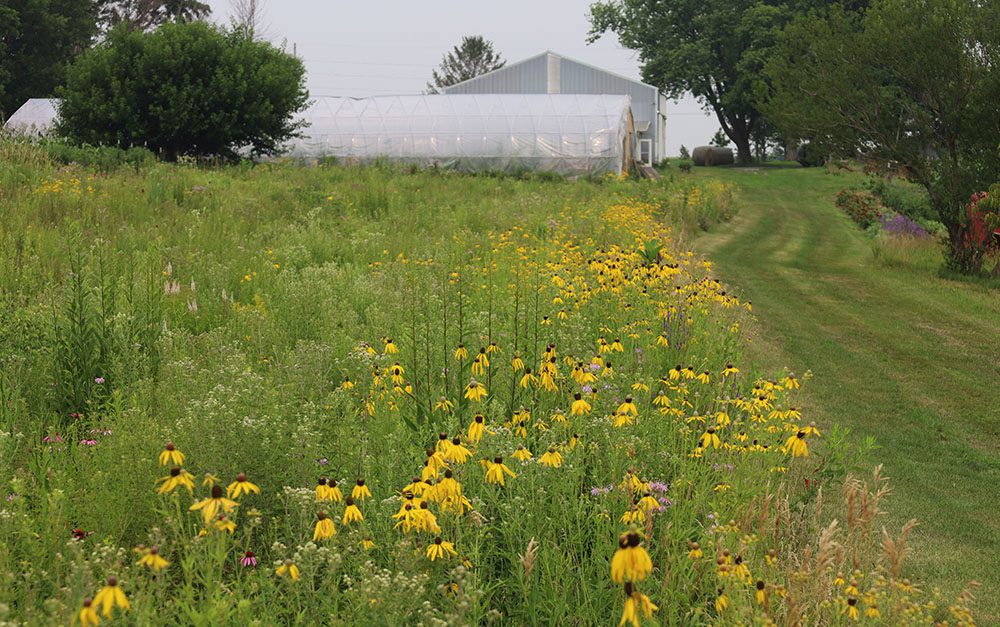
The Yellow Coneflower and the Monarda are just entering peak bloom in two small fields that are within a couple of miles of our farm. Each of these plantings are new within the last few years, and were funded by the Federal Pollinator Habitat Initiative (CP-42) under the Conservation Reserve Program (CRP). Along with the Conservation Stewardship Program (CSP), these are initiatives that are part of the Farm Bill of which I have seen positive results.

While it is important to recognize that these programs are, in my opinion, not enough to address a whole host of problems that come with large-scale, chemical-intensive cropping systems, they do illustrate for us the potential we have to be better stewards of and partners with our land.

farm field grass

Giving water a place to be

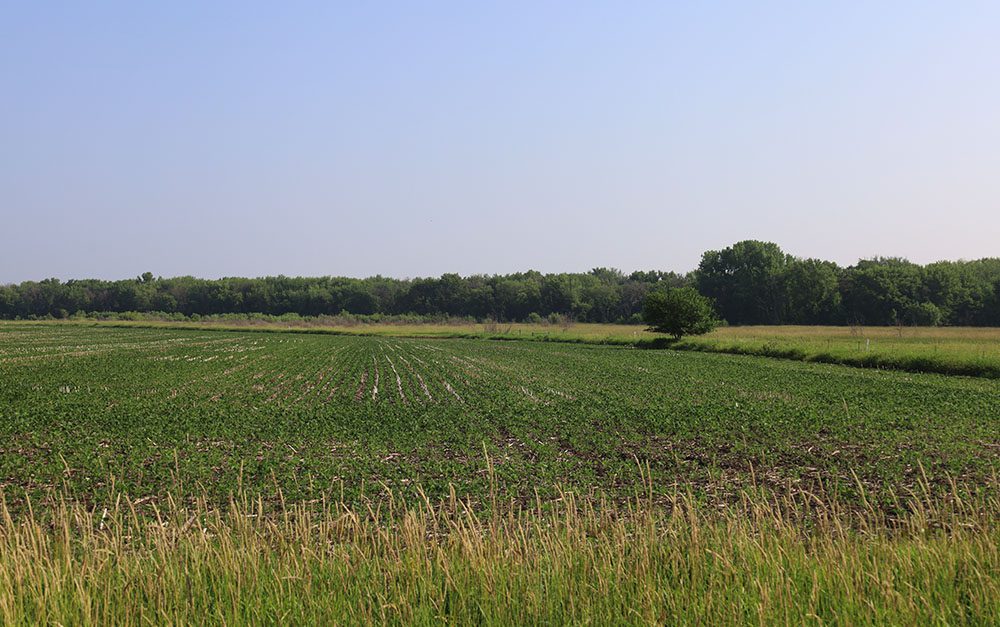
During the first seven years we lived at the farm, we observed the frequent occurrence of flooding in a field a few miles away and adjacent to the Wapsipinicon River. Each year, the land was planted with corn or soybeans. And, most years, a flood would damage the crop and wash valuable topsoil away.

Thankfully, the landowner eventually accepted federal assistance to take that land out of production and put it into perennial plant cover. While they still plant the higher ground in corn and soybeans, the low ground is now built to handle the ebb and flow of a river that is being asked to deal with more frequent heavy run-off as extreme rain events have become more common in this part of the world due to climate change.

This also means there is more space for Red-winged Blackbirds to nest and Dickcissels to sing.  Wildlife has a bit more of a corridor to travel as they seek food and fresh water. And our eyes are given the opportunity to see something other than another corn or soybean field in Iowa.

That, in itself, is good for my soul.

farm rows

Letting water move without taking soil with it

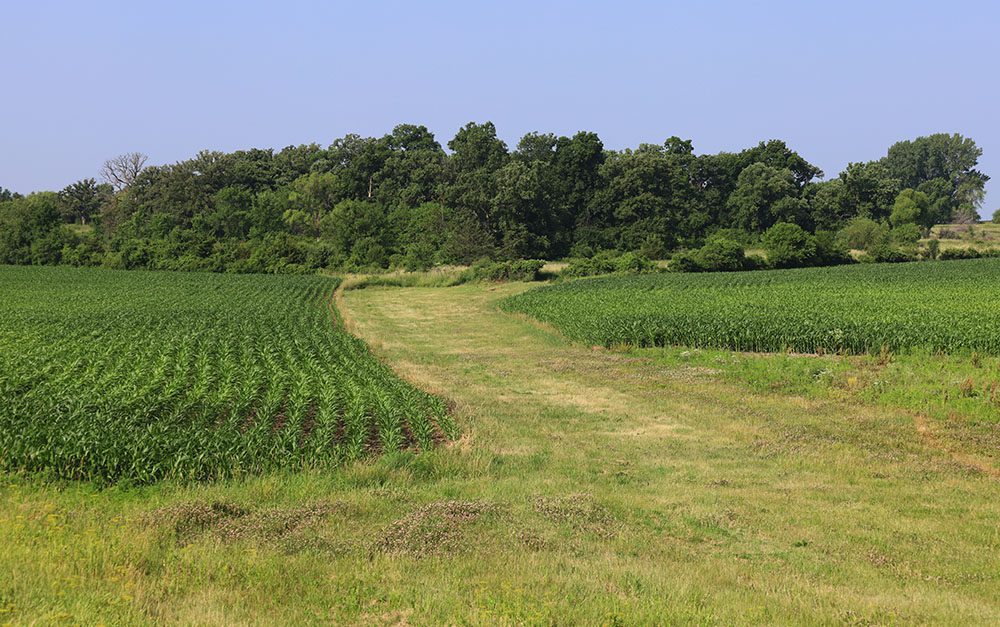
Some row crop farmers also take advantage of federal funds that are part of the Farm Bill to seed down parts of their fields with perennial cover crops where water run-off typically goes. In Iowa, they often select grasses that they can cut, bale, and use for animal bedding or feed during the winter months.

Sometimes these waterways are fairly generous, like the one shown above. But there are still many fields where no effort is made to identify where water runs. These fields often show deep runnels where soil has washed away during the spring rains before the annual crop has had a chance to establish significant roots in the ground.

Funding for programs like these help farmers do things that are better for the land. This is especially true when we consider those who work on smaller family farms, where the budget for these sorts of projects is often tight. My observation for where I live is that these farms are typically more likely to seek out and follow through with these projects, while the larger, corporate farms are happy to seek out the funds, but not as happy to take any land out of production.

farm wildflowers

Impacts go beyond a single field

While it is true that there are farmers who would act on their heart’s calling to be a steward of the land without external support, it is also true that this support makes it easier to do just that.  And, we need to remember that the success of one field of pollinator habitat, or a wetland area, or even a single in-field waterway, has impact beyond the borders of the land where the project has been undertaken.

We have noticed that a few wildflowers have moved into the ditches by the road between our farm and the nearest pollinator planting. We have also noticed the diversity in the populations of pollinators on our farm have improved slightly. While we are still concerned about the overall health of these populations due to the extreme use of pesticides in our area, we also see the power of nature, as it shows us it is still interested in sharing the beauty of the world around us.

The projects that are undertaken to handle the flow of rainwater also have impacts beyond the borders of the fields where they reside. A well-placed waterway planting can keep more soil on the land and less in our rivers and the Gulf of Mexico. A wetland near the Wapsipinicon River not far from our farm can absorb and slow the flow of floodwaters before they reach communities downstream, possibly making a difference in many lives.

Maybe these programs aren’t the perfect solution, but they can be a part of moving towards better solutions. I want to make sure we don’t walk backwards and take even these pieces of progress away in future versions of the Farm Bill – because look at the positive results that even smaller efforts can provide.

Thursday, August 3, 2023

Screwy Data

When I walk behind a wheel hoe or run Barty (the walk-behind tractor) around the farm to prepare ground or cultivate, I find that my mind is able to multi-task fairly well.  Obviously, I have to pay consistent attention to what I am doing so I don't destroy plants I want to keep with the wheel hoe and the stakes are higher with the walk-behind tractor.  With Barty I can both destroy plants AND potentially do a bit of harm to myself or whatever else gets in the way.

Now, if I am cultivating with Rosie, the tractor, there is usually even less brain multi-tasking going on because that tool has even more potential to do harm.  But, I digress...


In any event, my brain can go all sorts of places when I am walking back and forth between 400 hundred foot rows of veggies.  One place it went to recently, much to my surprise, was my eighth or ninth grade science class.   I don't recall for certain which, and that doesn't matter.

Different Abilities
The instructor for the class was Mr. Rasmussen and he was, generally speaking, a capable teacher.  Certainly, as far as I was able to tell, he knew plenty about what he was teaching and I actually liked most of the things we covered - which is saying something when you are talking about middle school.

Everyone who is reading this knows this is going somewhere - so let's just get right to it.  Mr. Rasmussen had a host of physical challenges.  When he walked, it was with a shuffle that made it look like he could topple forward with each step, his arms hanging at his sides as if they might be too heavy for him.  There were days when Mr. Rasmussen would remain seated for the entire class.  He spoke as if his tongue were two sizes too large for his mouth and the rumor (I never found out if it was true) was that he had had polio when he was younger.

Sometimes he would try to give a demonstration in class that required measuring out some liquid into a glass tube.  He would start with one tube with too much liquid and try to pour from that tube into a second tube to get his required amount.  It was painful to watch as he would pour the liquid from one tube to another.  The shaking of his hands and arms made it virtually impossible for him to get what he needed.

The entire class sat there and watched, unsure of what we should do.  I could tell that some of the members of the class were inclined to just think it was funny and others thought it was sad.  But, in general, it was supremely uncomfortable.  You see, Mr. Rasmussen did not seem to want help, though he did accept it when one member of the class offered to pour it out.

I certainly learned from Mr. Rasmussen, but I suspect I learned more after the experience than I did during it.  Or - at least - I didn't fully realize what I was learning at the time. 


A Lesson Learned

One of the things I learned is that it takes a great deal of bravery to break away from the crowd.  When you add to it the uncertainty that comes with being a young person who is not sure if you are supposed to help....

I remember a good deal of internal pressure and debate when we witnessed our teacher struggling.  I would feel embarrassment on his behalf, but then I would berate myself that there was nothing to be embarrassed about.  His body only allowed him to do so much and there was no shame in that.  The next battle was whether or not he would appreciate help and whether I dared to step forward and offer to change what was going on.  I knew the answer - but then I had to fight my own shyness that was at its peak in middle school.  That, and as a middle school student, I still ran on the training that you waited for the person in authority to direct what was going on.

Mr. Ed Rasmussen

I would like to say that I was the student who finally won the battle and volunteered to help.  But, I wasn't.  Instead, I desperately wanted to be that person.  All the while, I felt a flood of relief when it was someone else who finally stepped up.

Good Data / Screwy Data

When our class would do a lab, he would shuffle from table to table, checking on our progress.  If things were going well, he would approve by saying "Good data!"  If you had made some sort of mistake, his response was always "Screwy data!"  I learned to appreciate the complement that was "good data" and I was determined to avoid "screwy data."  Such is the life of a kid that gets positive reinforcement by academic success.

The desire to achieve "good data" overrode my reticence to try new things in front of an audience.  I have to admit that lab and hands-on courses terrified me at that time for that very reason.  I would very much prefer to try things out without others nearby to witness potential failure or - even worse - see that I did not quite understand what was going on. 


Stepping Up

Stepping up and doing what seems like the right thing always sounds so easy when we say it.  But, if it is really all that easy, why don't we do it more often?  A big part of it is because you and I are all too worried about what others will see and think about us.

Happily, I have changed a bit since middle school.  Sadly, I still lose the battle with myself to do the right thing too often.  But, as far as I am concerned, hearing the words "screwy data" even once is too many.

And so, I find that I try to push myself a bit every day to stand up for someone else just so I can hear Mr. Rasmussen say "Good data" in my head.  Sometimes I do something small like writing a blog that addresses difficult things.  On other days, I speak up when I hear someone say something that is cruel or inappropriate.  Once in a while, I'll stop the truck and help someone at the side of the road who needs it.  There are times when I volunteer to do something to help someone else - even if it isn't something I want to do.

Here's to you Mr. Rasmussen!  Thank you for stepping up.
That's good data.

Wednesday, August 2, 2023

Long Days


It's true.  The daylight hours are getting to be fewer each day as we enter the month of August.  It's also true - the days can be plenty long when you have a small-scale, diversified farm to go along with an off-farm job for each farmer and a life we'd like to live in addition to all of that!

Tuesday turned into a very long day after Monday was a very long day.  But both were long for different reasons.

Monday's long day started because we wanted to prepare for the arrival of some contractors at the farm to help jump-start a farmhouse project.  As many of you know, the kitchen area is often the center of the house.  So, it's a pretty big project when you need to shut it all down and move stuff out of the way when it involves the kitchen area.

The good news?  We were pretty well prepared for their arrival and the project we asked them to do was completed (up to the point we hired them to work).  The true completion of the project is up to us, of course.

Tuesday's long day started with Tammy heading out to try out some kayaking very early.  Rob tried to get out and do some farm work during the cool hours, only to be diverted by evidence that rats were predating on our broiler chicks.  After doing what I could do on that front, I had to drive to pick up feed for our poultry - and we were off and running.

The day ended after the sun was going down and we were moving the chicks into different containers that we hope will be "rat proof."   We're also hoping to find some rats in snap traps in the morning instead of dead chicks.

And that is the anatomy of a truly LONG day at the farm.  Start it with dead chicks and rats and end it with live, safe, chicks and very tired farmers.

Tuesday, August 1, 2023

Who Said You Could Have a Routine?


At some point this past Winter, I was asked if I had any particular lessons I had learned after (mumble mumble) years of farming.  I was actually honored that someone was asking me that question, because that implies that at least one person has some respect for my thoughts or maybe my farming - misguided as they might be.  And, I actually like that question a lot because it encourages me to reflect, reframe and relearn.  All things I think can be very good for my mental health.

I gave what were probably some common lessons that other farmers might throw in there.  Things like, "always make sure the gate is properly latched."  Or, "a big part of the job is about how you treat water and soil."  But, there was one that actually still has me thinking because it explains some of the struggles growers on small-scale farms face.

The lesson is this - "finding a successful farming routine is a myth."  And by that, I mean an invariable routine.  A sequence of things you do daily, or monthly, or even yearly, that will almost always give you predictable results.

Certainly, there are things that could be considered a routine of sorts.  We feed and water the animals every morning and we get them safely to their shelters every night.  But, even that routine changes as the year progresses, or as the weather dictates, or as life changes require, or....

Well, you get the picture.  

For example, our routine for dealing with our animals has changed pretty dramatically over the past week.  We moved the laying flock to a new pasture area.  We moved the henlets to a new location.  We added broiler chicks to the mix.  We had to address a problem with raccoons in the laying hens and now we have to address an issue with rats and broiler chicks.  The overall routine is still food, water, shelter - but the execution is very different now.

Just when we had settled into what one might think was a pretty good routine, we went and changed all of that up.

The reality of a small-scale, diversified farm is that the routine routinely changes throughout the year.  Transitions are continuous and success is largely in how you navigate those shifts that may or may not follow the grand plan you had set out with at the beginning.

You know what?  This is a great topic.  Maybe I'll write on it more.

Once I get used to the new routine.

Monday, July 31, 2023

Calm After the Storm


Once the storms cleared out on Friday and the rain was over, we went outside to do the remaining farm chores.  We'd already shut down the high tunnels in case the ominous clouds packed any poofs that would send our hoop buildings into the next county if they were left open.  Tools and any items that were a risk to taking flight in nasty weather were also already put away or under shelter.

But, we still needed to put the chickens to bed.  So, we stepped outside as the sun was setting in the newly clearing skies to the west.  

Then I stepped back inside to grab the camera.

I looked for ways to show the contrast of the sunset colors with the impending darkness.  I took experimental photos from different angles and from different locations too.  Some of them actually turned out pretty well. 

I was able to catch some Mammatus clouds that appeared over the Poultry Pavilion once we walked to the north side of the farm.  Their presence at the back edge of the storm, not far from the cloud edges that were collecting the last of the day's sun, was not a surprise to us.  But, they do add some interesting texture and drama to the sky.

As we approached Crazy Maurice, our Weeping Willow friend who is hosting the laying hens in their Summer Cottage, we were treated to some other dramatic scenes.

There was still a heavy rain cell to our northwest and they obscured the last as the sun as it dipped below the horizon.  They also provided interesting contrast and depth.  A few scud (or Fractus) clouds were still evident as they tried to decide if they wanted to keep up with the weakening rain cell or just float away.

The truly good news about the show in the sky was that it gave us both something to look at as we waited for the chickens to decide it really WAS time to go to bed.  This putting the laying hens to bed thing is going to be just that... a thing... for a while now.  

The Summer Cottage has a board that serves as a ramp to give the hens better access to their shelter.  So, unlike the Poultry Pavilion, where they had been housed before, there really is no good way for us to herd the birds into the room.  There's not much for it except to wait - patiently or not - until they all make the slow decision to climb the ramp and seek out a perch.

Not every night is going to have a storm and a sunset show to provide interest to the evening's tasks that we do on the farm.  But that's ok.  If it happened every night, it would cease to be special.  But even if it did happen every night, I'd like to think that I would still appreciate seeing it and that I would find myself being much more patient as I look at the sky...

and wait for our poultry decide their day was done. 

Sunday, July 30, 2023

For What Ails You - Postal History Sunday

If you are new to Postal History Sunday, you are most welcome!  If you are returning, you know what to do!  Grab a snack and a beverage and pull up your favorite chair to join the rest of us.  Maybe we'll learn something new together this week?

Oh - and before we get started, we need to take those worries and troubles and spread them on the bottoms of your shoes.  Put those shoes on and walk around outside for a few minutes until you've successfully wiped them off and you can't recognize them anymore.

There - now we're ready!

The 1893 Columbian issue of postage stamps

Like so many collectors of United States stamps, I always held the 1893 issue that commemorated the landing of Columbus as something I would love to obtain a complete set of someday.  This is a tall order because there are sixteen different stamps in the group and the last five have denominations of $1 through $5.  That translates to a significant chunk of change if you want to collect a whole set.  Why?  Well, they don't cost a couple of dollars anymore - they can cost a whole lot of dollars!

The most common denomination is the 2 cent stamp.  There were lots and LOTS of these printed and you can find pretty much as many of them as you would like if you wish without spending much money at all.  And, if you would like to collect postal history with that stamp, you can do just fine on a limited budget.

For example, here is a fairly common piece of mail from Stoughton, Wisconsin to Madison mailed in the 1890s.  I like it because we used to live in Madison and we had friends living in Stoughton.  There's a personal connection which makes it a little more interesting for me.

I have a long-standing goal to see if I can find a piece of postal history showing each of the Columbian stamps that have a denomination UNDER the $1 value.  I suspect I won't allow myself to spend what it would take to get those with $1 and up denominations - and I am okay with that.  The majority of the items with dollar values on cover typically fail to show payment of an actual postage rate.  They were often mailed to or from a collector who overpaid the postage needed - just to get a postally used copy of that stamp.  There's absolutely nothing wrong with that, it just doesn't appeal to me enough to want to build up the funds and then spend the money. 

After all, there is enough of a challenge (and reward) finding the lower value stamps properly paying a postage rate as it is!

Along Comes the Otis Clapp & Son Correspondence

If you are a postal historian, you recognize that we owe a debt to those who kept all of their old envelopes and wrappers and we owe an equal debt to the subsequent caretakers of this material who eventually allowed someone to acquire them for collecting purposes rather than burning them!

There are a fair number of items that were addressed to or sent from Otis Clapp & Son.  Most of the material appears to be the address and postage portions of packages that were wrapped in the typical brown paper used for parcels at that time.

Above is a package front addressed to Otis Clapp & Son of Providence, Rhode Island.  Total postage is 45 cents, including a 30 cent and 6 cent Columbian issue stamp.  For those of you keeping track at home, the Columbian denominations under one dollar were 1, 2, 3, 4, 5, 6, 8, 10, 15, 30 and 50 cents.  So, I can cross off the 30 and the 6 from that list!

Unfortunately, the mute cancels are smudged and unreadable if they had any words on them in the first place.  And, since there is no return address on this package piece we cannot ascertain where it was mailed from, nor can we be absolutely certain as to the year it was mailed.  

However, it is a fairly safe bet that this item was mailed in 1893 simply because the 1 cent and 2 cent issues are from the stamp series that was commonly found at post offices from 1890 to 1893.   The stamps with most common use (such as these low value stamps) tend to make their appearance on postal history items closer to their dates of issue.  If this package were mailed in 1895, for example, we would expect the designs of the 1 and 2 cent stamps to match a newer series of stamps issued in 1894.

Wait!  You want to know what I mean by a "mute cancel?"  

Let me remind you of this stamp:

The oval cancel has city name "Boston" across the top.  If you look at the oval cancels on the package wrapper, you will see no indication as to the town and there doesn't appear to be a date either.  They have nothing to say - hence they are mute.  It's not my term, but it is the one used in the hobby to indicate that no city or date is included in the postal marking.

Internal Fourth-Class Mail 1879-1912

Since these are package fronts, we cannot be certain, but it is a good, educated guess, that the contents fit the definition of fourth-class mail.  Essentially, anything that was not classified as first, second or third class mail fell into this final class of items that could be sent via the postal service.  This included various merchandise, including the types of materials Otis Clapp and Son might ship out or receive. 

The rate was very simple - 1 cent for every ounce up to 4 pounds.  And, this postal rate was effective from May 1, 1879 to December 31, 1912.  Thus, the item above would have weighed 45 ounces (2 lbs 13 oz) if we agree that it was a fourth class mail item - which I think is an accurate conclusion.

A similar, third-class mail rate was 1 cent for every 2 ounces and was applied to all types of printed matter packages, such as books, circulars and newspapers.  It too, had a 4 pound limit, which eliminates it as a possibility for the package front shown above (at this rate, it would have weighed over five pounds, which was not allowed by regulation).

The item shown above is franked only by a 15-cent Columbus stamp and is likely an example of a 15 ounce package mailed at the fourth-class rate.  However, we cannot rule out the possibility that this was printed matter carried in a wrapper, making it a third-class rate.  We may never know for certain, and that's just the way things are sometimes!  But maybe we can figure out the most likely solution and accept that as good enough.

There are two options to describe this one:

  1. It was a catalog or some such printed item that weighed 30 ounces and was mailed as a third-class mail item.
  2. It was merchandise of some sort that weighed 15 ounces and was mailed at the fourth-class rate.

Thirty ounces is a pretty hefty catalog for a specialized company like J. Ellwood Lee and Co, so my conclusion is that this was also a fourth-class mail item.

Unlike the first item, we have no other other clues to help us determine a likely year of mailing.  And, just like the first item, we have no postmarks that will help us.  However, a quick history of the J. Ellwood Lee Company gives us an idea that, perhaps, we should not be surprised if it was mailed somewhere in the 1893-1894 period.

J. Ellwood Lee Co

The J Ellwood Lee Company of Conshohockem, Pennsylvannia, (say that town name three times fast!) was a well-known supplier of medical supplies, such as rubber gloves, ligatures, rubber tubing, as well as other medical equipment.  

John Ellwood Lee was born in 1860 and started the business in the attic of his parents' home in 1883.  By the time the Columbian Exposition came around (the time when the Columbian stamps were issued) in 1893 his company was quite well established.  J Ellwood Lee Company won five gold medals against international competition at the fair.  The company's involvement in the exposition doesn't make it hard to see why Columbian issue stamps might be on some of their mailings.  A proud winner of five gold medals was celebrating by using the stamps issued in conjunction with the exposition to mail product.  It seems unlikely that he would have purchased so many stamps that they would be in use too many years after 1893.

This article on the Pennsylvania Heritage site can provide more detail on J Ellwood Lee if you find that interesting. 

Oddly enough, Johnson & Johnson (yes, that Johnson & Johnson) purchased J. Ellwood Lee Company in 1905, placing Ellwood Lee onto its board of directors. 

Supposing this package held rubber tubing (not a bad guess giving Otis Clapp & Son's activities), 15 ounces could have held a reasonable amount of tubing.  Below is an invoice that was on an online auction site (image no longer available).

The invoice shows an 1894 purchase of reels of silk - presumably used for stitches.  Given Otis Clapp & Son's focus as a pharmaceutical business and the advertising on the front, I think it more likely that the second package front carried some sort of rubber tubing - but it is still only a guess.

Antikamnia Chemical Company

Above is an item that bears 51 cents in postage to carry a package that must have weighed three pounds and three ounces of weight.  Unlike the other two, this one was sent from Otis Clapp & Son to a customer in St Louis, Missouri, the Antikamnia Chemical Company.

Once again, we have a 1 cent stamp from the 1890-93 definitive issue that encourages me to believe that this, too, is an 1893-94 mailing.

The Antikamnia Chemical Company (established 1890) was known for its powder and tablet products to reduce pain.  The main ingredient, acetanilid, was sometimes mixed by this company with other active ingredients such as codeine, heroin and quinine.  The initial efficacy of acetanilid rested on a single German study of 24 patients, but Antikamnia is known for prolific advertising to maintain sales of this product even after running afoul of the Pure Food and Drug Act of 1906.  

In his article, William Fiedler (see resources) states that "Antikamnia, representing a therapeutically acceptable remedy for which many totally unfounded claims were made, could well be called a 'pseudo-ethical pharmaceutical.'"  Fiedler's article does a fine job of outlining the history of this company for those who have interest.  The founders, Frank Ruf and Louis Frost, both later laid claim to the ideas that started the business and Frost was forced to sell his share of the company in 1892.  

The bookmark shown above is not in my possession and was found as an offering on Etsy.  An interested person could find numerous items showing advertising by each company highlighted in today's Postal History Sunday with a little looking.

Otis Clapp & Son

Otis Clapp first opened his retail homeopathic pharmacy in 1840 and the company Otis Clapp & Son was still operating until it was purchased in 2008.  Oddly enough, you can find the company advertising various homeopathic remedies over a long span of time AND you can find it listed as a publishing company.

By all accounts, Otis was a remarkable individual, serving in the Massachusetts House of Representatives, is listed as a founder for M.I.T., the Boston Female Medical College and an orphanage. 

Otis' son was also quite remarkable.  Dr. J. Wilkinson Clapp was a professor of pharmacy at the Boston University Medical School and put emphasis on research.  A decent outline of their history can be found at the Sue Young Histories site.  Sadly, the old Otis Clapp company site with the company history has been taken down, so I can no longer reference it.

Apparently, Otis Clapp bottles are a fairly popular collectors item.  These bottles were found on the Antiques Navigator site. 

What I find interesting in all of this is the connections these three pieces of postal history make within the medical and pharmaceuticals fields.  Clearly, Otis Clapp & Company was populated by exceptional people and the early stories surrounding that company are generally positive.  Similarly, J Ellwood Lee was seen in a good light - even by employees well after he could have been excused from personal interaction with the workers.  In both cases, the primary players saw significant success while being regarded as good and honorable individuals.

On the other hand, the founders of the Antikamnia Chemical Company could be said to have found financial success, but there is some question about the ethics and product quality that went along with it all.  It could be interesting to uncover how Clapp and Lee might have felt about Antikamnia in the 1890s.  Maybe that's a project for another day? 

But, perhaps we should get back to the postal history stuff now?

Why the Ugly Cancellations?

The postal markings available to us on these parcel fronts are far from helpful to the postal historian.  However, they did the job they were intended to do - deface the postage stamps so they could not be re-used.  

Most third and fourth class mail items were struck with cancellation devices that did not include a date and sometimes did not even indicate a city/town of origin.  In the fine book by Beecher and Wawrukiewicz (see resources), they suggest that these 'mute' cancels purposefully eliminated the date to not call attention to the speed of delivery of this type of mail.  

We need to remember that all sorts of things were being mailed in fourth-class.  Sometimes an item would simply have a mailing tag tied to it.  With all of the different sizes and shapes, shipping could provide some interesting puzzles for the postal service.  It is no wonder that it might take longer and it is understandable that they did not want to give customers any additional ammunition to complain about the speed of delivery.

Not all of these cancels were perfectly mute - often giving a town name.  It is possible the markings on the items shown today had such text, but I can't make it out if they did.

As far as the quality of the strikes are concerned, we can also surmise that the package surface was rarely as stable as a flat letter on a solid table top or mailing counter would be.  It does not take much of an experience with a stamping device to figure out exactly how hard it is to get a clean strike on an unevenly supported surface.

Thank you for joining me this week.  I hope you have a great remainder of your day and a fine week to come.

Resources:

H. Beecher and T. Wawrukiewicz, US Domestic Postal Rates, 1872-1999, 2nd ed.  ( a newer, third edition to 2011 is now available) 

Fiedler, William C. (1979). "Antikamnia: The Story of a Pseudo-ethical Pharmaceutical". Pharmacy in History. 21 (2): 59–72

-----------------------------------------------

Postal History Sunday is published each week at both the Genuine Faux Farm blog and the GFF Postal History blog.  If you are interested in prior entries, you can view them, starting with the most recent, at this location.

Saturday, July 29, 2023

Farmer Jitters


I have the advantage that I can (and do) read weather forecasts and view various weather maps.  I also have some experience with being outdoors at our farm and seeing all kinds of weather rolling in.  So, with the knowledge that there was going to be a fairly big change from hot, humid conditions to much cooler, drier air, I knew there might be something up with Friday's weather.

As the day rolled on, I could feel the energy.  I saw clouds that told me something could certainly come of it starting at about 1 PM in the afternoon.  And, I let Tammy know we needed to watch for things coming out of the west as the day progressed from there.

I started the day alert for the possibility.  Then as I saw the signs that severe weather was going to be likely in our area develop, I got downright jittery.

The good news for us?  Well, the gravel road in this picture heads straight west.  Most of the nasty is to the left (South), so we got the edge of the front line of storms and then a nice downpour followed a bit after that.  Even better for us, more nasty weather broke to our North as well.  We got about an inch and a half of rain and maybe some tiny bits of hail - but that's it.

Still, it was an impressive storm as it went over.  Things were dark enough at 6:45 PM that our solar lights decided it was time to switch on.

Apparently a funnel cloud was spotted to the south of us maybe eight to ten miles away.  Close, yet so far away.  We even saw what looked like a little spin-up to our East after the squall front passed.  Nothing serious, but certainly an indication of unstable air as Mother Nature looked to sweep some of the hot and soupy air away from us for awhile.

And maybe the farmer can get over the jitters.

Friday, July 28, 2023

Go To Bed Chickens!


Go to bed chickens, it is getting darker and the sun has fallen below the edge of the earth.  

Go to bed chickens, the farmer's eyes are getting heavy and he doesn't want to watch you do your chickeny things any more today.

Go to bed chickens, there will be moths to chase and food to eat and eggs to lay in the morning.

Please... just... go to bed chickens.

The laying hens have now spent three nights in the Summer Cottage out by Crazy Maurice, the Weeping Willow tree and resident tree-friend to farmers.  That means the hens have had two nights to test the farmer's patience in a new location as they dawdle about trying to decide if it is time to... go to bed.

The first installment of a short, three-part series is shown above.

The second installment is shown below:

The nice thing about chickens is that they typically will go back to the place where they woke up in the morning.  This makes moving hens relatively easy.  Though there is always an exception or two to the rule that you might have to deal with.  That's why I was maybe a little bit more interactive with the last few birds in the videos.

You see, we have had some adult laying hens decide that the running gear under the Summer Cottage is a fine place to roost too.  While they might be fine there overnight because we have electric netting around their pasture, the birds that roost there often leave their shelter early enough to be in prime owl hunting time.

That reminds me of Clyde.  Clyde was a chicken and Clyde had guts.  We know this because an owl got Clyde one morning and the only evidence that Clyde existed at all were his... um... guts.  

Here's part three of the video series.

I was told by someone some years ago, when I made that joke in a blog, that it was in bad taste.  I am certain if Clyde were still with us, he would agree.  But I bring it up again to remind everyone who does not work with farm animals or nature quite as closely as we do that we witness some not so nice things.  It's part of life (and death) on a farm and one way to help yourself cope is by having some sense of humor about it.

And, by telling the chickens they really do need to go to bed.

Thursday, July 27, 2023

Low Cloud Cover

One of the advantages, if you can call it that, of having a phone that also has a camera is that you can capture a moment in time without having to go out of your way to find the camera.   Sadly, the quality of pictures are inferior.  But, it still means that I was able to record a couple of moments on the farm that would otherwise have been missed.

The mist rises late on a May day

I admit that I fought moving from the old flip phone for some time, just as we delayed moving from a land line.  It is not that I don't appreciate what a person CAN do with a "smart" phone.  It is more that I do not appreciate some of the things these phones seem to encourage people to do (and not do).

But, this blog post is not just a rant about phones.

So, what IS this blog about, you ask?

That's a great question!  And, when I started the blog I was not entirely sure where it was going to go, but I knew the root of it would have something to do with the pictures I discovered on my phone.  That, in turn, made me think about phones (as you just saw).  I rapidly moved past that to consider the 'why.'  Why do I tend to adopt new technologies slower than many people?  This might seem especially odd given my education in Computer Science.

Here comes another squall line!

Sometimes I see new technologies as something akin to the storm that is approaching in the photos above and below.  You see them rapidly approaching from the horizon and they look pretty impressive at the outset.  Before you know it, they're on you and the weather they bring is not always all that beneficial to you.  Sometimes, the promised rain is barely more than a drop or two.  Other times, the damage caused by the storm is far greater than any promise there was for a beneficial rain.

Technology can be a lot like that.  Gee, this new technology is going to take the world by storm!  Nope, never mind... Or, that sure looks impressive.  Just think of all the good it will do!  Nope, never mind...


A friend of mine in college, who also happened to be someone I had great respect for, told me that they regretted taking a class on the analytical study of music.  Why?  It was because they felt it actually was reducing their appreciation of music as a whole because they were, perhaps, getting into the music so deeply that it was difficult to merely listen without starting to deconstruct what was there.

In a similar fashion, my studies in computing made me very aware of all that goes into technology.  Because of those studies, I tend to deconstruct new technologies and immediate look for unintended consequences that might follow or ways people are likely to misuse something once it is developed.  I am also fully aware that many 'new tech' items are simply vaporware - unable to deliver on the promise.  As a result, I am not likely to rush towards new tools and I often hold them away from myself until it is required that I use them or I am convinced that their use would truly be beneficial.   Happily for me, my training also makes it a bit easier for me to adapt and properly use the technology once I decide I must use it.

The technologies that seem to find their way into my toolbox are often more like the mist that you see developing in the first two photos.  They have slowly permeated our world until we can't seem to escape their presence - even if we wanted to.  

Wednesday, July 26, 2023

Water Cooler Talk


A common topic of conversation towards the beginning of a work or school day a person might have with co-workers or fellow students/teachers often centers around what people did the evening or night before.  I find that I am typically evasive with my answers because I am fully aware that what I did last night is outside the experience and, often, understanding of a large portion of the population.

If you want to make a connection with the people around you at the water cooler, you need to choose something that most of them can relate to.  For example, a very high percentage can probably see themselves sitting down to watch a television show or a movie at some point during the evening.  So, comparing and discussing shows is a pretty safe way to get into a conversation that is relatable.

You can fairly quickly turn the flow of conversation on or off depending on what you decide to share regarding WHAT you watched, of course.  If you're into some of the currently popular shows, then you'll have a wider appeal for a more animated conversation.  If you pick something like an old British comedy called Good Neighbors, you're going to have to do a fair amount of explaining - and there's no telling how long people will stick around the water cooler to see if they want to learn more about it.

Another really good topic that everyone can relate to at some level is to share what you had for dinner.  Although, you might find the audience will dwindle as you get into the nitty gritty details as to HOW you went about securing or making that dinner.

Another popular subject area that you can talk about is something your kids (or grandkids) did or are doing.  Those who do not have children might check out a bit on that conversation, though I suspect they will nod politely.  But, if you REALLY want to get people to nod politely - while looking a bit dazed - you can tell them that you moved your current laying hen flock from the room in the Poultry Pavilion to the portable Summer Cottage.

Only a very select portion of the population in our world today can fully relate to the idea of moving hens from one location to another on a small (or even larger) farm.  And that's why I often find myself mumbling words like "oh, nothing much," when someone makes the polite inquiry about what I did last night.  Or, I simply make the bold statement, "We moved the hens from one location to another one."  People around the cooler can take it at face value or not.  

It's just that this approach runs the risk that one of those folks are going to ask me to explain what I mean by that.  And that is when the fun begins.

How much can I explain before it becomes obvious that it was only a polite request and the person really did NOT want to know all the details about spreading straw in the portable building we call the Summer Cottage?  They probably did not want to know how we had to wait until dusk to grab the birds from their perches - and chase several of them into corners - so we could put them into that building.  I suspect they're not interested in how we had to mow down an area for the portable electric fence or how we set that fence up.  

And I know they don't want details about sweat dripping down the tip of my nose.

So, go ahead.  Ask me what I did last night and I'll tell you.

Oh, nothing much.