Sunday, November 5, 2023

Dutch Treat - Postal History Sunday

Another Sunday, another Postal History Sunday entry!  This time around, I am dispensing with all of the introduction stuff I seem to like to put up here and get right to it.  I hope that's okay with all of you?

Well, even if if it's not, I'm the one writing it - so that's what's happening today!

Today's question: Why do I like this cover?


A few people sent a comment that they really enjoyed learning why I found a cover with the word "Humbug" written on it to be fascinating.  This was especially true for people who were less familiar with postal history.  This makes perfect sense to me.  It's the process of exploration and discovery that is often compelling.  And, if that's the case, it becomes easier to write with some enthusiasm and bring you all along for the ride - even if you aren't sure why a person wants to collect and study old pieces of paper!

So, I asked myself the question (on your behalf) - why I am I so interested in this envelope that was mailed from New York to the Netherlands in December of 1866, arriving January, 1867?

The short answer is this - this envelope can be likened the scavenger hunt item on the list that is unlikely to be found.  The 27-cent per 1/2 ounce prepaid postage rate using British Mail was only in effect from July of 1866 to December of 1867 - a fairly short period of time.  But, there is more to it than that.

Choices choices

One of the things that makes international mail prior to the General Postal Union so interesting to me is the different postal rates available to send mail between two locations.  Just because you could mail a letter from the United States to Holland for 27 cents per 1/2 ounce doesn't mean that this was the only option.  A person mailing a letter actually had some choices to make, and those choices could change how much it cost and who paid for those costs.

To simplify things, let's focus on how a person would send a simple letter from the US to Holland in the 1860s. I shaded the background for the rate that applies to our first cover to make it easy to see where it belongs.

Advertised Letter Mailing Options - US to the Netherlands, 1860s


British

Open

French
Mail

British
Mail
US
direct
Bremen
Hamburg
Dutch
Mail

1860

yes

yes

- -
-
-

July 1866

-

yes

yes -
-
-

October 1866

-

yes

yes yes
-
-

February 1867

-

yes

yes yes yes -
January 1868
-
-
-
-
-
yes

When the decade opens, there were only two choices for the exchange of mail between the US Post Office and the Dutch postal system.  One used the British mail as an intermediary and the other went through the French mail.  There was no direct agreement between the US and the Netherlands at that time.  

The British mail option is often referred to by postal historians as the "open mails." If a person selected this choice, they could not prepay all of the postage.  The recipient would be responsible for everything except the US costs.  The French mail, on the other hand, would allow the sender to prepay all of the costs OR they could send the letter unpaid if they wished. 

A likely choice: French Mails

So, if a person were to go searching for old letters written in the 1860s that were sent from the US to the Netherlands, it stands to reason that the French Mail rate of 21 cents per quarter ounce would be one of the most likely to be found in this scavenger hunt.  The rate was actually in effect starting in April of 1857 and it was in force until December of 1867.  So, it was available through 80% of the 1860s.

But, being available is only part of the battle.  A service can be available, but people might not select it if it is inconvenient or if it is perceived to be too expensive.  

Well, for six and a half years (1860 to mid 1866) the only other option was to send letters via the British Open Mail, which did not provide the option to prepay all of the postage.  The costs were fairly competitive as well.  There were circumstances where each was a better deal, if a person wanted to do a little shopping.  Typically, French mail was a better deal for very light (7.5 grams or less) correspondence.

In both cases, letters had multiple opportunities to get on a ship and cross the Atlantic each week, so there wasn't much of a time incentive to use one option over the other.

What this folded letter looks like unfolded

This folded business letter, written in Dutch, is an excellent example of a simple letter sent through the French Mails.  The dateline on the letter itself tells us it was written January 24, 1863 in New York.  The earliest dated postmark on the cover is the red New York exchange marking dated January 28.  This does not mean the letter-writer waited until the 28th to get to the post office, instead this was the date of the intended departure of the ship that would carry it across the ocean.

It was a standard practice for the New York Foreign Mail Office to place an exchange marking that featured the scheduled departure date of the trans-Atlantic ship intended to carry the letter.  The 28th was a Wednesday in 1863, which was the day of the week Cunard Line ships let New York City for Queenstown, Ireland.  And, sure enough, the ship named China was to depart on that date - and if you look at the front of the cover you will see the words "per China."  

Like many letter writers of that day, this person was aware of the scheduled mail sailings that went "across the pond" (Atlantic Ocean).  So, while they wrote this letter on Saturday, the 24th, they knew they would not get it to the post office in time for the Saturday ship departures.  We can't know which day of the week they actually took this letter to the post office for certain, but it was some time after Saturday mails closed and before mails closed for the Wednesday ship departure.


This letter is a good example because it is clean, all the postmarks and dates can be read, and it illustrates for us beautifully what a letter from the US to Holland via France looked like when everything went as it should.  It even has some content I can work to interpret some day!

Another worthy choice: British Open Mail
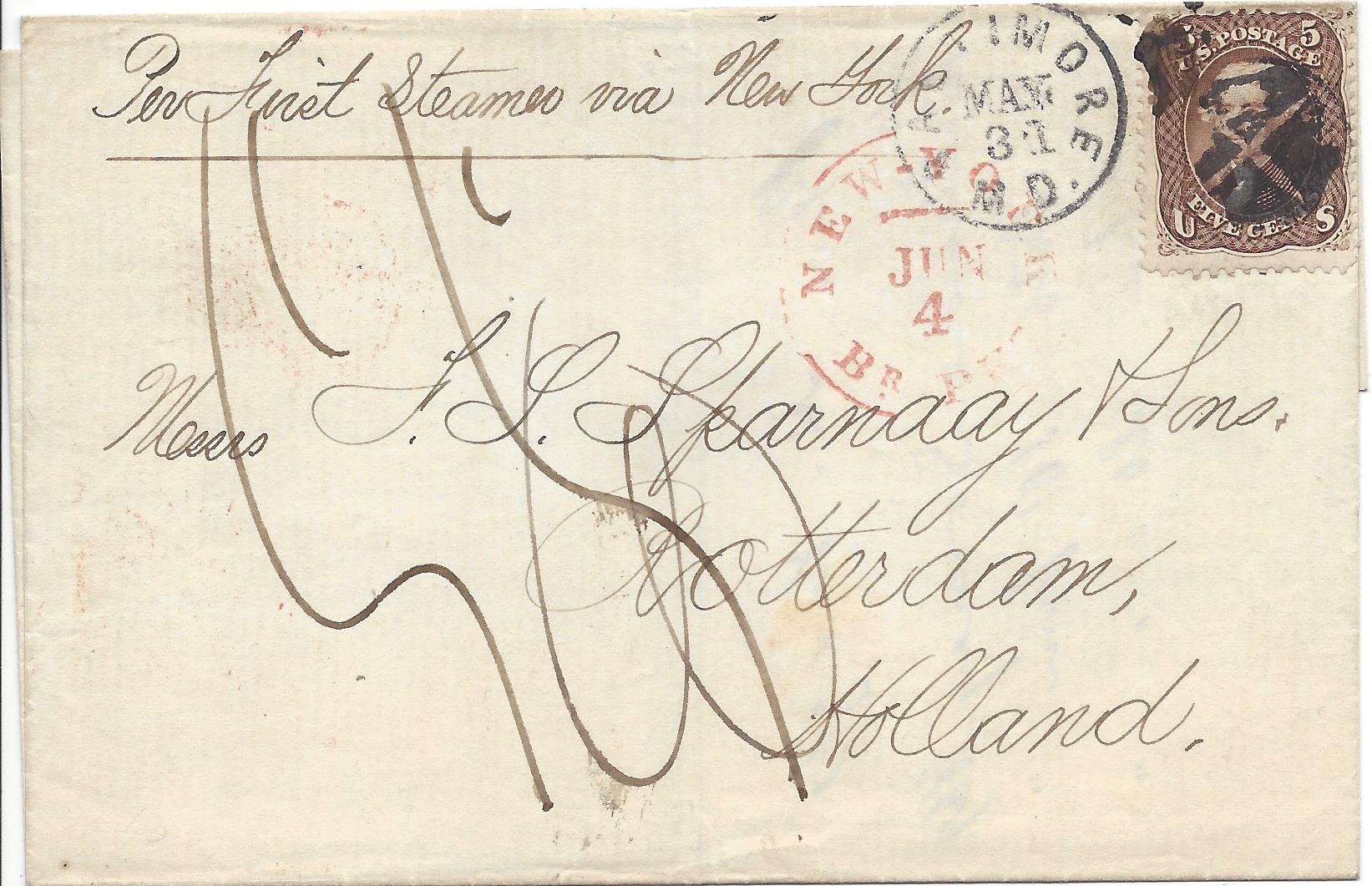
British open mail is a topic that is worthy of its own Postal History Sunday, so I will gloss over some details with our second item because it will probably be featured when I complete an entry on that topic.

This folded letter was posted in Baltimore on May 31, 1867.  A five cent stamp was placed on the envelope to pay only the United States portion of the postage required to get it to Rotterdam, Holland.  As soon as this cover left the control of the United States' mail, it was unpaid from that point forward.  That means the Netherlands treated it as if it was an unpaid letter from... the United Kingdom.  So, they collected 55 Dutch cents from the recipient (the big dark ink scrawl is a "55" for those who want to know!).

The five cent postage stamp essentially paid to get this letter from Baltimore, to New York City and then Boston.  Once it boarded the ship named Africa, all postage costs from that point were the responsibility of the recipient.  This letter left the control of the United States Post Office as soon as it boarded the Cunard Line ship on June 5 in Boston.  

What we need to remember at this point is that some trans-Atlantic shipping lines had contracts with the US and some had contracts with the British.  If this were carried on a ship that had a contract with the United States, the sender would have been required to pay 21 cents, because the sea voyage cost 16 cents for a letter weighing no more than a half ounce.  

Once again, letter writers could use knowledge of ship sailing dates to save themselves (or their recipient) some money.  In this case, the sender's choices resulted in the recipient paying for the sea voyage.


At this point, I am wondering if some of you have noticed a discrepancy within this article?  Did you notice the dates I provided in the opening table for British Open Mail?  According to what I wrote there, this option was not available for mail to the Netherlands in 1867.

I guess you can't believe everything you read - nor could people in 1867, apparently!  Even though this option was not listed in the effective rate tables of the time, this cover clearly was treated just as mail via the British open mail was treated PRIOR to the July 1866 rate announcement.  The Post Office's intention was that the 27 cent rate was to replace the previous British open mail arrangement.  But, not everyone followed that logic and it seems when someone used the "old approach" everyone else just followed along with the old procedures and treated it as if nothing was wrong.

The treasure in the scavenger hunt

This brings us back to our original question - why am I so interested in this particular cover? 

Well, of course, there is a 24 cent stamp from the 1861 series on this envelope, so that plays into it.  That postage stamp and the 3 cent denomination fully pay the 27 cents required for a prepaid simple letter from the US to the Netherlands using the British mail rate effective from July 1866, to December of 1867, a total of eighteen months.

A short effective period for a postal rate is certainly going to make an item harder to find. I don't think anyone reading Postal History Sunday is going to argue with me that it would be harder to find something mailed during the effective 18 months for this postal rate versus eight years (if we only include the 1860s) for the French 21-cent mail rate.

But, we need to remember the other important factor here.  Were the competing mail options more attractive than this one?

The short answer is this - it depends on how you look at it.  And, I also need to remind you that my British Open Mail example was from May 1867.  So apparently, a person could ALSO send a letter via that option instead of paying this postage rate during its active period.  There was more competition than it might initially have seemed.

courtesy of Chip Gliedman

So, how uncommon was it for a person to select this choice over the other options they had at their disposal?  To my knowledge, there are no surviving or accessible post office records that will tell us how much a particular mail rate option might have been taken.  

But we can piece some things together.  For example, we can work backward and search for and study covers from that time period from the US to the Netherlands.  At this point, I can tell you that I have only located two examples of this postal rate being prepaid.  The other is shown above and was once in the collection of Chip Gliedman.

I tell you folks, this is the scavenger hunt item that encourages even a typically stoic individual to raise their voice above a murmur!

Stiff competition

Letter Rates - US to Netherlands
Effective Date Treaty Rate Unit Mail System
Apr 1857 - Dec 1867
21 cents
quarter ounce
French Mail
Jul 1849 - Jun 1866 *
5 cents / 21 cents
half ounce
British Open
Jul 1866 - Dec 1867
27 cents
half ounce
British Mail
Oct 1866 - Dec 1867
17 cents
half ounce
US direct
Feb 1867 - Dec 1867
18 cents
half ounce
Bremen-Hamburg
Jan 1868 - Jan 1870
15 cents
half ounce
Dutch Mail

* British Open Mail was apparently available after June 1866, likely until Dec 1867.

First, we should probably consider that mail volume between the US and the Netherlands was fairly light in contrast to other European nations.  There are records in the Reports of the Postmaster General that can help confirm this.  Also, there was a reason there were mail conventions with the British, French, and Germans, and not the Dutch (until 1868).  The demand to act quickly on an agreement just wasn't there.  

Already, I think you will agree with me that finding mail to the Netherlands will be more difficult simply for that reason.

announcement in the July 1866 US Mail and Post Office Assistant

Now we need to consider that there were years where there were only two available options (French and British Open mail) to the relatively small number of people who wanted to send an overseas letter to Holland.  Postal patrons and postmasters were all used to using those two options and it was going to take some time to get them to remember and use this new 27 cent rate.

Then, we need to consider whether the 27 cent per half ounce rate provided a marked improvement over these existing rates.  If you compare cost to the mailer, it was only better than French mail for a heavier item.  And, if you preferred to make the recipient pay more of the postage, British Open Mail could be used to do that.  So, there wasn't exactly a financial reason to select this option in most cases.

Oct 1866 announcement, click to enlarge

Then, only three months after this rate was introduced, a new, cheaper rate, of 17 cents per half ounce was added for mail that was carried on US contract steamships that sailed directly to Antwerp, Belgium.  While this WAS cheaper, it relied on steamship lines that could not maintain the service.  In fact, it is probably true that finding a cover using this rate is even harder than a prepaid 27 cent rate.  However, this rate's mere existence might have been enough to raise the question regarding the cost of the British 27 cent rate.
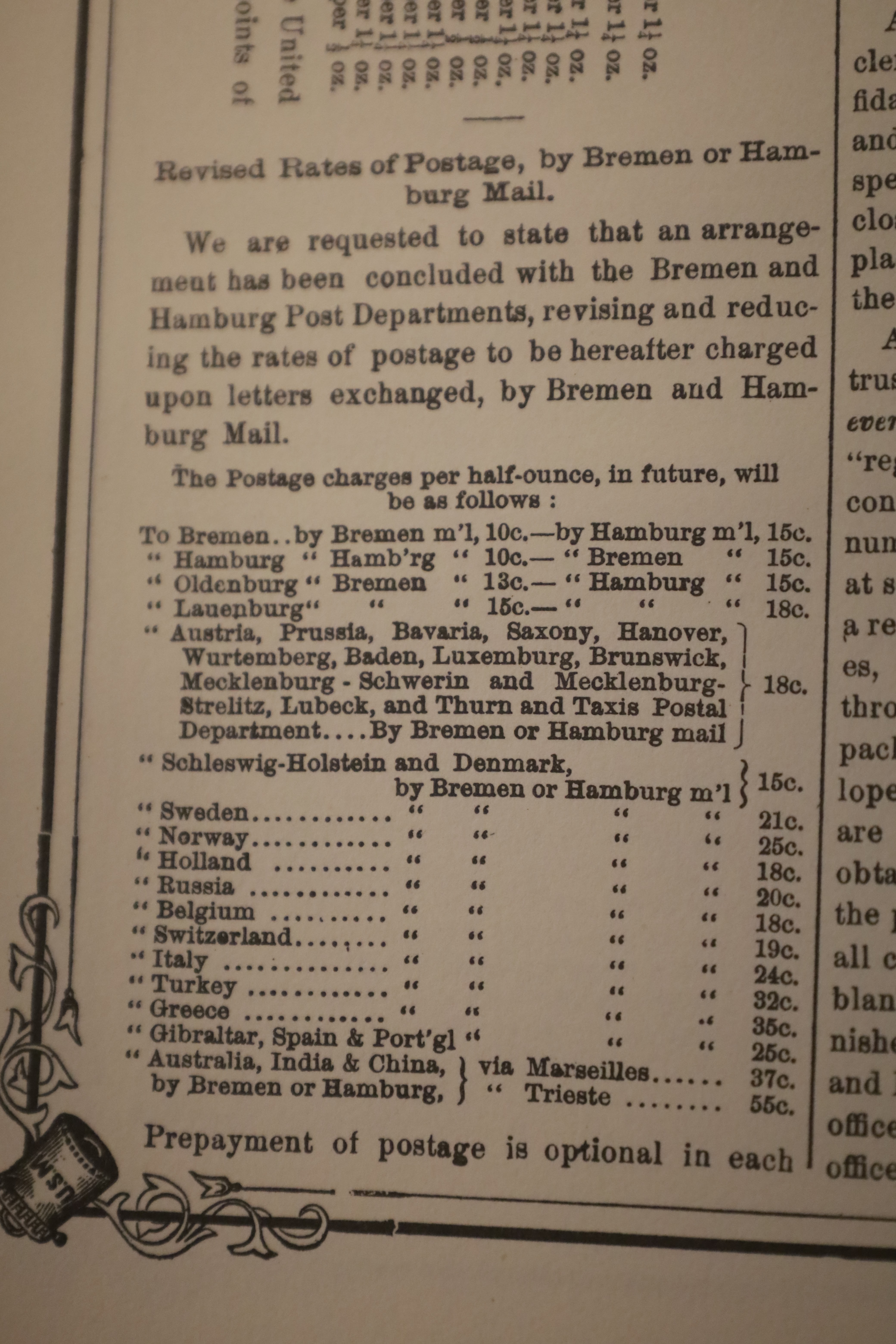
Feb 1867 announcement, click to enlarge

Not long after that, Bremen and Hamburg mails added an 18 cent rate per half ounce.  With a longer history of reliable mail service and established trans-Atlantic sailings to both German ports, the argument of reliability was removed for a service that was less expensive.  Certainly, those who studied mail ship sailing dates could find reasons to pay a little more to shave some time off of the transit for an urgent piece of mail.  But, I am guessing that was a fraction of the customers looking to use the postal services to Holland.

And, one more consideration...

Other than the initial British Open Mail rate, all of the other rates allowed the sender to either prepay the postage or send the letter unpaid and allow the recipient to pay full postage.  This actually means it might be even more difficult to find a cover that shows the 27 cent rate prepaid than I've already argued. Why?  Because it seems to me that sending mail unpaid to the Netherlands was used more frequently than it was for other western European destinations.

As it stands, there probably aren't many examples of this postal rate being used for unpaid mail either.  Dick Winter, a recognized expert in trans-Atlantic mail, states in his Understanding Trans-Atlantic Mail, Vol II, that he has seen less than a handful of covers sent under the 27 cent rate unpaid and he was apparently unaware of any prepaid examples since he illustrated none in his excellent book.

More reason to like it

The rest of the story is tied to my long-standing search for interesting postal history items that bear the 24-cent stamp from the 1861 US postage series.  This postage stamp can be found on hundreds of covers to the United Kingdom.  It's not terribly difficult to find things sent to the German States, France, Italy, Switzerland, Belgium.  I've been aware of letters to Sweden, Norway, Greece, Turkey and other European nations for quite some time.

But, it has taken a long time to find something to the Netherlands.

This makes sense if you consider the postage rates to pay for a simple letter to Holland were all less than 24 cents until this 27 cent rate came along.

In the end, I like it because I can claim success after a very long search.  Maybe that's the best reason of all.  Have a great remainder of your day and a fine week to come.

-----------

Postal History Sunday is published each week at both the Genuine Faux Farm blog and the GFF Postal History blog.  If you are interested in prior entries, you can view them, starting with the most recent, at this location.

Saturday, November 4, 2023

Experimentation


Several years ago, during a cold, winter day, I grew curious about the things I could do with some of the digital images I had at my disposal.  I had some vague idea that I might be able to actually act on some creative ideas I had to promote the Genuine Faux Farm.  But, it was probably more true that I just simply didn't want to do the tasks I knew I had to do on that particular day.

Well, I know longer know if I actually got the tasks done that I needed to do.  That is lost to my memory and is a time past and those tasks, frankly, hold little consequence for how my life has turned out up to this point.  At least, that's what I tell myself now.  Maybe I neglected something that was truly pivotal and I just didn't recognize it.  I guess I'll never know.

And I'm not going to let it bother me.


The evidence of that particular day still exists in the form of a few images that I manipulated using some of the artistic filters provided by the software I was using at the time.  I do recall that there were several other pictures that I either didn't think deserved to be saved or I have since purged them because they did little for me.  A hand-full of them remain.  And I stumbled upon them as I was looking for something else.

In both of the first two images, I suspect I was playing with features that "find the edges" in the image.  These are places where color and contrast are strongest.  The edge of a roof.  The place where the sky meets the ground.  Surfaces that are reflecting the light from a sunset.

Softer edges, like the sunbeams from that sunset against the sky, or the texture of the grasses, require a bit more imagination or inspection to see them.  They are there, but they are much more subtle.

I also tried my hand at some other artistic approaches that either blurred or suppressed fine details in an image.  

One of my favorites is still this one.  The original photo was interesting, but maybe not something I want to hang on my wall as it was.  Why?  Well, the plant material was mostly burr dock and maybe some other weedy things I am not always super fond of seeing highlighted in a Genuine Faux Farm photo.  Their presence is often a reminder of farm "imperfections" I'd rather not think about while I am enjoying an image.

Now, the picture focuses on the impression of shapes.  It doesn't matter that much what sort of plants were the basis for the design.  I can just appreciate the colors, the shades and the composition of what is in front of me.

I certainly will not profess to be an expert or even proficient in this sort of - may I call it art?

I don't know enough about it to know if any of it is "good" when compared to what a professional or expert could do.  I have no idea if anyone else might enjoy any one of these.  I don't even possess the correct language to even begin to discuss relative merits or ... lack thereof.  

And yet, I actually enjoyed coming across them and viewing them once again.  So, I will call it "art" for art's sake.  I still recall feeling enjoyment during the process of creation and there is at least a little bit of pleasure in seeing them once again.  Whether they are "good" or not doesn't matter.  What matters is that I participated in the process of creation.

And that's your Saturday Genuine Faux Farm blog thoughts for a Saturday!  Have a good remainder of your day and thank you for reading.

Friday, November 3, 2023

Identification Please 2023

"[E]veryone tells a story about themselves inside their own head.  Always.  All the time.  That story makes you what you are.  We build ourselves out of that story."  

Bast to Chronicler in "Name of the Wind" by Patrick Rothfuss.

I distinctly remember a moment in time when I was working on my doctoral thesis that I realized that my story - the one I told myself about myself - had just changed.  I am not sure if there was a particular driving event, but I simply understood that I was no longer an individual who wanted to achieve completion of a PhD.  Instead, I knew I was a person who had earned that PhD and it was simply a matter of dotting i's and crossing t's to get others to recognize that same thing.

It was also at that time that I realized that many doctoral committees are simply waiting for the student to come to this conclusion.  Once a student begins to identify as someone who belongs in the group of people who have moved on to the 'next step,' then it is time to facilitate moving to that next step.

Of course, the transition from student to academic with an earned degree wasn't quite as instantaneous as that.  There were still days that I told myself a story of uncertainty.  Was I just an imposter trying to be something and somebody else?    

But, over time, the story gained clarity and I became someone who belonged, more or less, in academia.  I say "more or less" because part of my story I told myself was that there were some traits attributed to academics that I didn't want applied to me.  So, I told myself a story of how I was 'my own kind' of academic.  I also say "more or less" because, like many people who are self-critical, there were plenty of moments where I still thought this all must be some sort of colossal mistake that I had a PhD...


When we moved to the Genuine Faux Farm, I had to adjust the story I told myself.  I was an academic waiting for the opportunity that was certain to come along.  In the meantime, I adjusted my story by re-inserting parts of myself that had 'gone on vacation' while I concentrated whole-heartedly on my education.  I also introduced new ideas and new concepts.  There were fresh subplots, plot twists and new characters.

Eventually, I became "Farmer Rob."  Once again, there was plenty of learning to do.  There were numerous occasions where I was not sure I was anything better than an imposter.  But, there came a moment when I knew that the Farmer Rob story was, in fact, who I was.  I belonged, more or less, in a community of people who worked hard to grow food for others.

Before you get the wrong idea, let me make it clear that a strong story does not mean there aren't moments of self-doubt and uncertainty.  That's simply part of my story of being human and imperfect.  This subplot is what keeps me looking to learn - keeps me questioning and pushing to do better - no matter what the rest of the plot for the story is.

I worked so hard to build Farmer Rob for a little over sixteen years that it was a little disconcerting to consider a dramatic change to the plot line.  And, yet, that's exactly what I did in 2020 - a time when so many others were thinking hard about where they needed to go next.  I took a job with Pesticide Action Network with the idea that both my academic story and my farmer stories could serve me in a new way.

Today, the story I tell myself often focuses around observing, learning, thinking hard, and writing.  I still have a lot of Farmer Rob in me, and there are significant moments where Teacher Rob, Music-lover Rob, Mentor Rob, Academic Rob, Postal Historian Rob, Nature-loving Rob, and whatever other Rob there is takes the lead.  Sometimes there are so many Robs in my story that it gets crowded and confused.  

But eventually one of these Robs decides they are going to eat today's lunch, no matter what the others might say about it.  

I have come to realize that my story changes a little bit every single day.  And that's my new battle.  If you think I had moments of self-doubt when I was focusing on entering the academic or farming worlds, what happens when you straddle several such worlds at one time?

Who am I today?  Who will I be tomorrow?  Which story is going to be the one I turn the pages on in the near future?  Are any of the stories closed?  Are there still unknown story lines to be introduced?

Well, I will tell you this much.  When I see myself next, I might have to ask to see my identification.

And no, I am not really having an identity crisis.  I am simply finding myself in a complex story.  One that I am telling myself.  One that defines who I think I am.  And I have come to the conclusion that it's not about trying to finalize my identity for comfort's sake.  It's about appreciating the story as it unfolds.

Wednesday, November 1, 2023

November, How'd We Get Here?


I thought I was just looking up at the trees to view the leaves just a few moments ago and now I look down - and there they are.  Still pretty, with their interesting colors and patterns.  And my body is just a little confused by the big change in temperature.  Sadly, Tuesday's winds did nothing to ease the transition in the least.  

Of course, we can blame the unseasonably warm temperatures we had just prior to the crash.  But, this has been a common occurrence each of the last several years.  One moment, things seem mild, and the next - not so much.  I don't really have the excuse that I haven't experienced this before.  I know I have and it wasn't that long ago.

Still, for some reason, this year's transition seems more jarring to me than some.  Perhaps it is simply because I just don't quite feel like it should be November just yet.  Both Tammy and I are feeling like we got here a bit faster than usual.  One moment, it was late August.  The next, we're saying hello to the gateway to Jack Frost's domain.

Up until the weekend, we still had some green.  But that was before we had temps enter the teens at the farm.  Even the grasses that were a vibrant green have lost some of that color.  The red leaves on the burning bushes and sumac are drooping and are rapidly falling as the wind pulls at their tenuous connections.  At this point, the slow change from the long, gentle weather is a memory.

If I don't remember to put on a jacket or coat, there are now consequences.  Sure, I can handle it.  But, as I say, there are consequences.  We've also entered the territory where gloves during even a brief chore run is a good idea.

Getting water to the chickens immediately becomes just that much more difficult because outside sources are no longer as convenient as they were just a few brief days ago.  Now I'm remembering that I need to set up water heaters and put up plastic to cover parts of the hen room we open up so there is air circulation during warmer months.  The crops that are now officially VERY DONE need to get cleaned up before they get either too slimy or too crispy for that job to be even remotely efficient.

And it all happened - just like that <snaps fingers>.

So remind me again.  How did we get here?

Tuesday, October 31, 2023

Not Responsible for Accidents


We were at Mount Hosmer Looking and Park in Lansing.  It was chillier than it's been in a while and it was cloudy and maybe not the most attractive day for people to want to visit the overlook.  So, of course, I enjoyed the relative solitude at a place that probably attracts a fair number of people on the nicer days.

They had a chain-link fence to enforce the idea that you don't want to get much closer to a precipitous drop-off.  It's just like scenic overlooks everywhere.  People are often not so good at self-regulating how close to get to the edges of the Earth.  There are even some that are unaware that there is a cliff.

Though, I would think the simple concept that a scenic OVERLOOK typically has you standing on a higher altitude looking DOWN at things below you.  It's part of the attraction.

Sprinkled along this fence were a few signs that proclaimed - in a no nonsense, unadorned font - that someone (we're not sure who) is not responsible for accidents.

I have a couple of problems with this (only two?).  First, I thought the very definition of the word "accident" was that no one was responsible for it.  An accident is an accident.  No one intended for it to happen - it just did.  And second, the sign only made me wonder who it was that didn't want to be responsible for them.

Is it you?  If so, you might want to sign your signs.

Monday, October 30, 2023

Shorter Break (Than Intended)


One misunderstanding many people have when it comes to the life of a college professor is that they get "so much time off."  And this may appear to be true if you look at an academic calendar and notice Fall Break, Thanksgiving Break, Christmas Break, etc...   There certainly does look like there should be plenty of time off - if you don't take any time to consider what the job requires if you intend to do it well. 

(Most who work at the smaller colleges do!  I won't speak for the larger universities as I have fewer connections there and won't make assumptions.)

In any event, Fall Break for Tammy was this past Thursday and Friday.  Because we have both been running in hyper speed for the past several months, we thought we would schedule a short getaway.  We planned to leave mid-day Thursday for the Lansing, Iowa, area and return Saturday.  We also arranged to see some good friends for part of this trip because (as they say) it's been a while.

Tammy did bring some work along in case a relaxed setting brought inspiration.  Folks, this is how things are during school terms.  The work doesn't stop during breaks - but you might look for a more relaxing place to concentrate and get some of the work done that can't be done when you're doing classes, advising, meetings and all of the day-to-day stuff.


But, we still have things to do at the farm (and the house) too.  So, we tried to push a little on Wednesday evening to get one more thing done.  Some work with the bee hives.

And this is how you get into trouble.  It's nobody's fault.  It's just what happens when you rush things a little bit when you shouldn't.  The net result, is Rob's bee suit didn't get completely closed up around the neck area.  It was getting a little dark and we were in a hurry to finish and it just got missed.  The end result was a series of 6 bee stings on the neck and face.  There was enough swelling going on that we went to Urgent Care the next day and decided we needed to stay home for one of the two planned nights away.

So, we accomplished giving Tammy a break from school work because it was impossible to concentrate on it with all of the bee excitement going on.  And, we took a break from our break because it made no sense to go somewhere when we were trying to be sure we got the swelling down to a safer level.  To be (bee) perfectly clear, the I do not typically react to bee stings all that much.  But, I also don't typically get six at once in the face area.  And, I was never in any serious danger.  It was enough to take the time to deal with it.

In the end, I could make the choice to be miserable (and scary looking) for a longer versus a shorter time.

After the visit to the doc, things calmed down fairly quickly.  So, the next day we did a bit more farm work and then left for a shorter than planned break.  We did get to visit with our friends and we did get to see some beautiful things - even if it felt pretty chilly and it was cloudy and overcast the whole time.

The leaves were still beautiful, but clearly past their peak.  While I didn't manage to capture an image of it, we noticed several places where a stand of trees had no leaves remaining, but they had a carpet of gold at the base of those trees.  We also took the opportunity to go up to the Mount Hosmer Lookout in Lansing.  You can see one viewpoint from that park in the first photo.

In the end, we still managed to do a little bit to balance our spirits with some time appreciating the natural world.  We also allowed ourselves some time to catch up with friends and do a few things that were not task related.

Sometimes, we debate whether it's the best option or not - because the work never goes away and it doesn't get any doner when you ain't a doin' any of it.  On the other hand, what's the point of working so hard if you can't also live your life and be you every so often?  

Good questions all.  And I suspect we'll keep asking them and keep struggling to find the balance, just like everyone else.  This time around, I think we made the right choice to take the time we could and find some peace.

Sunday, October 29, 2023

When I Grow Up - Postal History Sunday

Welcome to the 167th Postal History Sunday entry since I started writing these weekly blogs in August of 2020.  For those who are relatively new to visiting, this started as a mini-project within a larger project.  Because we were in the midst of the pandemic and the social isolation that came with it, I felt that I could do my part to both help myself and others by writing - since I had (and have) some skill in that area.

My initial goal was to write a blog entry every day for three months on our farm blog (Genuine Faux Farm), starting at the end of March.  I reached that goal and continued writing.  Because I was writing frequently, and I enjoyed postal history as a hobby, it made sense to share some of that in addition to the various other topics (like farming) I covered.  Then, before I knew it, I'd written a series called Postal History Sunday for a year.  

My goal has remained the same.  I try to share something I enjoy in a way that people with little to no knowledge in postal history can understand what is written.  But, at the same time, I hope to provide enough that even those with significant postal history knowledge can also appreciate what is here.

So, put on those fuzzy slippers.  Grab a favorite beverage - but it keep it away from the computer keyboard and the paper collectibles.  Take your troubles and push them under the cushions in your couch (never to be seen again).  Maybe you'll find today's blog interesting and perhaps we'll all learn something new - or at least be entertained by the attempt.


One of the neat things about postal history is that you can often find connections to your own personal life.  For example, the illustrated cover shown above advertised the American Agriculturist for just $1.50 per year!  As a small-scale, diversified farmer, it is not hard to see how this particular item might attract my attention.  As the person who is just stopping by to read the blog, I can see why YOU might also be attracted to it.  There is so much to see here!

If you look carefully, you will find apples, pears, pumpkins, turnips, chickens, hoes, rakes, plows and even a couple of birds at the top left and right of the postage stamp.  In the text that describes the journal, they tout "300 to 400" instructive and beautiful engravings inside the journal itself.  The envelope's engravings probably aren't terribly instructive, but they certainly are beautifully done.

The postal history side of this item seems fairly simple.  It appears to have been mailed at the domestic rate for mail internal to the United States.  The postage stamp indicated payment of three cents, which was appropriate for a simple letter that weighed no more than 1/2 ounce.  

It looks to me as if the postmark is from New York - which would make sense if the mailer was the American Agriculturist.  The recipient's mailing address is a Box in the New York Post Office (NYPO).  It seems to me that this might have qualified for the lower, drop letter mail rate (local mail).  But, that was not used here, even if it did qualify.  

The letter was most likely mailed in 1868 given the style of postmark and the fact that the 3 cent postage stamp has something called a "grill" impressed in its paper.

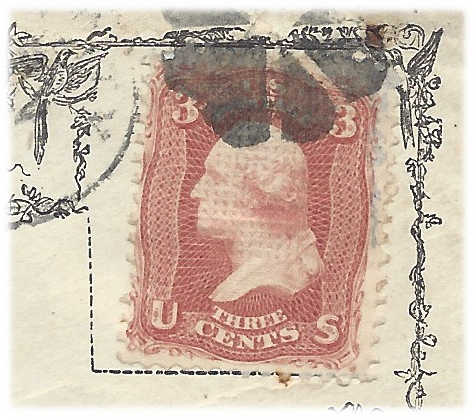
If you look carefully at the image shown above, you can see a grid on the face of George Washington.  This is where the grill was impressed on the stamp.  At the time, the US Post Office was concerned about the loss of revenue caused by persons seeking to use stamps a second time by cleaning the post marks off of them.  The Post Office tried several new techniques to make cleaning hard to do.  In this case, by impressing a grid into the paper, they felt it would allow the ink to sink into the paper more (note the darker spots of cancelling ink where the grid is).  Also, the stamp might be more prone to breaking down during the cleaning process.

If you'd like to learn more about grills, you can view this Linn's Stamp News article by James Lee, or you can read this one by Peter Mosiondz, Jr

Now, getting back to what I was saying after I was distracted by the grill thing....

I will admit that I have not been terribly aggressive pursuing items simply because they have a personal connection for me, even though are numerous ways a person could do so.  You could hunt for items mailed to our from locations you once lived.  You could look for things postmarked on dates that are important to you or find covers that reflect your interests or occupation, as this one does for me.  The choices are limitless.

So, of course, I got into postal history by looking for things like this instead.


If you have visited this blog in the past, you might recall that I have pursued postal history that bears postage stamps with the design of the one shown above.  These stamps are the 24-cent value of the 1861 design of postage stamps.  Their typical use period was from August of 1861 through the 1860s.  Some might still be found that were in use into the early 1870s. 

This letter was mailed on November 29 of 1861 from Susquehanna Depo, Pennsylvania, to London, England.  The cost for a simple letter that crossed the Atlantic Ocean to England was 24 cents as long as it weighed no more than 1/2 ounce.  The letter traveled from Pennsylvania to New York City, where it left on a Cunard Line ship.  The red "19" was applied there and it was placed in a mailbag and not taken out until it got to the London foreign mail office.

The twenty-four cent stamp was attractive to me because I enjoyed viewing the fine lattice work around the stamps.  It's kind of like the American Agriculturist cover - there's lots to see here if you want to spend the time looking.  Can you imagine the time it took the engraver to etch this particular design?  Just take a moment to appreciate the skill that must have been required to do this in the first place!

People who study the 1861 issues, and the 24-cent stamp in particular, are aware that the papers and the inks changed over the period of time this design was printed (Aug 1861 to 1868).  Earlier papers tended to be whiter and thinner.  Also, there are some distinct color varieties (if you have a good eye for color) that are sought after.   In this case, the example shown above is a "steel blue" shade, which was printed during the earliest periods of production.

But, for me, the shades are secondary to the postal history and social history that each cover brings along with it.  

I have been actively enjoying covers that use this particular stamp since before the year 2000, and I have developed and shown an exhibit one to two times a year at various philatelic (stamp collecting) gatherings.  The exhibit has undergone many changes and improvements over the years.  It has done very well it's last couple of times out - one in Chicago (2021) and the other in Omaha (2019).  But, it took significant time and a fair amount of effort to get to that point.

What are you going to do when you grow up?

My first attempt at exhibiting happened in 1999, I think.  I showed one frame (16 pages) that included 24-cent stamps and some postal history.  At that time, the single frame exhibits were being touted for beginners and I did just fine in that class, getting a top prize in my first attempt.  Looking back, I'm not sure that it was so much because I good versus the fact that maybe I showed a little promise - of just that the competition was all "less good" than I.

So, I decided to jump into the big pool a year later and learned that I had a lot to learn.  But, that did not prevent me from coming back to try again and again - making adjustments to the display each time.  

At one point, my hope was to be able to receive a "gold" medal for the exhibit.  For those who are not initiated in this sort of exhibiting, a gold did not mean you'd won first place.  It simply meant, at the time, that you had an exhibit that was considered to be in the upper tier.  I might liken it to getting an A or A- in a class in school (maybe even a B+).  I appeared to be firmly entrenched in the "B range," which is the vermeil medal level. 

These exhibiting competitions include a judge's critique where all of the exhibitors can hear some critique for their work (and for the work of their peers who had also participated).  I recall one year in particular where I, once again, had received a vermeil award.  I raised my hand to request my comments and told them the title of my work.  Upon hearing it, the head judge took one look at me and exploded...

"What are you going to do when you grow up?!?"

I could have taken that wrong if I'd wanted, but I didn't.  I knew what this person meant.  Exhibiting has been (and still is) dominated by folks who are near or past retirement age.  The majority are men, though there were and are many women who are very well-respected.  I was, in the eyes of most of the judges and nearly all of the exhibitors - a pup.  And, it was not normal for a pup to be attempting a topic like this.  A farming exhibit - yes.  Postal history for the 24-cent 1861 postage stamp?  Not so much.

Still not sure what I'll do when I grow up

There is still some debate as to whether I have grown up or not.  I suspect that discussion never will be settled.  And I am perfectly fine with that.

So, while others argue one side or the other of that topic, I intend to continue to dive deeper into the postal history and social history that surround postal artifacts using the 24-cent stamp that was designed and put in use in 1861.  If I can also find a personal connection hidden in there at the same time, I won't say no.

For example, this envelope was mailed on September 22 (1860s) in Cincinnati, Ohio.  The letter bears 28 cents in postage which covers the price of a simple letter to Hannover - one of the German States.  The letter traveled from Cincinnati to New York City (by train), crossed the Atlantic on a Cunard Line ship and was off-loaded at Southampton.  From there it crossed the English Channel to Ostende, Belgium.  It crossed Belgium and entered the Prussian mails at Aachen, where it was taken out of the mailbag for the first time since it departed New York. From there, it took the railroad to its destination in Hannover.

The personal connection has to do with the origin.  I have been a long-time Cincinnati Reds (baseball) fan.  It may seem like a silly thing, but there is still a tiny thrill when I find a letter that is over 150 years old and I see the name "Cincinnati" on it.  It doesn't have to make sense.  It doesn't have to matter to you.  But, I like it.  I can enjoy some of the postal history I've been digging into for many years now and still indulge the personal connection.

Back to the American Agriculturist

At the point our first envelope was mailed, the American Agriculturist was published by Orange Judd and Company in New York City.  The journal started in 1843, and Orange Judd took control of its monthly publication in 1856.  Eventually, it moved to a weekly publication.

Advertisement for the journal in the American Agriculturist of January, 1869

An excellent article by Stephen Mandravelis focuses on the artwork in that journal and the increased use of engravings once Orange Judd and Company took over publication.  In fact, there are between 300 and 400 engravings in one year's worth of publication for the American Agriculturist in the mid-1860s, which is the time period when the letter must have been sent.  By the time we get to 1878, the journal had reached a number of engravings that measured beyond the 700 mark.

Mandravelis points out, in his paper, that the American Agriculturist promoted its product by emphasizing its artistic work - in addition to practical articles that could be useful to a wide range of people, including the "Boys and Girls."  Just look at the page on the right and towards the bottom and you will see how they sold what they did to the public.

"The best paper in the world in illustrations and original matter on agriculture, horticulture, housekeeping and for the boys and girls."

If you are interested in seeing some of the actual publications, they are housed on the Biodiversity Heritage Library.  You can find the image shown above if you view the 1869 volume (it is located in the second page labeled "text" after page 36).

And here is a letter advertising the Genesee Farmer, another contemporary farming journal.  A run of this journal from 1847 to 1865 can also be found on the Biodiversity Heritage Library.  The American Agriculturist absorbed the Genesee Farmer in 1866, so there is actually a direct link between the two.

If you do take a moment to view some of both of these publications, it rapidly becomes clear that the Genesee Farmer was not bent on employing the very best engravers for the artwork.  While there are some illustrations, the better illustrations are often found in the advertisements, rather than the text.  On the other hand, it is possible that I may find one or the other has better writing - should I allow myself the time to read more than I have already.

I took a moment and read something at random in the Genesee Farmer (page 124 of the 1864 volume), and found, much to my amusement, discussion and disagreement about the "proper" time to prune fruit trees.  Even today, I have heard much debate regarding the "best and proper" pruning period.  I've even heard some folks joke that the best time to prune is when you have the pruner in your hands (that includes Tammy and myself).

A good 2023 article by the Orchard People gives a nice summary of how different pruning timings might be best for certain situations.  And it should be noted, that timing is different based on region and the type of fruit tree.  In the end, the answer is like so many things in life - it depends.   But there is certainly agreement that Fall and early Winter is rarely a good time if you live in a colder, Northern Hemisphere climate, whether you read an article in 1864 or 2023. 


And now I transport you to the year 1949.  The postage rate for a simple letter is STILL 3 cents - but a simple letter can be as heavy as one ounce (instead of a half ounce).  The Farm Journal is still active in 2023 and there are online versions available from its inception in 1877 to 1943 at the University of Pennsylvania site.

A May 1878 Farm Journal article for the orchard on page 125 extols the virtue of having hogs in the orchard.  They root up the ground, fertilize the area and eat the fallen apples and pears.  The benefit of having those hogs eat the fallen apples is to prevent the increase of the codling moths, who like to lay their eggs in the young fruit.  Those fruit tend to fall to the ground, so the pigs eat the fruit AND the codling moth eggs/larvae.

So, there you are folks.  If you are having codling moth problems, move the pigs into the orchard!

Another Postal History Sunday in the books!  I hope you enjoyed it.  Have a great remainder of your day and a fine week to come.

------------

Postal History Sunday is published each week at both the Genuine Faux Farm blog and the GFF Postal History blog.  If you are interested in prior entries, you can view them, starting with the most recent, at this location.

Thursday, October 26, 2023

Outstanding in the Rain

As small-scale vegetable and poultry farmers dedicated to local sales, we became experts at numerous things.  We're very good about doing lots of laundry and Farmer Rob barely blinked at putting in a few hundred cloves of garlic in a short period of time this Fall.  We can tell if there is an invader in the chicken yard from the other side of the farm.  We know when the broccoli heads are at peak harvest quality and I can usually put together a couple of pounds of (name your veggie) without also finding a scale.  

And we have been very good at standing in the rain.

People who have outdoor jobs, such as farming, can probably relate to the "Five Stages of Being Wet" that we introduced for the first time in the early years of the blog.  Sometimes, you get wet because you don't have a choice.  The job (whatever it is) can't be brought to a halt just yet, so - there you are.  At other times, the job can't continue once things get too wet, so you keep pushing until it reaches that point.

I can recall numerous times that we were pushing to get a 'few more things' planted just prior to a rain.  We would keep an eye on the skies so we would know if we needed to be ready to pack it all in.  But, there was a huge difference between a rain that caused us to rush and gather all the equipment and go versus those light or steady rains that we would just tolerate as we continued with our task.

There were even more times that we pushed to harvest despite the rain, even when it was quite heavy.  You see, when you have two to three deliveries a week, you can't just 'not harvest' when the weather is less than ideal.  Of course we plan our harvests so we pick things that won't be adversely affected because we are working with them in the wet.  "One and done" crops like lettuce or cauliflower are often good choices, but I never did like harvesting wet root crops.  There are only so many times you want to say to yourself, "I know there must be a carrot in the middle of all that mud I just pulled up."

So, I told you those stories so I can tell you about the tolerance we developed for standing in the rain.  

I can recall numerous farmers' markets where we dealt with downpours, strong winds, and continuous rains.  There were even multiple events where it was cold (35 degrees) and the rain was falling sideways in a stiff, northwest wind.  I remember multiple CSA distributions in rainy conditions.  One season, we had nine consecutive Thursdays (typically our Cedar Falls distribution) where it rained during the entirety of each of our two and a half hour delivery periods.

It was not uncommon for us to stand outside the shelter area so our customers could stay dry and we very rarely packed up early, simply because we knew there were some folks who had to come later.  And, if there were still people on our delivery list that had not arrived to pick up their share, we stayed until 'closing time' because that's just what you do. 

I have realized that I have become less willing to stand in the rain than I once was.  Or, more accurately, the reasons I accept as being good enough to stay out in the rain have changed.

I will stand in the rain, the cold and the wind - for hours if I must - for someone who needs me to do so.  I will work in the pouring rain if the task really must be done - I will not forsake it just because I don't want to be cold and wet.  There will still be times that I will stay in the field, work in the pasture or remain on the tractor when conditions are not optimal.  After all, that is part of what I bargained for when I decided to be a grower and raise poultry.

On the other hand, I will no longer stand in the rain for the sake of potential business.  I won't get soaked for the possibility of another couple of dollars in sales.  But, I will stand in the rain for you.

I realize this is a fine distinction, so let me try to make it clearer for you.

If someone specifically needs me to stand in the rain to get them food that they need - I'll do it.  If someone else's tent blows over and their product is exposed to the elements, I will be among those who will rush over and help them get things under cover - even if I get soaked doing it.  If I'm in one of our fields and I know another ten minutes will finish the task, I can handle getting cold and wet.  If someone has a flat by the side of the road, I'll help them change to a spare even if (and maybe especially if) conditions are poor.  And, if my spirit wills it, I will stand in the rain because I want to.

I just don't see the need to stand in the rain because some unwritten rule or a misplaced sense of obligation says I am supposed to.

This has been a gradual revelation to us over the years.  Our last couple of years offering farm shares saw us seeking out delivery locations that provided us with more (rather than less) shelter, preferably with indoor options when the weather got difficult.  Our delivery times became more compact, reducing the need to stand around in possibly inclement weather for too long.  And now, we make deliveries to about once every other week to two locations.  While we are outdoors, we have very brief periods of scheduled time for those deliveries.

It is possible that we place a higher value on our own comfort than we once did.  Or more accurately, we might consider our own discomfort to be enough of an 'expense' to cause us to look for alternatives. 

It is actually even more complex than that.  Over time, we have come to realize that our willingness to be soaked rarely paid off.  At farmers' market, rain usually signaled the end of customers coming to purchase, even if it cleared up well before closing time.  And, with CSA distributions, we had the same number of shares to deliver whether we were soaked or not.  Wouldn't you rather make deliveries without being soaked?  With a rare exception or two - we would prefer to stay on the drier side, especially if it meant we would have to ride in a truck for forty-five minutes before we could get home to change. 

After all, if we get damp on the farm, we just go into the farm house and change into dry clothes (and maybe, ironically, take a shower).  

What if you get caught in the rain 45 minutes from home?  Welcome to exploring the world of being damp!  

Did we tell you about the time the farmers' market in Waterloo experienced a downpour, complete with wind knocking over tables and tents?  It rained and blew so hard that some of our produce washed away and went down the storm sewer that was hundreds of feet away.   After the clean-up, we squelched into the nearby box store, bought clothing and went into their restroom to change.  Yep, we started taking a change of clothing with us to any market or delivery that looked like it might rain from then on and we started backing away from farmers markets the next season.

So, here's to the next time we get caught in the rain and we have a choice of whether we want to get to shelter or if we want to feel the cool drops landing on our shoulders. If we do that, we'll have a good reason for it - even if that reason is "because I want to."

Wednesday, October 25, 2023

A Genuine Harvest


I was able to carve out some time on Wednesday to prepare beds and plant next year's garlic crop before we get a batch of wet (and then cold) weather.  I only put in a little more than 350 garlic for the 2024 season, but that's 350 more than we planted last fall.  The only garlic we harvested were the heads that we failed to pull the year before.

It might seem odd to hear me see it, but I was surprised at how easy it was to plant the garlic this time around.  The soil was warm and not too wet (or too dry).  The beds we chose to use had been potatoes this year, which has been a normal rotation order for us for some time now.  That meant the soil was already loose and the bed was clean of weeds because of the potato digging process.

And once the garlic was in, I grabbed the last of the onion crop and pulled that in.

Planting the garlic is actually a milestone that reminds us to celebrate the season's harvest.  Traditionally, at the Genuine Faux Farm, we have a hard time finding the time to plant the garlic until we've pulled in the majority of the long-season crops.  Apples, squash and potatoes are usually on that list.

So, since I planted the garlic, we can now reflect on the year's harvest.  Of course, there are a few more things to bring in, but the bulk of the harvest work is now done.

We've already written about the bounty from our special Cortland apple tree.  We've been happily munching on those apples for a month now and we were able to get the rest to various interested people.  Meanwhile, our Fireside apple tree gave us a smaller harvest (in quantity) all while producing the largest apples we've ever seen.  And - of course - they are delicious!

Apples are symbolic of some of our long-term effort and planning at our farm.  There were no fruit trees at the farm when we first moved here.  Now, we get a fair amount of apples most seasons.  I call that a good result.

This season's melon crop was smaller, and bigger, than we've had in prior years - all at the same time.  This time around, we didn't plant with the intention of having excess to sell or donate.  Yes, we planted more than we needed.  But, we also experimented with the varieties in hopes that we could feed ourselves with melons for breakfast as long as possible this year.

Believe it or not, we had one of our favorite melons (Ha'Ogen) just last week.  They last pretty well in the refrigerator and we've had delicious melons for weeks this year.

While that's great, the real success is our rediscovery of some of the melons we liked in the past.  Along with that is the healthy reminder that we should both enjoy the growing and the eating of the food we raise on our farm.

Some of the enjoyment for us comes with the discovery and rediscovery of vegetable varieties that are open-pollinated.  Often they are heritage of heirloom varieties.  Our hot peppers this year were Joe's Long Cayenne and Ausilio Thin-Skinned Italian.  Joe has been on our grow list for a very long time, while Ausilio is a new, and pleasant, surprise for us this year.

We don't need all that many hot peppers ourselves, but we do still like having some of them and we enjoy growing them.  The biggest problem we had with them in the past is that only a subset of our CSA customers wanted them (and what they wanted typically wasn't very many of them).  Meanwhile, we were rarely able to find a bulk outlet for the excess at a price that made the effort worth our while.


Tammy's favorite sweet pepper has been Golden Treasure for quite some time now.  So, I was pleased to be able to put a few of them in Valhalla (our larger high tunnel).  After a couple of years where we did not do well with the few plants we grew, we had a great year with these plants.

Why was this year better?  I can point to a whole host of reasons, but the key is still the visit we received in June from our farming friends.  If they hadn't come when they did, there were be no blog today talking about our 2023 harvest.

It makes me feel good to know that Tammy is able to take one or two of these to school for a snack or for lunch each day when she wants.  And that's probably as good a reason as any for growing some of what we grew this year.

Many of the tomatoes in Valhalla did well this year too, despite a late start.  In particular, the Black Krim tomatoes really made us proud.  We still have some green tomatoes out there.  Maybe I'd better get out there soon?  But, even if I don't, we still should be pleased, and maybe even a bit proud, with the 2023 tomato harvest.

Like every season, this one was not perfect.  We had some crop failures and we had some personal failures.  I'll certainly process the lessons our failures put before us before the 2024 growing season is upon us.  But, we also had successes - and that's what I'm focusing on right now.

Tuesday, October 24, 2023

Walk During Peak Fall Color

We had so much to do and travels we had to make on Sunday, so we almost did the "responsible" thing and did not go to Backbone State Park this past Saturday.  After all, we had gone the prior weekend so Tammy could kayak and I could walk.  And, I know Tammy was a little worried about how her body would handle the hike since she hasn't been doing that much hiking of late.  That's what happens when you have limited time to get out in nature and you start using some of that time to be on the water instead of on the trail.

Also, we knew it would be a windy day and there was some discussion that maybe all of the Fall leaves would be removed from the trees by the time we got there.

Happily, we went and not only were the leaves there - I think it is safe to say that they were at their peak.

The sky was that gorgeous blue we sometimes get in an Iowa October.  And, the wind lifted some of the yellow leaves off of the trees and launched them into that blue sky.  I tried to capture what I was seeing with this image and it doesn't really do it justice.  Let me just say that it felt we were in a "snow" globe where we had leaves instead of snow floating around us for much of the walk.

The East Lake Trail provided a fair amount of shelter from the wind, but we were reminded that wind does dislodge walnuts and small branches along with the leaves.  While nothing landed too close to us, I was reminded that it is a good idea to pay attention to your surroundings.  It did nothing to put a damper on the walk and it actually had me looking at things from different angles even more often than I usually do.

And, as you know, that's not a bad idea as far as I am concerned.

Tammy remarked about some of the images I was able to capture on this walk, so I felt like it might be nice to put some of her selections in the blog.  I noticed that she favored photos that featured the water somewhere in the picture, but she also liked it when there was a nice range of color.  Some areas had predominantly yellow leaves, but it wasn't hard to compose pictures on the trail that would show reds, oranges, blues and greens to go with that yellow.

While the colors were better on this walk, I actually took many fewer pictures with the camera.  Part of the reason is obvious, I was not the only person walking this time around.  I had to consider Tammy's pace in addition to my own.  Also, there were many more people walking the trail this time around, which made the opportunities for nature-only photos less frequent.

On the flip, side, I was being a less experimental this time.  Instead, I went for the best natural scenery images I could frame in areas that were most compelling to me or Tammy.  It wasn't all that hard to know when something caught Tammy's attention because it is easier for her to keep moving once she starts walking.  So, if she stopped, there was likely something pretty nice to look at... or maybe she needed a rest.  But she did tend to rest in locations that had lots of nice things to collect images of on this walk.

I know I have mentioned this before, but I am often struck by the pleasant nature of the people we meet on the trail as we walk at Backbone.  Yes, it is true that sometimes there are folks that are a bit loud on the trail for our tastes.  And, yes, sometimes it feels like there are people who aren't truly observing and appreciating the beautiful world around them.  Still, they are almost always respectful of others, of the trail and the natural world around them.

I could detect some the effects of awe and wonder in people's kind greetings as we passed each other.  More than once I noticed a person who had stopped just off the edge of the trail - not just to let us pass - but also so they could just take time to look at something beautiful.  More often than not, we were the ones who stepped aside for others.  And when we did, people seemed to recognize what we were doing and they could appreciate it.

Now that the work week has started, we were both tempted to tell ourselves that maybe we should not have taken the time to go to Backbone and take this hike.  Except we knew that would be a lie.  It was very important that we did take this hike.  It was a fulfilling life event that was necessary for us to balance out the hard work, the stress, and the worry that has been pushing at us almost continuously of late.

This Fall, we can look at each other and instead of saying, "I wish we'd been able to go visit one of our favorite hiking spots during the peak of the Fall color this year," we can say we DID take that walk.  

And, why is that important?

It's important because for most of the years of our lives together we have expressed that regret.  Our lives as academics and farmers usually precludes the pursuit of the changing of the colors of the leaves.  We normally take the "responsible" route and deprive ourselves of some moments of joy because that's just how it has to be.  Or, we substitute a walk with a slightly altered driving route in the car - and we drive by the colors at speeds that are too fast to really get the full effect.

Now, to be perfectly fair, there are only so many days where the weather conditions are as appealing as they were this past Saturday.  Perhaps our regret some years is that there was not much choice for enjoying a quality Fall show.  It's not long ago that we slogged through some very wet September and October months that did not promote much of a show.

So, for this year, at this time, and in that place, we took the time to appreciate the world around us.  And we took in one of the greatest shows on Earth.  The perfect Fall day in Iowa.

Monday, October 23, 2023

An October Morn


One week ago Sunday, there were significant changes that were made at the Genuine Faux Farm.  The broiler chicken flock (meat chickens) were taken to "the Park," on their way to "Freezer Camp."  And, the last of our older hen flock were taken to new homes.  And with those birds went my reasons to take a walk out to the northwest part of our farm every morning.

So, what did I do multiple times last week?

I walked out to the northwest.  Part of the reason for these trips was to keep a promise I had made to myself and to Crazy Maurice, our Weeping Willow who stands watch over that part of our farm.  But, on Thursday, I just knew it was exactly the right thing to do because it just might have been the perfect October morning.

The skies were a beautiful blue.  It's the kind of blue that happens maybe a dozen times each year at the farm - and I try to take note of it whenever it happens.

The air felt soft with the tiniest bit of crispness that comes with cooler weather.  Maybe it would be more accurate to say that the air felt and smelled fresh.  But, there was enough humidity and warmth still in it to keep it all feeling relaxed.  And there was only a hint of a breeze.  Just a bit to move the air and prevent you from breathing in the same air twice - if you know what I mean?

Even the sunbeams had a quality that made them feel friendlier than usual.  And, perhaps, gently playful.  Shadows were dark enough to be interesting, but not so much that they were foreboding.  And the light warmed up the colors of the leaves, and the granary, and anything else it touched.

The grass just might have been greener than it has been for much of the year because we've gotten a little bit of rain to encourage it.  Blaise, the maple tree was at his best showing off his coat of red leaves.  And, there were a fair number of smaller migratory birds making themselves known as they flitted from Maurices branches to some of his companion trees in the area.

I ended up spending much more time out there than I initially planned.  And I didn't regret it in the least.

I hope you have opportunities to fully admire a perfect October morning.  And, if they don't come by the 31st, you can always keep your eyes open.  I've heard November can have some pretty nice moments as well.