Friday, March 12, 2021

Wagging the Dog

For some reason, I have been thinking about the idiom "wagging the dog" lately.  I realize that the traditional sense of the phrase is the idea that something less important is controlling something more important.  The idea is that the tail has been given enough control that it can be the base and the dog's body has to bounce around instead of the tail.

Bree, one of our Farm Office Supervisors at the farm, isn't terribly impressed that I am thinking about this because she believe that dogs are kind of 'air-headed' any way.  What should it matter whether the body or the tail of a dog wags?

A Recent Prompting

It isn't exactly a 'wag the dog' thing, but here's where my brain started on all of this:

We left the farm for a doctor visit or some such thing and came back just after sunset.  That meant that I had to go straight out and close up the chickens for the night.  As I walked out there I heard loud voices that sounded like they were out by our east fields.  After completing chores, I investigated a bit.

What I found was that there were three snowmobiles and drivers out at the edge of our property.  Clearly, one of them was stuck and they were loudly trying to 'unstick it.'  As I walked down the road towards them, they must have succeeded.  Upon doing so, they said something about cigarettes and beer, hopped on their machines, drove rapidly across the road and across our neighbor's field.

Um. ok.

The rest of the story is this.  There is a snowmobile trail that runs to the North and to the South of our property between farm fields.  The path goes around our farmstead by jogging to the West.  There is no trail to our East.  But, we have noticed a few times that there were some folks who seemed to want to go all over our neighbors' fields.  We don't know if they had permission to do so - we just noticed there were a few who were doing this.

Apparently, on this particular night, in the process of running on our neighbors field, one of the drivers thought our little farm would be a neat place to try zipping around.  They hung themselves up on some caged bushes we have in our buffer zone that were mostly buried under the snow drift.  So, we've got some crushed cages and bushes there now - and maybe they have some damage to their machine.  I'll never know.

Letting the Minority Define the Majority

And now we get to my parallel to wagging the dog.  

The temptation after this is for the two of us to conclude that people who drive snowmobiles are ... well...  what should we think?  Let's just say that we're not impressed and leave it at that.  It's so easy to want to grumble at EVERY and ANY snowmobile that goes by our farm after events like this.

But, that's the problem.  We should not allow three individuals define what we think of all who enjoy snowmobiling.  After all, the vast majority of them who go by our farm stay on or near the trail.  They tend to go by at reasonable hours and not at 1 AM as has happened rarely.  They appear to be enjoying themselves while still being responsible and respectful.  

But, these three - and maybe it was just this ONE person - they make us entertain the idea that everyone who gets on a snowmobile is irresponsible and disrespectful.  Should we assume that if we see you on a snowmobile that you are are going to start driving all over one of our lines of bushes we worked hard to put in and care for each year?   Should we paint you with the same brush and curse at you as you drive by?

Bigger Picture

The number of hate crimes against Asian-Americans is on the rise.  Apparently, because some people have made a claim that China "caused" the Covid crisis, anyone who looks like they might have any Asian characteristics is to blame and should be punished.

Without even getting into the whole "what causes a pandemic" thing, let's consider this with the same lens I used for the snowmobile drivers. 

Is it fair if I blame every single person who likes to snowmobile for damage to those bushes and cages?

No.

Does everyone who drives a snowmobile intend to damage my farm or wake me at 1 in the morning?

No.

Why would anyone think it is right to assume anyone who "looks Asian-American" is suddenly to blame for our current situation?   How could you possibly justify your bad behavior towards people because you can't differentiate between responsible parties and everyone or anyone else? That's a tail wagging a dog if there ever was one.

And then, how is it that we are then surprised when everyone who is "like us" is lumped into a group and pegged as violent, uncaring and ignorant? 

I happen to be a white male of European decent.  Therefore, I am aggressive, prone to violence, foul-mouthed, and inconsiderate.  I am domineering and unsympathetic.  I sneer at people of color and think they are inferior to me and I believe women are ok, except when they start acting like they might be smarter than I am.  If that happens, I will put them in their place.  And, of course, I am likely to commit a mass shooting in the United States.

If you know who I am, I sincerely hope you disagree with those statements.  And yet, there is a whole host of examples of people who are ALSO white males of European descent for whom those descriptions fit.  Since I am like them, I must be .... like them?!?

My lesson to myself (and maybe for you) for today?

The next time someone who is not like ourselves enters our world, don't make the assumptions that they are like the worst versions of whatever group we think they belong to. 

That snowmobile driver over there is not necessarily inconsiderate and bent on the destruction of bushes and cages.

The Asian-American walking down the street or living in your neighborhood is not plotting to infect you with a virus, nor are they inclined to do you harm.

And you and I, no matter what groups we identify with, will be lumped with the worst characteristics shown by other people who also identify with that group.  Until we all make an effort to consider individuals on their own merits.

Don't let the tail wag the dog. 

Thursday, March 11, 2021

Still Breathing in a Chemical Haze

It was the end of July, 2017, and the air was heavy and warm.  The sun was part way towards the horizon in the West as it tried to burn through a chemical haze.  The breeze didn't want to come out to play that evening and I couldn't blame it if it were more interested in an ice-cold lemonade while it sat on the porch.  However, I am certain that it would not have opted to sit outside that night if it could choose.

That evening had the potential to be a beautiful Summer evening.  While the day was warm, it was not oppressively so.  The sun was bright, but not blinding.  Since it was Friday, there were no additional workers on the farm.  That meant we could more easily run a couple of errands during the hottest part of the day and use the cooler hours in the evening to work in the fields.  There is something relaxing about the knowledge that you have a fair amount of work to do, but week-long stresses of working AND managing the work of others can be eased away by taking a productive walk behind a wheel hoe.

Unfortunately, were in the middle of one of the "Spray Seasons" in Iowa.  Eighty-five percent of the land in this state is farmed in some fashion (30.5 million of 35.7 million acres according to USDA 2016 numbers).  Of the acres that are farmed, 23.4 million were dedicated to corn and soybeans (76.7%).  Another 2 million acres were planted to hay and alfalfa and about 170,000 were in small grains.  It would be safe to make the observation that nearly all of the corn/soybean acreage is farmed using herbicide, fungicide and pesticide applications as their most common tool for dealing with pests and weeds.  

Everyone was frantically trying to get the pesticide and fungicide applications done in Bremer County and the surrounding counties during a ten-day period.  But, that Friday was the peak.  Everyone wanted to spray and they wanted to spray NOW.

The buzz of airplane engines started just before 7 AM and were still going at 7 PM.  The whine of high-boy spray rigs rushing down the road at their top speeds gave an unwelcome counterpoint, though I have to admit there were certainly fewer of those since aerial spray seems to be the thing to do.  If there were birds singing - and I actually doubt that they were - you couldn't hear them.  In fact, I found myself hoping that the birds and other critters we like had found good places to hide. 

 Unfortunately, with the human tendency to tear out every brushy area or stand of trees because it is "not productive land" I doubt there were many places they could go to find sanctuary.  In just five years, as a response to high corn and soybean prices, 97,000 acres of woodland in Iowa were cleared (from 2009 to 2013).  Three quarters of these losses are due to agricultural operations and Iowa now has 100 million trees fewer than we did in 2010.

Agri-chemicals are to commodity crops what pharmaceuticals are to the health industry.  We all want to take a pill or spray a chemical and make the problem go away.  The case study of bifenthrin, which was registered for use in 1985, can be used to illustrate the expansion of use for many chemicals in agriculture.  You can find similar maps and view them to your heart's (dis)content at the United States Geological Survey site

While it is true that not every chemical shows the same trend as bifenthrin, you should take note of the state that is most often completely covered to show heavy use for a wide range of herbicides, pesticides and fungicides.  Why, yes, that is our state - Iowa.  To further make the point, I suggest that you go to the survey site linked above and check out Atrazine, Trifloxystrobin, Glyphosate (Round-up is the most well-known product) and whatever else you are curious about.  

Below is the yearly trend chart for the use of bifenthrin:

Part of what makes this whole situation even more concerning to me is that it takes a few years for all of the data to be verified and made available.  The most recent data at the USGS site is from the 2017 growing season.  If we want to make decisions on these things, we will be looking at data that is three to four years old.  Take a look at the use of dicamba shown below:

With the approval of dicamba for over-the-top use on cotton and soybeans in 2016, use of this chemical doubled in 2017.  Since that time, dicamba use is known to have grown significantly, but the data is not official.  Based on what I have read, I suspect the use numbers will show doubling for cotton and soybeans in 2018 and again in 2019, with probably a bit of a plateau in 2020.

Dicamba is an herbicide that has gained more popularity with the introduction of dicamba-resistent seed for soybeans and cotton.  Dicamba products have been in use for some time for corn.  Bifenthrin is a broad spectrum insecticide, which means it does not target any particular insect - instead it just kills them all, whether you think they could be beneficial or not.

A new hatching of dragonflies were zipping around the East fields of our farm that Friday morning in 2017, and I took pleasure in watching them go from hovering in one spot to hovering in another after a quick movement in what seemed like an impossible direction.  Then, I found myself apologizing about all of the pesticides that were certain to be added to every surface of the county over the next few days.  I muttered something about 'bad timing' and 'I hope you all survive this.'  

What a strange thing to say to a creature that has ancestors that were on this earth 300 million years ago.  A dragonfly is a fantastic predator (if a bit indiscriminate) to have on our farm since it will eat any number of pests that might cause problems with our vegetables.  The adults can live for several weeks to a couple of months if a bird or other larger predator doesn't take them.  This batch was seen on our farm for two days.  Fill in the blanks.  We may work to provide habitat and a safe haven on our farm that these critters favor, but they don't see borders the same way we do.   

But, then again, airborne spray doesn't see borders like we do either. 


Take a moment and click on the picture above to see a larger version.  All of those dots in the sky?  Those are dragonflies on our farm.  I still have hope because our little island oasis does provide some respite for the dragonfly - even if the spray crosses our borders.  It gives me hope because if we have more people who provide these oases - we could have more dragonflies (among other things).

But, let's be honest, the sheer volume of pesticides being dumped on acre after acre of land in Iowa results in coverage that is not limited to just the target crops.  We all know this, we just don't want to think about.  In fact, we are so adverse to thinking about the possibility that we are willingly poisoning our world that we aren't even doing much research to either prove or disprove this.  It's a good deal like avoiding seeing the dentist about the tooth that hurts because you are afraid that she'll say you have a cavity.  

Let me remind you of the first picture I showed that was taken on that July evening in 2017.

The sheer volume of spraying going on during the end of July helped to make the air heavy and difficult to breathe.  A quick look to the skies reminded me of smog we had witnessed during visits to certain larger cities.  And, it didn't just look that way on our farm.  It looked and felt that way when were in Tripoli... and Sumner... and Waverly, as we ran errands during the heat of the day. 

In the interest of full disclosure, the overcast was not entirely due to the agricultural activities either.  On top of it all, there were multiple wildfires in the West and Canada.  It is possible that this was just another day where smoke from locations many miles way contributed to the overall effect.  But, there was no denying that the spray activities were a significant part of the issue.

So, what does that mean for us as we considered the 200 foot rows of broccoli and onions that needed a pass with the wheel hoe?  Were we supposed to go shut the windows of our 140 year-old farmhouse and hide?  Did that mean we are supposed to stay inside for this ten to fourteen day period?  How were we supposed to do the work that we do if we shouldn't be outside?  What about all of the other people who work outdoors in the Summer months?  Is it okay that their bodies have contact with all of this stuff during spray season?  Are all of the outdoor enthusiasts supposed to stay in?  Should the bike paths, swimming pools and tire swings stay empty at this time?  And what about all of the creatures on this earth that have no 'inside' to go to?  Are we just supposed to deal with it since it is the cost of living in Iowa?

My answer always depends on the moment.

On bad days, I DO want to run and hide.  It hurts too much to witness this.  It worries me every time we enter each Spray Season - and it isn't just the July season - we worry during the Spring herbicide spray season too.  I wonder if I should tell our young workers who are often high school and college age that they should go home and not work during Spray season.  We have pulled them from fields before, maybe they should just never go out during that time?  And, what about us?  What sorts of physical issues are we creating for ourselves because we chose to do the work that we do?

As I face the loss of my left kidney to renal cancer, I am left to ask if I did this to myself.  Has the cumulative exposure to these various pesticides over time contributed to this problem?  It is unlikely anyone can prove or disprove a specific cause, because such things are rarely simple and are part of a whole set of circumstances.  But, should I even have to be asking this question of myself?  Why should it be my fault when I wasn't the one putting these chemicals into the air I breathe and onto the surfaces I might touch?

On better days, I get angry and I want to see change.  I want to see more meadowlarks and tiger swallowtails.  I want to see the skill and art of farming return with the use of a bigger toolbox than the one provided by application from a sprayer boom.  I want to see dragonflies darting around me as I walk behind a wheel hoe amid the broccoli and onion rows.

What do you want? 

---------------------

A first effort on this topic appeared on this blog on March 14, 2018.  As part of the throwback post series that shows up on Thursdays, I selected this for a re-write and an update. 

If there are take-aways I hope you have after reading this, they might be as follows:

  1. We rely far too much on pesticides in our world right now.  Pesticides are a dangerous tool that requires a cautious approach to their use.  We are failing to treat this tool with respect.
  2. If we fail to use pesticides with great care and appropriate precautions, we harm others.
  3. We need to make changes.  

Wednesday, March 10, 2021

Few Words Needed

 You know what?  I kinda like her.  If I ask, do you think she'll agree to marry me?

Thanks for being my partner for life.

Tuesday, March 9, 2021

Iowa News

Rob writes Iowa News about once a month for Pesticide Action Network.  You can sign up to get materials from PAN that would include Ground Truth blogs and Iowa News (if you have an Iowa address).  The Iowa News updates are also published as a part of the Ground Truth blog online.  You can read them there as well as read blogs Rob and other PAN staff write.

I realize not everyone has a chance to see what I put out there for Iowa News, so I thought I would share on our farm blog this week.  I am also including a photo of Crazy Maurice, who endorses Rob's work (it's good to have the support of a thoughtful and insightful tree.


----March 2021 Iowa News for Pesticide Action Network----

Since our last Iowa News, we have had to manage our way through some very cold weather, and I suspect many of you would agree with me that we’ve had enough of it for now! I am not terribly unhappy to see the snow melt, even if it means the beginning of “mud season” on the farm.

The legislative session has been a whirlwind of activity, and the results have not been what we were hoping for thus far (see a detailed legislative update below).  Still, we continue to listen to the voices of Iowa farmers and rural people as they share some of their concerns and dreams for the future of agriculture in the state.  Even as we hope for some last-minute legislative success, we remain committed to building a vision for the future that supports people on the land.

Personally, I continue to be concerned that we do not place enough value on the food we eat.  We need to remind ourselves daily that how we raise our food is very nearly as important as working to ensure that we have enough food.  If you would like to explore that topic further, please visit our Ground Truth blog and read “We need to consider the real value of our food.”

I continue to have faith that there are many individuals in our state who truly want to raise good food, and they want to do it in ways that work with nature.  I also believe there are many others who would like to join those ranks, and we need to find ways to support their entry into a diversified and healthy food and agriculture system.

Part of the solution is to remove barriers such as damage caused by pesticides that drift.  I was honored to participate in a discussion with Melinda Hemmelgarn of Food Sleuth radio about the topics of healthy foods and the threat of dicamba.  Clearly, the landscape has to change regarding the careless overuse of chemicals if we want to provide opportunities for young and beginning farmers in the state.

On a somber note, we mourn the loss of Paul Johnson (Feb 15).  Paul’s vision for the Iowa Land Ethic has always spoken to me and I hope his words will continue to motivate us to strive to be better stewards of our state’s greatest resource.

If you find value in our Iowa News, please share with someone you know and encourage them to sign up here with the Pesticide Action Network.

State legislative updates

Online Drift Reporting

There have been numerous phone calls, texts, emails, and other contacts between our state organizer, Carmen Black, and various legislators regarding the proposed Online Drift Reporting bill over the past several weeks.  In lieu of legislation, one option was that the Iowa Department of Agriculture and Land Stewardship (IDALS) could voluntarily submit the online drift reporting tool as a line item in the Pesticide Bureau’s budget.  Failing that, several legislators from both political parties expressed interest in co-sponsoring a bill that would require development of this tool.  Unfortunately, the priorities of the members in this current session appear to have squeezed this bill from consideration.  If this changes, we are prepared to contact you and ask for your support to get the bill passed.

Pesticide Bureau Funding

SF 601 will move funds collected for pesticide applicator licenses from the General Fund to the Pesticide Bureau.  Securing this funding could provide more stability for the Pesticide Bureau staff, who are often overwhelmed with chemical drift reports.  It appears that this bill will move forward with a unanimous vote to approve on the committee level.  We will continue to monitor this bill and consider it to be a potentially useful step in providing resources for the enforcement of pesticide use labels in the state.

Upcoming Events and Opportunities

There are numerous opportunities to expand your knowledge and interact with others in farming during the coming weeks:

Rodale and the Organic Farmers Association are offering micro-grants for small-scale farms run by individuals who are Black, Indigenous or a Person of Color (BIPOC).  The deadline for application is March 31.

Farmers can take advantage of opportunities to interact with their peers.  Practical Farmers of Iowa is hosting virtual meet-ups for field crop farmers on Thursday evenings through April and similar events for horticultural crop farmers on Friday evenings.  

You can also take advantage of a “shared learning call” hosted by PFI’s Stefan Gailens on March 5 at 12:15pm.  The topic will be “Estimating N-Credit from Legume Cover Crops.

Ron Rossman will present a webinar sponsored by the Iowa Organic Association on March 16 at noon.  If you are interested, you can register to attend  “Organic Farming and the 2020 Western Iowa Drought.” 

The Iowa Farmers Union continues their Lunch and Learn series every Thursday at 12:30pm.  The list of upcoming half-hour programs features a diverse set of topics and presenters.  The March 11 topic will be “Black farmers, their history and challenges,” and will be followed by “The state of rural health care” on March 18.

If you prefer farminars on habitat and pollinators, you will find two opportunities offered by PFI in the near future:

“Using EQUIP to Improve Wildlife Habitat on Private Lands” on March 9 with Kelsey Fleming or “Pollinators & Climate Change: Making a Difference on the Farm” featuring Xerces Society’s Angela Laws and Sarah Nizzi.  You can register for both here

Iowa Learning Farms is also continuing to offer mid-day webinars starting at noon on Wednesdays.  The March 10 edition features Iowa State’s Matt Liebman as he discusses “Crop System Diversification as a Step to Greater Sustainability.”

Monday, March 8, 2021

Burst of Energy

I have to admit that I am not terribly sad to see the snow melting at the farm right now - even though it means we enter the first "mud season" of the year.  In fact, the beautiful weather this past weekend (and likely until mid-week) has given us a bit of a boost that both of us really needed.

I've always kind of joked that I am "solar-powered," typically doing better on sunny days to get things done than on cloudy days.  That may not be as true during the hottest months of the year, but it sure seems to be true when the days are shorter.  Speaking of that, have you noticed that the sun is rising and setting closer to true East and West than it has been for some time.  In Iowa, that usually means you have to adjust your eyes as you drive East in the morning or West around sunset.  So, that can be an inconvenience, but I'll take the promise of longer hours of light that it brings and run with it.

Dead Outs

We took the time this weekend to check out our bee hives (three of them) and can honestly say this is probably the first time we have been able to do that since it got really cold.  If you'll recall, the bees appeared to have a pretty good year on the farm.

Sadly, they had a pretty bad Winter.  Each of our hives is what they call a "dead out."  There were no live bees in any of the hives, but there was a fair bit of honeycomb and honey in two of the hives.  Ah well, these things happen and we'll learn for next time.

So, part of the process on Sunday once we discovered the hives had no live bees was to pull out the frames that had honey and get them into a freezer so we could go through the process of saving the honey.  You see, with no live bees and warming temperatures, that honey was going to attract some problem critters, so we needed to deal with it.

Fortunately, we have multiple freezers on the farm, so we have options.

Defrosting

Actually, the timing of all of this couldn't be much better.  You see, we had emptied two of our freezers and unplugged them a couple of months ago.  It was so cold that we didn't worry about those freezers all that much.  But, now, suddenly, we needed one of the freezers to put the frames with honeycomb into.  

I went to check the freezers and found that they were just beginning to defrost.  Wait too much longer and things were going to get a little ugly - phew!  Glad we took care of it today.

Actually, I had cleaning the freezers on my 'to do' list for the coming week.  But, it's just as well we got it today because it is easier to just take the chunks of ice and toss them out than it is to mop up the water in the bottom of a chest freezer.

One Year In

And, last year at this time, we were still in the process of turning the house into something that looked a bit more like the owners actually cared.  One year later, we're still happy when someone says the house looks good.  And, one year later, we still have some finishing touches to do on the outside of the house.  

Hey!  It's a house.  It requires maintenance.  At least we don't have scaffolding standing next to it right now.

Two Years Ago

And now I remind us all of what the farm looked like exactly TWO years ago.  Yeah.  That's the year the drifts by the north bush line got tall enough that I could stand on them and see OVER the high tunnel.  That's a good bit of snow.


I put that there as a reminder that March is actually still at least partly the purview of Old Man Winter.  Before we get too excited that Spring has sprung, we'd better give ourselves a little reality check before the temperatures fall back to the averages in about a week.  

Still, that doesn't mean we can't take this nice little shot in the arm and use the burst of energy that seems to have come from it!

Welcome Returns

We both heard our first Killdeer on the farm yesterday (Sunday) and I heard and saw one of our Cardinal friends out by the barn.  We drove down to Sweet Marsh and watched/heard some Sandhill Cranes fly overhead. And, yes, the Canada Geese had to honk at us too.

The bitter cold streak we had was pretty hard on the wildlife.  It was about two-thirds of the way through that bitter cold that I noticed a little sparrow sitting on the snow near the corner of the granary.  I expect it to fly away as I approached, but it did not.  That's when I realized that it was no longer living - frozen in a repose that it would not rise from.  

I knew the cold was breaking when the Sparrows and Juncos started exhibiting more energy.  The Chickadees started calling more often and the Horned Larks suddenly disappeared from our landscape, just a day before we heard the Killdeer's song.

Right now, I just don't see what the Horned Larks can possibly like about the weather they chase back northward.  But, they have my respect.  It takes a special little bird to find subsistence and comfort in the frozen places of the world.

And now, if you don't mind, I am going to go BACK outside.  It isn't terribly breezy and there's sunshine out there.  And maybe, just maybe, I'll hear a Robin sing and tell me it's been a good day.

One can hope.

Sunday, March 7, 2021

Turn, Turn, Turn - Postal History Sunday

Welcome to this week's edition of Postal History Sunday on the Genuine Faux Farm blog!  

Take those troubles and worries and put them in the middle of a book you know has a dull spot around page 212 that you normally skip over.  Don't we all have one of those that we read the introduction and get about half-way and we find we just want to skip to the end?  Really, there is no reason to feel guilty as we have read that section once and we can be forgiven if we skipped a few words even the first time because they were not really speaking to us.  And, if you are the sort to re-read books, you know the rules are different - read what you want and skip the pages around 212.  You have more motivation to do so because you know your worries are tucked safely between those pages!

Two Addresses, Two Stamps, Two Postmarks?

So, we'll start this week's Postal History Sunday with a circular that was sent in 1865 from Etna, New York to Dryden, New York and to Edward Welsh.  If you look on the lower half of the folded letter you will see the very light Etna postmark dated April 7, 1865.  There is a 2 cent stamp depicting Andrew Jackson that paid the 2 cent fee for an unsealed circular.

The letter met the requirements for a circular and its cheaper postage rate because it was left open so the postal clerk could check for a personal note.  Also, the content was pre-printed except for a few hand-written things that were allowed by the regulations of the time.

The curious thing about the item?  Well, there happens to be ANOTHER 2 cent stamp paying the 2 cent circular rate where Mr. Welsh mailed the item from Dryden on April 10 back to the Town Clerk at Etna.  To avoid confusion, he crossed out his name and address.

So, what was Mr. Welsh returning to Etna?  This is a signature confirmation form where Mr. Welsh was accepting the position of "Overseer of Highways for District No. 143."  Postal laws of the time allowed for such signature confirmations to be an unsealed circular, even though there was hand writing in addition to the printed matter.  The handwriting only consisted of signatures, a date and a district number.  There was no personal message included, which would have disqualified it for the special rate.

This certainly makes sense that Welsh would simply use the paper that required his signature and mail it back by re-addressing the letter and adding appropriate postage.  Why waste the paper and put it in an envelope?  Doing so might even require that he pay an extra penny for the 3 cent letter mail rate - something I'm sure he didn't want to do.  After all, what compensation do you think a Overseer of the Highways would receive in 1865?

By the time we reach 1865, the development and upkeep of turnpikes were on the decline.  The principle of a turnpike was that private companies would undertake the building of a road, and by doing so, they would have the right to collect tolls.  This site provides a short and interesting history of the Great Western Turnpike in New York state.  Of interest is the fact that the story mentions an alternate route the locals often used to avoid the toll road - these were often referred to as "shunpikes."  (and now you know)

I mention this because I found some record of a couple of attempts to create turnpikes through Dryden.  One in 1836 (the Norwich and Ithaca Turnpike) and another in 1816 (the Homer and Genoa Turnpike).  It is unclear to me if either were completed or active in Etna in 1865.  That said, overseers of highways, whether they were turnpikes or publicly funded roadways, were often farmers who might contract to maintain a section of road.  There might be several such positions for any given township. 

 An interesting short history of road development and turnpikes in the United States can be found at the link for those who want to learn more.

The Concept of a "Turned" Cover

Each of the items I am showing today are examples of what a postal historian would call a "turned cover."  The concept is pretty simple.  An item was mailed with an initial address and then the same letter or envelope was modified to allow for it to be sent on to a different address.  

What we see next is actually an envelope that was unsealed completely and then refolded and re-glued.  The original postal address and stamp were on the INSIDE of the envelope and the second use was on the outside.  An astute collector noticed this and slit the sides open so a person could easily see each side.

This envelope was clearly another unsealed circular (2 cent rate) mailed from Trenton, New Jersey on May 22, 1868 and received, apparently, the next day at Brandon, Vermont.  The printed corner card (that's the red ink printing at the upper right) is for John A. Roebling in Trenton.  It turns out that this was a company (John A Roebling & Sons) that made wire rope which later went on to building suspension bridges.  They made the cables for the George Washington Bridge connecting New York and New Jersey and the Golden Gate Bridge in San Francisco.

The docketing may pertain to some sort of business dealing by the addressee E.D. Selden of Brandon, but I cannot be certain.

Selden must not have been a wasteful sort, because when they needed an envelope, they deconstructed this one and essentially folded it inside out, re-gluing it and remailing it with a 3 cent stamp for the letter rate.  It was sent on to M.F. Blake Esq. of South Barton, Vermont.  The "Esq." typically indicates that the addressee advertised as a lawyer.

According to the History of Rutland County, Vermont, Vol 1, E.D. Selden had been the owner of the Selden Quarry (1849-1864).  But, we cannot be sure if this E.D. Selden after he had sold the quarry or if this is one of Selden's offspring with the same initials.

Turned Covers Aren't Always Neatly Opened

As you can imagine, not every piece of postal history comes out of the process of doing its job (carrying the mail) unscathed!  How often have you opened mail, only to tear it into a an unsightly mess?  After all, you aren't thinking that someone might like to collect that useless envelope in the future, right?

Now, imagine that the envelope served its duty by carrying mail once, was deconstructed, folded inside out, reconstructed and mailed again - only to have someone violently open it that second time around!  That envelope might look a bit like this one does:

Here we have another unsealed circular mailed from an unknown location to Front Royal, Virginia.  The year is likely after the Civil War and I would place it between 1866 and 1869.  The envelope was repurposed and mailed by Thomas W Ashby, Esq at the 3 cent letter rate, being sent from Front Royal to Pattonsburg (VA).  There is likely enough information here to learn more about the correspondents, but that may be for another day.


Paper Scarcity and Paper in Transition

One of the themes you might notice here is that the first mailing of a re-used (or turned) item was typically a printed matter item (an unsealed circular).  A printed matter item was typically mass-produced and several were sent out at one time, accounting for the discounted postage rates enjoyed by such items.  

So, suppose you are Mrs. Eleanor Boles of Mooreland, Ohio and you receive this nice, big envelope from some company mailing a circular to you advertising their wares.  You might not be interested in what they have to offer, but you can certainly use that nice, big envelope!  


In fact, you could mail something that was a bit heavier!  Something that weighed over a half ounce and no more than one ounce, and put six cents of postage on there to send it to Mr. Andrew Daig in Rochester, Pennsylvania. 


The shortage of paper in the Southern states during the Civil War is well-known and often written about.  In fact, there are numerous examples of envelopes being made out of wall paper in the South at that time.  These, and turned covers, are often referred to as "adversity covers" in that context.  

But, there was even more at play here.  Up until this point, most paper was made of ragstock (rags), which was a bit more expensive and becoming harder to come by.  On the other hand, the mid 1800s shows the rapid growth of the paper industry that used wood pulp as the basis for paper (the first machine credited to be able to do this was developed in 1844).

At the same time, postage rates were being decreased by many nations to support the use of postal services by the general public.  In the United States, the event of the Civil War found more people desperate to communicate with loved ones separated by conflict.  The demand for paper and envelopes for mail was increasing.

Then, you add the normal shortages that happen when there is a conflict and you either have people unwilling to pay the price for paper products or people unable to easily get said paper products.  Whether it was for the purpose of scrimping and saving or lack of access, we will never know - but we still get two stories for the price of one when we find a turned cover!

---------------------------

Thank you for joining me for this week's Postal History Sunday!  I hope you learned something new and that you were entertained while I shared something I enjoy.  

If you would like to read a bit more about the history of paper in the United States, I found this article:

The Press, Paper Shortages, and Revolution in Early America by Roger Mellen

Roger Mellen (2015) The Press, Paper Shortages, and Revolution in EarlyAmerica, Media History, 21:1, 23-41, DOI: 10.1080/13688804.2014.983058

Have a good remainder of the weekend and a great week to come!

Saturday, March 6, 2021

Snow Crown

Last week we started a series on the blog called "Variety Show" that I hope to feature on most Saturdays that will feature a single variety we have grown at the Genuine Faux Farm over the years.  There is no particular plan as to what I will write about and when and, like so much else I share here, it will go as long as I feel like writing them and for as long as it seems to interest a few people.


We've mentioned before that we prefer open pollinated varieties when we can manage to find one that works for us.  As a quick reminder, an open-pollinated variety is one where, if you let it go to seed and planted that seed, you would get the same variety (unless, of course, you grow lots of varieties of the same vegetable, then they could cross and could get something completely different).

Snow Crown is an F1-Hybrid variety cauliflower, which means seed is created when the seed producer uses two parent varieties and intentionally crosses them to produce a consistent variety.  If you let these go to seed and then planted them, you would not get the same variety.  So, you can only get Snow Crown if you know the parentage, grow them out and then work to make sure they are crossed correctly.

We tried for several years to identify an open-pollinated cauliflower that would give us consistent production and failed on that front until more recently - but that's a post for another blog!

Snow Crown was actually the first hybrid cauliflower that we felt we received consistent production on our farm.  This cultivar is probably one of the most forgiving for heat and numerous other stressors that we have found.  On the other hand, it has a tendency to set loose curds with a purplish hue (see the photo) when the plant is stressed.  The good news is that they maintained their taste and texture despite the visual 'flaws.'  

Early on at the farm, we did not run drip irrigation and tended to let Mother Nature do most of the watering.  We have found that cauliflower is much more consistent in production with a watering program - especially if you might be running them into warmer weather.  

You can harvest Snow Crown at various sizes, but like most cauliflower, you need to watch for separation in the curd, which is an indication that it may be starting to bolt (go to seed).  It is normal to harvest heads that average just a little over 1 pound and in a perfect situation they have gotten as big as two pounds for us.  We even pulled them in when they weighed 1/3 pound in a year where we tried a very late planting and wanted to avoid having them freeze.  Yes - they still tasted good.

Many people hesitate to grow cauliflower because traditional varieties required that you had to "blanch" the heads to avoid having them change colors form the prized white or light cream color we expect.  The idea of blanching is that you tie the surrounding leaves up around the head to prevent exposure to the sun. When you grow as many things as we have, you can't always dedicate that amount of time for a crop - so we favor varieties like Snow Crown that advertise as "self-blanching."  That either means they grow their own leaf cover OR they are not affected as much if the head is exposed (Snow Crown falls into the latter class for us).

Snow Crown has a mild taste, which makes it one of the most accessible varieties for people who aren't ready for some of the stronger varieties.  The heads is usually on the flatter side and the main stem is typically quite short.  And, these heads are not often perfectly uniform.  But, what are you worried about uniform for?  It tastes good, right?  You were going to cut it up to eat, right?  Ok, then!

Despite our tendency to prefer open-pollinated varieties, Snow Crown landed at #11 for our 2015 Veggie Variety winners.  So, I expect it will sound odd if I tell you we won't be growing Snow Crown in 2021!  If you'll recall, we have been seeking our open-pollinated options and believe we have found them in Amazing and Goodman.  It's not a knock on Snow Crown, it's still a good variety to start with if you still aren't sure if you can grow cauliflower.

Friday, March 5, 2021

Best Laid Plans

The semester is going full tilt and Tammy has a list a few miles long of things that require attention.  I also have my own list of things that must be completed before a very real deadline in mid-March.  In short, there is a little bit of stress in the household as we try to hold it all together and get it all done.  

This is all part of a normal cycle for us. Academia always has its cycles with moments of hysteria and moments of... less hysteria.  Farming also has its cycles and its moments of frantic activity.  When things feel a bit out of control, the two of us try to make an effort to plan some things out so that important things do not get missed.

The Food Plan

We have gone through phases over the year with how we go about meal planning and our most recent approach has been to talk about it at the end of each week and come up with a tentative menu for the coming week.

Why tentative, you may ask?

Well, when we tried to call it an actual meal plan that we would follow, we were always disappointed when the whole plan was scuttled on the second day of the plan - for whatever reason.  Something took longer than we expected and we needed to create a meal that was simpler than the one that was planned.  We discovered, last minute that a key ingredient was not in the house, so we had to move on to plan B or maybe plan C.  Someone (who shall remain nameless - except it was me) either took out the wrong thing to thaw or forgot to take out ANYTHING to thaw.

Things happen.  While we might have been happy with the plan when we wrote it down and discussed it, there was next to zero chance we were ever going to follow that plan to the letter.  Life just doesn't allow that to happen.

We've actually come to embrace that a bit and we come up with a list of ideas and a tentative schedule as to when it would make sense to do those things.  Many meals are "leftovers," which allows us to take advantage of meals prepared largely in advance when other options aren't going to happen.  Hey!  If you're going to cook pork chops, rice and squash for dinner, you might as well cook up extras and put them in containers for a lunch in a day or two?  Right?


The Farm Plan

If you know me and you know our farm, you likely have some idea that each year's growing season is based on a fairly complex plan that is worked up in the off-season.  What you might not know is how upsetting it was for me in the first several years that those plans never came to fruition as I envisioned them.  

Yes, we grew things and delivered things and were generally successful.  And, yes, we knew there would be events we could not control.  But, it just seemed like Plan A, Plan B and Plans C-G were all scrapped by the time we got into April.  It was enough to make me question why I spent so much time planning.

But, I continue to plan - always knowing these fantastic scripts I am writing will be filled with all sorts of participants who prefer to ad lib their lines.  

Why do I do it?  Because I have come to appreciate - even more than I did at first - that good plans prepare me to react more efficiently to all of the unexpected things that are going to happen.  It doesn't really matter if I need to take elements from Plans A through Z and throw in a few "off the cuff" things.  In the end, food was produced, sales were made, projects made forward progress, and we are still living and breathing.

Good enough.  And maybe better than good enough.

The Blog Plan

I actually started musing on this topic because I have, at various points in time, created a 'blogging plan' for myself.   Years ago, it was based on an idea that I could provide some consistent material with themes that might help us to promote our farm.  And, over time, plans came and went, themes were offered and then they faded away.  The only plan that worked over the long run was that I would continue to offer up something on the blog.
Frankly, I never was sure that it did anything specifically to help our farm sales or the farm's image.  But, I knew that it helped me to write things down and it reached some important family and friends so they could see what we were up to and some of what we were thinking.  I can live with that.
Perhaps that is not being fair to myself?  Just like the farm plan and the meal plan, the effort I expended became part of a pool of ideas into which I could dive when I was looking for something to put here.  More often than not, the preconceived blog post would not get written, but it would inspire me to write something else that was actually much better than the original!

It might seem odd that I would talk about a blogging plan.  After all, writing here pays no bills.  Those who read the blog don't NEED me to write (at least I assume you have other more important things in your lives than this blog).  This simple blog only wields a tiny bit of influence, if any.  

But now that writing is a larger part of my life (I do get paid to write for PAN now, you know) I am finding it, too, needs a bit of planning so I can be successful.  If I plan and develop a pool of options for myself, I am more able to come up with something when it is needed, even if it isn't anything I had on my original list

Just last week, I was able to put together a blog for PAN on short notice when it was needed.  Maybe I'm on to something here?


The Life Plan

So, how are you doing with the plan you made for yourself?  The one you made where you told yourself where your career would go, where you would live, how your family would take shape, and what important things you would accomplish?

Yeah.  Mine too.

Except, I find that my life plan has been very much like our food plans, our farm plans and my blog plans.  All of those plans provided me with a foundation that I could work from.  When I think a little harder I realize that there are parts and pieces from all sorts of plans for my life that have come together to make this life what it is. 

It makes me think that our plans for the future are not the important thing.  It's the act of planning for the future that IS the thing.

I plan on having a good and productive day - and I hope you are able to do that too.

Thursday, March 4, 2021

Heat Mats and Grow Lights - Lyrics by a Man with a Hat

 Heat Mats and Grow Lights
(adaptation of Heat of the Moment by Asia and an ode to those plants in trays that always seem to not get the water at the right time)


I never meant to be so bad to you  
One thing I said that I would never do 
Fresh veg from you that I would not waste
And that would put the smile back on my my face
 

Do you remember when we filled some trays?
And sprouts arose from the seeds we placed
One thing lead to another we were busy
We could almost scream , in such a tizzy!
 

It was the heat mats and grow lights
Making the soil dry out

The heat mats and grow lights - at least we tried!

And now you find yourself in compost too
The soil hot spots held no charm for you 
We concerned ourselves with other things
If watered more, income you would bring 

'Cuz it's the heat mats and grow lights
The heat mats and grow lights

The heat mats and grow lights - oh how we sighed!

You were looking good. My! How you'd grown.
How many times these seeds we've sown.
You wouldn't think we would miss that shelf.
Our best intentions, should blame myself.
 

But, 'twas the heat mats and grow lights
Making the soil dry out

The heat mats and grow lights - yes, they fried!

It was the heat mats and grow lights
Heat mats and grow lights
Heat mats and grow lights - again we will try....

=====================================================

Anyone who has grown many starter trays of plants can relate to the various mini-disasters that occur every Spring and Summer on a farm like ours.  The time we fumbled a couple of trays and dropped them, spilling tender plants and soil everywhere (ok there was more than one such time).  Or maybe the year when we transported trays on a hayrack and had the wind blow a bunch of them off.  And, of course, the trays various critters found and mowed down.

And there is always at least one tray that gets missed when we water.  It must be an unwritten rule or something.

The original song and video by Asia is here.  You can listen to it and maybe follow along and insert my new lyrics and see if they work!


I posted these alternate lyrics in March of 2013 for the first time.  A couple of tweaks and the addition of the video - and here we are!  Enjoy!

Wednesday, March 3, 2021

Picturing Paradise

Many of us can visualize for ourselves what we think paradise might be like.  Or, at least, if push comes to shove we can point to some of the elements that might make for a beautiful setting that we might enjoy being in for quite some time.

I have no illusions that everyone would agree on the details and I also recognize that the wide range of experience that people have would make it impossible for everyone to understand where everyone else is coming from.  But, I do believe that most people would probably react positively if they were exposed more often to the beauty of nature.

I have memories of school field trips to Ashton Wildwoods Park in Jasper County.  One trip I remember fairly well included a little bit of time with a Park Ranger - or maybe it was two?  I wish I could remember them better, but I wasn't very old and I probably didn't think that information would be useful for a blog later in life.

On this particular trip, I remember we were each encouraged to find a tree and touch it and then try to draw it and write a few words about it.  I also remember learning about Bloodroot, Jack in the Pulpit, and Dutchman's Breeches.  I remember thinking that these things must be so terribly exotic and precious because even my seven or eight year-old self could recognize that there weren't that many places in our state that would be amenable to these plants.

They were interesting, beautiful and mysterious.  And I was not the only student who was feeling this way.

I found it interesting that Bloodroot was actually used by people indigenous to Iowa as a red dye and the ranger even found us a plant and gently dug up the roots to show us how that might have worked.  They went on to tell us about stone tools and mentioned that a person could still find arrowheads and other artifacts at the park.

The stream you see to the left is the stream at Ashton Wildwoods Park.  As we walked by an area similar to this I happened to look down and saw a stone with an interesting shape.  I picked it up and showed it to the ranger and asked if it was an arrowhead.  He confirmed that it was, looking a little impressed that I could find one moments after the presentation on the topic.

Here's where the story turns away from paradise and towards humanity's reality.  I was curious and wondered how strong this arrowhead was, so I tested the strength by trying to bend it.  Of course it snapped, because it had worn to a fairly thin piece of rock in the stream.

I was devastated.  And ashamed.  And I told no one.  

Happily the ranger did not think to ask me to show everyone what I had found.  So, I dodged that embarrassment at least.

Over time, I took a liking to things like German Bearded Iris and green beans and snapdragons.  Cultivated and tamed representations of some of the wild beauty one could find in those rare places in our state were a pale shadows of the wild places that struggle to exist now.  But, at least I could find a small place where the soil was black wherever I lived and I could grow a few things, adding some plants to my world so I could have a little taste of whatever paradise I was allowed.

I find beauty in a solid row of green beans with some marigolds mixed in here and there.  It gets even better if there are some other crops and plants nearby.  The soil has its own beauty, though I know it prefers not to be as exposed as I often make it when I farm.  But, I enjoy the participation nature allows me to have when I raise food crops and add in other plants for habitat and.. well... just the joy of adding them.

As recognition that nature often pays a cost for my participation, I try to honor it as best as I am able by trying to remind myself that I should not try to control it all.  Because I have seen some of the beautiful places, I know that I need to curb my greed and find ways to participate and not dominate.  After all participation can take just as much (or more) effort and it actually is much more rewarding.

I've learned that paradise isn't just about me, though my part in it can mean so much from my point of view.  Of course that makes sense, because how I feel about it IS about me.  And I know I wouldn't feel the same awe and joy if it was only about me.

Taking a walk next to a cold stream clearly has nothing to do with anything I have cultivated other than the love I have for plants and cold, clear water and fresh air and the feel of the ground under my feet.

These little slices of beauty provide me with fuel to live and it has little to do with anything I have done and everything to do with the fact that I am being "allowed."  Allowed to experience.  Allowed to feel, smell, taste and see.  Allowed to breathe in deep.  Allowed to simply drink it all in.

I just wish we would allow more of these places in our world to be what they are - if only so we can be allowed to visit paradise once in a while.

Tuesday, March 2, 2021

We Need to Consider the Real Value of Our Food

'Tis the season that small farms in the Midwest, such as ours, begin to feel the pressure that is building for the coming year.  Seeds really do need to be started and supplies need to be acquired if we are actually going to grow good food once again.  

Meanwhile, various local food and farming organizations fight for some of our attention before our season really gets going, and we have none to spare.  There are usually 'local foods' events and promotions that feature our farms.  Nice things will be said and implied promises will be made.  But, I am concerned that all of these good intentions fail to become useful actions far too often.  I worry that many fail to see the potential value of what we eat, leaving the stewards of these farms wondering what it will take for eaters to consider the real value of food.

We do not value food

We almost started to value our food, as the pandemic put some serious bumps in the road for our misguided and poorly designed food supply chain that we have allowed to develop over the past century.  But, once the urgency spurred by the shortage of certain products died down, too many of us fell back to our old habits quickly.  As our collective memories dim, I suspect we will return to business as usual and the burgeoning support for local, sustainably raised products will cycle downward once again.

One symptom of the problem is the amount of energy small, diversified farms need to spend to put on a successful and attractive face for public consumption.  While there is nothing inherently wrong with agri-tourism and farm promotion, there is something not quite right about a farm that is working very hard to produce high quality food having to add entertainment value to get you to buy their products.  You should not want to buy good, healthy food because the producer does a song and dance for you — you should want it because it is good, healthy food.

People jumped on the bandwagon this past Spring, filling up my farmer peers' subscription lists and raising their hopes that maybe things will really get moving for local foods.  Maybe — just maybe — people will continue to support the production of healthy foods on farms that care about stewardship of the land and the community.

However, I have seen this before — this zeal and excitement.  And, I have watched it fade rapidly.  If past history is any indication, I predict that half of the new local foods purchasers that emerged this year will not return for 2021, and even more will disappear the following year.

I invite all of you who eat food to prove me wrong without needing a pandemic or other disaster to encourage you.  Instead, I would like you to consider providing your consistent and enduring support for local food, diversified farms, and ecological farming practices.  

Adding value through the diversity a farm brings to the table

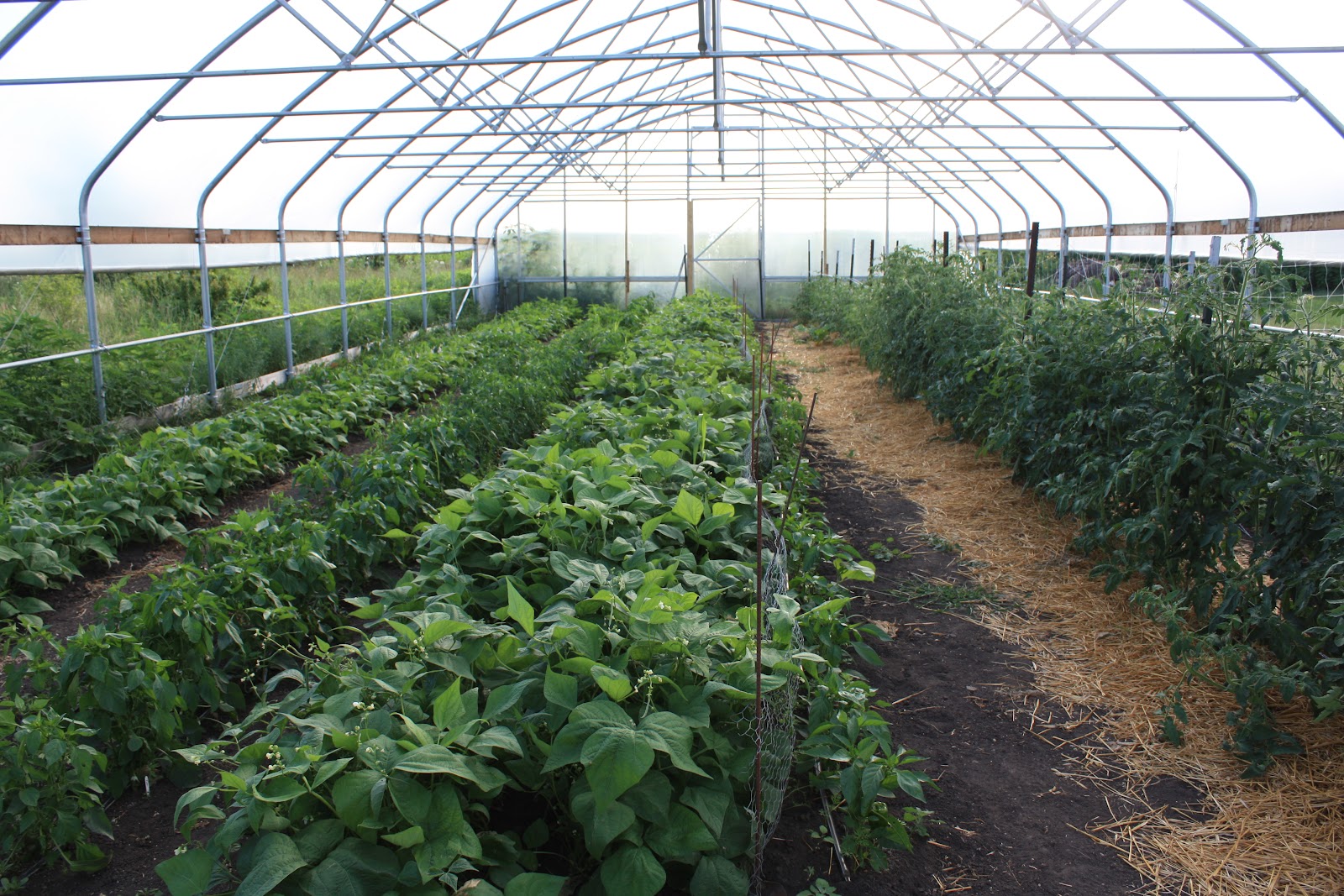
This is a typical view of vegetable crops in one of our high tunnels for any given year at the Genuine Faux Farm.  If you look carefully, you can see tomatoes, peppers, green beans and beets.  Not visible would be melons, onions and maybe the stubble of lettuce that has been harvested.  There are even some flowers interspersed that are not readily apparent from the photo.

We strongly believe that a healthy natural system is one that maintains a diversity of organisms.  That is why we place importance on crop rotations, integrated pest management, natural areas, and interplanted crops — even in our high tunnels.  We are continuously working to find ways to achieve diversity without forsaking too much efficiency — because we do need to produce healthy food and get it to those who will eat it, pay our bills, and live our lives.

When you devalue your food, you remove a farmer’s ability to add the benefits that come with caring for the land so it can continue to produce good food in the years, decades and centuries to come.  If we place more emphasis on the value of food, and the work of the people who produce it, we will find that the farmscape will diversify and the land around us will heal and become vital once again.

We need more successful fields

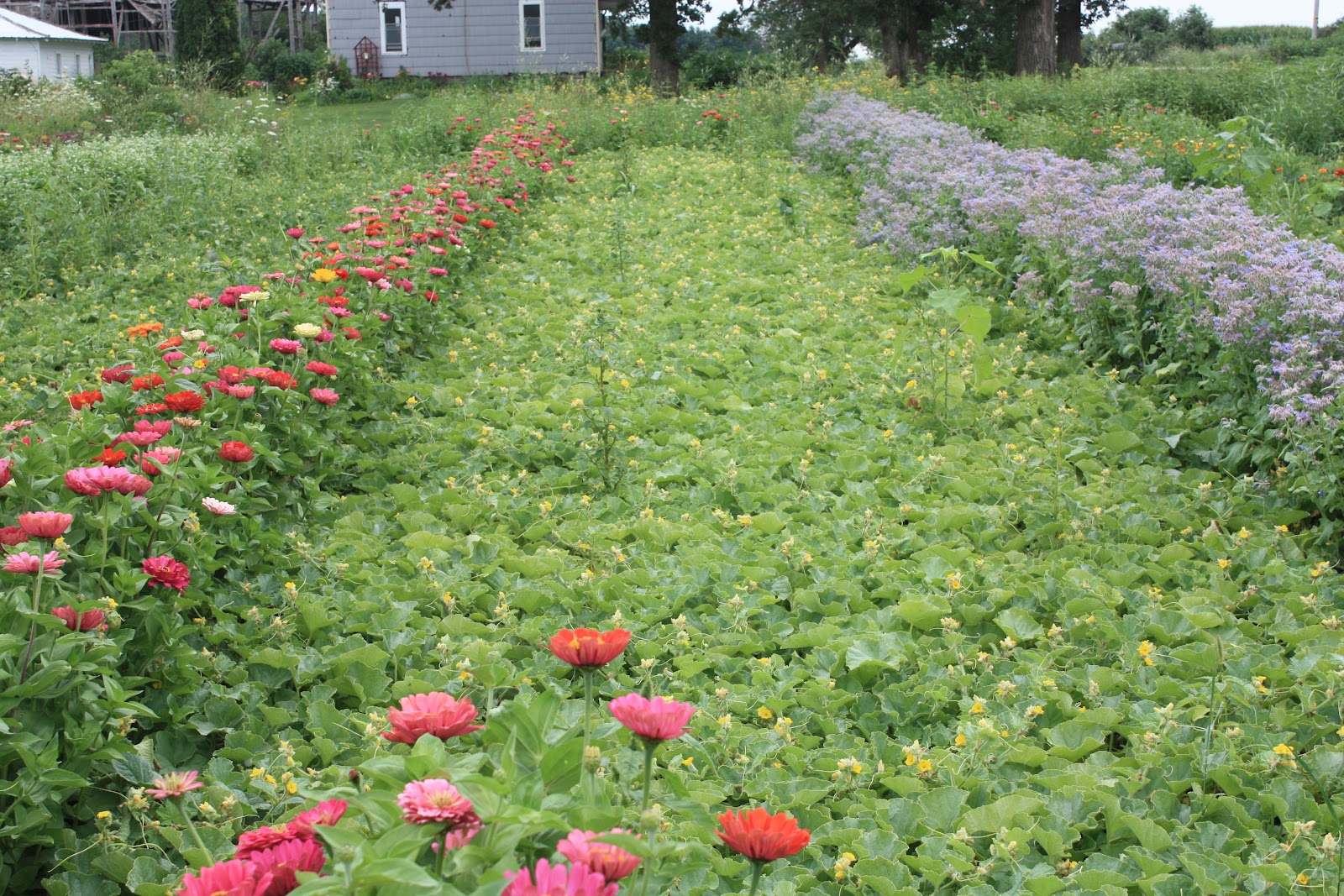
This is one of my favorite pictures from our farm.  I have told people that a successful field for a farmer is one they want to spend time in.  This picture shows me a very successful field.

If you are a farmer that has more land than our fifteen acres, it might seem small, but the technique can be scaled up or down for different sizes of operations.  The overall space shown here is about eight thousand square feet and it is one of many plots where we grow a wide variety of vegetables and fruits.  This plot was dedicated to melon/watermelon production as our cash crops, and the amount of space used for those crops has been consistent from one year to the next.

We decided to intentionally reduce the number of melon plants put into the field space by 30% and use that space for more pollinator support plants.  There are zinnia at the left and borage on the right.  Not easily seen in the picture is buckwheat, sunn hemp, basil, calendula and, of course, more melons.

It looked great.  There were all sorts of bees, toads, frogs, snakes, and other useful critters.  It felt great to go out there.  I was proud of that field and how it looked.  

And I expected to harvest about one third fewer melons because we had that many fewer plants.

Instead, we harvested 30% MORE melons — and the average weight was higher than it had been in the past.  Melons need pollinators.  Pollinators need habitat.  We provided habitat and the pollinators were present.  Nature wins.  Again.

The root of it all

I want more fields that I love being in — because those are successful fields.

We want healthy soil and a diverse system of organisms on our farm.  Sometimes, we fantasize that the migrating birds and butterflies see our farm as an oasis in a vast desert of corn and soybeans.  Other times, we despair that our little patch is not enough to support them as they pause, exhausted on their way north or south.  But, we still reap rewards when Mr. Bunting sings, the Bull Snake slithers by and the Cucumber Frog jumps and startles us.  We see the benefits when green beans taste fantastic and fresh spinach is heaped on our plates.  

The best news is that we know we are not the only ones who want to grow food for you and be the best stewards of the land we can be.  In fact, there are numerous other people who would like to join the ranks of land stewards that produce nutritious food.  But, we need you to help us remove the hurdles that make it nearly impossible for us to succeed.  One of those steps is for all of us to understand exactly how valuable food can be — and then support the efforts to reach that potential.

We’re out here.  Farmers and future farmers who will grow food with value that goes beyond nutrition and we want to cultivate successful fields.

We do it for us.

And we do it for nature.

And we do it for you.

===============================

This post is a cross-post of an entry I provided for Pesticide Action Network's Ground Truth blog.

Monday, March 1, 2021

Long Day

 Some days you just feel like the bell pepper shown below after a long day.


Sunday was the big day - the day I really buckled down to move as much as I could from the faithful old computer to this new, spiffy... annoying machine.  This has been a long time coming since I actually budgeted for and purchased the computer a while back.  But, new jobs, limited hours in the day and so many things changing found me putting this painful process off over and over again.  

Sadly, the blue screen of death has visited old faithful a few times recently and I know the signs that I cannot rely on it anymore.  That, and a couple of the keys stick.  But, I'll miss the little notch on the keyboard on the space bar where my thumbs have hit it many, many times over the years.  For that matter, you can tell what letters of the alphabet get used the least in normal English typing.  The label on those letters can still be read on my keyboard.  The common letters like "a", "s", "d", "n", "o" etc no longer have the label on them. 

Full disclosure - I was a computer scientist in a former life.  I am able to do this and I am not completely lost.  However... many of the trends for computer use and software development are leaving me behind.  Not entirely because I can't keep up mentally.  It has more to do with a couple of other factors:

1. Everything now assumes you have a constant, unlimited connection to the internet with excellent speeds.  If you don't - you have to work around everything.  And it just so happens that a large portion of rural America does not have reliable, fast internet.

2. Everyone now assumes that every individual wants to be fully connected to the rest of the world and we want all of our files on the cloud.  I don't.  Why would I want all of my files held hostage when the internet fails?  I want to work when I want to work - not just when the internet service says I can.  Besides, you can't access my personal data on the machine if I'm disconnected - so there's that too!

There are some fine pieces of software out there that you can purchase very reasonably that will move your files and even install your software for you (with a few hiccups of course - because, you know, computers).  But, these usually assume that you'll just upload everything into the cloud and then download it to the new machine.  

I'm sorry, but our internet contract would max out the data before I was a quarter of the way through the process.

Even if you do use this software, there is always a transition period where you figure out where everything on the user interface moved to.  The keys on the keyboard are a little bit different in spacing and feel, so the touch typist struggles too.  And, if you've been working with a number of software packages (some more than others), it is fairly major project just to be sure you have all of the files, settings and tools ready to go for when you need them.

I'm going to be mentally bruised for a while after this project.