Sunday, November 25, 2018

Queue and A

I was given the opportunity to speak a group of fine people in Dr. Wen's Capstone class at the University of Northern Iowa.  I thoroughly enjoyed talking with them and was reminded by their responses that the willingness to share, listen and respond thoughtfully is not a lost art.  I recently received the gift of feedback and additional questions from this group and I hope to provide timely responses in a series of blog posts that might continue a useful dialogue.

I took a moment and tried to 'snip out' segments in reflections that contained questions or had points that might bring out some interesting discussion.  I will periodically link in another blog post that already exists here.  Feel free to read it - or not - your choice.

I'll try and respond to something from each person over a series of posts.  I will not credit the questioner to maintain anonymity since I don't have their permission to post their names.   Anyone who wants to join in the discussion can respond in the comments below.  Observe common sense rules for respectful response and we'll all be good to go.

Natural Insecticides:
I think natural insecticides are interesting and I think it is a very clever way to assemble your garden. How long does it take to figure out these natural insecticides? Does it take multiple years or do you research new plants before you plant them? Do you make a game plan of where you are going to plant each one?

We do create plans every season on our farm that consider, among other things, how pests, pollinators and predators might react to our planting plan.  In fact, planning is one of the most important aspects of our farm, though this blog post concludes that there is an even more important job that the farmer does.  The simple answer is that we have daily work plans, weekly task plans, monthly project plans and yearly growing plans.  All of that is a part of a three to five year whole farm plan.  This much planning might sound a bit excessive to you (and maybe a little nuts), but it actually saves us time and heartache in the end.

2017 was a great cabbage year at GFF (despite the rabbits)!
Let's make it a little easier with a quick example.  I know from my own farm experience, from historical record, and research reports that intercropping with cabbage is a good idea.  I also have information that tells me it isn't wise to plant potatoes or tomatoes adjacent to these crops, so I wouldn't choose them to be an intercrop companion for my cabbage.  I start with that knowledge to come up with a rotation for several years, so I don't plant similar crops in exactly the same place from year to year.  That plan tells me what goes into each plot, so it is then up to my yearly plan to figure out exactly WHERE in each plot my cabbage will go and what sorts of crops or other plants I will put next to them.  As the season progresses, I make adjustments based on current circumstances.  The first batch of cabbage plants were eaten by rabbits right after transplant - now we have to make an adjustment!
Garter snakes - another good pest control measure.

It can take a long time to figure out if a particular pairing of plant types actually does anything at all.  And, if you really want proof, it can take years of carefully designed and replicated research projects to conclusively show anything.  That's where it helps to look at historical growing records and writings by farmers who came before me.  It is absolutely amazing how much help can be found in writings from decades (and centuries) prior to our current time. 

Just to make it more difficult, every year is different and every farm has different variables.  So, it makes sense to learn best practices and then find out how to adjust them to a particular farm or season.  In other words, it takes a whole lot of learning!  But, that should not stop anyone from taking the first steps and using general knowledge to their advantage.  In fact, we keep hoping that more funding will be made available to study intercropping as a pest control option.  There is a great deal we still have to learn.


Regional Differences in Sustainable Farming:
When thinking about questions to ask you after class, I could not stop thinking about how sustainability may
change in different parts of the country. For example, if an organic farm was placed in the middle of New York City or in the Rocky Mountains, how much or little will each three factors (environment, community, or profitability) affect the farming industry?


If someone asks me why I am bothering with these blog posts, I'll point them to these three questions as a starter.  They were the first three I read and the topics are vastly different!  All three people were at the same presentation and they each came away with something different.  This, all by itself, makes me happy that I participated.

The environmental component would be the most obviously different if you move to different parts of the country.  As you go West, finding sufficient water for crops and livestock becomes a larger issue, which means conservation of that resource becomes extremely important.  Any land with a grade (hills, mountains, etc) is going to increase the worry about soil loss due to water erosion while flatland with no shelter will have increased pressure to address wind erosion.  In short, the surroundings dictate the priorities of environmental stewardship that a farmer must consider.  At our farm, we have come to believe that protection of our pollinators may be our biggest and most important challenge.
It's difficult to find flatter land or better soil than where we farm.


Community considerations take a little more thought on my part.  I am tempted to say that it might be easier to build a supportive sub-community in areas where the population is more dense.  However, that is balanced by the peril that the rest of the surrounding community just might decide that your farm isn't wanted where it is.  Martin and Atina Diffley lost a multi-generational family farm to suburban development in Minnesota. 


Profitability differs from farm to farm, even in the same region.  But, from the wider view, costs to farm as we do are typically higher in denser populations.  Similarly, we could charge a good deal more for some products if we had more access to a larger and more affluent market.  In the end, it is simply important that a farm finds a way to 'set prices' rather than 'take prices.'  If you set a price, you can do your best to charge what is needed to cover expense and earn what you need.  If you take a given price, you abdicate control and are much more likely to fail.  Another issue is the availability of resources that the farm needs.  We are lucky to have a seed company in Decorah (Seed Savers) and another in Albert Lea (Albert Lea Seed Company) that we can patronize.  But, where do we go to get equipment that is sized for our farm? 
Nolt's is located about an hour north of our farm.
Ah, so that isn't as much of a problem either for us.  But, distance to needed resources does impact the economic portion of the farm.  We very much prefer to find sources as close to us as we can get.  The personal connection to suppliers actually helps us put our suppliers into the 'community' part of our sustainability plan, which strengthens two parts of the three-legged stool.

How Community Sees the Genuine Faux Farm:
Another question I have is regarding the way people see your farm in your community. Does your community see your farm as an asset, or do they see it in a different way? 

A picture at our farm by one of our customers
I was initially at a loss as to how I should answer this question.  In a way, it's a good question that maybe we should be asking ourselves more than we have up to this point.  Let me ask you this: would you really want to hear what people would say if you asked them "How do you see me?"  I am guessing your answer would be both a 'yes' and a 'no.'

We do ask our customers for feedback on a frequent basis and we are occasionally granted candid and useful responses.  Sometimes we are given positive feedback that encourages us to keep doing what we do and other times we are given a useful criticism that allows us to make adjustments and get better.  But, this is not really the crux of the question this person was asking us.  The question is really more this - "if someone who knew about your farm was asked their opinion of it, how would they respond?"

There are people that remind us that they see us as a positive presence.  When we needed help to put plastic on one of our high tunnels, this is what happened.  At a presentation I gave to a local service community I was surprised (and pleased) when our farm was introduced as "frequently giving to the community."  While we like to think that we try to do the right thing, I guess we usually don't think what we do is all that noteworthy - but we do what we can.  On the other hand, there are people in the community who have told us that we are intentionally causing discord in the area by simply making the decision to farm as we do.  Other individuals have indicated that we are naive to continue with a farm that requires so much effort with so little monetary return.

In other words, it's probably a mixed bag that depends on exactly who you ask and when you ask them.  I will also be honest and tell you that some of my opinions may not make some people happy with me, while others may suddenly think better of me.  But, that's not the game we are playing here.  I don't need you to like us or our farm, though it would be nice if you did.  We are certainly not looking to make enemies.  What I do need is for people to listen and work on being better and doing better when it comes to agriculture and food production/consumption.

Saturday, November 10, 2018

What It Looks Like When III

We have continued to post the wisdom of our Farm Supervisors on Facebook using the hashtag #GFFWhatItLooksLikeWhen.  We compile these posts into the blog once we reach about a month's worth and add some extra writing for your reading pleasure.  As has been the case for our first and second installments, we now provide you with a third blog installment of these posts for your enjoyment.

What It Looks Like When

This is what it looks like when the cat population wants to stage a protest.  They execute what is known as a "sit on."
Some few people may say, "hey, that one seems familiar!"  Ok, probably only ROB will say it sounds familiar because he used this picture and idea once before in a prior post.  If you need a laugh or three, go check it out!

Perhaps the irony of this particular photo is the fact that it comes from 2014 and as of this Spring, we have none of these fine felines at our farm any longer.  Cubbie, Mrranda and the Sandman were a pretty cool batch of farm supervisors and they provided us with multiple photo ops.
This is what it looks like when the farmer tells you the story about the florist friars AGAIN.
Bree puts up with a great deal as an Indoor Farm Supervisor.  Rob likes to test out his pun stories on her first to see what sort of reaction he can get.  The photo above is a pretty normal reaction from her.  Kind of a resigned, "why me?"  Usually, she can be pacified by a gentle skritch or three.
This is what it looks like when you know something they do not know (he's not left-handed either).
Hello, my name is the Sandman.  I didn't know my father.  Prepare to nap!

We were sorely disappointed by the Facebook response on this one.  While we do not live or die by the number of 'likes' or visits we get in social media, we figured we'd at least get ONE response that would further our Princess Bride references.  Alas, a chance for fun and general silliness was wasted.

Yes, that IS a challenge.  I dare you to use the comment section on this post.  HA!  We have an overdeveloped sense of ... well, something.

This is what it looks like when you blame the farmer for all of the puddles that make it hard to keep you sensitive paddy paws dry.
We make no bones about it.  Farmer Rob and Soup R Cali the Fragile Mystic tolerate each other, but that's about it.  If there is something wrong, Soup usually gives Rob a look that says, "THIS is your fault."  However, since she usually cannot be bothered to do much about anything, she leaves it at a look.

Thursday, November 8, 2018

Sights for Sore Eyes

Every month of the year on the farm has some aspect of transition from one thing to another.  You see, I noticed a pattern in our monthly newsletters that we have been putting out in this blog since early 2017.  Most of those newsletters starts with some opening that references the prior month and the new, upcoming month.  I have a tendency to highlight each month as some sort of transition and, on reflection, it's just a reminder that running a diversified farm, such as ours, means that we are in constant transition.
The garlic is IN!  Color the farmers happy.
The period from late October until Thanksgiving may be one of the most jarring transitions we have to experience.  This is especially true if the weather decides to jump past November into mid-December.

But, that's not exactly the point I am trying to make.

First, there are some very real, very solid deadlines that have to be met.  One of those deadlines is solid in a very real sense.  It's called frozen ground and frozen water!  Once the ground freezes, you have a pretty difficult time planting garlic.  Pulling out stakes or putting in stakes become much more difficult.  Hoses that have been out for use need to be drained or you are stuck with hoses that WILL snap if you try to move them.  Poultry that are out in the field need to be moved in so that you can keep their water unfrozen.

You can mulch garlic once the ground freezes, but planting it is pretty difficult.  It's also much more difficult to spread compost after it freezes.  So, the fact that we actually got our garlic in, composted and mulched in OCTOBER is a pretty big deal for us.  
A recent farm visitor took notice that our garlic was in.
That's a second point about this time of year.  We always have major projects that need doing.  If you ask me to define "major" I'll point to the following criteria:
1. The number of hours that project alone will require
2. The number of DAYLIGHT hours the project will require (we've got fewer of those right now!)
3. The complexity of the task.
4. The amount of stress the farmers feel UNTIL the project is completed
5. The size of the impact to our farm should we fail to complete the project by the "deadline."
6. The observable change to the farm once it is completed.

The garlic planting process clearly qualifies.  We had five different people involved over parts of two days.  The process included finishing trimming the garlic, splitting out the cloves, harrowing the field, raising the planting beds and doing a quick till in the planting area.  Once that was done we were planting the garlic, putting compost on the garlic and mulching the garlic.  But, the best way to measure the project is to assess how the farmers feel about life on the farm AFTER the project is done.

Ya, this farm isn't so bad after all.  Kind of like it, actually.  Why?  'Cuz, the garlic is in.  And compost is on.  And mulch is on.  Life is good.
Approaching the sunset of 2018.
Perhaps the most interesting thing about projects like this one is the potential for a complete reversal of attitude about that particular part of the farm.  The plot that now holds our garlic was the same one that had potatoes and beans this year.  Let's just say that this was NOT our happy place for 2018.  To be more specific, we purchased more pounds of seed potatoes than we harvested from the field.  Ya, lots of rain tends to make potatoes rot.  And, beans don't like it much either.

Suddenly, that particular field is a sight for sore eyes.  I actually like to go look at it.  Apparently this was a successful VIP (Visual Improvement Project).  Successful enough that I'm more willing to take moment to greet Bald Eagles in the Oak trees and observe the brilliant sunsets that sometimes occur this time of year in Iowa.

Monday, November 5, 2018

November Newsletter

Not An Entirely Ill Wind
The saying "it's an ill wind that blows nobody any good" is one that reminds me to look for the silver lining in all situations.  A bad situation for many people can actually be a pretty good scenario for a select few.  Not only that, but there are times when difficulties can actually lead to simpler solutions after the problems been overcome.  It is no secret that between weather and chemical misapplication issues this year, we had a tough time of it.  However, once we get a little distance from the worst of it, we are beginning to realize some good things that have come from the bad.

Look!  A new farmer selfie!
Because we did lose many of our Fall crops, we have actually been able to work on several Fall tasks that often take a back seat to harvest.  For example, the garlic is planted, fertilized and mulched.  The planting alone is often being completed just before the ground freezes because that's when we are faced with the reality that if it doesn't get done now, it will NEVER get done.  Nearly all of the drip tape, with just a few lines as the exception, have been pulled from the fields.  This is something that often gets left until December or later if snow covers it up before we get to it.

Perhaps we've felt the benefit the most at the completion of "Poultry Week" at the farm.  The turkeys, the third batch of broilers and the retiring hens have all been given their trips to the Park and then Freezer Camp.  We've already held the "Great Turkey Pickup" and a separate pickup for unfrozen broilers and stewing hens.  Significant amounts of time are spent moving birds around during this "week" that is actually more like ten to fourteen days of related tasks before it calms down. 
The garlic is IN!

It turns out that this might be a very good thing since it looks like it is going to get colder a bit faster than we've seen for the last several years.  Usually, we don't expect the ground to freeze until Thanksgiving.  While that might still be the case this year, it feels to us like there is a good chance it will be earlier this time around with upcoming forecasts calling for days that fail to get above freezing.

Perhaps the best thing to come of this year is a dedication to making some potentially dramatic changes at the farm for next season.  This may sound like a repeat to some people who know us.  After all, we make adjustments every year in an effort to improve and do better.  But, this time around, we're willing to push those changes a bit harder simply because certain weaknesses on our farm were thoroughly exploited this year.  What was the biggest weakness we identified?  We're not perfect and we think we ought to be.  But, that seems like it would be a worthy topic for its own blog post.  So, until then - we bring you the November Newsletter from the Genuine Faux Farm.

Veg Variety of the Month

Waltham Butternut
Butternut squash are the most likely winter squash for any commercial grower simply because it can handle vine borers, squash bugs and other pests far better than most other types.  Of course, seed companies continue to try to create a "better" butternut squash, but we intend to continue to stick to the Waltham Butternut.  While many of the newer varieties tout more 'uniform' characteristics, we favor the variable sizes because that's what serves our customers best.  Some want larger fruit and some want smaller fruit.  Since we do not pre-pack our shares and our CSA members get to choose the squash they want from the bin, this works out well.  It doesn't hurt that Waltham has a great taste and an excellent track record on our farm.  While we pay attention to what is out there for options, we see no reason to change something that works well for us.

Weather Wythards

Oh look!  October had above average rainfall.  We are shocked! Shocked, I tell you!  We just missed the October rainfall record that was set in 2009.

October's Report

High Temp: 85
Low Temp: 22

Highest wind gust: 40 mph
Rain: 5.08"
Snow: 1 inch


Our mean temperature for the month was actually a few degrees lower than normal and we did have lows below the freezing mark more times than normal.  We were hit with a 'full night' freeze Oct 20 and 21 this year.

Year Through August
High Temp: 97
Low Temp: -20
Lowest Windchill: -34
Highest Heat Index: 119
Highest Wind gust: 46 mph
Rainfall: 49.93"
Barometer Range: 29.39 to 30.89

November is getting a start on getting to the average rainfall during the first week because it doesn't want to be outdone by September and October.

Song of the Month
A little bit of S.O.A.R. by Devour the Day?  For those who don't know, they use SOAR as an acronym for Suffer Overcome and Recover.  I wonder why this song caught my attention?


Picture of the Month

We had all kinds of neat snow pictures in late March AND April this year.  Why should October be any different?  We realize this one showed up more than once in the blog already - but it's a good picture.  That's the requirement for the picture of the month (at least Tammy likes it), so there you have it.

Other Farm News


It worked for October, so we'll do it for November - a bunch of short bullet items for you to enjoy, consider or ignore as you wish:

  • As of this writing, we believe all of our turkeys have been sold.  If you still want a turkey, contact us in case someone fails to follow through with their reservation. 
  • We do have about 30 stewing hens remaining available at a cost of $8/bird and 130 or so broilers at $3.50 a pound.
  • The CSA season is winding down - perhaps a bit earlier than we scheduled.  But, when you don't have crops, you can't give crops.  Nonetheless, we anticipate two more weeks of delivery before we are done for the year.  
  • There IS plenty of garlic available at this time.  That is one crop we did not run out of - but we suspect people don't want a CSA share of 20 garlic heads and nothing else...
  • We are not the only diversified vegetable farm in Iowa that is feeling the "hurt" this year.  At least three farms with some history are confirmed to be packing it in this year and there are rumors about several others.  The extra-ordinarily difficult weather is certainly a key component here, but the issues are far more complex than that.  Inconsistent demand for verifiable local food, difficulty in finding workers, chemical misapplication, reduced pollinator populations combined with a realization by veteran farmers that they might be able to do something else with significantly less pain and suffering are all contributing to the situation.
Leaving the Park and on the way to Freezer Camp
The Outdoor Farm Supervisors (Inspector and Soup) are protesting some of the changes that occur on the farm in the late Fall months.  In particular, they are displeased that access to certain building is completely denied to them.  Inspector likes a little attention now and then and he feels that he is not getting his allotment of skritches because there are fewer people working on the farm regularly and when Rob is out there, he is usually doing something that doesn't allow for a many good skritches.  Inspector has lodged a complaint with the farmers that sounded a bit like, "Meow."  We told him to submit it in writing and we would look into it.  That might explain why he lodged a cat protest by sitting on Rob's back while he crawled to plant lettuce in the high tunnel.  That is known as engaging in a "sit-on protest."  The complaint was duly noted.

Tuesday, October 30, 2018

Veg Variety Winners for 2018

Every year we attempt to identify the top varieties that were grown on the farm during the year.  Criteria include production, quality of fruit, taste and plant health.  Additional factors that may increase the rating for a variety might be performance as compared other varieties of the same type or one that surprised us by doing far better than anticipated.  You might also note that we will give a tie break to a variety that has not been awarded a top slot over one that has.
For those who want to see what has gone before:
About 2018's Growing Season
As part of my pre-writing work for this yearly post, I review the prior year's post to balance my response to the current year.  The summary for 2017 was that it was a pretty well-balanced year with some record crops.  That actually helps me to feel better about a 2018 season that was among our most difficult that we've experienced at the Genuine Faux Farm.  If my summary for 2017 had also highlighted the negative, I would need to review more years to see if this is a multi-year trend.

To be blunt, this list was difficult to put together because so few of our crops made us happy this season.  We will grant you that we keep trying to raise the bar for measuring success, so it is harder for any crop to blow us away at this point in our careers.  So, we'll balance the realities of the season and our historical results and provide you with a good list - even this year!

15. A and C Pickling Cucumber
It is likely that the A and C Picklers deserve a spot further up this list because any difficulty they had this year had nothing to do with their production.  But, we have another cucumber variety on the list and we normally try not to overload our lists with one type of crop.

Our goal for cucumbers is to try to get eight to ten marketable cucumbers per row foot that we plant.  This year's A and C's were not far off at between six and seven.  Before you get to critical, you need to realize that we had to throw a significant number of good looking cucumbers because of a chemical drift issue this season.  If you add those in, we would pass the target number.  We were pleased to have a good cucumber season after the debacle that was 2017's cucumber crop.  But, we should not be surprised.  Wet conditions in June favor cucumbers and wet conditions in August helped them to continue.  When you also consider that most of the production came from the later successions that came after the spray incident, you can't help but be a little bit impressed by this variety.

The fruit for A and C Pickling works equally well if they are harvested small (pickler size) or large (slicer size).  We tend to just try to keep them picked by harvesting two to three times per week.  We were very impressed by the bee activity during the month of August in our cucumbers and the flower density if usually quite high for this cultivar.

14. Quadrato asti Giallo
Quadrato asti Giallo is one of those variety names that sound great mostly because it is an Italian name.  An English equivalent name would be Four-Lobed Yellow Bell Pepper.  Ya, I agree, let's go with the Italian this time.  There are clearly a couple of strains of this pepper floating around because we have gotten some very different results over the years.  One season saw us getting huge, rounded yellow bell peppers and another saw an increased number of fruit that were on the smaller side.  This year tended to see smaller sized fruit, but they were more likely to turn fully yellow than some strains have shown.

Nearly every choice on this list is going to have a caveat this year, which is just the way it is when you have a challenging year.  All of our field peppers were impacted by Dicamba drift and we harvested less than ten marketable peppers from several hundred plants out there.  That means all of our pepper production came from the high tunnels.  Luckily for us (and all of you) we had some Quadrato's in Eden this year and they even managed to survive wet weather that soaked the soil in that building multiple times.  In fact, it seems to us that Quadrato is probably not as happy in a high tunnel as they usually are in the field.  Perhaps we need to increase the amount of water we give them when they are in there?

Fruit taste pretty good even when green, but they taste best when there is at least some streaking of yellow.  Pepper wall thickness is average to marginally thick and the texture is excellent.

13. Westlander Kale
After a slow start, the kale was doing fairly well for us until we hit September this year.  We over-planted kale a bit last year, so we dialed it down, only to find a place that would buy kale from us (doesn't that figure?).  Of course, as the demand seemed to settle in, the rain did as well.  The net result is that all of our kale struggled in very wet soil, so production pretty much stopped once we got into the Fall months.  This is not typical since we usually expect kale late into the season.

We prefer open-pollinated varieties when we can get them, which is why we grow the likes of Dwarf Blue Scotch, Vates and Westlander for our green curly kales.  The Dwarf Blue has been with us since we started growing kale and we still like it.  However, Westlander seems more likely to give us a more consistent, tight curly leaf that restaurants seem to prefer.

12. Dr. Wyche's Yellow Tomato
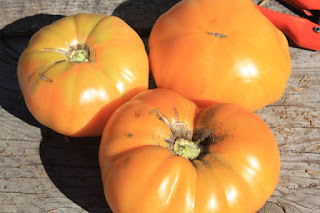
Believe it or not, we have tomatoes on this list this season!  Dr. Wyche has been on this list in the past as an "Honorable Mention."  These plants produce a beefsteak style fruit that averages around a pound in weight and have a slightly sweeter taste that is common for yellow tomatoes.  The plants themselves tend to be larger and have been known to lift their supporting cages out of the ground before finally succumbing to gravity and taking the cage with them.

Clearly, Dr. Wyche's Yellow prefers high fertility since they landed in a spot that had free-range chickens the previous season.  We'll keep that in mind for future seasons and give them a bit more to work with than some of our other varieties.  Our regret this season is that the wet weather that began in August resulted in the lost of a significant number of beautiful fruit.  We did our best to pull fruit before problems got to them and managed to get a reasonable number of them before the entire crop of outdoor tomatoes were terminated.  Dr. Wyche was the last to give up.

11. Bunte Forellenschus Lettuce

This season was a fairly balanced one as far as lettuce varieties were concerned.  This was, in part, because we were consciously trying to measure results of a wide range of cultivars this year.  Overall, lettuce production ran near our average for number of heads produced, but the average weight was lower than usual.  We really can't say that any particular variety stood out completely from the rest this year.  The numbers bear that out, but we still felt that lettuce did well enough that it needed a representative on this list.  So, we went with the lettuce that we were most proud to hand to our customers this season, Bunte Forellenschus.

Bunte Forellenschus is a butterhead type of lettuce that has a slightly softer texture than some lettuces.  The darker green leaves have chartreuse speckling that make these lettuce heads very attractive in our opinion.  We have had some people worry that these speckles are indications that the lettuce is 'going bad,' which couldn't be further from the truth.  When Bunte is going well, they are a joy to grow and harvest.  They cut easily at the base, clean easier than many lettuces and give a good looking-proportional head at all stages of growth.

10. Imperial Broccoli
We participated once again in a Summer broccoli trial with the Practical Farmers of Iowa Cooperator's Program this season.  As was the case a few seasons ago, we ran a randomized replicated trial with Gypsy, Belstar and Imperial.  The two former varieties have been with us for several years and have a good track record with us.  Imperial was not available last year, but it got its second chance with us this season and we were pleased with the plant health, head size, shape and taste.

Imperial is a F1-hybrid, which is a strike against it in our veg variety posts.  But, we have yet to find a single open-pollinated broccoli that will do what we need it to do (note, we have found cauliflower that works).  Very few seed companies seems interested in developing an open-pollinated broccoli, so we are left with hybrids.  Head size during this season averaged around one pound and the plants did not seem terribly interested in producing side-shoots.  Like so many of our crops, the late broccoli was severely reduced by wet weather.  Our Fall succession is still sitting in the fields trying to decide if it will head out and the Summer succession lost side-shoot production in the standing water.

9. Tolli Sweet Pepper
Tolli Sweet is one of the varieties on our farm that just keeps plugging on from year to year.  It never seems to get the respect it might deserve and it rarely gets much by way of recognition.  Well, this is the year, Tolli Sweet!  You made it to number nine!  Well, ok, Tolli Sweet got some love last year as well at number 13.

Tolli Sweet Peppers are a carrot shaped pepper that is best when it is allowed to turn red.  The fruit size is quite variable and the pepper wall is fairly thin.  Persons who have some trouble with digesting peppers may find that Tolli Sweet is much more tolerable to them and they are good for fresh eating, sandwiches, salads and nachos.  The plants are small in stature and prefer not to have wet feet, which makes them perfect for high tunnel production.  Fruit do not hold on the plant particularly well either, so you want to keep them picked at early to mid stages of ripeness.  Waiting too long tends to result in splits or issues with the fruit.  Despite that, we get a decent harvest every season from Tolli Sweet and the taste is excellent.

8. Thelma Sanders Acorn Squash
We have been telling people about Thelma for many years (both growers and consumers).  In our opinion, we think the quality of this tan acorn squash is better than most green acorns and Tammy and I prefer the less stringy texture.  Even better, the production numbers are quite favorable.  Once again, we had trouble with wet weather, which did reduce our yield on the Thelma's somewhat, but the fruit did not suffer from rot the same way many other squash seemed to.  As a result, we had a reasonable yield of these for the season.

Thelma Sanders is showing up in more seed catalogs!
Thelma Sanders seems to be handle some weed pressure, dry seasons, wet seasons and it doesn't seem to struggle too much with pests.  In short, it's a tough cultivar that is prepared to compete and succeed.  Perhaps you could find acorn squash varieties that will produce more fruit per plant, but we doubt they'll have the same quality.  If you need further argument, we no longer grow any other acorn squash at the Genuine Faux Farm.

7. Dragon Carrot
Oh my goodness!  A carrot made the top variety list for the Genuine Faux Farm.  This is not the first time it has happened, but it is certainly not a common situation for us to be in.  As a matter of fact, it is so abnormal that we don't usually take pictures of our carrots.  We actually still have some more in the ground in one of the high tunnels, so we may add a picture later.

Dragon has a purple exterior and bright orange interior.  The taste has a slightly spicy overtone that many people seem to enjoy.  The carrots themselves seem to germinate better than many varieties and handle a wider range of adverse growing conditions.  The biggest danger seems to be in letting them get too big, at which point they have a tendency to split, though they don't necessarily get pithy at that point.  Dragon makes the list by virtue of a decent stand in the field and a correspondingly good stand in a high tunnel this season.  Essentially, it did what it was supposed to do, which is better than many crops this year!

6. Redwing Onion
We have been very fortunate to have some level of success every season since 2014 when White Wing made it to our top 10 list.  Redwing shared the limelight a couple of seasons ago with Ailsa Craig, but it gets to have its own spot on our Veg Variety list in 2018.


Redwing at the right
Amazingly enough, the success or failure of our onion crop this season was balanced on a razor's edge.  Our seedlings just didn't want to put on any growth and we were placed in the position of wondering what to do if they didn't get up to a transplanting size.  Happily, our friends at Grinnell Heritage Farm had numerous extra onion starts that they were going to compost unless we wanted them!  We certainly wanted them.

The net result is that, while we didn't get to grow some of the varieties we wanted to grow, we still got to grow Redwing.  The size this year tended to be between a half pound and three-quarters pound and the taste was good, as expected.  The only issue was a fair amount of stem and root rot that was noticeable at harvest and later in storage.  We did have to work hard to check and re-check our stored onions to be sure we didn't lose them.  Once again, we believe much of this has to do with the wet season.  So, while we lost some good sized onions to those issues, we still have some beauties in storage at the end of October.

5. Dunja Zucchini
Dunja is being sneaky as it was number 8 last year and it has moved up three slots to number five this year.  Once again, this is a F1-hybrid rather than an open-pollinated variety.  But, once again, we just haven't found an open-pollinated zucchini that will do what we need it to.

Dunja plants tend to stay smaller and have an open growth habit that helps us to see fruit before they get too large.  As a result, we can typically keep from growing an absurd number of "Louisville Sluggers."  They are also consistent with fruit set and tend to produce nice, straight fruit without bulbed ends.  It doesn't hurt that the seed cavity is often smaller and the texture is consistent throughout.

We will admit that we had a harder time this year getting the harvest in before fruit size got a bit larger.  As a result, many of the zucchini crossed the one pound mark.  The good news?  Dunja doesn't get seedy at that size and are perfectly good to use in a wide-range of recipes.  

4. Berries and Cherries
This is one thing we never thought we would put on our veggie variety list on the farm.  First, berries and cherries are not a crop we've ever really intended to turn into a marketable crop.  Second, we really haven't intentionally done much with varieties of these things - we just make sure to give them space to do their thing each year and if we have a crop combined with the time to pick some -well, there you are.  And finally, these aren't veggies, so all of our veggie crops are probably offended that we put this in here.


Here's the thing.  We had a great year for mulberries, raspberries and Nanking cherries.  We had a poor start to the season for our veggies and we needed to harvest something for our CSA members.  There it is in a nutshell.  We maintain a diverse environment on our farm and in a poor year that diversity stepped up to help us out.  While I didn't think of it that way until recently, that is exactly what happened.  We got some payback for our efforts in the form of these tasty treats.  Given that, I think we would be remiss if we did not recognize this in our winner list for the year.


And, before everyone gets excited that we're going to expand or otherwise increase our berry/cherry production for our customer base, you need to remember that these crops are very season-dependent.  You also need to remember that we have never set ourselves up to be berry/cherry farmers.  This is just the happy by-product of trying to maintain a healthy farm.


3. Silver Slicer Cucumber
Our cucumber grow list has been fairly stable for a number of years now, so we can't exactly explain what made us decide to trial Silver Slicer last year and then continue with it this season. We already grow Boothby's Blonde, which has made it onto our lists more than once.  We did decide to stop trying to grow True Lemon because we couldn't quite find the harvest niche on our farm for them.

It turns out that Silver Slicer has a great fresh-eating taste that makes our local cucumber taste expert (Tammy) very happy.  When the rest of the crew confirmed her initial opinion, it seemed reasonable to grow them again this season.  Silver Slicer seems to be fine with a late season start and doesn't seem to have a tendency to grow the cucumbers too large, having what seems to be a top size at about 8 inches.  We like to harvest them around six inches, but the size doesn't seem to impact the taste or texture too terribly much.  Like many open-pollinated varieties, it has more to do with age on the vine than actual size of the fruit. 
2. Macintosh Apples
    
Here is another entry that breaks with tradition.  As is true with the berries and cherries, apples are not something we have advertised as a Genuine Faux Farm product.  While it is true that we have planted apple trees (and other fruit trees) on the farm, we never expected to become an orchard of any repute.  We have friends who do that professionally and we respect what they do too much to even pretend that this is anything more than a diverse farm wanting a few apple trees for themselves.  The thing is, this year was perfect for our apple trees (unless you count the poor tree that was taken down by winds this year).

We selected the Macintosh as our 'variety' this time around because these trees were most productive and seemed to give us the best quality apples of the group.  We do like our Fireside Trees (and the others too), but the Macs had the best quality overall (and they didn't fall down in the wind).  We believe this year's late Spring actually was favorable for our apple crop, encouraging our apples to wait until later to bloom when more pollinators were available.  On top of that, that period of the Spring was less windy than usual.  The net result is that the blooms stayed on longer and the pollinators had more perfect days to visit flowers.  We are certainly grateful, but we also do not expect a repeat of this performance in 2019.

1. Minnesota Midget

Minnesota Midget
Minnesota Midget is no stranger to our lists, showing up at number 2 in 2015.  This year, they take the prize, setting a record for high tunnel production this year on our farm.  During a season that saw so many things go wrong, it sure is pleasant to look at a crop where most everything seemed to go right.  As a matter of fact, things didn't go perfectly with Minnesota Midget since the planting in Valhalla did not go in on time, so they performed poorly.  But, the earlier succession in Eden did so well, it set a production record for the farm ALL BY ITSELF.

Fruit size can be variable, though a consistent watering program can reduce that variability.  The hard part is trying to reduce water prior to ripening so the fruits set more sugars for a better taste.  The net result is that later sets may be smaller in size due to the reduced watering regimen.  Regardless, our CSA membership were able to have some quality melons in their shares this year and the farmers were also able to enjoy melons for breakfast on a semi-regular basis.  We'll call that a win!

Sunday, October 28, 2018

Captain Obvious

If you have ever farmed, you can appreciate the fact that exclamations are going to come out of your mouth in response to what is going on in the moment.  This is especially true if you are frustrated by whatever is happening.  I am not one to drop "swear words" very often, but every once in a while the words that are uttered make you stop and consider the situation for a second or two before moving on.  Perhaps one of the best examples I can think of is the nun who was a Social Worker in a county where Tammy worked some years ago.  Apparently, words that are not associated with a nun came out of her mouth.  If a nun says "damn it," you can't help but wonder if there is more impact than if I were to say it!  In her defense, I just have to say that the field of Social Work can be incredibly frustrating - and so can farming.

You... You... TURKEY!
Growing up, I learned that you could call inanimate objects, animals and sometimes your siblings a 'turkey' if they got on your nerves.  It's a fairly safe thing to say and few people will be overly offended by it if it is overheard.  Drop a wrench for the second or third time and watch while it bounces into a place that's hard to reach that third time?  Well, call it a turkey. You get to express displeasure in a way that is 'family-friendly' that way!

But what happens when the thing that is getting on your nerves is...
Yes, I was trying to finish loading the truck to get to a CSA distribution.  Yes, I was on time, but I didn't have much EXTRA time.  Yes, I heard interesting chirping noises coming from the area of the turkey pasture.  And, what did I find?  Most of the flock had managed a break-out through the fence.

I hustled out to try to get the birds back into their pasture and most of them complied with minimal fuss.  Except for one bird that wanted to make life more interesting.  After the third time that it managed to go in entirely the WRONG direction I found myself forcefully saying,

"YOU TURKEY!!!!"

I stopped moving.  The turkey stopped moving.  We looked at each other.  I could swear I could see it thinking, "Yes.  That's me.  What do you want?"

Not All Birds are Turkeys
I'll admit that this was not the first time that I've called a turkey a "turkey" with the intent of expressing displeasure and finding that the turkeys are pretty much immune to that particular insult.  But, normally, I find myself being much more judicious with my exclamations after this sort of thing happens.  The conversation goes something like this:

Analytical Me: "Ok, you just called a turkey a turkey.  Good for you.  If you are really getting so upset as to believe it will do any good to do that, you should back off a second and figure out a better way to do what you are trying to do."

Not So Analytical Me: "Stupid bird!  Of course it has to be a turkey so my yelling turkey at it doesn't make a difference!  Grrrrrr!  I need to go drop a wrench or something!"

I finally got the last turkey in and got the CSA distribution done.  The next day, I was feeding and watering the broiler chickens.  Usually, I don't let the birds out of their building before I give them their food and water.  When I do let them out too soon, they are underfoot and they make the task just that much harder.  So, of course, on this day, I let them out FIRST.  Ooops.

Now I had to watch every step I took and had to push birds out of the way so I could set the food bucket down.  As I did so, one bird acted like it wanted to take me on.  Chickens have a hard time with perspective.  You LOOK smaller when you are further away, so they figure they might be able to beat you in a fight.  But, as you approach, you keep getting bigger, which results in their decision to high-tail it away from you.  As I looked down at this particular bird and it looked up at me, I saw the tiny hamster-wheel in its head spinning.  The conclusion it made was to turn around and run away from me.  It was a good choice, but before I knew it, I was yelling, "CHICKEN!!!!"

Yes, yes they are.
Unlike the turkey, they didn't stop what they were doing and they really didn't pay much attention to me.  They were more interested in the food and water.  I was disappointed because I thought I was being inadvertently clever.  Yes, that's correct, I wasn't trying to be funny.  I wasn't even thinking about it, it just came out.  Once again, the target audience found my commentary to be accurate while failing to inspire or dissuade them in any way.

Analytical Me: "You need to stop letting the weather and the farm getting under your skin so much.  One of these times, you're going to let something slip that will have actual consequences."

Not So Analytical Me: "Yelling 'chicken' at a wrench doesn't make sense."

These Things Come in Threes
The third time, of course, was the charm.  This time, it was a (largely) inanimate object that incurred my wrath.  You see, the hen room needed to be scooped out.  The process pretty much consists of using a pitchfork and a shovel to take loads out to the bucket of the tractor.  Once the tractor bucket is full, you take it to the compost pile.
Portable Poo Producers
Unfortunately for us, we don't have an opening immediately next to the room to throw the 'used' bedding and poo into the bucket of the tractor.  Instead, we have to walk each 'load' on the pitchfork (or shovel) through a door and then an opening before we can toss it into the bucket.

I had a nice big load on the fork and I made it successfully through the door of the hen room.  I only had a few more steps to go and the load slipped off the fork and onto the floor.

The intelligent words that escaped my mouth at that moment?  "Oh, shit!"

Yes, yes it was.

Friday, October 26, 2018

Why Do You? - Talking Turkey

Every year, when the turkeys approach the point in time that they go to "the Park," "Freezer Camp" and then are "Guests of Honor" at various homes for Thanksgiving, we get a batch of questions about how we raise our birds and/or why we do things the way we do with respect to our turkey flock.  Sometimes these questions are directly posed to us and other times, they are implied.  Either way, we hear them and we'd like to take some time to answer at least some of your questions.  After all, we realize that we are definitely part of a small portion of the population that actually raises turkeys - so we should not expect everyone else to understand what goes on without a little bit of help.

Other Blog Posts that Talk Turkey
We have written about our turkeys multiple times AND we have even asked some of our turkeys to write blog posts.  We encourage you to visit some of these if they might amuse you or address your specific questions:

  • What does a turkey sound like?  You can at least get a sampling in this blog post.
  • Our most popular turkey post is the one that discusses the stages the birds go through on our farm.  This includes an introduction to some terminology.  Want to know what a snood is?  Go to this post.
  • Jake the turkey provided us with a very useful turkey perspective that many people also enjoy.  His perspective about "little bald turkeys" might amuse you a little.
  • Before you think turkeys are less than intelligent, Ima Turkey's documents revealed some of the research the turkeys have undertaken in the past.  
  • And, before you think everything is all 'honey and light' here, we do have a post that features dark humor about a situation involving rats in the turkey room.
Day Ranging Turkeys
Our birds are 'pasture raised' but we tend to prefer the much more accurate term 'day ranging.'  Our turkeys are given access to a nice pasture (see below) during the daylight hours.  But, for their protection, they go into a building at night.  This is especially important when they are smaller and might be more a matter of principle when they are larger.  Once turkeys establish a 'home' they tend to go back to it - even if they are a bit SLOW about it sometimes.  Tammy and I get a little frustrated with them when we just want to GO INSIDE OURSELVES and they aren't interested in marching right on in just yet.  This is especially true when it is raining.


Yes, turkeys stay outside, even when it is raining.  They could go inside their room because we leave it open for them.  The hens often go inside when it is raining, but turkeys do not.  They might try to stand under a tree or the eave of the building.  But, at you can see, the trees are still a bit small and the eave area can only accommodate so many birds.

They will not allow themselves to be herded into their room before it is night time, so don't even suggest that we try.  They want their outside time and they are going to get it, darn it! 
Oh look! Damp turkeys!
Why day range these birds?  Well, first of all, we feel that the turkeys are healthier than those that are raised in a confinement/building environment.  That does not mean we won't lose a turkey to injury or illness.  That's just a part of life.  However, these birds have the opportunity to find a corner of the pasture away from other birds if they want - though most of them just stay with the flock.  We stick with about 60 birds in our flock and they will often splinter into 'cliques' of ten to thirty birds - especially when they get out of their fenced pasture!

Because these birds are given the opportunity to forage, their diet is more diverse.  They are encouraged to walk and run which improves the overall muscle tone.  One of the positive results for carnivores who like turkey for dinner?  The quality of the dark meat is every bit as good as the white meat.  More of the bird is truly useful, so you get more bang for your buck as well.

Feeding Feed and Whatever Else They Find
Some folks have asked if we just let the birds forage for their entire diet.  The answer to that is definitely a 'no.'  While we understand that some people are asking because they want us to raise these birds more 'naturally,' we need to point out that we would need a significantly larger farm to have a prayer of doing this.  And, you have to consider the issues of protein and sufficient bulk to keep the birds happy.

If you look at the pasture photos, you'll see that the birds have trimmed the grass very short and there are no tall weeds for the most part.  They will eat bugs - and frogs - and whatever else that we haven't necessarily witnessed.  They receive veggies from the farm and they get straw in their room that probably has some seeds in it still.  We have aronia berries in the field that they also seem to enjoy.  The service berries were too good since we're not sure those plants will survive.

But, the reality is that the pasture does not hold a full diet for this size flock for the entire time that we have them.  The berries are there for a week or so.  Frogs learn to NOT be in that pasture quickly.  And, the grass doesn't grow much when the sun doesn't shine and it gets colder in October.

We are blessed to have a connection with the Canfield Family Farms.  Earl and his family do a fantastic job of raising diverse crops and creating feed mixes that are well-balanced with many grain types.  All of the grain products come from THEIR farm and we trust them to provide high quality feed in ways that are in harmony with nature and excellent farming practices.  This is how local foods is supposed to work - and we're very happy to be doing things this way with our turkey flock.

Late October Processing
We get the most questions that have some relationship to processing, the timing of that processing, the cost of the birds and the size of the birds.  That certainly makes sense since people who want a turkey are going to be looking at these things.

But, why late October processing when most people don't want a turkey until late November for Thanksgiving?
62 turkeys sitting quietly waiting to be taken home by their new families.
You asked, we'll answer the first question now and the others later:
  1. The pasture growth is slowing/stopping in October and won't improve in November.  We need that pasture to recover so it is available next season.
  2. Veggies aren't as easily available.  The diet becomes increasingly feed intensive at a time when they want MUCH MORE to eat.
  3. Our friendly, state-inspected processor in Greene, Iowa (Martzahn's Farm) is a small business with limited capacity.  They can't process everyone's turkeys in mid-November!  We like their work very much, so we work with the schedule they have (and yes, we schedule the processing date in the Spring, it's not a last minute thing).
  4. The farmers are getting tired of poultry by this time of year.  We've been managing four to five flocks for several months in a row and our help declines as we go deeper into the year.  
  5. Water is necessary to keep birds healthy and alive.  If you haven't noticed, water freezes when it gets colder. Huh.  Who knew?
  6. We've learned that if we want to get all of the turkeys sold prior to Thanksgiving, we need to have them for three to four weeks prior to that date. 
We Actually Do Miss Them - Sort of

Turkeys, wondering if they should have been ducks this year.
Our turkey flock does tend to interact with us more than the broiler chickens or the laying hens.  They are curious and interested in the world around them.  They crowd gobble at the crows that fly-over and taunt them.  They run in a knock-kneed fashion that is humorous to watch.  They get excited when they hear power tools for some reason and they think visitors are part of a rival flock that they need to impress.

And yet, we're still ok that they are now at Freezer Camp and will be going to other homes for Thanksgiving.  Except for the bird that has been invited to ours - that one can stay.