Sunday, January 9, 2022

Correspondence Course - Postal History Sunday

Welcome to this week's Postal History Sunday, hosted on the Genuine Faux Farm blog and the GFF Postal History blog.  

I'd like to recognize those of you who may be discovering Postal History Sunday thanks to the publication of prior PHS blogs in the WE Expressions electronic journal or on the American Philatelic Society website.  Thanks for stopping by!

Whether you have been reading Postal History Sunday for some time now or if you are just joining us, you are welcome.  It does not matter if you don't collect postal history or if you have much more experience in the area than I do.  Some who have been reading PHS for a while have informed me that they do not intend to join the hobby, but they still like reading these posts!  Others with more expertise have kindly provided me with more information and resources that I can use for future posts.

Whatever your background or motivation, put on your fuzzy slippers and get a favorite beverage (but keep it away from the paper collectibles!).  I'll take a little time to share something I enjoy and, hopefully, we'll all learn something new in the process.

----------------------

Have you ever considered where all of the postal history comes from that people, like this farmer, collect?  All of these old envelopes, folded letters and package fronts had to come from somewhere, didn't they?

Much of the postal history that I collect is available thanks to the willingness of individuals or businesses to maintain files and bundles of old correspondence and then allow them to become publicly available.  Sometimes, family descendants are responsible for the dispersal or maybe the new owners of a business.  Often, most or all of the contents are removed, and, frequently, these papers have been harvested for the stamps and the rest of the paper material is tossed. 

And, we need to remember - for every correspondence that is saved and placed in the care of museums, schools, or individual collectors, there are countless others that were simply destroyed.

A correspondence can have value for the postal historian because it provides a broad view of many postal systems, postage rates, and routes for the delivery of mail.  By simply finding a few examples from a given correspondence, you can begin to get a feel for how mail worked at that time and place.  For example, the Luden & van Geuns material can give us an idea of how business letter mail was handled in 1850s and 60s Europe.

There are other times that a single correspondence provides us with almost ALL of the examples of mail between two locations during a certain time in history.  We'll start with one such correspondence. 

Jose Esteban Gomez Correspondence

Our first example provides postal historians with examples of how the mail worked between the United States and Spain in the 1860s.  Because I do focus on the 24-cent 1861 stamp (which you will see at the top right on this folded letter), most of my focus has been on the items that have that stamp.

To my knowledge, there are just under twenty examples of the 24 cent stamp on mail from the United States to Spain.  Of those, only a couple do not come from the series of postal items that were sent from Dutton & Townsend in New York to Gomez in Cadiz.  The postage cost for the 1868 folded business letter shown above was 22 cents per 1/2 ounce via the British mail system and the 24 cent stamp overpays that amount.  If you want to learn more about Dutton & Townsend's willingness to overpay on their letters, you can view Costs of Doing Business, which was a May, 2021, Postal History Sunday.

There are, of course, other pieces of mail to Gomez in the 1860s that do not bear a 24 cent stamp, and those were all sent by someone other than Dutton & Townsend.  By my informal count, there are approximately another twenty or so items out in the world of collectors right now.  It seems likely there are more as I have not worked very hard to track all of the Gomez items down.  I mean... I do have a job and a farm to run, you know!

The value of this series of business letters to a postal historian is in the way it illustrates the varied postal rates that could be used to accomplish the same end result - delivery of mail from the US to Senor Gomez.  There was no agreement for the exchange of mail between the United States and Spain in the 1860s.  Instead, a person could choose between one of several options.

The most common option was to send the letter via the "open mail" provision provided in the convention the United States had with the United Kingdom.  Essentially, the sender had to pay for any postage required to get the letter into the hands of the British Mail system.  The rest of the postage would be paid for by the recipient (Gomez). 

This letter provides us with an uncommon rate - at least as far as surviving pieces of postal history are concerned.  This 22 cent rate was only available starting in January of 1868 and was terminated in December of 1869.  A person could still use the open mail provision during those two years, if they wished, but this 22 cent rate paid for the entire cost of postage and Gomez would not have been required to pay anything to receive it.

Elie Beatty Correspondence

Here is another item I have featured before.  This cover initially appeared in By the Sheet that was published in April of 2021. If you are curious about some of the rate details, take the link to that blog.

The Hagerstown Bank correspondence has value for postal historians and those who study banking systems.  Elie Beatty was a well-respected cashier and was apparently quite talented at his job.  The site linked in the prior sentence gives us this summary:

"The historical significance of the collection lies primarily in the insights it offers to the operations of a prosperous regional bank during a tumultuous period in United States banking history. The antebellum decades witnessed a series of banking crises, most notably the Panics of 1819 and 1839, recurring recessions and depressions, and the famous "Bank Wars." The financial and political upheaval, combined with disastrous harvests during the 1830s, wreaked havoc on Washington County, Maryland, and caused the Williamsport Bank to suspend specie payments in 1839. Despite the prevailing economic climate, the Hagerstown Bank emerged as a stable financial institution with considerable holdings."

Elie Beatty's story can certainly be expanded upon, but I will suggest that you can take the link and read the summary there if you have interest.  If there was a doubt as to Beatty's dedication to his job, I will add the following from the site linked above.

"Beatty resigned his position on April 23, 1859, citing "feeble health and the infirmities of age." Beatty died on May 5, 1859 at the age of eighty-three."

So much for retiring and traveling the world or doting on grandchildren...

Beatty covers are far more numerous than those in the Gomez correspondence and they cover a much wider time frame.  As a result, collectors can find inexpensive examples that allow them to explore the postal rates and routes during the first half of the 1800s in the eastern United States.  Most of the Beatty material you can find will exhibit the frequently used rates and routes.  However, the fun comes when you start looking for as many different rate or route variations that you can find.  There are some very uncommon postal rates that can be shown with a Beatty cover - if only you can find them!

Again, this is part of the value of these larger collections of letters to the same recipient.  They give us perspective into what was the most common approach to using mail services and what was exceptional.

Frederic Huth and Co Correspondence

Frederick Huth established this London banking company in 1809, which eventually became a part of the British Overseas Bank in 1936.  The Huth correspondence has provided significant volumes of European postal history examples for the 1800s - especially during the period prior to the use of postage stamps to prepay the cost of postage.

At this time, postage was typically accumulative - meaning longer distances required more postage.  Also, each postal service that handled a piece of mail wanted their fees paid, which could lead to some very costly correspondence.  This is one reason much of the surviving postal history prior to the mid 1800s come from the affluent or business concerns such as Huth's.  It cost a great deal of money to send a letter.

The letter shown above was sent collect to Huth & Co and the postage fee of 2 shillings & 2 pence was collected in London.  The rate structure that was used to determine this postage amount was in effect from July of 1812 to July 20, 1836.  For comparison, it cost only 6 pence to send a letter from London to any part of Spain in 1868 (versus 26 pence in 1828).

This folded business letter was mailed from Coruna, a coastal city in northwest Spain in the Galicia region.  The letter itself is dated May 3, 1828 and a postal marking on the back tells us it got to London on May 28 of the same year. Yes, that is over three weeks later - you counted correctly!

I will not try to pretend that I am an expert in European mail during the 1820s and I will admit to getting help figuring out the postage rate from other experts.  Instead, I included this item to make a few points.

First, take a moment to click on the letter portion shown above and take note of the fine penmanship.  And, the paper has a higher rag content, so it feels a bit softer and is far more resilient than modern papers.  The condition of the item is amazing - especially considering its age.  I added this to my collection because it was quite inexpensive and an extremely attractive looking piece of postal history (and I thought it might be a good Postal History Sunday subject).

In other words, it looks good and I am thrilled to be able to hold an item in my hands that was mailed in 1828!

Because the Huth & Co correspondence was carefully maintained in their files and then was eventually released to collectors, people like me can affordably explore pieces of postal history that are nearly 200 years old.  If I wanted to, I could collect and learn all about many of the postage rates and routes of the time, simply by finding and researching letters that were a part of this correspondence.

Luden and van Geuns Correspondence

Like the Gomez correspondence, I have several items from the Luden & van Geuns correspondence.  Unlike the Gomez material, the Luden & van Geuns material shows a broader range of postal origins.  Below is a letter mailed from Branch Office Number 4 in Firenze (Florence) on Apr 28, 1868, arriving in Amsterdam on May 2.


This business letter shows an overpayment of the 50 centime rate.  The route for this item is interesting since there were no completed rail service lines from Italy to the Netherlands via Switzerland.  Rail service could take this item as far as Como (Italy) until it was placed on a Lake Como steamer on which it traveled to Colico.  From there, it went by coach via the Splugen Pass to Chur.  Swiss rail service took this item towards St Gallen where it likely crossed the Boden See on its way to Fredrichshaffen in Wurttemburg.  From that point, this letter was able to travel by rail the rest of the way to Amsterdam.


I get the feeling I should have spent time putting together a route map on that one! 


Johannes Luden was born in Amsterdam in 1792 to a family that had connections in the whaling business on his grandmother’s side.  His father ran the firm Jb. H. Luden and Sons that was active in West Indies Dutch Colonial trade.  I presume that Johannes may well have been involved in his father’s company before joining G. Nolthenius and Albert van Geuns in their own enterprise.  Johannes Luden died in Amsterdam in January of 1868, so this letter arrived after his death, though the company kept his name.


The van Geuns family is an extremely well-known Mennonite family that was affluent and influential in the Netherlands during the 1700s and 1800s.  Family papers are kept in the Utrecht archives that apparently go back as far as 1647, so further research on better known family members is certainly possible.  Albert van Geuns was born in 1806 and, despite his status as founder of a bank, is overshadowed by numerous physicians, lawyers and ministers of note that can be found in the family tree.  The family connections almost certainly must have provided significant capital to get a bank started.

Evidence that the financial house of Nolthenius, Luden and van Geuns was active as early as 1839 can be seen with the purchase of a new sailing frigate that was christened the Suzanna Christina.   At some point after 1846, Nolthenius was removed from the name of the company and it appears Luden and van Geuns were active financiers until the early 1870’s.  
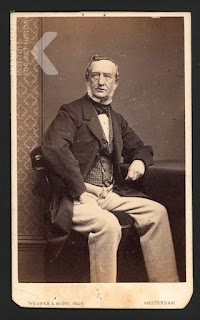
 

van Geuns ca 1860

Luden and van Geuns were active bankers in Amsterdam at a time when the tides were turning against traditional Dutch power concentrations in the merchant houses.  International banking businesses were changing towards less centralized structures and the old models struggled to stay relevant in the finance industry.  

 Luden and van Geuns may well have found themselves straddling both worlds, modeling themselves on traditional financial houses, but being part of a wave of new banking institutions.  Unlike many newer banks of the time, they appeared to rely on family wealth (and thus limited investors) for their initial capital.  Other banks spread out risk by having a larger number of investors, often allowing publicly traded shares.  It  seems that Luden and van Goens could not weather the trends or they could find no one to continue operations as its legacy did not carry on beyond the lives of its founders.    

Nonetheless, their records included folded letters and envelopes that were mailed to them from all over the world.  Most of these items illustrate fairly common rates and routes in Europe, but there are some items that are quite uncommon, including at least one letter from Brazil (and no, I don't have that sort of thing - sorry).

However, I have managed to find a few more letters addressed to Luden & van Geuns and wrote an article for the Postal History Journal in 2019 that focused on this subject.  The article can be found in Issue No. 172 which can be downloaded for reading here

If you are not inclined to go download that article - or even if you are - here is a second example from this correspondence.  This folded letter from 1870 originated in Paris, France and shows an 80 centime and 40 centime stamp paying the postage for a triple weight letter from France to Holland.  Other items in that article show different uses from Italy, France, Prussia and Belgium.

------------------------------

Ah!  Once again you have come to the end of a Postal History Sunday entry.  Hopefully, you were so enthralled by it all that you were surprised that you made it to the end already.  If that's the case - great!  If not, we'll try to do better next time!

Thank you for joining me and letting me share something I enjoy.  I hope you have a great remainder of your weekend and a fine week to come!

Saturday, January 8, 2022

Games for Two

It's time for something completely different on the Genuine Faux Farm blog for a Saturday.  This time around, I thought I would share the games Tammy and I enjoyed during the Holiday Season this year.  The last you probably heard from us, we were still playing Wingspan nearly every day, at the exclusion of practically any other board game.

We still love Wingspan, of course.  And we still play it regularly.  It's a comforting game for us because it is now so familiar.  We tend to leave it out so set up is pretty quick.  But, we will both also admit that it is not the most portable game we have.  So, when we found ourselves planning to go on a trip - we had to consider what we could successfully pack.

Arboretum

Here is a game that can be reduced to just a deck of cards if you already know the rules and don't feel a need for an "official" score pad.  Since we did NOT know the rules prior to our trip, we had to take them - and we brought the score pad.  But, it was still an easy thing to pack.

Arboretum could be played with as many as four players, but we found it plays pretty well with two.  I suspect the game plays VERY differently with three or four because it would be much harder to track where cards might be.  The suits are essentially different types of trees and you play with more suits when you have more players.  The two person game plays with six suits.

In our case, we stuck with the trees in the deck that we know a bit better.  So, there are Oaks, Maples, Spruces and Willows (which we refer to as Maurices, of course).   Cherry Blossom and Dogwood round it all out for the deck we use.  The cards are beautiful and do nothing to change our natural affinity for trees.

The affinity for certain trees can actually be a detriment when we are playing.  There is a certain amount of consternation when one considers throwing away a "Maurice," for example.

Initially, we were a little uncertain about the mechanics of the game, but it actually ended up being fairly easy, taking a couple of plays to get it figured out.  I suspect we would have picked it up even faster if someone who already knew the game taught us.

The game requires a little table space to play cards in your "arboretum" so it doesn't work if you are short on table top.  But, it is quite compact in transit.

Hive

Here is a game that is meant for two and only two players AND the pocket version is extremely easy to pack and take with you wherever you might go.


Even better, as far as we are concerned, is the fact that the game pieces are heavy, hexagonal tiles.  If you are outside, these will not blow away.  And, you don't need much flat surface to make it work either.  There is no board, so any surface will do.

Each insect in the hive moves a certain way and the goal is to encircle your opponents Queen Bee.  The pieces consist of various critters, including grasshoppers, spiders, ants, ladybugs and more.  

There are similarities to games like chess in that each organism has its own movement and its weaknesses and strengths as far as game play is concerned.  And, like checkers, chess, go and other similar games, there is no luck involved - no randomness other than determining who starts.

So, if you prefer to be able to blame your losses on luck, then this one may not be for you.  Otherwise, once you learn the pieces, it can be a good game to play.

Parks

We can thank our good friend, Mark, for introducing us to Parks - a game that will work for anywhere from 2 to 5 players.  I guess it could also be played solitaire as it includes rules and extra cards to allow for solo play.

This game actually has a lot of pieces, so it wouldn't normally qualify as being easily portable.  However, the box is packaged cleverly and no space is wasted - unlike many games where the box is two to four times larger than it needs to be.

This is another beautiful game that features another topic Tammy and I enjoy - US National Parks.  You can visit parks, take pictures and purchase gear for your hike.  

Unlike the first two games, set up time is longer and the complexity of the rules is greater.  It definitely helped to have someone walk us through it once before we tried it ourselves.  However, the rules are extremely well written, so we would not have had to climb a terrible learning curve to play.  Now remember, we have played a number of different games by now, so we can rely on the experience of those games to help us learn new ones.

The only criticism is that the rules for the camera and taking pictures are a little confusing - but we've got it figured.

Lost Cities

If two-person and portable are the necessary requirements, then Lost Cities is an excellent choice.  Like Arboretum, Lost Cities only requires that you bring a deck of cards with you.  And, yes, it would be good to have a piece of paper and pencil to keep score.

Our Lost Cities deck is beginning to show its wear after many years of use.  It does come with a board for the discard piles, but that board isn't really necessary and we no longer pull it out when we play.

We've played Lost Cities in restaurants while waiting for our food.  We've played Lost Cities on airplanes.  Like most of these games, it is not terribly hard to learn, but there's always some small feature that is a bit confusing.  The hardest thing to remember for us is that you play a card BEFORE you draw a replacement.  If you have played any card game, you are probably more used to the reverse on that order.

This is a good counterpart to Hive.  If one person likes strategy games with no luck and another likes shuffled cards that add the luck of randomization to the game - both people can be happy.

Splendor

And, to close things out, we played another game introduced to us by Mark.  This game can be played with up to 4 players and is fairly quick to set up and put away.


The box is actually far bigger than it needs to be and surprisingly enough, we can fit what we needed for travel into the Arboretum box along WITH the deck of Arboretum cards.  Full disclosure, we only brought as many of the pieces as we need for two person play.  Any additional pieces stayed home.  It would not have fit if we needed all of the pieces/cards for both games.

This game was very quick to pick up and I am not sure it would have been any harder to figure out if we hadn't had a chance to play with someone else who already knew the game.  Again, I am certain part of the ease of learning has to do with our experience with other modern board games.

This is a game that definitely plays very differently in 2 player than it does with three or four players.  With two players, there is plenty of "room" to play without necessarily competing for the same cards or resources.  Yes, you can certainly play a little defense and try to prevent your opponent from doing everything they want.  But, there are usually plenty of options so the most you can do is slow them down by one or maybe two plays.  This will come at the cost of one (or maybe two) plays of your own - so the incentive to play defense seems pretty low. 

Still, it's an entertaining game, it's fairly portable if you don't rely on their box, and it has simple set up and tear down.

----------------

There you are, a completely different blog from the farmer!  While we may be making it sound as if we have lots and lots of board games and tons of experience with them - don't let that fool you.  We just enjoy a subset of board games out there and are happy to share what we've experienced.  Don't expect me to do much more than this as it isn't likely to happen.  But, maybe in another six months to a year...  who knows?

I hope this was interesting to some of you and have a great remainder of your day!

Friday, January 7, 2022

Stuck on You - Friday Faux Real Stories


Rob and Tammy had actually been growing produce and raising poultry on the Genuine Faux Farm for six seasons before they added a building, called a high tunnel, to their farm during the seventh such season (2010).  A high tunnel is a hoop building that uses the solar gain provided by a plastic covering to extend the in-soil growing season both at the beginning and the end of the year.

The first high tunnel was put up in July of that year, too late for an early Spring crop - but plenty of time for us to go 'all in' for our late Fall and early Winter crops.  The picture you see above is what the building looked like on November 5 of that year.  The building was full of lettuce, kale, spinach, collards, mustard greens and a few other things.  It was about this time (early November) that we started harvesting from the building for our extended Fall season CSA shares.  

The field crops were done - so this was it.  We had to make these things, along with any storage crops we had, work for the rest of the year's farm income.

This high tunnel has a metal frame for both the hoops and the end walls and a single layer of plastic for the cover.  On a sunny day, temperatures can get quite warm despite cold temperatures outside the building.  However, once the sun sinks below the horizon, the thin covering will not hold the heat for long.  And, yes, the walls themselves can actually be at temperatures below freezing while the area near the soil is well above freezing during the day.

All in all, the high tunnel, which we dubbed "Eden" worked pretty well - allowing us to harvest up to the week before Christmas.  But, harvest was not without its perils.

The Scenario
Temperatures during the first week of December were in the low single digits (Fahrenheit).  The sun was out and there was not much wind - both of which I considered a blessing.  I had to pick for the extended season CSA shares and the crops were all in the unheated high tunnel.

In order to harvest all of this leafy green goodness, the temperatures needed to get warm enough so that I wasn't picking frozen greens.  With the sun out, temperatures had reached 40 degrees by 11:00 AM and it made it to 58 degrees for a brief time at the peak of the day.  After my check of the temperature at 11, I figured I could start harvest at noon.

So, I worked outside the high tunnel for awhile.  Just because there is snow on the ground and it is cold, that doesn't mean there aren't things the farmer has to do.  There are chickens that need food and water.  Eggs need to be collected.  Some things needed to be moved.  It's just the way it is.  

In the process of doing all that work, I got some snow on my black coat.  That's normal too.  No big deal.  So, I went to the Truck Barn and collected the harvest equipment - then I trudged through the snow toward Eden.

Some of the crops had an extra cover on them, which I had to remove.  There was a little moisture there as well and that landed on me and my coat.  Once again - not a big deal.  It happens all the time.

I proceeded to do the harvest, picking the various greens into each of their designated tubs, being careful to pick enough so each person would get their fair share of the produce.  After about an hour of harvest, I decided to stand up at the end of a row, next to one of the end walls.  I needed to stretch out my back - so I lifted my arms to the sky, arched my back and.....

Review of the Facts

Let's remind you of a few things before we continue with the story.  Rob wears a black coat.  Black tends to collect heat from the sun.  Rob's coat had moisture from melted snow and water from the row covers.  The end walls of the high tunnel have metal.  The walls are much cooler than the air in the high tunnel - probably well below freezing.

Back to the Story
Ahem.... as I was saying...

I needed to stretch my back - so I lifted my arms to the sky, arched my back and... the back of my damp coat touched the metal supports on the end wall.  The end wall's temperature was below freezing, the coat was wet and.... the coat adhered to the metal.

The Thought Process
Hmmmmm.  I appear to be stuck to the metal on the end wall.   I'm glad that wasn't my tongue....or my hand.  You know what?  I appear to be really stuck to this wall.  Why was my back so wet?  Oh yeah, snow melted.  You know, I should give it a bit more of a tug.  

Oy, that's on there good.  I hope I don't rip the coat.  Maybe I should just unzip the coat and worm out of it?  You know, it might be a bit silly if my coat has to stay on this wall until warmer weather.  But, it could be sillier still if I just stayed here....

And It Got Even Sillier

Now, you need to get a little bit better picture of what this must have looked like.  I was standing up against the wall and my hands were up just a bit over my head level and my elbows were bent.  Almost as if this was a 'hold-up' and I was the victim.  Oh - wait.  That's exactly what this was.  I was being held up and at the mercy of our new high tunnel.

The coat was a zip-up coat, so there was no way I was going to reach down with my hands to unzip the coat and step out of it.  My cell phone was in a side pocket of my jeans that resided just above my knee.  Once again, there was no way I was going to be able to reach that.  And, if I did... who do you call?  And once you do call someone... what do you say?

"Hello.  I'm stuck to the wall of our high tunnel and I can't get out?"  After the giggle fit the recipient of the call was bound to have, I am sure they would suggest that I figure it out on my own.

I tried to ask Doughboy, the farm supervisor cat, for a little help.  He just yawned and proceeded to sit down to watch what I would do next.  Some help.

So, I figured I had two choices.  I could try to worm out of the coat by bending my knees and wriggling out the bottom of the coat.  Then, I would leave my coat there until the Spring thaw.  Or, I could just leave the coat on and use a bit more force to pull myself free.  I supposed it might rip the coat - but that's better than waiting until our customers called Tammy to tell her I was absent from the delivery four hours later.

So, I lifted one leg up to help get some momentum and tore myself free.  There was some pilling from the back of the coat still attached to the end wall, but otherwise the coat seemed fine and continued to serve me well after that point.

And, since that time, I always stretch my back when I'm in the middle of the building.

Thursday, January 6, 2022

Kind, Nice ... Kinda Nice?

When a person works with words as often as I have over the past couple of years, it is only natural that I might take a few moments to consider the fine distinctions between two words.  For example, I was contemplating the difference between "nice" and "kind."  

I think most of us would initially feel like those two things are interchangeable.  But, once you think about it a bit more, you realize that they are not.  Kind is usually something more than nice.

I put a picture of some day lilies from last July in this blog.  Those flowers are quite nice, don't you think?  However, I suspect you would agree that they aren't necessarily kind.  On the other hand, it was nice of me to put flowers in this blog.  But, was it kind?

nice : pleasant; agreeable; satisfactory

        : pleasing; agreeable; delightful:

kind: having or showing a friendly, generous, and considerate nature 

       : of a good or benevolent nature or disposition,

Kind implies that there is a particular motivation behind an action, whereas nice does not.  You can be nice and say all of the right words, hold the door open for others and smile when you are supposed to.  But, you can do all of that and not be kind at all.

For example, you can say "thank you" to someone else because you are supposed to say "thank you."  It is the nice thing to do.  You can say thank you because you don't want other people to think you don't have manners.  You can say thank you because you don't want other people to grumble about your lack of gratitude.

Or you can say thank you because you really are grateful - and that would be kind.  Because the motivation is to communicate honest and heartfelt gratitude - rather than to simply look good to others.

So, is the placement of daylilies in this blog nice, kind or both?  

If you like flowers, these are definitely nice.  If you don't?  Well, maybe you might still find the composition of the picture to be pleasing or nice.  Or - I suppose, you don't find it nice at all because it reminds you that it is January and there AREN'T day lilies blooming where you are right now.

My motivation for placing them here is to give all of us who are currently experiencing Winter a little bit of color and a reminder that there are days when these flowers will grace us again with their presence.  I am hopeful it will cheer you up.  Or, failing that, it might give you strength to get through whatever you are currently dealing with because it symbolizes the possibility of better things.

I shared these photos in hopes that it was a kind thing to do.  But, maybe kind is not always nice, just as nice is not always kind.

If you have ever heard the terms "Iowa Nice" or "Minnesota Nice," you might recognize that these are not necessarily complimentary descriptions.  People who work so hard to make sure everything is always pleasant and polite to maintain the appearance of BEING nice has the motivation of worrying about what others think of you.

Me?  I would rather we be "Iowa Kind" and worry about trying to do the right thing for others.  If the kind thing to do is to point out a problem to someone else, then we should do just that.  We don't have to be nasty about it.  But, sometimes, it would be unkind to sugarcoat the problem just so it goes down easy.

So, what do you think?  Was this blog entry nice?  Or kind?  Or just kinda nice? 

Have a kind day everyone!

---------------------------------

I recognize that many have taken on the nice/kind distinction before me, so I took a little time to hunt a few online articles down on the subject to see what others had to say.  This article was interesting as it points out that working to be "too nice" may actually be unhealthy.  Or, more accurately, when our motivation for being nice is to gain approval, this becomes a problem.

No wonder I keep saying that thinking is a dangerous pastime!

Wednesday, January 5, 2022

PACTPA 2.0: Putting People Before Pesticides

This is one of those times where my job with Pesticide Action Network intersects with our farm blog.  Over the years, we have written more than once about the problems the overuse and misuse of pesticides cause for farms like ours and for everyone's health.  If you are not sure where I am coming from with respect to the issue - perhaps this fairly recent farm blog will begin to fill you in. 

Many fine people have asked me what they can do to help us when it comes to pesticides infringing on our crops, making them inedible or causing us to pull our workers from our fields because someone else is not being responsible with their application of pesticides.  Well, here is one way you can help. 

I ask you to read the article I wrote for PAN below.  I also encourage you to read the actual bill language and any additional material linked in the article or that you might find in your searches.  If, once you have done so, you agree that this is worthwhile piece of legislation, please go here and send a letter to your Senator encouraging them to support this bill.

------------------------------------------

After a brief attempt in 2020, the Protect America’s Children from Toxic Pesticides Act (PACTPA) was re-introduced by Senator Cory Booker on November 23 of this year, and PAN is among the organizations that support its passage.  This bill would overhaul U.S. pesticide regulations, ultimately mandating new rules to protect people and the environment.

PAN Senior Scientist Margaret Reeves says it best:

The science is crystal clear.  These chemicals are putting our health, environment and food supply at risk and we must help farmers move away from them. [This] bill puts science, public health and on-farm resilience over corporate profits — its passage is urgently needed and would finally put us on the right track.

FIFRA fails to protect people

Each year the United States uses over one billion pounds of pesticides — nearly a fifth of worldwide usage — and use levels continue to increase. 

The current law governing U.S. pesticide regulations, the Federal Insecticide, Fungicide and Rodenticide Act (FIFRA) contains provisions that prioritize pesticide industry interests above the health and safety of people and our environment. 

Once approved, under FIFRA, pesticides typically remain on the market for decades, even after scientific evidence shows significant harm to people or the environment.  This outdated law continues to support widespread application of pesticides by failing to respond to the real and measurable threats these chemicals pose:

  • Organophosphate insecticides have been linked to farmworker poisonings and neurodevelopmental damage in children.
  • Neonicotinoid insecticides contribute to pollinator collapse around the world and have recently been shown to cause developmental defects, heart deformations, and muscle tremors in unborn children.
  • Paraquat is one of the most acutely toxic herbicides in the world.  Science has shown that chronic exposure to paraquat increases the risk of developing Parkinson’s disease by 200% to 600%. It is already banned in 32 countries.

It is crystal clear that the current law is past its useful lifespan.  It is past time to protect people, not chemical companies’ bottom lines.

PACTPA has the potential to succeed

The proposed Protect America’s Children from Toxic Pesticides Act addresses many of FIFRA’s shortcomings.  This bill provides significant protections for communities that bear the brunt of pesticide exposure, prohibits the use of old stockpiles of banned pesticides, and requires the listing of inert ingredients on all pesticide products, which are often as dangerous as the active ingredients.

PACTPA would:

  • Ban dangerous pesticides including organophosphate insecticides, neonicotinoid insecticides and paraquat herbicides;
  • Close loopholes that have allowed the EPA to issue emergency exemptions and conditional registrations to use pesticides even before they go through full health and safety reviews;
  • Create a petition process for the people which will allow citizens to request review of pesticides that would otherwise be approved for use indefinitely;
  • Support local community protective actions from preemption of veto by state law;
  • Protect farmworkers from harm by requiring injury reports, directing EPA review of these reports, improved pesticide label instructions and requiring labels in Spanish and any other language that can be shown to have 500 or more applicators using that language; and
  • Broaden the knowledge base by requiring suspension and review of pesticides deemed unsafe by other nations.

It’s time to move forward

FIFRA puts new products on the market quickly, while making it difficult to remove dangerous products.  PACTPA would begin to shift the needle toward a regulatory system that protects the people and the environment.

Comparable efforts in other countries show us that we can prioritize public health and the environment while building healthy food and farm systems.  This time around, let’s take this step forward and push PACTPA through the legislative process — for people, workers, and our environment.

Tuesday, January 4, 2022

Genuine Faux Farm Year in Review

We've always found it to be useful and, frankly, a healthy exercise to look at the previous year in early January just to look more objectively at what went well, what went poorly, and everything else in between.  We can put things into perspective and perhaps that will inform us as to where the farmers and the Genuine Faux Farm will go in 2022.

2021- Year of Anniversaries

I suspect there were many people celebrating a number of new "1-year Anniversaries" in 2021 - considering the pandemic encouraged us all to make some changes in our lives.  But, even with the pandemic, there were some changes we were already planning at our farm that celebrated their one-year anniversary in 2021.

2020 was the first year since 2005 that our farm did NOT offer a Community Supported Agriculture (CSA) Farm Share.  We did not reintroduce those farm shares in 2021 and even removed the farm credit program we instituted the year before.  I know, it is kind of odd to celebrate the anniversary of the removal of something.  But, it turns out the changes to our farming operation were well timed (more on that one later).  Instead, we focused more on growing larger amounts for bulk sales or seed production, reducing the labor that is needed for the CSA and a reliance on direct to consumer sales.

Another anniversary was celebrated in late March, when the blog blitz that started as we all began isolating to avoid the spread of Covid-19 reached its one-year anniversary.  At that point, I backed off just a little bit - until it picked back up again at the end of the year.  It turns out that nearly daily writing is useful for me and apparently periodically helpful for those who read the blog.  We'll see where we stand at the two-year anniversary!  Along the same lines, Postal History Sunday celebrated one year of weekly posts in August.  Yes, they are connected - and yes, these anniversaries celebrate persistence, if nothing else.

April also marked the one-year anniversary for Rob's job with Pesticide Action Network.  That's one anniversary that really snuck up on me and I was pretty amazed how quickly it happened.  Part of the irony of all of this is that my job with PAN is also a writing intensive occupation.  The good news?  I can often share what I write for PAN here and the writing I do here frequently informs what I write there.  You can call it double-dipping if you like.  I'll just call it using one experience to help build up another.

The other offshoot from the PAN job and the pandemic were more opportunities to speak in different forums.   I was also asked to speak on postal history, as well as some of the normal talks I often do regarding our type of farming.  Yes, most of it was via Zoom or other, similar, distance tools.  But, I might not have had a chance to do these in person in a normal year, given the focus the farm usually requires and the limitations we have for travel opportunities.  So, it was actually a bit of a blessing to me that others ALSO had to resort to distance communications and it allowed me to participate more often.

2021 - Year of Weather Silliness

Ok.  You would not be out of bounds if you told me that EVERY year at the Genuine Faux Farm seems to feature some sort of weather silliness.  It's a farm.  The weather plays a significant role in what goes on here every single day.  So, we have to expect that the weather is going to be featured.

We got our first decent snow in late January.  Soon after that, temperatures took a dive, making care for our poultry a bit more difficult.  After a couple of weeks of that, we barely averted a fire in the poultry room when we discovered a split electrical cord on a water heater.  I will say this - it is nice to say we AVERTED a fire, rather than reporting on a fire that took out a building and all of our laying flock.  I'll take it!

Power outages stack up as the December derecho heads East

The warmer months were fairly calm, with minimal severe weather, minimal rain and warmer than usual temperatures UNTIL a freak killing frost hit us and took out many of our crops at the end of May.  Then, things calmed down once again.  Very little severe weather and limited rainfall until a series of storms hit Iowa in July - with one narrowly missing our farm. 

Once again, things calmed down, lulling us into thinking we might have dodged the weather bullet, until August hit and we had a storm, that didn't travel enough to classify as a derecho, hit the farm.  And there was rain and flooding - in August.   Yes, that was a pretty rough stretch of weather there.

Things were pretty calm again, until we got to December.  Then, just as Tammy and I were trying to prepare the farm for a trip away - a December derecho hit.  Really?  The good news is - we managed to get the farm about as well prepared as we could have and we dodged significant damage this time around.

2021 - Year of the Kidney

Actually, 2021 was the year of farmer health struggles.  Tammy has been fighting a bone spur near the Achilles tendon for some time now - but Rob had to upstage her by dealing with a blood clot in a leg and a tumor in his left kidney.  

Tammy and I found ourselves working in overdrive to prepare for the late April surgery that would result in that kidney being removed after it was determined to be too rambunctious to keep.  Tammy had work to do for Wartburg.  Rob had work to do for PAN.  And we both needed to get things on the farm to a point where it could handle having one farmer down and the other one stretched between her Wartburg job and caring for her partner.  

It would be dishonest if I did not tell everyone that early recovery was... well... awful.  But, we received many kindnesses from many different quarters.  And despite our personal struggles, the farm continued to move forward with plenty of help from others. After a couple of months, the farmer was feeling like he could actually pull his weight around the farm again.  Although, when I look back at that post, I can tell you I still wasn't really pulling my full weight even then.  It still took a couple more months before I could work without worrying too much about what I was doing.

This is where I return to the reference earlier that the changes we were making to the farm were timely.  If we were still trying to run a CSA Farm Share program and everything else we had been doing in prior years, we would not have fared at all well in 2021.  As it was, we already had a plan that was a revision of our 2020 farm that gave us a little breathing room.  We set goals that concentrated on bringing some of the joy of growing back to our farm and gave the farmers more opportunities to live life (and survive kidney removal).

We must have done reasonably well this year since our grades were pretty good.

2021 - Year of Caring for the Farmers

If there is one thing farmers on a small-scale, diversified farm are notoriously bad it - it is self-care.  You would think that the opportunity to be outdoors, eat good food that is good for you, frequent exercise and movement, etc etc would be enough.  But, often the farm is overwhelming and we can't say "no" to all of the things just have to be done.  Farmers who do what we do are often isolated from support networks and frequently give up things they need for the good of their farm and their customers.  This year emphasized the need for these farmers, at least, to change that narrative.

We worked at giving ourselves opportunities to balance hard work with rejuvenating play.  We took the time to walk in some beautiful places in Iowa that we often failed to give ourselves time to do in prior years.  We stuck to playing a nightly board game - even when we were tired.  We even took a couple of nights away in July when we were given the gift of someone watching the farm for us.  This is not at all easy to do and we highly recommend that others who farm as we do find some way to do it.  

The walks were actually quite doable.  We selected locations that were only one hour away so we did not have to get coverage for our morning and evening chores.  The time away required more effort - but the investment was worth the improved mental health and balanced perspective.

If you can't take at least most of a day off once per month to be away and take a breath, then you need to re-evaluate how you farm.  Let's just leave it at that.

2021- A Decent Year Overall

All in all, 2021 was a decent year for us on the farm despite the challenges.  It would be tempting to point at the lost crops due to weather and the health conditions and proclaim ourselves "glad to be rid of 2021."  But, we won't.

Why?

Because our faith in others was rekindled by the support we got when we needed it.  By college students who came and willingly helped on the farm.  By help from others who encouraged us to become more comfortable with the care of our bees.   And, through kind words at times when we actually did not know we needed them.

Our interest in the world around us has been rekindled as we gave ourselves more room to experience awe and wonder.  We witnessed a fireball and had the energy and desire to learn more.  And, while our farm had some failures, we still had enough success that it all balanced out - including a five pound cauliflower (well, almost).

Rob actually won another award for his postal history exhibit and Tammy received recognition for her work at the college.  Both are reminders to us that our long-term efforts do eventually bear fruit and our efforts do matter.   We need to remember to take a moment to recognize when that happens.

Here's to 2021 - and an even better 2022.

Monday, January 3, 2022

Shocks to the System

It is very quiet here and a bit chilly.  And... we're feeling maybe a little bit lost, to be perfectly honest.  We expected this, of course.  But, it doesn't make it any easier to adapt.  Yet, adapt we will, because that's what we need to do.

For those who did not know and/or did not catch the blog posts that shared a bit of our recent travels to one of our favorite places in the world (Kaua'i), we will simply point out that we saved up and sent ourselves on a healing trip away from the farm over the holidays.  If you are near the Pacific Ocean, you have the constant sound of waves.  The trees and plants were green and the breeze moved them around, adding that sound to the mix.  And, of course, there were many more people than we typically see at the farm.  In addition to those who live on the island, there were plenty, like us, who were just visiting.  That added up to a fair amount of traffic.

All of those things also added up to a fair amount of sound.  Even when we were at the location below - with no other people in sight - there was the crashing of the waves from the shore to our left, there were birds singing and the sound of the wind blowing through the grasses.

Around here, a normal day might see a total of a dozen vehicles driving by the farm.  There are only two people on the farm, and neither tends to be the "loud" sort.  Sunday was a cold day with very little breeze, so we didn't get much wind-created noise.  There wasn't much sound from birds - except for a crow that decided to go on a "cawing" fit for a few minutes and the hens when we brought them a treat.  It's possible one of the loudest sounds outside after the crow was the crunching of our boots on the snow. 

Don't get me wrong.  There is nothing wrong with silence or quieter locations and times.  It's just the fact that things ARE different between the two places.

On Kaua'i, you are surrounded with the noises of water.  If you are close enough to the shoreline, there is the ever present sound of waves.  In some places, a wave would hit the shore just right and cause a deep "thumping" noise and the spray would fly up and then each droplet would make its own independent sound as it landed on shore or back in the ocean.

The sound of raindrops were fairly common on this trip.  These could be barely more than a mist or it could come down in sheets.  Each type of rain has its own signature tune that would change depending on the surface it was striking.  And then, there were the streams.  Or a puddle as you stepped into it.  And the waterfalls.


We are familiar with the sounds of  the outdoors on our farm too.  In the spring, we will hear birds all day and katydids, frogs and crickets all night.  Nature - and the country - can have plenty of sound.  

So, it is the variable that is human population density that might be one of the biggest differences.  On Kaua'i we were constantly seeking ways to not be surrounded by people.  And, we did a decent job of achieving that goal.  When we are on the farm, we often have to seek out contact with humans if we want it.

And, of course, there are plenty of other reasons to have to adjust.  We don't expect to see any rainbows on the farm any time soon.  We're not likely to want to go on hikes every other day either.  Going outside in Iowa in January requires a fair bit of preparation.  On Kaua'i, we did not have to put on quite so many layers of clothing, that is for certain.  And, of course, we did not have to worry about farm chores for a while too.

Then there's this.  It was rainy and the temp was around 70 degrees Fahrenheit at 11pm in Lihue.  Our weather station at the farm recorded a low of -11 for our first night back.

All in all, I think we can be forgiven if we have to make a few adjustments and I think it would be understandable if we grumbled a bit about a few things.  But, it's actually pretty hard to grumble because we realize how good it is that we can take a trip like this.

Here's to adjusting and listening to the quiet.

Sunday, January 2, 2022

Led Astray - Postal History Sunday

Welcome to the first Postal History Sunday of 2022.  We had a pretty decent run during 2021 - not missing a week.  So, let's see if we can match it this year, shall we?

If you are visiting Postal History Sunday for the first time, or you've run across a couple of them, but weren't sure what the background was, this seems like a good time to give it.  Postal History Sunday is posted every Sunday on the Genuine Faux Farm blog and the GFF Postal History blog by a vegetable and poultry farmer (Rob Faux) who just happens to find postal history fascinating.  This project started in mid-2020 as a way to reach out to others during the pandemic and has not missed a Sunday since the tail end of August of 2020.

All are welcome here! These blogs are meant to be accessible to people of all backgrounds, whether they have no intention to collect postal history, might wish to start doing so, or already have a collection of their own.  So let's get down to business and let the farmer share something he enjoys - maybe we'll all learn something new.

------------------------

Last week's Postal History Sunday was titled Speedy Delivery, and I explored the different options for delivering the mail to the recipient in the mid 1800s.  I had several options for covers that could illustrate delivery to the recipient by a carrier, and I initially started work on this letter, sent in August of 1864 from New York to London.

This envelope no longer has its contents, so we can't know for certain who it came from, but the earliest postmark is an August 24 exchange marking at the bottom right that was applied in the New York foreign mail office.  While it might be tempting to make the claim that the letter was mailed on the 24th, we cannot be entirely certain of this since the New York exchange office typically applied these markings to reflect the departure date of the mail steamship.

In other words - this item could have been at the New York exchange office on August 23 (for example), but the clerk would still put an August 24 date on the letter if that was the date for the departure of the ship this letter was to leave on.


The sender of this letter was apparently quite aware of the mail sailing schedule, as they placed a docket at the top left that read "by the Persia, August 24 v(ia) New York."  In fact, the Persia did depart New York on that date in 1864 and it arrived at Queenstown (Ireland) on September 2.  At that point, the mailbag containing this letter was taken off of the ship and placed on a train that went to Kingston (near Dublin), Ireland.

From there the letter crossed from Ireland to Holyhead on another steamship and continued by train from Holyhead to London.  These mail trains ran both night and day and this letter traveled on the night train since the London arrival marking is dated September 3.
 

The cost of a simple letter in 1864 that was sent from the United States to anywhere in the United Kingdom was 24 cents for an item weighing no more than 1/2 ounce.  The volume of mail using this rate was significant enough to warrant a postage stamp with the 24 cent denomination.  This particular design was first issued in August of 1861 and remained in use through 1868.

To sum up - this letter was fully prepaid by the 24 cent stamp and nothing more would be owed by the recipient.

Finding Mrs. Channing

My goal last week was to illustrate that a precise address on a piece of letter mail typically indicated that a delivery to that address was expected by a letter carrier.  A common source of evidence for determining the most likely delivery method can be found by reading the address panel (the area on the envelope that shows the destination address). 

Here is what I THOUGHT this address panel read initially:

Mrs. W.H. Channing  at Rue de Saaler's, Roslyn Manse, Hampstead near London, England

This arms me with several pieces of information that might allow me to find an actual location on the map.  That, in turn, could help me identify the recipient.  The easy part, of course, is "London, England," but that hardly narrows the search.

I was able to refine my search by focusing on "Roslyn Manse" and "Hampstead."  I did some searching for period maps and found Stanford's Library Map of London for 1864, where we find this rendering of the area that is Hampstead - a very affluent area.

(Some of you might notice the name Sir Rowland Hill at the bottom right.  If the name means nothing to you, we'll give you a little information at the end.) 

If you click on the map image shown above and look towards the bottom left, you will find Roslyn House.  It was built in the 1720s and became known as Roslyn (or Rosslyn) House in 1793 when the first Earl of Roslyn, Alexander Wedderburn took possession of the property.  This site actually provides us with an opportunity to view different London maps of the same area over time, so we can see how the area has changed.  And, for those who would like to read more about the history of Rosslyn Hill, there is Old and New London: Volume 5. Originally published by Cassell, Petter & Galpin, London, 1878 - check pages 483-494.

Roslyn House

Where is Rue de Saaler's?

There is always temptation when you find something to believe you've got it all figured out and there is no reason to keep digging.  But, I had a problem with the conclusion that the letter's destination was Roslyn House.  Where is "Rue de Saaler's" on this map?  

For those who do not know "rue" is French for "street" and it is not entirely unknown to find a letter to England from the United States that might use the French version of a street address.  

But, you would think if the writer would include a street name that there should be evidence of that street SOMEWHERE on the map, right?  I went backwards and forwards in time, looking at maps from different periods and could not find a street with this, or a similar, name.

So, let's look at that address again.

You know.  At second glance that says "Sadler's."  The second "a" is a short "d" - kind of like the one found in Hampstead.   Ok.  That's great.

Except I didn't find a "Sadler's Street" either.

Looking from another angle

Well, I could chalk it up to an error by the sender or some other thing, but that did not feel right.  So, I looked at it from the perspective of the recipient.  Who was Mrs. W.H. Channing?

A little searching turned up this article put together by Dr. Anne Woodlief for a graduate class on American Transcendentalism.  William Henry Channing was born in Boston in 1810 and was a Unitarian Minister for various congregations throughout his life, including some time spend in Liverpool, England from 1854 until the Civil War, at which time he returned to the United States.  According to Woodlief's material (viewed Dec 29, 2021):

"He was the chaplain of Congress, labored in the hospitals, gave much of his time to the work of the Sanitary Commission and the Freedman's Bureau, and did valiant service in the cause of the union and for emancipation. He returned to England at the close of the war, preached for a time in London, and also in other places."
image from wikimedia commons

While there certainly could be many other W.H. Channings in the world at that time - this one's biography seemed to fit for this letter.  So, why would Mrs. Channing be at Roslyn House?  It made sense that she may have stayed behind in England while her husband returned to work during the war - but it seemed like a connection to this particular residence needed to be found.

This is where Sadler comes in

This is where I started putting things together.  Let's look at the map again.  And to help you out, let me show you what I remembered seeing that was going to put it all together.


On Roslyn Hill there was a Unitarian Chapel.  The house occupied by a Presbyterian minister is a "manse."  I had heard of parish house, parsonage, clergy house and rectory - but not manse.  So, of course, I initially made the connection of "manse" to large house or mansion.  It was only by happenstance that there actually WAS a Roslyn House in Hampstead to lead me astray.

It turns out Thomas Sadler was a Unitarian minister who served at Roslyn Hill from 1846 until his death in 1891.  He oversaw the construction of the new chapel that opened in 1862.  Like Channing, he is also credited with several written works, though he was not nearly as prolific nor as well known.  And, Thomas Sadler lived at Roslyn Manse, the clergyman's house.

It certainly does makes sense that Mrs. Channing might be the guest of another Unitarian minister at the time that her husband would return to serve as the chaplain of Congress during the war. 

And now we actually KNOW what was written on the address panel:

"Mrs. W. H. Channing, at Rev. Dr. Sadler's, Roslyn Manse, Hampstead near London, England"

The clues were likely there all along and they seem much more obvious now that we know what we are looking for.  If this had read "rue de Sadler's" we would perhaps see "Rue" capitalized, but not normally "de" - and I was bothered from the start that the road would have an apostrophe "Sadler's."  And why would a person bother with the word "at" before a road name anyway?

And, yes, it is highly likely that the mail carrier took this letter to Roslyn Manse so Mrs. W. H. Channing could receive her mail sent care of the good Reverend Doctor Sadler.

---------------------

There is your story for this fine Sunday (or whatever day you end up reading this).  This is just an illustration of how easy it is for any of us to err with respect to the details on a piece of postal history.  We can easily misread what is written and we can fail to recognize that some words do not have the same meanings now as they did at the time when the letter was written.  This is one reason why I am not always satisfied with leaving parts of an item unexplained.  If we choose to look at only a subset of the details we can be led astray and to conclusions that are simply wrong.

Bonus Material!

Sir Rowland Hill is a name that happens to be known by many postal historians and philatelists as he is often credited with the invention of the postage stamp.  But, more importantly, Hill was on the forefront of postal reforms that led to cheaper postage, making it possible for more of the populace to avail themselves of this service.  He wrote "Post Office Reform: Its Importance and Practicability," which led the United Kingdom to implement those reforms in 1840.  The link is to the 3rd edition published in 1837.  

If you are interested in a very short bio and a portrait of Hill, you will find them at this location in the National Portrait Gallery.

Thank you again for joining me for Postal History Sunday.  I hope you have a great remainder of the day and a fine week to come!

Saturday, January 1, 2022

Resolved

Welcome to the new year.  Perhaps you see January 1st as just another day - or maybe you see it as a new start?  In my case, the realist in me tells me that today is no different than any other, but the dreamer in me still nudges me to treat it as something a bit more special than that.  When I put all of me together, I find that my opinion of New Year's is an odd mix.

But, when it comes down to it - I see the turning of the old year into the new as an opportunity.  And like many opportunities - it will only be as valuable as we make it.

In with the Old

I know the phrase is supposed to be "out with the old and in with the new" and I am here to tell you that we've got it mostly wrong and only partly right.  

"Out with the old" implies the disposal of something that no longer has value.  It emphasizes the negative and encourages us to forget lessons that could be valuable for us as we travel through our lives.  It pushes a narrative of failure, pain, and suffering and discourages us from looking for the balancing positives that are out there for us.  

Out with the old?  Does that mean we throw it all out with the trash?  Even a diamond can look less appealing when it is surrounded with coffee grounds and rotting banana peels. 

I do not mind the idea of using the new year to give the bad things less power in our lives.  So, if by "out with the old" you mean getting rid of a grudge I hold against someone and being free of cancer - I can get behind that.

But, I also want to say "in with the old" by taking the insights that come with the recovery from a major surgery with me as I go forward into the new year.  I say "in with the old" when I think about the grudge I held a bit differently by looking at how I might have been hurt and how I can avoid hurting someone else in the same way.

Maybe it should just be "in with the new perspective on the old."  But, that doesn't really roll off the tongue does it?

And, what about all of the truly WONDERFUL things we got to experience in the past year?  Out with the old?  Nope! Sorry!  These good things still have value for me and I don't see a good reason for tossing them out either.

In with the New

It's a nice sentiment to make it sound like we all enter the year with a clean slate.  But, I suspect this is why so few people actually succeed with their New Year's resolutions.  They temporarily deceive themselves by thinking that the baggage of days past won't draw them back.  Oh, they might be able to leave it by the side of the road for a week or two - but it isn't too long before all of that stuff either finds legs and tracks us down or we get pulled back to it because...  Well, it is still a part of who we are.

Even so, I still admit to feeling some of the illogical power that comes with the end of one year and beginning of another.  And to top it off, I don't really think that's all a bad thing either.

Reflect on the Old, Build for the New

Here's were the pragmatist meets the idealist - I like to take a practical approach towards the energy that comes with the new year.  It's a perfect time to review and reflect on the past year and remind myself of the things that helped me become who I am now.

There are a few wounds that are still quite tender, and it makes no sense for me to spend time probing them just to cause more pain.  There are also other things where I have yet to find a good balance - so I can just nod at them in passing.  The rest, on the hand, is full of all sorts of insight and joy and pain and relief and...  whatever else.  Much of this is ready for me to find closure.  And some of it is ready for me to build more.

And there's the value that the turning of the year has for me.  It's a natural point for me to assess the progress I have made on the building that is my life - and to figure out what I should do to correct problems and how I can accentuate the good things.


Resolved 

Last year, my January 1 post concluded with a resolution for the new year that was 2021.  My "resolution," if you want to call it that was as follows:

My resolution is to continue to work on being better at understanding what others are seeing so I might have a chance to recognize what motivates them to do and say what they do.  And, I will also listen better to what people might say about me and where I am, so I can appreciate the good things from a different perspective and contemplate what is in need of my attention so I can make changes.
Did I succeed?  

The answer is a "yes," because I DID work to do these things and I STILL work to do these things.  But, I also feel that I have tried to do this for much of my life.  Sometimes fairly well.  Sometimes very poorly.  And I know I never will be perfect at any of it - which is why it remains a good resolution for me in the coming year.

It's all a part of building.  Reflecting on the old - identifying the faults and taking note of the strengths.  Then, building for the new - remembering the vision of where we want to be and doing our best to get there.

Friday, December 31, 2021

The Best Medicine

They say that laughter is the best medicine.  And, if it is not laughter, then it might be cats.  The list for New Year's Eve from the Genuine Faux Farm will include plenty of both.  Well, ok.  WE think some of these might make some people laugh.  If you don't think they're funny, you can just laugh at us for thinking they are funny.  

Mission accomplished either way!

Each entry will include a link to the blog followed by a quote from the blog so you can get a taste of what might be waiting for you should you elect to take that link. And, just like all of our other GFF lists - this one starts at 11!

11. VAP Angst

I have certainly considered making a VUP (Very Unambitious Plan), but when I want to make a VUP, I usually don't have the motivation to do it (get it?  Huh huh?!?).  

10.  Bang for Your Buck

Would I have put this in the blog if the only two signs were "Mole Catcher" and "Frog Juggler?"  Probably not.  "Chicken Whisperer" might have encouraged me to share this picture in a blog post on our poultry...but I would probably forget to do so.

But, when you add "Squirrel Matador 1800-800-OLE" to the list?  There's the bang for your buck.  Hoorah for the squirrel matador!


 9. More Lost Writings of the Sandman 

"Public transportation should be about comfortable feet.  If your feet are cold, find a farmer."

And now you know.  Uncomfortable feet?  Find a farmer - that'll fix it!

8.  The Bunny Trap

One day, the neighbors noticed the cute little bunnies in the bunny nest. "Aren't they cute? Would you like to pet them?"
 
"No. No, thank you."  Even then, they had beady eyes.  Never trust a critter with beady eyes.  Especially when vegetables are on the line.
 
The neighbor's dog noticed the cute little bunnies just outside their bunny nest a week later.
 
"Aren't they cute? Would you like to taste them?"
"Yes, I would," said the dog.
 
Run bunnies! Run! Run dog! Run!

7. It's Easy, Except Um, For That

All of this could be very amusing to the farmers if they didn't REALLY NEED someone to provide the help.  And, so far, no one has been crushed by a falling roll-up door, even if they did let it get away from them.  And, if they did, none of them have had the courage to report that this has actually happened.

Now - wait until I tell them they should not stand where they are because they could fall through the floor.

6. Taught I Taw a Puddy Tat

He was big enough to reach up and turn door knobs and he shocked both of us one day when one of us asked, "I wonder if cats can wink?"  And Strider promptly winked at us.  At another point we noticed some flies buzzing against the screen door and one of us wondered out loud if cats would eat a fly.  Once again, Strider obliged.We're not sure if that showed intelligence or ... something else... you can decide.


5.  Where is That Button?

I've taken them apart, replaced lids, fixed floats, removed them and installed them.  But, I still can't find that @#@% button that must be somewhere on the toilet that tells people that my rear end just hit the seat and it is now time for them to call me.

4.  Inspector's Findings

How important is dignity to a cat?

What is it with your questions for today?  A cat is ALWAYS dignified because a cat is always doing what it wants to do when it wants to do it.  How can that NOT be dignified.

(The farmer attempts to explain that it has to do with a picture of him accepting a belly-rub...)

You're offering a belly-rub?  Ok.

(After a belly-rub, the farmer attempts to explain.... one more time)

Let's see.  You're telling me that you offering a belly-rub and me deciding I like that idea is somehow undignified?  I did get you to do something I like when I wanted it didn't I?

(The farmer concedes the point.)

3. Genuine Faux Farm to English Dictionary v. 1

Skritch - our cats like to get a good skritch now and then.  You do not scratch a cat, they scratch you - especially if you don't skritch them properly (and often enough). 

Skritcher - any tool used to scratch up the ground and make life more difficult for weeds. Officially, a skritcher has tines - but we stretch the definition for saddle hoes, wire weeders, etc.

2. It Must Be That Time Again

 Moms everywhere will be pleased to hear that we are going to expand our dandelion farming operation.  Children from all over the state will be invited to come pick a pocket of yellow posies to give to their mother - expecting that she will exclaim over their beauty and put them in a vase or glass with water (until she can find a time to sneak them back out of the kitchen later on).

1. Chewing Gum and Baling Wire

As a side note: T-posts are not recommended for use as a mulch.  Grasses, in particular, always find a way to grow around them and will eventually obscure your t-post mulch project.  Then, one day, you will forget about the project and try to mow down that tall patch of grass.  

Yeah.  Not a good solution.

-----------------

There you have it!  The Genuine Faux Farm top 11 countdown of blog posts for 2021 that qualify for the "Best Medicine" Award.  

I hope you found a chuckle or two - and maybe even a little bit of a snort.  Perhaps we caught you drinking and a little bit came out of your nose if we caught you at the right moment.

No?

Well, we'll do better next time.  

Enjoy your remaining moments of 2021 - and here's to a wonderful 2022 for all of us!