Showing posts with label BestofGFF2022. Show all posts

Thursday, January 19, 2023

Farms Need Wild Spaces - BOGFF 22


I have been watching, on and off throughout the last few weeks, as one of our neighbors methodically removes all of the bushes and small trees that populate a fence line between their field and another neighbor’s field.  One side of the fence has been planted to field corn every year since 2010, and the other alternates between corn and soybeans.  By removing the woody perennials between the two fields, they might each get another row or two of field crop.  But, I find myself doubting the wisdom of this effort.

When did it become imperative that we put every scrap of land into service for personal gain?  Why is it so difficult to leave even these small parcels of habitat available to wildlife?

Gateway to nowhere  

There is a gate that once held a position of prominence on our farm during the days when there were more pigs than chickens and others worked the land that is now under our care.  Today, a gate post holds up one side of the gate and a tree holds up the other.  The tree, being the obstinate sort, has decided it wants to be where it is and it will slowly swallow up the gate by growing around it.  It is possible that we could have removed the gate during the first couple of years of our stewardship, but there were so many other things on our 'to do' lists that this task was barely worth a mention.

Now, I usually don't take notice of the gate at all during the growing season.  Leaves and grasses hide it from my vision and it really doesn't lead to anywhere that I want to go.  Instead, it waits until the late Fall and Winter months to remind me of its presence.  When the leaves are gone and the grasses and other plants have died back, I start considering whether or not this area is due to be 'cleaned up' this year or not.  The answer, thus far, has been 'not now.'  It is possible that the answer for us might even be 'not ever.' 

Not every part of a working farm needs to be 'cleaned up' and not every gate has to 'go somewhere.'  Too many people have a tendency to believe that everything has to work for us and that it is a sin to not take advantage of every resource.  

I do not believe that the needs of the humans on the farm are, by necessity, larger, or more important, than other beings that make the farm their home.  Sometimes it is the 'messy' areas that become the most useful by providing that location where the frogs and toads can hibernate, or where the ground nesting bees can manage their colony with minimal disturbance.

Does this gate do anything in particular to provide habitat?  Oddly enough, it does.  The gate will not open the way it is.  Which means the humans don't go behind it without significant effort.  The farmers put up fences to exclude pests from getting at the hens or the broccoli.  Well, here is a case where a fence is being used to keep the pesky farmers out.  In a weird way, I actually find that refreshing. 

Wild places have a place on farms

Fence lines are fast becoming a thing of the past, as we continue to support the consolidation of farms into larger, corporate structures — and as we push the narrative that the only things that matter are yield per acre and acres in production.

It was just last winter that I watched a flock of a dozen Cardinals flitting around in the cover this particular fence row provided.  Flying gems that would then head over to our farm to partake in the dried berries in some of our bush lines and then back again as part of their daily routine.

I grieve a little bit every time I see another fence row flattened.  These borders have value — just like that gate on our farm.  They are reminders that the ‘wild’ places that are part of our farmscape have a purpose and that every purpose does not have to serve us.

-----------------

What's with the BOGFF 22 in the title?  I (Rob) am giving himself a bit of a blogging break at the end of the year in hopes that it will give me space for more creativity in the future.  Rather than creating a post or two linking the "best of" blogs for the year, while continuing to put out new material, I am resubmitting what I feel were some of the best posts for 2022.  Enjoy!

Thursday, January 12, 2023

Artistry in Nature - BOGFF 22

Tammy and I were talking together and solving all of the world problems, something the two of us are particularly good at - especially if we are not forced to actually test our solutions in the laboratory that is real life.  But, we do come up with some worthwhile ideas between the two of us.  Sometimes they are things we can actually implement - and sometimes they are ideas that we think might be interesting for others to try.

During our "Brief Escape" that was (gasp) actually a month ago now, we made lots of time to talk about things we don't often discuss during our often full days at the farm and with our off-farm jobs.  One of those topics was inspired by our observations at a Mississippi River overlook.  We were happily looking at the river AND enjoying seeing a couple of birds we don't see at the farm AND observing all of the insect life on some nearby goldenrod.  We also observed a family (with three-generations represented) piling out of their vehicle for the obligatory family photo op.  

Then they piled back in and drove away.

As we watched, we saw the phones coming back out as the kids found their seats - and we both thought it was a missed opportunity.

After all, if people are going to have "phones" attached to them all the time, perhaps we should be finding ways to encourage their use to learn, explore and interact.  What if the parents had challenged the kids to spend fifteen minutes and take different pictures, record different sounds or create a mini-video talking about what they were seeing?  What if, this time around, they all focused on finding SMALL things or looking at things UP CLOSE.  Like the rind of the Orangeglow watermelon I took the picture of (and that is shown at the top of this blog)?

What if - instead of texting friends constantly or watching Youtube, parents helped to set a theme to explore - using those phones as a tool for that exploration.

Today, let's explore color!  Take pictures of the sky during a sunset.  Tomorrow, let's explore textures.  The next day, let's find a new (to us) living creature and take a picture or video it.  Take the time to try to use internet resources to identify what it is and what it eats.  

If that phone has to be ubiquitous, then let's find ways to make it a more positive part of our world.  In fact, it could help us to connect to that world even more.

Tammy and I do not typically use our phones in this way, but we do use our digital camera when we go different places and sometimes when we walk about the farm.  Simply holding the camera in my hand encourages me to slow down and look for different things and different ways of LOOKING AT things.  And when I actually come up with a decent photo or recording, I am often encouraged to learn more about what I am seeing.

Then, after I see some success, I find that I get interested in exploring more and learning more.  Suddenly, I feel like I want to share some of these neat things with others.  And, it just happens we have a farm blog that allows me to do just that.

You know what?  It doesn't matter if the person wielding the phone is a kid or not.  I think we could all benefit from exercising our curiosity for the world around us a bit more.  Get out there with your phones, or cameras, or.... heck, maybe just your eyes and ears.  

Take a look around.  Cultivate your senses of awe and wonder.

And check out the Rudbeckia triloba that is growing wild out by the winter squash.  They're looking pretty good this year!

And if you want to identify some of your plant pictures, you can try using Pl@ntNet Identify or  Candide.  They both appeared to agree on this identification for the photo shown below.  Or, if you really want to use your phone, check out this list.

-----------------

What's with the BOGFF 22 in the title?  I (Rob) am giving himself a bit of a blogging break at the end of the year in hopes that it will give me space for more creativity in the future.  Rather than creating a post or two linking the "best of" blogs for the year, while continuing to put out new material, I am resubmitting what I feel were some of the best posts for 2022.  Enjoy!

Saturday, January 7, 2023

Life on the Edges - BOGFF 22

We stopped at an overlook to view the Mississippi River earlier this week when we took a short, much needed, break.  And, we did what most everyone should do when they go to an overlook.  We looked out to the area the overlook was meant to encourage us to see.  And, we took our time to enjoy the Mighty Miss in all its glory.

We watched while a van filled with a three-generation family piled out and lined up for the obligatory family photo in front of the river and then piled right back in and left not long after arriving.  Box checked, on to the next box.

We, on the other hand, were busy being awed by nature - and it wasn't just the river that we were looking at.

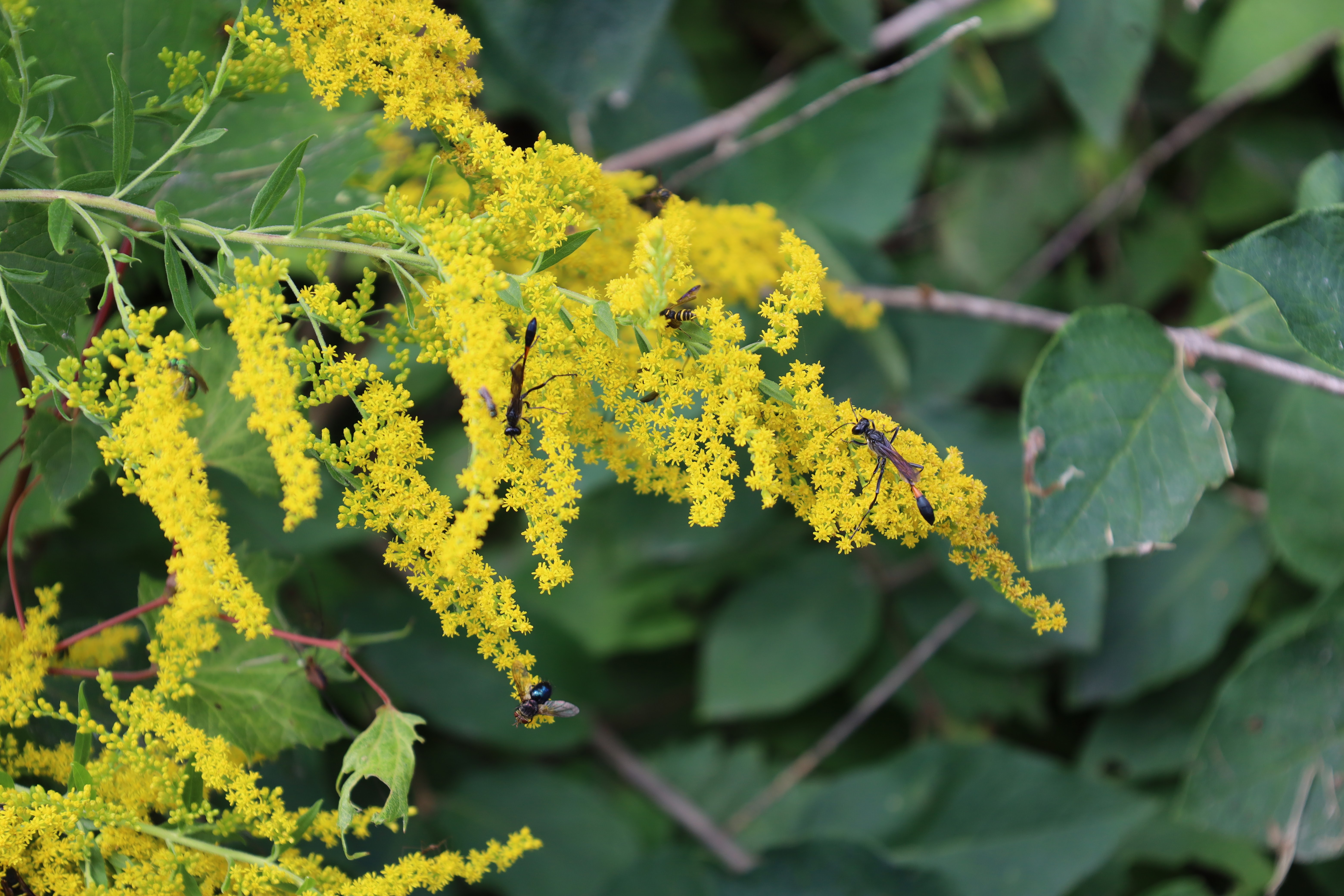
There was some Goldenrod blooming right next to the parking area and we noticed that there was an AMAZING amount of activity on the flowering stems of these plants.  And, it wasn't just one type of insect.  We saw bees, flies, butterflies....  just, lots of critters!

At another location on a gravel road near Rush Creek, we saw more Goldenrod blooming with some Monarda (Bee Balm or Wild Bergamot) next to it.  Both are excellent pollinator habitat plants, though we didn't see quite the activity the plants at the overlook provided us.  I am certain it had something to do with time of day and other conditions.  But, there was certainly activity in most of the places we observed flowering plants.

There were patches of Hoary Vervain that exhibited a significant amount of activity.  Much of that activity consisted of various types of bumble bees.  We were amazed by the large patches of this perennial wildflower in the Mississippi River valley this time of year.  

There was even one area by a homestead that exhibited a very dense and healthy stand of this plant.  Since it was next to someone's house, we didn't feel comfortable with taking photos.  But, there were several opportunities later in other locations to view the Vervain up close and personal.

Because Tammy can't do too much walking and is limited to flat and even surfaces, we were constricted to observing nature from the edges of human environment (roads, parking areas, etc).  While we might have liked to have done a little hiking, we still took great pleasure in observing all of the life on the edges.

The edges of the road exhibited many different wildflowers and pollinators.  The edges of a stream gave us an opportunity to see different birds, insects and plants.  The edges of the river provided us with chances to see lotus flowers and wading birds like the Great Blue Heron.  We witnessed how the edges of a wooded area with the edge of an open/prairie area resulted in a mix of wildlife with the Eastern Wood Pewee constantly telling us it was out and about in the woods and the Tufted Titmouse singing both in the woods and on the edges.  The Mississippi River itself was providing a place for American White Pelicans to stake out sections for their own personal hunting ground.

There were single plants and sometimes small patches of Cardinal Flower here and there near the Mississippi River when we took some time to drive around a park that was situated on the riverbank and some the backwaters.  We know this plant well from our days trying to make perennial flower plantings on the farm and in our prior residences.  

It's actually a bit of a shock to see a plant that you associate with a groomed perennial garden showing up in the wild.  Yet, this gives me some hope that perhaps we can introduce (or re-introduce) some of these plants so that they gain a bit more of a foothold in the wild spaces on our farm.  We would welcome Cardinal Flower, Wild Bergamot and Goldenrod here.  In fact, we do have some of the last two, but we wouldn't cry if we had a bit more.

One of the things that struck me the most was that the activity on the plants we observed during our short break from the farm is both familiar and different to us.

In the past, at some of our prior living locations, we have seen plants covered in pollinators.  For example, we had healthy hyssop at a couple of locations that was covered in a wide range of beneficial insects.  What I do not recall seeing was the wide variety of critters we saw on this short excursion.  Whether that is because we didn't have so much variety or I did not know what to look for them - I'll never know for certain.

I can also say that, despite our efforts to provide habitat and despite having Goldenrod and other excellent pollinator plants, our farm still struggles to see the activity I would expect for the amount of flowering plants we have here.  We know part of the issue is that our small farm is surrounded by less hospital lands for these pollinators.  The monocropped fields around us have fewer edges, providing less opportunity for a variety of living beings.

I suppose I could be discouraged by this because I would like to see this kind of activity on our farm.  Instead, I have come to realize that we are blessed with significant pollinator and beneficial insect activity on our farm.  Some of it through actions we have taken (or not taken - if you will) and most of it simply because nature is amazing.

We'll just keep creating and maintaining edges and wild spaces on our farm and hope we are doing the right things - adjusting each time we learn more.  And we'll keep on learning so we can appreciate all of the life on the edges.

-----------------

What's with the BOGFF 22 in the title?  I (Rob) am giving himself a bit of a blogging break at the end of the year in hopes that it will give me space for more creativity in the future.  Rather than creating a post or two linking the "best of" blogs for the year, while continuing to put out new material, I am resubmitting what I feel were some of the best posts for 2022.  Enjoy!

Friday, January 6, 2023

Critter Criterion - BOGFF 22

I admit that Tammy and I do not always manage to take pictures every time we see a different critter on the farm, but we have come up with a few decent photos over the years.  It is a testament to a couple of things that I think I am justifiably proud of.

  1. Both of us do a reasonably good job of paying attention to the world and ecosystem around us at the Genuine Faux Farm.
  2. I think we do a reasonably good job of providing some diverse habitat that is welcoming to more species than some.

Of course, we are always trying to do better on both counts.  In fact, that is part of the reason that I believe we are doing pretty well - we are both seeking to continue to better ourselves and improve the ways we can be observant and supportive to the various creatures that call our farm their home.  If we just spent time patting ourselves on the back for our amazing accomplishments (bleah), then we'd be both hypocritical and ineffective.

I have to admit that there is some tension that comes with all of this.  For example, I recognize that not everyone is all that fond of spiders - despite all the good they do for us in this world.  And, I will admit that walking into a spider's web while doing night-time chores is the ONLY way to get me to try out new dance moves.  By the same token, many folks have a problem with snakes - and I realize that comes with the fact that some of them know full well how to protect themselves in ways that could be hurtful to us.

Even the conehead shown above can bring about a little... shall we say... ambivalence, when it comes to our feelings about them.  Coneheads are not necessarily a pest for our crops, nor are they a beneficial, feeding on grassy plants (and some of them are opportunists as far as their diet is concerned).

I also admit that we look more kindly at the tiny tree frog that has been known to sit on our soap bottle resting near the basement sink than we would a spider sitting in the same place.  Tammy even got to be serenaded by a little tree frog that came in with some of our houseplants the previous winter.

Even so, there is a bit of tension when it comes to our willingness to share habitat.  And, I think that is a natural feeling - but it is one many of us need to suppress, or, at least, tone down a bit.  It is this attitude - the animals and critters go over there and the people get to be over here - that leads us to continue to take away the opportunity to live that other species should be given.  If each and every one of the 7 plus billion people have the attitude that "animals and critters are fine...as long as they aren't near me," it leaves next to NO space for any other species.  And it's worse than that because humans can't seem to stay on their side of the room.

Humans draw the line, then they cross it.  Then they redraw the line.  And cross it again.

And this is why I find myself working harder to accept co-existence whenever I can in my habitat.  Yes, I would draw the line on termites living in the house.  I am not overly fond of Buffalo gnats and would be happy if a bunch of Barn Swallows moved in to munch as many of them as they can.


But, I hope you notice that I am looking for nature to provide some of the remedy, rather than me reaching for a fogger and resorting to non-discriminating pesticides.   

Part of what is required of me (and you) is some patience while nature does its thing.  An abundance of a pest that has a natural enemy will, eventually attract that natural enemy - as long as you haven't already eradicated that natural enemy.  This is exactly why it is so hard for growers who have used insecticides to give them up.  Often the insecticides have also reduced the predator population.

The cycle then becomes clear.  You decide to stop with the pesticides.  The pest, which usually has MORE reproductive cycles in a season than the predators, sees an opportunity and the population explodes.  Your crops suffer and that REALLY makes it hard to stick with the program.

Meanwhile, the predators - once again assuming you haven't killed them all already - work their way back.  The feast that is the burgeoning pest population provides a boom cycle for the predators and they eventually catch up, if we allow that to happen.

Yes, it's inconvenient for us - because we really hate to have reduced crop yields for a few seasons while things balance back out.  I feel that - because I have LIVED through it.

And, yes, I recognize that I have attempted to simplify one of the most grand and complex things - the natural world.  But, we can't let that complexity push us to simplify by removing all of that diversity.  That would be very sad and very bad...

...and there would be so much less to behold and appreciate in this world.

-----------------

What's with the BOGFF 22 in the title?  I (Rob) am giving himself a bit of a blogging break at the end of the year in hopes that it will give me space for more creativity in the future.  Rather than creating a post or two linking the "best of" blogs for the year, while continuing to put out new material, I am resubmitting what I feel were some of the best posts for 2022.  Enjoy!

Thursday, January 5, 2023

The Oaks Painted the Sky - BOGFF 22


 I walk a fine line between two worlds.  The world of "responsible individual, with many things that need to be done" and the world of the "person who takes the time to observe things that evoke feelings of awe, wonder and gratitude."

You see, I value both worlds.  I like to meet my obligations and I feel some pride in work that I do and tasks that I perform.  I recognize the value of responsibility, consistency, and real effort.  I also believe that it is extremely important to take the time to recognize beauty in nature, artistry created by talented humans, and peace that comes with observation and reflection.

The difficulty here is that I often find conflict between the two.  There are many times on the farm that I have work to do and I just need to concentrate and get it done.  But, as I go about my tasks, a butterfly floats by and the sunflowers nod at me as they weave a lazy pattern in the breeze.  I find my steps slowing as nature tugs at me to take a moment and just appreciate the world around me.

Then, there are those moments where I purposefully give myself a chance to just be - to give myself a chance to really feel what the wind has to say, or listen the birds as they train their young to navigate in the world.  But an internal time clock keeps telling me that this is irresponsible.  There are things to do.  People are relying on you.  You are wasting time that should be spent accomplishing!

Our elder Oaks on the farm took a moment to teach me a lesson when they noticed me trying to hurry myself up at a time when I'd actually got the camera out because I thought the sky was interesting to look at.  They reminded me of contrast, and how it helps you see the beauty of very different things.  

"A picture of the sky - and only the sky - might be ok," one of the oaks whispered to me, "but come over here and watch us paint the sky for you."

This is remarkable, because the oaks don't talk to the farmers much at all.  They have even chided some of our younger trees for doing just that.  Don't get me wrong!  We do hear the oaks talking frequently, but they rarely direct their slow, patient words to us.  After all, we've barely been on the farm long enough for them to notice.

Perhaps my habit of saying hello to them when I go out to check the mail each day is finally breaking the ice?  Whether that's the case or not, the oaks were right.  They painted the sky with their shadowed leaves and branches and the sky looked deeper, richer and so much more fascinating.

And for a few moments, I forgot I had things I needed to do.  I took a few pictures and then I just soaked it all in.

-----------------

What's with the BOGFF 22 in the title?  I (Rob) am giving himself a bit of a blogging break at the end of the year in hopes that it will give me space for more creativity in the future.  Rather than creating a post or two linking the "best of" blogs for the year, while continuing to put out new material, I am resubmitting what I feel were some of the best posts for 2022.  Enjoy!
Wednesday, January 4, 2023

A Thousand Cuts - BOGFF 22


Many of us like to glorify the efforts of small-scale, diversified producers of quality food.  We like to point to their willingness to work with, rather than against, nature.  Some of us, myself included, actually harbor a belief that this sort of farming (or some version of it) would be a key move towards building a healthier world.  

But, let me tell you a secret - it is a whole lot easier to try to sell that vision when I am not stuck in a position where I have to rely on living that "dream" at the same time I am promoting it.

A recent conversation with a respected colleague (and they will probably know who they are if they read this) brought it all home to me once again. 

People who try to raise food on a small-scale, diversified operation are a rare breed that work incredibly hard to put their ideals into action.  They also do it so they can earn, through extremely hard work, a reasonable living.  They stick with their operations because they love what they do - or at least they love most of what they have to do, much of the time.

The work is very diverse with tasks ranging from marketing and story-telling in the effort to sell product to horticulture, entomology, and small-engine repair.  There are many points each season where the job is all-encompassing.  The moments in time where you can feel as if you are "caught up" are rare and don't last more than a couple of minutes.  One blink and the farm once again can feel like it is on the brink of disaster.

And that's how the best of us feel most of the time on our farms.  And you wouldn't know it by looking at us - unless you are also one of us.

There is probably no worse time to be a diversified produce and poultry farm than mid-May to mid-June, in my opinion.  I realize most people are fully enamored with the beauty of Spring and the promise of a Summer of fun.  For me, after seventeen (or so) years of doing this sort of farming, I see this as the time where I die a death inflicted by a thousand cuts.

I guess the saying implies that they are "tiny" cuts - but I can tell you they come in all shapes and sizes.  

I thought about this very carefully, because I want to maintain my integrity with those of you who read this.  I even looked back on my daily farm notes from a few years back.

In a single one-week period, each of the following things happened at the Genuine Faux Farm:

  • a windstorm flattened half the plants in a couple of crop successions
  • a woodchuck ate 15 trays of broccoli and cauliflower plants that were due to be planted that week
  • another storm dropped four inches of rain on already saturated soil, making it impossible to do any field work
  • the Buffalo gnats were so bad that anyone who did not cover themselves completely, even in temperatures in the high 80s to low 90s, were going to be covered in welts from the bites.
  • we discovered that the raccoon parents were teaching their young to pick off members of our hen flock a couple at a time in the middle of the day by creeping through a hole in the fence
  • the early cold season crops were bolting because of some unseasonably warm temperatures
  • the warm season crops were either not in the ground or stunted by wet weather
  • deer ate the hearts (centers) out of a number of our maturing romaine lettuce crop
  • someone missed watering four trays of squash transplants and those trays did not recover
  • the windstorm required some clean-up during days when our task lists were quite full
  • we did not notice a leak in the irrigation inside a high tunnel until a small pond had developed on one end
  • a key tractor implement broke while we were trying to complete work before the rains came
  • we had to work around a contractor who was doing work in the farm house
  • we had to say "no" on several egg orders because we had fewer eggs (see raccoon issue)
  • we cancelled a CSA farm share delivery because we did not feel we had enough to justify counting it as a week in our CSA, opting to add a week at the end and removing a week from our potential Winter shares.

I think that's enough for you to get the point. 

My colleague and friend recently shared their current frustrations with the wildlife making off with the produce they are working so hard to nurture, weather making the process of growing good food difficult, and the issue of limited helping hands adding to the challenge.  

"I must be stupid or a complete failure.  I've been doing this long enough, you would think I could find a way to deal with these problems."

For a second, my heart broke - even if it didn't look like it.  I heard what this person was saying, and I recognized words I had spoken to myself.  And I can tell you that I have often taken these failures (big and small) to heart because it was so very important to me to fulfill my obligations to our customers, to the land, to those who work at the farm, and to all of the other folks who try to grow as we do.  All of that responsibility just makes each little cut bleed a little bit more.

A thousand cuts.  A thousand tiny cuts will make the most dedicated, intelligent, skilled, and capable people wonder - "Why am I still trying to do this?"

This is why I keep pushing the idea that we need to do better at supporting farms and growers like these.

If we like the idea of working with, rather than against nature.  If we prefer to have more people on the land, working on a smaller-scale that is responsive to the needs of the community.  If we see value in local foods.  If we want food that is raised with fewer chemicals and we want growers who hold on to the highest ethics when it comes to treating workers well, being stewards for the land, and being caretakers for a healthier future.

Then we've got to stop adding our own small slices to the ten thousand cuts these people suffer so frequently as they try to do that job that they love.  On the land that they care for.  For the good people they so willingly serve.

I'm going to share another secret.

Our farm survived that "week of horrors" that illustrated all of the natural things that can go wrong on a farm like ours.  I suspect my friend will also move forward and be able to look back on a reasonably successful season at the end of the year (even if it doesn't feel like it now).

In fact, we had a solid year - because we actually were pretty good at what we do.  We just needed a full season to get the perspective we needed to see it.  After all, we DID sign up for those kinds of problems when we took on the job of running our respective farms. Yes, it does get annoying when we lose a crop to rabbits (or some other critter) AGAIN.  And, yes, we wonder how we could let it happen once more.  Surely we must be too dumb to figure it out.  

This is normal frustration speaking.  We're human and it feels this way.  

We also know that the whole equation of our farms are much more complex than "guard against rabbits" and sometimes the most successful strategies for that particular task are not practical for the moment in time that we are in.  

Until the rabbits make us pay too much and we adjust.

The real issue, as I see it, are those other cuts and injuries that could be prevented if we, as a society, were willing to provide remedy.

We need to stop supporting corporate farming and chemical-based agriculture.  If there were more of us out there doing this small-scale/diverse farming thing, we'd have that much more support to get through the rough times.  We need to remove the possibility of chemical trespass from the list of things that can go wrong on our farms.  

We need to be sure those who work on these small farms have appropriate health care.  We need to adopt size-appropriate regulations that don't define "small business" as anyone under $20 million in sales.

And we need to put these small, local producers back in front of the line when it comes to supplying the foods that we eat.

-----------------

What's with the BOGFF 22 in the title?  I (Rob) am giving himself a bit of a blogging break at the end of the year in hopes that it will give me space for more creativity in the future.  Rather than creating a post or two linking the "best of" blogs for the year, while continuing to put out new material, I am resubmitting what I feel were some of the best posts for 2022.  Enjoy!

Tuesday, January 3, 2023

Affirmation by Discussion - BOGFF 22


The area outside the backdoor of the farmhouse at the Genuine Faux Farm looks a bit different than it has for many years.  We're very pleased to have a new sidewalk that extends from the relatively new back steps.  All of this leads to a drive area that has gotten the first couple of fresh loads of gravel in a decade.  (edit: and now that we've shoveled a few times, we're really happy.)

As I looked at this picture from earlier in May, I reflected on the process Tammy and I went through as we made the decisions to make each of these things happen.  I think, in each of these cases, we both knew pretty much what really needed to be done from the outset.  However, we still went through a period where we explored options and considered various alternatives (including just letting it all stay as is).  But in the end, I believe we ended up with what we were initially considering in the first place.

Yet we still went through a process I dubbed "affirmation by discussion."

Why bother talking it out if you already know?

This is a perfectly valid question and worth an answer.  So, I'll give you sort of an... oblique answer.

We've been doing the work and making a myriad of decisions on a yearly, monthly, weekly and daily basis since 2004 with respect to our farm.  As a matter of fact, there have been periods of time where we were making decisions from moment to moment that had the potential for far-reaching impact when it came to the viability of our farm business.   As a result, I think we've learned three things:

  1. You will never know enough to be able to select the perfect solution - if it even exists.
  2. You will never know enough to make the best possible solution if you don't explore.
  3. Once the decision is made, you need to agree that it is the best possible solution for that moment in time with the situation as it stands.

And that is why we often engage in affirmation by discussion around here.  That and, well, it's a thing I think I have often done without realizing it for most of my life - sometimes resulting in some confusion with those I interact with.

The good news is that Tammy and I have figured this out (for the most part).  The bad news?  Well, not everyone else has figured out that I often operate that way.

For example, I have now worked for two years with Pesticide Action Network.  I am honored that the people there trust me to be competent and to do my job well.  But sometimes I get surprised when I offer up an idea or a possible solution - and it is immediately accepted with little or no discussion.

Um... Now what happens if I was just offering up a "straw man idea" so we could talk it through?  Ok, that's not such a bad thing because I can adjust so that I don't offer up those sorts of things without making it clear that's what it is.  But there are times when it would be nice if, after I offer up an idea that I do believe is a good one, we still engaged in the process of affirmation by discussion.

I suppose part of the reasoning is that even a little bit of discussion illustrates that the other members in the group actually listened and understood the suggestion.  "Oh yeah, that sounds good," can be code for "Sure, Rob, do whatever, as long as we don't have to do anything with it." 

But, here's the thing that makes me want to engage in affirmation by discussion.  I've learned a 4th thing:

4. We need to be willing to reverse a decision if new information shows that our best possible solution is no longer a fit and must be changed.

This may be my biggest reason that I like to engage in the affirmation by discussion process.  I may THINK I've got a good solution right now. But, I'd like to avoid #4 if I can.  It turns out that I have a good idea that I do NOT know everything - so seeking out other opinions and thoughts area key component of good decision making.

So, yeah.  I appreciate having the respect that others give when they tell me that they trust me to do a good job and come up with some decent solutions.  It just turns out that I might have to talk it out with them anyway - because that's part of what built that trust in the first place.

-----------------

What's with the BOGFF 22 in the title?  I (Rob) am giving himself a bit of a blogging break at the end of the year in hopes that it will give me space for more creativity in the future.  Rather than creating a post or two linking the "best of" blogs for the year, while continuing to put out new material, I am resubmitting what I feel were some of the best posts for 2022.  Enjoy!

Saturday, December 31, 2022

The Path to You - BOGFF 22


If you could go back - if you could go back to any point of time in your life and change something that you regret.  Or if you could go back and take an opportunity that you missed.  Or if you could take a time machine and give your previous self a warning or a piece of advice.

What would you do?  When would you go?  How would you rather have things end up?

It's a common question and a common fantasy.  If I could go back and just change that, everything would be so much better.  I wouldn't have this stain on my soul.  I wouldn't have missed this chance.  I'd be richer.  I'd be more successful.  It would be better.

I was asked this question once, in a classroom in which I was the instructor.  Would you change some of the decisions you have made in your life if you could go back and make them again?

It wasn't a question I was prepared for because that wasn't exactly on topic.  And yet, it was a very good question, because it actually could be used to bring about some useful learning that was actually very much ON topic.  

I don't remember exactly what I said that day, but I do recall the basic idea of much of what I said.

Would I go back and make a change if I could? Would I if I could find an event that, for me, was so awful or an event that was pivotal, leading me to one of the darkest moments in my life - and a change by me could possibly remove the pain and maybe even make things better?

Perhaps I would be tempted.  But, then I hope I would remember.

The path I have taken to this day, has led me to this.  The path I have taken to this day has made me who I am.  The path I have taken up to this point, has led me to you.

-----------------

What's with the BOGFF 22 in the title?  I (Rob) am giving himself a bit of a blogging break at the end of the year in hopes that it will give me space for more creativity in the future.  Rather than creating a post or two linking the "best of" blogs for the year, while continuing to put out new material, I am resubmitting what I feel were some of the best posts for 2022.  Enjoy!

Friday, December 30, 2022

Do You Want to Feel Needed? - BOGFF 22

Sometimes you hear things in passing that get you to thinking, even if what you heard was out of context and not meant for you specifically.  Not too long ago I heard someone as I passed by.. or they passed by.. say a phrase that I've heard others say and maybe I've even thought or said it myself.

"I just want to feel needed."

I think we all get it in some way or another.  "I just want to feel needed" is a plea that says, "Please, someone, tell me that I have value and that you see that value."  It's a natural feeling.  It's normal to want to see evidence that others "see you" and recognize your presence and your... necessity... in this world.

And, before I go to far, let me say this.  You are needed.  The place you hold in this world is made for you and it is up to you how you operate in that space.  I recognize that many spaces are far more difficult to be in than others - but it is still your space and I see you there.  Thank you for being you and being who you are.

But, let's not take this desire to be needed thing too far.  If we predicate our own happiness on being "needed" in every space that we enter, we are likely to be very disappointed and VERY unhappy.

I remember how hard I worked at one of my early jobs out of college.  I worked all sorts of unpaid overtime.  I never said "no" when I was asked if I could do something, even with short notice.  I was doing everything I could to reach that point where I was the necessary cog for the machine that was the place I worked.  I was certain that, eventually, others would recognize my critical value to the organization and things would be ... good ... once that happened.

I worked so hard that I got sick.  I missed some work time.  So, I cut back my hours, realizing that I had to balance my life a bit better.  And, I got my recognition - in the form of a "concern that I was not working as many hours" as I had before.  There wasn't really any concern for me, as a person.  Just that I did not seem to want to be working as slavishly for this place as I had before I fell ill.

To make a long story less long, I eventually left that place of work.  Despite my absence, they eventually did finish the project I had been working on too.  They did NOT really "need" me to accomplish what was done.  That doesn't mean my contributions had no value.  In fact, looking back, I am sure they did.  If I were never involved they would have gotten somewhere - just like they did with my involvement.  The "somewhere" might have been different, but "somewhere" would have been reached.

Not everyone is motivated in the same way I am, but enough people are.  We want to show others that we are useful, that we are valuable, that we can accomplish and do good things on behalf of those we work for.  We have a tendency to discard much of ourselves in that quest to show that we are an important and critical resource.  But, we do so without recognizing that we may be asking to be needed in the wrong places and in the wrong ways.

After all, that business I worked for?  It had been active for decades before I came along and it continues to do its thing to this day.  My presence certainly was NOT needed for it to continue to exist and do what it did/does.  

I needed to change my goal from being "the necessary cog" in the machine to a "useful cog."  Instead of wanting to feel needed, I have learn that I actually needed to be helpful... in whatever it was I hoped to be doing.  That meant I needed to keep myself healthy so I could consistently be a positive member of the team.  An over-worked, burnt out individual is going to break down and become less than helpful eventually.

So, do you want to be needed?  Well, you are.  Because you're the only you we've got!  But instead of trying to make the case that we are needed - needed more than anyone else - maybe we should all make the case to ourselves that we need to be helpful.  And, we have to recognize that we cannot be helpful if we are not also caring for ourselves.

Do you want to feel needed?  Well, you are!  I need you to be helpful.  I need you to be kind.  I need you to do the best you can in whatever you do.  And, I need you to find ways to keep learning to be the best you that you can be.

Have a good remainder of your day, and thank you for joining me on the blog today.

-----------------

What's with the BOGFF 22 in the title?  I (Rob) am giving himself a bit of a blogging break at the end of the year in hopes that it will give me space for more creativity in the future.  Rather than creating a post or two linking the "best of" blogs for the year, while continuing to put out new material, I am resubmitting what I feel were some of the best posts for 2022.  Enjoy!

Thursday, December 29, 2022

A Touch of QWERTY - BOGFF 22


I have had a week full of busy office days after taking a week off from my Pesticide Action Network job.  Now, don't get me wrong.  This wasn't exactly a full week long vacation because we only spent a couple of nights away from the farm.  Part of the deal was we both needed to step away from jobs so we could spend some time actually doing things on the farm.  So, yeah, it was a vacation from the salary earning jobs, if you will - and it was wonderful.

Upon returning to the PAN job, I found I had a bit more energy for it - something I had been lacking for a while.  But, I also found my email inboxes full (both for the farm and PAN) and there were a host of things I needed to do and LOTS and LOTS of correspondence that needed me to reply.

So, I've doing a significant amount of typing.  After a flurry of email responses and a stint editing someone else's document I started to realize exactly how fast I was typing.  And, I gave myself a minute to feel grateful that my Mom taught me how to be a touch typist at a young age.

We had a manual typewriter at home that also doubled as an exercise machine for our hands and fingers.  Each key would cause a metal arm to swing towards the paper.  As it approached, the typewriter would raise the ink ribbon up so that it was between the top of that arm and the paper.  The trick was to strike each key sharply enough that it would impress some ink onto the paper.

The innards of our typewriter would have looked a bit like the one shown below.
 

Of course, Mom wanted each of us to learn how to be a "touch typist."  In other words, we learned where the "home row" was and we taught our hands to know where all of the keys on the keyboard were without looking down (other than to check at the beginning that we had placed our hands correctly over that home row).

Over time, I got to be pretty good with typing.  But, our typewriter had a few issues.  One of them was the fact that we didn't get a new ribbon very often so I sometimes had to stop and wind the ribbon forward past sections that didn't have much left to them.  The other was that if you got going too fast, you could end up with a tangle of those arms all jumbled up part way between their resting place and the paper.  Then you would have to spend time UNjumbling the mess before you could start again.

And, let's not talk about what you had to do if you DID make a mistake.

But, hey!  It was motivation to get really, REALLY good at typing.

At the time I was attending junior high they were still teaching typing classes and everyone had to take it.  The typewriters were newer and were (gasp) electric.  That meant you didn't have to muscle each key to the paper.  It also meant you got fewer ...er... jumblings of the keys.  Which meant you could type faster.  And, of course, they measured your progress by giving you tests to determine the words per minute you could type.

After the teacher reminded me that I did not have to pound the daylight out of the keys as I selected them, I started hitting speeds in the 80 words per minute range and made it to the 90s before class was over.  I was curious, so I took a typing test at this site just to see where I would land now.  And, that's when I remembered that typing tests require that you translate something from another source to your brain and then to the paper (or screen) as you type.

I'm um... not used to that.  After all, most of my typing starts with stuff in my brain that I put onto the screen.

My first attempt was miserable because I didn't realize a couple things.  First, single spaces after periods (that's a case where my training failed me).  Second, once you are off by one character with this typing test, everything that follows will be an ERROR.  Ooops.

Armed with that knowledge, I gave it another try and landed at 71 words per minute and 98% accuracy.  Ok.  I can handle that.

A Dvorak typewriter keyboard layout - from this NPR page viewed 8/25/22

I remember the confusion my siblings and I had when we were introduced to the QWERTY keyboard that was the boon for all well-trained touch typists and the bane of everyone else.  Why in the world were the letters OUT OF ORDER?  Who decided that asdfghjkl; should be the "home row?"  I mean, at least the darned numbers were in order - but what was with the rest of them?  Speaking of jumbled messes!

This interesting article on the NPR website actually talks about some of the alternative keyboard layouts that some have argued would be better.  For example, the Dvorak keyboard layout shown above places the letters that comprise 70% of the most commonly used letters on that home row, rather than asdfghjkl;

It is clear to me that the proponents for the Dvorak keyboard have never typed on a typewriter where you had to slam each key with enough force to make the floor shake.  I gotta tell you.  If you have to use your pinky finger as often as you would on the Dvorak keyboard, you'd be crying to go back to QWERTY as soon as you possibly could.

Or you'd just join the group of people who use your two index fingers and "hunt and peck" your way through life. 

Well, all right.  I'll grant you that the "a" is in the same place.  It's that darned "s" that would have gotten me.  And, why in the world would you put the "x" where your strongest fingers would be and the "v" and "l" where the weakest ones are?  

The article shows another alternative called the Colemak design... and I might concede on that one except for one thing. I'm already a touch typist on the QWERTY keyboard, why would I even entertain the idea of a different keyboard design?  

Um.  I wouldn't.  But, I might consider celebrating National Typewriter Day - it's on June 23 next year.

And now you know.  Have a great rest of your day!

-----------------

What's with the BOGFF 22 in the title?  I (Rob) am giving himself a bit of a blogging break at the end of the year in hopes that it will give me space for more creativity in the future.  Rather than creating a post or two linking the "best of" blogs for the year, while continuing to put out new material, I am resubmitting what I feel were some of the best posts for 2022.  Enjoy!

Wednesday, December 28, 2022

Ripples on the Pond - BOGFF 22


I was out doing some morning farm work when I looked and saw a significant smoke trail on the horizon.  It is certainly not the first time I've seen a smoke trail, but this one struck me because it had fooled me when I glanced out the window earlier in the morning into thinking the day was going to be very hazy.  Well, it was a little bit hazy, I suppose, but really it was more clear than anything.  

Now, before I go much further, let me assure you that this was not a house or barn fire - there appeared to be no emergency in progress.  Instead, it was a deliberate burn and I will give no more details than that - because that's not the point.

The point is this:


How often do we take an action and either fail to consider how it will impact others or simply decide to ignore the ripples that result when we throw a stone into the pond?

Just look how far that smoke had traveled from this single point.  It's a great example of what a temperature inversion (warmer air acting as a cap for cooler air and preventing smoke from rising further off the ground).

Tammy and I like to have our windows open, especially at night.  Unfortunately, there have been many times we have been awoken to the smell of smoke that causes one of us to get up to investigate in case we have a problem.  Usually, the smoke is from someone's fire miles away that has been capped by just such an inversion.  And, I am pretty certain that those who lit that little fire to burn their trash (or whatever) did not consider who else might be affected by what they were doing at that moment. 

But, this is not a rant about people burning things on days where there is a temperature inversion.  After all, where does that smoke go when there isn't a warm-air cap?  It goes higher into the atmosphere - along with so many other things we like to spew out into the air.  Eventually, it comes down in rain.  So, it's not as if it disappears.  It's still there.  And there is no telling where it will eventually land.

The point is this.  The things one person puts into the air (smoke from fires, pesticides, vehicle emissions - you name it) can impact places that are far away.  The ripples each of us make on the pond can make a difference in the lives of other people, places and things.

And we seem to have a difficult time taking that reality seriously.


What you are seeing now is a close-up picture of one of our ash trees that died after the Emerald Ash Borer came and infested all of the ash trees in our area.  The borer larvae essentially burrow (and eat) their way through the part of the tree just under the outer bark, where water and nutrients are transported to the branches and leaves.  The net result is that the tree dies.  This has been devastating in our area because there were a significant number of ashes on farmsteads and woods.

The Emerald Ash Borer originated in Russia and northern China and was first identified in the US in 2002.  The likely vector for travel was wood used in cargo ships for packing and crating consumer goods.  Now - 20 years later - we're lucky to find any ash trees that aren't dead or dying in Iowa.

The ripples on the pond have reached our shores.

How did it happen?  I'm sure we'll never know. And it isn't important that we pinpoint who made the decisions or made the mistakes that led to the use of infested wood for packaging.

Someone took a shortcut to get a job done that they were being pressured to do.  Someone decided that expending more effort, time or resources to make sure lumber was not infested was not worthwhile.  Someone wasn't even aware Emerald Ash Borers were a thing.  Or maybe someone decided it wasn't worthwhile to read through all of the restrictions for packing materials (that might have alerted them to the problem) because it was annoying and infringed on their rights to just get things done the way they wanted to do it.

After all, people don't often see these far flung results - the ripples that wash ashore somewhere else to become someone else's problems.  Besides, they're probably too busy being worried and bothered by the waves someone else has created that are flooding their own lives.

Happily, not all ripples in the pond are unwelcome.

I've noticed that some of the ditches on the gravel roads in our area have been exhibiting more flowers over the past several years.  A neighbor a half mile down the road put in many acres of pollinator habitat that includes these flowers.  It appears that one unintended (and welcome) consequence is that these flowers are showing up in ditches around us.

This is the great equalizer that we desperately need to remind ourselves of.  If you, or I, or someone else does something with forethought, wisdom and good intent, those ripples can also find their way to distant and unknown shores.

When we take the time to consider the consequences, both negative and positive, and we act on the positives - there is no telling how many lives and places may benefit in the end.

-----------------

What's with the BOGFF 22 in the title?  I (Rob) am giving himself a bit of a blogging break at the end of the year in hopes that it will give me space for more creativity in the future.  Rather than creating a post or two linking the "best of" blogs for the year, while continuing to put out new material, I am resubmitting what I feel were some of the best posts for 2022.  Enjoy!

Tuesday, December 27, 2022

Conflicting Signals - BOGFF 22


We love our flowers at the Genuine Faux Farm, and we make a big to-do about the German bearded iris and the day lilies, with the big, bright and showy flowers.  We also love our pollinators at the Genuine Faux Farm, and we make a similarly big to-do about how we strive to make our farm friendly for beneficial insects and other critters to flourish and thrive - all while pollinating our veggie and fruit crops.

But, when these big flowers bloom, we rarely see any pollinators visiting them.  Instead, we see pollinators on flowers like this:

Rudebekia, Purple Coneflower, Milkweed, and numerous smaller, less showy flowers like clover, goldenrod, or hyssop are the stars when it comes to pollinator attention.  And we know why that is.

You see, the highly hybridized day lilies are bred specifically for flower and plant characteristics that humans appreciate.  There is very little, if any, consideration for making sure the traits that make a lily flower interesting to a pollinator remain (or are enhanced).  In fact, there has been so many generations of selection to get flowers like the one I opened the blog with that I wouldn't be surprised that pollinators, if they could talk to us, would tell us that these are not, in their eyes, even flowers.

On the other hand, flowering plants that are native to our region or are closer to the native strains have been selected over time by the pollinators.  What I mean by that is that many of these plants rely on pollinators for their reproduction.  If pollinators do not visit, then these types of flower cease to reproduce successfully - so it is in their interest to show off for the pollinators.  If humans like them, that's fine too, because then we're less likely to mow them down or spray them, I guess.

On the other hand, an iris, like the one shown above survives and is able to propagate as long as humans show them favor.  So, the big blooms that don't tend to attract pollinators make sense because their path to survival is to impress US.  

This, of course, does not mean that these flowers fail to attract attention from other critters.  Deer have been known to take healthy bites of our day lilies and there are other insect pests that can give these plants some grief.  This is the source of some of the conflicting signals I referenced in the blog title comes from.

Even today, many of the big companies that propagate perennial plants that people like to put in their gardens still use neonicotinoids to provide a systemic resistance to pest insects that like to munch on decorative plants.  After all, a decorative plant with bites taken out of it seems much less decorative.  But the problem with this is the fact that neonics do not discriminate.  They kill pollinators just as readily as they do the pests that damage the plants.

This is why we got away from buying plants unless we could ascertain whether or not they were treated with these systemic insecticides.  Yet we still have these big beautiful plants here and there on our farm.

Are we sending conflicting signals?

Well, if we didn't send at least some conflicting signals about most anything we do, we would not be humans.  Humans are notoriously inconsistent.  But, we are doing the best we can to be as consistent as we are able.  We still love our big and bold flowers and we still love the less conspicuous flowers that the pollinators appreciate.  

We are consistent in our inconsistency.  We appreciate beauty in many forms.  We respect nature and how it works.  We do our best to find a balance.  We are always questioning whether we've got it right or not.  We do our best to adjust as we learn.

At present, our big beautiful blooms coexist with our pollinator habitats.  Neonicotinoid treatments are typically residual in a plant for one to two years.  So, any plants we may have unknowingly acquired with this insecticide (and are still alive) should have worked it out of their system.  Newer plants have generally been purchased after inquiring about pesticide treatments.  And we continue to work on providing wild space for our pollinators.

It's a worthwhile effort.  What do you think? 

-----------------

What's with the BOGFF 22 in the title?  I (Rob) am giving himself a bit of a blogging break at the end of the year in hopes that it will give me space for more creativity in the future.  Rather than creating a post or two linking the "best of" blogs for the year, while continuing to put out new material, I am resubmitting what I feel were some of the best posts for 2022.  Enjoy!

Monday, December 26, 2022

Entitled to What? - BOGFF 22


My siblings and I attended Emerson Hough Elementary in Newton, Iowa, and I recall being taught at least a little bit about who Emerson Hough (1857-1923), the school's namesake, was.  He was a person with many callings: teacher, lawyer, outdoorsman, writer, and conservationist.  Hough was born in Newton, graduated from the Newton schools, and went on to publish several novels.  Two of these (The Covered Wagon and North of Thirty-Six), were turned into screenplays - becoming popular silent films.

Newton, itself, was established in 1846 and had just been incorporated as a city during the year of Hough's birth (1857).  In a way, Emerson Hough was, perhaps, the first Newton-born settler to reach some level of fame.  Though, I am afraid we'll never know how Hough would have stacked up against the generations of native sons and daughters who came before as members of the Ioway.  Yet, if we look at white culture in the United States, Hough did do things worthy of recognition.

So, the school I attended was named after him.  The building was put up in 1927, so Hough was no longer alive for the building's naming.  I suspect it was not something he had asked for, but it happened nonetheless.

I got started on this topic because someone I know was sharing an article on social media and I decided I should at least look at it.  I read the first few lines and quickly skimmed the rest - rapidly giving it up as a bad cause.

The author started out the whole thing by saying they had donated millions of dollars to an institution and had a wing of a building named after them.  This had been several years ago.  But now, this person wanted special dispensation by the college to do something else.  What followed was essentially a rant about a topic that will not be mentioned here.

So, why do I bring it up?

I want to ask you this:  

If you give a gift to someone, or some organization, what does that entitle you to?

If I give a gift to a sibling's child, does that mean that I should expect - and maybe demand - their love and adoration in return?

If I donate money to the local food bank, do I expect them to cook a special meal or two for me in the future?

If this person donated money and wanted to have their name placed on a sizable chunk of a building, that's another thing altogether.  All I can say is they got more return than a gift merits.  Not because a gift is not worthy of recognition.  No.  It's because a gift is not a gift if you expect a return from it.  

This person bought publicity, personal achievement, and glory by purchasing a place to have their name prominently placed for as long as that building stands.  And now, this person wants more, solely on the basis that they gave a gift...once upon a time.

So, what are we entitled to if we give a gift - if anything?

I know that I like to receive some acknowledgement, if only to confirm that the gift was received.  And, I might admit that it means more to me if the friend, relative, or other individual to whom I gave a gift lets me know they do appreciate what they received.... assuming they actually did (please don't lie about it!). 

And, for those rare moments when I actually surprise you (and me) that I found something you really like, I do actually really enjoy hearing that you still like to use it, or look at it, or whatever.  But, I don't expect any other sort of return.  It's just nice to know that you like it, that's all.

And, when it comes to donations...  well, I always have to wonder a bit when a person seems to need to see their name in print, or receive other accolades in return for something that is supposed to be a gift.  And, I definitely have a problem when that person starts feeling like they are owed more in return for those same "gifts."

In fact, many charitable programs fall into this trap themselves by listing donors - in order from biggest donations to smallest - as if the $10 donation from a person who makes less than minimum wage is worthy of less praise than a person who donated $10,000 and for whom that 10 grand was a tiny percent of the money available to them.  

You know.  A nice list of people who donated is good enough, by way of a thank you, without highlighting who has money and who does not - don't you think?  Unless, of course, this IS a transaction.  And, if it is, let's stop calling it charity and call it for what it is.  

Then we can clearly delineate in the contract where the service being purchased starts...and where it ends.

Meanwhile, I still like the idea that I went to a school named after Emerson Hough - a person who appears to have embraced life-long learning, had an affinity for the natural word, and liked to write.  It helps that I suspect the naming of the school was not transactional in nature.  Instead, the people of the town looked at someone who had come from there and done some pretty cool things.  It's a gift that goes a couple of ways - it tells the descendants of Emerson Hough that some people thought he did pretty well in the world.  And it encourages elementary students to consider what others have done before them and to think about what they might want to go on to do.

I can live with that.

-----------------

What's with the BOGFF 22 in the title?  I (Rob) am giving himself a bit of a blogging break at the end of the year in hopes that it will give me space for more creativity in the future.  Rather than creating a post or two linking the "best of" blogs for the year, while continuing to put out new material, I am resubmitting what I feel were some of the best posts for 2022. 

Note: I included this one during the last week of the year for a specific reason.  Many people participate in "end of year" giving to various charities for reasons that are particular to each individual.  Perhaps you can consider what I wrote above as you consider your own gifts this year.