Showing posts with label agri-fauxbia. Show all posts

Tuesday, December 5, 2023

Farming for More than Yield and Money

The following is a cross-post of material I wrote recently for Pesticide Action Network and their Ground Truth blog.  As I often do, I am re-posting in our farm blog in the week following its release on the PAN website.  Thank you for considering my thoughts and words.

---------------------------------

One of the stories that is frequently told to, and sometimes by, farmers is that growing food or crops is all about yield and the bottom line.  It doesn’t matter whether you are a grazier, a row crop farmer, an orchardist, or you work a small-scale, diversified farm; the temptation is to measure the success of your efforts based solely on these two measurements:

Did the farm produce as much as it could have?

Did the farm bring in as much income as it can?

Unfortunately, when a person views farming that way, they fail to consider so many other measurements of success that are just as important.  This limited set of measures also fail to recognize that there is a difference between “enough” and “as much as is possible.”

I like to broaden my farm’s balance sheet to include measurements that go beyond total yield and profit.  In my opinion, there is much more to being a successful farmer and land steward than money and yield.

Considering investment in natural assets

When a farmer considers only how much they can produce and to turn it into the most money they can get, they close their mind to investments that can bring stability to future production and success.  This short-term thinking makes it easy to pretend that pesticides, synthetic fertilizers, mono-cropping (one crop in a field) and tilling up every square inch of land are not only good ideas, but the best ideas. Suddenly, confining as many animals into a shelter as possible because there is a better return per square foot of space suddenly seems reasonable and even preferable.

Instead, land stewards recognize that the health of the soil we grow our crops in needs to be maintained with an eye towards future success, not just this year’s numbers.  A cover crop will represent an expense on the regular balance sheet, but it can be an asset for soil health.  A perennial crop in the rotation may represent a loss in potential income for a season or two, but it also provides value when we consider the health of the land being farmed.

Bumblebees in borage
 
On our farm, we have considered the health of our pollinators to be another line on our balance sheet that needs attention.  Many of our crops are pollinator-dependent.  If we want them to produce, we need these natural workers to be present.  So, we invest in them by intercropping plants that attract these organisms and we maintain wild spaces so they have a refuge and a home nearby from season to season, year to year.

Considering a broader farm balance sheet

We also find ourselves thinking about a balance sheet that goes beyond our farm.  Rather than focusing only on this season’s production and income, we consider how what we do impacts our neighbors, our communities, and our environment.

There are many farms, like ours, that produce a wide range of foods and strive to sell those foods locally or regionally.  It should not be a surprise that a direct relationship with the market encourages investment into the communities where that market resides.  Sometimes that investment comes in the form of money, such as when our farm buys feed from another local farm for our laying hens, or when we pay an accountant in town to help us with our taxes.  But, it is just as likely that growers, like ourselves, will be found at local events supporting schools or donating food to a community dinner.

It should be no surprise that the connection to the community lands on both sides of the balance sheet.  Certainly, there are some costs that come with running a local business of any sort.  But, they are outweighed when you consider the support the community can give the farm when things aren’t going well.  And when it comes to product pricing, a farmer has an opportunity to be a price-maker, covering their expenses, rather than a price-taker, being forced to accept a loss because a broader market forces it to happen.

Thinking beyond yield and money

We need to challenge ourselves to think even more broadly.  For example, many vegetable farms use plastic mulch to help control weeds in their crops.  We understand fully why this option is a popular choice.  The cost per foot is relatively low and weeds are often one of the toughest things to deal with in a growing system.

Unfortunately, plastic mulch can only be used once.  After that, it just becomes more single-use plastic in the landfill.  In this case, it is important to consider the larger balance sheet that includes a broader segment of society than the effect on our farm and its immediate surroundings.  After thinking hard about this, our farm moved to using mulches made from organic materials, such as paper, straw and grass.

Straw mulch in intercropped field

This decision was reached out of concern for (for lack of a better phrase) the greater good.  But, it turns out there were some very good reasons to do it for our farm’s good.  First, these natural products break down and produce organic matter for our soil, while still suppressing weeds effectively.  And, it turns out that the use of black plastic over a longer period of time actually can result in a build-up of plastic debris in the soil.  By avoiding their use altogether, we prevent this from becoming a future problem on this land we steward.

A broader focus leads to better farming

I fully recognize that all of this might sound idealistic and impractical.  But, I would like to suggest that our current focus on the two outcomes, yield and profit, are far less practical.  Each time we have challenged ourselves to think more broadly about how our farm performs we’ve been able to identify options that ended up providing more benefits to more people and the environment.  Often (but not always) these choices included better long-term yield or profitability for our farm along the way.

So, why don’t more farmers think this way?  The system we have in place for food and farming is a big part of the problem. It’s in the interest of chemical companies and Big-Ag to encourage a focus on profit, yield and short-term risk/gain, because it drives up their profit.  For example, crop insurance measures risk on the basis of a single season, so options that might be good for the medium or long term success of the farm aren’t encouraged.  In effect, farmers can find themselves feeling trapped with few alternatives to pesticides and large, industrial farms.

The good news is this: There are farms, like ours, that still manage to be successful when they look at a broad-view balance sheet, despite the systems that are in place.  Imagine what we could do if we changed our policies, stopped catering to industry, and supported successful farming beyond yield and profit.

Wednesday, September 20, 2023

Zealot or Zealous?


If a person were motivated enough to dig up my views and how they have changed (and not changed) over the years they might find that I am no different than anyone else.  There will be themes and topics where my thoughts and opinions have morphed and adjusted as my experiences taught me.  But there will also be numerous guiding principles that have been relatively consistent.  They too, have changed, as I learn and grow.  Yet they have been refined because I have always sought to be better and do better - as much as I possibly can.

You could say that I have exercised a great deal of zeal in my effort to learn throughout my life.  But, would you say that I am a zealot?  And, if you did, would that be a good thing?

Historically, a Zealot was a member of a Jewish sect in the first century AD that put themselves against Rome and polytheism (the Romans recognized a pantheon of gods).  They were aggressive in their opposition and uncompromising in their opinions and beliefs.  The term "zealot" now refers to any person who is fanatical and uncompromising as they pursue their beliefs and ideals.  

That leaves me with a question.  I have been told that I was zealous in my pursuit of learning and that I show zeal when I promote intercropping or pollinator planting.  I take that as a compliment.  But, is it a compliment if someone tells you that you are a zealot?  

The first-century Zealots were so committed to their points of view that they came to despise fellow Jews who sought peace and conciliation with the Romans.  Some even resorted to terrorism and assassination, killing those they felt were friendly to Rome (it didn't matter if the "target" was a Jew).  One issue here is that some Zealots became so set in their views that they no longer considered persons who did not wholly agree with them to be worthwhile humans.

I wonder sometimes how those people found themselves going down that path.  And then I realize that people in every age of the world have taken that same journey.  It's a journey that starts with an ideal that seems right and appears to have real value.  Over time, that ideal gets jeopardized by alternative viewpoints that may or may not fully agree with a person's perception of that ideal.  Some people take the time to learn and re-assess what they know - hopefully coming out on the other side with a more complex and complete understanding of the world around them.

Others militantly reject anything that doesn't appear to line-up without further consideration.  Eventually, they begin to devalue anything who doesn't agree.  And once you don't think another idea has any value, it doesn't take much more to decide the person who has that idea also has no value.

That's when we have a problem - in my opinion.

In the end, I decided that I was ok with someone telling me I was zealous in my pursuit of learning.  Or that I have shown zeal over time in my efforts to encourage people to support a wide range of pollinators.  But, the word "zealot" bears with it the possible implication that a person is, in my opinion, no longer an effective advocate for the things that person has zeal for.

For example, I presented at an event where I was talking about pesticide drift.  It can be a difficult, and often polarizing, topic.  And, one person could not contain themselves, aggressively and uncompromisingly expressing an opinion that clearly set boundaries of good and evil, acceptable and unacceptable, decent human-being and something unworthy of mention.

Eventually, they were asked to allow the panel - who had worked hard to prepare for this event - the opportunity to share their information with the audience, some of whom were getting a bit impatient with this person.  Even if some of them - and some of me - agreed with some of this person's sentiment.

So what was the problem?  If we had some point of agreement, why was it that many of us grew tired of what they were saying?

Well, I don't know about the other people in the room, but my problem was that they were actually eroding the credibility of what actually could be a pretty good argument.  The result of being this kind of zealot is that you push others who might actually agree with you AWAY and you harm the ultimate cause.

I know this is not how that person saw it.  In fact, I am certain they now feel that my opinion no longer has value because I did not stand beside them and denounce that which is evil with the same zeal (and agenda and language) that they had.  They let me know that I had sullied myself by my very presence with people who were clearly "them."

There was more to it than that as well.  But this is not the time to cover it.  Instead, I'll leave you with this.  It is one thing to be zealous, to have energy for sharing the good agendas in your life.  It is quite another to force that agenda on others.  The life of a zealot is not for me.

Thursday, August 24, 2023

Caretaker

The picture of newly hatched chicks in a Genuine Faux Farmer hands may still be one of my favorites.  By the shape of the hands, it looks like Tammy was the picture taker and I was the hand model for this photo.  I am no longer certain who took this one and it doesn't really matter - because both of us would have had rough, cracked hands.

And we both would have held the chicks gently, watching for their well-being even as we took the time for a photo opportunity.

The artistry of Norman Rockwell has been something that has captured my attention since I first encountered it at my grandparent's house in an over-sized, coffee-table book.  Rockwell had a way of capturing people in a way that let you get lost in the layers of fine detail.  And yes, I mean detail in more than one way.

Norman Rockwell illustration

In the piece shown above, it is absolutely amazing how things like the texture of the wood on the scythe and the roughness of the farmers' hands are so clear to see.  But, even more amazing is the depth and consistency of the detail of the work.  Other than the unlikely appearance of the flying bird in the panel in just that position, nothing really seems out of place.  Nothing rattles against the subconscious - telling us something isn't right.  Even that bird belongs.

It is perfectly clear that the clothing worn by this individual is something familiar and functional.  There is a wear pattern on the handle of the scythe that implies this is not the first time it has been used - just as the hands of the farmer who is wielding it are roughened and experienced in manual labor.  The details showing the difference between skin regularly exposed to the elements (face, hands and neck) versus those less frequently exposed (upper arm) shows an honest familiarity of what it means to work outside.  The hair is likely a little mussed under that hat and it isn't likely to get much better until the end of the work day and all of the chores are done.

This is one of my favorite Rockwell pieces as it portrays the farmer as a caretaker - one who works hard, but keeps an eye on the well-being of the world around them.  The farmer has an appreciation for hard work and fully understands that 'things don't get any dunner, if you don't do them!"  At the same time, there is a recognition of natural beauty and the fragility of life.  And - the farmer knows that there is time to observe, honor, and protect these things, even while the work waits.

Those tough, thick-fingered hands don't blister much anymore because they are all callous - but they can still hold a small bird.  Gently.  Kindly.  With awe and wonder.

This is the image of farmer I wish we could see realized on a regular basis.  Caretakers.  Not businessmen.  Stewards.  Not commodity growers.  There are plenty out there who have the heart to be this kind of farmer.  It would be good if we could find a way to employ them and realize the depth of value, beauty and worth that this type of caretaker brings to the land.

Monday, July 17, 2023

Occasionally Loud


We first moved to our current location, at the Genuine Faux Farm, in 2004.  The first neighbor to approach us was an older woman, Ruth Bergmann, who "only lived a half-mile away."  She brought us a dessert and invited us over for a dinner when we were ready.  It was a kind offer that we were, honestly, a bit startled, but still grateful, to receive.  You see, in all of our other places of residence, we had not been welcomed by a neighbor - so we did not expect anything different this time around.

While we did not spend a great deal of time over the years with Ruth and her husband, Loren, who had lived there for many years, we did do our level best to offer assistance when their garden needed tilling.  And, we tried to be good neighbors to them, even when the farm and jobs made it difficult to carve out the time.  Perhaps we could have done more.  No.  We certainly could have done more to befriend them.  But I don't think we did anything to be bad neighbors.

Today, her grandson lives in the house down the road and we're pleased to say that we also get along with them just fine.  In fact, we were gifted with this sign that had come into their possession.  This sign had once been Sparky Zander's.  You see, Sparky and Kent Harms were two people who introduced themselves to us early when they learned we intended to do farming - and be Certified Organic.

Perhaps we'll get into that history at another point in time - for today, I wanted to share the sign.  You might notice that it does all sorts of things to be "loud."  Exclamation points!  Capital letters!  Underlining the word "NO!"  Bright colors and even a neat little trick with a pair of eyes.

Sometimes, those of us who wish to raise food or work with the land in a way that is not reliant on chemicals find ourselves needing to be loud - because otherwise, it feels like too many folks seem to believe it is okay if they infringe on the practices of growing that we are dedicating ourselves to following.  In fact, we can sometimes become downright unpleasant if we find ourselves having to try to defend the small parcels of land we steward over and over .... and over again, with no discernible changes in behavior that might indicate we've been heard at all. 

There was a reason both Sparky and Kent were vocal and, sometimes, bitter, about the situation.  Kent spoke passionately against the "aerial terrorists" that were becoming far more common in Iowa in the years just prior to his premature death in 2010.  He and Sparky both encouraged us to hold our ground and do what we needed to do.

Well, we've tried and are trying.  Maybe we're not the same kind of loud - but sometimes we can get a few people to listen.

Monday, June 5, 2023

An Old, Radical Idea - Farm Well

The following is a cross-posting of my work published on the Pesticide Action Network blog.  I try to share what I write for PAN here every once in a while so you can all see what I am up to!  Thank you for considering my thoughts and words.

-------------------------------------

There are many voices who argue effectively and well that agroecology holds the answers that can address the shortcomings of our farm and food systems.  I have added my voice to theirs as a farmer and steward of my own small-scale, diversified farm in Iowa.  Many make the mistake of thinking that this battle has just begun, even when there is plenty of evidence that many of the techniques of growing that would be better for our world have been discussed and promoted for generations.

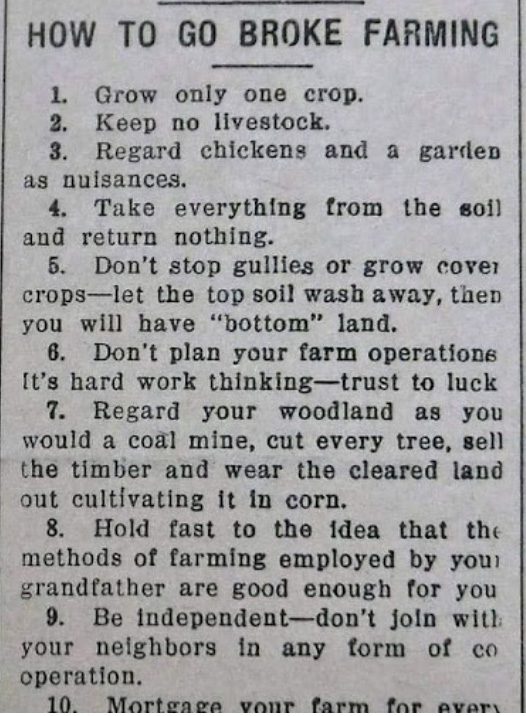
How to go broke farming

As a small-scale farmer, I have a membership in a hard-working community of like-minded land stewards who often share knowledge and information freely with each other.  Several months ago, an old newspaper clipping from the June 17, 1927 Farm and Dairy publication was passed from person to person through email and social media platforms.

This is not the only historic example of farming wisdom that has been circulated in recent years.  I have viewed documents from the 1940s, 1870s and, yes, even the 1700s that discuss farming practices that, for some reason, have been historically overlooked by many of those who farm.

how to go broke farming

Here is a summary of this article:

  • Grow only one crop
  • No animals on the farm
  • Take everything from the soil and return nothing
  • Let top soil wash away
  • Don’t plan
  • Cut every tree and grow corn
  • There is no reason to learn and adjust your farming methods
  • Don’t cooperate with other farmers

This list, assembled by the University of Tennessee Extension, outlines some of the approaches that were well-established as bad practices for a successful farm in the 1920s.  In my opinion, this is all just common sense.  Of course you should grow a diverse set of crops, using a carefully planned crop rotation and implementing intercropping.  The concept of integrating animals for both fertility and diversification on the landscape isn’t hard to understand.  Protecting the health of the soil feels like it should be a basic tenant for all food producers.  And, the concept of continued learning and the spirit of cooperation between growers just seem like necessary tools for a successful farming system.

Apparently the lesson is difficult to learn

As I read this news clipping from 1927, I asked myself why they felt it necessary to point out that these practices were a bad idea.  That’s when I realized that the authors were fighting the same battle we find ourselves fighting today.  There were a significant number of farmers and landowners in the 1920s, just as there are today, that fail to recognize that farming needs to be a complex operation.

Yes, you heard that right.  The way many of our grandparents and previous generations farmed was less than optimal.  And it feels like there are plenty of folks out there who are quite happy to maintain that tradition in the present day. The only real constant for generations in the United States has been a willingness of too many people to ignore the principles of land stewardship.

Perhaps the only difference is that people have found a way to continue making money despite abusing the land they farm.  If anything, the changes in our food and agriculture systems since 1927 have made it difficult to farm well.  Instead, our systems reward the pesticide and synthetic fertilizer industries (among other big ag businesses) and place hurdles in front of anyone who might like to engage in being a steward-farmer.  Bigger farms growing single crops in larger fields that sit bare during the winter months while the soil erodes is what we currently reward.  We prop these farms up with our governmental programs so they can feed the ag industry — even if we know that this model would fail as soon as we kicked these false supports away.

Eventually some of these false supports for poor farming — such as herbicides — are no longer able to hold the wolf at the door.  The weeds are adapting and the strain of continuous tillage and pesticide use is making our soils less fertile and less productive.  The deep, rich soil we have in states like Iowa isn’t as deep and rich as it once was and we will be called to pay for our debt to the land.

If we spent more time caring for the land, it would take care of us.  We wouldn’t need to rely on the next new and novel technological solution for pest control, soil fertility, and weed control.  Instead, we could use those tools in only the most exceptional of circumstances, relying on complex and healthy systems instead.

We can still learn and act to change

I recognize that there are many people, from every generation and many different backgrounds, who have farmed and been true stewards of the land.  These people, some Indigenous, some people of color, some white immigrants, have stood out from the crowd.  They are often seen as the exceptions (and sometimes hailed as exceptional) and they often feel the pressures of not going along with the corporate plan for agriculture during their time.

This is, in my opinion, backwards from the way the world should be.  These are the food growers and land stewards who should be faceless (except when they are in their own communities) because there should be so many of them.  Those who should stand out as exceptions are those who fail to farm well.  And then, our strong farming communities could provide the support they would need to join the rest in being positive and effective stewards of the land.

I know, it’s a radical idea.  And apparently it’s been radical for generations.  Perhaps it’s time for this to be the mainstream attitude?

Tuesday, May 23, 2023

How to Go Broke Farming

One of the things that drives me a bit nuts is our tendency, as human beings, to treat every existing problem as new and needing novel solutions.  The other is the mistake we make when we discount the knowledge and wisdom of prior generations, closely followed by those of us who believe the old ways were perfect.

The newspaper clipping shown above was published in the June 17, 1927 Farm and Dairy and was put together by the the University of Tennessee Extension Office.  This is not the only example of farming wisdom that has floated around to various communities via social media in recent years.  I have viewed documents from the 1940s, 1870s and, yes, even the 1700s that discuss farming practices that, for some reason, often have been overlooked by those who would farm.

Yes, you heard that right.  For the most part, the way many of our grandparents and great-grandparents (etc etc) farmed was less than optimal.  And it feels like there are plenty of folks out there who are quite happy to maintain that tradition in the present day. The only real constant for generations in the United States has been a general willingness to ignore the principles of land stewardship.

Perhaps the only difference is that people have found a way to still make money despite abusing the land they farm.  If anything, the adjustments that have been made since 1927 have made it difficult to farm well.  Instead, our systems reward the pesticide and synthetic herbicide industries (among other big ag businesses) and place hurdles on anyone who might like engage in being a steward-farmer.

But eventually, things - such as herbicides - will cease to hold the wolf at the door.  The deep, rich soil we have in states like Iowa isn't as deep and rich as it once was and we will be called to pay for our debt to the land.  If we spent more time caring for the land, it would take care of us.  We wouldn't need to rely on the next new and novel solution for pest control, soil fertility and weed control.

I know, it's a radical idea.  And it's been radical for generations.  Perhaps it's time for this to be the mainstream attitude?

Monday, April 17, 2023

Agroecology: Adapting Agriculture to the Land


Over the last couple of months, I have observed multiple changes to the landscape in Iowa and most of those changes have been initiated in the interests of agriculture. For example, a fencerow near one field had all of the bushes and trees taken down and the grasses burned.  A small grove of trees in the corner of another field is now piled up, likely awaiting a calm day for a bonfire.  In another field, I noticed that a grass strip to prevent soil erosion had been tilled and was showing signs of soil loss.  And, of course, farm equipment to apply synthetic fertilizers and pre-emergent herbicides have made their first appearances for the season.

Agroecology is about complexity

Each of these actions is an example of adapting the land to agriculture.  Fields keep getting larger so more of one crop can be grown using bigger equipment and more pesticides.  It’s a vicious cycle and it is difficult for me to acknowledge and write about it.  But we do have alternatives.  We can adopt the principles of agroecology.  We can turn the story around and adapt our agriculture to the land, rather than the other way around.

The more I have considered it, the clearer it has become — agroecology is all about acknowledging, learning about, accepting, and promoting complexity in our agricultural and food systems.  This complexity manifests itself in the ecological, social and economic aspects of agriculture.

Biodiversity on the farm

On our farm, I have come to believe that a successful field is one that I want to be in.  This might seem obvious, but it may not be for the reasons you expect.  Certainly, it is true that part of my appreciation comes from the success of the crops I hope to harvest.  But the key is that this is only a part of what makes a field successful.

I appreciate a field that has diversity in plant life, especially if some of that plant life includes flowers that I (and the pollinators) can enjoy.  When I stand in a successful field, I often observe a wide range of animal life, including birds, insects, snakes, frogs and toads.  The soil itself is healthy and full of both visible and microscopic life.  And I have found, over time, that these fields often produce better than those dedicated only to one kind of plant, where any other life is discouraged.

There is a wide range of tools farmers can use to increase the biodiversity on their farm.  It can begin with a longer crop rotation, and it can be expanded to include intercropping.  A farm can support biodiversity with wild spaces and perennial plantings, including wooded areas, terraces, and prairie strips.  A growing system becomes more diverse with the integration of animals, and soil health can be protected with cover crops.

Complexity results in diversity.  Diversity is health on the farm and in our world.

More, and smaller, farms

Many are attracted to larger fields with a single crop (monocropping) for their relative simplicity.  Till the soil, plant the seed, spray the pesticides and harvest the crop.  Every square foot of the land is treated pretty much the same.  If a portion of it isn’t immediately suitable, it is altered until it can be used.  The number of people who are truly invested in the process of food production is reduced, and those who do the actual labor are rarely given the power to act as stewards.

Smaller farms place more people in a position to listen to the land and adjust to its needs.  More people on the land increases the personal investment our global population has in agriculture and growing food.  

If we wish to promote an agriculture and food system that relies on more and smaller farms, we must also make land accessible to all who would be stewards.  An increase in the number of farms provides space for a broader spectrum of people to grow food and care for the land.  Indigenous farmers can restore or resume cultural food practices.  People of color and people who do not have great personal wealth can have opportunities to stand and work in successful fields, wielding the power and responsibility of caretakers.


Peer mentorship and local support

More farmers on smaller farms provide an opportunity to reconnect our food production systems at the local and regional levels.  On the other hand, large farms with corporate or absentee owners have no incentive for cooperation, and their employees are often powerless to make management decisions.  The people that do the work often feel detached from the land they work on.  

In my own farming experience, I have come to value my connections with my peers who operate or work on small-scale, diversified farms.  The farmer-to-farmer exchange of knowledge and the focus on shared success have been critical for our own health and our farm’s resilience.

Similarly, our interactions with the communities that surround us characterize a relationship that goes beyond an economic basis.  Our farm provides the rest of the community with a connection to the land and food production.  The community hears a different story through our farm that creates an understanding and appreciation for complexity.  In return, the community has been willing to provide support when our farm has faced extreme challenges — like pesticide drift or a physical ailment.

Local connections provide support, which makes it possible for small-scale farms to introduce the complexity that supports diversity.  It’s a circle that sustains all of us, and this is an important part of agroecology.

Farm practices and farm research adapted to the land and community

Our farm has participated in numerous on-farm research projects in tandem with other farms over the years.  Perhaps the most important lesson I have learned is that every farm is different.  While there might be some “best practices” that we can all adapt to our systems, the reality is that we must adjust those practices as we make our own observations of what is going on where we are.

We participated in a research project that was intended to evaluate varieties of broccoli for production in Iowa.   Several farms reported results that indicated one particular variety was a very poor choice.  That variety was the best performer on our farm for this trial.  The reasons for these differences were uncertain, but they could be any combination of weather, soil types, disease, pest pressure, surrounding environment, or growing techniques.  What it illustrated for me was the fact that we should not expect growing solutions that work everywhere for everyone.  It also encouraged me to participate in more on-farm research.

Simply put, growing food is complex and it is different according to a wide range of factors –  we should treat agriculture and food production in a way that recognizes this.

The balance sheet is more than profit/loss

Large-scale, chemical-based food production measures itself by yield (how much of the crop is produced per acre) and money gained or lost.  Many vegetable producers use black plastic mulch in their growing beds to prevent weed growth in their crops.  From a monetary investment perspective, it makes sense because this is one of the cheapest ways to control weeds in a commercial vegetable production system.  However, the environmental costs of producing this plastic and then disposing of it are not part of the farm’s balance sheet — even if it should be.

Agroecology encourages practices that are efficient – minimizing waste and optimizing energy use. One good example would be the integration of animals into a small-scale farm to provide fertility, rather than purchasing synthetic fertilizers.  This becomes even more efficient if the animals are included in the crop rotation so they can spread their own manure in a field that will produce food in subsequent seasons.

Agroecology is a name for answers we already have

The beauty of agroecology is that it provides room for the successes of many.  Indigenous producers of kalo (taro) on Hawai'i have a place to grow with agroecology.  We could have hundreds of smaller-scale egg production farms in Iowa, stewarded by the workers that currently find themselves working unfulfilling jobs in confinement production.  A row-crop farm could produce a variety of grain and soy crops without reliance on chemicals.  And my small-scale, vegetable and poultry farm  — my home  — also has a place with agroecology.

We already have the foundation for what we need to get started.  The answers reside in known science, inherited and Indigenous knowledge, and in the beauty of complex systems.  It’s up to us to continue to learn how they apply in each place we live and grow food.  It’s up to us to adapt our agriculture to the land, not our land to the agriculture.

-------------------------

I authored this entry originally for PAN's GroundTruth blog and it is cross-posted here.  I hope you found this article interesting and worthy of consideration.


Monday, March 20, 2023

The Crossroads for a New Agriculture?

March in Iowa is a peculiar crossroads between seasons.  It is not at all uncommon to have snow and ice storms and it is also possible to have warm days bathed in golden sunshine.  At my farm, there is still frost in the ground, so the cold rain simply sits in the low areas.  The remnants of dirty snow drifts, evidence of wind erosion from neighboring row-cropped fields, are still visible.

As I walk around the farm, I am tempted to describe it all as ugly and inhospitable.  But, I know this is not the truth.  There are signs of change that portend an amazing and fruitful future.  The yellow branches on our willow tree tell us that sap has begun to run and our perennial plants are beginning to awaken.  The gentle rain will help ease the frost from the ground and prepare it for new growth.  There is a bountiful harvest and natural beauty here if we give it the opportunity to be realized.

This is also the time of year when the damage caused by chemical intensive farming practices, with large-scale, single crop fields seems most apparent to me.  So many fields are tilled right up to the edges, encroaching on fencerows and ditches and resulting in more soil erosion as the rains hit unprotected soil.  

The landscape is bleak and the remaining diversity and wild-spaces seem sparse and inadequate in the face of the widespread desolation created by the reliance on two field crops.  Did you know that 23 of Iowa's 26 million acres of cropland are dedicated to corn and soybeans?  In a world where diversity indicates health, this commitment to monocropped fields isn't a good look. 

It is tempting to look around and succumb to hopelessness and despair.  Will we ever see a Spring landscape with diverse crops on smaller farms, surrounded by wild spaces and healthy waterways in Iowa and the rest of the Midwest?

Here’s the good news.  I am beginning to see signs, like the yellowing of the branches on our willow, that give me hope for the future.  A neighbor transitioned an area that had been corn and soybeans to a perennial pollinator mix three years ago.  As that planting has matured, I have noticed some encouraging signs.  Flowering plants are returning to the ditches in our area, providing highways for a diverse set of pollinators to travel to and from that field and our farm.

This may seem to be a small thing at first, until you realize how this illustrates the power of the natural world to heal and bring life.  We just need to give it the opportunity.

There are other signs that the tide may be turning.  For the first time since we arrived at our small farm, cover crops were seeded in nearby fields in an effort to cover the soil during the cold months.  I witnessed a group of row-crop farmers learning how to study the invertebrate life in their soils, looking for signs of health and considering ways to promote that life.  I have listened while other farmers have begun talking about successful fields that feature prairie strips.  I have witnessed discussions where longer crop rotations are being considered.

And I have seen evidence that more farmers would prefer to be stewards and that they understand there is more to growing than achieving the highest crop yield per acre.  For the first time in a long time, I feel as if there are more growers who agree that we need to adapt our agriculture to the land, not the land to our agriculture.

I sense that more farmers are becoming increasingly frustrated with the industrial ag model and are looking for reasons to hope for a better future.  They are more willing to consider farming solutions that embrace a diverse landscape and utilize more complex growing systems.  I have seen their faces become more thoughtful when they consider the possibility that a successful field is a field we want to be in, rather than a barren plot that produces so many bushels per acre when it is propped up with synthetic fertilizers and pesticides.

Now we all need to work together so we can move away from today’s lifeless landscapes and move forward to fields we would all like to be in.  We have the ability to reshape our national farm policies as we consider a new Farm Bill in the coming months.  We can push for more controls on pesticides by promoting the ideas in PACTPA (Protect America’s Children from Toxic Pesticides Act).  The natural world is ready to change with us, it’s just waiting for us to give it the opportunity to succeed.

Monday, February 20, 2023

Rustic or a Dump - at least it's Authentic

I remember the day I overheard someone at a field day (not ours, though it could have been) say something along the lines of "why can't they keep their farm neater than this? It looks like a dump!"

To be honest, I had to admit that the particular area on this farm that was being commented on DID look a bit like a dump.  But, I also had been fairly impressed with the farm, with the farmers, and with the operation in general.  It was a bit distressing to think that this might be the takeaway this person would go home with.  It also got me to thinking about our own farm.

I mean, it looks like a dump too.  Except for where it doesn't look like a dump.


The stack of pallets leaning against a wall isn't actually awful to look at.  They have future purposes and they are neatly out of the way in their designated spot.  But, I suppose they aren't all that attractive either.  Let's just say they won't win us any "Better Homes and Gardens" awards or the praise of whomever wants to judge a working farm by what they consider to be positive eye appeal.

We have not yet used any of our valuable time to deconstruct or re-use the flair box that went on a running gear that we are using for something else now.  We also parked an old hayrack with its rotting wood and frozen steering mechanism nearby.  And, of course, we didn't take the time last fall to clean up the tall grasses and other plants that grew around them.  I guess I would admit, if pressed, that this might look "dumpy."


There is a bin just outside the Poultry Pavilion that has a pile of red and green hoses - all tangled up.  It's hardly the most attractive decorating touch a person could use, I suppose.  But, it is a good way to put hose segments that are no longer appropriate for delivering water.  Yet a hose segment or two can be useful for any number of things.  For example, staking up a tree - or putting a cover on the sharp edge of a raised bed wall.

Even so, I might admit that we've accumulated more of the raw material in this spot than we really need.

But what about this mess, Rob?  Let's see you explain it away like the others!  If this doesn't confirm that you don't care what your farm looks like, I don't know what does.

Well, you got me.  A pile of wood.  A pile of potentially useful wood.  But, still, an ugly pile of wood.  

I suppose you could argue that the wheeled contraption on the pile and the kitty litter buckets don't help with the ambiance.  

Well, the grass catcher is where it is because we needed to move it so we could fill in the pit that was in front of this part of the Poultry Pavilion.  The kitty litter buckets were in use to carry water as recently as this past Spring, when their handles broke.  Rather than throw them in the trash, I'd like to rinse them out and recycle them.  But, you got me, I didn't get that task done and there they are still.  

I am so very ashamed....  Alas for me!

I will readily agree that there is a point where the normal detritus and mess that comes with any operation like ours crosses the line and becomes a "dump." And it is one of our goals to avoid crossing that line.  In fact, there are many things we would love to find the time and energy to clean up a bit - and numerous other things are "in progress" and there just isn't enough of us to move to "complete" this very moment.

Part of the problem is that not everyone can tell the difference between useful items that are there for a reason and an honest to goodness mess.  You can probably guess that the rolled up hose in a cart with a couple of feeder covers is probably there for a reason (stored for the Winter).  But, they also probably don't look all that attractive either.   There's a pile of metal that is waiting for the next metal drive - and that's not something you walk someone by when you want them to think your place is beautiful either.

I will also hazard a guess that chicken transport crates are not likely to be most people's choice of decorative items either.

Oh, wait!  I was wrong.  Here is an ebay lot where you can buy an old, slightly broken down chicken crate for $245.  Or maybe you want them from this company for $150 each?  You can polish it up and make a coffee table out of it and sell it for $750.

Just use the words "rustic," "antique," or "primitive."

I guess I should NOT have burned that old wooden crate that could no longer be repaired to be useful.  Do you think if I left a little chicken poop on it it would have gone for more?  

Available, one primitive design, vintage antique with authentic farm ambiance (also known as chicken manure).... this can be yours for just $800.

I wonder how much I can sell the plastic crates for?  If I use the right words, do you think I can at least get three digits for each one?  

And now that I realize there are people out there who buy old chicken crates for hundreds of dollars I find myself worrying less about what others think regarding the aesthetics of our farm.  After all, it is "authentic" and it is "rustic" so it must be good.

And, really, the overall impression isn't half-bad even if chicken crates aren't your style.

Have a good day everyone!

Monday, January 16, 2023

Snirt Alert

If you've been driving in the country around my neck of the woods lately, you have probably observed a fair amount of snirt on the edges of fields and in the ditches by the roads.  If you're not from around here or you are not a person who periodically drives in rural areas where row crop fields are the predominant feature in the landscape, then I suspect you might not know what snirt is...  until now.

All you have to do is look at the picture above.  The pile at the right is a snow drift on the north edge of our property.  Snow is, of course, typically thought to be white in color.  But, that's not true if a fair amount of dirt came for the ride as the wind blew across acre upon acre of flat ground that has very little for windbreaks or groundcover.

Our farm has very deep snow drifts on the north and west edges because we have been working to develop vertical buffer strips around our farm with trees, grasses, bushes and even brush piles. But to be more accurate, our farm has had drifts on the edges every year we've been here once we took land in the southwest and east and changed it over to diversified production with buffer strips and pathways.

Today's snirt is on our farm, in part, because of the words of Earl Butz, Secretary of Agriculture for Richard M. Nixon.  Butz called upon farmers in the United States to plant from fencerow to fencerow and encouraged individual farms to get big or get out.  I should be clear here, however, that his declaration in 1973 did not mark the beginning of snirt in Iowa and other locations.  It merely emphasized a style of agriculture that has little regard for diversity and natural processes - a style that was already gaining steam, especially after World War II.

As a matter of fact, it started when Europeans moved west across the American continent and were insistent on adapting the land to their agriculture versus adapting their agriculture to the land.

Before you think that I will now make the claim that I know the best way to be a steward of the land without a shadow of a doubt, let me disabuse you of that notion.  I am fully aware that I do not have all of the answers.  All I know is that Tammy and I are dedicated to doing our best to be good stewards that listen to the land and are willing to be servants that keep it as healthy as we are able.  That means we make the best decisions and take the best actions we can with what we know and then adjust as we learn more.

There are, however, some things I do have a pretty good idea about.  For example, all of the "recreational tillage" so many land operators partook of this fall has resulted in places like ours collecting a batch of their top soil.  It is pretty well known that excessive tillage in abnormally dry to drought conditions is a bad idea.  And, if you don't believe me, here is some information from Iowa State University that gives you some reasons why this is the case.  And if you don't believe them, do some more searching on your own, I'm pretty confident that I've got this one right.

And to top it off, most of the state still looks pretty colorful given the January drought monitor.

Before you think I am getting all "high and mighty" here - let me admit that we have made mistakes at the Genuine Faux Farm and not made the best decisions for our land all of the time.  In fact, we have, at times, taken actions that were completely the wrong ones.  And that's part of the reason why I struggle with what I observe here.

I'm not convinced that enough people are thinking all that hard about whether their actions, when it comes to the land, are the right actions.  If they did, I would think knowledge regarding best and worst time to conduct tillage would be more common - and it would be less likely that so many would run contrary to that wisdom.

This drift along the north line of our farm is as deep as six to eight feet in places - and this is after they've been reduced a bit in size.  The first two evergreens you see in this picture are both about twelve feet tall.  Most of this is courtesy of the pre-Christmas storm that brought frigid cold, high winds and ... two to six inches of snow.

I think it is safe to say that our farm collected most of the snow that fell on it.  Though, with winds like that I am sure some of it blew somewhere else.  But, my point is these drifts formed because there are miles and miles of land in Iowa that has very little to no breaks for that wind.  When the particulates - both snow and soil - finally get slowed down by a few trees, bushes and tall grasses, they land.

And pile up.


The picture above gives you a good case study.  The area to the north of Valhalla has a bush line at the property edge.  The land between the bush line and the high tunnel has some tall (ish) grass.  It is not bare ground.  You can see white snow that probably gives me evidence that our farm likely got about 3 inches of snow, maybe four during that storm.

But then you look at the drift that formed nearer the bushes and you see the snirt.  The drift here is about five feet tall and gets taller as you move away from the picture, probably getting to eight feet at the far end. 

You see, the land at our farm is capturing much of its snow, despite the wind.  And, I think that's great because we want to replenish the soil moisture.  And snow, water filtration, freeze/unfreeze cycles are all part of the natural processes we rely on to help keep our soil healthy.

And we're also importing a fair amount of snow and dirt because others are refusing delivery of their snow.  Take a good look around at the corn and soybean fields and you will find very little snow there.

I watched a neighbor applying an amendment to their fields this past week and they drove heavy equipment along the edge of their field near the road entry point.  That ground is, certainly, more compacted than the rest.  By my observation, that area has lower yields.  Just by looking at it from the road, I can tell.  I would not enter their property without their permission.

I can also tell you, by observing from the road, that their worst weed pressures are along this edge of the field.  Lower production and higher costs, all in this strip at the edge of their fields.  The economics of it alone tell me that it might be wise to seek another solution.  Perhaps a grass strip?  Or a prairie strip?  Maybe allow the fenceline by the road to be something that catches the wind.

Maybe Earl Butz was mistaken and that we need to till it all up.  

Maybe I shouldn't say anything so I can keep collecting everyone else's top soil?

Friday, November 11, 2022

Intercropping: an Underutilized Tool


After nearly two decades of vegetable and fruit production, I have come to the conclusion that one of the most under-used tools in a farmer's toolbox is intercropping.  It doesn't seem to matter how big the farm is, whether it is certified organic, or if the main focus is on perennial or annual plants.  If intercropping techniques are used at all, they are rarely prioritized and are often discarded if they fail to meet unrealistic expectations the first time a grower tries them.

My own experience tells me that intercropping is just like any other potentially effective tool.  You need to expend a little effort on becoming proficient before you fully understand what it can do for you.  It was only when we fully embraced intercropping for our melons and watermelons that we unlocked the potential for vine crops on our own farm.

What is intercropping?

A brief, and simple, explanation is that intercropping is the intentional use of plant diversity within a growing system.  And, I offer up the example at the top of this article as exhibit A.  In that picture you will see melons surrounded by zinnias and borage.  Not easily seen in the photo are two additional types of melon, watermelons, buckwheat, calendula, and sunn hemp.  All of this diversity was fully intentional on our part - and very successful in terms of our production for the season.

A grower, whether they are a large-scale row cropper or a small-scale vegetable producer, can effectively introduce diversity several ways.  Some of that diversity can come in the form of different cash crops (crops that we intend to harvest).  In the example above, the melons and watermelons were our targeted cash crops.  The rest of the plant diversity we identified as support crops because we did not intend to harvest them.

We introduced diversity within our cash crops by growing three types of melons and two types of watermelon in this plot.  We enhanced the diversity in the field further by introducing several types of flowering crops as well as some things that are considered to be cover crops (buckwheat and sunn hemp).  The flowering crops help to support pollinator services and the cover crops help to improve soil health.

How might a grower introduce intercropping?

Every farm has different needs and different strengths, so intercropping may not be entirely the same from location to location and farm to farm.  Row crop farms could add diversity to their fields by using "strip intercropping."  I noticed a couple of farms on a recent drive that integrated corn and soybeans into the same field along with grassy terraces in some of the steeper areas.  Each cash crop strip was twice as wide as their planting equipment.  I also was pleased to see another farm who added perennial prairie strips into their fields to support pollinators and add diversity to their land.

On my own farm, we have always implemented row intercropping.  Each row or bed in our fields is intentionally paired with other rows in hopes that we can introduce positive interactions between crops.  Row intercropping keeps it simple so the increase in necessary labor is minimal.  And, the positive interactions can take many forms.  We typically have planted our carrots between our peas.  There is not a specific interaction between the plants, but we do trellis our peas.  That fencing keeps the deer out of our carrots.

I like to call it functional on-farm diversity.

Over time, we've taken our intentional diversity further by doing more with mixed intercropping (putting different plant types in the same row or bed) and relay intercropping (having two crops in different stages of development in the same bed).  This can be as simple as putting in a few flowers as crop markers to tell us when a crop variety changes to starting lettuce in the tomato rows and harvesting that lettuce as the tomatoes grow and the lettuce matures.

It seems complicated, why do it?

Research in ecology has shown us that biological systems are healthiest and most productive when there is more, not less, diversity.  So, it stands to reason that the closer we get to a single plant type for large areas of land, the less healthy it is because the natural services of the ecosystem are hindered.

But, if you need an argument from the standpoint of farm productivity, consider the natural crop insurance a farm can enjoy when it raises multiple crops.  Some years favor one crop, some years favor other crops.  A diversified cropping system is more likely to provide consistent returns from year to year without external support.  Perhaps you have heard the phrase, "don't put all of your eggs in one basket?"  That's exactly what our reliance on huge agricultural fields with one plant species is like.  It is less robust and far more likely to break when stress is put on it.

There is research that shows us that intentional diversity in cropping systems can provide natural pest control, improve soil health, decrease weed biomass, attract beneficial organisms and - believe it or not - improve overall production.

This brings me back to our cover photo for this article.  That field was a "grand experiment" for the farm that season.  We made the intentional choice to plant 33% fewer melon and watermelon plants that season and we replaced them with more support crops to increase our intentional diversity in that plot.   We were fully prepared to harvest fewer melons and watermelons as a result.  Instead, we harvested 33% more melons and watermelons than we had in prior years.  And we replicated that same thing the next year - and the year after that - and the year after that. 

Thursday, November 10, 2022

Downstream

It's only natural.  We curse those upstream from us and ignore those who live downstream from us so they can have their turn cursing at us.  I am not particularly found of cursing and curses, so I wonder if that is why this particular tendency bothers me so much.  I am guessing, however, that this is not the reason I am bothered... read on if you want to learn more!

Big Picture Issues with "Sending it Downstream"

When we established the Genuine Faux Farm in 2004/2005 we ushered in a phase in our lives where we were to become ever so much more sensitive to the weather, the climate, and the things we all do to our environment in the course of doing whatever it is we do.  I'd like to think that Tammy and I were aware of many of the issues that come with living in the 'commons' that is our world and that we were doing our level-best to not be part of the problem.  And, maybe, just maybe, we were sometimes part of the solution.

"Do the best you can until you know better. Then when you know better, do better."  – Maya Angelou


It turns out that we were woefully uninformed and lacked full appreciation for what is going on in our world.  And, oddly enough, I am hopeful that I will continue to experience life and learning in the years to come so that I can say the same about the "current me" at some later point in time.  In the meantime, we'll get by with what we think we know now and we'll continue to do what we can to do the right things in the right ways, whatever we think these actions/goals might be.

Up until the point where we scaled our farm back and stopped offering our farm share CSA program, Iowa had experienced an increased number of excessive rain events.  It felt personal because the number of flooding and heavy rain events set record after record throughout the state making it difficult for us to continue.  Now that we have scaled back, we've had dry weather and now drought (something our farm is better able to handle).

But, in case you hadn't noticed, this still hasn't mean the excessive rain events have stopped.  Reference the Summer flooding in 2021.

Whether you "believe in" climate change or not, we are foolish if we fail to learn from the floods that have been happening and prepare for future floods (or fires or droughts or...  you get the idea).  Failing to plan for the future is the equivalent of sending the problem downstream for someone else to deal with.

“Forgive yourself for not knowing what you didn’t know before you learned it.”Maya Angelou

And my own corollary to that?  Forgive others for not knowing as well and help them to learn it. 

Let's say for a moment that we all agree heavy rainfalls have happened and that more could certainly happen in the future.  So, what are the things that could be done that might alleviate this situation?

Clearly, our most common solution for far has been to "get the water AWAY from HERE."  In other words, we are passing the problem downstream to someone else for them to deal with it.  If we really want to be effective, we are going to have to make ourselves a bit uncomfortable and do some difficult things.  Things like taking acres out of row crop production and putting them into hayfields, wetlands and woodlands.  Some solutions will might mean some personal property is lost, production of commodity crops may not be the best option and perhaps even whole communities may need to be moved.  Any worthwhile solution is going to have its painful moments and are going to require some soul-searching and commitment.

But that isn't going to happen until we stop looking for someone to blame - we need to start looking for someone (many someones) to begin the work of adjustment and restoration.

A Personal View of What it Means to NOT Send It Downstream

I want to turn the focus of this post on to the things we think we need to do right now so we are not passing current Genuine Faux Farm problems downstream to a point where the problem is only bigger and badder - or just not "ours." 

1. I don't want to ignore a problem and pass it downstream to a later point in time if I can help it.  A known problem usually doesn't just go away - it tends to get more difficult to solve.
2. I don't wish to pass any of our problems/mistakes on to someone else.  Though I admit to being imperfect, so I am sure we'll make a few mistakes in the process that will result in someone else feeling some pain.  Sorry in advance.
3.  I hope that I can stay alert for unintended consequences that only result in passing things downstream.
4. There comes a point when a band-aid will not work.  If all you can do is a baling wire and duct tape solution, then that's what you have to do.  But, if you have a choice to do better, you should do that - even if it is frustrating, annoying, inconvenient and even ... painful.

Bringing It Home to the Genuine Faux Farm
As many of you know, we found ourselves trying to fix our old farm-kitchen a few years ago when it became apparent that it was falling apart and it needed to be done soon.  This was not a 'I hate the paint color and want different cabinets' thing.  This was a 'hey look - there's a hole developing in the floor' thing.

We could have 'band-aided' the whole thing by taking out the sink, the lower cabinets on one wall and the offending area of floor and fixing/replacing that.  But, there were a couple of underlying problems that were causing the rot issue.  One was that the plumbing was placed on a cold outer wall over a granite foundation.  The other was that the blown insulation from a prior generation was collecting moisture and causing rotting issues in the walls.  Without going much further into it, there were a host of other problems we could have covered up and passed that issue downstream to either a later version of ourselves or to some future owner.  We opted to do our best "in the now" in hopes that our choices were the right ones and there were a couple of times where the irritation of being delayed so we could just do it right was pretty high!

With the kitchen (mostly) done a few years later.  We still have to finish trim and the floor.  And, like any project in an old house, it has spread to other things.  

In 2019, we found ourselves looking at some big problems with our farm that we could no longer push downstream.  We realized as that season progressed that we had been applying band-aids for a few years just so we could continue to serve the demands of our Community Supported Agriculture (CSA) program.  For those who do not know what that means - we ran a subscription program for fresh produce from 2005 to 2019.  During most of those years, we delivered for 32 weeks each season.  That meant we had 64 points in time each season where we needed to have a sufficient quantity and diversity of product to supply as many as 120 members with a good CSA product each time.

So, what exactly is the problem with that?

Well, if you are focused on doing whatever it takes to grow produce for the share program, when do you have time to address other issues that crop up over time? (I am not sorry for any puns, intentional or otherwise, that appear in my writing - so there).

This is where we found ourselves after fifteen seasons of running a successful CSA program.  A combination of changing weather patterns, chemical drift issues, and declining local food sales were forcing us to push too much downstream.  When you add in mounting crop failures due to excessive moisture you might understand how this could have an effect on the psyche of the farmers.  It is very difficult to feel successful when you are surrounded by so much failure.

One example of the issue is shown at the left.  This was one of our onion beds that was planted in June of 2019 (late for an onion crop).  Wet fields forced the delays in planting until we found we could wait no longer if we were hoping to get anything in.  That meant we had to till a bed when the soil was too wet.  This is bad for the overall health of the soil, so we hated to do it.  But, it isn't just bad for that reason.

Take a look at the 'pebbling' in the planted area.  Those 'pebbles' don't break down for most of the season.  The soil contact with the new transplants is inconsistent with this soil consistency, so transplant loss is often higher.  Cultivation, if it dries up enough to allow it, doesn't work so well either when you have all of these solid clumps, which means you often have to resort to hand weeding.

The good news - we actually got some nice onions anyway.  Why?  That's a topic for another post - maybe. 

I don't want this post to be all about the negatives, but it is important to get a better idea of the scope of the problem first.  The picture at the right shows one of our fields that had melons and winter squash planted into it.  We put down paper mulch in the planting rows in 2019, which was one of our responses to the wetter seasons.  If you can't cultivate, try to prevent weed growth with mulch.  And, to some extent this worked.  Until we started noticing our squash and melon plants showing signs of inhibited growth. 
 

You can't argue that the transplants were poor - these were some of the best we've put in over the last several years.  You could also argue that the wet conditions may have contributed to the issue.  But, the variable that may well have got us the most was the extended herbicide application range on the corn/soybean fields in the area.  Remember, dicamba drift does not have to come from next door, it can come from a couple of miles away in the right (wrong) conditions.  To make a long story less long, we harvested no melons from the two eastern plots that held them.  We harvested a single butternut squash and very few other winter squash. 

The signs were there that told us we had to change.  We could have changed what we are doing and do something else entirely or how we did what we were doing.  Maybe even a little of both.  But, the reality was that we could not work to find a solution without getting a bit uncomfortable. 

GFF, a few years later

It turned out that our efforts to make big change were well-timed and poorly timed.  Just as all such decisions are.  It depends on how you look at it.

From a growers perspective, the last three years have, on the whole, been much more amenable for the type of growing we had been doing on the farm - if you look at the weather.  Yes, 2021 had a late frost that killed some crops and a nasty storm in August that destroyed others.  But, overall, the weather conditions actually suited our heavier soils, the tools we have, our scale, and the things we grow/grew.

On top of that, the pandemic actually provided a spike in interest for local foods.  One that we missed because we set ourselves to scale down in 2020.

On the other hand, the timing could not have been better for us.  With the pandemic, we found that our access to workers dried up completely.  Our pipeline of college and high school students was gone and we weren't in a good position to find substitutes.  And, of course, as I suspected, the increase in local food demand in our area was probably more of a bubble that has, to a large extent, deflated in 2022.

And then, there are the health issues that have challenged us over the past two growing seasons.  With no workers and one or the other of us recovering from a major health concern - there was no way we could have done what we once did.

But, perhaps most importantly, I am beginning to fully realize that, perhaps, I passed something downstream that was beneficial.

You see, when I think about passing things downstream, I usually think about troublesome things like floodwaters, pesticides and contamination, and topsoil.  I think about failing to address problems and leaving them for another day.

Yet, I find that I might have passed something downstream that the current me in 2022 is just beginning to realize.  My love for growing things was being tarnished by what had become a slog through muddy fields.  And now, when each moment is not a desperate struggle to survive as a farm, I find the desire to grow returning.

The trick is to take the lessons passed downstream and use them wisely.