Showing posts with label Pesticide Action Network. Show all posts

Tuesday, January 9, 2024

A New Year and Renewed Effort for Agroecology


As I add another year of growing food for others into the books, I find myself doing what so many people do in late December and early January — reflecting on what has been and considering what may be.  It’s tempting to fall prey to the belief that this is the moment that everything will change, making it a key transitional event in the life of our farm.  Except, I’ve realized that good stewardship recognizes that a farm is always in transition, from one season to the next, from week to week, from task to task.

A farm that implements the principles of agroecology is one that embraces complexity.  That complexity often comes in the form of transitions, moving from planting to cultivation to harvest.  These farms are prepared to work with whatever the land and the weather brings to them.  The people that do this work are strong and capable, and they achieve a great deal.  But they do all of this despite, not because of, our current agriculture and food systems.

Broken food and farming systems

Our current food and farming systems have come about due to a thirst for control, simplicity and money.  To be successful, a farm always has to be seeking “more” and the concept of “enough” is considered to be no better than failure.  Bigger is better.  Achieving the highest crop yields is necessary, regardless of the non-monetary costs.  As long as the people who happen to be at the top of the ladder keep increasing their sphere of influence and their assets, these systems are considered successful.

The bigger our farms get, and the more they embrace larger fields with single crops, the harder it is to get away from a reliance on pesticides.  As these farms increase in size, the harder it becomes for new growers to access land and enter the profession.  The laws and the regulations continue to skew towards the preferences of these large, corporate farms and the industry that promotes them.  The power in food and farming is definitely not in favor of a complex and diverse agriculture.

Meanwhile, on a small-scale farm

Our small-scale farm has been among those who continue to embrace agroecology despite the pressures of a system that would prefer we “get big or get out.”  We have been scaling back out of necessity since I started working with PAN, but we still play a part in providing food to our local community.

I wanted to give you a partial picture of what providing food to our local community entails.  But, before I do, I want to assure you that we do love doing this – but we are also glad we don’t do it as much as we used to.  The time was right for us to scale back and we’re just trying to find the right scale for where we are in our lives now.  We are trying to determine what is “enough” instead of getting caught in trying to always acquire and achieve more.

One day in August, we delivered 32 dozen eggs, 35 pounds of tomatoes, 35 pounds of green beans and a bushel of onions.  We also delivered smaller amounts of zucchini, summer squash, cucumbers, peppers and lettuce.  A couple of individuals were thrilled to get some HUGE zucchini, while others were happy to receive zucchini that were only six inches long.  Another person walked to the delivery point and found they could not carry it home, so we dropped it off at their home when all the other pickups were done.

While orders “only” came from 24 individual families, there was certainly effort expended to promote sales, manage orders, process those orders and deliver them.  On the same day, we worked with a couple of young people to harvest green beans, we performed all of our farm chores and tasks, and we both fulfilled our duties for our off-farm jobs.

Now imagine this.  When I worked on the farm full-time we offered a CSA (Community Supported Agriculture) farm share.  We had as many as 120 members getting a share every week.  We typically offered anywhere from 7 to 15 different items in a share every week — which meant we might deliver 120 pounds of green beans, 240 pounds of tomatoes, 240 heads of lettuce and other produce in similar amounts each week.

A small-scale, diversified farm can fill a farmer’s day.  Now imagine adding in the difficulties a broken food and agriculture system presents for this type of farm.  Concerns brought about by pesticide drift, the struggle for land access, and the pressures of regulations built for farms one hundred times our size are added to the burden.

Promoting a transition to agroecology in 2024

I know many of you who will read this patronize local growers of food and I salute you and have much gratitude for you.  But sometimes patronage is not enough.  Sometimes, it is important that we take the next step to understanding what it takes to grow good food on a small-scale with sustainable practices. And, once we have that understanding, we need to stand with current growers and those who want to enter the profession to change the policies that actively work to remove us from the food and farming system.

Perhaps you are also a steward who implements the principles of agroecology.  I recognize the value in your efforts and I understand that it can be hard, but rewarding, work.  And this is one of the reasons I work at PAN to do advocacy work.  I do this because the people who work so hard to raise food in the best ways possible for their communities shouldn’t also have to expend the energy or time to fight alone against a system that is stacked against them.

As a farmer and steward, I appreciate the work each of you has done on behalf of the small-scale, diversified growers who strive to be stewards of the land and their communities.  As a member of the PAN community, I look forward to a new year of promoting a real and lasting transition of our farm and food systems towards agroecology.

--------------

Thank you for considering my words.  This blog is a cross-posting from the Ground Truth blog for Pesticide Action Network that I wrote for their year-end issue.  I hope you find something here worth pondering.

Tuesday, December 5, 2023

Farming for More than Yield and Money

The following is a cross-post of material I wrote recently for Pesticide Action Network and their Ground Truth blog.  As I often do, I am re-posting in our farm blog in the week following its release on the PAN website.  Thank you for considering my thoughts and words.

---------------------------------

One of the stories that is frequently told to, and sometimes by, farmers is that growing food or crops is all about yield and the bottom line.  It doesn’t matter whether you are a grazier, a row crop farmer, an orchardist, or you work a small-scale, diversified farm; the temptation is to measure the success of your efforts based solely on these two measurements:

Did the farm produce as much as it could have?

Did the farm bring in as much income as it can?

Unfortunately, when a person views farming that way, they fail to consider so many other measurements of success that are just as important.  This limited set of measures also fail to recognize that there is a difference between “enough” and “as much as is possible.”

I like to broaden my farm’s balance sheet to include measurements that go beyond total yield and profit.  In my opinion, there is much more to being a successful farmer and land steward than money and yield.

Considering investment in natural assets

When a farmer considers only how much they can produce and to turn it into the most money they can get, they close their mind to investments that can bring stability to future production and success.  This short-term thinking makes it easy to pretend that pesticides, synthetic fertilizers, mono-cropping (one crop in a field) and tilling up every square inch of land are not only good ideas, but the best ideas. Suddenly, confining as many animals into a shelter as possible because there is a better return per square foot of space suddenly seems reasonable and even preferable.

Instead, land stewards recognize that the health of the soil we grow our crops in needs to be maintained with an eye towards future success, not just this year’s numbers.  A cover crop will represent an expense on the regular balance sheet, but it can be an asset for soil health.  A perennial crop in the rotation may represent a loss in potential income for a season or two, but it also provides value when we consider the health of the land being farmed.

Bumblebees in borage
 
On our farm, we have considered the health of our pollinators to be another line on our balance sheet that needs attention.  Many of our crops are pollinator-dependent.  If we want them to produce, we need these natural workers to be present.  So, we invest in them by intercropping plants that attract these organisms and we maintain wild spaces so they have a refuge and a home nearby from season to season, year to year.

Considering a broader farm balance sheet

We also find ourselves thinking about a balance sheet that goes beyond our farm.  Rather than focusing only on this season’s production and income, we consider how what we do impacts our neighbors, our communities, and our environment.

There are many farms, like ours, that produce a wide range of foods and strive to sell those foods locally or regionally.  It should not be a surprise that a direct relationship with the market encourages investment into the communities where that market resides.  Sometimes that investment comes in the form of money, such as when our farm buys feed from another local farm for our laying hens, or when we pay an accountant in town to help us with our taxes.  But, it is just as likely that growers, like ourselves, will be found at local events supporting schools or donating food to a community dinner.

It should be no surprise that the connection to the community lands on both sides of the balance sheet.  Certainly, there are some costs that come with running a local business of any sort.  But, they are outweighed when you consider the support the community can give the farm when things aren’t going well.  And when it comes to product pricing, a farmer has an opportunity to be a price-maker, covering their expenses, rather than a price-taker, being forced to accept a loss because a broader market forces it to happen.

Thinking beyond yield and money

We need to challenge ourselves to think even more broadly.  For example, many vegetable farms use plastic mulch to help control weeds in their crops.  We understand fully why this option is a popular choice.  The cost per foot is relatively low and weeds are often one of the toughest things to deal with in a growing system.

Unfortunately, plastic mulch can only be used once.  After that, it just becomes more single-use plastic in the landfill.  In this case, it is important to consider the larger balance sheet that includes a broader segment of society than the effect on our farm and its immediate surroundings.  After thinking hard about this, our farm moved to using mulches made from organic materials, such as paper, straw and grass.

Straw mulch in intercropped field

This decision was reached out of concern for (for lack of a better phrase) the greater good.  But, it turns out there were some very good reasons to do it for our farm’s good.  First, these natural products break down and produce organic matter for our soil, while still suppressing weeds effectively.  And, it turns out that the use of black plastic over a longer period of time actually can result in a build-up of plastic debris in the soil.  By avoiding their use altogether, we prevent this from becoming a future problem on this land we steward.

A broader focus leads to better farming

I fully recognize that all of this might sound idealistic and impractical.  But, I would like to suggest that our current focus on the two outcomes, yield and profit, are far less practical.  Each time we have challenged ourselves to think more broadly about how our farm performs we’ve been able to identify options that ended up providing more benefits to more people and the environment.  Often (but not always) these choices included better long-term yield or profitability for our farm along the way.

So, why don’t more farmers think this way?  The system we have in place for food and farming is a big part of the problem. It’s in the interest of chemical companies and Big-Ag to encourage a focus on profit, yield and short-term risk/gain, because it drives up their profit.  For example, crop insurance measures risk on the basis of a single season, so options that might be good for the medium or long term success of the farm aren’t encouraged.  In effect, farmers can find themselves feeling trapped with few alternatives to pesticides and large, industrial farms.

The good news is this: There are farms, like ours, that still manage to be successful when they look at a broad-view balance sheet, despite the systems that are in place.  Imagine what we could do if we changed our policies, stopped catering to industry, and supported successful farming beyond yield and profit.

Wednesday, November 22, 2023

Danger of Chlorpyrifos Revealed Over Time

It has been over a decade since the moment I felt the droplets of pesticides on my head and shoulders as a crop duster flew over our farm in Iowa.  To be precise, it has been 11 years, 3 months and 18 days since a mix of chlorpyrifos and two other pesticides was dumped on the western portion of our farm, coating our vegetable crops, our poultry, our bees, and our person, with an unwanted cocktail of poisons.  If you cannot tell by this introduction, that moment was a pivotal point for my farm and my life.

So, I was among those who were glad to hear that EPA effectively banned chlorpyrifos on food and feed crops in 2021, by setting tolerance levels of that pesticide on food to zero.  While it did not solve the problems of drift and pesticide misapplication I have experienced, I knew this step was an important one.  And now, I am among those who are equally dismayed by a recent court ruling that reversed EPA’s action to limit use of this dangerous insecticide.

Chlorpyrifos injury starts the journey

After I was coated with pesticides during the 2012 incident at our farm, I was left with the question, “Now what do I do?”  After a quick call to a trusted doctor, I ended up taking a shower for the next half hour.  But the damage was done.  I ended up having to seek treatment for breathing problems and I found that I sunburned much more easily during the weeks that followed.

That was my first truly meaningful introduction to chlorpyrifos – an acute pesticide poisoning caused by an aerial applicator that wasn’t terribly concerned about where they dropped the chemical.  Prior to that, it was just another pesticide that row crop farmers used on their crops every year.  I didn’t like it, but I lived in Iowa and that’s how it was.  I was just like other members in a rural community – we just dealt with it.

I also farmed, but I had opted not to use any form of chemical pesticide, preferring to use crop rotation, intercropping and wild spaces to deal with pests and diseases.  So, while I was aware that other farmers used them, I didn’t really concern myself too much with the details of particular chemicals or formulations.  I was more concerned that their applications of pesticides stay on their side of the fence.

But after experiencing this misapplication, I became invested in learning about chlorpyrifos and other pesticides.  And, what I was learning moved me from having a general concern that pesticides were a philosophical problem to a growing realization that they posed a great danger to us all.

Chlorpyrifos drifts easily

A few years later, in 2015, our farm participated in PAN’s Drift Catcher, a citizen-science project.  As a participant, we were given a compressor that would pull air through test tubes with resins that would collect certain insecticides, chlorpyrifos among them, if they were there.

I diligently changed the test tubes twice a day during spray season.  I labeled each carefully and placed them in a freezer until all of the samples were collected and could be sent in for testing.  I wrote down observations about the weather and took notes about who in the area was spraying.

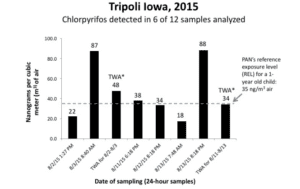
When the results came back, we learned that we had “positive results” for chlorpyrifos.  And this was certainly one of those times where “positive” did not mean “good.”  Neither of these readings were taken at a time when one of the fields adjacent to our farm was applying pesticides.  Instead, both readings came at a time when the target field was at least a half-mile away.

It was at this moment I learned something else.  Chlorpyrifos drifts from its target application easily and well.  Particle drift of pesticides occurs during the spray, or application, process.  Smaller particles of the pesticide can be carried by the wind to locations outside of the intended spray zone.  Some pesticides are more prone to drift than others, and chlropyrifos is among those that drift easily.

Drift catcher results table

TWA – Time Weighted Average; REL – Reference Exposure Level

As I reviewed our test results, I was astonished to learn that one set of positive readings was the result of an application that was over a half-mile away and, while the wind was coming our way, the wind speed did not exceed five miles an hour.

I started to ask myself how much exposure people like Tammy, my partner, and I have had to chlorpyrifos over the years?  How much did we inadvertently allow our farmworkers, often college or high school students – somebody’s children – to be exposed to these chemicals?  And what about the neighbors’ children?  Clearly chlorpyrifos travels through the air and is finding its way into our bodies.  And we knew its use was, and still is, ubiquitous in our state.

EPA needs to affirm and complete the chlorpyrifos ban

I realize that it is often difficult for people to fully appreciate and understand the dangers chlorpyrifos poses to those who are regularly exposed to it – until they or someone they care for experiences it for themselves.  I am ashamed to admit that I was among those people.  But now I have had some of my own experiences and I believe it is important to share them with you – hoping you will understand without going through this process of discovery by exposure.

This is why it is important for the EPA to re-establish the chlorpyrifos ban on food and feed products.  But, that, by itself, isn’t the whole story.  The food ban does not impact corn crops for ethanol, or row crops used for seed production.  It does not remove its availability for ornamental plants or roadside applications. This is why I believe the EPA should go further and simply ban its use entirely.

It’s for the good of farmworkers who spend their days outdoors and in harm’s way.  It’s for the children in communities who play next door to fields that receive regular applications of this chemical.  It’s for you and me, because we don’t need persistent doses of this dangerous pesticide in our lives any longer.

=====================

This blog is cross-posted from the Pesticide Action Network's Ground Truth blog.  I write and serve as Communications Manager for that organization.

Tuesday, August 29, 2023

Linking Fossil Fuels and Pesticides to Greenhouse Gases

Someone asked me, a couple of weeks ago, if "all I did" for Pesticide Action Network, was write a blog under my name once a month and an occasional Iowa newsletter.  The answer was "of course not," but it can sometimes be difficult to explain everything a person does as a part of any given job.  It was easy, however, to point out that there is some writing that does not have my name on it that is still, nonetheless, something I had a hand in doing.  So, today, I thought I would share an example that can be found here on PAN's website.  I have done some reformatting to fit the GFF blog.  

Take a gander, you might learn something new.  

---------------------

Did you know that the greenhouse gas emissions associated with the production, transportation, and application of pesticides are strongly linked to fossil fuels? In fact, 99% of all synthetic chemicals, which include pesticides, are derived from fossil fuels.  And it isn’t surprising that several oil and gas companies (like Chevron, Shell and ExxonMobil) play major roles in developing pesticide ingredients and profiting from their use.

Pesticide manufacturing and greenhouse gases

Researchers have calculated the energy use associated with the production of specific pesticides, which can then be used to estimate carbon dioxide emissions. For example, the greenhouse gas emissions that result from the manufacture of glyphosate, the world’s most popular herbicide, produces 31.29 kilograms of carbon dioxide equivalent (CO2e) per kilogram of product (Audsley, et al).  Several pesticides produce amounts greater than 40 kilograms of CO2e per kilogram. To put this in perspective, the energy used to produce the amount of glyphosate used globally in 2014 was equal to the energy needed to fuel about 6.25 million cars for a single year.

While it would be useful to have more recent research, the data still paint a picture that is relevant today.  On average:

  • Herbicide production creates 18.22 to 26.63 kg of CO2e per kg
  • Insecticide production creates 14.79 to 18.91 kg of CO2e per kg
  • Fungicide production creates 11.94 to 29.19 kg of CO2e per kg

These numbers result in a significant contribution to the total greenhouse gas emissions that have played a role in a changing climate.

Hydrocarbons to pesticides


A pesticide consists of both active and inert ingredients. The active ingredients kill the pests (weeds, insects, fungi) and the inert ingredients make it easier to apply the product, coat the target plant and extend the effectiveness of the product.  Many pesticides are also coated in microplastics, which are classified as an inert and derived from fossil fuels, to ensure more controlled release of the product.

Most active ingredients are synthesized from hydrocarbons derived from petroleum, known as hydrocarbon feedstocks. These feedstocks are combined with other elements, such as chlorine, oxygen, sulfur, phosphorus, nitrogen and bromide to create chemical intermediates.  This process is responsible for the greenhouse gas emissions that result from the creation of pesticides.

Various inert ingredients are then added to formulate the final pesticide product.  Some of these inert ingredients are recognized as active ingredients in other pesticides and some inert ingredients are biologically active and are potentially, or are verified to be, toxic.

Research doesn’t account for the entire story

The calculations provided in the study of greenhouse gas emissions by pesticides only factor in the energy used to produce the active ingredients.  A true estimate would also include other stages of a pesticide’s lifecycle.  Transportation, pesticide application and post-application effects are all omitted from the calculated emission levels.   These numbers also fail to include the energy needed to formulate the final pesticide products and manufacture the inert ingredients, which typically account for most of the volume of a pesticide. For instance, inert ingredients make up as much as 50–75% of glyphosate products.

More than 500 of these so-called inert ingredients have been or are currently used as active ingredients, yet due to proprietary protections, the identification and volume of these ingredients are kept secret from the public (Cox and Surgan). This makes it impossible to calculate energy requirements for the manufacture of pesticide products in their entirety.

Fossil fuel and pesticide industries pouring out the carbon

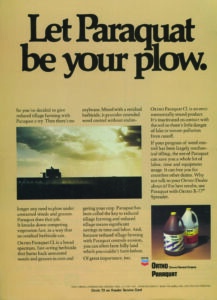
Fossil fuel corporations like Chevron have been advertising their pesticide products to farmers for decades – like this 1972 featured in the publication No Till Farmer.  Paraquat is an herbicide with links to Parkinson’s Disease.

 ParaquatAdvertNoTillFarmer1972

Since World War II, pesticides have typically been synthesized from petroleum or petroleum by-products and petroleum industry giants ExxonMobil, ChevronPhillips Chemical and Shell, all produce pesticides or their chemical precursors. Multiple pesticide corporations self-report high CO2e emissions related to their operations. For instance, 9.8 million tonnes of CO2e directly or indirectly resulted from Syngenta’s operations in 2021 – the rough equivalent to the annual carbon dioxide emissions of more than 2 million passenger vehicles.

Would you like to learn more?

Climate change is one of the greatest challenges facing humanity today. Scientific evidence indicates that pesticides contribute significantly to greenhouse gas emissions while also making our agricultural systems more vulnerable to the effects of climate change. You can view our full report if you would like to learn more.

But we’re not just talking about the problem.  You can view each of our webinars.  The first summarizes our report and the second focuses on the solutions available to us if we adopt the principles of agroecology.  We can make a difference, and that difference can start by moving away from reliance on pesticides.

Print bibliography:

Audsley, E., Stacey, K. F., Parsons, D. J., & Williams, A. G. (2009). Estimation of the greenhouse gas emissions from agricultural pesticide manufacture and use. Cranfield University.

Cox, C., & Surgan, M. (2006). Unidentified inert ingredients in pesticides: implications for human and environmental health. Environmental Health Perspectives, 114(12), 1803-1806.

Thursday, August 10, 2023

PAN Iowa News

I thought this would be a good time to share the Iowa Newsletter that I author periodically for Pesticide Action Network.  If you live in Iowa and would like to receive these, along with alerts and our Ground Truth blog in your email, you can join PAN here.  This gives you a quick look into some of the things I do as a part of my off-farm job.

--------------------------

When we first moved to the place that has become the Genuine Faux Farm, the first neighbor to approach us was an older woman who “only lived a half-mile or so away.” She brought cookies and invited us over for dinner when we were ready. It was a kind offer that we were, honestly, a bit startled, but still grateful, to receive. You see, in all of our other places of residence, we had not been welcomed by a neighbor – so we did not expect anything different this time around.

While we did not spend a great deal of time over the years with Ruth and her husband, Loren, we did do our best to be good neighbors to them, even when the farm and jobs made it difficult to carve out the time. This is the model we would like to be reality in rural Iowa all of the time. Neighbors welcoming and helping neighbors.

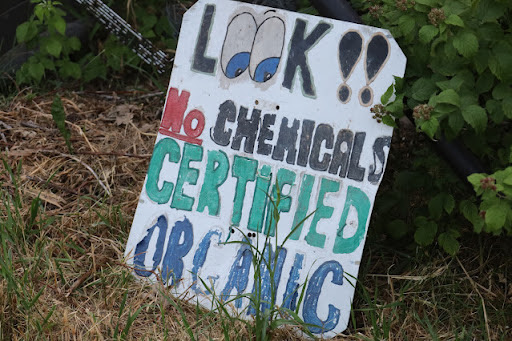
look sign

Today, Ruth’s grandson lives in the house down the road and we’re pleased to say that we also get along just fine. He recently gave us the “no spray” sign shown above that belonged to a mutual acquaintance named Sparky. Sparky approached us during our first year of farming when they learned we intended to follow organic practices and encouraged us to be strong advocates.

You might notice that it does all sorts of things to be “loud.” Exclamation points!! Capital letters! Underlining the word “NO!” Bright colors and even a neat little trick with a pair of eyes.

Sometimes, those of us who wish to raise food or work with the land in a way that is not reliant on chemicals find ourselves needing to be loud, even if we don’t like being loud. Otherwise, it feels like too many folks seem to believe it is okay if they infringe on the practices of growing that we are dedicating ourselves to following. In fact, we can sometimes become downright unpleasant if we find ourselves having to try to defend the small parcels of land we steward over and over and over again, with no discernible changes in behavior that might indicate we’ve been heard at all.

Sparky and his friend, Kent, were vocal and, sometimes, bitter, about pesticide drift and misapplication. Kent spoke passionately against the “aerial terrorists” that were becoming far more common in Iowa in the years just prior to his premature death in 2010. He and Sparky both encouraged us to hold our ground and do what we needed to do.

In the present day, we find ourselves with two legacies that we have agreed to follow. We believe in doing our best to be good, and considerate, neighbors. And, while we are not the same kind of loud as those before us, we still do what we can to get people to listen and consider better alternatives to chemical-based food production systems.

If you would like to learn about ways we are “being loud” at PAN, read on!

Thank you for being willing to consider my thoughts and words. Be well,

Rob Faux
PAN’s Communications Manager
Owner/Operator, Genuine Faux Farm, Tripoli, IA

PAN’s website has a new look

If you haven’t visited our website recently, I would like to invite you to do so.  The Communications Team at PAN, which includes yours truly, are pleased with the results.  The resources that people value are easier to find and we will use the new design to provide more dynamic content that we can all use to make a difference as we do our best to “be loud” when it comes to our stand for agroecology and against chemical-based, corporate farming and food production.

We appreciate your feedback, including if you identify a problem with our website.  Please feel free to contact us through the various access points you can find while you visit.

Being louder…visually

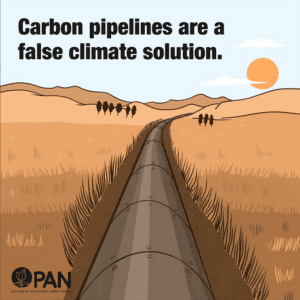
Perhaps you have already noticed if you are on some of the various social media platforms, but PAN has been producing more original content that combines excellent artwork by Mikhaila Markham with writing support by the Communications Team.  One of our recent efforts has a specific relevance to Iowa.

carbonpipeline

We would like to encourage you to like and share these images to reach a wider audience so we can be louder when we speak about things that matter to us all.  We can be found on Instagram, Facebook and Twitter.

Other things on my mind

It is still also possible to “be loud” with the written word.  Even though this year’s Pollinator Week is in the rear-view mirror, pollinators have been very much on my mind recently.  I thoroughly enjoyed doing an exploration of different pollinators that we often fail to appreciate.  I didn’t stop there, also considering the role lawn diversity could have in supporting these pollinator populations in our world.

pollinatorcardgreenbee 

If we truly want to support pollinators in Iowa, we need to reconsider the use of seed treated with neonicotinoid pesticides.  At the very least, the loophole that allows these treatments to remain unregulated needs to be closed.  Perhaps we can take some ideas from recent legislation in Minnesota to inform future work here as we seek to be a bit louder about the possibilities of a better, and healthier, future in our state.

Tuesday, August 8, 2023

Supporting Pollinators with Lawn Diversity

I realized I had fallen behind in sharing some of my Pesticide Action Network writing that is published on their website.  This is one of those cases where I started the thought process on our farm blog and then refined it for a broader audience.  This way you get to see both!  This was published on June 22 in PAN's News and Analysis on the website.

---------------------------------------------

Pollinator Week happens once each year and I always hope to write one or two articles for PAN to get the word out that we can and must support our pollinators. But, as a steward of a small-scale, diversified farm, I can’t afford to think about pollinators for one week. I think about them year-round.

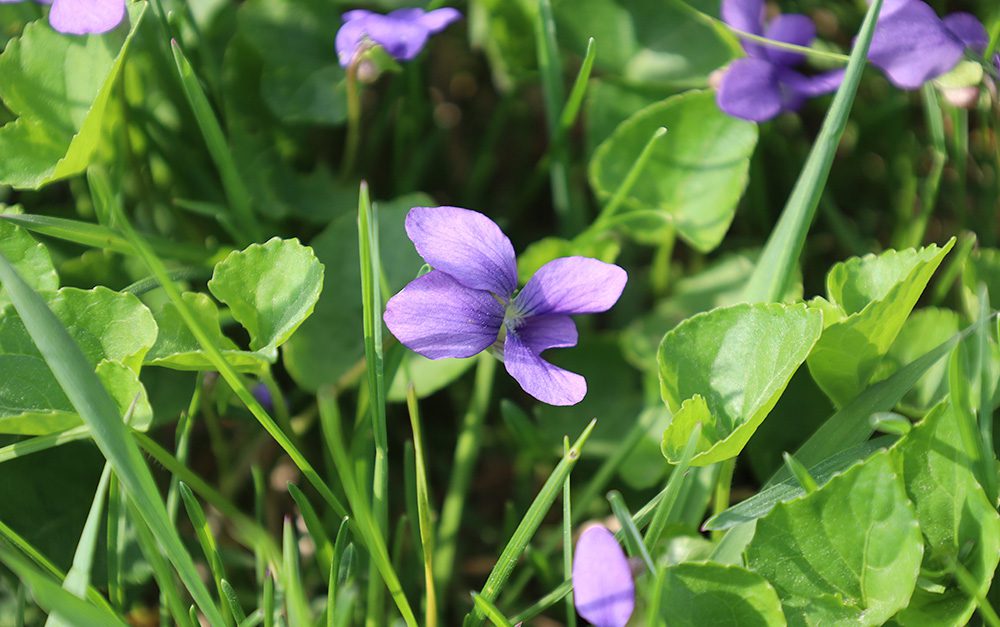
In late April and early May, the grassy areas on our farm were dotted purple with Common Violets, especially under the oak trees and by our smaller high tunnels (a hoop house where we grow vegetables). These little lawn jewels bloom longer in years when we aren’t having our ninth driest May on record. Seeing them got me thinking about how strange it is that we have allowed ourselves to be convinced that less life is better in the outdoor spaces around us, that a “well-maintained” lawn is preferable to a diverse landscape that provides food for our pollinators.

Clover, dandelions, and violets – oh my!

I remember spending a fair amount of time outside and on the ground when I was a kid so I could look at clover, dandelions and violets. My siblings and I even bought into the May Day idea of collecting some of the early spring flowers and putting them into baskets. The only difficulty was figuring out which houses would appreciate finding one of those little baskets at their door after we put them there, knocked – and ran away.

Not everyone saw the beauty in a small, sometimes bedraggled, bouquet of flowers. It’s kind of a shame that so many people didn’t, really.

Violets are an indicator of healthy diversity

If you were (or still are) one of those children who took some amount of delight in picking a few Common Violets, you would know that each flower appears atop its own stem that comes from the top of the root ball. There are no leaves, or other flowers, that share the stem. This means they are perfect for miniature flower art projects.

Violet

Every so often, I have found violets that are white, which seems like a conflict of interest or something. Aren’t violets supposed to be . . . violet? Well it turns out that is true, except when they’re white, or maybe even yellow. While yellow violets are a different species, the Common Violet can sometimes have white coloration. We had a couple of plants that featured mostly white flowers down by the high tunnel last year, but I did not see them this year.

Yes, I noticed that they weren’t there. Yes, I went looking for them. And, yes, I missed them.

Some people herald violets for their potential as a foraged food in natural landscapes. Both the leaves and flowers are edible, though I will admit that I prefer observing them to eating them myself. On the other hand, there is another camp that sees violets as a nasty weed to be controlled. After all, you wouldn’t want a slightly different texture and a little color to become part of our urban landscape!

At least some lawn care sites provide a little balance, citing the Common Violet’s beauty and potential as a food item – before telling you how to kill them with herbicides.

Dandelions welcome

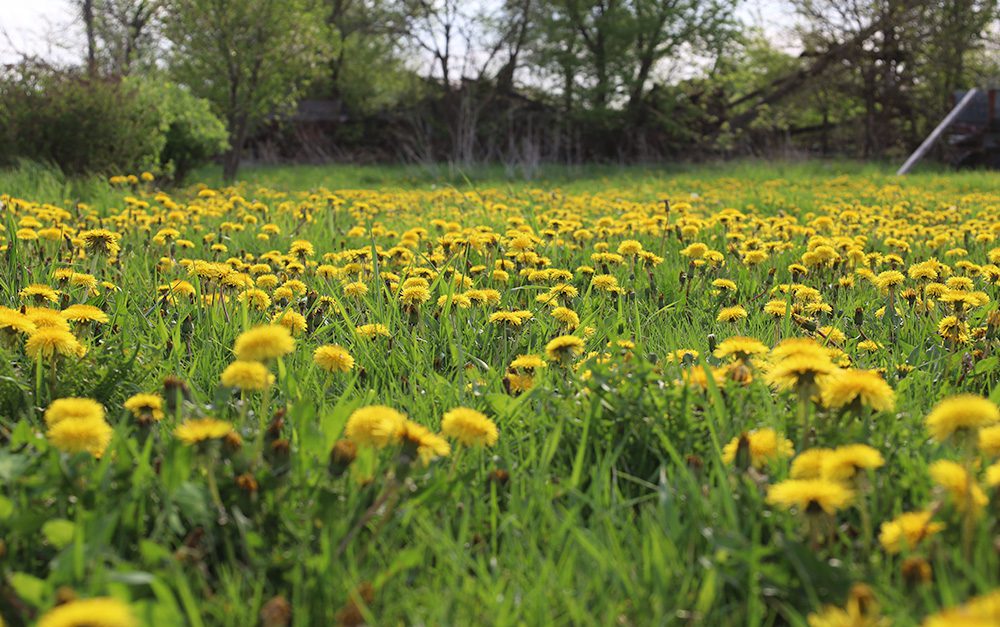
Perhaps you don’t think it’s odd to look for violets, but you do think I am at least a little strange for enjoying a nice, healthy bloom of dandelions. But maybe you would change your mind if you noticed the bumblebees bumbling their way around the flowers during their early season flights.

dandelions

Isn’t it strange how we have somehow decided that clover, dandelions and violets are all undesirables in our lawns and grassy areas? It is documented that Europeans brought dandelions with them as both a food and medicine. Some sources make the claim that dandelions were introduced to North America by the Puritans in the 1600s, though the actual introduction to the continent is a bit less certain.

We wanted dandelions in our lives until we started listening to the sales pitch that they should be killed. Especially if we spent the money for products promoted by the pesticide and synthetic herbicide industries.

From a soil health perspective, we like the way the deep taproots of the dandelion loosen and aerate the soil. We feel that these same roots bring nutrients up from deeper soil layers so they can be used by other plants. And, because they draw most of their moisture and food from a deeper soil layer, they often don’t compete with our food crops, so they aren’t a bad weed for a vegetable farm.

We can relearn that clover isn’t bad

And then there is the clover. Prior to the 1960s, clover was a regular part of lawn seed mixes until the herbicide industry began selling the idea that grass, and only one kind of grass, should be welcome in a “well-maintained” lawn. I still remember that barefoot children always took note of where the clover was so they didn’t accidentally step on a bee and get stung! Now, barefoot children stay off the lawn because it’s been recently sprayed with pesticides.

Give me more clover, more violets and even more dandelions. Certainly, there will be places on our farm where we remove some in favor of other plants. But as far as weeds go, these three are our friends. And, they, along with other flowering plants, provide a long season of food for our pollinators.

Friday, August 4, 2023

Conservation Programs Have a Place in the Farm Bill

The following was published in Pesticide Action Network's Ground Truth blog on July 19 and I thought some might like to read it here if you didn't notice it there.

--------------------------------------

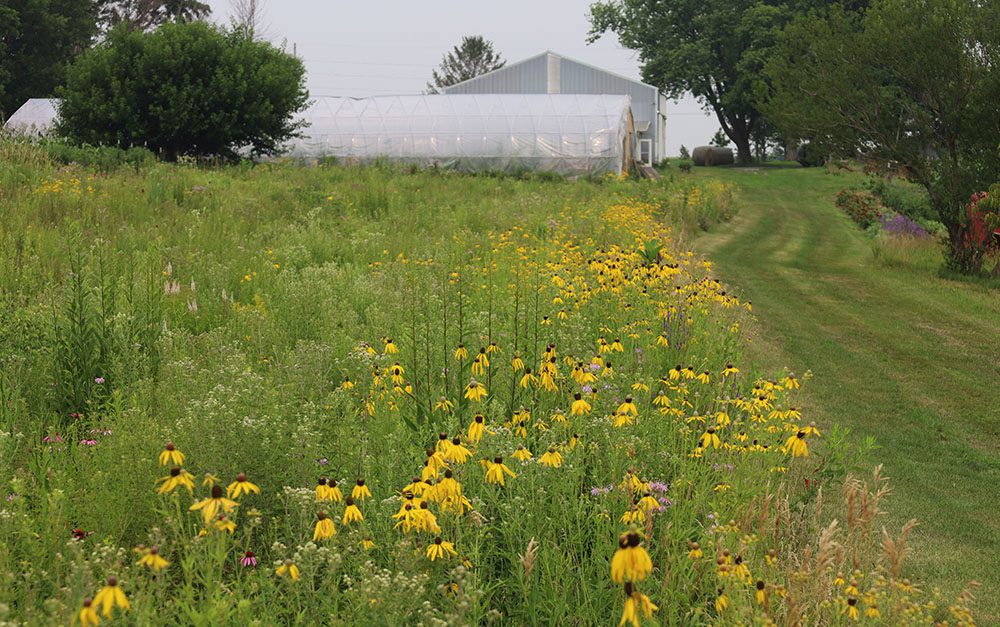
The Yellow Coneflower and the Monarda are just entering peak bloom in two small fields that are within a couple of miles of our farm. Each of these plantings are new within the last few years, and were funded by the Federal Pollinator Habitat Initiative (CP-42) under the Conservation Reserve Program (CRP). Along with the Conservation Stewardship Program (CSP), these are initiatives that are part of the Farm Bill of which I have seen positive results.

While it is important to recognize that these programs are, in my opinion, not enough to address a whole host of problems that come with large-scale, chemical-intensive cropping systems, they do illustrate for us the potential we have to be better stewards of and partners with our land.

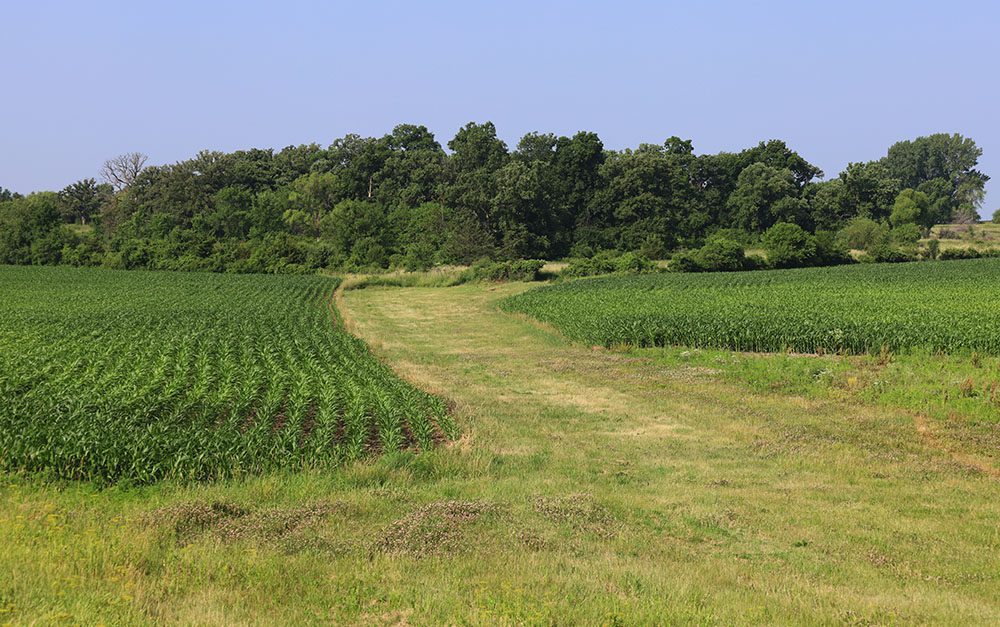
farm field grass

Giving water a place to be

During the first seven years we lived at the farm, we observed the frequent occurrence of flooding in a field a few miles away and adjacent to the Wapsipinicon River. Each year, the land was planted with corn or soybeans. And, most years, a flood would damage the crop and wash valuable topsoil away.

Thankfully, the landowner eventually accepted federal assistance to take that land out of production and put it into perennial plant cover. While they still plant the higher ground in corn and soybeans, the low ground is now built to handle the ebb and flow of a river that is being asked to deal with more frequent heavy run-off as extreme rain events have become more common in this part of the world due to climate change.

This also means there is more space for Red-winged Blackbirds to nest and Dickcissels to sing.  Wildlife has a bit more of a corridor to travel as they seek food and fresh water. And our eyes are given the opportunity to see something other than another corn or soybean field in Iowa.

That, in itself, is good for my soul.

farm rows

Letting water move without taking soil with it

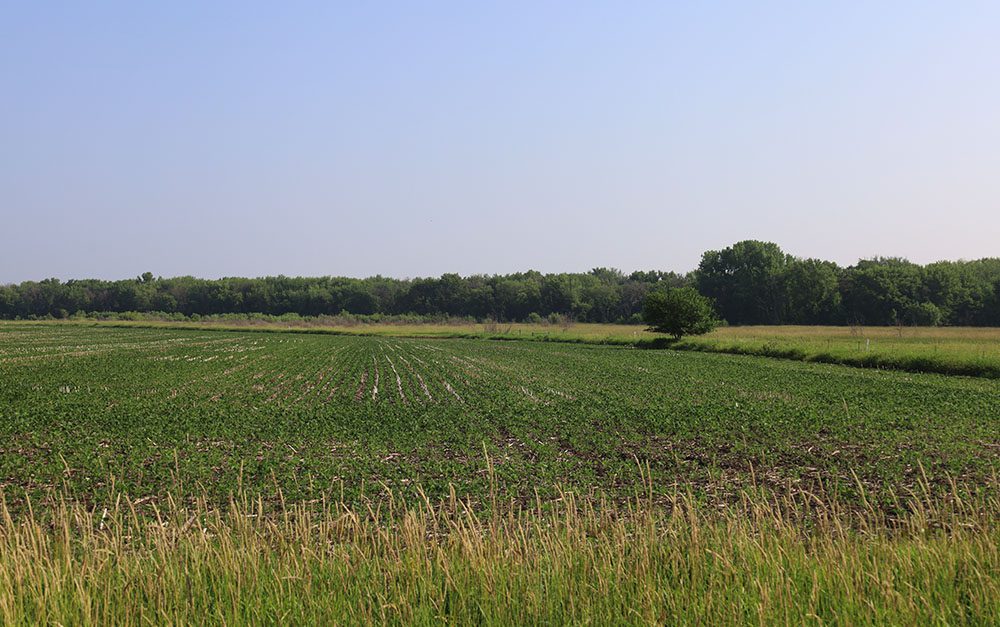
Some row crop farmers also take advantage of federal funds that are part of the Farm Bill to seed down parts of their fields with perennial cover crops where water run-off typically goes. In Iowa, they often select grasses that they can cut, bale, and use for animal bedding or feed during the winter months.

Sometimes these waterways are fairly generous, like the one shown above. But there are still many fields where no effort is made to identify where water runs. These fields often show deep runnels where soil has washed away during the spring rains before the annual crop has had a chance to establish significant roots in the ground.

Funding for programs like these help farmers do things that are better for the land. This is especially true when we consider those who work on smaller family farms, where the budget for these sorts of projects is often tight. My observation for where I live is that these farms are typically more likely to seek out and follow through with these projects, while the larger, corporate farms are happy to seek out the funds, but not as happy to take any land out of production.

farm wildflowers

Impacts go beyond a single field

While it is true that there are farmers who would act on their heart’s calling to be a steward of the land without external support, it is also true that this support makes it easier to do just that.  And, we need to remember that the success of one field of pollinator habitat, or a wetland area, or even a single in-field waterway, has impact beyond the borders of the land where the project has been undertaken.

We have noticed that a few wildflowers have moved into the ditches by the road between our farm and the nearest pollinator planting. We have also noticed the diversity in the populations of pollinators on our farm have improved slightly. While we are still concerned about the overall health of these populations due to the extreme use of pesticides in our area, we also see the power of nature, as it shows us it is still interested in sharing the beauty of the world around us.

The projects that are undertaken to handle the flow of rainwater also have impacts beyond the borders of the fields where they reside. A well-placed waterway planting can keep more soil on the land and less in our rivers and the Gulf of Mexico. A wetland near the Wapsipinicon River not far from our farm can absorb and slow the flow of floodwaters before they reach communities downstream, possibly making a difference in many lives.

Maybe these programs aren’t the perfect solution, but they can be a part of moving towards better solutions. I want to make sure we don’t walk backwards and take even these pieces of progress away in future versions of the Farm Bill – because look at the positive results that even smaller efforts can provide.

Tuesday, June 20, 2023

Appreciation for Different Pollinators


When I first entered the world of growing professionally, it was tempting to assume that any new insect was intent on destroying my crops.  The acts of placing seeds in the ground and nurturing plants for food are not effortless, nor is the process worry-free – a lot can happen between germination and harvest.  So, it makes sense that growers risk falling into the trap of focusing on the pests.

However, it is equally important for farmers to learn about invertebrates that work with us – as well as those that are steadfastly neutral with respect to our crops – to successfully steward our land.  Many of the crops on our diversified farm rely on pollination services to produce the food we hope to make available to others.  Last year, for Pollinator Week,  I spent some time learning more about wasps and their role as pollinators.  This year, I wanted to explore some other, less well known invertebrates and their powers of pollination.

Hoverflies – they’re everywhere

I will readily admit that I have not given much thought to hoverflies (also known as flower flies or syrphid flies) until I started a project four or five years ago to take photos of the insects that we could find around our farm.  As I began the work of identifying the insects in these images, I was surprised to find many in the family Syrphidae.

Hoverflies can be found on every continent except Antarctica and there are approximately 6,000 known species.  Hoverfly populations are often greater than wild bee species, so even if they are less efficient than bees, they can make up for that with their relative abundance.  On our farm, we have noticed Oblique Stripetail Hoverflies more often than any other hoverfly.  It turns out that these insects are good pollinators and their larva will predate on aphids, one of the pests we want to control on our farm.

Research on hoverflies has been sparse, but one study suggests that true flies (Diptera) are the second most important order of pollinating insects after Hymenoptera (bees, wasps and ants).  Hoverflies are generalists, visiting a wide range of plants looking for nectar as a food source.  Unlike most bees, they are not restricted to a limited home range and they can carry pollen over longer distances while foraging or during migration.

Green Bees – showy and shy

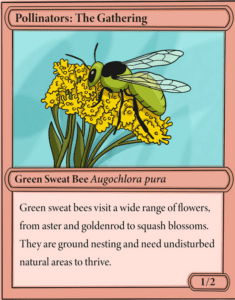
Another insect that has had my attention for a while is the Green Bee or Green Sweat Bee.  We can’t help but notice them because their sparkling green color is almost startling.  The problem for me is that they are a bit shy, preferring not to pose for the camera.  And that’s why I am pleased to offer up this cropped photo that provides evidence that I finally succeeded in capturing an image of one.

Green Bees will visit a wide range of flowers, though they favor asters, goldenrods and coreopsis in late summer and fall on our farm.  Once they emerge in the spring, they will forage until the fall, so they have to adjust their food sources as the year progresses.  I have observed them visiting the small flowers on maple trees in the early spring and squash flowers in the summer.

Green Bees are typically ground nesting, though some will use hollow twigs and logs.  The parent Green Bee will mix pollen and nectar with their own saliva to leave as a food source once the larva hatches.  It has been suggested by some scientists that the saliva keeps the food fresh and helps to protect the eggs in their sealed chamber.

Simply knowing a few facts about Green Bees has encouraged me to continue our farm’s program to leave areas of the ground undisturbed, rather than tilling everything.  It also solidifies our desire to leave leaf litter and brush piles as natural areas.

Soldier Beetle – they eat, you harvest

The Soldier Beetle is another frequent visitor to our growing areas at the farm.  When I first became aware of them, I mistook them as a pale-colored lightning bug.  But, once I started farming in earnest, it didn’t take me long to identify who they really were.

My opinion of the Soldier Beetle became much more favorable the moment I learned that they are great predators of caterpillars, aphids and other soft-bodied insects that find our vegetable plants attractive.  These beetles have one generation of young each year, while some types of aphids can have eight or more generations of young.  If you ever need an example to explain why broad-spectrum insecticides are a bad idea, here it is!  The pest can rapidly repopulate while the predator cannot.

While Soldier Beetles might supplement their diet with pollen and nectar, they particularly like to visit flowers where they can lie in wait for their prey.   We see them most frequently around our farm in August and September.  They are frequent guests on some of the flowers we intercrop with our melons and squash.  As a result, they appear on the vine plants as well.


Hawkmoth – long tongue, will pollinate

It’s hard not to be fascinated by the Hummingbird Moth or Hawkmoth as it hovers over flowers seeking nectar.  Their flight patterns are similar to a hummingbird and we typically see them around our farm in the evenings, though we might also see them earlier in the morning.

I wanted to include the Hawkmoth to remind all of us that pollinators are not dedicated to servicing the food crops farms like mine grow.  As a matter of fact, some hawkmoth larva can cause problems for our crops.  I’m looking at you, Tomato Hornworm (Five-Spotted Hawkmoth)!  But it is important to recognize that this is just one type of hawkmoth and there are ways to deal with the Tomato Hornworm naturally.  At my own farm, we’ve simply recognized that their population isn’t too large and the small amount of damage they might create isn’t a problem.  As long as our natural system is balanced, they don’t qualify as a pest – especially when you consider their value as pollinators.

Hawkmoths have a long proboscis that enables them to reach into flowers that keep pollen and nectar deep within them.  Many plant and hawkmoth pairings have evolved over time.  The hawkmoth receives food and the plant gets pollinator services.  If either the plants or the hawkmoths are removed from the natural system, the other will die off.

Hawkmoths can carry pollen as much as fifteen to twenty miles from the source, unlike honeybees that typically go no further than three to five miles from their hive.  As humans continue to develop land areas, wild plant populations become more fragmented.  The hawkmoth’s sturdy build and ability to fly longer distances makes it possible for pollination to occur even when plants are not nearby.

If it’s on a flower and it moves…

The process of learning more about different kinds of pollinators has increased the depth of my appreciation for the incredible diversity in the natural world that surrounds us.  I am coming to understand that I won’t always see the value any given organism brings to the world until I explore more.  And even if I don’t discover a redeeming feature, that doesn’t mean there isn’t one.

But I think I have discovered one thing that seems certain.  If it’s an insect on a flower and that insect can move to another flower, it has a chance to carry pollen and support the next generation of plant life.

-------

For those who are interested, this is my latest blog for Pesticide Action Network that is intended to draw attention to pollinators during Pollinator Week.  One of our efforts at PAN is to fight against the overuse of pesticides that harm our pollinators.  Part of my job is to remind everyone that pollinators are important, interesting and worthy of protection.  I hope you will take some time to consider this issue.

Monday, June 5, 2023

An Old, Radical Idea - Farm Well

The following is a cross-posting of my work published on the Pesticide Action Network blog.  I try to share what I write for PAN here every once in a while so you can all see what I am up to!  Thank you for considering my thoughts and words.

-------------------------------------

There are many voices who argue effectively and well that agroecology holds the answers that can address the shortcomings of our farm and food systems.  I have added my voice to theirs as a farmer and steward of my own small-scale, diversified farm in Iowa.  Many make the mistake of thinking that this battle has just begun, even when there is plenty of evidence that many of the techniques of growing that would be better for our world have been discussed and promoted for generations.

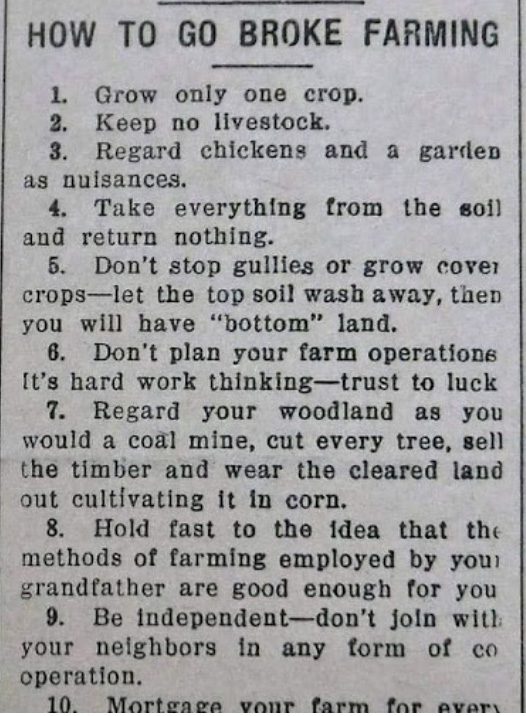
How to go broke farming

As a small-scale farmer, I have a membership in a hard-working community of like-minded land stewards who often share knowledge and information freely with each other.  Several months ago, an old newspaper clipping from the June 17, 1927 Farm and Dairy publication was passed from person to person through email and social media platforms.

This is not the only historic example of farming wisdom that has been circulated in recent years.  I have viewed documents from the 1940s, 1870s and, yes, even the 1700s that discuss farming practices that, for some reason, have been historically overlooked by many of those who farm.

how to go broke farming

Here is a summary of this article:

  • Grow only one crop
  • No animals on the farm
  • Take everything from the soil and return nothing
  • Let top soil wash away
  • Don’t plan
  • Cut every tree and grow corn
  • There is no reason to learn and adjust your farming methods
  • Don’t cooperate with other farmers

This list, assembled by the University of Tennessee Extension, outlines some of the approaches that were well-established as bad practices for a successful farm in the 1920s.  In my opinion, this is all just common sense.  Of course you should grow a diverse set of crops, using a carefully planned crop rotation and implementing intercropping.  The concept of integrating animals for both fertility and diversification on the landscape isn’t hard to understand.  Protecting the health of the soil feels like it should be a basic tenant for all food producers.  And, the concept of continued learning and the spirit of cooperation between growers just seem like necessary tools for a successful farming system.

Apparently the lesson is difficult to learn

As I read this news clipping from 1927, I asked myself why they felt it necessary to point out that these practices were a bad idea.  That’s when I realized that the authors were fighting the same battle we find ourselves fighting today.  There were a significant number of farmers and landowners in the 1920s, just as there are today, that fail to recognize that farming needs to be a complex operation.

Yes, you heard that right.  The way many of our grandparents and previous generations farmed was less than optimal.  And it feels like there are plenty of folks out there who are quite happy to maintain that tradition in the present day. The only real constant for generations in the United States has been a willingness of too many people to ignore the principles of land stewardship.

Perhaps the only difference is that people have found a way to continue making money despite abusing the land they farm.  If anything, the changes in our food and agriculture systems since 1927 have made it difficult to farm well.  Instead, our systems reward the pesticide and synthetic fertilizer industries (among other big ag businesses) and place hurdles in front of anyone who might like to engage in being a steward-farmer.  Bigger farms growing single crops in larger fields that sit bare during the winter months while the soil erodes is what we currently reward.  We prop these farms up with our governmental programs so they can feed the ag industry — even if we know that this model would fail as soon as we kicked these false supports away.

Eventually some of these false supports for poor farming — such as herbicides — are no longer able to hold the wolf at the door.  The weeds are adapting and the strain of continuous tillage and pesticide use is making our soils less fertile and less productive.  The deep, rich soil we have in states like Iowa isn’t as deep and rich as it once was and we will be called to pay for our debt to the land.

If we spent more time caring for the land, it would take care of us.  We wouldn’t need to rely on the next new and novel technological solution for pest control, soil fertility, and weed control.  Instead, we could use those tools in only the most exceptional of circumstances, relying on complex and healthy systems instead.

We can still learn and act to change

I recognize that there are many people, from every generation and many different backgrounds, who have farmed and been true stewards of the land.  These people, some Indigenous, some people of color, some white immigrants, have stood out from the crowd.  They are often seen as the exceptions (and sometimes hailed as exceptional) and they often feel the pressures of not going along with the corporate plan for agriculture during their time.

This is, in my opinion, backwards from the way the world should be.  These are the food growers and land stewards who should be faceless (except when they are in their own communities) because there should be so many of them.  Those who should stand out as exceptions are those who fail to farm well.  And then, our strong farming communities could provide the support they would need to join the rest in being positive and effective stewards of the land.

I know, it’s a radical idea.  And apparently it’s been radical for generations.  Perhaps it’s time for this to be the mainstream attitude?

Monday, May 8, 2023

Iowa News from PAN

Some of you have said you might be interested in seeing the Iowa Newsletter I author eight to ten times a year for Pesticide Action Network.  These are sent out as emails to Iowans who have subscribed to our list and are also posted on the PAN website.

You might see, periodically, themes that I have also explored on the Genuine Faux Farm blog.  Well, that makes sense, since it's the same author!  I hope you enjoy this peek into my work with PAN.

----------------------------------

Last Sunday night, I had the opportunity to view a brilliant display of the aurora borealis (Northern Lights) that was stronger than any I had witnessed previously. The lights pulsed and reached for the skies directly above me.   It was quite an experience that has colored my thoughts for this month’s Iowa News.

I took a few pictures and was amazed how much richer the colors were in the photo than they seemed at first. I learned that the cells that make up most of our night vision only see black, white and shades of gray. Typically, when we see Northern Lights in Iowa, they are not bright enough for our eyes to use the cells that see color. Sunday’s show was actually bright enough that my eyes were picking up some of the color, which tells you something about their strength.

I often wonder how it is possible that people don’t always see how our current food and agriculture system is hurting us. I admit that I have been surprised when someone admits they don’t see a difference between industrial agriculture and a system based on agroecology. Perhaps the problem is that we aren’t shining a bright enough light on the differences between the two. Or maybe, we just need to turn up the intensity when we talk about how much better things could be?

Northern Lights are created when energized particles from the sun strike our planet’s magnetic field at forty-five million miles per hour. The evidence of Earth’s effort to protect life on the surface is more than a show that we can admire and share with each other on social media. The aurora borealis is a reminder that we also have a responsibility to protect each other and the planet on which we live.

We can begin by changing how we grow food. It seems to me that Iowa would be the perfect place to start. If you would like to learn more, read on!

Thank you for being willing to consider my thoughts and words. Be well,

Rob Faux
PAN’s Communications Manager
Owner/Operator, Genuine Faux Farm, Tripoli, IA

What is agroecology?

You might notice that we are using the word “agroecology” more frequently in our work at PAN. Agroecology is about much more than just agricultural practices, which could include organic and regenerative agriculture. If you would like to learn more, I offer this entry I authored that was recently published in our Ground Truth blog. I think it provides a good overview from my Iowa farmer perspective.

If you want a global picture on agroecology, I encourage you to view the ten elements of agroecology, as outlined by the Food and Agriculture Organization of the United Nations.


Why is racial justice in our food systems important?

An individual recently asked us why PAN makes the connection between racial justice and agriculture. We invite questions like this one because they give us all an opportunity to learn. I recommend these remarks by Dr. Ricardo Salvador, a scientist and food and farming expert with strong Iowa ties. Give yourself permission to take the time you need to read that article fully with an open mind.


Carbon pipeline

Last month, the Iowa House of Representatives passed a bill that would ban the use of eminent domain for carbon capture pipelines unless 90% of the route is first acquired through voluntary land sales. The bill was amended and would put fewer restrictions on carbon pipelines than the original proposal. This article by Iowa Public Radio provides more details.

The claim that a pipeline to move liquified carbon (created by ethanol and pesticide plants) will be an environmental “win” is flawed.   Instead, it is an attempt to make our outsized reliance on corn and pesticides “less bad,” while also allowing a wealthy few to capture government funds in the process.

A better solution would be to not create the carbon by-products in the first place. The science behind carbon capture tells us that we can have a meaningfully positive effect on reducing greenhouse gas emissions by adopting policies that support the principles of agroecology.


Ongoing dicamba lawsuit

In 2020, the US 9th Circuit Court of Appeals found that the Environmental Protection Agency (EPA) broke the law by continuing with the provisional registration of dicamba herbicides. The original decision ordered EPA to invalidate the registration based on the demonstrated harm dicamba causes when it volatilizes (becomes a vapor) and drifts after application.

Contrary to the court order, EPA has maintained the registration of dicamba products while making minimal adjustments to the use restrictions. PAN, along with National Family Farm Coalition, Center for Food Safety, and Center for Biological Diversity have filed a continuation. We are asking that the court once again order the EPA to rescind approval of these products. If you would like to learn more, I recommend this article.

Monday, April 17, 2023

Agroecology: Adapting Agriculture to the Land


Over the last couple of months, I have observed multiple changes to the landscape in Iowa and most of those changes have been initiated in the interests of agriculture. For example, a fencerow near one field had all of the bushes and trees taken down and the grasses burned.  A small grove of trees in the corner of another field is now piled up, likely awaiting a calm day for a bonfire.  In another field, I noticed that a grass strip to prevent soil erosion had been tilled and was showing signs of soil loss.  And, of course, farm equipment to apply synthetic fertilizers and pre-emergent herbicides have made their first appearances for the season.

Agroecology is about complexity

Each of these actions is an example of adapting the land to agriculture.  Fields keep getting larger so more of one crop can be grown using bigger equipment and more pesticides.  It’s a vicious cycle and it is difficult for me to acknowledge and write about it.  But we do have alternatives.  We can adopt the principles of agroecology.  We can turn the story around and adapt our agriculture to the land, rather than the other way around.

The more I have considered it, the clearer it has become — agroecology is all about acknowledging, learning about, accepting, and promoting complexity in our agricultural and food systems.  This complexity manifests itself in the ecological, social and economic aspects of agriculture.

Biodiversity on the farm

On our farm, I have come to believe that a successful field is one that I want to be in.  This might seem obvious, but it may not be for the reasons you expect.  Certainly, it is true that part of my appreciation comes from the success of the crops I hope to harvest.  But the key is that this is only a part of what makes a field successful.

I appreciate a field that has diversity in plant life, especially if some of that plant life includes flowers that I (and the pollinators) can enjoy.  When I stand in a successful field, I often observe a wide range of animal life, including birds, insects, snakes, frogs and toads.  The soil itself is healthy and full of both visible and microscopic life.  And I have found, over time, that these fields often produce better than those dedicated only to one kind of plant, where any other life is discouraged.

There is a wide range of tools farmers can use to increase the biodiversity on their farm.  It can begin with a longer crop rotation, and it can be expanded to include intercropping.  A farm can support biodiversity with wild spaces and perennial plantings, including wooded areas, terraces, and prairie strips.  A growing system becomes more diverse with the integration of animals, and soil health can be protected with cover crops.

Complexity results in diversity.  Diversity is health on the farm and in our world.

More, and smaller, farms

Many are attracted to larger fields with a single crop (monocropping) for their relative simplicity.  Till the soil, plant the seed, spray the pesticides and harvest the crop.  Every square foot of the land is treated pretty much the same.  If a portion of it isn’t immediately suitable, it is altered until it can be used.  The number of people who are truly invested in the process of food production is reduced, and those who do the actual labor are rarely given the power to act as stewards.

Smaller farms place more people in a position to listen to the land and adjust to its needs.  More people on the land increases the personal investment our global population has in agriculture and growing food.  

If we wish to promote an agriculture and food system that relies on more and smaller farms, we must also make land accessible to all who would be stewards.  An increase in the number of farms provides space for a broader spectrum of people to grow food and care for the land.  Indigenous farmers can restore or resume cultural food practices.  People of color and people who do not have great personal wealth can have opportunities to stand and work in successful fields, wielding the power and responsibility of caretakers.


Peer mentorship and local support

More farmers on smaller farms provide an opportunity to reconnect our food production systems at the local and regional levels.  On the other hand, large farms with corporate or absentee owners have no incentive for cooperation, and their employees are often powerless to make management decisions.  The people that do the work often feel detached from the land they work on.  

In my own farming experience, I have come to value my connections with my peers who operate or work on small-scale, diversified farms.  The farmer-to-farmer exchange of knowledge and the focus on shared success have been critical for our own health and our farm’s resilience.

Similarly, our interactions with the communities that surround us characterize a relationship that goes beyond an economic basis.  Our farm provides the rest of the community with a connection to the land and food production.  The community hears a different story through our farm that creates an understanding and appreciation for complexity.  In return, the community has been willing to provide support when our farm has faced extreme challenges — like pesticide drift or a physical ailment.

Local connections provide support, which makes it possible for small-scale farms to introduce the complexity that supports diversity.  It’s a circle that sustains all of us, and this is an important part of agroecology.

Farm practices and farm research adapted to the land and community

Our farm has participated in numerous on-farm research projects in tandem with other farms over the years.  Perhaps the most important lesson I have learned is that every farm is different.  While there might be some “best practices” that we can all adapt to our systems, the reality is that we must adjust those practices as we make our own observations of what is going on where we are.

We participated in a research project that was intended to evaluate varieties of broccoli for production in Iowa.   Several farms reported results that indicated one particular variety was a very poor choice.  That variety was the best performer on our farm for this trial.  The reasons for these differences were uncertain, but they could be any combination of weather, soil types, disease, pest pressure, surrounding environment, or growing techniques.  What it illustrated for me was the fact that we should not expect growing solutions that work everywhere for everyone.  It also encouraged me to participate in more on-farm research.

Simply put, growing food is complex and it is different according to a wide range of factors –  we should treat agriculture and food production in a way that recognizes this.

The balance sheet is more than profit/loss

Large-scale, chemical-based food production measures itself by yield (how much of the crop is produced per acre) and money gained or lost.  Many vegetable producers use black plastic mulch in their growing beds to prevent weed growth in their crops.  From a monetary investment perspective, it makes sense because this is one of the cheapest ways to control weeds in a commercial vegetable production system.  However, the environmental costs of producing this plastic and then disposing of it are not part of the farm’s balance sheet — even if it should be.

Agroecology encourages practices that are efficient – minimizing waste and optimizing energy use. One good example would be the integration of animals into a small-scale farm to provide fertility, rather than purchasing synthetic fertilizers.  This becomes even more efficient if the animals are included in the crop rotation so they can spread their own manure in a field that will produce food in subsequent seasons.

Agroecology is a name for answers we already have

The beauty of agroecology is that it provides room for the successes of many.  Indigenous producers of kalo (taro) on Hawai'i have a place to grow with agroecology.  We could have hundreds of smaller-scale egg production farms in Iowa, stewarded by the workers that currently find themselves working unfulfilling jobs in confinement production.  A row-crop farm could produce a variety of grain and soy crops without reliance on chemicals.  And my small-scale, vegetable and poultry farm  — my home  — also has a place with agroecology.

We already have the foundation for what we need to get started.  The answers reside in known science, inherited and Indigenous knowledge, and in the beauty of complex systems.  It’s up to us to continue to learn how they apply in each place we live and grow food.  It’s up to us to adapt our agriculture to the land, not our land to the agriculture.

-------------------------

I authored this entry originally for PAN's GroundTruth blog and it is cross-posted here.  I hope you found this article interesting and worthy of consideration.