Showing posts with label overspray. Show all posts

Wednesday, November 22, 2023

Danger of Chlorpyrifos Revealed Over Time

It has been over a decade since the moment I felt the droplets of pesticides on my head and shoulders as a crop duster flew over our farm in Iowa.  To be precise, it has been 11 years, 3 months and 18 days since a mix of chlorpyrifos and two other pesticides was dumped on the western portion of our farm, coating our vegetable crops, our poultry, our bees, and our person, with an unwanted cocktail of poisons.  If you cannot tell by this introduction, that moment was a pivotal point for my farm and my life.

So, I was among those who were glad to hear that EPA effectively banned chlorpyrifos on food and feed crops in 2021, by setting tolerance levels of that pesticide on food to zero.  While it did not solve the problems of drift and pesticide misapplication I have experienced, I knew this step was an important one.  And now, I am among those who are equally dismayed by a recent court ruling that reversed EPA’s action to limit use of this dangerous insecticide.

Chlorpyrifos injury starts the journey

After I was coated with pesticides during the 2012 incident at our farm, I was left with the question, “Now what do I do?”  After a quick call to a trusted doctor, I ended up taking a shower for the next half hour.  But the damage was done.  I ended up having to seek treatment for breathing problems and I found that I sunburned much more easily during the weeks that followed.

That was my first truly meaningful introduction to chlorpyrifos – an acute pesticide poisoning caused by an aerial applicator that wasn’t terribly concerned about where they dropped the chemical.  Prior to that, it was just another pesticide that row crop farmers used on their crops every year.  I didn’t like it, but I lived in Iowa and that’s how it was.  I was just like other members in a rural community – we just dealt with it.

I also farmed, but I had opted not to use any form of chemical pesticide, preferring to use crop rotation, intercropping and wild spaces to deal with pests and diseases.  So, while I was aware that other farmers used them, I didn’t really concern myself too much with the details of particular chemicals or formulations.  I was more concerned that their applications of pesticides stay on their side of the fence.

But after experiencing this misapplication, I became invested in learning about chlorpyrifos and other pesticides.  And, what I was learning moved me from having a general concern that pesticides were a philosophical problem to a growing realization that they posed a great danger to us all.

Chlorpyrifos drifts easily

A few years later, in 2015, our farm participated in PAN’s Drift Catcher, a citizen-science project.  As a participant, we were given a compressor that would pull air through test tubes with resins that would collect certain insecticides, chlorpyrifos among them, if they were there.

I diligently changed the test tubes twice a day during spray season.  I labeled each carefully and placed them in a freezer until all of the samples were collected and could be sent in for testing.  I wrote down observations about the weather and took notes about who in the area was spraying.

When the results came back, we learned that we had “positive results” for chlorpyrifos.  And this was certainly one of those times where “positive” did not mean “good.”  Neither of these readings were taken at a time when one of the fields adjacent to our farm was applying pesticides.  Instead, both readings came at a time when the target field was at least a half-mile away.

It was at this moment I learned something else.  Chlorpyrifos drifts from its target application easily and well.  Particle drift of pesticides occurs during the spray, or application, process.  Smaller particles of the pesticide can be carried by the wind to locations outside of the intended spray zone.  Some pesticides are more prone to drift than others, and chlropyrifos is among those that drift easily.
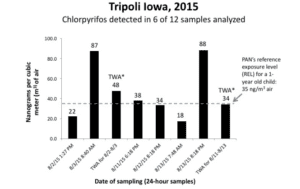
Drift catcher results table

TWA – Time Weighted Average; REL – Reference Exposure Level

As I reviewed our test results, I was astonished to learn that one set of positive readings was the result of an application that was over a half-mile away and, while the wind was coming our way, the wind speed did not exceed five miles an hour.

I started to ask myself how much exposure people like Tammy, my partner, and I have had to chlorpyrifos over the years?  How much did we inadvertently allow our farmworkers, often college or high school students – somebody’s children – to be exposed to these chemicals?  And what about the neighbors’ children?  Clearly chlorpyrifos travels through the air and is finding its way into our bodies.  And we knew its use was, and still is, ubiquitous in our state.

EPA needs to affirm and complete the chlorpyrifos ban

I realize that it is often difficult for people to fully appreciate and understand the dangers chlorpyrifos poses to those who are regularly exposed to it – until they or someone they care for experiences it for themselves.  I am ashamed to admit that I was among those people.  But now I have had some of my own experiences and I believe it is important to share them with you – hoping you will understand without going through this process of discovery by exposure.

This is why it is important for the EPA to re-establish the chlorpyrifos ban on food and feed products.  But, that, by itself, isn’t the whole story.  The food ban does not impact corn crops for ethanol, or row crops used for seed production.  It does not remove its availability for ornamental plants or roadside applications. This is why I believe the EPA should go further and simply ban its use entirely.

It’s for the good of farmworkers who spend their days outdoors and in harm’s way.  It’s for the children in communities who play next door to fields that receive regular applications of this chemical.  It’s for you and me, because we don’t need persistent doses of this dangerous pesticide in our lives any longer.

=====================

This blog is cross-posted from the Pesticide Action Network's Ground Truth blog.  I write and serve as Communications Manager for that organization.

Monday, July 17, 2023

Occasionally Loud


We first moved to our current location, at the Genuine Faux Farm, in 2004.  The first neighbor to approach us was an older woman, Ruth Bergmann, who "only lived a half-mile away."  She brought us a dessert and invited us over for a dinner when we were ready.  It was a kind offer that we were, honestly, a bit startled, but still grateful, to receive.  You see, in all of our other places of residence, we had not been welcomed by a neighbor - so we did not expect anything different this time around.

While we did not spend a great deal of time over the years with Ruth and her husband, Loren, who had lived there for many years, we did do our level best to offer assistance when their garden needed tilling.  And, we tried to be good neighbors to them, even when the farm and jobs made it difficult to carve out the time.  Perhaps we could have done more.  No.  We certainly could have done more to befriend them.  But I don't think we did anything to be bad neighbors.

Today, her grandson lives in the house down the road and we're pleased to say that we also get along with them just fine.  In fact, we were gifted with this sign that had come into their possession.  This sign had once been Sparky Zander's.  You see, Sparky and Kent Harms were two people who introduced themselves to us early when they learned we intended to do farming - and be Certified Organic.

Perhaps we'll get into that history at another point in time - for today, I wanted to share the sign.  You might notice that it does all sorts of things to be "loud."  Exclamation points!  Capital letters!  Underlining the word "NO!"  Bright colors and even a neat little trick with a pair of eyes.

Sometimes, those of us who wish to raise food or work with the land in a way that is not reliant on chemicals find ourselves needing to be loud - because otherwise, it feels like too many folks seem to believe it is okay if they infringe on the practices of growing that we are dedicating ourselves to following.  In fact, we can sometimes become downright unpleasant if we find ourselves having to try to defend the small parcels of land we steward over and over .... and over again, with no discernible changes in behavior that might indicate we've been heard at all. 

There was a reason both Sparky and Kent were vocal and, sometimes, bitter, about the situation.  Kent spoke passionately against the "aerial terrorists" that were becoming far more common in Iowa in the years just prior to his premature death in 2010.  He and Sparky both encouraged us to hold our ground and do what we needed to do.

Well, we've tried and are trying.  Maybe we're not the same kind of loud - but sometimes we can get a few people to listen.

Wednesday, August 31, 2022

Pesticide Labels: What we ignore (but shouldn't)


I’ve spent more time than most reading the use labels on pesticides. I can tell you that it has nothing to do with a riveting plotline or excellent character development.  Instead, it is because of where we live (Iowa) and what we do here (small-scale, diversified farm).   

No, we have not decided to use pesticides on our farm – but that would have been a better reason for us to spend time reading these labels.  That would have meant that we were researching a tool that we thought we might use.  It would mean that we were intent on following those instructions and that we were considering the possible harm we might cause by using them.

Instead, I find myself reading the labels because our farm is susceptible to many of the chemicals that are applied to the neighboring row crop fields.  We aren't always entirely sure that applicators read these labels carefully, and if they do, it feels like too many of them seem to misunderstand or ignore whatever is inconvenient for them to follow.

These chemicals are poisons and are dangerous if not managed correctly.  For that matter, they can be dangerous even if they are managed properly.  Shouldn’t that be enough to encourage a little reading and a healthy dose of caution?

The hazards are real

first aid warnings for a pesticide label

Shown above is one of the chemicals that was used on a field near our farm in 2018.  It was applied with other pesticides on a day when the wind was strong and coming our direction.  Once I determined the product, I looked up the use label.  Since a big part of my job as a grower of food has me spending time outside, I think it makes sense that I want to avoid being coated with any product that has First Aid warnings if it gets in my eyes, if I breathe it in, or if it gets on my skin or clothing.

Did the applicator, on this particular day, do anything to make sure any of the workers in our fields were not exposed to this chemical?  No, they did not – but we made it our responsibility once they started spraying.  I did not have confidence that they had read the use label themselves.

And what about collateral damage?

environmental hazards on a sample herbicide use label

One important responsibility that comes with any potentially dangerous tool is to use it in a way that ensures it does its job without collateral damage.  

For example, many agricultural chemicals are known to cause problems if they enter the water system.  If you don't think this matters to you, consider this tidbit about my home state: 20% of Iowa's drinking water comes from surface water.  While much of the rest comes from various aquifers, they too can be impacted by chemical run-off.  If it is not enough for you that allowing run-off harms other living (but non-human) beings, then maybe knowing it can get into our drinking water would be enough to encourage a person to be careful with pesticides.  

The label for the pesticide used on this particular day made it clear that it should not be applied prior to a rainfall within 48 hours.  It rained that night.  I don’t think they met the suggested period for dry weather.

When is it safe for me to be where pesticides were sprayed?

sample agricultural use requirements on pesticide use label

Most pesticides not meant for residential use have an Agricultural Use Requirements section.  This is typically where information is kept that could be important to you even if you do not use these chemicals yourself.

There is a 24-hour "do not enter" period for workers/humans for the pesticide applied on this windy day (you can find it in the middle of the text of the image above).  This is called the Restricted Entry Interval (REI).  If the chemical goes 'off-target,' that increases the "Do Not Enter" zone to the drift area.  If you find that you are in a drift zone, you need to remove yourself from that area if at all possible for this period of time.  And, yes, that could include your home.

Applicators should be aware of who may be in the drift zone and they need to:

  1. Cease application if they witness people in the spray zone

  2. Inform anyone who might enter the spray zone that they need to stay out and give them information about the chemicals used.

Sadly, it has been our experience that if an applicator was willing to apply a chemical in conditions that were not optimal, they were just as unwilling to let us know that we should vacate the area until the REI period was cleared.  And, we have rarely witnessed an applicator stopping once they have started if they see people nearby.

Defend yourself by knowing proper conditions for applications

drift management section of an herbicide use label

Pesticide labels provide specific guidance for proper weather conditions at the point of application.  Most pesticides have limits for wind velocity and many put restrictions on temperatures at the time of application.  There is often guidance for everything from sprayer nozzle types to how long you have to wait before you harvest and consume a crop that has been sprayed with a given pesticide – this is called a setback period.

Setback periods for food products often require that you look through a multi-page document that will include the number of days after application before the food crop is deemed safe to eat.  These setbacks can be anywhere from 48 hours to a month (or more) depending on the crop.  And, if that crop is not listed, that means the pesticide shouldn’t be used on that crop at all.

We had snap beans in the drift area that were going to be ripe for harvest in seven to ten days.  If you look at the setback period shown above, we had to wait for thirty days before it was safe to harvest and provide to our customers.  That crop was a loss for us because they were going to be ripe and ready to harvest well before the setback period was completed.

rotational crop instructions on a herbicide use label

There is more to this puzzle than just the current crops in the ground.  Herbicides that are applied can impact future crops because these chemicals linger in the soil (this is known as carry-over).  In our case, we knew that the products being sprayed were herbicides.  Their purpose is to kill or prevent the germination of anything except the cash crop currently in the field.  Now that our ground had chemical residue on it, we had to consider whether we would have to deal with carry-over effects in future crops.

Our green bean and pea crops were among those we lost in 2018 to this chemical trespass.  That meant we had to accept that loss and look at the possible options for our next crop in that spot.  Unfortunately for us, the remaining growing season was too short for any of the options listed.   And, if you look at the portion of the label above, you will see that we had to consider what we could plant in that area during the next growing season as well.

The perspective of a food producer

I am a grower of safe, good-tasting foods for our customers.  I read pesticide labels frequently, even though I do not intend to use them.  Pesticides are dangerous even if they are used properly.  And I do not understand why so many of us are willing to accept uses that result in what amounts to chemical trespass?

We believe part of the problem is that others do not understand exactly WHY chemical drift is a problem for farms like ours.  First and foremost, it is a FOOD SAFETY ISSUE.

Some might say, "hey, the leaves on your cucumbers had spots on them, but the fruit look fine."  The implication is that we are over-reacting and that we should just continue as if nothing happened.  That's all fine until someone gets ill, I suppose.  But, you tell me, should we ignore it and give everyone cucumbers that we know have pesticide residue on them – and that pesticide is not rated for use on cucumbers?  If someone has a reaction, who is responsible?  That would be me, the grower of the food product.

Second, and at least as important is that it is a PERSONAL SAFETY ISSUE.

These chemicals were not created with the intent that workers meander around in the fog of the spray without protective equipment on.  That should also be true for the family living on the edge of town next to a soybean field, and for me and the young workers we often employ.

Third, it is an ENVIRONMENTAL ISSUE.

That environment includes any surrounding crops, such as our peas and cucumbers.  It includes the waterways and natural areas.  It includes your garden and your yard and the nearby stand of trees.

What makes me most upset about pesticide use is the fact that they are used nonchalantly.  Too many people seem to believe that if you didn't see anyone get violently ill immediately during/after the point of spray, it must all be ok?

Well, it is not ok.  

Change is needed and we need everyone on board.  You can start by becoming aware of what exactly is on the use label so you can talk intelligently about the risks and the responsibility that come with pesticide use.  This is one path of many toward becoming aware of the real costs of pesticides so we can move away from our unhealthy reliance on them.

----------------

This was recently published on Pesticide Action Network's Ground Truth blog.

Wednesday, July 27, 2022

Combat Zone


It is the last week of July and, once again, we feel like we are living in a combat zone with the number of spray planes diving around the fields in our area.  I have to admit that, thus far, things have not been as concentrated as it has been some years.  This is, in part, due to a much larger window of decent weather than we sometimes have for optimal application conditions.

I find that I have had lots of trouble concentrating on my own work because I still react very badly to the sound and/or sight of a crop duster.  I hate calling it PTSD (post-traumatic stress syndrome) because it feels like I belittle the experiences people who have dealt with survival in actual war zones.  But, the description is so accurate for how I feel and how I react that I find it an apt and accurate description to try and get others to understand why I react the way I do.

While we have not been in the farm all that long compared to many folks who have lived in the area all their lives, we have noticed changes over the years.  When we first moved here, aerial application of insecticides was the exception, rather than the rule.  But, that rapidly changed and now two things are much more common than they used to be.

1. Aerial application this time of year is the rule rather than the exception

2. Fungicides are applied much more regularly than they used to be - even though it can be argued that fungicide application most years will not "pencil out" as being a reasonable investment for row crop farmers.

Reasons for Frustration

There have been moments when I revisit the idea of anti-aircraft guns for the farm this week.  Perhaps more practical is Tammy's idea of getting some larger balloons and tying them to the borders of our farm.  Why?  Well, we have one flyer who apparently gets their giggles by buzzing over our farm as low as they can go. It's certainly not every flyer.  But, it is pretty obvious that this one person has made us a target.

No, they aren't spraying anything as they fly over.  And, no, I don't get a thrill out of their daring-do as they zoom by.  And, no, I don't care much for the point they might be trying to make either.

On a more philosophical note - I struggle with the farming system we support with governmental funds and programs that rewards larger fields with single crops.  This type of farming almost forces farmers to use pesticides and seems to punish them for any sort of alternative crop or cultivation techniques.  I am also frustrated by how much power this system gives to those who sell pesticide products and how little is left for those who wish to be stewards of the land and growers of good food. 

I am also frustrated that the highly visible spraying of insecticides/fungicides in late July through early August often overshadows the real problems we also have with herbicides and synthetic fertilizers earlier in the year.  Have you noticed how many of our trees in Iowa are showing signs of weakness or illness?  Have you noticed that many of the bush lines, including many that were planted to provide snow-catching windbreaks near highways, are struggling?  

If you are wondering why that might be, let me remind you that everything in nature has to fight through disease and pests.  So, healthy trees, plants and animals will still feel pressure from these natural phenomena.  However, if you begin to tilt the playing field against these living things by, for example, applying pesticides liberally, they are more likely to succumb to the combined attacks of disease, natural stresses, and pesticides.  It's a simple equation - but we don't seem to understand it very well.

And finally, I am frustrated because I am, again, noticing lower numbers of butterflies (for example) on the farm.  And, we have been watching a very strong batch of baby birds fledging in recent weeks. Adding more pesticides into the surrounding environs certainly does not help either population.  And I find that troubling.

Reasons for Hope

But, I still have reasons to hope and motivation to keep trying to make a difference.  For example, we have a newer, neighboring, young farmers who have been texting us to let us know when they hope to make a pesticide application and they give us some idea as to what they intend to do.  They also voluntarily provided a buffer zone next to our farm where they did NOT spray herbicides.

It was almost enough to make me cry.  

The good news is that the buffer zone does not appear to be having terrible weed pressure except for, perhaps, the row right by the edge.  I am very invested in seeing that this move be rewarded, so I've actually walked out to cut down a few taller weeds without being asked.

The other thing that gives me hope is an odd one.  It's the fact that we have observed things changing to include more flyers for pesticide application over the years and we have noticed increased use of fungicides.  They both seem like a negative from my perspective until I realize something important...

It illustrates to me that farming can change dramatically over a fairly short period of time.

It can change for the bad.

And it can change for the good.

And, that, my friends, is what I will hold on to.

Tuesday, October 26, 2021

Unfinished Business

I was invited to the celebration and I wanted to participate. The U.S. Environmental Protection Agency (EPA) had just announced that “it will stop the use of the pesticide chlorpyrifos on all food to better protect human health…” This is what PAN and many partnering organizations have been working on for years. Getting here has not been easy, and people are understandably ready to give a sigh of relief and enjoy the feeling of a job well done. 

Unfortunately, despite this very real success, I could not get into the spirit of the celebration — and I still can’t. The chlorpyrifos ban we’ve been celebrating isn’t quite finished. And, it is the people who live in the rural areas, where soybeans and corn fill most agricultural fields, who will continue dealing with this insecticide unless EPA finishes the job.

Catching the Drift

Back in 2015, our farm participated in an Iowa drift-catching campaign with PAN. Tammy and I were well aware that our work on our small-scale, diversified farm likely exposed us to a number of pesticides, none of which we would have applied ourselves. Rather than rely on an educated guess without any specific data to back it up, we took the leap and faithfully took samples and recorded weather and field conditions. We did this work with mixed feelings. A positive test result was not going to be, from our perspective, at all positive.

Once the samples were analyzed, we learned that there were two specific spray events that resulted in measurable drift amounts of chlorpyrifos in the air at our farm. In one of those instances, the application occurred one mile away. The winds reached no more than five miles per hour, moving in our direction from the application site. In other words, this application was well within the parameters set by the product label and the field wasn’t right next door.

And we were still breathing it in.

What the EPA ruling does do

There have been some questions regarding the scope of EPA’s decision to limit the use of chlorpyrifos, an organophosphate insecticide, acaricide and miticide that has long been known to be harmful to the health and development of children. The August 18 decision will remove tolerance levels of chlorpyrifos pesticide residues in food as of February 28, 2022. This includes residues of the pesticide in animal feed or in meat, milk or other animal products that might come as a result of consuming contaminated feed. In short, once tolerances are revoked, the pesticide cannot be used on food crops — which is why many have interpreted the decision as a “ban.”

This is truly good news. There is no such thing as a safe amount of chlorpyrifos on our foods. EPA finally stepped up and recognized what the scientific research has been showing for years — we should not be ingesting any amount of this product as we sit down to eat. The decision also protects families living near and individuals working in fruit and vegetable fields where chlorpyrifos will no longer be applied.

It is now clear that the use of this insecticide on orchard and vineyard crops, which are among the top four crop types that have seen the use of chlorpyrifos in recent years, will not be tolerated. On the other hand, future use of this pesticide on corn and soybeans is not as clearly defined. 

And what it doesn’t

EPA hasn’t yet proposed the cancellation of chlorpyrifos registration, which is different from crop tolerance levels. At present, non-food uses of chlorpyrifos for crops such as ethanol corn, seed and sod crops, flowers, or ornamental plants, will continue. This means a small-scale farmer in Iowa who spends much of his time outdoors may still be able to get measurable readings of chlorpyrifos with a Drift Catcher next year and for years to come — revealing my own personal hesitation when it comes to celebrating this recent decision.

It is true that field corn and soybeans are both used for animal feed and for the creation of various food products. If growers want to sell their harvest for those uses, they will need to avoid this insecticide. On the other hand, corn is also used for ethanol production and various manufactured goods. It is estimated that 57% of Iowa’s field corn is used for ethanol production alone. And, let us not forget that the corn belt (Iowa, Illinois, Nebraska) is home to significant seed corn production.

Soybeans are a slightly different case, with most soy products going to animal feed or food products. There are some non-food uses for soybean oil, and, of course, there is always seed production. However, Dow-Corteva has identified soybeans as one of the uses it wants to retain and will continue to exert pressure for exemptions where it can. 

And, finally, let’s not forget that food tolerance levels apply to foods to be consumed in the United States. That could mean growers may decide to use the product for crops to be exported to countries that will accept chlorpyrifos residues on these products. For context, consider that the United States exports about 2 billion bushels each of field corn and soybeans every year.

We’re not done yet

While I celebrate the move to no longer allow any level of this dangerous pesticide on our foods in this country, I believe we can do better than that. I would like to be able to say that we also value the lives of the people who live near and work in fields used for all types of agricultural production.

EPA says they “will proceed with registration review for the remaining non-food uses of chlorpyrifos. . . which may consider additional measures to reduce human health and ecological risks.”  They say their review is underway, and that they’ll release a decision by next October.  

We’re not at the finish line yet, but we’re close, and we want you to help us to finish the job! This is why PAN and our partners are gearing up to press EPA to cancel all remaining uses of chlorpyrifos.

Count me in as one rural American who is hoping our health, and the health of our children, is worth protecting too.

--------------------------------

This is a cross-posting from Pesticide Action Network's Ground Truth blog.   If you would like to support the effort to remove chlorpyrifos from all uses, whether it is on soybean fields grown for seed or sod on a golf course, please consider joining us.

Friday, July 30, 2021

Anniversary

My jaw muscles have been sore lately and I've been exhausted at the end of each day - but I still sleep badly.  I have things I need to do on the farm, but I have been finding reasons to go inside sooner than I should.  When I am inside, I find myself getting up and going to a window far more frequently than I usually do so I can scan the horizon.  Each time I hear the whine of a big piece of equipment coming down the road or the roar of an airplane, my shoulders creep up to my ears, my blood pressure goes up and and I fight the desire to either hide or go yell profanities to whomever might hear them.  I find that I have to remind myself that I do not like violence and it will not solve anything....

Once again, we are "celebrating" the Anniversary We Did Not Want.  This is the time each year that I am gifted with the opportunity to better understand why it is people who feel like they are being mistreated might lose their patience with a system that doesn't seem to want to change and fix the problems it has.

So, I hover between the wish that I could take aggressive action and a desire to just hide until it all goes away.

This blog post is actually a pretty good illustration of how I feel right now. 

For example, the photo above shows a Wenk's Yellow Hot Pepper on the plant.  It is now the season of salsa and BLTs at the farm (if only our lettuce wouldn't get so badly singed in this heat!).  There is a whole host of fresh produce we can enjoy.  I'd really like to write about and focus on that.

Then, another sprayer applies chemicals a half mile or so away from the farm (this picture is from a different year, but you get the idea).  My brain goes to places I do not want it to go and I have to work to take my mind away from a "fight or flight" reflex.

Right now, I am so tired that I opt for flight and I shut the door as I go inside, seal up the windows, and turn my back from the view to the outside.

I look at photos I took of some of our day lilies.  They are a little less robust this year because of the drought, but they are still quite pretty.  I would prefer to be writing a post about our annual "Lilypalooza" and show pictures like this one.

Or maybe I want to show you pictures like this one.

It is no mistake that I have highlighted pictures where we are up close and personal with the flowers.  It is as if I am trying to drown out the rest of the world with the beauty of these blooms.  

Perhaps that isn't far from the truth, because when I look up, I see this:

I try to remind myself that the people doing the application are just trying to do a job and earn some money to feed their families and live their lives.  But, that reminder doesn't work right now.

Well, it works enough that I remind myself that many of these people are just as much a victim of the system as I am, whether they know it or not.  A combination of the corporate ag giants and the governmental systems they influence have created this opportunity for us to celebrate our "anniversary" every year at this time.  And, it is humanity's tendency to want to boil it all down to profit and loss that encourages so many of us to pretend there isn't another option.

This is how I feel.  I feel as if there is a life and a world out there that can be brilliant and beautiful, but I am having a difficult time seeing it right now.  The solution can't be found by me running outside and yelling at the guy in the spray rig nor will we get to a solution if I hide myself in a dark room.

Yet that's what I want to do right now.  Maybe I need to show myself a little grace and accept that perhaps I do need to vent a little and/or I need to hide for a while.

Just as long as I promise myself that I'll come back out and try to do the right thing once I feel better.

Here's to feeling better - may it happen soon.

Friday, July 16, 2021

What We Ignore

You do this, I do this, we ALL do this.  Or should I say, we DON'T do this.  In general, we do NOT read labels.

Ok, the farmers at the Genuine Faux Farm may be exceptions to the rule because we've put ourselves in a position where reading labels has a bit more consequence than it might have been if our lives had gone another direction.  But, here we are, reading herbicide labels.  No, we have not decided to use herbicides on our farm - but that would have been the RIGHT reason for us to spend time reading an herbicide label.  That would have meant that we were researching a tool that we thought we might use on our farm.

I tend to read these labels for two reasons:

1. Our farm is susceptible to many of the chemicals that are applied to the neighboring row crop fields.  We aren't always entirely sure that applicators read these labels all that carefully - and if they do - they seem to ignore whatever is inconvenient for them to follow. (Perhaps this is not entirely fair.  There are applicators out there who take their job seriously, but from our perspective it doesn't seem like enough of them do).

2. It's part of Rob's job with Pesticide Action Network to have some awareness regarding these labels.

These chemicals are poisons and are dangerous if not managed correctly.  For that matter, some of them are dangerous even IF they are managed.

Warnings on the Atristar/Battlestar herbicide

Shown above is one of the chemicals that were recently used on a field near our farm in 2018.  It was applied with other chemicals on a day when the wind was strong and coming our direction.  That explains why I looked up the use label.

You can read about those details here.

I will grant you that most every household is likely to have containers with warning labels that show at least as strong a warning as this label does.  I will ALSO grant you that there are numerous things that occur in nature that are every bit as (and more) dangerous than this particular herbicide.  But, in turn, you must grant me the good grace to admit that we do not want to see anyone coated with this product.  Fair enough?  That gives us a place to start.

Environmental Hazards from the Battlestar label

One responsibility that comes with any tool is to use it in a way that it does its job without collateral damage.  

For example, many agricultural chemicals are known to cause problems if they enter the water system.  If you don't think this matters to you, consider this: 20% of Iowa's drinking water comes from surface water.  While much of the rest comes from various aquifers, they too can be impacted by chemical run-off.  If it is not enough for you that allowing run-off harms other living (but non-human) beings, then maybe knowing it can get into our drinking water would be enough to encourage a person to be careful with the application of this item.  

If it truly has to be all about you, then you are impacted if you like to boat, fish, swim and/or hike around Iowa's rivers and lakes.  But, it really should be enough to know that someone or something could be hurt to make you want to manage use of this chemical carefully.  I refuse to believe that many people willfully want to hurt others - though I know some people of that sort do exist.


Supposedly, it is against federal law to apply chemicals, such as Battlestar, in ways that go against the label requirements (see the first sentence under Directions for Use).  But, a law is nothing if there is no enforcement.  And, enforcement doesn't happen if people don't stand up and report when there are problems.  Frankly, I would rather not need to use enforcement because I'd like all applicators to take their job seriously and use these tools cautiously and well.  But, our experience tells us this isn't happening.

The other thing that everyone should notice is the 24 hour "do not enter" period for workers/humans.  This is called the Restricted Entry Interval (REI) on agricultural chemical labels.  If the chemical goes 'off-target' that increases the "Do Not Enter" zone to the drift area.  Applicators should be aware of who may be in the drift zone and they need to
  1. Cease application if they witness people in the spray zone
  2. Inform anyone who might enter the spray zone that they need to stay out and give them information about the chemicals used.
If it is hard to figure out whether or not there is a problem we want people to think of the "Loved Small Child Test."  If you are certain that little one you care for so much could be harmed if they are standing in a neighboring field, then all is well.  If you aren't so sure, don't risk it. 


The label says what should be common sense.  If the spray might go where it shouldn't, don't spray.  What else can I say about this?


Once again, the label is fairly clear.  Please note that the reference to wind speed in this is non-directional.  In other words, you just do NOT apply when the wind reaches these levels.  Prior to this, the labels indicate that if the wind is going in the DIRECTION of something that is sensitive, you should not spray.  But, once we get to 15 mph, you should NOT spray, period.  

Why is this, do you think?  Could it be the chemical producers are aware that some of the chemical could go a LONG way in winds 15 mph and higher?  Now it may not be about the neighbor - it's the neighbors next to those neighbors (and so on).


There is more to this puzzle than just the current crops in the ground.  Chemicals that are applied can impact future crops.  After all, Battlestar IS an herbicide.  It's purpose is to kill or prevent the germination of anything except the cash crop currently in the field.

So, what happens when the chemical goes where it isn't supposed to be?  Take a look at the numbers at the right.  These are the number of months before you plant a new crop of certain types.

We lost our peas in 2018 to a chemical application that included this chemical.  What options do we have to try to make something out of that space this year?  It looks like dry bean and snap bean are our choices.  Too late for potato (and they won't work in our rotation in that spot).  But, since the application occurred on June 29, we actually have to consider what we will plant next Spring.  It is possible there will be enough carryover residue that some seeds will have trouble germinating.

The labels include all sorts of nitty gritty, but not always details that will help if a crop that the product was never intended for is drifted on.  In this case, we can see that Battlestar could potentially be used in snap and dry beans.  Apparently, this can be applied as pre-planting/pre-emergent or after the beans reach a certain size.  The beans could display some damage that they should 'grow out of' according to the label.

But, you still have to consider the set back periods for every crop.  Snap beans can not be harvested until 30 days after application and dry beans are 45 days.  These numbers are extremely important to people such as ourselves when drift occurs.  They are also one of the reasons drift can be painful.

If my snap beans are only 15 days away from harvest and there is chemical drift from Battlestar on them, that means that 15 days of what should be the production period of my plants are now not safe to eat.  I cannot harvest these and sell them.  

Sure, I could sell them and pretend I didn't know.  But, if anyone gets sick, their insurance company will come to us for the money.  First, I don't want to make anyone ill.  Second, our farm certainly couldn't afford the results of illness due to sharing chemically fouled produce.

So, what do we do for 15 days of bean harvest?  Well, if we hope to harvest AFTER those 15 days, we have to keep the plants picked during those 15 days so they are encouraged to produce more beans.  And, of course, we would destroy the beans by composting.  We can't feed them to the chickens or other animals (note the additional information that you shouldn't let livestock forage on the plants).

Is that worth it?  Or should we plant new beans?  From a labor perspective, that's probably what we should do.  But, what do you do if you were counting on those beans in two weeks?

Why Did We Do This Post?

We believe part of the problem is that others do not understand exactly WHY chemical drift is a problem for farms like ours.  First and foremost, it is a FOOD SAFETY ISSUE.

Some might say, "hey, the leaves on your cucumbers had spots on them, but they look fine otherwise."  The implication is that we are over-reacting and that we should just continue as if nothing happened.  That's all fine until someone gets ill, I suppose.  But, you tell me, should we ignore it and give everyone cucumbers?

How would that be any more responsible than ignoring the label and spraying when drift is likely?

Second, and at least as important is that it is a PERSONAL SAFETY ISSUE.

These chemicals were not created with the intent that workers meander around in the fog of the spray without protective equipment on .  That should be doubly true for the family living on the edge of town in Janesville next to a soybean field.

And yet, we seem to feel that we don't need to take the application of these products seriously.  

So, tell me.  I had my left kidney removed because there was cancer in that internal organ.  Is it possible that the cause of this problem had something to do with my exposures to various agri-chemicals?  Well, there are too many variables to prove causality in my own case, of course.  

But, should I even have to think about this?  Not if we take human safety seriously.

Third, it is an ENVIRONMENTAL ISSUE.
That environment includes any surrounding crops, such as our peas and cucumbers.  It includes the waterways and natural areas (such as they are in this state).  It includes your garden and that beautiful "Love Lies Bleeding" plant that looked so good until...

While I still believe that we over-use chemicals in this world, I do tend to agree that the bigger issue is that we use them nonchalantly.  We didn't see anyone get violently ill immediately during/after the point of spray, so it must all be ok?

Well, it is not ok.  It's a theme I have been writing on periodically since 2012... and perhaps before that too.  And, I don't believe we've made any progress on the issue.  If anything, it feels like we have gotten more careless. 

Change is needed and we need everyone on board.  Let's make it happen before it is your child having a kidney removed and you find yourself wondering if maybe the chemicals they were exposed to might have contributed to the problem.

Thursday, March 11, 2021

Still Breathing in a Chemical Haze

It was the end of July, 2017, and the air was heavy and warm.  The sun was part way towards the horizon in the West as it tried to burn through a chemical haze.  The breeze didn't want to come out to play that evening and I couldn't blame it if it were more interested in an ice-cold lemonade while it sat on the porch.  However, I am certain that it would not have opted to sit outside that night if it could choose.

That evening had the potential to be a beautiful Summer evening.  While the day was warm, it was not oppressively so.  The sun was bright, but not blinding.  Since it was Friday, there were no additional workers on the farm.  That meant we could more easily run a couple of errands during the hottest part of the day and use the cooler hours in the evening to work in the fields.  There is something relaxing about the knowledge that you have a fair amount of work to do, but week-long stresses of working AND managing the work of others can be eased away by taking a productive walk behind a wheel hoe.

Unfortunately, were in the middle of one of the "Spray Seasons" in Iowa.  Eighty-five percent of the land in this state is farmed in some fashion (30.5 million of 35.7 million acres according to USDA 2016 numbers).  Of the acres that are farmed, 23.4 million were dedicated to corn and soybeans (76.7%).  Another 2 million acres were planted to hay and alfalfa and about 170,000 were in small grains.  It would be safe to make the observation that nearly all of the corn/soybean acreage is farmed using herbicide, fungicide and pesticide applications as their most common tool for dealing with pests and weeds.  

Everyone was frantically trying to get the pesticide and fungicide applications done in Bremer County and the surrounding counties during a ten-day period.  But, that Friday was the peak.  Everyone wanted to spray and they wanted to spray NOW.

The buzz of airplane engines started just before 7 AM and were still going at 7 PM.  The whine of high-boy spray rigs rushing down the road at their top speeds gave an unwelcome counterpoint, though I have to admit there were certainly fewer of those since aerial spray seems to be the thing to do.  If there were birds singing - and I actually doubt that they were - you couldn't hear them.  In fact, I found myself hoping that the birds and other critters we like had found good places to hide. 

 Unfortunately, with the human tendency to tear out every brushy area or stand of trees because it is "not productive land" I doubt there were many places they could go to find sanctuary.  In just five years, as a response to high corn and soybean prices, 97,000 acres of woodland in Iowa were cleared (from 2009 to 2013).  Three quarters of these losses are due to agricultural operations and Iowa now has 100 million trees fewer than we did in 2010.

Agri-chemicals are to commodity crops what pharmaceuticals are to the health industry.  We all want to take a pill or spray a chemical and make the problem go away.  The case study of bifenthrin, which was registered for use in 1985, can be used to illustrate the expansion of use for many chemicals in agriculture.  You can find similar maps and view them to your heart's (dis)content at the United States Geological Survey site

While it is true that not every chemical shows the same trend as bifenthrin, you should take note of the state that is most often completely covered to show heavy use for a wide range of herbicides, pesticides and fungicides.  Why, yes, that is our state - Iowa.  To further make the point, I suggest that you go to the survey site linked above and check out Atrazine, Trifloxystrobin, Glyphosate (Round-up is the most well-known product) and whatever else you are curious about.  

Below is the yearly trend chart for the use of bifenthrin:

Part of what makes this whole situation even more concerning to me is that it takes a few years for all of the data to be verified and made available.  The most recent data at the USGS site is from the 2017 growing season.  If we want to make decisions on these things, we will be looking at data that is three to four years old.  Take a look at the use of dicamba shown below:

With the approval of dicamba for over-the-top use on cotton and soybeans in 2016, use of this chemical doubled in 2017.  Since that time, dicamba use is known to have grown significantly, but the data is not official.  Based on what I have read, I suspect the use numbers will show doubling for cotton and soybeans in 2018 and again in 2019, with probably a bit of a plateau in 2020.

Dicamba is an herbicide that has gained more popularity with the introduction of dicamba-resistent seed for soybeans and cotton.  Dicamba products have been in use for some time for corn.  Bifenthrin is a broad spectrum insecticide, which means it does not target any particular insect - instead it just kills them all, whether you think they could be beneficial or not.

A new hatching of dragonflies were zipping around the East fields of our farm that Friday morning in 2017, and I took pleasure in watching them go from hovering in one spot to hovering in another after a quick movement in what seemed like an impossible direction.  Then, I found myself apologizing about all of the pesticides that were certain to be added to every surface of the county over the next few days.  I muttered something about 'bad timing' and 'I hope you all survive this.'  

What a strange thing to say to a creature that has ancestors that were on this earth 300 million years ago.  A dragonfly is a fantastic predator (if a bit indiscriminate) to have on our farm since it will eat any number of pests that might cause problems with our vegetables.  The adults can live for several weeks to a couple of months if a bird or other larger predator doesn't take them.  This batch was seen on our farm for two days.  Fill in the blanks.  We may work to provide habitat and a safe haven on our farm that these critters favor, but they don't see borders the same way we do.   

But, then again, airborne spray doesn't see borders like we do either. 


Take a moment and click on the picture above to see a larger version.  All of those dots in the sky?  Those are dragonflies on our farm.  I still have hope because our little island oasis does provide some respite for the dragonfly - even if the spray crosses our borders.  It gives me hope because if we have more people who provide these oases - we could have more dragonflies (among other things).

But, let's be honest, the sheer volume of pesticides being dumped on acre after acre of land in Iowa results in coverage that is not limited to just the target crops.  We all know this, we just don't want to think about.  In fact, we are so adverse to thinking about the possibility that we are willingly poisoning our world that we aren't even doing much research to either prove or disprove this.  It's a good deal like avoiding seeing the dentist about the tooth that hurts because you are afraid that she'll say you have a cavity.  

Let me remind you of the first picture I showed that was taken on that July evening in 2017.

The sheer volume of spraying going on during the end of July helped to make the air heavy and difficult to breathe.  A quick look to the skies reminded me of smog we had witnessed during visits to certain larger cities.  And, it didn't just look that way on our farm.  It looked and felt that way when were in Tripoli... and Sumner... and Waverly, as we ran errands during the heat of the day. 

In the interest of full disclosure, the overcast was not entirely due to the agricultural activities either.  On top of it all, there were multiple wildfires in the West and Canada.  It is possible that this was just another day where smoke from locations many miles way contributed to the overall effect.  But, there was no denying that the spray activities were a significant part of the issue.

So, what does that mean for us as we considered the 200 foot rows of broccoli and onions that needed a pass with the wheel hoe?  Were we supposed to go shut the windows of our 140 year-old farmhouse and hide?  Did that mean we are supposed to stay inside for this ten to fourteen day period?  How were we supposed to do the work that we do if we shouldn't be outside?  What about all of the other people who work outdoors in the Summer months?  Is it okay that their bodies have contact with all of this stuff during spray season?  Are all of the outdoor enthusiasts supposed to stay in?  Should the bike paths, swimming pools and tire swings stay empty at this time?  And what about all of the creatures on this earth that have no 'inside' to go to?  Are we just supposed to deal with it since it is the cost of living in Iowa?

My answer always depends on the moment.

On bad days, I DO want to run and hide.  It hurts too much to witness this.  It worries me every time we enter each Spray Season - and it isn't just the July season - we worry during the Spring herbicide spray season too.  I wonder if I should tell our young workers who are often high school and college age that they should go home and not work during Spray season.  We have pulled them from fields before, maybe they should just never go out during that time?  And, what about us?  What sorts of physical issues are we creating for ourselves because we chose to do the work that we do?

As I face the loss of my left kidney to renal cancer, I am left to ask if I did this to myself.  Has the cumulative exposure to these various pesticides over time contributed to this problem?  It is unlikely anyone can prove or disprove a specific cause, because such things are rarely simple and are part of a whole set of circumstances.  But, should I even have to be asking this question of myself?  Why should it be my fault when I wasn't the one putting these chemicals into the air I breathe and onto the surfaces I might touch?

On better days, I get angry and I want to see change.  I want to see more meadowlarks and tiger swallowtails.  I want to see the skill and art of farming return with the use of a bigger toolbox than the one provided by application from a sprayer boom.  I want to see dragonflies darting around me as I walk behind a wheel hoe amid the broccoli and onion rows.

What do you want? 

---------------------

A first effort on this topic appeared on this blog on March 14, 2018.  As part of the throwback post series that shows up on Thursdays, I selected this for a re-write and an update. 

If there are take-aways I hope you have after reading this, they might be as follows:

  1. We rely far too much on pesticides in our world right now.  Pesticides are a dangerous tool that requires a cautious approach to their use.  We are failing to treat this tool with respect.
  2. If we fail to use pesticides with great care and appropriate precautions, we harm others.
  3. We need to make changes.  

Friday, February 26, 2021

More Talk, Same Walk

Every once in a while I am asked to speak for classes or conferences or... maybe a radio show once in a while.  I must admit that I do enjoy public speaking, despite my tendencies to be introverted.  Like most introverts, it takes a good bit of energy to work up to it and then I need some recovery time.  But, if someone thinks I have something to contribute - I do like doing it.

Does that make me a failure at being an introvert?  Let's all go to our respective corners and think that one through, shall we?

One of the more recent radio shows I was on was the well-loved DonnaLonna Kitchen Show featured on KHOI Radio on Tuesdays (noon and replayed at 7PM).  I met Donna a few years ago when she was an outgoing board member for the Iowa Organic Association and I was an incoming board member.  I was struck by her intelligent, yet caring, attitude when it came to all things farm and local foods and I appreciated her willingness to just speak honestly in conversation.  In short, she got my respect fairly quickly.  

When I was asked if I would come on their show and speak about things like the ban of glyphosate in Mexico, dicamba drift and other things farm - I was honored.  And here is that show!

Like so many things we do with Zoom - there are so many moments where it was hard to read the cues, so we ended up speaking over each other a few times.  But, otherwise, I had a great time and I enjoyed speaking with Lonna and Donna.  I'd heard some of their shows in the past and I find them to be informative, yet uplifting - even if the topic may not be an entirely happy one.

Another recent radio conversation with Melinda Hemmelgarn (Food Sleuth Radio), aired in January.  After Rob's Pesticide Action Network blog Living A Dicamba Nightmare was published I was contacted by Hemmelgarn and was impressed with her preparation and insight.  It was not a difficult decision to agree to have a conversation about the production of healthy foods and the hurdles, such as dicamba drift, the prevent farms like ours from doing what we do best - raise good food for you while maintaining a healthy and diverse farmscape.

After the conversation I came to realize what it means for a person to have exceptional interviewing skills.  And the production quality was fantastic, even though I was not in a studio and only had my cell phone to make the connection to their studio.

You can listen to that show right here

If you like what you hear, feel free to share.  Not only will you share what I hope is a useful message, but you will also be pointing people to two useful and interesting radio show series that are worthy of our listening support.  In both cases it was an honor and a privilege to be able to be a participant.

Maybe I'll get to have a good conversation with these fine people again in the future!

Tuesday, December 15, 2020

New GE corn would be a disservice to farmers

The writing was on the wall. It had become clear to my partner Tammy and I that we would have to make some drastic changes if we wanted to continue to successfully raise quality fruits and vegetables on our farm. Changes in weather patterns combined with multiple pesticide drift incidents clearly required that we seek alternative growing strategies. 

Stepping away from our farm, we see that agriculture in the United States is reaching a tipping point. The writing is on the wall for an agricultural system that relies too much on pesticides. The efforts of Bayer/Monsanto to continue pushing new Genetically Engineered (GE) corn that is resistant to five different herbicides is counterproductive and discourages the change that must happen.

A simple answer: Change is hard

Why did it take our farm so long to begin to adapt when it was clear that we needed to do something?

Our farm has had its share of successful crops over the years. We use a wide range of techniques including complex rotations, cover crops, pollinator strips, cultivation, mulching, and intercropping. We like to think that we are willing to be innovative and, on the surface, that seems to be true. But, when it comes down to it, we resist change — even if we know it has to happen. When you would rather not change, it is not all that hard to find excuses to delay.

Change requires us to climb new learning curves and it can make us feel uncomfortable. We make mistakes as we adjust and we certainly reserve the right to be unhappy about being forced to adapt. We even feel a bit of resentment that the ‘old methods’ no longer provide the same rewards. 

But, that doesn’t alter the fact that we must move on rather than cling to past success.

Herbicide-resistant corn is not what farmers need now

Weed scientists are sounding the alarm that the current model for weed control will not be viable for much longer.  It is time to step off of the pesticide treadmill and move to farming systems that use diversified weed and pest control systems.

Unfortunately, Bayer/Monsanto's desire to push yet another product that promotes the old chemical-driven system only encourages farmers to wait, rather than be proactive and address the new realities in agriculture. Contrary to Monsanto’s claims, the new GE corn is not about giving farmers more choices, it is about capturing market shares and supporting large conglomerate farming operations rather than the skilled individuals and families who farm. Apparently, it is more important to continue selling herbicides for weed control than it is to encourage farming practices that are tailored to the needs of each farm. 

We all should have known better, because once there is a claim that there is a ‘silver bullet’ in farming, it only means the disadvantages are not readily apparent. Herbicides and GE seeds merely push the costs elsewhere. Pesticides have helped to build a farming culture that has forgotten that these are dangerous tools whose negative impacts are not confined to the applicator and the target crop. These tools are responsible for chemical trespass, genetic drift, human health concerns and environmental damage. They have limited and overshadowed alternative innovations in farming and diverted resources for research that could have resulted in effective alternatives.

And now, after several decades of chemical-intensive agriculture, farmers are about to pay some of those costs with painful transitions being forced on them by herbicide-resistant weeds.

It is time to move on

It is important that we recognize that most commodity crop farmers will need to make some difficult changes as the system that has dominated agriculture runs out of time. Many of the answers we need to make those changes are known, while others are being developed, and all of them require dedication, skill and resources to make them work.

This is not going to be easy for farmers. But, we can do them a favor by removing the temptation to delay their transition to other models. We can say ‘no’ to additional herbicide-resistant GE seeds.

The new GE corn and its resistance to five different herbicides is not what farmers or the rest of us need right now. This is why PAN, Friends of the Earth and the National Family Farm Coalition worked to collect over 33,000 signatures opposing the introduction of this new seed. We must make changes to our farming systems now, because waiting only makes things harder.

-------------------------------

Are you interested in seeing more content related to the Pesticide Action Network?  Take the link to the GroundTruth blog.   Your "favorite" farmer is featured there once a month on average.

Originally published on PAN's Ground Truth blog on July 13, 2020.

-------------------------------