Showing posts with label Pollinator Paradise. Show all posts

Friday, October 6, 2023

Answers to Name That Flower

We played a game on Monday's blog called "Name That Flower."  I gave you until this Friday to see if you could figure them out on your own - now I'm going to give you the answers!  Remember, I'm not going to break it down to variety names and I am just going to stick with common names here.  Nothing fancy.  Just a little fun.

a) Zinnia

b) Aster


c) Chleome or Spider Flower

d) Cockscomb

e) Okra


f) Gazinia

g) Amaranth


h) Basil

i) Broccoli

I hope you enjoyed trying to figure these out!  If you know growing and gardening, I am guessing most of these were not too hard for you.  But I am betting you don't always think of some of these as potentially providing valuable pollinator habitat.  Diverse flower types, growth habits and bloom periods help provide the food that maintains a diverse ecosystem.  And, on our farm, that diverse ecosystem provides pollinator services for the food crops we like to grow.

Even if the broccoli bolts (stretches the heads into flower stalks) before we can harvest.  Make the best of a "bad" thing and let them feed the pollinators too.

Have a good day everyone!

Monday, October 2, 2023

Name That Flower

We're going to play a game this Monday.  The game is called "Name That Flower."  If you bothered to read the title of this blog post, I suspect you were not at all surprised by the name of the game.  And, if you've read the first couple of sentences and you understood all of the words, you won't be surprised when I tell you that you're supposed to guess the names of the flowers I show you in the blog!

There are times in our lives when we just need a break.  There are times when we need something that helps us to feel good about ourselves.  So, I'm taking a break and I hope you will as well for just a few minutes.  Let's play a little "Name That Flower" and see how we feel at the end of it!

a) Monarchs have loved our long rows of these for years.

We'll start with what should be a relatively easy one for most people who read the blog.  But don't feel bad if you don't know it - that's not the point of the whole thing.  Instead, you should enjoy the pictures and the beauty depicted in them.  Appreciate the fact that Monarchs do like these flowers, and so do the larger bumblebees.  

These are an annual plant in Iowa and we grow long rows of them most years at the Genuine Faux Farm.  Oddly enough, this picture is not from our farm.  Instead it is from Blue Gate Farm.  So, that tells you this type of flower is commonly planted with vegetable crops on farms like ours.

And, before some of you get nervous, I am not looking for variety names here.  Low stress - remember?

b) A common Fall blooming perennial in Iowa

The next picture I am sharing with you is a plant at our farm.  It caught my attention because it is in full bloom right now AND it had three Monarchs on it at once.  Now, before you get all excited that we have lots and lots of Monarchs at our farm, let me disabuse you of that notion.  Sadly, it seems that the population continues to decline from our perspective.  It's not for a lack of trying on our part.

The biggest issue with Monarch decline in Iowa and the Midwest is how thoroughly we have removed connected habitat for them.  As always, there is more to it than that - but I did say this was supposed to be low stress.  Ups, sorry about that.

In any event, you will find reddish purple and purple versions of these flowers in some of the ditches in Iowa.  We've had several on our farm in the past, but it seems the dry year might have resulted in some decline this year.  Still, we've got some and we love their color and we appreciate how many different pollinators will visit them.

c) This flower, like many flowers, is known by several common names

Our next subject is another annual that we have planted most years at the Genuine Faux Farm.  It's an odd thing that the seeds are slow to germinate in the trays we use, but we often have volunteers that we can move to where we want them.  They have a range of colors that tend to go from white to purple and the plants can be as tall as four feet in height.

I will admit that I don't often see pollinators visiting these plants.  And yet, I am pretty sure someone visits them.  One of the cool things about nature is different flower shapes attract different pollinators.  There are so many different strategies for plants to produce pollinated and viable seeds - and that's part of what makes nature so interesting.

d) We grow an heirloom variety of this annual

I don't usually think of this flower as a big pollinator favorite, and yet, I have seen lots of traffic on these blooms this year.  Maybe it's because I made the wrong assumption and have not looked in the past?  I guess it doesn't matter because I have seen flies, bumblebees, honeybees, lady beetles and some very small bees on these plants in the last couple of weeks.  

And, yes, hummingbirds often check them out too, but I don't think they provide the type of flower the hummingbirds typically like.

e) Not every flower is grown just for the flowers

This picture is also from Blue Gate Farm.  We have grown this particular flowering plant ourselves in the past, but we haven't done so for the past several years for multiple reasons.  One of those reasons is that this plant is more productive where the weather is warmer and the growing season is a bit longer.  We have had some success in the past, but it's not always a sure thing for us.

It looks a bit like a hollyhock - but it's not.  I'll give you that much to go on.

f) a bright flower we usually grow in pots

Over the years, we've moved away from some of the hybridized flowers in an effort to stick with plants that might be truer to what our pollinators appreciate.  We remind ourselves that the characteristics that make a flower attractive to us often do not match what a pollinator is looking for in a flower.  But, we do indulge in a few things - and this is one of them.

This type of flower (maybe not this hybrid) is native to Southern Africa and works as a colorful ground cover.  We do sometimes see bumblebees visiting these flowers, but not frequently.

g) There are very few pollinators on this plant.


I have not seen many pollinators on this next plant.  Perhaps that is because it is self-fertile and it does not need to attract pollinators to reproduce.  Now, I will admit that I have not spent much time observing these flowers over time for a whole host of reasons.  One of those reasons is that it is related to some plants that are irritating weeds on our farm.  In fact, we know that there will likely be a host of volunteers where this ornamental is growing next spring.

That's ok, we'll be able to take care of it with minimal effort.  And I do hope to spend a little time before the first frost figuring out who might like visiting it.

h) You've likely seen this one if you've done vegetable gardening

There are several types of plants we have grown for some purpose other than their production of flowers - and yet we happily expect them to bloom and serve as food for our workers - the pollinators.  The plant you see above has a honey bee floating nearby - and we often see many types of smaller bees amidst the blooms.  In the past we would grow hundreds of row feet of these as a companion planting and as a food crop.

i) Another picture of the same flowers as in the very first image

And to close things out, I'll show you another picture of the flowers that opened the blog.  We definitely do not plant these for the flowers, but if they start to bloom, we know full-well that the pollinators will let us know that they like them.  And that's why we often leave them.

I hope you have enjoyed the pictures and maybe even tolerated some of the words that went with them.  Take your time guessing.  I'll post answers later this week in the blog - so stay tuned!

Friday, September 22, 2023

More Than One Way to a Pollinator Paradise


One of the things we hope to achieve during our time as stewards of the land that we call the Genuine Faux Farm, is to work with nature and provide habitat for pollinators.  We do all sorts of things - some of them might seem strange to other growers - to support a wide range of pollinators.  We let patches of clover and daisies grow in our "lawn" areas and we try to manage when we mow to promote new blooms, while still allowing these non-lawn plants a chance to thrive.  We plant a range of annual flowering plants with our vegetables and I have been known to let broccoli bloom because I know our little friends like them.

I am sure I have a long list of ideas for others who might like to create their own pollinator paradises.  But, one thing is certain, I won't pretend that my way is the best or only way.  It's what works for us, on our farm, with our tools, our available time, and our land - most of the time.

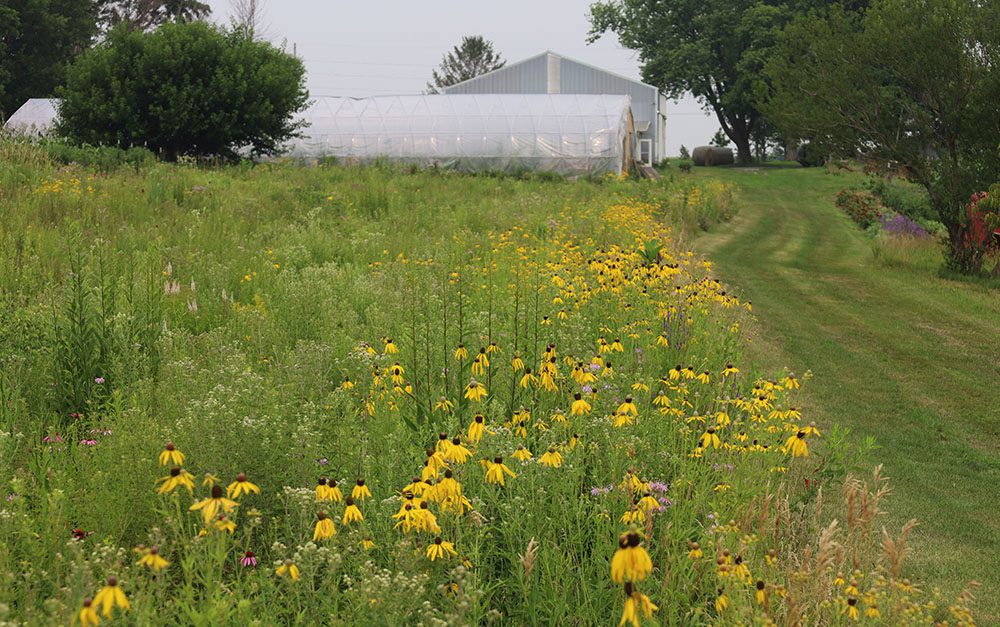
In July, we took a trip to the Scattergood Friends School farm.  Scattergood is one of the farms we have traditionally visited to do some work and share some food each year.  Our friends there have a bit more land to work with than we do and they also have a very different landscape to work with too.

Certainly they use flowers in their vegetable planting.  And, yes, they have pasture area, trees, bushes and other spaces that provide a long range of bloom period to feel the wildlife and the pollinators.  They also worked with Xerces to establish a perennial pollinator habitat.  

While I was there, I took out the camera and took a few pictures, focusing on some of the flowers that were blooming at the time.  There were only a few of these Butterfly Milkweed plants near the edge of the planting, but I was able to get close enough without tromping through the plot.

Then, just this last weekend, we visited Blue Gate Farm.  Our friends there are also part of our peer mentorship group.  Again, there are similarities to what we do and what Scattergood does.  And, of course, there are differences.

While Tammy and I both work off the farm now, this is not true for our friends at Blue Gate.  The farm produces their income, so they need to be aware of money-making opportunities, while also working to provide pollinator habitat.  

What it looks like when a larger bumblebee flies right in front of the camera!

Of course, our friends at Blue Gate recognize that a healthy pollinator population is a key for the production of many of the crops they hope to sell.  But they also look to the beautiful flowers as a source of income, selecting a wide range of blooms that they can harvest and sell as flower arrangements.  So they select many of their annuals based on blooming habits that provide excellent cut flowers over a longer season of production.

While Blue Gate might not use borage or marigolds as much as we do (because neither provide excellent cut flowers for sales), they are also intent on providing habitat.  They're just hoping that their efforts can be repaid both by flower sales and by pollinator services.

In all three examples, the Genuine Faux Farm, Blue Gate Farm, and Scattergood, diversity is a central theme.  That diversity provides a longer bloom time and provides different flower types that appeal to a wider range of pollinators.  Also, in all three cases, there is wild space, there are perennial and annual plantings, and a desire to avoid insecticides that will kill the pollinators.

Yet the biggest similarity might be the hearts of the farmers that want to build these Pollinator Paradises - even if the ways they go about it are different.

Monday, August 28, 2023

Coneflowers and Goldenrod

The coneflowers are just past their peak at the Genuine Faux Farm and the goldenrod is just getting going.  Of course, that doesn't mean we don't still have blooming coneflowers - they will have flowers for a while yet.  But, the peak, when there were very few flowers at the tail end of their quest to produce viable seed and most were at their very best for attracting pollinators (and the attention of this human) was clearly just last week.

At one point in time, we had some very specific places we had planted coneflowers.  Over time, the seeds have found new places to grow and the original plants are likely long gone.  Now they show up here and there, especially in the southwestern portions of our farm.

Goldenrod is not something we have purposely added to our landscape at the Genuine Faux Farm - though I wonder why we haven't done more with it sometimes.  Maybe it's because it introduces itself where it will anyway?  

Like the perennial planting by the cherry tree?
 

I wanted to clean that planting up this year, especially since we had lost part of the tree in the big storm a couple of years ago.  We've lost another chunk of it this Spring, too.  But, once I recognized this was a nice batch of goldenrod, I decided to leave it for now.  

All sorts of pollinators will love this patch - and I love our pollinators.  So... there it is.  As always, the hard part is trying to figure out the balance between some of the things I like with the things nature likes.  On our farm, this feels like a continuous negotiation that goes something like this...

Mother Nature: "How about a nice BIG patch of goldenrod where you planted those iris."

Farmer Rob: "Um...  I would rather that go over..."

Mother Nature: "And while we're at it, some thousand-flower aster would be great next to it."

Farmer Rob: "But that's where I put the iris and day lilies!  Could we just..."

Mother Nature: " And that cherry tree....  it needs some trimming."

Farmer Rob: "Ok, I'll take it down the rest of the way."

Mother Nature: "Here's a great crop of cherries this year."

Farmer Rob: "Does my opinion count for anything here?"

Mother Nature: "Wait.  Were you talking?"

It can certainly feel like two one-sided conversations that don't seem to meet in the middle.  But, I remind myself that we did introduce the coneflowers and Mother Nature seemed to appreciate that.  Our bush lines are homes to many birds and other critters and Crazy Maurice is here because we invited him.

So maybe we do participate a little bit in ways that Mother Nature approves of?  

Or maybe she just approves of our willingness to learn to approve of goldenrod and coneflowers.

Have a great week everyone!

Tuesday, August 8, 2023

Supporting Pollinators with Lawn Diversity

I realized I had fallen behind in sharing some of my Pesticide Action Network writing that is published on their website.  This is one of those cases where I started the thought process on our farm blog and then refined it for a broader audience.  This way you get to see both!  This was published on June 22 in PAN's News and Analysis on the website.

---------------------------------------------

Pollinator Week happens once each year and I always hope to write one or two articles for PAN to get the word out that we can and must support our pollinators. But, as a steward of a small-scale, diversified farm, I can’t afford to think about pollinators for one week. I think about them year-round.

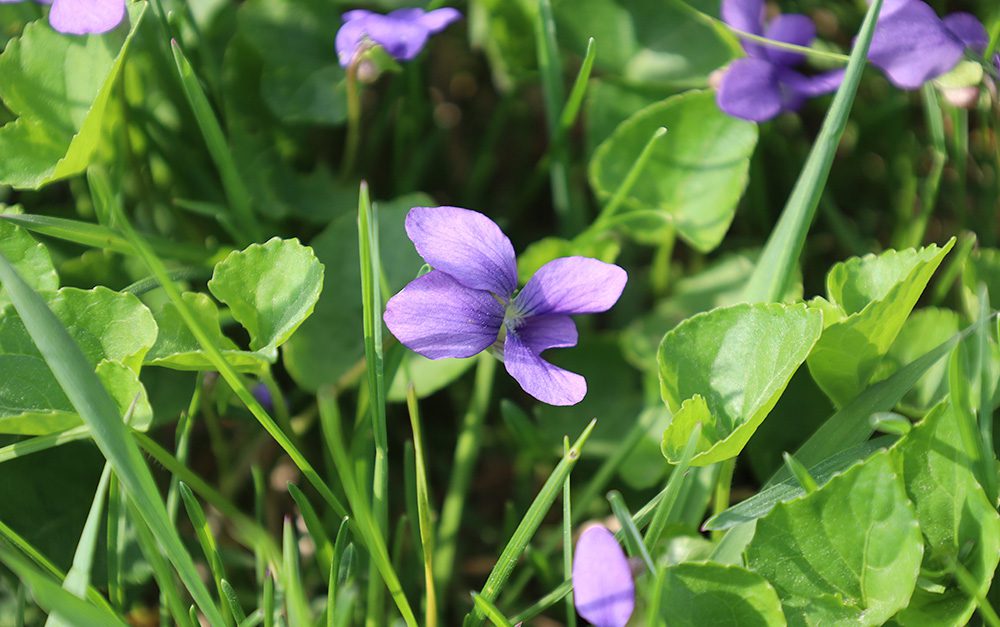
In late April and early May, the grassy areas on our farm were dotted purple with Common Violets, especially under the oak trees and by our smaller high tunnels (a hoop house where we grow vegetables). These little lawn jewels bloom longer in years when we aren’t having our ninth driest May on record. Seeing them got me thinking about how strange it is that we have allowed ourselves to be convinced that less life is better in the outdoor spaces around us, that a “well-maintained” lawn is preferable to a diverse landscape that provides food for our pollinators.

Clover, dandelions, and violets – oh my!

I remember spending a fair amount of time outside and on the ground when I was a kid so I could look at clover, dandelions and violets. My siblings and I even bought into the May Day idea of collecting some of the early spring flowers and putting them into baskets. The only difficulty was figuring out which houses would appreciate finding one of those little baskets at their door after we put them there, knocked – and ran away.

Not everyone saw the beauty in a small, sometimes bedraggled, bouquet of flowers. It’s kind of a shame that so many people didn’t, really.

Violets are an indicator of healthy diversity

If you were (or still are) one of those children who took some amount of delight in picking a few Common Violets, you would know that each flower appears atop its own stem that comes from the top of the root ball. There are no leaves, or other flowers, that share the stem. This means they are perfect for miniature flower art projects.

Violet

Every so often, I have found violets that are white, which seems like a conflict of interest or something. Aren’t violets supposed to be . . . violet? Well it turns out that is true, except when they’re white, or maybe even yellow. While yellow violets are a different species, the Common Violet can sometimes have white coloration. We had a couple of plants that featured mostly white flowers down by the high tunnel last year, but I did not see them this year.

Yes, I noticed that they weren’t there. Yes, I went looking for them. And, yes, I missed them.

Some people herald violets for their potential as a foraged food in natural landscapes. Both the leaves and flowers are edible, though I will admit that I prefer observing them to eating them myself. On the other hand, there is another camp that sees violets as a nasty weed to be controlled. After all, you wouldn’t want a slightly different texture and a little color to become part of our urban landscape!

At least some lawn care sites provide a little balance, citing the Common Violet’s beauty and potential as a food item – before telling you how to kill them with herbicides.

Dandelions welcome

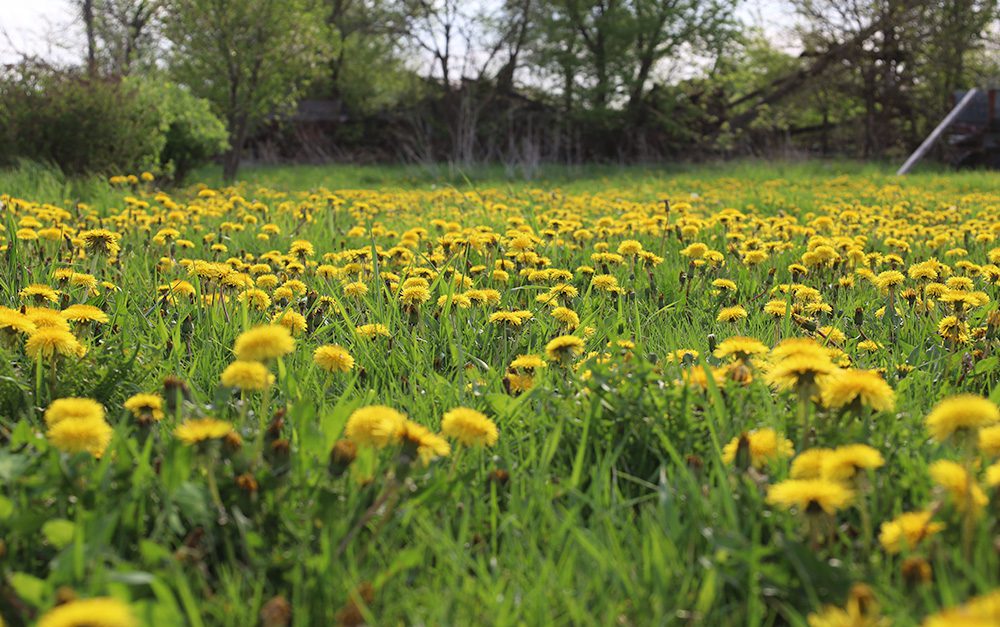
Perhaps you don’t think it’s odd to look for violets, but you do think I am at least a little strange for enjoying a nice, healthy bloom of dandelions. But maybe you would change your mind if you noticed the bumblebees bumbling their way around the flowers during their early season flights.

dandelions

Isn’t it strange how we have somehow decided that clover, dandelions and violets are all undesirables in our lawns and grassy areas? It is documented that Europeans brought dandelions with them as both a food and medicine. Some sources make the claim that dandelions were introduced to North America by the Puritans in the 1600s, though the actual introduction to the continent is a bit less certain.

We wanted dandelions in our lives until we started listening to the sales pitch that they should be killed. Especially if we spent the money for products promoted by the pesticide and synthetic herbicide industries.

From a soil health perspective, we like the way the deep taproots of the dandelion loosen and aerate the soil. We feel that these same roots bring nutrients up from deeper soil layers so they can be used by other plants. And, because they draw most of their moisture and food from a deeper soil layer, they often don’t compete with our food crops, so they aren’t a bad weed for a vegetable farm.

We can relearn that clover isn’t bad

And then there is the clover. Prior to the 1960s, clover was a regular part of lawn seed mixes until the herbicide industry began selling the idea that grass, and only one kind of grass, should be welcome in a “well-maintained” lawn. I still remember that barefoot children always took note of where the clover was so they didn’t accidentally step on a bee and get stung! Now, barefoot children stay off the lawn because it’s been recently sprayed with pesticides.

Give me more clover, more violets and even more dandelions. Certainly, there will be places on our farm where we remove some in favor of other plants. But as far as weeds go, these three are our friends. And, they, along with other flowering plants, provide a long season of food for our pollinators.

Friday, August 4, 2023

Conservation Programs Have a Place in the Farm Bill

The following was published in Pesticide Action Network's Ground Truth blog on July 19 and I thought some might like to read it here if you didn't notice it there.

--------------------------------------

The Yellow Coneflower and the Monarda are just entering peak bloom in two small fields that are within a couple of miles of our farm. Each of these plantings are new within the last few years, and were funded by the Federal Pollinator Habitat Initiative (CP-42) under the Conservation Reserve Program (CRP). Along with the Conservation Stewardship Program (CSP), these are initiatives that are part of the Farm Bill of which I have seen positive results.

While it is important to recognize that these programs are, in my opinion, not enough to address a whole host of problems that come with large-scale, chemical-intensive cropping systems, they do illustrate for us the potential we have to be better stewards of and partners with our land.

farm field grass

Giving water a place to be

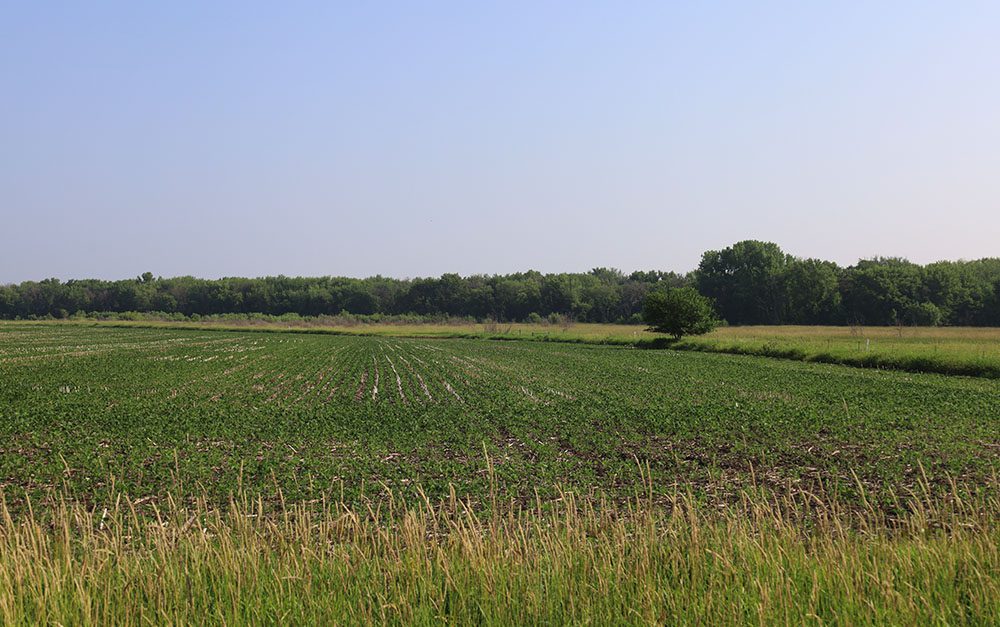
During the first seven years we lived at the farm, we observed the frequent occurrence of flooding in a field a few miles away and adjacent to the Wapsipinicon River. Each year, the land was planted with corn or soybeans. And, most years, a flood would damage the crop and wash valuable topsoil away.

Thankfully, the landowner eventually accepted federal assistance to take that land out of production and put it into perennial plant cover. While they still plant the higher ground in corn and soybeans, the low ground is now built to handle the ebb and flow of a river that is being asked to deal with more frequent heavy run-off as extreme rain events have become more common in this part of the world due to climate change.

This also means there is more space for Red-winged Blackbirds to nest and Dickcissels to sing.  Wildlife has a bit more of a corridor to travel as they seek food and fresh water. And our eyes are given the opportunity to see something other than another corn or soybean field in Iowa.

That, in itself, is good for my soul.

farm rows

Letting water move without taking soil with it

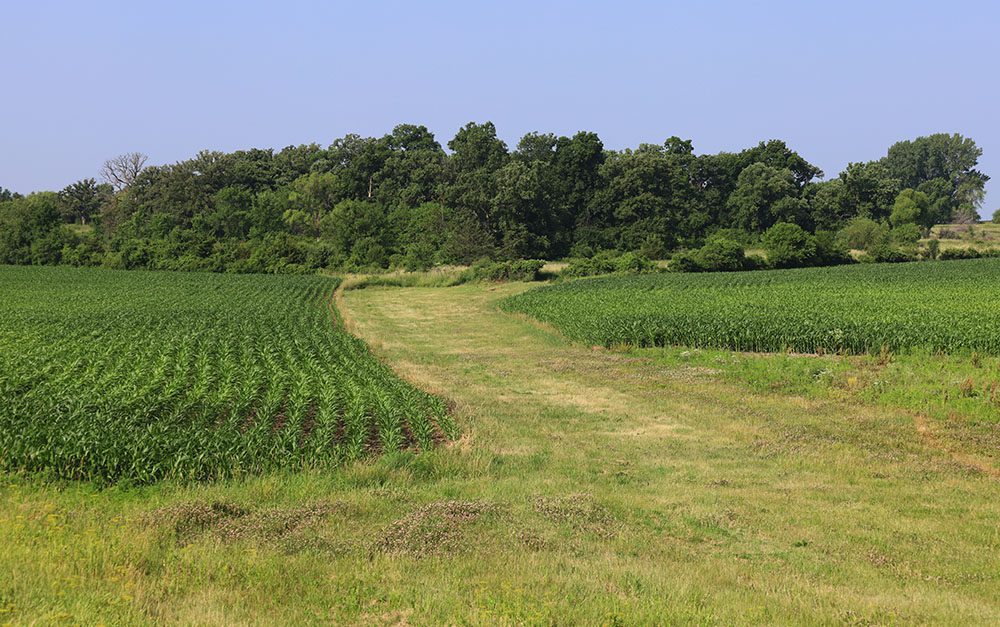
Some row crop farmers also take advantage of federal funds that are part of the Farm Bill to seed down parts of their fields with perennial cover crops where water run-off typically goes. In Iowa, they often select grasses that they can cut, bale, and use for animal bedding or feed during the winter months.

Sometimes these waterways are fairly generous, like the one shown above. But there are still many fields where no effort is made to identify where water runs. These fields often show deep runnels where soil has washed away during the spring rains before the annual crop has had a chance to establish significant roots in the ground.

Funding for programs like these help farmers do things that are better for the land. This is especially true when we consider those who work on smaller family farms, where the budget for these sorts of projects is often tight. My observation for where I live is that these farms are typically more likely to seek out and follow through with these projects, while the larger, corporate farms are happy to seek out the funds, but not as happy to take any land out of production.

farm wildflowers

Impacts go beyond a single field

While it is true that there are farmers who would act on their heart’s calling to be a steward of the land without external support, it is also true that this support makes it easier to do just that.  And, we need to remember that the success of one field of pollinator habitat, or a wetland area, or even a single in-field waterway, has impact beyond the borders of the land where the project has been undertaken.

We have noticed that a few wildflowers have moved into the ditches by the road between our farm and the nearest pollinator planting. We have also noticed the diversity in the populations of pollinators on our farm have improved slightly. While we are still concerned about the overall health of these populations due to the extreme use of pesticides in our area, we also see the power of nature, as it shows us it is still interested in sharing the beauty of the world around us.

The projects that are undertaken to handle the flow of rainwater also have impacts beyond the borders of the fields where they reside. A well-placed waterway planting can keep more soil on the land and less in our rivers and the Gulf of Mexico. A wetland near the Wapsipinicon River not far from our farm can absorb and slow the flow of floodwaters before they reach communities downstream, possibly making a difference in many lives.

Maybe these programs aren’t the perfect solution, but they can be a part of moving towards better solutions. I want to make sure we don’t walk backwards and take even these pieces of progress away in future versions of the Farm Bill – because look at the positive results that even smaller efforts can provide.

Monday, July 3, 2023

Another Unsung Pollinator

Over the last few years I have been gaining more appreciation for pollinators and beneficial insects (and other critters) that can be found at the Genuine Faux Farm.  Yes, I've always had some appreciation for them, but I think it is safe to say that we all start out with some basic knowledge and appreciation - somehow most of us learned early that honeybees and butterflies are good.  But after that, the appreciation of the general populace for other critters is spotty, at best.

In my case, I willingly admit that my understanding and acceptance of different pollinators is an ongoing project.  It all starts with a willingness to learn about them.  It's always harder to feign indifference or outright hostility when you know more about someone or something.  And, after last year's endeavor to learn more about wasps, I find myself looking harder at the various wasp-like creatures and finding a wide range of types and temperaments.

I was doing some small-engine maintenance and I noticed this little critter fly by me with a long blade of dry grass.  It was dry grass mostly because that's all we had a little over a week ago.  So, this picture is from the days when rainfall was only a myth at the farm.

The wasp pulled the grass into the pipe and was in there for a while.  So, I thought I'd try and get a picture of it emerging.


If you look carefully, you can see it peeking out at us here.

Now, truth in advertising the FIRST picture you see in this blog is actually later than the second.  I didn't have a camera when I first noticed my little friend, so I dashed to get the camera and hoped I could catch it as it emerged and flew away from the pipe.


The next picture I took, thinking I would catch it emerging was this one.

I was a little slow.

Look carefully at this picture towards the bottom right.  You will find my little friend's head.  I actually captured it in mid-flight, but barely in the frame of the picture.  It's almost as if it were teasing me on purpose - or intended to photobomb me.

Happily, it did return and repeat the process of pulling a piece of dried grass into the tube, where it was most certainly building a nest.  Now, I have to figure out how I want to handle this bucket with pipes that I intended to recycle because I don't want to disturb the nest!

I did spend a little time looking and found out that - surprise surprise - this has been named the "Grass-Carrying Wasp" and has the scientific name Isodontia mexicana.

This particular wasp had a beautiful purple sheen to its wings and it was very industrious in building a next for its young.  It would go find a nice blade of grass, cut it off and then carry it back to the pipe.  There are some great pictures from the site I referenced above of the nest, so I suggest you take that to see more images and to learn more about them.

These wasps are not aggressive.  I suppose if you tried to hold one in your hand and keep it captive, it might feel like it had no choice but to sting.  Otherwise, it's more interested in building a nest, or finding some food, than it is in you.  Yes, sorry, it isn't all about you.

These wasps tend to hunt crickets and will visit flowering plants for nectar - making them yet another unexpected pollinator in our world.  They often show a preference for white flowers, though I know I have seen them on Goldenrod in the past.  The nectar provides energy for the female as she works to build the nest for her young.

I haven't noticed this wasp recently, so the nests must be complete.  Maybe now is the time to decide where they will stay until the young hatch.

Tuesday, June 20, 2023

Appreciation for Different Pollinators


When I first entered the world of growing professionally, it was tempting to assume that any new insect was intent on destroying my crops.  The acts of placing seeds in the ground and nurturing plants for food are not effortless, nor is the process worry-free – a lot can happen between germination and harvest.  So, it makes sense that growers risk falling into the trap of focusing on the pests.

However, it is equally important for farmers to learn about invertebrates that work with us – as well as those that are steadfastly neutral with respect to our crops – to successfully steward our land.  Many of the crops on our diversified farm rely on pollination services to produce the food we hope to make available to others.  Last year, for Pollinator Week,  I spent some time learning more about wasps and their role as pollinators.  This year, I wanted to explore some other, less well known invertebrates and their powers of pollination.

Hoverflies – they’re everywhere

I will readily admit that I have not given much thought to hoverflies (also known as flower flies or syrphid flies) until I started a project four or five years ago to take photos of the insects that we could find around our farm.  As I began the work of identifying the insects in these images, I was surprised to find many in the family Syrphidae.

Hoverflies can be found on every continent except Antarctica and there are approximately 6,000 known species.  Hoverfly populations are often greater than wild bee species, so even if they are less efficient than bees, they can make up for that with their relative abundance.  On our farm, we have noticed Oblique Stripetail Hoverflies more often than any other hoverfly.  It turns out that these insects are good pollinators and their larva will predate on aphids, one of the pests we want to control on our farm.

Research on hoverflies has been sparse, but one study suggests that true flies (Diptera) are the second most important order of pollinating insects after Hymenoptera (bees, wasps and ants).  Hoverflies are generalists, visiting a wide range of plants looking for nectar as a food source.  Unlike most bees, they are not restricted to a limited home range and they can carry pollen over longer distances while foraging or during migration.

Green Bees – showy and shy

Another insect that has had my attention for a while is the Green Bee or Green Sweat Bee.  We can’t help but notice them because their sparkling green color is almost startling.  The problem for me is that they are a bit shy, preferring not to pose for the camera.  And that’s why I am pleased to offer up this cropped photo that provides evidence that I finally succeeded in capturing an image of one.

Green Bees will visit a wide range of flowers, though they favor asters, goldenrods and coreopsis in late summer and fall on our farm.  Once they emerge in the spring, they will forage until the fall, so they have to adjust their food sources as the year progresses.  I have observed them visiting the small flowers on maple trees in the early spring and squash flowers in the summer.

Green Bees are typically ground nesting, though some will use hollow twigs and logs.  The parent Green Bee will mix pollen and nectar with their own saliva to leave as a food source once the larva hatches.  It has been suggested by some scientists that the saliva keeps the food fresh and helps to protect the eggs in their sealed chamber.

Simply knowing a few facts about Green Bees has encouraged me to continue our farm’s program to leave areas of the ground undisturbed, rather than tilling everything.  It also solidifies our desire to leave leaf litter and brush piles as natural areas.

Soldier Beetle – they eat, you harvest

The Soldier Beetle is another frequent visitor to our growing areas at the farm.  When I first became aware of them, I mistook them as a pale-colored lightning bug.  But, once I started farming in earnest, it didn’t take me long to identify who they really were.

My opinion of the Soldier Beetle became much more favorable the moment I learned that they are great predators of caterpillars, aphids and other soft-bodied insects that find our vegetable plants attractive.  These beetles have one generation of young each year, while some types of aphids can have eight or more generations of young.  If you ever need an example to explain why broad-spectrum insecticides are a bad idea, here it is!  The pest can rapidly repopulate while the predator cannot.

While Soldier Beetles might supplement their diet with pollen and nectar, they particularly like to visit flowers where they can lie in wait for their prey.   We see them most frequently around our farm in August and September.  They are frequent guests on some of the flowers we intercrop with our melons and squash.  As a result, they appear on the vine plants as well.


Hawkmoth – long tongue, will pollinate

It’s hard not to be fascinated by the Hummingbird Moth or Hawkmoth as it hovers over flowers seeking nectar.  Their flight patterns are similar to a hummingbird and we typically see them around our farm in the evenings, though we might also see them earlier in the morning.

I wanted to include the Hawkmoth to remind all of us that pollinators are not dedicated to servicing the food crops farms like mine grow.  As a matter of fact, some hawkmoth larva can cause problems for our crops.  I’m looking at you, Tomato Hornworm (Five-Spotted Hawkmoth)!  But it is important to recognize that this is just one type of hawkmoth and there are ways to deal with the Tomato Hornworm naturally.  At my own farm, we’ve simply recognized that their population isn’t too large and the small amount of damage they might create isn’t a problem.  As long as our natural system is balanced, they don’t qualify as a pest – especially when you consider their value as pollinators.

Hawkmoths have a long proboscis that enables them to reach into flowers that keep pollen and nectar deep within them.  Many plant and hawkmoth pairings have evolved over time.  The hawkmoth receives food and the plant gets pollinator services.  If either the plants or the hawkmoths are removed from the natural system, the other will die off.

Hawkmoths can carry pollen as much as fifteen to twenty miles from the source, unlike honeybees that typically go no further than three to five miles from their hive.  As humans continue to develop land areas, wild plant populations become more fragmented.  The hawkmoth’s sturdy build and ability to fly longer distances makes it possible for pollination to occur even when plants are not nearby.

If it’s on a flower and it moves…

The process of learning more about different kinds of pollinators has increased the depth of my appreciation for the incredible diversity in the natural world that surrounds us.  I am coming to understand that I won’t always see the value any given organism brings to the world until I explore more.  And even if I don’t discover a redeeming feature, that doesn’t mean there isn’t one.

But I think I have discovered one thing that seems certain.  If it’s an insect on a flower and that insect can move to another flower, it has a chance to carry pollen and support the next generation of plant life.

-------

For those who are interested, this is my latest blog for Pesticide Action Network that is intended to draw attention to pollinators during Pollinator Week.  One of our efforts at PAN is to fight against the overuse of pesticides that harm our pollinators.  Part of my job is to remind everyone that pollinators are important, interesting and worthy of protection.  I hope you will take some time to consider this issue.

Friday, June 2, 2023

Not Beneath Our Notice


In late April and early May, our lawn areas were dotted with purple (and sometimes white), especially under the oak trees and by Eden, the smaller of our two high tunnels.  These little lawn jewels bloom longer in years when we aren't having one of our top ten driest May months on record.  But, that doesn't mean we can't enjoy them when they are there.

from KWWL
I remember spending a fair amount of time outside and on the ground growing up so I could look at clover, dandelions and violets.  My siblings and I even bought into the May Day basket idea of collecting some of the early Spring flowers and putting them into baskets.  The only difficulty was figuring out which houses would appreciate finding one of those little baskets at their door after we put them there, knocked - and then ran away.

Yes, it's true.  Not everyone saw the beauty in a small, sometimes bedraggled, bouquet of flowers.  It's kind of a shame that so many people didn't, really.

If you were (or still are) one of those children who took some amount of delight in picking a few Common Violets, you would know that each flower appears atop its own stem that comes from the top of the root ball.  There are no leaves, or other flowers, that share the stem.  This means they are perfect for miniature flower art projects.

Every so often, I have found violets that are white, which seems like a conflict of interest or something.  Violets are supposed to be violet colored, except when they're white, or maybe even yellow.  While the yellow violets are a different species, the Common Violet can sometimes have white coloration, occasionally mixing the color violet with white.  There was a couple of plants that featured mostly white flowers down by Eden last year, but I did not see them this year. 

Yes, I noticed that they weren't there.  Yes, I went looking for them.  Why?  Is that weird?

Perhaps you don't think it is weird to look for violets, but you do think I am at least a little bit strange that I enjoy a nice, healthy bloom of dandelions.  But maybe you would change your mind if you noticed the bumblebees bumbling their way around the flowers during their early season flights.

Getting back to the Common Violets, however, it is interesting to note that some people herald them for their potential as a foraged food in natural landscapes.  Both the leaves and flowers are edible, though I will admit that I prefer observing them to eating them myself.  On the other hand, there is another camp that sees violets as a nasty weed to be controlled.  After all, you wouldn't want a slightly different texture and a little color to become part of our urban landscape!  At least this lawn site gives a little balance, citing the Common Violets beauty and potential as a food item - before telling you how to kill them.

Isn't it strange how we have somehow decided that clover, dandelions and violets are all undesirables in our lawn.  While some people make the claim that dandelions were introduced to North America by the Puritans in the 1600s, the actual introduction to the continent is a bit less certain.  However, it is documented that Europeans brought dandelions with them as both a food and medicine source.  If you are wondering how to eat dandelions, try this source.

From a soil health perspective, we like the way the deep taproots loosen and aerate the soil.  We feel that these same roots bring nutrients up from deeper soil layers so they can be used by other plants.  And, because they draw most of their moisture and food from a deeper soil layer, they often don't compete with our food crops, so they aren't a bad weed for a veggie farm.

And then there is the clover.  Prior to the 1960s, clover was a regular part of lawn seed mixes until the herbicide industry began selling the idea that grass, and only one kind of grass, should be welcome in a "well-maintained" lawn.  I still remember that barefoot children always took note of where the clover was so they didn't accidentally step on a bee and get stung!  Now barefoot children stay off the lawn because it's been recently sprayed with pesticides.

It's amazing to me that we have allowed ourselves to be convinced that less life is better in the outdoor spaces around us.  Well, I don't buy it.  Give me more clover, more violets and even more dandelions.  Certainly, there will be places on our farm where we remove some in favor of other plants.  But as far as weeds go, these three are our friends.  Maybe there are some other new friends we will also learn to get along with too?  We're always open to learning and we'll let you know as we do!

Thank you for considering my words and thoughts.  Have a wonderful day and a fine upcoming weekend.

Saturday, May 6, 2023

Pasque Flower Season

It's early May and some of the Pasque Flowers are already starting to fade, though they are also teasing us with a few more blooms.  We first 'discovered' these wonderful perennial plants several gardens ago when we lived in Minnesota.  We realize that most perennial Pasque Flowers that are sold in nursery's are the European varieties (pulsatilla vulgaris) where as the natives to the United States may be found as Pulsatilla patens  or Anemone patens.


For those who like wildflowers, I would like to point out that the first link takes you to a page on the US Forest Service website and the second to a site dedicated to Minnesota wildflowers.  Here is yet another from University of Wisconsin.  It seems that the US Forest Service page is not a permanent one as they feature a wildflower periodically and then move the web page to a new address when it gets featured again.  I admit that I get mildly nervous when excellent web resources that are put together by some of our government agencies disappear or are threatened for various reasons.  But that's probably another day's writing.


The horticulture Pasque Flowers have been hybridized to develop some variety in color and flower form.  We have seen colors ranging from red to white.  Personally, I might prefer large numbers of the native plants, but I find that I am not immune to appreciating some of these varieties as well.  The natives tend to bloom about a week to ten days earlier and they can handle much more competition than the garden varieties people might buy at a nursery. 


The flowers are featured on these plants much earlier than the leaves, which is true for many early flowering perennials.  As the season progresses, these leaves will get much bigger and the flower stalks will stretch out above the plant to hold their seeds high for potential distribution to a new location for a new plant.  If given the chance (with a bit less competition) the leaves can be quite attractive until we hit August.


The other nice thing about Pasque Flowers?  They can handle a little snow and cold.  Even if that snow comes in May (which was when the picture above was taken).  Obviously, I am NOT talking about this May.  Please not this May....
 

The 'fruits' or 'seedheads' on the plants actually can be quite decorative as well.  This year, we've noticed that some of our other plants are encroaching a bit on our Pasque Flowers more than they used to.  Maybe we'll move one or two to a new location so we can enjoy them more?  I don't know.  I guess we'll wait and see where the energy is for such things.

But, the best thing about these flowers?  It's seeing the first bit of green pushing up out of the soil - daring us to hope once again.

Wednesday, October 12, 2022

Leave the Leaves


No one rakes the forest.  

Or, no one should rake the forest.  Because I suspect there are places where trees cover up the clear blue sky and humans feel compelled to rake the fallen leaves into piles and then burn or bag them up.  Well, actually, I don't just suspect.  I know there are people who live in forested areas and then work themselves into a tizzy because they just HAVE to get all of those $%@# leaves raked up!

Sure, I get it.  We want people to see that we care about where we live.  And, too many of us have gotten it into our heads that leaves on the ground are a bad thing.  

It's not just that.  Sometimes people see Fall as a time of closure.  If you clean up the yard and the outdoor areas around you, it says "ok, Summer's over and I'm prepared for the Winter."  All of the mistakes you might have made in your yard and garden can be erased with a good mowing down and raking up.  And, we don't have to see the stems that were once beautiful flowers.  Sometimes those reminders are painful.  These things were beautiful for such a short period of time, and now there is only this dry bunch of sticks and leaves.  The green leaves are tattered and not as lovely as they once were.

Things are ragged.  Tired.  

And we don't like ragged and tired, because we don't want to feel ragged and tired ourselves.


Sometimes people clean things up because they don't want to admit to themselves that the growing season is over.  There is still a desire to do more.  More weeding, more caretaking.  But the options are a bit more limited in October in the northern areas.  So clean it up.  It shows progress and there is definitely significant visual changes that can be quite satisfying.

Or maybe it's the old "get it done" feeling.  We know we're going to want to clean it up at some point, so might as well do it now.  There is always something to that attitude.  If a person feels like doing something now and they might not feel like it later, then ... why not?

Well, there are a whole bunch of reasons "why not."  And they are all hoping that you don't mow your lawn that "one last time" and you leave the leaves and plant residue in your perennial plantings and annual gardens.  So, once again, I am using the farm blog to ask those who read it to consider things you can do to support pollinators and other beneficial critters where you live.  And, I will also you point you to the Xerces Society, which is pushing the #LeavetheLeaves campaign this year.

The Genuine Faux Farm has evolved its approach to Fall clean up over the years.  Some of it has been due to changes in what our farming goals have been.

For example, when we would grow a full 200 foot by 60 foot plot of tomatoes and basil, complete with straw mulch in the tomato rows - we had a particular strategy for that area.  The basil plants and straw mulch were left to provide shelter, collect snow and prevent soil erosion.  Ideally, we would pull all of the tomato cages and trellising and get the tomato vines out of the field.

The choices we made were balanced between what we had to accomplish given the labor hours we had available, the possible pathogens we might support if certain plant residues were left all winter, and a desire to support a diverse ecosystem.

Over time, we started being more intentional with our desire to not mow the lawn and pasture areas down too low in the fall months.  We usually haven't bothered with raking because the wind tends to distribute our leaves widely before we have a chance to even consider it.  We have, sometimes, run the mower on high to cut up the leaves some in areas where we felt it was important to keep things a little neater.  For example, there are paths and places where we still have to walk during the cold months.  If you add taller grass and other obstacles to snow, it can get lead to a few more tumbles than either of us really wants.

This year the Genuine Faux Farm is going to have to make some more choices about what we cut down and what we leave standing.  We balance future plans with current needs.  And not all of those plans and needs are focused on us.

That's why our farm doesn't mow it all down.  That's why our farm leaves the leaves.  That's why things aren't always straight lines, neat borders and level cut, same species grass.  

It's not that we don't care how things look.  It's just that we aren't necessarily catering to how humans think it looks.  Sometimes we hope the snakes, toads, bumblebees, predator beetles and other critters like what they see at our farm.