Showing posts with label Researchers R Us. Show all posts

Friday, May 5, 2023

Researcher or Research Subject?


I was cleaning the turkey room recently (preparing for a new flock in 2023) and came across something that concerns me a little bit.  I found some paper - and it was not paper that was shredded for bedding.  This paper had writing that had been put there in a chicken-scratch hand... er... no... a turkey-scratch hand that looked like it was intended for someone other than the farmer.

This document had been made to look like one of our turkeys wrote it and we're not sure who might have placed it there.  The alternative - that one of our turkeys actually wrote this - is a bit more disturbing than we are willing to admit.  So, we're wondering if you all could weigh in on the matter and give us some advice.

Here's what was on the paper:

----------------------------

Staff Writer: Ima Turkey

Individuals looking for an entertaining afternoon should look no further than the Genuine Faux Farm. We have found the guy with the red hat to be extremely amusing as he runs around the farm. In fact, we are conducting a study to find out what sorts of actions/sounds he can be made to respond to (see Pavlov and others). Since he is not really an intelligent being (unlike us turkeys), we have no fear that he will figure out that we are conducting experiments regarding his behavior.
 
Observations thus far:
  • Subject tends to mumble audibly when one of us flies onto or over the fences
  • Subject will hesitate in making a choice chasing us (when we're outside the fence) if we divide our numbers and go in opposite directions
  • Subject makes strange "hahaha" sounds whenever we run to/fro our room and the gate in the morning.  We think it is a nervous tic of some kind.
  • Subject tends to throw yummy produce to locations in the field where one of us is NOT located, though he does tend to have a left/right/forward/back pattern.
  • Subject can be trained to bring more tomatoes and cucumbers by eating them quickly.   Similarly, the subject seems to reduce offerings of other food types if we show less enthusiasm.  Have not yet managed to get ice cream.
  • Subject appears to have limited language ability.  Has attempted to respond to "crowd gobbles."  Enunciation is terrible.  We highly doubt the subject has understanding of the meaning of the words.
  • Subject has been trained to allow us to drink out of the hose periodically.  However, Muck learned that subject isn't terribly steady with the hose after getting a face full of water.  Subject has not shown consistency in allowing us to drink out of the hose.  We continue to work on finding a proper prompting action to elicit the desired response.
  • Subject appears to respond to sunrise and sunset with certain activities, including bringing us food and water at sunrise and coming out to see us into our room at night.  Has apparently imprinted on us.  Though subject does show independence - thank goodness.  Who would want to deal with THAT all day and night?
  • Subject has been trained to respond and come into view on certain calls, but appears unaware of the desired response once in view.  We remind ourselves that we must take baby-steps in this process.
  • Subject appears to be unaware of our scientific endeavors - our ruse continues to be successful.
We expect to make a final report to the community in December regarding this study.
Respectfully,
Ima Turkey

-------------------------

Well, there you have it.  Once again, advice would be appreciated.

I don't know what exactly was going to happen in December, but I think it might be a good thing we had a trip to "the park" scheduled before that.

Thursday, March 16, 2023

It is Not This Day


Tammy and I have been regular attendees of the Practical Farmers of Iowa Cooperators Meeting for some time, and it has been odd to have missed each of the past couple of years.  This is what happens when your life changes.

The two-day Cooperators Meeting features discussion and presentations on how research projects fared during the previous year and then on designing new projects for the upcoming season.  It's a time to exercise curiosity and to seek camaraderie with other agriculturists who seek to become better at their craft by testing what we think we know and learning from careful observation.

Tammy was asked to give the closing remarks for the 2016 Cooperator's Meeting and she was a bit uncertain as to whether she should agree to do so or not.  It was certainly understandable, the meeting typically occurs late in the year, when Tammy's school schedule is fairly stressful.  Adding yet another thing to the "to do" list probably didn't sound all that attractive.  

Still, I encouraged Tammy to do it.  Why?  Well, I happen to think Tammy is far more creative than she gives herself credit for and I thought it would be useful to hear her perspective.  So, with some trepidation, she performed the task - and performed it well. 

In fact, it was liked well enough that PFI put it out on YouTube.  That's a compliment.  And I will continue with the compliment by including the video at the end if you would like to see it.  

But first, let me give you the text.  While this was all presented in a lighthearted fashion, there is a great deal of meat to what is being said here.  Take a moment and enjoy.

---------------------------------------

JRR Tolkien knew how to write a good story.  Is that an understatement, or what?!  For those of you who are not familiar with his work, John Ronald Reuel Tolkien, is an author and linguistic scholar, best known for his high-fantasy novels The Hobbit and the Lord of the Rings. He is also known for his intense attention to detail. I have long loved Tolkien stories and grown to appreciate the importance he placed on detail and accuracy.  “Close enough” was just not good enough.  

I see a lot of Tolkien's dedication to detail and knowledge in PFI farmers and our dedication to detailed research.  Rob has convinced me, despite my admitted preference for “I think” to move to “I know” on the farm.  Count it, measure it, record it, then plan it.  And, repeat - Count it, measure it, record it, then plan it.  

Tolkien writings offer so much timeless wisdom including this exchange early in the “Rings” journey:
“I wish it need not have happened in my time,” said Frodo.
“So do I,” said Gandalf, “and so do all who live to see such times. But that is not for them to decide. All we have to decide is what to do with the time that is given us.”

There are many things farmers struggle with - including increasingly extreme weather and uncertain economics and changing policies.  What we CAN do is decide what WE want to do with what we have – not just “Go along”.

At one point, one of the HEROES in the Ring Trilogy, Aragon, inspires his troops before a seemingly hopeless battle:
"Hold your ground, hold your ground! Sons of Gondor, of Rohan, my brothers! I see in your eyes the same fear that would take the heart of me. A day may come when the courage of men fails, when we forsake our friends and break all bonds of fellowship, but it is not this day. An hour of wolves and shattered shields, when the age of men comes crashing down! But it is not this day! This day we fight! By all that you hold dear on this good Earth, I bid you stand, Men of the West!"

I hope our farming does not seem “hopeless”, though we certainly face challenges.  So, with thanks to Tolkien and assistance from Dick Thompson:
 
Hold your ground,  Protect your ground!  Farmers of Iowa - Row Cropper, Grazier and Horticulturist.  
I see in your eyes that same passion for farm and soil that inspires me.   
A day may come when the courage of farmers fails, when we forsake our passion for sustainable, well managed farms and break all bonds with our history of smart farming.
But that is not this day.  
An hour of weeds, pests and disease, a day of intense pressure to conform, to “go along”, when the age of “thinking farmers” on diverse farms comes crashing down.   
But, it is NOT this day!  
This day we research!  By all that you hold dear for the good of this earth, I bid you, RESEARCH and LEARN, Farmers of the Land!

-----------------------------

It's a good thing to have great respect for your partner in life.  It's also good to be proud of their efforts, the things they produce and the heart they exhibit for the good things of this world.

It's an even better thing to be able to stand together for things we care about.  Perhaps the day will come where we can't.

But, today is not that day.


Monday, September 7, 2020

What Yield Data Can Do For You

A few years ago an idea was floated around the Practical Farmers of Iowa Cooperators Meeting within the horticulture group.  Without obscuring the point of this blog with too much detail, suffice it to say that growers and PFI staff recognized that it is NOT easy to get reliable yield numbers for all of the varieties and crops that exist.  This is even more true if you want numbers specific to the state of Iowa.  You could go to resources such as Knott's Handbook for Vegetable Growers to get some ideas about what you should expect to produce for a given hort crop.  But, the numbers there are general guidelines and may not be as useful depending on scale and location.

A Simple Yield Data Collection Tool

PFI has created a Yield Data Collection Site that is fairly simple to use and has the potential to be a useful tool for hort growers in the state.  

If you collect yield information and have records for planting and harvest dates.  If you can calculate the square footage dedicated for a given crop.  If you can answer some simple questions regarding your growing culture - direct seed, transplant, irrigation, under cover, etc.  Then your data could be a part of a useful aggregate that we all can use.

Start With One Crop Type

If you are interested in adding data, I strongly encourage you to do so.  And, if you do, concentrate on one crop first to get used to the tool.

In our case, we had onion yield data readily available for a few recent years.  I simply entered the data for one variety for one of those years, made sure to save it and THEN I used the 'clone crop' function to create a new copy.  I then edited the new crop with the data for another variety for the same year or for another year's results of the same variety.

Take a Moment and See What You Can Learn

Once I had three year's worth of data, for a total of 13 crops, I decided I wanted to learn what I could from my data AND the data provided by other growers in the state.


I did a search by crop - in this case - onions.  And I found that there were 48 records in the data base for onions at this time.  Entries came from various parts of the state and included records for growers with small production amounts as well as larger production amounts.  As I reviewed the data, I would say that we were a 'moderate sized' onion grower for those that had shared yield data.  However, I could see that we had the ability, with changes to how we do things, to scale up to onion planting areas that were as big or bigger than other farms that had reported using this tool.  This tells me that there are some potential models of comparison in the data should I wish to go that way.

I was curious what would happen if I wanted to look at a specific variety, so I chose the White Wing variety that we like on our farm.

I found five entries for White Wing.  Most of those were entries for our crops, so it was clear that I wasn't going to learn a whole lot more than I already knew at this point.  But, this illustrates the reason why it would be better if more growers entered their yield data into the site.  The data points are not excessive and the clone crop function reduces the effort significantly.  Did you raise White Wing onions?  Add some data so I can learn more!  Ok... add some data so you can learn more too!

The "export CSV" is an easy to use function that allows you to download the data to a spreadsheet so you can do some comparisons and do any of your own calculations you might like to try.   A snapshot of the data I received when I downloaded the CSV file for White Wing is below.

The data includes information on crop spacing, growing zone, irrigation, plant and harvest dates.  If you happen to see differences in the data from entry to entry, it is possible you might glean some of the reason for those differences based on the cultural information found there. 

I downloaded the CSV for all of the onions.  I then focused on the red onions to see what I could learn.  


The three entries at the bottom come from our farm. 

  • Column 3 is square footage for the crop
  • Column 4 is total pounds of production
  • Column 5 is pounds of production per square foot
  • Columns 6 and 7 give the plant spacing and the dates show the date range for harvest

The first thing that jumps out at you would be our harvest for 2018.  Over 1 pound per square foot is a ridiculous number.  But, as far as that year was concerned for our red onions - it WAS a ridiculously good year.  So, we can take that as an example of what might happen if the planets align and everything goes right.  We clearly cannot expect that on a yearly basis.

On the other hand, it seems that numbers from .42 to .69 pounds per square foot are not out of the question in Iowa for red onions.  Based on this information, I might say that a half pound per square foot would be a reasonable goal for a grower in the state.  But, of course, the data set is still small, so you have to be careful about what you conclude.

Other information that might be of use to a grower includes the harvest date range.  You might notice that our harvest dates (again the last 3 entries) are significantly later than other growers.  By the same token, if you were to look at the planting dates, you might also notice that we are slower to get things in the ground as well.  What this data does is give a grower reasonable date ranges to work with and still be able to expect a crop.

You might also notice that the harvest date ranges are small - with a start and end date typically being one or two days apart.  This is no surprise to most growers as they typically harvest all red 'storage' onions at the same time.  Wider harvest ranges indicate crops (like tomatoes, peppers and beans) that are harvested more than once.  In that case, you might get an idea as to what a reasonable harvest window might be.

Take A Moment, Enter A Crop on a Rainy Day

So folks - since Iowa needs rain and some appears to be on the way - use a rainy day to enter some horticulture crop data into this useful tool.  If we can all manage to do a bit of this here and there, we will benefit in the long run.  We will listen to our own recommendation and enter ten entries for green bean data next.

And, before you think I don't understand that this sort of thing can take time - and time is often in short supply for diversified growers - let me assure you that I rarely can get everything done that I think is worth doing.  Despite being a backer of this project for some time, I STILL have trouble finding time to do this.  So, I get it.  And I still say we should all take the time and participate.  Enter one crop for one year today.  Do another one next week.  And one more the week after that.  It's amazing how much can happen with a slow, steady commitment to the process.

Consider how we might benefit from this:

  • Beginning farmers could use some baseline numbers as a starting point so they can learn what they should expect and adjust when they fail to reach those expectations.
  • Those who are considering crop insurance can have some baseline numbers for Iowa that can be used to support claims during a bad year.
  • Growers of all sorts can use each others' experiences to consider varieties to try on their own farms.
  • Growers can consider different cultural approaches, such as plant and row spacing, succession timing and irrigation practices by looking at the base data provided in this tool.

But, it only works well if we participate.

Thursday, September 3, 2020

Learn Something New (Again)

A week or so ago, we put a post out that was titled "Learn Something New" and I got some positive feedback that more of these were desired.  I certainly understand why!  If you are a curious soul, like I am, it can be quite enjoyable to dig into something and learn.  I will also admit that learning new things can be a comfort.  And, after the post just prior to this one, I think we all (those of us who write the blog and those who read it) could use a little comforting.

So - let us dive in to a little learning!

Singing a Night Song

They are out in force!  The katydids and their family make up the lion's share of the soundscape each evening on the farm these days.  Yes, sure, there are crickets and there have been some cicadas.  An owl will occasionally make itself known as well.  We have been scaring up some Killdeer when we walk out to do the chores in the evening as well.

There is a 'click-click' type of noise that we associate with the katydid is an Oblong-winged Katydid - but we have not heard quite as many of those this year as we have in recent Summers.  Most of the noise is coming from critters known as the Slightly Musical Conehead.  But even that song is a bit less than it has been recently.  We also have a significant population of Nebraska Coneheads.  While we haven't laid eyes on them personally, their singing is pretty clear at night.  This also should not surprise us because Nebraska Coneheads use the strategy of dropping from their more  prominent perches in 'weedy patches' into the litter at the base of the plants when they are disturbed.  They make their escape from there. As you can see from the picture, the Slightly Musical Conehead can be found and held for the camera.

I've always thought the sound Round-Tipped Coneheads make was a cricket.  But, if you visit the link, you might understand the confusion.  I am still not certain I will be able to tell the difference between the two when I hear them, but it is interesting to know.  I am also pretty sure I won't be able to tell these and the Nebraska Coneheads apart if I should see them.  And, if I do see them, how should I greet them?  What is polite to a Conehead?  I'm not sure I'll ever know that.

There are around 200 different types of katydids (coneheads are katydids) in North America.  If you are interested in learning more, you can go here to learn more about their calls.

What Does it Mean to Be Certified Organic?

I took the liberty of taking a screen shot of one of the parts of our Organic System Plan for our farm that was submitted for review this past Winter.  The section I 'grabbed' for you all to see highlights the things our farm does to support biodiversity.  When we first started certifying, things were not put together in a checklist like this - instead, I provided text describing everything we were trying to do to promote diversity on our farm.  

The National Organic Program includes guidance for all aspects of an organic operation, including guidance for natural resource and biodiversity conservation.  I need to stress that this is ONLY one part of being a certified organic operation.  But, I think it is an incredibly important part.

It would be natural for those who are not growers to assume these are all 'easy choices' to make.  But, the reality is that there is some conflict for each farm and every farmer when it comes to the actions taken (or not taken) on a given farm.

For example: "leave crop residue in the field for wildlife"

On the surface, this sounds like it isn't so hard to do.  And, in fact, it isn't.  But, it is never that simple, is it?  Some crops will have pathogens that can be stored in the residue and the soil.  Even if you do not grow that crop there the next year, those pathogens can be moved by wildlife, wind and water.   Sometimes the litter from a crop is a host for the very pest that gave that crop problems this season.  If you leave it in the field, you create a better environment for that pest to return.  In other words, there are always choices to be made for each succession of every crop.  Sometimes you leave the residue, sometimes you don't.

And, when you leave crop residue, it is highly likely you will leave some weeds behind as well.  This is where it comes in handy to know some things about weed seed predation by rodents and insects.  A healthy population of seed eating critters can reduce an easily accessible seed source by 7 to 22 percent during the growing season depending on conditions, type of seed and the population of interested seed eaters.  The trick, as we have learned too late over time, is to make sure that seed is available and not buried by fall tillage AND that there is sufficient cover for the seed eaters to want to be in place to predate on the seed.

And now you know more about why one single item on the Organic System Plan means so much more than the eight words and a checkmark.


Is this type of Genuine Faux article to your liking?  Keep encouraging and you'll see more of them!


Friday, August 14, 2020

Learn Something New

I enjoy learning new things and I like to share information with others.  Sometimes I follow-up on questions I have had for some time.  For some of the things below, pictures from a recent hike spurred exploration into new topics (or topics I have explored some in the past).  And, there are also times when there are things I have done some extensive research on and I enjoy sharing that as well, in hopes that others will learn something new.

I hope you learn something new as you read this.  And if you don't, I hope it is just because you are REALLY smart and just happened to have already explored these particular topics.  Either way - good for you!

Jewelweed's Benefits?

Jewelweed, also known as Touch-me-not, is a plant that it blooming right now in northeast Iowa, preferring damp, shady locations.  They are a member of the genus impatiens and as such create seedpods that will burst when you touch them.  I have read that this is where the "Touch-me-not" name comes from, though I am unsure if I can verify that or not.   

The interesting thing I thought I would share about this is that Jewelweed was used by various Native American tribes to treat rashes - including those caused by poison ivy.  A 2016 study published in Pubmed shows that there is at least some efficacy for using a mash concocted from these plants.  The study also seemed to indicate that modern soaps were probably better to deal with the problem, though I suspect from the method description that they did not test it on advanced rashes, but more as a preventative after exposure.  

There you go - something new to me.  Perhaps it is new to you?

Dunning's Spring and Cold Water

There are a number of cold water springs in northeast Iowa that are fed by underground water sources.  The "Driftless Region" of Iowa is known for many of its karst landforms.  Sinkholes, caves and cold water springs are common features of karst landforms.

According to this Iowa DNR Survey in 2005, Dunning's Spring's temperature is 45 degrees Fahrenheit year round with slight variation if heavy runoff from rain or snow melt joins the stream.  The underground caverns and streams flow through 'carbonate' rocks such as limestone and dolomite, which can be quite strong, but will slowly dissolve as it comes in contact with the acidic waters.

There you go - something that I knew a little bit about and now I know a bit more.  How about you?

Black Borders for Mourning

The 1860s would mark a shift in mail use that saw many more people sending personal correspondence in the United States.  Prior to this, most mail was limited to business or to those in the upper class.  The Civil War prompted more letter writing, just as the surge of settlers to the Western states also encouraged people to 'write home.'  The use of envelopes became more common and specialized stationary followed suit.

While you can certainly find black-bordered envelopes used for mail prior to the 1860s, they became more common and were used as a way to indicate that the contents held a death announcement, hence the label 'mourning cover.'  Their use became less prevalent as the 1800s waned, but you can still find them in later periods of time.

There it is - a partial summery that is likely new to many who read this, but not new to me.  

I hope everyone has a fine weekend.  And, maybe, I'll do this again on future weekends.  What do you think?

Thursday, February 27, 2020

2020 Practical Farmers of Iowa Presentation

Once again the Practical Farmers of Iowa Annual Conference was a quality event and we were pleased that we were able to get there despite some very questionable weather.  In fact, attendance was actually quite good despite the storm that hit right around the time the event was scheduled to start.  It is amazing to think that there would likely have been more activity if the weather had been nicer!

The link above will take you to the current conference page that includes access to presentation slides and videos of sessions that were recorded.  So, if you missed the conference, you can still pick up some of the ideas and knowledge that were freely shared between farmers of all sorts during this event.  While there, Tammy and I attended sessions on establishing cover crops in row cropping systems, selecting plants for seed saving purposes, bush berry production, mechanical cultivation options and techniques and several others.  The staff do a fine job of identifying topics and presenters so that there is something for everyone.  Livestock, commodity crops, horticulture?  There is something of value to be had for each.

This year, Rob was honored to be able to give a presentation on mulching techniques in a vegetable production system.  Even better, this session was recorded.  Since we have had a few requests for slides from the presentation, we thought we would do one better and provide a direct link to PFI's You-tube channel and the actual presentation.

We think it went pretty well and we hope it will be useful to others.


Wednesday, February 7, 2018

Research Agenda 2018

The research agenda for the Genuine Faux Farm in 2018 is very nearly set and, per the norm, it is an ambitious list.  But, before you point me to the Farmer Delusional Syndrome issue that happens every year during the Winter months, please allow us to share the agenda with you.  THEN, you can tell us to go look at our own post regarding Farmer Delusional Syndrome.

Interplanting Flowers in Cucurbits
Part of the reason for the optimism I have this year in our ability to accomplish these research projects is that most of them are built upon prior work, rather than being a complete fresh start on a topic.  We have been sold on the value of putting flowers in many of our crops from the beginning.  We even held a field day for PFI at our farm in 2016 that focused on pollinators on the farm.  While we may be convinced of the value of growing flowers as companions, we'd like to help grow the database of knowledge in this area to encourage others to do the same thing.


The Genuine Faux Farm applied for a two-year Farmer/Researcher grant with SARE (Sustainable Agriculture Research and Education) to help fund a project where we will attempt to measure the value and/or cost of our preferred growing system versus one devoid of all of the intercropped flowers.

Essentially, we will grow one of our 60'x200' fields the way we want to grow melons and winter squash.  We'll add our full rows of borage and zinnia and other flowers to the field.  We'll interplant nasturtium and other flowers in the row with the cucurbit vines (melons and winter squash are cucurbits - in case that flew past you).  Then, we'll do something that neither of us really wants to do.  We'll plant a different 60'x200' field with the other half of our melons and winter squash.  And we will make sure to plant NO intercropped flowers.  This field will be all cucurbits ALL the time.  We'll even keep the border path clover mowed to reduce flower availability.

Why do this?  After all, the way I see it - we're putting half of our crops at risk of failure.  (hint - it's not the field with all of the flowers in it)  But, the reality is this - even growers that I consider to be highly interested in sustainable methods fail to dedicate themselves to diverse planting techniques.  They need more data to encourage change.  Hopefully, we can provide some of that data.

Broccoli Variety Trials
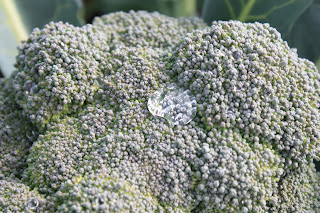
Two years ago, our farm participated in broccoli variety trials sponsored by Practical Farmers of Iowa that compared Belstar, Gypsy and Imperial.  What happened?  Well, we had the worst broccoli crop we had seen in years.  It was just a bad year for broccoli state-wide.  We wanted to run the trial again in 2017, but Imperial was not available.  We still took records of Belstar and Gypsy, which we had done for several years prior to 2016 as well.  But, we really want to run the trial with what we hope will be a "normal" broccoli growing year.   The odds are good, given 2016 was an aberration as compared to all other years of production since 2012.

In fact, last year was a record broccoli production year at the farm.  We'd be happy for average production that can give us a good gauge as to how each of these varieties might fare during most seasons on the farm.

Lettuce Variety Trials
Lettuce can be difficult to grow once we get into the warmer months.  Even so, CSA farms, such as our own, often hope to have lettuce for large percentage of the deliveries we make.  In particular, we hope to have beautiful lettuce during some of the more difficult share weeks in July.  This motivated several PFI cooperator farmers to trial the varieties, Magenta, Muir and Coastal Star last season (we were among those farmers).  The results were favorable for both Magenta and Muir.  On our farm, we were most pleased with Magenta and found Muir to just be acceptable.

This year, we will be trialing Concept, Nevada and Winter Density.  Magenta will return as the "check crop."  For those who might not know, a "check crop" is usually a crop that has an established record (if you can call one year an established record).  If the check crop performs in a fashion that is abnormal, you can guess that the results you are getting from the other crops might not be their normal performance as well.

Fertility Delivery Trials
Once the farm acquired Rosie, the tractor, and her loader/bucket, we became much better at turning compost piles.  The net result is that we have had access to more 'black gold' than we've ever had on the farm.  We will run a randomized/replicated trial in our romanesco planting this year that will test the viability of our own compost versus a purchased product and compare the results with a no-product control.

As is true with most every research project we attempt, we have a pretty good idea as to what we want for a result.  But, the whole point of research is to see what actually DOES happen.

Cherry Tomato Enterprise Budget
We don't tend to grow too many cherry tomatoes on our farm because they are labor intensive during harvest.  However, we have had inquiries as to whether we might be willing to grow more cherry tomatoes for sale.  Add in a PFI project that will help participants to take measurements regarding the costs and returns of the crop and you see an opportunity to learn that shouldn't be passed up.


Heirloom Tomato in the High Tunnel Trial
In prior years, we have watched while other Practical Farmers of Iowa Cooperators have measured results for hybrid high tunnel tomatoes.  Each year, when we hear about the results, we could swear our heirlooms compare reasonably well with the hybrids.  Since we already collect nearly all of the data that is used in this sort of trial, it seemed only natural to offer to run a trial with heirlooms.

The only reason why we hesitate with this one?  Well, there have been 'research trial curses' in the past on our farm.  Crops that have done well for years end up having a down year when we do a research trial.  We really need our high tunnel tomatoes to do well.  So, we wonder - is it worth the risk?    Then, we remind ourselves that we are not superstitious and that a bad (or good) year will happen whether we're running a trial or not.  It's just that you examine the bad year so thoroughly if you're running a trial!

What Makes Us Think We Can Manage All of This?
Please believe me when I say we've asked this question several times of ourselves.  And, the answer is still 'yes.'

Part of the advantage of many of these research projects is that we collect 80% of the data required for these projects in a normal year.  The broccoli, lettuce and heirloom tomato trials require no additional data collection beyond what we already do.  The only difference is that we need to plant them in replicated sections to control for soil and other variables.  The even better news here is that we've done the broccoli and lettuce trials before, so there isn't a learning curve to climb.

The Fertility Delivery Trial adds an early season sample testing of soil and compost (being sent to a lab), which is something we want to do anyway.  Otherwise, we have done these processes before.  Again, no big learning curve to climb.  The Interplanting in Cucurbits is also not changing up our farming practices significantly.  The big deal is taking the time to observe the differences (and similarities) between the two fields.  Since we are highly invested in this one, I see no problem with expending a little extra time on that one.

That leaves us with the Enterprise Budget project.  In this case, I see the extra data being collected as something that will pay us back in the following year.  In short, it's an investment in analyzing a crop for profitability on our farm.  If the numbers are poor, we may decide it's a crop to continue to limit in our production unless we're willing to make big changes.  If the numbers are good, we may decide it would be worthwhile to scale up production.

Friday, December 1, 2017

Goodbye Ontario

Rob and Tammy are saying "farewell" to Ontario after a brief visit to allow Rob to speak at the recent EFAO (Ecological Farmers Association of Ontario) conference and the Farmer-Led Research Symposium.  These events were located in the Blue Mountains just South of Lake Huron's Georgian Bay.
Farmer selfie - Waving a friendly 'good-bye' to EFAO.
The EFAO staff and the members of EFAO (in particular those who attended the Research Symposium) made both of us feel welcome and let us know that our contributions to their events were of value.  We felt that both sessions went very well and we were extremely impressed by the positive participation levels.  The questions were on point, clear, and worthwhile to consider and discuss.  We feel that, at the very least, participants could leave with better questions to be asking themselves so that they could improve how they farm within their own systems.  And, perhaps, they might even leave with an idea or two that they could adapt and make work on their own farms.

For some reason, we left the camera in the room and didn't pull it out during the conference.  But, since Rob tends to favor pictures of himself like the one above, I guess all is well on that front.  Maybe EFAO got a few just to prove to people that he really did talk?

After leaving the conference, we took advantage of Rob's first trip out of the United States to do a little exploring.

A couple of highlights included...

Inglis Falls
We haven't really had time to digest all of the pictures yet.  Per the norm, we took several shots in hopes of landing a couple we really like.  This one is nice because it shows nearly the entire structure of the falls area.  The sun came out in patches, so we were trying to catch those moments with the camera as we were able.

After Inglis, we tried to check out Indian Falls and found our way blocked with a flooded path to the falls.  We headed up the Bruce Peninsula and made sure to see Lake Huron while we were there.  Just so we could say we have now seen each of the Great Lakes.

Road construction obscured the access to Jones Falls, so we missed it as well.  But, we pressed on and managed to catch one more site just as the sun was setting.
Eugenia Falls
And we were super pleased we made it in time to visit Eugenia Falls.  Of course, given the opportunity for hindsight, we would trade some of the time spent at Indian Falls hiking back only to be blocked and some of the time hunting around for Jones Falls for more time at Eugenia Falls.  But, we couldn't have known if we hadn't tried.

This made us think - "hobbits"
 A couple of other immediate picture favorites came from the Inglis Falls area.  There were some very nice opportunities there for Rob to pretend to be a photographer.

But, more importantly, we took the time to look at things from different angles and to appreciated nature in all of its forms.

Good-bye Ontario.  We enjoyed seeing some of the best you have to offer.

Friday, May 8, 2015

DUCK!

Duck Breed Trial

Last season, we raised two types of ducks, Muscoveys and Silver Appleyards.  Practical Farmers of Iowa sponsored the research and we helped produce the report highlighted on this PFI blog post.  If you wish to see the full report, you can take the link here.   In the end, as much as we enjoyed the Silver Appleyards, we may not focus on raising them as much as the Muscovey's after we ran the numbers.  But, we also admit that a single trial is not sufficient because one must learn the differences of each breed so you can maximize their strengths and minimize the weaknesses.    At present, we have three Muscovey and four Appleyard ducks on the farm.

It's a quick quack blog post!
 The white birds in the picture are our Muscoveys.  These birds tend to be, on average, a bit bigger than the Appleyards.  In fact, the male Muscovey (who is named Diggle) is quite a bit bigger than all of the other ducks.  It is common for the drake Muscoveys to be significantly larger than the females.  Another interesting fact - Muscovey's are 'quackless' ducks.  They do make hissing noises, but they will not quack.

On the other hand, Appleyard ducks enjoy discussing everything and anything.  Recently, they've taken to standing in a line in front of Rob and telling him how he could improve his caretaking techniques.  Unlike the Muscoveys, the drake (in this case he is named Dippet) is not much bigger than the females.

Both were laying eggs until recently.  But, since we weren't separating them, we aren't completely sure which eggs belong to which birds. 

Tuesday, June 17, 2014

June Picture This

Here we are - mid-June.  And we haven't done a picture this for June.  So, here we go!

Clover and Bumbebees
We have a fair amount of clover on the farm and we try to leave some of it taller and let it flower.  If you look at the first picture, you should see one reason why.

Do you see it?
Bumblebees are some of our best workers on the farm.  Despite their size and the buzzing sound that they make, these are non-threatening critters that provide alot of pollinating services to various plants on our farm.  In general, if you don't swat at a bumblebee, step on them, etc, they will not bother you.  After all - what would you do if someone hit you or stepped on you?

Oh! There you are!
This is why we seeded clover into many of the paths around our fields several years ago.  We wanted to provide food for our pollinators.  This is also why we aren't upset by the plethora of dandelions we usually have in the Spring.  Like all critters, the pollinators need to eat - and early Spring can get pretty sparse.

Soapbox Warning!
And this is one reason why we want people to reconsider the need to have a perfect lawn with no clover and no dandelions.  It'll be cheaper if you just cover your yard with astroturf if that's what you really want (no we don't like that idea either).  We are creating lifeless, grass deserts in our cities and towns that are no better for our earth than acres of monocrops (corn, soybeans, etc).

Paper Mulch
We've managed to get the melon/watermelon planting in.  This is part of a SARE grant funded study to explore the role paper mulch might have in helping with the survival of heirloom melons.  We'll take some more pictures and keep you up to date on it throughout the season.
I think we missed a spot there
Fruit Trees
At some point during the early Spring we posted some pictures that showed rabbit damage to some of our fruit trees.  So, we thought we had better follow up on that a little.
Well, it's not quite dead.
We lost one small apple tree that was likely on its way out.  And, another is now relegated to 'bush' status.  Essentially, the snow was deep enough to allow the rabbits access OVER the fence.  They girdled the tree over the lower branches.  So, those leafed out while everything above it did not.

The peach trees fared less well.  The new tree only has one branch that is living.  The other is better off, but not as happy as we would like.  But - what did we expect?  Peach trees in our area are always a gamble.
The leaning apple tree of GFF
We may want to consider staking a few of the trees.  Prevailing winds have been working on them over the years.  But, the really good news is that most of the apples made it through the winter, the flowering started later so they weren't impacted by frost.  So, a good fruit set has started!

Apples!

Garlic
We thought you might want a gratuitous garlic crop picture for the year so far.  They are looking VERY good.

Garlic next to young summer squash and zucchini plants.
Broilers

They are getting bigger and more annoying.  That's a good sign.  It means they are healthy and exercising their ...uh... broilerness. 
It's good to see them out and about.
The Silvery Fir Tree Tomato
Every year we mean to keep track of some extra this or that and put it in the blog regularly.  Does it happen?  Well....sometimes.
There's a tomato already started in that mass of foliage!
And, we also planted a Nebraska Wedding in another pot.  This pot is bigger because we expect this plant to get bigger.
Nebraska Wedding with basil surrounding it.
June 16 Storm
Many of you already know that a twister was sighted West of Tripoli last night.  So, to answer the immediate question - the farm was not in its path.  We did get heavy rains, wind and a little hail.  We've been outside and found minimal damage in general.  Most plants should find a way to pull themselves back out of the mud.

Both of us were getting increasingly agitated as the day wore on because we could sense the potential for difficult weather.  Once we sent our crew home (and after all of the melons and watermelons were in the ground) we worked to get things under cover and put anything that could become a projectile in wind into better situations if possible.  Rob did spot the tornado to our Southwest and we barreled on down to the basement for a time.

The twister hit the corner of Hwy 93 and 63.  The car dealership there took a direct hit.  It looks like it skirted most of the homes in the area and the path ran SouthEast for over a mile.  It was probably no more than an EF1 tornado and maybe not that - but it still made a mess of things.

We're grateful for the concern people showed for us and relieved that we are not participating in clean up at the farm this morning.  On the other hand - we can say that the fields are now very wet and we hope Mother Nature sees fit to allow for moderation in this area!
GFF was a couple miles away, no worries!

Tuesday, December 3, 2013

Uncovered Documents by Ima Turkey

We just uncovered some interesting documents as we were cleaning the turkey room recently.  As many of you know, we raise turkeys from chicks to full size.  At that point, we take them to the "park" and they are then key participants in dinners all over the Cedar Valley.  

It appears the trip to the park came none to soon since this last batch of turkeys had among them an individual who was studying our habits a bit too closely.  In fact, this particular bird was looking to take over blog writing duties at some level.  See below what we discovered.

======================================================

Staff Writer: Ima Turkey

Individuals looking for an entertaining afternoon should look no further than the Genuine Faux Farm. We have found the guy with the red hat to be extremely amusing as he runs around the farm. In fact, we are conducting a study to find out what sorts of actions/sounds he can be made to respond to (see Pavlov and others). Since he is not really an intelligent being (unlike us turkeys), we have no fear that he will figure out that we are conducting experiments regarding his behavior.
Observations thus far:
  • Subject tends to mumble audibly when one of us flies onto or over the fences
  • Subject will hesitate in making a choice chasing us (when we're outside the fence) if we divide our numbers and go in opposite directions
  • Subject makes strange "hahaha" sounds whenever we run to/fro our room and the gate in the morning.  We think it is a nervous tic of some kind.
  • Subject tends to throw yummy produce to locations in the field where one of us is NOT located, though he does tend to have a left/right/forward/back pattern.
  • Subject can be trained to bring more tomatoes and cucumbers by eating them quickly.   Similarly, the subject seems to reduce other food types if we show less enthusiasm.  Have not yet managed to get ice cream.
  • Subject appears to have limited language ability.  Has attempted to respond to "crowd gobbles."  Enunciation is terrible.  We highly doubt the subject has understanding of the meaning of the words.
  • Subject has been trained to allow us to drink out of the hose periodically.  However, Muck learned that subject isn't terribly steady with the hose after getting a face full of water.  Subject has not shown consistency in allowing us to drink out of the hose.  We continue to work on finding a proper prompting action to elicit the desired response.
  • Subject appears to respond to sunrise and sunset with certain activities, including bringing us food and water at sunrise and coming out to see us into our room at night.  Has apparently imprinted on us.  Though it does show independence - thank goodness.  Who would want to deal with THAT all day and night?
    Ima Turkey at left.
  • Subject has been trained to respond and come into view on certain calls, but appears unaware of the desired response once in view.  We remind ourselves that we must take baby-steps in this process.
  • Subject appears to be unaware of our scientific endeavors - our ruse continues to work.
We expect to make a final report to the community in December regarding this study.
Respectfully,
Ima Turkey

Wednesday, October 2, 2013

Customer Satisfaction

This blog post is another "picture this" type of post.  We've had a few pictures that were enjoyed by those who use Facebook, but we know many people do not see those and like to see them here.  

Plus, we get to say more about them here.

The Sandman has spoken - this is a good spot.
We are all about customer satisfaction - as you can clearly see in the picture shown above.  That is one satisfied customer.  I'm not sure the Sandman understood exactly what it was we were planning on doing with the tray or the cart, but whatever it was didn't happen for a while.
CSA truck tetris
 I tried to take a few pictures of the truck in its various states as I packed it during one Tuesday this month (September).  But, as I expected, I ended up getting a bit too busy to take many pictures.  So, here is one that is a few steps away from done.  Once our workers leave at the end of Summer, I adopt a few different techniques that work (more or less) for packing.  One is to pack as I get things done.  *Usually,* I avoid missing something if I put it in the truck - or by the truck.  It is a little inefficient sometimes when I have to pull a few things out to repack, but it works most of the time.

Heard on a commercial:
  the *******  team is dedicated to providing you with an amazing home loan experience.

I'm sorry, but I'm afraid this just started Tammy and I laughing.  Apologies to the people in the store that thought we'd lost it.


Peach Blow Sutton tomato
It turns out one of our new tomato varieties is an excellent tasting tomato IF you let it sit on the counter and get softer.  It is alot like the Wapsipinicon Peach in that regard.   So far, several thumbs up *as long* as you let it sit for a couple of days.  If you eat it while it is still too firm, the taste is pretty bland.

Red Xpress cabbage
We've been getting a nice batch of small red cabbage.  For the most part, we are going on the assumption that most of our CSA members like the smaller cabbages.  Of course, this isn't the only variety we grow.  But, the 1/2 to 1 pound size seems to be less intimidating when you are getting a big bag/box/bucket full of produce.

Guest appearance by Pippi Longstocking
Every once in a while I see something that amuses me *and* I have the camera around.  I saw this Dwarf Blue Scotch kale plant and decided it reminded me of Pippi Longstocking.  Either that, or the little girl in Emperor's New Groove.  Both have the pig tails sticking out the sides.  How many of you read books about Pippi? 

Flowering buckwheat

We are doing a cover crop trial for Practical Farmers of Iowa.  That, and we have a plot that needed rehabbing anyway.  It's given us trouble for several years.  The plot has sections of millet, clover, field pea and buckwheat.  The picture above shows you what our buckwheat section looks like.  Lots of flowers and excellent coverage.  The bees and other pollinators love this patch.  We've always wanted to do more with buckwheat as a cover crop, this experiment will encourage us to do much more.

What is a cover crop?
In essence, a cover crop is a planting of a (potentially) beneficial plant that farmer puts in to cover the soil during a period when it might otherwise be bare.  Cover crops are selected for ability to cover the ground and hold it and for the potential they might have to improve soil health.  For example, clover pulls nitrogen into the soil.  Tillage radish breaks up compacted soil.  Buckwheat chokes out difficult weeds, such as Canadian thistle.  We have used cover crops over the last several years.  But, we don't feel we have done very well with them.  This project is helping us to work with them more effectively.
Dr Wyche's Yellow tomato
Dr Wyche's Yellow is a tomato that seems to have peaks and valleys for production for us.  This year is a rare 'half-way' year.  We'll take it.  We'd probably classify these in the beefsteak category, though the size can be variable.

Rouge d-Hiver lettuce
The Fall lettuce is growing and looking great.  Two varieties that may not be as familiar to everyone in our CSA are shown here.  Rouge d-Hiver is a romaine type.  However, unlike many romaines, it does not have a tightly packed 'heart.'  The taste is outstanding, especially in the Fall.  It looks like we hit the timing right for them this year.

Amish Deer Tongue has a texture that reminds us a bit of spinach.  They grow in a tight cluster, making them very dense.  They may not look impressive next to the large loose-leaf lettuce, such as Grandpa Admires.  But, you'll get plenty of lettuce to eat from one of these.  The texture alone makes a person who loves spinach and is less fond of lettuce happy.
Amish Deer Tongue lettuce
We periodically get asked why we don't have more pictures of the farmers on our blog and elsewhere.  Well, Tammy got ahold of the camera this past weekend and told Rob to hold up the carrots he was carrying.  An excellent likeness.
The farmer has carrots for you.